

|
시장보고서
상품코드
2109156
자동차용 강판 스탬핑 시장 기회, 성장 촉진요인, 업계 동향 분석 및 예측(2026-2035년)Automotive Steel Stamping Market Opportunity, Growth Drivers, Industry Trend Analysis, and Forecast 2026 - 2035 |
||||||

세계의 자동차용 강판 스탬핑 시장은 2025년에 905억 달러 규모로 평가되었고, CAGR 5.3%로 성장하여 1,498억 달러에 이를 것으로 추정되고 있습니다.
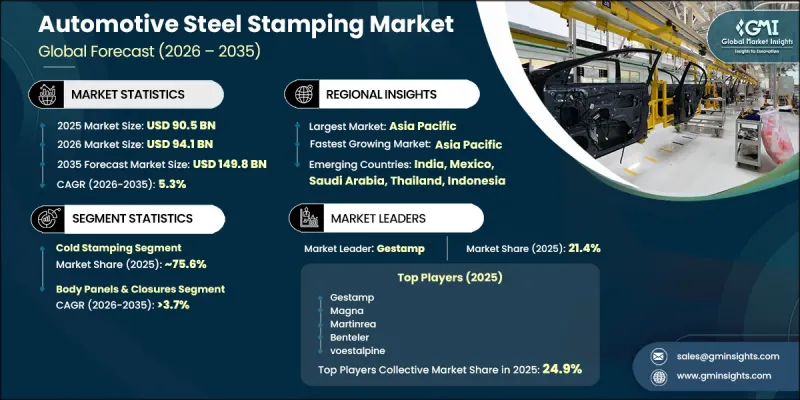
이 시장은 내구성이 높고 정밀도가 뛰어나며 비용 효율이 좋은 자동차 부품의 대량 생산을 뒷받침함으로써 자동차 제조에 지속적으로 기여하고 있습니다. 전기차 및 하이브리드차 개발에 대한 투자 확대와 더불어, 차량 효율화 및 배기가스 감축에 대한 규제 강화가 맞물리면서 첨단 강판 스탬핑 솔루션에 대한 수요 양상이 변화하고 있습니다. 각 자동차 제조업체들은 진화하는 차량 설계를 뒷받침하는 경량이자 고강도의 구조 부품을 생산하기 위해 개선된 프레스 가공 기술을 점점 더 많이 도입하고 있습니다. 강판 스탬핑이란 특수한 성형 공정을 통해 강판을 완성된 자동차 부품으로 가공하는 것으로, 이를 통해 여러 차량 플랫폼에 걸친 효율적인 생산이 가능해집니다. 이 기술은 기존의 자동차 제조와 신흥 차량 아키텍처 모두에 필수적이며, 공급업체가 혁신적인 솔루션을 개발할 기회를 창출하고 있습니다. 고급 강재 등급의 채택 확대, 최적화된 소재 설계 및 제조 기술의 향상으로 생산 효율과 부품 성능이 더욱 개선되고 있습니다.
| 시장 범위 | |
|---|---|
| 시작 연도 | 2025년 |
| 예측 기간 | 2026-2035년 |
| 시작 금액 | 905억 달러 |
| 예측 금액 | 1,498억 달러 |
| CAGR | 5.3% |
2025년에는 콜드 스탬핑 부문이 시장 점유율의 75.6%를 차지했으며, 연평균 성장률(CAGR) 3.7%를 나타낼 것으로 예측됩니다. 이 부문은 비용 효율성, 높은 생산 효율성, 그리고 대량 생산되는 자동차 부품 제조에 대한 적합성으로 인해 주도적인 위치를 유지하고 있습니다. 콜드 스탬핑은 운영 효율성을 유지하면서 제조 비용을 절감하고, 금속 부품을 안정적으로 생산할 수 있기 때문에 자동차 제조업체들에게 계속해서 널리 채택되고 있습니다.
차체 패널 및 클로저 부문은 2025년에 29%의 점유을을 차지했으며, 2026년부터 연평균 성장률(CAGR) 3.7%로 성장할 것으로 전망됩니다. 이 부문에는 정밀한 치수, 우수한 구조적 성능, 경량성 및 고품질의 표면 마감이 요구되는 주요 차량 외장 부품이 포함됩니다. 첨단 프레스 성형 기술을 통해 제조업체는 이러한 부품을 정밀도, 재현성 및 제조 일관성을 향상시켜 생산할 수 있게 되었으며, 이는 자동차 업계 전반에 걸쳐 증가하는 수요를 뒷받침하고 있습니다.
중국의 자동차용 강판 스탬핑 시장은 2025년에 54.2%의 점유율을 차지하며 230억 달러 규모 시장 규모를 기록했습니다. 중국은 광범위한 자동차 제조 거점, 확립된 공급망 네트워크, 그리고 자동차 제조업체, 철강 제조업체, 부품 공급업체의 강력한 입지를 바탕으로 주도적인 위치를 유지하고 있습니다. 자동차 생산 증가와 전기차(EV) 제조 확대로 인해 첨단 스탬핑 기술에 대한 막대한 수요가 발생하고 있습니다. 고장력 강재, 첨단 프레스 가공법, 그리고 자동화 생산 시스템의 도입으로 제조 효율이 향상될 뿐만 아니라, 국내 자동차 경량화 노력도 뒷받침되고 있습니다.
자주 묻는 질문
목차
제1장 조사 방법
제2장 주요 요약
제3장 업계 인사이트
제4장 경쟁 구도
제5장 시장 규모 및 예측 : 스탬핑 프로세스별(2022-2035년)
제6장 시장 규모 및 예측 : 구성 요소별(2022-2035년)
제7장 시장 규모 및 예측 : 차량별(2022-2035년)
제8장 시장 규모 및 예측 : 최종 사용자별(2022-2035년)
제9장 시장 규모 및 예측 : 지역별(2022-2035년)
제10장 기업 개요
KTH 26.08.20The Global Automotive Steel Stamping Market was valued at USD 90.5 billion in 2025 and is estimated to grow at a CAGR of 5.3% to reach USD 149.8 billion by 2035.
The market continues to help in automotive manufacturing by supporting the large-scale production of durable, accurate, and cost-efficient vehicle components. Growing investments in electric and hybrid vehicle development, combined with increasing regulatory focus on vehicle efficiency and emission reduction, are reshaping demand for advanced steel stamping solutions. Automotive manufacturers are increasingly adopting improved stamping technologies to produce lightweight yet strong structural components that support evolving vehicle designs. Steel stamping involves transforming sheet metal into finished automotive parts through specialized forming processes that enable efficient production across multiple vehicle platforms. Technology remains essential for both traditional automotive manufacturing and emerging vehicle architectures, creating opportunities for suppliers to develop innovative solutions. Increasing adoption of advanced steel grades, optimized material designs, and improved manufacturing techniques is further enhancing production efficiency and component performance.
| Market Scope | |
|---|---|
| Start Year | 2025 |
| Forecast Year | 2026-2035 |
| Start Value | $90.5 Billion |
| Forecast Value | $149.8 Billion |
| CAGR | 5.3% |
The cold stamping segment accounted for a 75.6% share in 2025 and is expected to grow at a CAGR of 3.7% through 2035. The segment maintains its leading position due to its cost-effectiveness, high production efficiency, and suitability for large-volume automotive manufacturing. Cold stamping continues to be widely adopted by vehicle manufacturers because it enables consistent production of metal components while maintaining operational efficiency and reducing manufacturing expenses.
The body panels and closures segment held a 29% share in 2025 and is projected to grow at a CAGR of 3.7% from 2026 to 2035. This segment includes key exterior vehicle components that require precise dimensions, strong structural performance, lightweight characteristics, and high-quality surface finishes. Advanced stamping techniques allow manufacturers to produce these components with improved accuracy, repeatability, and manufacturing consistency, supporting growing demand across the automotive industry.
China Automotive Steel Stamping Market accounted for a 54.2% share, generating USD 23 billion in 2025. The country maintains its leading position due to its extensive automotive manufacturing base, established supply chain network, and strong presence of vehicle manufacturers, steel producers, and component suppliers. Increasing vehicle production and rising electric vehicle manufacturing are creating significant demand for advanced steel stamping technologies. The adoption of high-strength steel materials, advanced stamping methods, and automated production systems is improving manufacturing efficiency while supporting vehicle lightweighting initiatives across the country.
Major companies operating in the global automotive steel stamping market include Gestamp, Magna, Martinrea, Benteler, Kirchhoff, Autokiniton, voestalpine, Shiloh Industries, AISIN, and Tower International. Companies operating in the automotive steel stamping market are focusing on technological innovation, production expansion, and strategic collaborations to strengthen their market position. Leading manufacturers are investing in advanced stamping equipment, automation technologies, and improved material processing capabilities to enhance efficiency and meet changing automotive requirements. Businesses are also developing lightweight and high-strength component solutions to support the growing demand for electric vehicles and fuel-efficient transportation. Strategic partnerships with automotive manufacturers help companies secure long-term supply agreements and expand their market presence. In addition, organizations are strengthening global manufacturing networks, improving operational capabilities, and investing in research and development to enhance product quality, reduce production costs, and maintain competitiveness in the evolving automotive supply chain.
Table of Contents
Chapter 1 Methodology
- 1.1 Research approach
- 1.2 Quality Commitments
- 1.2.1 GMI AI policy & data integrity commitment
- 1.2.1.1 Source consistency protocol
- 1.2.1 GMI AI policy & data integrity commitment
- 1.3 Research Trail & Confidence Scoring
- 1.3.1 Research Trail Components
- 1.3.2 Scoring Components
- 1.4 Data Collection
- 1.4.1 Partial list of primary sources
- 1.5 Data mining sources
- 1.5.1 Paid sources
- 1.5.1.1 Sources, by region
- 1.5.1 Paid sources
- 1.6 Base estimates and calculations
- 1.6.1 Base year calculation
- 1.7 Forecast
- 1.7.1 Quantified market impact analysis
- 1.7.1.1 Mathematical impact of growth parameters on forecast
- 1.7.1 Quantified market impact analysis
- 1.8 Research transparency addendum
- 1.8.1 Source attribution framework
- 1.8.2 Quality assurance metrics
- 1.8.3 Our commitment to trust
Chapter 2 Executive Summary
- 2.1 Industry 360° synopsis, 2022 – 2035
- 2.2 Key market trends
- 2.2.1 Regional
- 2.2.2 Stamping Process
- 2.2.3 Component
- 2.2.4 Vehicle
- 2.2.5 End User
- 2.3 TAM Analysis, 2026-2035
- 2.4 CXO perspectives: Strategic imperatives
Chapter 3 Industry Insights
- 3.1 Industry ecosystem analysis
- 3.1.1 Supplier landscape
- 3.1.2 Profit margin analysis
- 3.1.3 Cost structure
- 3.1.4 Value addition at each stage
- 3.1.5 Factor affecting the value chain
- 3.1.6 Disruptions
- 3.2 Industry impact forces
- 3.2.1 Growth drivers
- 3.2.1.1 Growing demand for lightweight vehicles and fuel efficiency
- 3.2.1.2 Increasing adoption of advanced high-strength steel (AHSS) and hot stamping technologies
- 3.2.1.3 Expansion of electric vehicle (EV) production and battery structural components
- 3.2.1.4 Stringent vehicle safety regulations driving demand for high-strength stamped components
- 3.2.2 Industry pitfalls and challenges
- 3.2.2.1 Volatility in steel and raw material prices
- 3.2.2.2 High capital investment required for advanced stamping equipment and automation
- 3.2.3 Market opportunities
- 3.2.3.1 Rising demand for battery enclosures and EV structural components
- 3.2.3.2 Increasing adoption of Industry 4.0, automation, and smart manufacturing technologies
- 3.2.3.3 Growing utilization of multi-material vehicle structures and precision metal forming
- 3.2.3.4 Expansion of localized automotive manufacturing and regional supply chains
- 3.2.1 Growth drivers
- 3.3 Growth potential analysis
- 3.4 Technology and Innovation landscape
- 3.4.1 Current technological trends
- 3.4.1.1 Advanced High-Strength Steel (AHSS) Stamping
- 3.4.1.2 Hot Stamping and Press Hardening Technologies
- 3.4.1.3 Servo Presses and Automated Stamping Lines
- 3.4.2 Emerging technologies
- 3.4.2.1 AI-Based Quality Inspection and Predictive Process Control
- 3.4.2.2 Digital Twin–Enabled Smart Stamping Manufacturing
- 3.4.2.3 Integrated Multi-Material Forming for EV Structures
- 3.4.1 Current technological trends
- 3.5 Pricing Analysis (Driven by Primary Research)
- 3.5.1 Historical Price Trend Analysis
- 3.5.2 Pricing Strategy by Player Type (Premium / Value / Cost-plus)
- 3.6 Regulatory guideline
- 3.6.1 North America
- 3.6.1.1 National Highway Traffic Safety Administration
- 3.6.1.2 Canada Motor Vehicle Safety Standards
- 3.6.2 Europe
- 3.6.2.1 UNECE Vehicle Safety Regulations, EU End-of-Life Vehicles (ELV)
- 3.6.2.2 UK Whole Vehicle Type Approval (WVTA)
- 3.6.3 Asia Pacific
- 3.6.3.1 China: China VI Emission Standards
- 3.6.3.2 India: Automotive Industry Standards (AIS)
- 3.6.3.3 Japan: Ministry of Land, Infrastructure
- 3.6.4 Latin America
- 3.6.4.1 National Traffic Council (CONTRAN) Vehicle Safety Regulations
- 3.6.4.2 Official Mexican Standards (NOM)
- 3.6.5 MEA
- 3.6.5.1 Emirates Authority for Standardization and Metrology (ESMA)
- 3.6.5.2 Saudi Standards, Metrology and Quality Organization (SASO)
- 3.6.5.3 National Regulator for Compulsory Specifications (NRCS)
- 3.6.1 North America
- 3.7 Porter’s analysis
- 3.8 PESTEL analysis
- 3.9 Patent Landscape (Driven by Primary Research)
- 3.10 Sustainability and environmental aspects
- 3.10.1 Sustainable practices
- 3.10.2 Waste reduction strategies
- 3.10.3 Recycled Steel & Circular Manufacturing
- 3.10.4 Energy efficiency in production
- 3.10.5 Eco-friendly Initiatives
- 3.10.6 Carbon footprint considerations
- 3.11 Impact of AI & Generative AI on the Market (Driven by Primary Research)
- 3.11.1 AI-Driven Disruption of Existing Business Models
- 3.11.2 GenAI Use Cases & Adoption Roadmap by Segment
- 3.11.3 Risks, Limitations & Regulatory Considerations
- 3.12 Forecast assumptions & scenario analysis (Driven by Primary Research)
- 3.12.1 Base Case - Key Macro & Industry Variables Driving CAGR
- 3.12.2 Optimistic Scenarios - Favourable macro and industry tailwinds
- 3.12.3 Pessimistic Scenario - Macroeconomic slowdown or industry headwinds
Chapter 4 Competitive Landscape, 2025
- 4.1 Introduction
- 4.2 Company market share analysis
- 4.2.1 North America
- 4.2.2 Europe
- 4.2.3 Asia Pacific
- 4.2.4 Latin America
- 4.2.5 MEA
- 4.3 Competitive analysis of major market players
- 4.4 Competitive positioning matrix
- 4.5 Key developments
- 4.5.1 Mergers & acquisitions
- 4.5.2 Partnerships & collaborations
- 4.5.3 New Product Launches
- 4.5.4 Expansion Plans and funding
- 4.6 Company Tier Benchmarking
- 4.6.1 Tier Classification Criteria & Qualifying Thresholds
- 4.6.2 Tier Positioning Matrix by Revenue, Geography & Innovation
Chapter 5 Market Estimates & Forecast, By Stamping Process, 2022 - 2035 ($Bn)
- 5.1 Key trends
- 5.2 Hot Stamping
- 5.3 Cold Stamping
Chapter 6 Market Estimates & Forecast, By Component, 2022 - 2035 ($Bn)
- 6.1 Key trends
- 6.2 Body Panels & Closures
- 6.3 Body-in-White Structural
- 6.4 Chassis Components
- 6.5 Powertrain
- 6.6 Safety & Reinforcement
- 6.7 Battery & EV Structural
Chapter 7 Market Estimates & Forecast, By Vehicle, 2022 - 2035 ($Bn)
- 7.1 Key trends
- 7.2 Passenger cars
- 7.2.1 Sedans
- 7.2.2 Hatchbacks
- 7.2.3 SUVs & crossovers
- 7.3 Commercial vehicles
- 7.3.1 Light commercial vehicles (LCV)
- 7.3.2 Medium commercial vehicles (MCV)
- 7.3.3 Heavy commercial vehicles (HCV)
Chapter 8 Market Estimates & Forecast, By End user, 2022 – 2035 ($Bn)
- 8.1 Key trends
- 8.2 OEMs
- 8.3 Tier 1 Suppliers
- 8.4 Aftermarket
Chapter 9 Market Estimates & Forecast, By Region, 2022 - 2035 ($Bn)
- 9.1 Key trends
- 9.2 North America
- 9.2.1 US
- 9.2.2 Canada
- 9.3 Europe
- 9.3.1 UK
- 9.3.2 Germany
- 9.3.3 France
- 9.3.4 Italy
- 9.3.5 Spain
- 9.3.6 Belgium
- 9.3.7 Netherlands
- 9.3.8 Sweden
- 9.3.9 Russia
- 9.4 Asia Pacific
- 9.4.1 China
- 9.4.2 India
- 9.4.3 Japan
- 9.4.4 Australia
- 9.4.5 Singapore
- 9.4.6 South Korea
- 9.4.7 Vietnam
- 9.4.8 Indonesia
- 9.4.9 Thailand
- 9.5 Latin America
- 9.5.1 Brazil
- 9.5.2 Mexico
- 9.5.3 Argentina
- 9.6 MEA
- 9.6.1 South Africa
- 9.6.2 Saudi Arabia
- 9.6.3 UAE
Chapter 10 Company Profiles
- 10.1 Global Players
- 10.1.1 Gestamp
- 10.1.2 Magna
- 10.1.3 AUTOKINITON
- 10.1.4 Martinrea
- 10.1.5 Benteler
- 10.1.6 KIRCHHOFF
- 10.1.7 voestalpine
- 10.1.8 General Motors
- 10.1.9 Ford Motor
- 10.1.10 Volkswagen
- 10.2 Regional Players
- 10.2.1 Futaba Industrial
- 10.2.2 Topre
- 10.2.3 Yorozu
- 10.2.4 Unipres
- 10.2.5 AAPICO Hitech
- 10.2.6 Sungwoo Hitech
- 10.2.7 Hwashin
- 10.2.8 Tata AutoComp
- 10.2.9 Coskunoz Metal
- 10.2.10 HUAYU Automotive


