

|
시장보고서
상품코드
2121088
프리미엄 및 고급차 시장 기회, 성장요인, 업계 동향 분석 및 예측(2026-2035년)Premium and Luxury Vehicle Market Opportunity, Growth Drivers, Industry Trend Analysis, and Forecast 2026 - 2035 |
||||||

세계의 프리미엄·고급차 시장은 2025년에 5,295억 달러 규모에 달하며, CAGR 4.3%로 성장하며, 2035년까지 7,744억 달러에 달할 것으로 추정되고 있습니다.
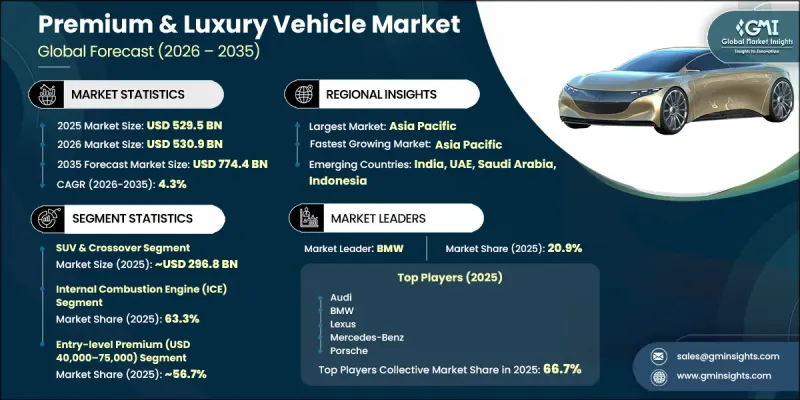
전 세계 프리미엄 및 고급차 시장은 차량 성능, 엔지니어링 품질, 추진 기술과 같은 기존의 평가 기준을 넘어 진화하고 있습니다. 현대의 경쟁은 첨단 디지털 경험, 지능형 소프트웨어 기능, 커넥티드 모빌리티 솔루션, 그리고 차량 소유 주기 전반에 걸친 장기적인 가치를 제공할 수 있는 제조사의 역량에 점점 더 의존하고 있습니다. 배터리 혁신, 소프트웨어 정의 차량 아키텍처, 무선 소프트웨어 업데이트(OTA), 커넥티드 생태계, 그리고 차세대 디지털 콕핏 기술은 프리미엄 차량 개발에 있으며, 필수적인 요소로 자리 잡고 있습니다. 자동차 기술의 발전이 지속되는 가운데, 소프트웨어 통합과 인공지능은 미래의 모빌리티 솔루션과 고객 경험을 형성하는 데 있으며, 점점 더 큰 역할을 하고 있습니다. 자동차 제조사들은 차량의 기능을 강화하고, 지속적인 기능 업그레이드를 가능하게 하며, 판매 후 새로운 수익 기회를 창출하는 독자적인 디지털 플랫폼을 점점 더 많이 구축하고 있습니다. 이러한 변화를 통해 프리미엄 및 럭셔리 자동차 제조사들은 세계 프리미엄 자동차 산업을 계속해서 정의해 온 높은 품질, 장인 정신, 혁신성, 브랜드 가치를 유지하면서 소프트웨어 역량 강화를 추진하고 있습니다.
| 시장 범위 | |
|---|---|
| 시작연도 | 2025년 |
| 예측 기간 | 2026-2035년 |
| 개시 금액 | 5,295억 달러 |
| 예측 금액 | 7,744억 달러 |
| CAGR | 4.3% |
프리미엄 및 고급차 시장에서 사업을 운영하는 각 제조사는 경쟁력을 유지하기 위해 연구개발, 차량 전동화, 디지털 전환, 그리고 첨단 안전 기술에 대한 투자를 지속적으로 확대하고 있습니다. 각사는 성능 향상, 더욱 정교해진 기술, 세련된 인테리어, 커넥티비티 강화, 그리고 전동 파워트레인 라인업 확충을 갖춘 개선된 모델을 출시함으로써 기존 제품 포트폴리오를 끊임없이 강화하고 있습니다. 이러한 지속적인 제품 진화를 통해 프리미엄 자동차 브랜드는 변화하는 소비자의 기대에 부응하면서 전 세계 시장 전반에서 경쟁력을 강화할 수 있게 되었습니다.
SUV 및 크로스오버 부문은 56.1%의 점유율을 차지하며, 2025년에는 2,968억 달러의 매출을 기록했습니다. 이 차종 카테고리가 리더십을 유지할 수 있었던 것은 넉넉한 실내 공간, 첨단 기술, 전동 파워트레인 대응성을 겸비한 프리미엄 유틸리티 차량에 대한 소비자의 강력한 수요 덕분입니다. 이 차체 스타일은 고급차 구매자가 기대하는 실용성과 편안함을 유지하면서도, 대형 배터리 시스템, 고급스러운 실내 사양, 그리고 첨단 전자 기술을 통합할 수 있는 유연성을 높이고 있습니다. 이러한 장점 덕분에 이 부문은 시장 전체 매출에 계속해서 크게 기여하고 있습니다.
엔트리 레벨 프리미엄(4만-7만 5,000달러) 부문은 2025년에 56.7%의 점유율을 차지했습니다. 이 가격대는 고급차 소유를 위한 합리적인 진입점을 제공함으로써 프리미엄 자동차 업계 내에서 가장 큰 고객 기반을 확보하고 있습니다. 그러나 이 부문의 구매 결정은 여전히 대출 조건, 금리, 세제, 전반적인 구매력의 영향을 크게 받고 있으며, 더 광범위한 경제 환경의 변화에 특히 민감합니다.
미국의 프리미엄·고급차 시장은 2025년에 1,135억 달러에 달하며, 2026-2035년까지 연평균 성장률(CAGR) 3.1%로 성장할 것으로 전망됩니다. 미국은 소비자의 강력한 구매력, 프리미엄 SUV 및 고성능 차량에 대한 지속적인 수요, 그리고 고급 전기자동차의 보급 확대에 힘입어 계속해서 프리미엄 및 고급차 시장에서 가장 큰 시장 중 하나로 자리매김하고 있습니다. 지속적인 기술 발전, 가처분 소득의 증가, 그리고 첨단 모빌리티 솔루션에 대한 소비자의 선호도 상승이 미국 전역의 시장 확장을 지속적으로 지원하고 있습니다.
자주 묻는 질문
목차
제1장 조사 방법
제2장 개요
제3장 업계 인사이트
제4장 경쟁 구도
제5장 시장 추산·예측 : 차체별, 2022-2035년
제6장 시장 추산·예측 : 추진 방식별, 2022-2035년
제7장 시장 추산·예측 : 차종별, 2022-2035년
제8장 시장 추산·예측 : 자율주행 레벨별, 2022-2035년
제9장 시장 추산·예측 : 최종 용도별, 2022-2035년
제10장 시장 추산·예측 : 지역별, 2022-2035년
제11장 기업 개요
KSA 26.09.02The Global Premium & Luxury Vehicle Market was valued at USD 529.5 billion in 2025 and is estimated to grow at a CAGR of 4.3% to reach USD 774.4 billion by 2035.
The global premium & luxury vehicle market is evolving beyond traditional measures such as vehicle performance, engineering quality, and propulsion technology. Modern competition increasingly depends on manufacturers' ability to deliver advanced digital experiences, intelligent software capabilities, connected mobility solutions, and long-term value throughout the vehicle ownership cycle. Battery innovation, software-defined vehicle architectures, over-the-air software updates, connected ecosystems, and next-generation digital cockpit technologies have become essential components of premium vehicle development. As automotive technology continues to advance, software integration and artificial intelligence are playing a larger role in shaping future mobility solutions and customer experiences. Vehicle manufacturers are increasingly building proprietary digital platforms that enhance vehicle functionality, enable continuous feature upgrades, and create new post-sale revenue opportunities. This transformation is encouraging premium and luxury automakers to strengthen their software capabilities while maintaining the high levels of quality, craftsmanship, innovation, and brand value that continue to define the global premium automotive industry.
| Market Scope | |
|---|---|
| Start Year | 2025 |
| Forecast Year | 2026-2035 |
| Start Value | $529.5 Billion |
| Forecast Value | $774.4 Billion |
| CAGR | 4.3% |
Manufacturers operating in the premium & luxury vehicle market continue to increase investments in research and development, vehicle electrification, digital transformation, and advanced safety technologies to remain competitive. Companies are consistently enhancing their existing product portfolios by introducing upgraded vehicle models equipped with improved performance, more sophisticated technologies, refined interiors, enhanced connectivity, and expanded electric powertrain offerings. This continuous product evolution allows premium automotive brands to address changing consumer expectations while strengthening their competitive position across global markets.
The SUV & crossover segment held a 56.1% share, generating USD 296.8 billion in 2025. This vehicle category maintained its leadership due to strong consumer demand for premium utility vehicles that combine spacious interiors, advanced technologies, and electrified powertrain compatibility. The body style provides greater flexibility for integrating larger battery systems, premium cabin features, and advanced electronic technologies while preserving the practicality and comfort expected by luxury vehicle buyers. These advantages continue to support the segment's dominant contribution to overall market revenue.
The entry-level premium (USD 40,000-75,000) segment held a 56.7% share in 2025. This price category attracts the largest customer base within the premium vehicle industry by offering an accessible entry point into luxury ownership. However, purchasing decisions within this segment remain highly influenced by financing conditions, interest rates, taxation policies, and overall affordability, making it particularly sensitive to changes in the broader economic environment.
U.S. Premium & Luxury Vehicle Market reached USD 113.5 billion in 2025 and is anticipated to grow at a CAGR of 3.1% between 2026 and 2035. The United States continues to represent one of the largest markets for premium and luxury vehicles, supported by strong consumer purchasing power, sustained demand for premium utility vehicles and high-performance automobiles, and increasing adoption of luxury electric vehicles. Ongoing technological advancements, higher disposable incomes, and growing consumer preference for advanced mobility solutions continue to reinforce market expansion across the country.
Major companies operating in the global premium & luxury vehicle market include BMW, Mercedes-Benz, Audi, Porsche, Lexus, Ferrari, Lamborghini, Bentley, JLR, and Volvo Cars. Companies participating in the premium & luxury vehicle market are reinforcing their competitive position through continuous investments in electrification, software development, connected vehicle technologies, and advanced safety innovations. Manufacturers are prioritizing research and development to improve vehicle performance, digital functionality, battery technologies, and intelligent mobility solutions. They are also expanding proprietary software ecosystems and introducing software-defined vehicle platforms that enable over-the-air updates and long-term feature enhancements. Product portfolio expansion through upgraded vehicle launches, greater personalization options, and premium customer experiences remains another important strategy. In addition, companies are strengthening strategic partnerships across technology, semiconductor, and battery supply chains while increasing manufacturing efficiency, optimizing production capabilities, and expanding their presence in high-growth regional markets to improve long-term competitiveness and market share.
Table of Contents
Chapter 1 Research Methodology
- 1.1 Research approach
- 1.2 Quality Commitments
- 1.2.1 GMI AI policy & data integrity commitment
- 1.3 Research Trail & Confidence Scoring
- 1.3.1 Research Trail Components
- 1.3.2 Scoring Components
- 1.4 Data Collection
- 1.5 Data mining sources
- 1.5.1 Paid sources
- 1.6 Base estimates and calculations
- 1.6.1 Base year calculation
- 1.7 Forecast model
- 1.7.1 Quantified market impact analysis
- 1.8 Research transparency addendum
- 1.8.1 Source attribution framework
- 1.8.2 Quality assurance metrics
- 1.8.3 Our commitment to trust
Chapter 2 Executive Summary
- 2.1 Industry 360° synopsis
- 2.2 Key market trends
- 2.2.1 Regional
- 2.2.2 Vehicle Body
- 2.2.3 Propulsion
- 2.2.4 Vehicle Class
- 2.2.5 Autonomy Level
- 2.2.6 End-Use
- 2.3 TAM analysis, 2027-2035
- 2.4 CXO perspectives: Strategic imperatives
Chapter 3 Industry Insights
- 3.1 Industry ecosystem analysis
- 3.1.1 Supplier landscape
- 3.1.2 Profit margin
- 3.1.3 Cost structure
- 3.1.4 Value addition at each stage
- 3.1.5 Factor affecting the value chain
- 3.1.6 Disruptions
- 3.2 Industry impact forces
- 3.2.1 Growth drivers
- 3.2.1.1 Rising UHNWI & Affluent Population
- 3.2.1.2 Luxury EV Portfolio Expansion
- 3.2.1.3 Growing Demand for Personalization & Bespoke Vehicles
- 3.2.1.4 Rapid Growth in Emerging Luxury Automotive Markets
- 3.2.2 Industry pitfalls and challenges
- 3.2.2.1 Inflation, Luxury Taxes & Affordability Challenges
- 3.2.2.2 Semiconductor & Raw Material Supply Constraints
- 3.2.3 Market opportunities
- 3.2.3.1 Software-Defined Vehicle (SDV) Revenue Opportunities
- 3.2.3.2 Growth of the Ultra-Luxury & Bespoke Segment
- 3.2.3.3 Luxury Subscription & Fractional Ownership Models
- 3.2.1 Growth drivers
- 3.3 Technology and innovation landscape
- 3.3.1 Current technological trends
- 3.3.1.1 Advanced Driver Assistance Systems (ADAS)
- 3.3.1.2 Connected Vehicle & Telematics Systems
- 3.3.2 Emerging technologies
- 3.3.2.1 Software-Defined Vehicles (SDVs)
- 3.3.2.2 AI-Driven Digital Cockpit & Generative AI Assistants
- 3.3.1 Current technological trends
- 3.4 Growth potential analysis
- 3.5 Pricing Analysis, 2022-2035 (Driven by Primary Research)
- 3.5.1 Historical Price Trend Analysis
- 3.5.2 Pricing Strategy by Player Type (Premium / Value / Cost-plus)
- 3.6 Regulatory landscape
- 3.6.1 North America
- 3.6.1.1 US - NHTSA (National Highway Traffic Safety Administration)
- 3.6.1.2 Canada - Transport Canada
- 3.6.2 Europe
- 3.6.2.1 EU - European Commission (DG GROW)
- 3.6.2.2 Germany - KBA (Kraftfahrt-Bundesamt)
- 3.6.3 Asia Pacific
- 3.6.3.1 China - Ministry of Industry and Information Technology (MIIT)
- 3.6.3.2 India - MoRTH / ARAI
- 3.6.4 LATAM
- 3.6.4.1 Brazil - SENATRAN
- 3.6.4.2 Argentina - ANSV (Agencia Nacional de Seguridad Vial)
- 3.6.5 MEA
- 3.6.5.1 UAE - MoIAT (Ministry of Industry and Advanced Technology)
- 3.6.5.2 Saudi Arabia - Saudi Standards, Metrology and Quality Organization
- 3.6.1 North America
- 3.7 Porter’s analysis
- 3.8 PESTEL analysis
- 3.9 Cost breakdown analysis, 2025
- 3.10 Patent analysis (Driven by Primary Research)
- 3.11 Trade Data Analysis (Driven by Paid Database)
- 3.11.1 Import/Export Volume & Value Trends, 2022-2025
- 3.11.2 Key Trade Corridors & Tariff Impact
- 3.12 Capacity & Production Landscape (Driven by Primary Research)
- 3.12.1 Installed Capacity by Region & Key Producer, 2025
- 3.12.2 Capacity Utilization Rates & Expansion Pipelines
- 3.13 Connected Vehicle & Software Ecosystem
- 3.13.1 In-Vehicle Software Architecture & OTA Update Capabilities
- 3.13.2 V2X Connectivity Standards & Adoption Trends
- 3.13.3 Luxury OEM Digital Services Platforms & Subscription Models
- 3.13.4 Cybersecurity Landscape for Connected Premium Vehicles
- 3.14 Autonomous Vehicle Product Pipeline by Key OEMs, 2026–2035
- 3.14.1 Confirmed Model Launches by Autonomy Level (L2–L5), 2026-2030
- 3.14.2 OEM R&D Roadmaps
- 3.14.3 Regulatory Approval Pathways by Geography
- 3.15 Sustainability and environmental aspects
- 3.15.1 Sustainable practices
- 3.15.2 Waste reduction strategies
- 3.15.3 Energy efficiency in production
- 3.15.4 Eco-friendly Initiatives
- 3.15.5 Carbon footprint considerations
- 3.16 Impact of AI & generative AI on the market
- 3.16.1 AI-driven disruption of existing business models
- 3.16.2 GenAI use cases & adoption roadmap by segment
- 3.16.3 Risks, limitations & regulatory considerations
- 3.17 Forecast assumptions & scenario analysis (Driven by Primary Research)
- 3.17.1 Base Case- Key Macro & Industry Variables Driving CAGR
- 3.17.2 Optimistic Scenarios- Favorable macro and industry tailwinds
- 3.17.3 Pessimistic Scenario - Macroeconomic slowdown or industry headwinds
Chapter 4 Competitive Landscape, 2025
- 4.1 Introduction
- 4.2 Company Market share analysis (value and volume), 2022-2025
- 4.2.1 North America
- 4.2.2 Europe
- 4.2.3 Asia Pacific
- 4.2.4 LATAM
- 4.2.5 MEA
- 4.3 Top 10 Company production & sales analysis, 2022-2035
- 4.4 Competitive analysis of major market players
- 4.5 Competitive positioning matrix
- 4.6 Key developments
- 4.6.1 Mergers & acquisitions
- 4.6.2 Partnerships & collaborations
- 4.6.3 New product launches
- 4.6.4 Expansion plans and funding
- 4.7 Company tier benchmarking
- 4.7.1 Tier classification criteria & qualifying thresholds
- 4.7.2 Tier positioning matrix by revenue, geography & innovation
Chapter 5 Market Estimates and Forecast, By Vehicle Body, 2022 – 2035 ($ Mn, Units)
- 5.1 Key trends
- 5.2 Sedan
- 5.3 Limousine
- 5.4 SUV & Crossover
- 5.5 Coupe
- 5.6 Convertible
- 5.7 Sports & Supercar
- 5.8 Luxury Pickup Truck
- 5.9 Others
Chapter 6 Market Estimates and Forecast, By Propulsion, 2022 – 2035 ($ Mn, Units)
- 6.1 Key trends
- 6.2 Internal Combustion Engine (ICE)
- 6.3 Electric
- 6.3.1 Battery Electric Vehicle (BEV)
- 6.3.2 Hybrid Electric Vehicle (HEV)
- 6.3.3 Plug-in Hybrid Electric Vehicle (PHEV)
- 6.3.4 Fuel Cell Electric Vehicle (FCEV)
Chapter 7 Market Estimates and Forecast, By Vehicle Class, 2022 – 2035 ($ Mn, Units)
- 7.1 Key trends
- 7.2 Entry-Level Premium (USD 40,000–75,000)
- 7.3 Mid-Level Luxury (USD 75,000–150,000)
- 7.4 High-End Luxury (USD 150,000–300,000)
- 7.5 Ultra-Luxury / Bespoke (USD 300,000+)
Chapter 8 Market Estimates and Forecast, By Autonomy Level, 2022 – 2035 ($ Mn, Units)
- 8.1 Key trends
- 8.2 Level 0 & Level 1
- 8.3 Level 2
- 8.4 Level 3
- 8.5 Level 4
- 8.6 Level 5
Chapter 9 Market Estimates and Forecast, By End-Use, 2022 – 2035 ($ Mn, Units)
- 9.1 Key trends
- 9.2 Individual / Personal
- 9.3 Corporate Fleet
- 9.4 Rental & Chauffeur Services
Chapter 10 Market Estimates & Forecast, By Region, 2022 - 2035 ($Mn, Units)
- 10.1 Key trends
- 10.2 North America
- 10.2.1 US
- 10.2.2 Canada
- 10.3 Europe
- 10.3.1 Germany
- 10.3.2 UK
- 10.3.3 France
- 10.3.4 Italy
- 10.3.5 Spain
- 10.3.6 Russia
- 10.3.7 Netherlands
- 10.3.8 Sweden
- 10.3.9 Norway
- 10.3.10 Denmark
- 10.4 Asia Pacific
- 10.4.1 China
- 10.4.2 India
- 10.4.3 Japan
- 10.4.4 South Korea
- 10.4.5 Australia
- 10.4.6 Singapore
- 10.4.7 New Zealand
- 10.4.8 Indonesia
- 10.4.9 Thailand
- 10.4.10 Vietnam
- 10.5 Latin America
- 10.5.1 Brazil
- 10.5.2 Mexico
- 10.5.3 Chile
- 10.6 MEA
- 10.6.1 South Africa
- 10.6.2 Saudi Arabia
- 10.6.3 UAE
Chapter 11 Company Profiles
- 11.1 Global players
- 11.1.1 Ferrari
- 11.1.2 Mercedes-Benz
- 11.1.3 BMW
- 11.1.4 Porsche
- 11.1.5 McLaren
- 11.1.6 Bugatti Automobiles
- 11.1.7 Jaguar Land Rover (JLR)
- 11.1.8 Audi
- 11.1.9 Bentley Motors
- 11.1.10 Lamborghini
- 11.1.11 Volvo Cars
- 11.1.12 Lexus
- 11.2 Regional players
- 11.2.1 Lincoln
- 11.2.2 Acura
- 11.2.3 Genesis
- 11.2.4 DS Automobiles
- 11.2.5 Alpine
- 11.3 Emerging players
- 11.3.1 Lotus Cars
- 11.3.2 Zeekr
- 11.3.3 Lucid


