

|
시장보고서
상품코드
2122401
고급차 : 시장 점유율 분석, 업계 동향과 통계, 성장 예측(2026-2031년)Luxury Car - Market Share Analysis, Industry Trends & Statistics, Growth Forecasts (2026 - 2031) |
||||||
 Mordor Intelligence
Mordor Intelligence에 따르면 고급차 시장 규모는 2025년 5,676억 5,000만 달러에서 2026년에는 6,032억 9,000만 달러로 확대하며, 2026-2031년에 CAGR 6.28%로 추이하며, 2031년에는 8,179억 4,000만 달러에 달할 것으로 예측됩니다.
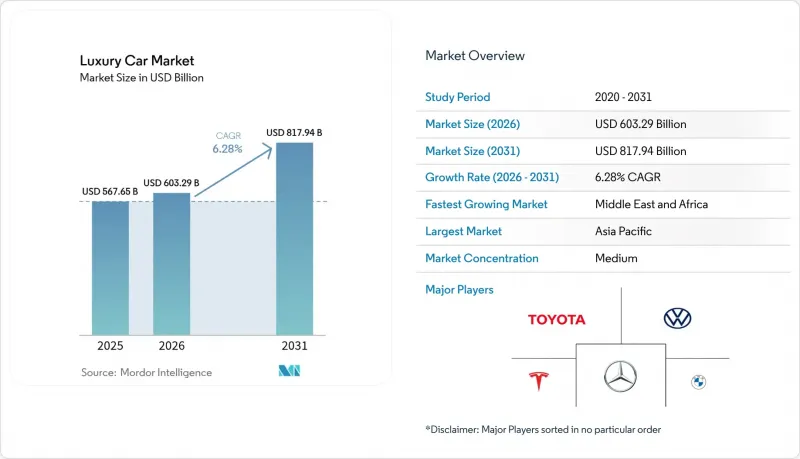
이 보고서는 차종별(해치백, 세단, 스포츠 유틸리티 차량(SUV), 기타), 구동 방식별(내연기관(ICE), 기타), 차량 등급별(엔트리 레벨 고급차, 기타),판매 채널별(정식 딜러, 소비자 직접 판매(D2C)·온라인), 지역별로 분류되어 있습니다. 시장 예측은 금액(달러)과 판매 대수(대)로 제시되어 있습니다.
세계 고급차 시장의 동향 및 인사이트
프리미엄 모델의 급속한 전동화
배터리 전기자동차(BEV)는 가장 빠르게 성장하고 있는 구동 방식입니다. 이는 EV를 단순한 규제 준수의 수단이 아닌, 정숙성과 토크, 최첨단 기술을 자랑하는 ‘할로 모델’로 포지셔닝하려는 각 프리미엄 제조사들의 노력에 힘입은 결과입니다. 인도에서는 메르세데스-벤츠의 전기자동차 판매 대수가 2024년 5월까지의 기간 중 전년 대비 94% 증가했습니다. 이는 현지에서 생산된 SUV ‘EQS 580’이 주도한 결과입니다. BMW는 같은 해 인도에서 순수 전기자동차 1,249대를 판매했으며, 51개 도시에 급속 충전기를 설치해 판매를 지원했습니다. 초고급 브랜드들은 여전히 신중한 태도를 유지하고 있습니다. 애스턴 마틴은 파워트레인의 추가 개선을 위해 첫 전기자동차 출시를 2026년으로 연기했습니다. 페라리는 정숙성이 뛰어난 파워트레인에서도 감성적 매력을 유지하기 위해 합성 배기음 관련 특허를 출원했습니다. 고급차 시장에서는 브랜드가 ‘소리’, ‘승차감’, ‘장인 정신’과 같은 독자적인 정체성을 어떻게 유지할 수 있는지가 전동화의 성공을 판단하는 중요한 기준이 될 것으로 보입니다.
아시아와 중동의 고자산가(HNWI) 인구 증가
아시아태평양의 고급차 시장은 고소득층 고객 기반의 확대에 힘입어 급성장하고 있습니다. 특히 첫 구매자나 차량 교체를 고려하는 계층을 중심으로 자산 수준이 상승함에 따라 프리미엄 모빌리티에 대한 수요는 더욱 높아지고 있습니다. 인도는 중요한 역할을 하고 있으며, 최근 수년간 고급차 판매 대수는 두 배로 증가했습니다. 예측에 따르면 초고액 자산가(HNWI)는 앞으로도 계속 증가할 것으로 보이며, 이는 ‘동경에 의한 소비’로의 전환과 유망한 장기적인 시장 전망을 시사합니다.
걸프 지역에서는 원유 가격 급등이 가처분 소득을 끌어올리며, 고급차에 대한 견고한 수요를 지원하고 있습니다. BMW 등의 브랜드가 인상적인 성장을 달성하고 있으며, 이 지역의 고급차에 대한 열기가 뚜렷이 드러나고 있습니다. 경제적 탄력성과 고급차에 대한 선호도가 맞물려, 걸프 지역은 고급차 제조사들에게 주요 시장으로서의 입지를 확고히 하고 있습니다.
반도체 및 부품 공급 부족
2022년 반도체 부족 사태에 대응해 새로운 웨이퍼 제조 시설이 가동을 시작했으나, 자동차용 특수 마이크로컨트롤러의 공급은 여전히 부족한 상황입니다. 이는 특히 인포테인먼트 시스템이나 편의 시스템에 필수적인 부품에서 두드러지게 나타납니다. 그 결과, 고급차 제조사들은 특정 기능이 누락된 상태로 차량을 인도할지, 아니면 고객에게 차량을 인도하는 시기를 연기할지라는 어려운 선택에 직면해 있습니다.
예를 들어 메르세데스-벤츠를 들 수 있습니다. 이 고급차 제조사는 최근 플래그십 모델인 S-클래스의 인도 일정을 연기할 수밖에 없었습니다. 이는 엘리트 모델조차도 이러한 반도체 부족의 영향을 피할 수 없음을 여실히 보여줍니다. 이러한 혼란은 생산 대수가 적고 사양이 풍부한 고급차에 가장 큰 타격을 주고 있습니다. 특수 부품에 의존하는 이러한 모델들은 생산 조정의 여지가 제한적입니다.
부문 분석
SUV는 2025년 고급차 시장 규모의 55.78%를 차지하며, 2031년까지 연평균 성장률(CAGR) 7.84%를 기록할 것으로 예측됩니다. 메르세데스-벤츠의 SUV 라인업은 사상 최대 매출을 기록했으며, AMG G 63은 판매 첫날 120건 이상의 사전 예약을 확보했습니다. 세단은 운전기사가 동승하는 환경이나 특정 초고급차 틈새 시장에서 여전히 문화적 위상을 유지하고 있습니다. 그러나 젊은 소유자층이 SUV의 다목적성을 우선시함에 따라 그 상대적 점유율은 축소되고 있습니다. 엔트리급 고급 해치백과 MPV는 지역적으로 제한된 미미한 존재에 그치고 있지만, 슈퍼카는 판매 대수가 극히 적음에도 불구하고 브랜드의 매력을 지탱하는 핵심 요소로 자리 잡고 있습니다. SUV의 맹렬한 기세는 당분간 이 차체 스타일이 고급차 시장에서 최대 수입원으로서의 지위를 공고히 할 것으로 보입니다.
현재 연구개발(R&D)의 우선순위는 SUV를 중심으로 한 제품 로드맵이 주도하고 있습니다. 아우디는 BMW iX나 메르세데스-벤츠 EQS와 같은 SUV의 출시보다 한발 앞서 나가기 위해, 플래그십 모델인 PPE EV의 개발 자원을 Q6 e-tron으로 재배치하고 있습니다. 랜드로버는 독자적인 소재와 색상 변형을 원하는 레인지로버 고객층을 충족시키기 위해 ‘SV Bespoke’ 스튜디오를 확장하고 있으며, 앞서 언급한 대량 맞춤화의 증가 추세를 지원하고 있습니다. 배출가스 규제가 엄격해지는 가운데, 전동화 SUV 모델은 틈새 파생 모델이 아닌 규제 준수를 위한 표준 전략이 되어, 고급차 시장은 SUV 주도의 성장 궤도를 유지할 것으로 보입니다.
2025년 시점에도 내연기관(ICE) 모델은 고급차 시장 규모의 68.35%를 차지하고 있었지만, 배터리식 전기자동차(BEV)의 시장 점유율은 연평균 성장률(CAGR) 8.79%라는 기세로 급속히 확대되고 있습니다. 메르세데스-벤츠와 BMW는 이미 400볼트 아키텍처를 주력 모델에 주류로 도입했으며, 포르쉐는 2027년 이후 새로운 내연기관(ICE) 플랫폼에 대한 투자를 동결했습니다. 급속 충전 인프라가 갖춰지지 않은 지역에서는 하이브리드차량이 과도기의 완충재 역할을 하고 있습니다. 렉서스는 중국에서 미니밴 ‘LM’을 출시하면서 하이브리드차 수요가 증가하는 모습을 보였습니다. 초고급 브랜드들은 단계적인 도입을 선호합니다. 애스턴 마틴은 승차감과 실내 음향 특성을 더욱 정교하게 다듬기 위해 첫 전기자동차 출시를 2026년으로 연기했습니다. 파워트레인의 다양화는 규제 요건, 인프라 구축 현황, 브랜드의 전통 간의 균형을 맞추는 어려운 과제이지만, 장기적인 관점에서 볼 때 고급차 시장에서 전동화가 주류가 될 것으로 시사되고 있습니다.
전기 전용 플랫폼은 소프트웨어 정의 인테리어를 구현하기 쉽게 해줍니다. 테슬라는 자체 개발한 칩셋과 완전 자율주행 기능 업데이트를 통해 프리미엄 전기자동차 시장에서 인지도를 주도하고 있으며, 경쟁사들에게도 더 깊은 수직 통합을 촉진하고 있습니다. 메르세데스의 ‘MB.OS’는 2025년 이후 모든 EQ 모델에 적용될 예정이며, 유료 기능 OTA(Over-the-Air) 업그레이드를 가능하게 함으로써 4년 주기로 차량 1대당 수익을 1,200달러까지 끌어올릴 가능성이 있습니다. 이러한 디지털 기반 수익화는 BEV(배터리 전기자동차)의 시장 점유율 확대를 가속화할 근거를 강화하고 있습니다.
지역별 분석
2025년, 아시아태평양은 고급차 시장 점유율의 42.75%를 차지했습니다. 이는 중국 시장 규모와 인도에서 프리미엄 차량 판매 대수가 5만 대(시간당 6대에 해당)로 급성장한 데 힘입은 결과입니다. 메르세데스-벤츠는 주식 시장의 변동을 배경으로 2025년 1분기 출하량이 둔화될 가능성이 있다고 경고하고 있으며, 이는 해당 지역이 자본 시장의 변동에 민감하다는 점을 지원합니다. 중국 국내 브랜드는 NEV(신에너지차) 보급률이 40.9%를 넘어 독일 브랜드의 점유율을 잠식하고 있으며, 기존 제조사들은 기술 제휴와 브랜드 메시지의 현지화를 서둘러야 하는 상황에 놓여 있습니다.
중동 지역은 유가에 연동된 가처분 소득과 인프라 확충에 힘입어 2031년까지의 연평균 성장률(CAGR)이 7.96%로 가장 높은 성장세를 보이고 있습니다. BMW는 2024년, X7과 7시리즈의 수요에 힘입어 걸프협력회의(GCC) 국가 전체에서 판매 대수가 15.4% 증가했습니다. 아랍에미리트(UAE)의 자동차 총 판매 대수는 15.7% 증가하여 견고한 거시경제의 호재가 확인되었습니다. 남아프리카공화국과 터키는 꾸준한 성장세를 보이고 있으나, 환율 변동으로 인해 구매 결정이 지연될 가능성이 있습니다. 각 고급차 제조사들은 지역에 따른 생산 거점을 구축하거나 달러로 청구하는 옵션을 마련함으로써 이러한 위험을 완화하고 있습니다.
북미는 성숙 단계에 접어들었음에도 불구하고 여전히 고급차 시장의 안정적인 버팀목으로 남아 있으며, 부유층의 존재가 금리 상승에 따른 결제 부담 증가를 상쇄하고 있습니다. 캐나다에서는 자원 수입의 급증으로 고급차의 보급이 가속화되고 있는 반면, 멕시코에서는 중산층의 자산 증가와 신용 접근성 개선이 맞물려 프리미엄 차량으로의 전환이 진행되고 있습니다. 유럽은 유로 7 규제와 플릿 CO₂ 배출량에 따른 과징금으로 인해 가장 엄격한 규제 제약에 직면해 있지만, 뿌리 깊은 브랜드 충성도는 유지되고 있습니다. 각 자동차 제조사들은 규제 준수 비용을 상쇄하기 위해 수익성이 높은 전기 SUV에 주력하고 있으며, 자사 소유의 배터리 공장과 재생 가능 에너지 크레딧을 활용하여 수익성을 지키고 있습니다.
기타 혜택
- 엑셀 형식의 시장 예측(ME) 시트
- 3개월간 애널리스트 지원
자주 묻는 질문
목차
제1장 서론
제2장 조사 방법
제3장 개요
제4장 시장 구도
제5장 시장 규모와 성장 예측
제6장 경쟁 구도
제7장 시장 기회와 향후 전망
KSA 26.09.07According to Mordor Intelligence, the luxury car market size is expected to grow from USD 567.65 billion in 2025 to USD 603.29 billion in 2026 and is forecast to reach USD 817.94 billion by 2031 at 6.28% CAGR over 2026-2031.
This report is Segmented by Vehicle Type (Hatchbacks, Sedans, Sports Utility Vehicles, and More), Drive Type (Internal Combustion Engine, and More), Vehicle Class (Entry-Level Luxury, and More), Sales Channel (Authorized Dealership and Direct-to-Consumer/Online), and Geography. The Market Forecasts are Provided in Terms of Value (USD) and Volume (Units).
Global Luxury Car Market Trends and Insights
Rapid Electrification of Premium Models
Battery-electric derivatives represent the fastest-growing drivetrain, supported by premium makers that position EVs as halo showcases for quiet torque and cutting-edge tech rather than regulatory compliance plays. In India, Mercedes-Benz's EV sales grew 94% year-on-year through May 2024, led by the locally-built EQS 580 SUV. BMW delivered 1,249 pure EVs in India the same year, supporting them with fast chargers in 51 cities. Ultra-luxury brands remain cautious: Aston Martin shifted its first EV launch to 2026 for additional powertrain refinement. Ferrari filed patents for synthetic exhaust acoustics to retain emotional appeal in silent drivetrains. The luxury car market will increasingly judge electrification success on how well brands preserve identity traits such as sound, ride, and craftsmanship.
Rising HNWI Population in Asia and Middle East
Asia-Pacific's luxury vehicle market is surging, driven by an expanding base of affluent consumers. As wealth levels rise, especially among first-time buyers and those seeking upgrades, the demand for premium mobility intensifies. India is a pivotal player, with luxury vehicle sales doubling in recent years. Projections show a continued rise in ultra-high-net-worth individuals, hinting at a shift towards aspirational consumption and a promising long-term market outlook.
In the Gulf region, buoyant oil prices have bolstered disposable incomes, fueling a robust demand for luxury vehicles. Brands such as BMW have grown significantly, underscoring the region's enthusiasm for premium automotive offerings. With a blend of economic resilience and a penchant for high-end mobility, the Gulf solidifies its status as a prime market for luxury OEMs.
Semiconductor and Component Shortages
Even with new wafer fabrication facilities launching post the 2022 chip shortage, there's still a tight supply of specialty automotive microcontrollers. This is especially true for those integral to infotainment and comfort systems. As a result, premium OEMs face tough choices: they deliver vehicles missing certain features or push back customer handovers.
Take Mercedes-Benz, for instance. The luxury automaker recently had to delay allocations of its flagship S-Class, underscoring that even elite models aren't shielded from these chip shortages. Such disruptions hit hardest in low-volume, high-content luxury vehicles. These models, dependent on specialized components, have limited leeway in production adjustments.
Other drivers and restraints analyzed in the detailed report include:
- Enhanced ADAS and Safety Expectations
- Online/Direct-to-Consumer Retail Shift
- Anti-SUV Climate Regulation Pressure
For complete list of drivers and restraints, kindly check the Table Of Contents.
Segment Analysis
SUVs controlled 55.78% of the luxury car market size in 2025 and are predicted to post an 7.84% CAGR to 2031. Mercedes-Benz's SUV roster secured record revenue and over 120 early orders for the AMG G 63 on its first retail day. Sedans keep cultural cachet in chauffeur-driven contexts and certain ultra-luxury niches; however, their relative share diminishes as younger owners prioritize the multi-utility profile of SUVs. Entry-luxury hatchbacks and MPVs remain minor, geography-specific plays, while supercars anchor brand desirability despite negligible volume. Ferocious SUV momentum cements the body style as the luxury car market's leading profit contributor for the foreseeable horizon.
SUV-centric product roadmaps now dominate R&D prioritization. Audi moved flagship PPE EV development resources toward its Q6 e-tron to pre-empt BMW iX and Mercedes EQS SUV launches. Land Rover is extending its SV Bespoke studio to cater to Range Rover clients seeking one-off materials and colorways, reinforcing the mass-customization uptick discussed earlier. As emission targets tighten, electrified SUV variants will become the default compliance strategy rather than a niche derivative, keeping the luxury car market on an SUV-led growth trajectory.
Internal-combustion models still represented 68.35% of the luxury car market size in 2025, but battery-electric entries are sprinting ahead at a 8.79% CAGR. Mercedes-Benz and BMW have already mainstreamed 400-volt architectures into core models, and Porsche has frozen new ICE platform investment beyond 2027. Hybrids offer a transitional buffer in regions lacking fast-charging density; Lexus saw a hybrid uptake for its LM minivan launch in China. Ultra-luxury marques favor a staggered roll-in; Aston Martin rescheduled its debut EV to 2026, arguing for additional refinement of ride and cabin sound characteristics. Powertrain diversification remains a balancing act between regulatory compulsion, infrastructure readiness, and brand heritage yet the long arc points toward electrified dominance within the luxury car market.
Electric-only skateboards also facilitate software-defined interiors. Tesla commands premium-EV mindshare via in-house chipsets and full-self-driving updates, nudging rivals toward deeper vertical integration. Mercedes' MB.OS will roll out across all EQ models after 2025, enabling paid feature over-the-air upgrades that could lift revenue per vehicle by USD 1,200 over a four-year cycle. Such digital monetization strengthens the rationale for accelerated BEV share gains.
Complete Report Scope:
- By Vehicle Type
- Hatchbacks
- Sedans
- Sports Utility Vehicles (SUVs)
- Multi-purpose Vehicles (MPVs)
- Sports / Exotic
- By Drive Type
- Internal Combustion Engine (ICE)
- Hybrid Electric
- Battery Electric
- By Vehicle Class
- Entry-level Luxury
- Mid-level Luxury
- Ultra-luxury / Exotic
- By Sales Channel
- Authorized Dealership
- Direct-to-Consumer / Online
- By Geography
- North America
- United States
- Canada
- Rest of North America
- South America
- Brazil
- Argentina
- Rest of South America
- Europe
- Germany
- United Kingdom
- France
- Italy
- Spain
- Rest of Europe
- Asia-Pacific
- China
- Japan
- India
- South Korea
- Rest of Asia-Pacific
- Middle-East and Africa
- United Arab Emirates
- Saudi Arabia
- Turkey
- Egypt
- South Africa
- Rest of Middle-East and Africa
- North America
Geography Analysis
Asia-Pacific commanded 42.75% of the luxury car market share in 2025, underpinned by China's scale and India's meteoric rise to 50,000 premium units sold, equal to six vehicles every hour. Nevertheless, Mercedes-Benz warned of softer Q1 2025 deliveries amid equity volatility, validating the region's sensitivity to capital-market swings. China's domestic marques erode German share as NEV penetration tops 40.9%, pressuring incumbents to localize tech partnerships and brand messaging.
The Middle East shows the steepest 7.96% CAGR through 2031, buoyed by oil-linked disposable income and infrastructure expansion. BMW tallied a 15.4% volume uplift across Gulf Cooperation Council states 2024, led by X7 and 7 Series demand. UAE total automotive sales advanced 15.7%, confirming robust macro tailwinds. South Africa and Turkiye add incremental gains but are subject to currency gyrations that can delay purchase decisions; premium makers mitigate risk with regional production hubs and U.S.-dollar invoicing options.
North America remains a mature but steady pillar for the luxury car market, with affluent demographics offsetting interest-rate-driven payment inflation. Canada's resource windfall aids luxury penetration, while Mexico is graduating toward premium vehicles as rising middle-class wealth intersects with improved credit access. Europe faces the heaviest regulatory drag via Euro 7 and fleet CO2 fines, yet maintains entrenched brand loyalty. OEMs are converging on high-margin electric SUVs to absorb compliance costs, leveraging in-house battery plants and renewable-energy credits to defend profitability.
- Mercedes-Benz Group AG
- BMW AG
- Volkswagen Group
- Toyota Motor Corporation (Lexus)
- Jaguar Land Rover Automotive PLC
- Stellantis NV (Maserati, Alfa Romeo)
- Tesla Inc.
- Volvo Car Group
- Hyundai Motor Group (Genesis)
- Nissan Motor Co. (Infiniti)
- Geely Holding (Lotus, Zeekr)
- FAW Group (Hongqi)
- SAIC Motor (IM, Roewe)
- BYD Co. (Yangwang)
- Lucid Group
- Rivian Automotive
- Ferrari NV
- Aston Martin Lagonda
- Rolls-Royce Motor Cars
- McLaren Automotive
Additional Benefits:
- The market estimate (ME) sheet in Excel format
- 3 months of analyst support
TABLE OF CONTENTS
1 Introduction
- 1.1 Study Assumptions & Market Definition
- 1.2 Scope of the Study
2 Research Methodology
3 Executive Summary
4 Market Landscape
- 4.1 Market Overview
- 4.2 Market Drivers
- 4.2.1 Luxury-SUV Demand Boom
- 4.2.2 Rapid Electrification of Premium Models
- 4.2.3 Rising HNWI Population in Asia and Middle East
- 4.2.4 Enhanced ADAS and Safety Expectations
- 4.2.5 Online/Direct-To-Consumer Retail Shift
- 4.2.6 Mass-Customization and Bespoke Options
- 4.3 Market Restraints
- 4.3.1 High Purchase and Ownership Cost
- 4.3.2 Semiconductor and Component Shortages
- 4.3.3 Macroeconomic Demand Volatility
- 4.3.4 Anti-SUV Climate Regulation Pressure
- 4.4 Value / Supply-Chain Analysis
- 4.5 Regulatory Landscape
- 4.6 Technological Outlook
- 4.7 Porter's Five Forces
- 4.7.1 Threat of New Entrants
- 4.7.2 Bargaining Power of Buyers
- 4.7.3 Bargaining Power of Suppliers
- 4.7.4 Threat of Substitutes
- 4.7.5 Competitive Rivalry
5 Market Size & Growth Forecasts (Value (USD), Volume (Units))
- 5.1 By Vehicle Type
- 5.1.1 Hatchbacks
- 5.1.2 Sedans
- 5.1.3 Sports Utility Vehicles (SUVs)
- 5.1.4 Multi-purpose Vehicles (MPVs)
- 5.1.5 Sports / Exotic
- 5.2 By Drive Type
- 5.2.1 Internal Combustion Engine (ICE)
- 5.2.2 Hybrid Electric
- 5.2.3 Battery Electric
- 5.3 By Vehicle Class
- 5.3.1 Entry-level Luxury
- 5.3.2 Mid-level Luxury
- 5.3.3 Ultra-luxury / Exotic
- 5.4 By Sales Channel
- 5.4.1 Authorized Dealership
- 5.4.2 Direct-to-Consumer / Online
- 5.5 By Geography
- 5.5.1 North America
- 5.5.1.1 United States
- 5.5.1.2 Canada
- 5.5.1.3 Rest of North America
- 5.5.2 South America
- 5.5.2.1 Brazil
- 5.5.2.2 Argentina
- 5.5.2.3 Rest of South America
- 5.5.3 Europe
- 5.5.3.1 Germany
- 5.5.3.2 United Kingdom
- 5.5.3.3 France
- 5.5.3.4 Italy
- 5.5.3.5 Spain
- 5.5.3.6 Rest of Europe
- 5.5.4 Asia-Pacific
- 5.5.4.1 China
- 5.5.4.2 Japan
- 5.5.4.3 India
- 5.5.4.4 South Korea
- 5.5.4.5 Rest of Asia-Pacific
- 5.5.5 Middle-East and Africa
- 5.5.5.1 United Arab Emirates
- 5.5.5.2 Saudi Arabia
- 5.5.5.3 Turkey
- 5.5.5.4 Egypt
- 5.5.5.5 South Africa
- 5.5.5.6 Rest of Middle-East and Africa
- 5.5.1 North America
6 Competitive Landscape
- 6.1 Market Concentration
- 6.2 Strategic Moves
- 6.3 Market Share Analysis
- 6.4 Company Profiles (includes Global level Overview, Market level overview, Core Segments, Financials as available, Strategic Information, Market Rank/Share for key companies, Products & Services, and Recent Developments)
- 6.4.1 Mercedes-Benz Group AG
- 6.4.2 BMW AG
- 6.4.3 Volkswagen Group
- 6.4.4 Toyota Motor Corporation (Lexus)
- 6.4.5 Jaguar Land Rover Automotive PLC
- 6.4.6 Stellantis NV (Maserati, Alfa Romeo)
- 6.4.7 Tesla Inc.
- 6.4.8 Volvo Car Group
- 6.4.9 Hyundai Motor Group (Genesis)
- 6.4.10 Nissan Motor Co. (Infiniti)
- 6.4.11 Geely Holding (Lotus, Zeekr)
- 6.4.12 FAW Group (Hongqi)
- 6.4.13 SAIC Motor (IM, Roewe)
- 6.4.14 BYD Co. (Yangwang)
- 6.4.15 Lucid Group
- 6.4.16 Rivian Automotive
- 6.4.17 Ferrari NV
- 6.4.18 Aston Martin Lagonda
- 6.4.19 Rolls-Royce Motor Cars
- 6.4.20 McLaren Automotive


