

|
시장보고서
상품코드
2122399
인도의 고급차 : 시장 점유율 분석, 업계 동향과 통계, 성장 예측(2026-2031년)India Luxury Car - Market Share Analysis, Industry Trends & Statistics, Growth Forecasts (2026 - 2031) |
||||||
 Mordor Intelligence
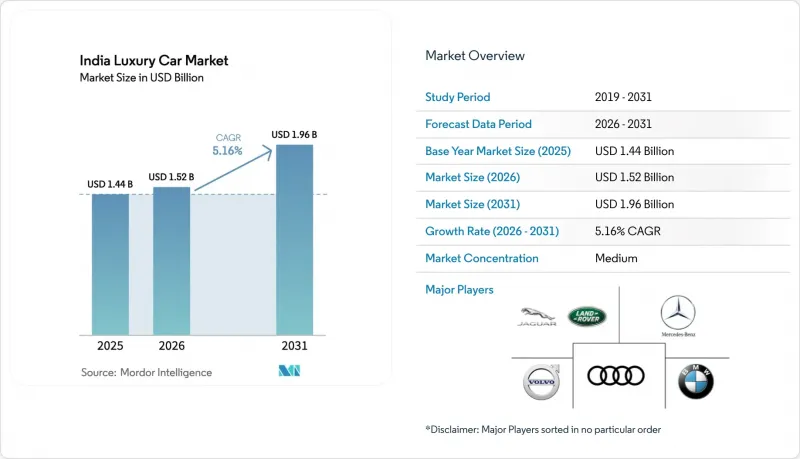
Mordor Intelligence에 따르면 인도의 고급차 시장 규모는 2025년 14억 4,000만 달러에서 2026년에는 15억 2,000만 달러로 확대하며, 2031년까지 19억 6,000만 달러에 달할 것으로 예측되고 있으며, 예측 기간(2026-2031년)에 CAGR 5.16%로 성장할 것으로 전망되고 있습니다.
이 보고서는 차종별(SUV, 세단, 해치백), 구동 방식별(내연기관(ICE), 하이브리드, 배터리 전기자동차),가격대별(200만-500만 인도 루피, 500만-800만 인도 루피, 800만 인도 루피 이상), 판매 채널별(자사 직영 쇼룸, 정식 딜러·프랜차이즈, 온라인), 지역별(북인도, 서인도,남인도, 기타)별로 분류되어 있습니다. 시장 예측은 금액(달러)과 판매 대수(대)로 제시되어 있습니다.
인도 고급차 시장의 동향과 인사이트
중상위층 가구의 프리미엄화
인도에는 현재 약 87만 1,000가구의 백만장자 가구(순자산이 8,700만 인도 루피 이상인 가구로 정의)가 존재하며, 이는 2021년(약 45만 8,000가구)에 비해 90% 증가한 수치입니다. 이러한 부유층 가구는 인도 전체 가구의 약 0.31%를 차지하며, 경제 성장을 배경으로 한 인도내 강력한 부의 창출을 반영하고 있습니다. 맞벌이 가구가 개인의 이동 수단을 점점 더 중요시함에 따라 고급차 구매의 62%를 핵가족이 차지하게 되었습니다(2020년 48%에서 증가). 10만 인도 루피 이상의 UPI 송금액이 전년 대비 34% 급증한 점에서도 자금의 유동성이 뚜렷이 드러납니다. 부동산 가격 상승세가 둔화되면서, 지위를 과시하는 수단으로서 자동차 소유가 주목받고 있습니다.
엔트리 레벨 모델(CKD)의 공급 확대
현지 조립을 통해 독일산 세단의 진입 가격은 489만 인도 루피로 낮아졌습니다. BMW의 X1 sDrive18i M Sport는 기존 CBU(완전 조립 완성차) 모델보다 65만 인도 루피 저렴합니다. CKD 방식을 채택함으로써 CBU에 부과되는 100% 관세를 회피하고, 28-32%의 매출 총이익률을 유지하면서 납기 기간을 6주로 단축할 수 있게 되었습니다. 메르세데스-벤츠는 2024년 인도에서 1만 9,565대를 판매했습니다. 아우디의 오랑가바드 공장은 2026년 말까지 BEV 플랫폼에 대응할 예정이며, 이를 통해 CKD 방식의 비용 절감 효과는 800만 인도 루피 이하의 전기자동차 모델로도 확대될 것입니다.
ADAS 및 고전압 시스템을 다룰 수 있는 숙련된 기술자 부족
자동차 기술 개발 위원회(Automotive Skills Development Council)의 추정에 따르면 2026년까지 240만 명의 기술자가 부족할 것으로 예상됩니다. 필요한 전기자동차(EV) 인증 기술자 50만 명 중 현재 확보된 인력은 고작 5만 명에 불과하며, 충족률은 10%에 그치고 있습니다. 이러한 인력 부족으로 인해 보증 청구 해결에 소요되는 일수는 대도시권의 4일에서 코임바토르나 자이푸르와 같은 2급 도시에서는 18일로 늘어났습니다. 이러한 기술 격차는 고객 불만으로 나타나고 있습니다. 2024년 J.D. Power의 조사에 따르면 2급 시장의 고급 전기자동차 소유자 중 42%가 애프터서비스에 대해 "기대 이하"라고 평가했으며, 그 이유로 기술자들이 배터리 열 관리 진단이나 무선 소프트웨어 업데이트에 익숙하지 않다는 점을 꼽았습니다. 이러한 요인으로 인해 브랜드별 순추천지수(NPS)는 대도시권에 비해 18포인트 하락했습니다.
부문 분석
2025년, 스포츠 유틸리티 차량(SUV)은 인도 고급차 시장 점유율의 47.43%를 차지했으나, 세단은 2031년까지 연평균 성장률(CAGR) 10.12%로 회복될 것으로 예측됩니다. 뒷좌석 엔터테인먼트 시스템의 도입률은 3분의 2를 넘어, 승차감을 중시하는 경향이 강해지고 있음을 보여줍니다. 노면 상태가 좋지 않은 2급 시장에서는 SUV가 여전히 필수적인 존재이며, 가격이 2,000만 인도 루피를 초과하는 초고급 SUV 틈새 시장은 롤스로이스 컬리넌(Rolls-Royce Cullinan)과 같은 모델을 배경으로 확대되고 있습니다.
해치백은 400만 인도 루피(약 4만 8,000달러) 이하의 프리미엄 차종이 존재하지 않기 때문에 여전히 극히 소규모의 부문에 머물러 있습니다. 2023년 메르세데스-벤츠 A-클래스의 판매 종료로 생긴 공백은 아직까지 경쟁사들에 의해 메워지지 않았으며, 엔트리 럭셔리 시장은 스코다 옥타비아와 같은 대중 프리미엄 브랜드에 양보되고 있습니다. 하이브리드 파워트레인은 세단의 부활을 더욱 지원하고 있습니다. BMW 530e나 메르세데스-벤츠 E 300e 등이 그 예이며, 이들 모델은 2025년 9월 GST가 38%로 인하되는 혜택을 받아,가격이 90만-110만 인도 루피(약 1만 800-1만 3,200 달러)가 되어, 동급 가솔린 모델과의 가격 차이는 불과 40만 인도 루피(약 4,800 달러)로 좁혀졌습니다. 대도시권의 휘발유 가격이 리터당 평균 105인도 루피(약 1.26달러)라는 점을 고려하면, 구매자는 6만 킬로미터를 주행하기 전에 이 차액을 회수할 수 있게 됩니다.
2025년 시점에 인도 고급차 시장 점유율의 74.68%는 여전히 내연기관 차량이 차지하고 있었지만, BEV(배터리 전기자동차)는 2031년까지 연평균 성장률(CAGR) 21.98%로 확대될 것으로 예상되며, 이로 인해 인도 고급차 시장 전체 성장 속도의 4배에 달하는 속도로 성장하게 될 것입니다. 메르세데스-벤츠 EQS SUV 구매자는 인도 세법에 따라 첫해 감가상각률 40%를 활용할 수 있으므로 투자 회수 기간이 단축됩니다. 플러그인 하이브리드 전기자동차는 2025년 9월 GST(상품 및 서비스세)가 38%로 인하된 것을 계기로 탄력을 받아, 등록 대수가 전월 대비 28% 급증했습니다. 잔존 가치에 대한 우려로 인해 가솔린 차량을 선택하는 구매자도 있으며, 주유 편의성과 저렴한 판매 가격은 여전히 중요한 고려 사항으로 남아 있습니다.
내연기관(ICE) 부문의 견고한 실적은 세 가지 요인에 기인합니다. 즉, 확립된 주유 인프라(주유소 8만 5,000곳에 비해 공공 전기자동차 충전소는 1만 2,000곳), 더 빠른 주유(3분 소요, 급속 충전은 25분 소요),낮은 초기 비용-BMW 530i는 729만 인도 루피(약 8만 7,500달러)로, i4 eDrive40보다 180만 인도 루피(약 2만 1,600달러)저렴하며, 연간 주행 거리가 1만 5,000킬로미터 이하인 구매자에게는 이 가격 차이를 정당화할 수 없습니다. 방갈로르나 푸네와 같은 도시에서는 BMW 530e나 메르세데스-벤츠 E 300e가 보급을 주도하고 있으며, 이 도시의 구매자들은 순수한 성능보다는 세제상 이점을 더 중요하게 여깁니다.
기타 혜택
- 엑셀 형식의 시장 예측(ME) 시트
- 3개월간의 애널리스트 지원
자주 묻는 질문
목차
제1장 서론
제2장 조사 방법
제3장 개요
제4장 시장 구도
제5장 시장 규모와 성장 예측
제6장 경쟁 구도
제7장 시장 기회와 향후 전망
KSA 26.09.07According to Mordor Intelligence, the indian luxury car market size is expected to grow from USD 1.44 billion in 2025 to USD 1.52 billion in 2026 and is forecast to reach USD 1.96 billion by 2031, growing at a 5.16% CAGR over the forecast period (2026-2031).
This report is Segmented by Vehicle Type (SUV, Sedan, Hatchback), Drive Type (IC Engine, Hybrid, Battery Electric), Price Range (INR 20 To 50 Lakh, INR 50 To 80 Lakh, Above INR 80 Lakh), Sales Channel (Company-Owned Showrooms, Authorized Dealerships/Franchise, Online), and Geography (North India, West India, South India, and More). The Market Forecasts are Provided in Terms of Value (USD) and Volume (Units).
India Luxury Car Market Trends and Insights
Premiumization of Upper-middle-class Households
India now has an estimated 8.71 lakh millionaire households (defined as households with a net worth of INR 8.7 crore or more), marking a 90 % increase compared with 2021 (from about INR 4.58 lakh). These affluent households represent roughly 0.31 % of all Indian households and reflect strong wealth creation in the country amid economic growth. Nuclear families now account for 62% of luxury purchases, up from 48% in 2020, as dual-income couples increasingly favor personal mobility. Liquidity is evident in UPI transfers above INR 1 lakh, which have surged 34% year over year. Slowing real-estate appreciation redirects status signaling toward automobile ownership.
Rising Availability of Entry-level Models (CKD)
Local assembly cut the entry point for German sedans to INR 48.9 lakh, with BMW's X1 sDrive18i M Sport priced INR 6.5 lakh lower than the prior CBU version. CKD economics avoids 100% CBU duties, preserves 28-32% gross margins, and trims delivery lead times to six weeks. Mercedes-Benz sold 19,565 units in India in 2024. Audi's Aurangabad plant will accommodate BEV platforms by late 2026, extending CKD savings to electric models below INR 80 lakh.
Scarcity of Trained Technicians for ADAS and High-Voltage Systems
The Automotive Skills Development Council estimates a 2.4 million technician shortfall by 2026, with only 50,000 of the 500,000 required EV-certified technicians currently available, resulting in a 10% fill rate. This shortfall extends warranty-claim resolution from 4 days in metros to 18 days in tier-2 cities like Coimbatore and Jaipur. The skills gap manifests in customer dissatisfaction; a 2024 J.D. Power study found that 42% of luxury EV owners in tier-2 markets rated aftersales service below expectations, citing technician unfamiliarity with battery thermal management diagnostics and over-the-air software updates, factors that depress brand Net Promoter Scores by 18 points relative to metro areas.
Other drivers and restraints analyzed in the detailed report include:
- EV Incentives by State Governments
- Rapid Rollout of 150 kW+ Public DC Chargers on Inter-city Corridors
- Slow Build-out of Certified Pre-owned Luxury Networks
For complete list of drivers and restraints, kindly check the Table Of Contents.
Segment Analysis
Sport Utility Vehicles (SUVs) captured 47.43% of India's luxury car market share in 2025, while sedans are expected to resurge with a forecast 10.12% CAGR through 2031. Rear-seat entertainment uptake exceeds 2/3, indicating a shift in value toward ride quality. SUVs remain indispensable in tier-2 markets with poor road surfaces; the ultra-luxury SUV niche, priced above INR 2 crore, is advancing on the back of models like the Rolls-Royce Cullinan.
Hatchbacks remain a negligible segment, constrained by the absence of premium offerings priced below INR 40 lakh (approximately USD 48,000). The discontinuation of the Mercedes A-Class in 2023 left a void that no competitor has filled, ceding the entry-luxury space to mass-premium brands like the Skoda Octavia. Hybrid powertrains further propel the sedan revival - BMW's 530e and Mercedes E 300e - which benefit from the September 2025 GST reduction to 38%, trimming prices by INR 9-11 lakh (approximately USD 10,800-13,200) and compressing the premium over equivalent petrol variants to just INR 4 lakh (approximately USD 4,800), a gap that buyers recover within 60,000 kilometers given petrol prices averaging INR 105 per liter (approximately USD 1.26) in metros.
Internal combustion engines still held 74.68% of India's luxury car market share in 2025; however, BEVs are expected to expand at a 21.98% CAGR through 2031, thereby quadrupling the overall pace of the Indian luxury car market. Mercedes-Benz EQS SUV buyers can leverage a 40% first-year depreciation under India's tax code, thereby narrowing the payback horizon. Plug-in hybrids gained momentum from the September 2025 GST cut to 38%, resulting in a 28% surge in month-on-month registrations. Residual-value anxiety keeps some buyers in petrol variants, where refueling convenience and lower sticker prices remain essential considerations.
The ICE segment's resilience stems from three factors: established refueling infrastructure (85,000 petrol pumps versus 12,000 public EV chargers), faster refueling (3 minutes versus 25 minutes for fast-charging), and lower upfront cost - the BMW 530i at INR 72.9 lakh (approximately USD 87,500) undercuts the i4 eDrive40 by INR 18 lakh (approximately USD 21,600), a gap that buyers with annual mileage under 15,000 kilometers cannot justify. The BMW 530e and Mercedes E 300e are leading the uptake in Bangalore and Pune, cities where buyers prioritize tax efficiency over outright performance.
Complete Report Scope:
- By Vehicle Type
- Sport Utility Vehicles (SUVs)
- Sedan
- Hatchback
- By Drive Type
- Internal Combustion Engine (ICE)
- Hybrid
- Battery Electric
- By Price Range
- INR 20 to 50 Lakh
- INR 50 to 80 Lakh
- Above INR 80 Lakh
- By Sales Channel
- Company-owned Showrooms
- Authorized Dealerships/Franchise
- Online (Direct-to-Consumer)
- By Region
- North India
- West India
- South India
- East and North-East India
List of Companies Covered in this Report:
- Mercedes-Benz Group AG
- BMW AG
- AUDI AG
- Jaguar Land Rover Automotive PLC
- AB Volvo
- Lexus
- Porsche AG
- Rolls-Royce plc
- Bentley Motors Limited
- Automobili Lamborghini S.p.A.
- Ferrari S.p.A.
- Maserati S.p.A
- Aston Martin Lagonda Global Holdings PLC
Additional Benefits:
- The market estimate (ME) sheet in Excel format
- 3 months of analyst support
TABLE OF CONTENTS
1 Introduction
- 1.1 Study Assumptions and Market Definition
- 1.2 Scope of the Study
2 Research Methodology
3 Executive Summary
4 Market Landscape
- 4.1 Market Overview
- 4.2 Market Drivers
- 4.2.1 Premiumization of Upper-Middle-Class Households
- 4.2.2 Rising Availability of Entry-Level Models (CKD)
- 4.2.3 EV Incentives by State Governments
- 4.2.4 Rapid Rollout of 150 kW+ Public DC Chargers on Inter-City Corridors
- 4.2.5 OEM-Financed Subscription and Leasing Schemes
- 4.2.6 Chinese Ultra-Luxury EV Brands Eyeing India as Next Launch Pad
- 4.3 Market Restraints
- 4.3.1 High GST and Cess Structure
- 4.3.2 Import Duty Uncertainty on CBUs
- 4.3.3 Slow Build-Out of Certified Pre-Owned Luxury Networks
- 4.3.4 Scarcity of Trained Technicians for ADAS and High-Voltage Systems
- 4.4 Value/Supply-Chain Analysis
- 4.5 Regulatory Landscape
- 4.6 Technological Outlook
- 4.7 Porter's Five Forces Analysis
- 4.7.1 Bargaining Power of Buyers/Consumers
- 4.7.2 Bargaining Power of Suppliers
- 4.7.3 Threat of New Entrants
- 4.7.4 Threat of Substitute Products
- 4.7.5 Intensity of Competitive Rivalry
5 Market Size and Growth Forecasts (Value (USD) and Volume (Units))
- 5.1 By Vehicle Type
- 5.1.1 Sport Utility Vehicles (SUVs)
- 5.1.2 Sedan
- 5.1.3 Hatchback
- 5.2 By Drive Type
- 5.2.1 Internal Combustion Engine (ICE)
- 5.2.2 Hybrid
- 5.2.3 Battery Electric
- 5.3 By Price Range
- 5.3.1 INR 20 to 50 Lakh
- 5.3.2 INR 50 to 80 Lakh
- 5.3.3 Above INR 80 Lakh
- 5.4 By Sales Channel
- 5.4.1 Company-owned Showrooms
- 5.4.2 Authorized Dealerships/Franchise
- 5.4.3 Online (Direct-to-Consumer)
- 5.5 By Region
- 5.5.1 North India
- 5.5.2 West India
- 5.5.3 South India
- 5.5.4 East and North-East India
6 Competitive Landscape
- 6.1 Market Concentration
- 6.2 Strategic Moves
- 6.3 Market Share Analysis
- 6.4 Company Profiles (Includes Global level Overview, Market level overview, Core Segments, Financials as available, Strategic Information, Market Rank/Share for key companies, Products and Services, and Recent Developments)
- 6.4.1 Mercedes-Benz Group AG
- 6.4.2 BMW AG
- 6.4.3 AUDI AG
- 6.4.4 Jaguar Land Rover Automotive PLC
- 6.4.5 AB Volvo
- 6.4.6 Lexus
- 6.4.7 Porsche AG
- 6.4.8 Rolls-Royce plc
- 6.4.9 Bentley Motors Limited
- 6.4.10 Automobili Lamborghini S.p.A.
- 6.4.11 Ferrari S.p.A.
- 6.4.12 Maserati S.p.A
- 6.4.13 Aston Martin Lagonda Global Holdings PLC
7 Market Opportunities and Future Outlook
- 7.1 White-space and Unmet-need Assessment


