

|
시장보고서
상품코드
2114865
북미 고급차 시장 : 점유율 분석, 업계 동향과 통계, 성장 예측(2026-2031년)North America Luxury Car - Market Share Analysis, Industry Trends & Statistics, Growth Forecasts (2026 - 2031) |
||||||
 Mordor Intelligence
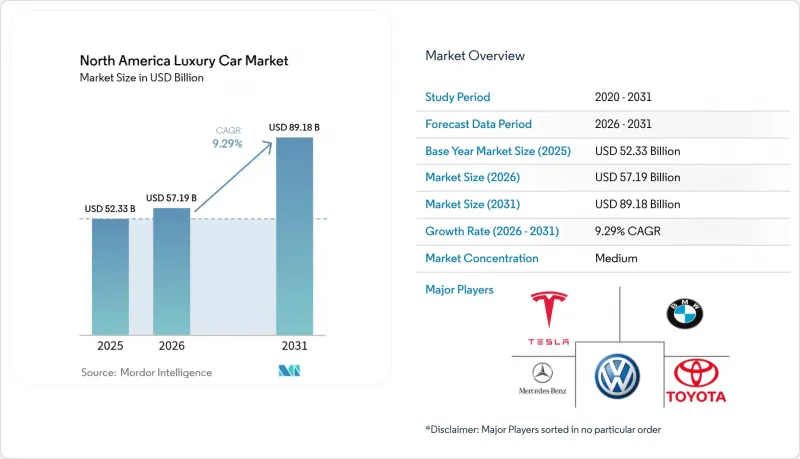
Mordor Intelligence에 의하면, 북미 고급차 시장 규모는 2025년에 523억 3,000만 달러로 평가되었고 2026년 571억 9,000만 달러에서 2031년까지 891억 8,000만 달러에 이를 것으로 예측되며, 예측 기간(2026-2031년) CAGR은 9.29%를 나타낼 전망입니다.
본 보고서는 차종(세단, SUV/크로스오버, 기타), 구동 방식(내연기관, 배터리식 전기차 등), 가격대(프리미엄: 5만-10만 달러,어퍼 프리미엄: 10만-20만 달러 등), 판매 채널(프랜차이즈 딜러, 소비자 직접 판매 등), 국가(미국, 캐나다 등)별로 분류되어 있습니다. 시장 예측은 금액(달러) 및 판매 대수(대)로 제시되어 있습니다.
북미 고급차 시장 동향과 인사이트
Y세대/고자산층의 프리미엄화 추세
밀레니얼 세대와 Z 세대로의 부의 재분배로 인해, 현재 고급차를 구매하는 부유층의 40%가 이 세대들에서 비롯되고 있습니다. 이들의 구매 결정 기준은 내장 소프트웨어, 환경 배려, 개인화된 경험을 중시하는 것이며, 이에 따라 각 브랜드는 옴니채널 판매 거점, 커넥티드 서비스 번들, 구독형 이용 모델 구축을 서둘러야 하는 상황에 놓여 있습니다. 정적인 지위 상징보다 기술 플랫폼이 더 중요시됨에 따라, 무선 업데이트 기능과 서비스 기반의 업셀 전략적 가치가 높아지고 있습니다.
2030년까지 고급차의 전기차 비율을 50% 이상으로 끌어올리려는 자동차 제조업체들의 노력
BMW 그룹은 임원에 대한 보너스를 전기차 보급률에 연동하고 있으며, 이에 따라 북미에서의 신차 출시 일정을 조정하고 있습니다. 캐나다의 리베이트 제도가 이러한 효과를 더욱 증폭시켜, 해당 시장에서의 모델 출시 주기를 가속화하고 있습니다. 자본의 흐름은 배터리 공급의 현지화를 뒷받침하고 있지만, 각 기업은 단기적인 내연기관 차량(ICE)의 수익성과 전기차에 대한 막대한 설비 투자 간의 균형을 맞추어야 하므로, 포트폴리오의 균형 조정이 경영진에게 매우 중요한 KPI가 되고 있습니다.
인플레이션으로 인한 연이율(APR) 급등이 리스 계약 확대를 압박
리스 지불액은 인플레이션 이전 기준치에 비해 25-30% 상승했으며, 특히 구매 의향이 강한 젊은 층에 불균형적인 영향을 미쳐 엔트리급 고급차 시장으로의 유입을 저해하고 있습니다. 각 자동차 제조업체는 판매 대수를 유지하기 위해 장기 리스 계약, 구독 서비스의 시범 도입, 금리 인하 등의 대책을 시행하고 있습니다.
부문 분석
북미 고급차 시장에서 SUV가 차지하는 비중은 2025년에 55.18%를 나타내고, 예측 연평균 성장률(CAGR)은 10.52%로 전망됩니다. SUV를 기술 분야의 주력 모델로 자리매김함으로써 우수한 이익률을 실현하고, 제조업체는 전동화 비용을 상쇄할 수 있게 됩니다. BMW와 메르세데스-벤츠, 그리고 신규 진입 제조업체들의 지속적인 전기차 SUV 출시가 이러한 추세를 유지하고 있습니다. 세단은 인구 밀도가 높은 대도시권에서는 여전히 인기를 끌고 있지만, 젊은 세대 사이에서는 SUV에 시장 점유율을 빼앗기고 있습니다. 쿠페, 컨버터블, 해치백은 애호가들을 위한 틈새 시장을 차지하고 있으며, 이들의 합산 점유율은 판매 대수의 5% 미만에 그치고 있습니다.
휠베이스가 긴 SUV는 실내 공간을 희생하지 않고도 더 큰 배터리 팩을 탑재할 수 있습니다. 그 결과, 배터리식 전기 SUV는 성능에 대한 기대와 환경 보호 노력을 양립시키며, 차세대 운전 보조 시스템의 전략적 발판이 되고 있습니다. 높은 시트 위치와 다용도 적재 공간이 주는 감성적 매력 덕분에 SUV는 고급차의 대표 모델로서 입지를 확고히 하고 있습니다.
2025년 시점에서도 북미 고급차 시장 점유율의 64.70%는 여전히 내연기관 차량이 차지하고 있지만, 배터리식 전기차는 2031년까지 연평균 성장률(CAGR) 10.76%를 기록할 전망입니다. 하이브리드 차량은 때때로 장거리 이동이 필요한 구매자에게 과도기적인 선택지가 되며, 플러그인 하이브리드 차량은 충전 네트워크에 의존하지 않고도 일상적인 전기 주행 거리를 제공합니다. 렉서스의 연료전지차 시범 도입은 수소 인프라가 미비하여 여전히 제한적인 상황에 머물러 있습니다.
캐나다의 규제안과 미국의 주 차원 제로 에미션 의무화로 인해 일정이 앞당겨지고 있으며, 자동차 제조업체들은 전용 EV 플랫폼 개발을 가속화하도록 촉구받고 있습니다. 테슬라가 확립한 시장 입지는 기존 제조업체들로 하여금 무선 업데이트(OTA) 역량 및 충전 생태계 구축 면에서 테슬라를 따라잡도록 강요하고 있으며, 이는 전동화를 위한 자본 투자를 더욱 가속화하고 있습니다.
기타 혜택:
- 엑셀 형식 시장 예측(ME) 시트
- 3개월간의 애널리스트 지원
자주 묻는 질문
목차
제1장 서론
제2장 조사 방법
제3장 주요 요약
제4장 시장 구도
제5장 시장 규모와 성장 예측
제6장 경쟁 구도
제7장 시장 기회와 향후 전망
JHS 26.08.26According to Mordor Intelligence, the North America luxury car market size was valued at USD 52.33 billion in 2025 and estimated to grow from USD 57.19 billion in 2026 to reach USD 89.18 billion by 2031, at a CAGR of 9.29% during the forecast period (2026-2031).
This report is Segmented by Vehicle Type (Sedan, SUV/Crossover, and More), Drive Type (ICE, Battery-Electric, and More), Price Band (Premium 50k-100k USD, Upper-Premium 100k-200k USD, and More), Sales Channel (Franchised Dealer, Direct-To-Consumer, and More), and Country (United States, Canada, and More). The Market Forecasts are Provided in Terms of Value (USD) and Volume (Units).
North America Luxury Car Market Trends and Insights
Premiumization Momentum Among Gen-Y/HNWIs
Wealth reallocation toward millennials and Gen-Z means that 40% of high-net-worth buyers choosing premium vehicles now come from these cohorts . Their purchase logic favors embedded software, green footprints, and personalized experiences, pushing brands to craft omnichannel storefronts, connected-service bundles, and subscription-based access models. The emphasis on technology platforms rather than static status symbols raises the strategic value of over-the-air update capability and service-based upselling.
Automaker Push Toward >=50% Luxury EV Mix by 2030
BMW Group ties senior bonuses to electrified-vehicle penetration and has aligned North American launches accordingly . Canadian rebates magnify the effect, prompting faster model cadence in that market. While capital flows favor battery supply localization, firms must juggle near-term ICE profitability with heavy EV capex, making portfolio balancing a critical executive KPI.
Inflation-Induced APR Spikes Squeeze Leasing Uptake
Lease payments have risen 25-30% versus pre-inflation benchmarks, disproportionately affecting younger aspirational buyers and eroding the entry-luxury funnel. Automakers are countering with longer-tenor leases, subscription pilots, and interest-rate buydowns to protect volume.
Other drivers and restraints analyzed in the detailed report include:
- SUV-Centered Product-Mix Realignment Raises ASPs
- OTA-Driven Feature-on-Demand Revenue Streams
- BEV Resale-Value Uncertainty Dents Buyer Confidence
For complete list of drivers and restraints, kindly check the Table Of Contents.
Segment Analysis
The North America luxury car market size attributed to SUVs reached 55.18% in 2025, supported by a 10.52% forecast CAGR. Positioning SUVs as technology flagships unlocks superior margins, letting manufacturers offset electrification costs. Continuous EV SUV introductions by BMW, Mercedes-Benz, and newcomers sustain momentum. Sedans continue to resonate in densely populated metros yet yield ground to SUVs among younger families. Coupes, convertibles, and hatchbacks serve enthusiast niches, collectively under 5% of volume.
A longer wheelbase allows SUVs to house larger battery packs without cabin compromise. Consequently, battery-electric SUVs bridge performance expectations and environmental commitments, making them strategic launchpads for next-gen driver-assist suites. The emotional appeal of heightened seating and versatile cargo room cements the SUV as a luxury staple.
Internal-combustion engines still represented 64.70% of the North America luxury car market share in 2025, but battery-electric vehicles will log an 10.76% CAGR through 2031. Hybrids provide a transitional hedge for buyers with occasional long-distance needs, while plug-in hybrids give daily electric range without charging network dependency. Lexus' fuel-cell pilot remains limited by hydrogen infrastructure.
The regulatory blueprint in Canada and state-level zero-emission mandates in the United States compress timelines, motivating OEMs to accelerate dedicated EV platforms. Tesla's entrenched mindshare forces incumbents to match over-the-air proficiency and charging ecosystems, intensifying capital deployment toward electrification.
Complete Report Scope:
- By Vehicle Type
- Sedan
- SUV/Crossover
- Hatchback
- Coupe
- Convertible
- By Drive Type
- Internal Combustion Engine (ICE)
- Mild/Full Hybrid
- Plug-in Hybrid Vehicle (PHEV)
- Battery-Electric Vehicle (BEV)
- Fuel-Cell Electric Vehicle (FCEV)
- By Price Band
- Premium 50k USD to 100k USD
- Upper-Premium 100k USD to 200k USD
- Ultra-Luxury Above 200k USD
- By Sales Channel
- Franchised Dealer
- Direct-to-Consumer
- Online Marketplace
- Subscription/Lease Fleet
- By Country
- United States
- Canada
- Rest of North America
List of Companies Covered in this Report:
- Tesla Inc.
- BMW AG
- Mercedes-Benz Group AG
- Volkswagen AG
- Toyota Motor Corporation (Lexus)
- General Motors (Cadillac)
- Ford Motor Company (Lincoln)
- Stellantis N.V. (Maserati, Alfa Romeo)
- Volvo Car AB
- Tata Motors (Jaguar Land Rover)
- Nissan Motor Co. (Infiniti)
- Honda Motor Co. (Acura)
- Kia Corp. (Genesis)
- Lucid Group
- Rivian Automotive
- Ferrari N.V.
- Aston Martin Lagonda
Additional Benefits:
- The market estimate (ME) sheet in Excel format
- 3 months of analyst support
TABLE OF CONTENTS
1 Introduction
- 1.1 Study Assumptions & Market Definition
- 1.2 Scope of the Study
2 Research Methodology
3 Executive Summary
4 Market Landscape
- 4.1 Market Overview
- 4.2 Market Drivers
- 4.2.1 Premiumization momentum among Gen-Y/HNWIs
- 4.2.2 Automaker push toward ?50% luxury EV mix by 2030
- 4.2.3 SUV-centred product-mix realignment raises ASPs
- 4.2.4 OTA-driven feature-on-demand revenue streams
- 4.2.5 Luxury ride-hailing & subscription pilots (under-radar)
- 4.2.6 Blockchain-enabled certified-pre-owned programs (under-radar)
- 4.3 Market Restraints
- 4.3.1 Inflation-induced APR spikes squeeze leasing uptake
- 4.3.2 BEV resale-value uncertainty dents buyer confidence
- 4.3.3 US rules of-origin distort NA battery-supply capex (under-radar)
- 4.3.4 ADAS litigation risk forces costly software recalls (under-radar)
- 4.4 Value/Supply-Chain Analysis
- 4.5 Regulatory Landscape
- 4.6 Technological Outlook
- 4.7 Porter's Five Forces
- 4.7.1 Threat of New Entrants
- 4.7.2 Bargaining Power of Buyers/Consumers
- 4.7.3 Bargaining Power of Suppliers
- 4.7.4 Threat of Substitute Products
- 4.7.5 Intensity of Competitive Rivalry
5 Market Size & Growth Forecasts (Value (USD) and Volume (Units))
- 5.1 By Vehicle Type
- 5.1.1 Sedan
- 5.1.2 SUV/Crossover
- 5.1.3 Hatchback
- 5.1.4 Coupe
- 5.1.5 Convertible
- 5.2 By Drive Type
- 5.2.1 Internal Combustion Engine (ICE)
- 5.2.2 Mild/Full Hybrid
- 5.2.3 Plug-in Hybrid Vehicle (PHEV)
- 5.2.4 Battery-Electric Vehicle (BEV)
- 5.2.5 Fuel-Cell Electric Vehicle (FCEV)
- 5.3 By Price Band
- 5.3.1 Premium 50k USD to 100k USD
- 5.3.2 Upper-Premium 100k USD to 200k USD
- 5.3.3 Ultra-Luxury Above 200k USD
- 5.4 By Sales Channel
- 5.4.1 Franchised Dealer
- 5.4.2 Direct-to-Consumer
- 5.4.3 Online Marketplace
- 5.4.4 Subscription/Lease Fleet
- 5.5 By Country
- 5.5.1 United States
- 5.5.2 Canada
- 5.5.3 Rest of North America
6 Competitive Landscape
- 6.1 Market Concentration
- 6.2 Strategic Moves
- 6.3 Market Share Analysis
- 6.4 Company Profiles (Includes Global level Overview, Market Level Overview, Core Segments, Financials as Available, Strategic Information, Market Rank/Share for Key Companies, Products & Services, and Recent Developments)
- 6.4.1 Tesla Inc.
- 6.4.2 BMW AG
- 6.4.3 Mercedes-Benz Group AG
- 6.4.4 Volkswagen AG
- 6.4.5 Toyota Motor Corporation (Lexus)
- 6.4.6 General Motors (Cadillac)
- 6.4.7 Ford Motor Company (Lincoln)
- 6.4.8 Stellantis N.V. (Maserati, Alfa Romeo)
- 6.4.9 Volvo Car AB
- 6.4.10 Tata Motors (Jaguar Land Rover)
- 6.4.11 Nissan Motor Co. (Infiniti)
- 6.4.12 Honda Motor Co. (Acura)
- 6.4.13 Kia Corp. (Genesis)
- 6.4.14 Lucid Group
- 6.4.15 Rivian Automotive
- 6.4.16 Ferrari N.V.
- 6.4.17 Aston Martin Lagonda
7 Market Opportunities & Future Outlook
- 7.1 White-space & Unmet-Need Assessment


