|
시장보고서
상품코드
1883942
예비 부품 관리(SPM) 시장 : 제공 제품별, 유형별, 전개 모드별, 조직 규모별, 산업별, 지역별 - 예측(-2030년)Spare Parts Management (SPM) Market by Solutions (Spare Part Tracking & Automation, Inventory Management, Procurement & Order Management, Reporting & Analytics, Planning & Forecasting), Spare Part Management Services, Type - Global Forecast to 2030 |
||||||

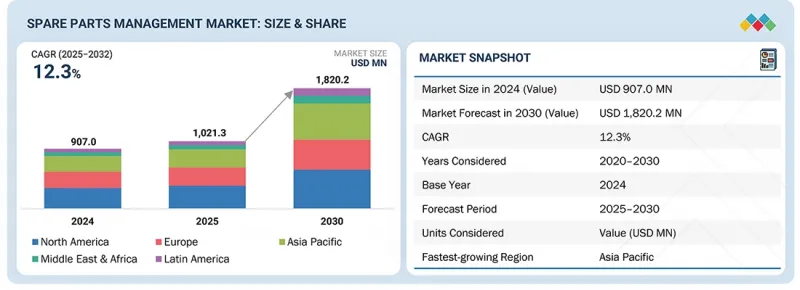
예비 부품 관리 시장 규모는 2025년 추정 10억 2,130만 달러에서 2030년까지 18억 2,020만 달러에 이를 전망이며, CAGR 12.3%로 확대될 것으로 예측됩니다.
| 조사 범위 | |
|---|---|
| 조사 대상 기간 | 2020-2030년 |
| 기준 연도 | 2024년 |
| 예측 기간 | 2025-2030년 |
| 대상 단위 | 100만 달러 |
| 부문 | 제공 제품별, 유형별, 전개 모드별, 조직 규모별, 산업별, 지역별 |
| 대상 지역 | 북미, 유럽, 아시아태평양, 중동 및 아프리카, 라틴아메리카 |
시장은 꾸준히 확대되고 있습니다. 그 배경에는 예기치 않은 다운타임으로 인한 자산 가동 시간 비용 증가, 정밀한 서비스 계획 수요 증가 및 제조업체의 애프터마켓이 수익원으로 중요성을 높이고 있습니다. 설비 고장으로 인한 재무 위험 증가에 직면한 조직은 분산된 사업 거점 전체에서 부품의 가용성을 높이고 보충을 가속화하며 서비스 중단을 최소화하는 지능형 계획 플랫폼을 도입하고 있습니다.
AI 구동형 수요 예측은 자산의 건전성 신호, 사용량의 변동성, 수리 이력을 해석하고 필링 레이트의 정확도를 높여 재고 정확도 및 서비스 레벨 성능을 향상시킵니다. 애프터마켓이 이익 성장에 있어서 맡은 역할의 확대에 따라, 계획, 가격 설정, 보증, 수리 및 반품 워크플로우를 통합하는 기능에 대한 수요도 높아지고 있습니다. 그러나 OEM과 서비스 에코시스템 간의 데이터 액세스를 제한하는 독점적인 잠금 및 예측의 신뢰성과 재고 조정을 저하시키는 부정확하고 일관성이 없는 부품 데이터가 시장 확대의 발판이 되고 있습니다. 취약한 분류 체계 및 비표준화된 분류 프레임워크는 상호 운용성을 제한하고 세계 네트워크 전체의 조화를 늦추어 업무 효율성을 더욱 저해하고 있습니다. 이러한 제약이 있음에도 불구하고, 데이터 품질, 고급 분석, 서비스 공급망 통합에 대한 투자는 가동 시간 향상과 애프터마켓 수익성 향상에 있어 현대적인 예비 부품 관리 시스템이 수행하는 중요한 역할을 계속 강조하고 있습니다.
독립형 예비 부품 관리(SPM) 소프트웨어는 예비 부품 운영에 특화된 제어 기능을 제공하여 모놀리식 엔터프라이즈 제품군에 비해 기업에 높은 유연성 및 신속성을 제공합니다. 이러한 플랫폼은 AI 기반 수요 모델링, 디지털 트윈 통합 및 고급 리필 로직을 활용하여 조직이 여러 계층의 예비 부품 재고를 독립적으로 관리할 수 있도록 합니다. 2024년 5월 Baxter Planning은 자체 독립형 플랫폼인 BaxterPredict를 강화하여 자동화된 서비스 부품 계획 기능과 통합된 지속가능성 지표를 추가했습니다. 이를 통해 고객 기업은 부품 초과 재고를 최대 25% 줄이고 계획 정확도를 20% 향상시킬 수 있습니다. 2024년 10월, Facilio는 시설 유지 보수와 예비 부품의 시각화를 통합하는 독립형 '연결 유지 보수 허브'를 발표했습니다. 이를 통해 기업은 실시간 부품 이용 분석 및 자동 교환 일정 관리를 실현합니다. 이러한 진전은 현대 서비스 생태계를 위해 설계된 독립형 솔루션의 성숙도와 보급이 진행되고 있음을 보여줍니다. 독립형 SPM 솔루션은 복잡한 기업 IT 인프라와의 독립성을 요구하는 조직에 전략적 이점을 제공합니다. 예측 인텔리전스, 모듈식 확장성 및 모바일 접근성을 통합함으로써 이러한 플랫폼은 신속한 전개와 가동 시간 및 비용 효율성에 대한 측정 가능한 영향을 제공합니다. API를 통한 상호 운용성과 내장 분석 기능을 갖춘 구성 가능한 클라우드 네이티브 시스템을 설계하는 공급업체는 디지털 예비 부품 운영의 다음 단계를 형성하여 고객이 민첩성, 정확성 및 제어성을 갖춘 운영을 가능하게 합니다.
대기업은 복잡한 세계 공급망, 여러 기지에서의 유지보수 업무, 고가치 자산 기반에 의해 지원되며, 예비 부품 관리(SPM) 시장에서 가장 성숙한 부문을 형성하고 있습니다. 이러한 조직은 조달, 물류 및 서비스 업무를 통합된 디지털 관리하에 동기화하는 깊고 통합된 엔터프라이즈급 SPM 플랫폼에 의존합니다. 2024년 10월, Limble CMMS는 SAP S/4HANA와의 통합을 발표하여 SAP의 기업 생태계 내에서 예비 부품 재고, 공급업체 데이터 및 구매 주문서의 실시간 동기화를 실현했습니다. 이 진전은 대규모 조직이 지속적인 부품 공급 및 운영 효율성을 보장하기 위해 시스템 간의 상호 운용성 및 데이터 일관성을 우선시하고 있음을 보여줍니다. 대기업의 경우 SPM 플랫폼은 지리적으로 분산된 네트워크 전체에서 가동 시간, 운전 자금 최적화, 서비스 신뢰성을 실현하는 전략적 기반이 됩니다. 고급 통합 기능, AI를 활용한 예측, 통일된 분석 대시보드를 통해 의사 결정자는 유지보수 전략을 세계 재고 정보와 일치시킬 수 있습니다. 이 분야에 주력하는 벤더는 확장 가능한 아키텍처, 다중 지역 대응, 컴플라이언스 대응 보고서 기능을 중시하고, 조달, 창고 관리 및 서비스 제공 기능 간의 원활한 연계를 확보해야 합니다. 디지털 전환이 자산 관리를 변화시키는 동안 대기업은 예측 인텔리전스 및 기업 수준의 프로세스 오케스트레이션을 결합한 SPM 플랫폼의 도입을 추진하고 지속가능한 성능 성과를 달성할 것입니다.
북미는 AI 탑재 계획 플랫폼의 적극적인 도입, 성숙한 애프터마켓 서비스 에코시스템, 자산 집약형 산업의 가동 시간 중시 재고 최적화에 대한 고수준 투자로 시장을 선도할 것으로 예측 한편 아시아태평양은 급속한 산업 디지털화, 확대하는 제조 거점, 고급 데이터 구동형 부품 라이프사이클 관리를 필요로 하는 서비스 주도형 수익 모델에 대한 의존도 증가를 배경으로 가장 급속한 성장이 예상되는 지역입니다.
북미의 예비 부품 관리(SPM) 시장은 강력한 디지털 인프라, 탄력적 인 물류 네트워크, 지역 조달 및 공급망 통합을 촉진하는 진화하는 무역 프레임워크로 형성됩니다. GSMA(2025년)에 의하면, 이 지역의 모바일 접속의 약 60%가 5G가 되어, 약 3억 2,000만 명이 모바일 인터넷을 이용하고 있어 IoT 기반의 감시, 예지 보전, 접속된 필드 서비스 업무에 이상적인 환경이 갖추어지고 있습니다. 이 광범위한 연결성을 통해 기술자와 OEM은 광범위한 서비스 네트워크 전반에 걸쳐 실시간 진단, 전자 부품 카탈로그 및 자산 원격 측정에 액세스할 수 있습니다. 한편, 북미의 GEP 변동성 지수는 2025년 6월 현재 -0.24로 개선되어 공급망 활동의 점진적인 회복을 시사하고 있습니다. 그러나 제조업체는 무역 및 관세 조정과 관련된 납기 지연에 계속 직면하고 있으며 SPM 시스템의 안전 재고 최적화 및 자동화된 리드 타임 관리가 필요합니다. 물류 및 운송 지표는 이 지역이 데이터 구동형 부품 관리에 대한 준비를 하고 있음을 더욱 돋보이게 합니다. 북미 전역의 철도화물량은 2025년 초래 2.4% 증가(미국 철도협회)로 내륙부에서 부품의 재배치 및 창고 간의 접속성이 향상되었습니다. 세계은행의 CPPI 2024에 따르면 항만 운영은 대체로 안정화되어 수입 리드타임의 변동성을 줄여줍니다. 한편 USMCA(미국, 멕시코 및 캐나다 협정)의 자동차 부품의 75% 지역 조달 규칙(Trade.gov) 등의 무역 정책은 제조업체에게 조달지 현지화 및 지역 재고 풀의 강화를 촉구하고 있습니다. 이러한 고접속성, 니어 쇼어링, 공급망 근대화 등의 동향이 함께 북미의 예측형으로 디지털 연계된 예비 부품 관리로의 이행이 가속화되고 있습니다.
본 보고서에서는 세계의 예비 부품 관리(SPM) 시장에 대해 조사했으며, 제공 제품별, 유형별, 전개 모드별, 조직 규모별, 산업별, 지역별 동향 및 시장 진출기업 프로파일 등을 정리했습니다.
자주 묻는 질문
목차
제1장 서론
제2장 조사 방법
제3장 주요 요약
제4장 중요 인사이트
제5장 시장 개요
- 서문
- 시장 역학
- 언멧 요구 및 공백
- 상호접속된 시장 및 분야 간 기회
- 새로운 비즈니스 모델 및 생태계의 변화
- Tier 1/2/3 기업의 전략적 움직임
제6장 업계 동향
- Porter's Five Forces 분석
- 거시경제지표
- 공급망 분석
- 생태계 분석
- 가격 분석
- 주된 회의 및 이벤트(2025-2026년)
- 고객 사업에 영향을 주는 동향 및 혼란
- 투자 및 자금조달 시나리오
- 사례 연구 분석
- 미국 관세의 영향 : 예비 부품 관리 시장 : 2025년)
제7장 기술의 진보, AI별 영향, 특허, 혁신 및 미래의 용도
- 기술 분석
- 기술 및 제품 로드맵
- 특허 분석
- 미래의 용도
- AI 및 생성형 AI가 예비 부품 관리 시장에 미치는 영향
제8장 규제 상황
- 규제 상황
- 규제기관, 정부기관, 기타 조직
- 지역별 업계 표준
제9장 고객 정세 및 구매 행동
- 의사결정 프로세스
- 구매자의 이해관계자 및 구매 평가기준
- 채용 장벽 및 내부 과제
- 다양한 최종 사용자 산업에서의 미충족 요구
- 시장 수익성
제10장 예비 부품 관리 시장 : 제공 제품별
- 서문
- 솔루션
- 전문 서비스
제11장 예비 부품 관리 시장 : 유형별
- 서문
- 독립형 SPM 소프트웨어
- 통합형 SPM 소프트웨어
제12장 예비 부품 관리 시장 : 전개 모드별
- 서문
- 온프레미스
- 클라우드
제13장 예비 부품 관리 시장 : 조직 규모별
- 서문
- 대기업
- 중소기업
제14장 예비 부품 관리 시장 : 산업별
- 서문
- 제조
- 운송 및 물류
- 건설 및 부동산
- 헬스케어 및 생명과학
- 에너지 및 유틸리티
- IT 및 통신
- 석유 및 가스
- 기타
제15장 예비 부품 관리 시장 : 지역별
- 서문
- 북미
- 미국
- 캐나다
- 유럽
- 영국
- 독일
- 프랑스
- 이탈리아
- 기타
- 아시아태평양
- 중국
- 인도
- 일본
- 기타
- 중동 및 아프리카
- GCC 국가
- 남아프리카
- 기타
- 라틴아메리카
- 브라질
- 멕시코
- 기타
제16장 경쟁 구도
- 개요
- 주요 진입 기업의 전략 및 강점
- 수익 분석
- 시장 점유율 분석
- 제품 비교
- 기업 평가 매트릭스 : 주요 진입기업(2024년)
- 기업 평가 매트릭스 : 스타트업 및 중소기업(2024년)
- 기업 평가 및 재무지표
- 경쟁 시나리오
제17장 기업 프로파일
- 서문
- 주요 진출기업
- SYNCRON
- IFS
- BAXTER PLANNING
- PTC
- FIIX
- SAP
- IBM
- ORACLE
- TAVANT
- DASSAULT SYSTEMES
- 기타 기업
- CRYOTOS
- EMAINT
- ERPAG
- MEGAVENTORY
- UPKEEP
- INFRAON
- VALUEAPEX
- MPULSE SOFTWARE
- ANTMYERP
- LIMBLE CMMS
- VERUSEN
- MASTEK
- RASEED
- PARTSCLOUD
- SPARETECH
- PARTFUL
- FACILIO
- TOOLSGROUP
제18장 부록
AJY 25.12.17The spare parts management market is projected to expand at a CAGR of 12.3%, reaching USD 1,820.2 million by 2030 from an estimated USD 1,021.3 million in 2025.
| Scope of the Report | |
|---|---|
| Years Considered for the Study | 2020-2030 |
| Base Year | 2024 |
| Forecast Period | 2025-2030 |
| Units Considered | USD Million |
| Segments | Offering, Type, Deployment Mode, Organization Size, Vertical |
| Regions covered | North America, Europe, Asia Pacific, Middle East & Africa, Latin America |
The market is expanding steadily, driven by escalating unplanned downtime asset-hour costs, rising demands for precise service planning, and the growing dependence on the aftermarket as a profit center for manufacturers. As organizations face increasing financial exposure due to equipment failures, they are adopting intelligent planning platforms that enhance parts availability, expedite replenishment, and minimize service interruptions across their distributed operations.
AI-driven demand forecasting enhances fill-rate precision by interpreting asset health signals, usage variability, and repair histories, which improves stocking accuracy and service-level performance. The aftermarket's expanding role in margin growth is also increasing demand for unified capabilities that connect planning, pricing, warranty, and repair-return workflows. The market's expansion is restrained by proprietary lock-ins that limit data access across OEM and service ecosystems, as well as by inaccurate and inconsistent parts data that reduces forecasting reliability and inventory alignment. Weak taxonomy structures and non-standardized classification frameworks further hinder operational efficiency by restricting interoperability and slowing down harmonization across global networks. Despite these restraints, investment in data quality, advanced analytics, and service supply chain integration continues to underscore the critical role of modern spare parts management systems in enhancing uptime and bolstering aftermarket profitability.
"By type, the standalone SPM software segment is projected to witness a higher growth rate than the integrated SPM software segment during the forecast period"
Standalone spare parts management (SPM) software delivers purpose-built, domain-focused control over spare parts operations, giving enterprises greater flexibility and speed compared to monolithic enterprise suites. These platforms utilize AI-driven demand modeling, digital twin integration, and advanced replenishment logic to enable organizations to manage multi-tier spare parts inventories independently. In May 2024, Baxter Planning enhanced its BaxterPredict standalone platform with automated service parts planning and integrated sustainability metrics, enabling clients to cut parts excess by up to 25% and improve planning accuracy by 20%. In October 2024, Facilio launched a standalone Connected Maintenance Hub designed to unify facility maintenance and spare parts visibility, providing enterprises with real-time part utilization analytics and automated replacement scheduling. These developments highlight the growing maturity and adoption of standalone solutions purpose-engineered for modern service ecosystems. Standalone SPM solutions present a strategic advantage for organizations seeking independence from complex enterprise IT infrastructures. By integrating predictive intelligence, modular scalability, and mobile accessibility, these platforms allow faster deployment and measurable impact on uptime and cost efficiency. Vendors that design configurable, cloud-native systems with interoperability via APIs and embedded analytics will shape the next phase of digital spare parts operations, enabling customers to operate with agility, precision, and control.
"By organization size, the large enterprises segment is estimated to lead the market during the forecast period"
Large enterprises represent the most mature segment of the spare parts management (SPM) market, driven by complex global supply chains, multi-site maintenance operations, and high-value asset bases. These organizations rely on deeply integrated, enterprise-grade SPM platforms that synchronize procurement, logistics, and service operations under unified digital control. In October 2024, Limble CMMS announced its integration with SAP S/4HANA, allowing real-time synchronization of spare parts inventory, vendor data, and purchase orders within SAP's enterprise ecosystem. This advancement demonstrates how large organizations are prioritizing interoperability and data cohesion across systems to ensure continuous parts availability and operational efficiency. For large enterprises, SPM platforms serve as strategic enablers of uptime, working capital optimization, and service reliability across geographically dispersed networks. Advanced integrations, AI-enabled forecasting, and unified analytics dashboards allow decision-makers to align maintenance strategies with global inventory intelligence. Vendors focusing on this segment should emphasize scalable architectures, multi-region support, and compliance-ready reporting, ensuring seamless coordination across procurement, warehousing, and service delivery functions. As digital transformation reshapes asset management, large enterprises will continue to drive adoption of SPM platforms that combine predictive intelligence with enterprise-level process orchestration to achieve sustainable performance outcomes.
"North America is estimated to lead the market due to its strong adoption of AI-enabled planning platforms, mature aftermarket service ecosystems, and high investment in uptime-focused inventory optimization across asset-intensive industries, while Asia Pacific is projected to be the fastest-growing region, driven by rapid industrial digitalization, expanding manufacturing bases, and increasing reliance on service-led revenue models that require advanced, data-driven parts lifecycle management"
The spare parts management (SPM) market in North America is being shaped by strong digital infrastructure, resilient logistics networks, and evolving trade frameworks that promote regional sourcing and supply chain integration. According to GSMA (2025), around 60% of mobile connections in the region are now 5G, while nearly 320 million people use mobile internet, creating an environment ideal for IoT-based monitoring, predictive maintenance, and connected field service operations. This widespread connectivity allows technicians and OEMs to access real-time diagnostics, e-parts catalogs, and asset telemetry across large service networks. At the same time, the GEP Volatility Index for North America improved to -0.24 (June 2025), signaling a gradual recovery in supply chain activity. However, manufacturers continue to face delivery delays tied to trade and tariff adjustments, prompting the need for safety-stock optimization and automated lead-time management in SPM systems. Logistics and transport indicators further highlight the region's readiness for data-driven parts management. Rail volumes across North America grew 2.4% year-to-date through 2025 (Association of American Railroads), improving inland parts repositioning and warehouse connectivity. Port operations have largely stabilized, according to the World Bank's CPPI 2024, which has reduced variability in inbound lead times. Meanwhile, trade policies such as the USMCA's 75% regional content rule for vehicles and parts (Trade.gov) are pushing manufacturers to localize sourcing and strengthen regional inventory pools. Together, these dynamics, including high connectivity, nearshoring, and supply-chain modernization, are reinforcing North America's shift toward predictive, digitally coordinated spare parts management.
Breakdown of Primaries
In-depth interviews were conducted with Chief Executive Officers (CEOs), innovation and technology directors, system integrators, and executives from various key organizations operating in the spare parts management market.
- By Company: Tier I - 30%, Tier II - 40%, and Tier III - 30%
- By Designation: C-Level Executives - 50%, D-Level Executives -35%, and others - 15%
- By Region: North America - 50%, Europe - 30%, Asia Pacific - 15%, and Rest of the World - 5%
The report includes a study of key players offering spare parts management products. It profiles major market players, which include PTC (US), Syncron (Sweden), Fiix (Canada), Dassault Systemes (France), IBM (US), Oracle (US), Baxter Planning (US), IFS (Sweden), Tavant (US), Cryotos (India), eMaint (US), Erpag (US), Megaventory (US), Upkeep (US), Infraon (US), ValueApex (China), MPulse Software (US), AntMyErp (India), Limble CMMS (US), Fleataable (Canada), Verusen (Georgia), Mastek (India), Raseed (India), PartsCloud (Germany), Spartech (Germany), Partful (England), Facilio (US), and ToolsGroup (US).
Research Coverage
This research report categorizes the spare parts management market based on offering (solutions [planning & forecasting, procurement & order management, inventory management, spare parts tracking & automation, reporting & analytics, others] and professional services [training & consultation, integration & implementation, support & maintenance]), type (standalone SPM software, integration SPM software), deployment mode (on-premises, cloud), organization size (large enterprises, SMEs), vertical (manufacturing, transportation & logistics, construction & real estate, healthcare & life sciences, energy & utilities, IT & telecom, oil & gas, other verticals [BFSI, retail & consumer goods]), and Region (North America, Europe, Asia Pacific, Middle East & Africa, and Latin America). The report's scope covers detailed information regarding the major factors, such as drivers, restraints, challenges, and opportunities, influencing the growth of the spare parts management market. A detailed analysis of key industry players was conducted to provide insights into their business overview, solutions, and services, as well as key strategies, contracts, partnerships, agreements, new product & service launches, mergers and acquisitions, and recent developments associated with the spare parts management market. This report also covers the competitive analysis of upcoming startups in the spare parts management market ecosystem.
Reason to Buy this Report
The report would provide market leaders and new entrants with information on the closest approximations of the revenue numbers for the overall spare parts management market and its subsegments. It would help stakeholders understand the competitive landscape and gain more insights to better position their businesses and plan suitable go-to-market strategies. It also helps stakeholders understand the market's pulse and provides them with information on key market drivers, restraints, challenges, and opportunities.
The report provides insights on the following pointers:
- Analysis of key drivers (Escalating unplanned downtime asset-hour costs, improvement in fill-rate precision with AI demand forecasting, growing dependence on aftermarket as a profit center), restraints (Proprietary lock-ins and restricted data access, inaccurate and inconsistent spare parts data, weak parts taxonomy and inconsistent classification standards), opportunities (Real-time IoT telemetry for inventory visibility, shift toward servitization and uptime-based contracts, expanding maintenance intensity across asset-heavy industries), and challenges (Managing long-tail, low-turn spare parts complexity, supplier lead-time volatility impacting fill rates).
- Product Development/Innovation: Detailed insights on upcoming technologies, research & development activities, and new product & service launches in the spare parts management market.
- Market Development: Comprehensive information about lucrative markets - the report analyses the spare parts management market across varied regions.
- Market Diversification: Exhaustive information about new products & services, untapped geographies, recent developments, and investments in the spare parts management market.
- Competitive Assessment: In-depth assessment of market shares, growth strategies, and service offerings of leading players such as PTC (US), Syncron (Sweden), Fiix (Canada), Dassault Systemes (France), IBM (US), Oracle (US), Baxter Planning (US), IFS (Sweden), Tavant (US), Cryotos (India), eMaint (US), Erpag (US), Megaventory (US), Upkeep (US), Infraon (US), ValueApex (China), MPulse Software (US), AntMyErp (India), Limble CMMS (US), Fleataable (Canada), Verusen (Georgia), Mastek (India), Raseed (India), PartsCloud (Germany), Spartech (Germany), Partful (England), Facilio (US), and ToolsGroup (US). The report also helps stakeholders understand the spare parts management market's pulse and provides information on key market drivers, restraints, challenges, and opportunities.
TABLE OF CONTENTS
1 INTRODUCTION
- 1.1 STUDY OBJECTIVES
- 1.2 MARKET DEFINITION
- 1.3 STUDY SCOPE AND SEGMENTATION
- 1.3.1 MARKETS COVERED AND REGIONAL SCOPE
- 1.3.2 INCLUSIONS AND EXCLUSIONS
- 1.3.3 YEARS CONSIDERED
- 1.3.4 CURRENCY CONSIDERED
- 1.3.5 STAKEHOLDERS
2 RESEARCH METHODOLOGY
- 2.1 RESEARCH DATA
- 2.1.1 SECONDARY DATA
- 2.1.1.1 Key data from secondary sources
- 2.1.2 PRIMARY DATA
- 2.1.2.1 Key data from primary sources
- 2.1.2.2 Breakdown of primary interviews
- 2.1.2.3 Key industry insights
- 2.1.1 SECONDARY DATA
- 2.2 MARKET SIZE ESTIMATION
- 2.3 DATA TRIANGULATION
- 2.4 FACTOR ANALYSIS
- 2.5 RESEARCH ASSUMPTIONS
- 2.6 RESEARCH LIMITATIONS AND RISK ASSESSMENT
3 EXECUTIVE SUMMARY
- 3.1 KEY INSIGHTS AND MARKET HIGHLIGHTS
- 3.2 KEY MARKET PARTICIPANTS: INSIGHTS AND STRATEGIC DEVELOPMENTS
- 3.3 DISRUPTIVE TRENDS SHAPING MARKET
- 3.4 HIGH-GROWTH SEGMENTS AND EMERGING FRONTIERS
- 3.5 SNAPSHOT: GLOBAL MARKET SIZE, GROWTH RATE, AND FORECAST
4 PREMIUM INSIGHTS
- 4.1 ATTRACTIVE OPPORTUNITIES FOR PLAYERS IN SPARE PARTS MANAGEMENT MARKET
- 4.2 SPARE PARTS MANAGEMENT MARKET, BY OFFERING
- 4.3 SPARE PARTS MANAGEMENT MARKET, BY TYPE
- 4.4 SPARE PARTS MANAGEMENT MARKET, BY VERTICAL
- 4.5 SPARE PARTS MANAGEMENT MARKET, BY REGION
5 MARKET OVERVIEW
- 5.1 INTRODUCTION
- 5.2 MARKET DYNAMICS
- 5.2.1 DRIVERS
- 5.2.1.1 Escalating unplanned downtime asset-hour costs
- 5.2.1.2 Improvement in fill-rate precision with AI demand forecasting
- 5.2.1.3 Growing dependence on aftermarket as profit center
- 5.2.2 RESTRAINTS
- 5.2.2.1 Proprietary lock-ins and restricted data access
- 5.2.2.2 Inaccurate and inconsistent spare parts data
- 5.2.2.3 Weak parts taxonomy and inconsistent classification standards
- 5.2.3 OPPORTUNITIES
- 5.2.3.1 Real-time IoT telemetry for inventory visibility
- 5.2.3.2 Shift toward servitization and uptime-based contracts
- 5.2.3.3 Expanding maintenance intensity across asset-heavy industries
- 5.2.4 CHALLENGES
- 5.2.4.1 Managing long-tail, low-turn spare parts complexity
- 5.2.4.2 Supplier lead-time volatility impacting fill rates
- 5.2.1 DRIVERS
- 5.3 UNMET NEEDS AND WHITE SPACES
- 5.3.1 UNMET NEEDS IN SPARE PARTS MANAGEMENT MARKET
- 5.3.2 WHITE SPACE OPPORTUNITIES
- 5.4 INTERCONNECTED MARKETS AND CROSS-SECTOR OPPORTUNITIES
- 5.4.1 INTERCONNECTED MARKETS
- 5.4.2 CROSS-SECTOR OPPORTUNITIES
- 5.5 EMERGING BUSINESS MODELS AND ECOSYSTEM SHIFTS
- 5.5.1 EMERGING BUSINESS MODELS
- 5.5.1.1 Spare parts management business models
- 5.5.2 ECOSYSTEM SHIFTS
- 5.5.1 EMERGING BUSINESS MODELS
- 5.6 STRATEGIC MOVES BY TIER-1/2/3 PLAYERS
- 5.6.1 KEY MOVES AND STRATEGIC FOCUS
6 INDUSTRY TRENDS
- 6.1 PORTER'S FIVE FORCES ANALYSIS
- 6.1.1 THREAT OF NEW ENTRANTS
- 6.1.2 THREAT OF SUBSTITUTES
- 6.1.3 BARGAINING POWER OF SUPPLIERS
- 6.1.4 BARGAINING POWER OF BUYERS
- 6.1.5 INTENSITY OF COMPETITIVE RIVALRY
- 6.2 MACROECONOMIC INDICATORS
- 6.2.1 INTRODUCTION
- 6.2.2 GDP TRENDS & FORECASTS
- 6.2.3 TRENDS IN GLOBAL ICT INDUSTRY
- 6.3 SUPPLY CHAIN ANALYSIS
- 6.3.1 TECHNOLOGY ENABLERS & PLATFORM PROVIDERS
- 6.3.2 SOLUTION INTEGRATORS & SERVICE PARTNERS
- 6.3.3 CHANNEL PARTNERS & MANAGED SERVICE PROVIDERS
- 6.3.4 VERTICALS
- 6.4 ECOSYSTEM ANALYSIS
- 6.5 PRICING ANALYSIS
- 6.5.1 AVERAGE SELLING PRICE OF SPARE PARTS MANAGEMENT, BY REGION, 2024-2025
- 6.5.1.1 Average selling price of spare parts management, by offering, 2024-2025
- 6.5.1 AVERAGE SELLING PRICE OF SPARE PARTS MANAGEMENT, BY REGION, 2024-2025
- 6.6 KEY CONFERENCES AND EVENTS, 2025-2026
- 6.7 TRENDS/DISRUPTIONS IMPACTING CUSTOMER BUSINESS
- 6.8 INVESTMENT AND FUNDING SCENARIO
- 6.9 CASE STUDY ANALYSIS
- 6.9.1 EMBRAER SUCCESSFULLY OPTIMIZES SPARE PARTS PLANNING WITH SERVIGISTICS AND SAVES MORE THAN USD 50 MILLION
- 6.9.2 SYNCRON ENABLES AL MASAOOD AUTOMOBILES TO ENHANCE INVENTORY EFFICIENCY AND SERVICE PERFORMANCE
- 6.9.3 EMAINT STREAMLINES SPARE PARTS MANAGEMENT FOR CERAPEDICS THROUGH CMMS INTEGRATION
- 6.9.4 TOOLSGROUP ENABLES LENNOX TO OPTIMIZE SERVICE PARTS PLANNING AND REDUCE STOCKOUTS
- 6.9.5 TRIANGLE TUBE ENHANCES AFTER-SALES EXPERIENCE THROUGH 3D DIGITAL TRANSFORMATION WITH PARTFUL
- 6.10 IMPACT OF 2025 US TARIFF - SPARE PARTS MANAGEMENT MARKET
- 6.10.1 INTRODUCTION
- 6.10.2 KEY TARIFF RATES
- 6.10.3 PRICE IMPACT ANALYSIS
- 6.10.4 IMPACT ON COUNTRY/REGION
- 6.10.4.1 US
- 6.10.4.2 Europe
- 6.10.4.3 Asia Pacific
- 6.10.5 IMPACT ON VERTICALS
- 6.10.5.1 Manufacturing
- 6.10.5.2 Transportation & logistics
- 6.10.5.3 Construction & real estate
- 6.10.5.4 Healthcare & life sciences
- 6.10.5.5 Energy & utilities
- 6.10.5.6 IT & telecom
- 6.10.5.7 Oil & gas
7 TECHNOLOGICAL ADVANCEMENTS, AI-DRIVEN IMPACT, PATENTS, INNOVATIONS, AND FUTURE APPLICATIONS
- 7.1 TECHNOLOGY ANALYSIS
- 7.1.1 KEY EMERGING TECHNOLOGIES
- 7.1.1.1 Predictive analytics and AI-driven demand forecasting
- 7.1.1.2 Digital twin and asset lifecycle intelligence
- 7.1.1.3 Cloud-native spare parts management platforms
- 7.1.2 COMPLEMENTARY TECHNOLOGIES
- 7.1.2.1 IoT-enabled asset tracking and condition monitoring
- 7.1.2.2 Computer vision and 3D recognition for parts identification
- 7.1.2.3 Blockchain-based parts traceability and warranty management
- 7.1.3 ADJACENT TECHNOLOGIES
- 7.1.3.1 Augmented reality (AR) for service and training applications
- 7.1.3.2 Low-code / no-code workflow automation platforms
- 7.1.3.3 Knowledge graphs and semantic search
- 7.1.1 KEY EMERGING TECHNOLOGIES
- 7.2 TECHNOLOGY/PRODUCT ROADMAP
- 7.2.1 SHORT-TERM (2025-2027) | CLOUD CONSOLIDATION & DATA UNIFICATION
- 7.2.2 MID-TERM (2027-2030) | PREDICTIVE INTELLIGENCE & SERVICE AUTOMATION
- 7.2.3 LONG-TERM (2030-2035+) | AUTONOMOUS, CONNECTED & CIRCULAR SERVICE PLATFORMS
- 7.3 PATENT ANALYSIS
- 7.4 FUTURE APPLICATIONS
- 7.4.1 AI-DRIVEN PREDICTIVE PARTS ORCHESTRATION (DIGITAL-TWIN INTEGRATED)
- 7.4.2 AUTONOMOUS SMART CONTRACTS FOR PARTS (BLOCKCHAIN / PART-PASSPORT)
- 7.4.3 ON-DEMAND DIGITAL INVENTORY WITH ADDITIVE MANUFACTURING INTEGRATION
- 7.4.4 COGNITIVE FIELD SERVICE AND AR-GUIDED PARTS FULFILMENT
- 7.4.5 CIRCULAR AND SUSTAINABILITY-LINKED PARTS LIFECYCLE MANAGEMENT
- 7.5 IMPACT OF AI/GENERATIVE AI ON SPARE PARTS MANAGEMENT MARKET
- 7.5.1 TOP USE CASES AND MARKET POTENTIAL
- 7.5.2 BEST PRACTICES IN SPARE PARTS MANAGEMENT
- 7.5.3 CASE STUDY OF AI IMPLEMENTATION IN SPARE PARTS MANAGEMENT MARKET
- 7.5.3.1 DMG MORI and Syncron drive AI-enabled efficiency and forecast accuracy in global spare parts management
- 7.5.4 INTERCONNECTED ADJACENCY ECOSYSTEM AND IMPACT ON MARKET PLAYERS
- 7.5.5 CLIENT READINESS TO ADOPT GENERATIVE AI IN SPARE PARTS MANAGEMENT MARKET
- 7.5.6 PARTSCLOUD: PARTSOS PLANNING
- 7.5.7 FIIX: PARTS & INVENTORY MANAGEMENT SOFTWARE
8 REGULATORY LANDSCAPE
- 8.1 REGULATORY LANDSCAPE
- 8.1.1 REGULATORY BODIES, GOVERNMENT AGENCIES, AND OTHER ORGANIZATIONS
- 8.1.2 INDUSTRY STANDARDS, BY REGION
- 8.1.2.1 North America
- 8.1.2.2 Europe
- 8.1.2.3 Asia Pacific
- 8.1.2.4 Middle East & South Africa
- 8.1.2.5 Latin America
9 CUSTOMER LANDSCAPE AND BUYER BEHAVIOR
- 9.1 DECISION-MAKING PROCESS
- 9.2 BUYER STAKEHOLDERS AND BUYING EVALUATION CRITERIA
- 9.2.1 KEY STAKEHOLDERS IN BUYING PROCESS
- 9.2.2 BUYING CRITERIA
- 9.3 ADOPTION BARRIERS AND INTERNAL CHALLENGES
- 9.4 UNMET NEEDS IN VARIOUS END-USER INDUSTRIES
- 9.5 MARKET PROFITABILITY
- 9.5.1 REVENUE POTENTIAL
- 9.5.2 COST DYNAMICS
- 9.5.3 MARGIN OPPORTUNITIES IN KEY APPLICATIONS
10 SPARE PARTS MANAGEMENT MARKET, BY OFFERING
- 10.1 INTRODUCTION
- 10.1.1 OFFERING: SPARE PARTS MANAGEMENT MARKET DRIVERS
- 10.2 SOLUTIONS
- 10.2.1 PLANNING & FORECASTING
- 10.2.1.1 Driving predictive spare parts readiness through AI-led planning and intelligent demand forecasting
- 10.2.2 PROCUREMENT & ORDER MANAGEMENT
- 10.2.2.1 Digitizing spare-parts procurement to enhance supplier visibility, accelerate orders, and reduce operational latency
- 10.2.3 INVENTORY MANAGEMENT
- 10.2.3.1 Transforming spare parts inventory into predictive, self-optimizing network that drives uptime and agility
- 10.2.4 SPARE PARTS TRACKING & AUTOMATION
- 10.2.4.1 Enabling autonomous spare part tracking and automation to drive precision, speed, and service continuity
- 10.2.5 REPORTING & ANALYTICS
- 10.2.5.1 Leveraging analytics-driven dashboards and reports to transform spare parts data into actionable intelligence
- 10.2.6 OTHERS
- 10.2.1 PLANNING & FORECASTING
- 10.3 PROFESSIONAL SERVICES
- 10.3.1 TRAINING & CONSULTATION
- 10.3.1.1 Enhancing workforce capability through analytics-driven training and consultative programs
- 10.3.2 INTEGRATION & IMPLEMENTATION
- 10.3.2.1 Enabling seamless digital deployment and process alignment through precise, domain-led integration and implementation expertise
- 10.3.3 SUPPORT & MAINTENANCE
- 10.3.3.1 Delivering intelligent, proactive support and maintenance services to ensure uptime, adaptability, and long-term system resilience
- 10.3.1 TRAINING & CONSULTATION
11 SPARE PARTS MANAGEMENT MARKET, BY TYPE
- 11.1 INTRODUCTION
- 11.1.1 TYPE: SPARE PARTS MANAGEMENT MARKET DRIVERS
- 11.2 STANDALONE SPM SOFTWARE
- 11.2.1 ACHIEVING PREDICTIVE ACCURACY, OPERATIONAL INDEPENDENCE, AND MEASURABLE EFFICIENCY GAINS IN SPARE PARTS MANAGEMENT
- 11.3 INTEGRATED SPM SOFTWARE
- 11.3.1 UNIFYING SPARE PARTS, MAINTENANCE, AND SUPPLY CHAIN SYSTEMS TO ACHIEVE CONTINUOUS VISIBILITY, PREDICTIVE CONTROL, AND OPERATIONAL RESILIENCE
12 SPARE PARTS MANAGEMENT MARKET, BY DEPLOYMENT MODE
- 12.1 INTRODUCTION
- 12.1.1 DEPLOYMENT MODE: SPARE PARTS MANAGEMENT MARKET DRIVERS
- 12.2 ON-PREMISES
- 12.2.1 PROVIDING DATA SOVEREIGNTY, LOW LATENCY, AND CERTIFIED LOCAL SUPPORT
- 12.3 CLOUD
- 12.3.1 UNIFYING GLOBAL SPARE PARTS OPERATIONS, ENHANCING PREDICTIVE INTELLIGENCE, AND ACHIEVING AGILE, DATA-DRIVEN SERVICE EXCELLENCE
13 SPARE PARTS MANAGEMENT MARKET, BY ORGANIZATION SIZE
- 13.1 INTRODUCTION
- 13.1.1 ORGANIZATION SIZE: SPARE PARTS MANAGEMENT MARKET DRIVERS
- 13.2 LARGE ENTERPRISES
- 13.2.1 UNIFYING PARTS INTELLIGENCE, AUTOMATION, AND CROSS-SITE COLLABORATION TO ENHANCE UPTIME AND EFFICIENCY
- 13.3 SMES
- 13.3.1 COMBINING AUTOMATION, TRACEABILITY, AND MOBILE USABILITY TO DRIVE OPERATIONAL DISCIPLINE AND UPTIME
14 SPARE PARTS MANAGEMENT MARKET, BY VERTICAL
- 14.1 INTRODUCTION
- 14.1.1 VERTICAL: SPARE PARTS MANAGEMENT MARKET DRIVERS
- 14.2 MANUFACTURING
- 14.2.1 DELIVERING MANUFACTURING-CENTRIC SPM SOLUTIONS TO MAXIMIZE UPTIME AND OPERATIONAL EFFICIENCY
- 14.3 TRANSPORTATION & LOGISTICS
- 14.3.1 DEPLOYING TRANSPORT-GRADE SPM TO MAXIMIZE FLEET UPTIME AND REDUCE REPAIR CYCLE TIME
- 14.4 CONSTRUCTION & REAL ESTATE
- 14.4.1 PROVIDING CONNECTED SPM SOLUTIONS FOR PROPERTY PORTFOLIOS TO PROTECT UPTIME AND PROJECT DELIVERY
- 14.5 HEALTHCARE & LIFE SCIENCES
- 14.5.1 DEVELOPING COMPLIANT, PREDICTIVE SPM PLATFORMS TO ENSURE CONTINUOUS EQUIPMENT READINESS AND UNCOMPROMISED PATIENT SAFETY
- 14.6 ENERGY & UTILITIES
- 14.6.1 DELIVERING ENERGY-SPECIFIC SPM SOLUTIONS TO ENHANCE GRID RELIABILITY AND OPERATIONAL RESILIENCE
- 14.7 IT & TELECOM
- 14.7.1 IMPLEMENTING CLOUD-ENABLED, FIELD-FIRST SPM TO MINIMIZE TRUCK ROLLS AND ACCELERATE REPAIRS
- 14.8 OIL & GAS
- 14.8.1 CREATING OIL AND GAS-OPTIMIZED SPM SOLUTIONS TO ENSURE RELIABILITY AND UNINTERRUPTED PRODUCTION
- 14.9 OTHER VERTICALS
15 SPARE PARTS MANAGEMENT MARKET, BY REGION
- 15.1 INTRODUCTION
- 15.2 NORTH AMERICA
- 15.2.1 US
- 15.2.1.1 Rising downtime costs and aftermarket scale to drive adoption of data-driven spare parts management
- 15.2.2 CANADA
- 15.2.2.1 High inventories, workforce gaps, and digital adoption to accelerate shift toward smarter spare parts management
- 15.2.1 US
- 15.3 EUROPE
- 15.3.1 UK
- 15.3.1.1 Rising supply delays, ageing vehicle fleet, and AI adoption to drive next phase of spare parts management growth
- 15.3.2 GERMANY
- 15.3.2.1 Rising service workloads, ageing vehicle fleet, and persistent supply delays to drive market
- 15.3.3 FRANCE
- 15.3.3.1 Persistent supply strain, rising costs, and expanding digital readiness to accelerate smart spare parts management adoption
- 15.3.4 ITALY
- 15.3.4.1 Digital maturity, automation, and aging assets to reshape spare parts management landscape
- 15.3.5 REST OF EUROPE
- 15.3.1 UK
- 15.4 ASIA PACIFIC
- 15.4.1 CHINA
- 15.4.1.1 Industrial digitalization, expanding asset base, and renewal policies to boost market
- 15.4.2 INDIA
- 15.4.2.1 Nationwide connectivity, expanding vehicle base, and policy modernization to fuel market
- 15.4.3 JAPAN
- 15.4.3.1 Inventory build-up, supply delays, and ageing assets to drive demand for data-driven spare parts management
- 15.4.4 REST OF ASIA PACIFIC
- 15.4.1 CHINA
- 15.5 MIDDLE EAST & AFRICA
- 15.5.1 GCC COUNTRIES
- 15.5.1.1 Saudi Arabia
- 15.5.1.1.1 Industrial growth, logistics modernization, and AI integration to drive market
- 15.5.1.2 UAE
- 15.5.1.2.1 Industrial localization, 5G integration, and fleet growth to propel market
- 15.5.1.3 Other GCC countries
- 15.5.1.1 Saudi Arabia
- 15.5.2 SOUTH AFRICA
- 15.5.2.1 Growing focus on reliability, digital maintenance tools, and fleet modernization to strengthen demand for spare parts management
- 15.5.3 REST OF MIDDLE EAST & AFRICA
- 15.5.1 GCC COUNTRIES
- 15.6 LATIN AMERICA
- 15.6.1 BRAZIL
- 15.6.1.1 Digital connectivity, industrial modernization, and aging assets to drive predictive spare parts management adoption
- 15.6.2 MEXICO
- 15.6.2.1 Digitalization, supply chain realignment, and fleet aging to propel demand for predictive spare parts management
- 15.6.3 REST OF LATIN AMERICA
- 15.6.1 BRAZIL
16 COMPETITIVE LANDSCAPE
- 16.1 OVERVIEW
- 16.2 KEY PLAYER STRATEGIES/RIGHT TO WIN
- 16.2.1 COMPETITIVE STRATEGIES
- 16.3 REVENUE ANALYSIS
- 16.4 MARKET SHARE ANALYSIS
- 16.5 PRODUCT COMPARISON
- 16.6 COMPANY EVALUATION MATRIX: KEY PLAYERS, 2024
- 16.6.1 STARS
- 16.6.2 EMERGING LEADERS
- 16.6.3 PERVASIVE PLAYERS
- 16.6.4 PARTICIPANTS
- 16.6.5 COMPANY FOOTPRINT: KEY PLAYERS, 2024
- 16.6.5.1 Company footprint
- 16.6.5.2 Region footprint
- 16.6.5.3 Offering footprint
- 16.6.5.4 Type footprint
- 16.6.5.5 Deployment mode footprint
- 16.6.5.6 Organization size footprint
- 16.7 COMPANY EVALUATION MATRIX: STARTUPS/SMES, 2024
- 16.7.1 PROGRESSIVE COMPANIES
- 16.7.2 RESPONSIVE COMPANIES
- 16.7.3 DYNAMIC COMPANIES
- 16.7.4 STARTING BLOCKS
- 16.7.5 COMPETITIVE BENCHMARKING: STARTUPS/SMES, 2024
- 16.7.5.1 Detailed list of key startups/SMEs
- 16.7.5.2 Competitive benchmarking of key startups/SMEs
- 16.8 COMPANY VALUATION AND FINANCIAL METRICS
- 16.9 COMPETITIVE SCENARIO
- 16.9.1 PRODUCT LAUNCHES AND ENHANCEMENTS
- 16.9.2 DEALS
- 16.9.3 EXPANSIONS
17 COMPANY PROFILES
- 17.1 INTRODUCTION
- 17.2 MAJOR PLAYERS
- 17.2.1 SYNCRON
- 17.2.1.1 Business overview
- 17.2.1.2 Products/Solutions/Services offered
- 17.2.1.3 Recent developments
- 17.2.1.3.1 Product launches and enhancements
- 17.2.1.3.2 Deals
- 17.2.1.4 MnM view
- 17.2.1.4.1 Right to win
- 17.2.1.4.2 Strategic choices
- 17.2.1.4.3 Weaknesses and competitive threats
- 17.2.2 IFS
- 17.2.2.1 Business overview
- 17.2.2.2 Products/Solutions/Services offered
- 17.2.2.3 Recent developments
- 17.2.2.3.1 Deals
- 17.2.2.4 MnM view
- 17.2.2.4.1 Right to win
- 17.2.2.4.2 Strategic choices
- 17.2.2.4.3 Weaknesses and competitive threats
- 17.2.3 BAXTER PLANNING
- 17.2.3.1 Business overview
- 17.2.3.2 Products/Solutions/Services offered
- 17.2.3.3 Recent developments
- 17.2.3.3.1 Product launches and enhancements
- 17.2.3.3.2 Deals
- 17.2.3.4 MnM view
- 17.2.3.4.1 Right to win
- 17.2.3.4.2 Strategic choices
- 17.2.3.4.3 Weaknesses and competitive threats
- 17.2.4 PTC
- 17.2.4.1 Business overview
- 17.2.4.2 Products/Solutions/Services offered
- 17.2.4.3 Recent developments
- 17.2.4.3.1 Product launches and enhancements
- 17.2.4.3.2 Deals
- 17.2.4.4 MnM view
- 17.2.4.4.1 Right to win
- 17.2.4.4.2 Strategic choices
- 17.2.4.4.3 Weaknesses and competitive threats
- 17.2.5 FIIX
- 17.2.5.1 Business overview
- 17.2.5.2 Products/Solutions/Services offered
- 17.2.5.3 Recent developments
- 17.2.5.3.1 Deals
- 17.2.5.4 MnM view
- 17.2.5.4.1 Right to win
- 17.2.5.4.2 Strategic choices
- 17.2.5.4.3 Weaknesses and competitive threats
- 17.2.6 SAP
- 17.2.6.1 Business overview
- 17.2.6.2 Products/Solutions/Services offered
- 17.2.6.3 Recent developments
- 17.2.6.3.1 Product launches and enhancements
- 17.2.6.3.2 Deals
- 17.2.7 IBM
- 17.2.7.1 Business overview
- 17.2.7.2 Products/Solutions/Services offered
- 17.2.7.3 Recent developments
- 17.2.7.3.1 Product launches and enhancements
- 17.2.8 ORACLE
- 17.2.8.1 Business overview
- 17.2.8.2 Products/Solutions/Services offered
- 17.2.8.3 Recent developments
- 17.2.8.3.1 Product launches and enhancements
- 17.2.8.3.2 Deals
- 17.2.9 TAVANT
- 17.2.9.1 Business overview
- 17.2.9.2 Products/Solutions/Services offered
- 17.2.9.3 Recent developments
- 17.2.9.3.1 Product launches and enhancements
- 17.2.9.3.2 Deals
- 17.2.9.3.3 Expansions
- 17.2.10 DASSAULT SYSTEMES
- 17.2.10.1 Business overview
- 17.2.10.2 Products/Solutions/Services offered
- 17.2.10.3 Recent developments
- 17.2.10.3.1 Deals
- 17.2.1 SYNCRON
- 17.3 OTHER PLAYERS
- 17.3.1 CRYOTOS
- 17.3.2 EMAINT
- 17.3.3 ERPAG
- 17.3.4 MEGAVENTORY
- 17.3.5 UPKEEP
- 17.3.6 INFRAON
- 17.3.7 VALUEAPEX
- 17.3.8 MPULSE SOFTWARE
- 17.3.9 ANTMYERP
- 17.3.10 LIMBLE CMMS
- 17.3.11 FLEETABLE 290 17.3.12 VERUSEN
- 17.3.13 MASTEK
- 17.3.14 RASEED
- 17.3.15 PARTSCLOUD
- 17.3.16 SPARETECH
- 17.3.17 PARTFUL
- 17.3.18 FACILIO
- 17.3.19 TOOLSGROUP
18 APPENDIX
- 18.1 DISCUSSION GUIDE
- 18.2 KNOWLEDGESTORE: MARKETSANDMARKETS' SUBSCRIPTION PORTAL
- 18.3 CUSTOMIZATION OPTIONS
- 18.4 RELATED REPORTS
- 18.5 AUTHOR DETAILS