|
시장보고서
상품코드
1996978
압전 고분자 시장 예측(-2030년) : 고분자 유형별, 재료 형상별, 용도별, 최종 용도 산업별, 지역별Piezoelectric Polymers Market by Polymer Type (PVDF, PVDF-TrFE), Material Form (Films & Sheets, Molded Components), Application (Sensors, Transducers), End-use Industry (Consumer Electronics, Automotive), and Region - Global Forecast to 2030 |
||||||

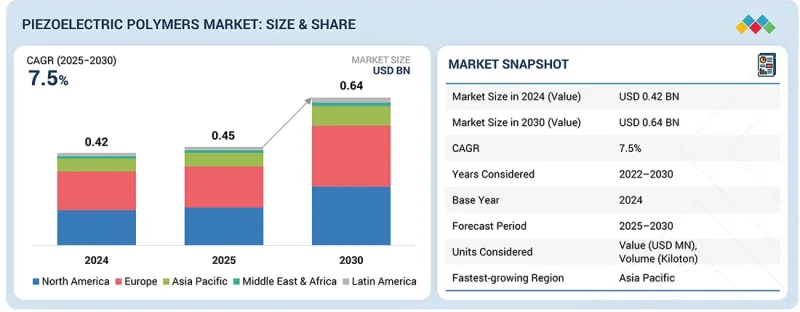
압전 고분자 시장 규모는 2025년 4억 5,000만 달러에서 2030년까지 6억 4,000만 달러에 달할 것으로 예측되고 있으며, 예측 기간 중 CAGR은 7.5%에 달할 전망입니다.
| 조사 범위 | |
|---|---|
| 조사 대상 기간 | 2022-2030년 |
| 기준연도 | 2024년 |
| 예측 기간 | 2025-2030년 |
| 대상 단위 | 금액(100만 달러) 및 킬로톤 |
| 부문 | 고분자 유형별, 재료 형상별, 용도별, 최종 용도 산업별, 지역별 |
| 대상 지역 | 북미, 아시아태평양, 유럽, 중동 및 아프리카, 남미 |
가볍고 유연하며 고성능의 기능성 소재에 대한 수요가 증가함에 따라 압전 고분자는 전자, 의료기기, 자동차 부품 및 산업 응용 분야에서 점차 주요 소재가 되고 있습니다. 효율적인 에너지 변환, 고정밀 감지 및 반응성 높은 작동에 대한 수요가 증가함에 따라 PVDF 및 PVDF-TrFE와 같은 폴리머에 대한 수요가 증가하고 있습니다. 전기 활성 고분자 재료는 높은 기계적 유연성, 매우 안정적이고 반복 가능한 성능, 우수한 구조적 무결성 및 다양한 제조 공정과의 호환성을 가지고 있습니다. 또한 전기방사, 용액 주조 및 다양한 인쇄 기술을 포함한 새로운 기술을 통해 이러한 재료를 대규모로 반복 가능한 성능으로 생산할 수 있게 되었습니다. 그 결과, 웨어러블 일렉트로닉스, 스마트 섬유, 소형화 장치 등의 기술 분야에서 기능성 소재로서 압전 고분자의 활용이 점점 더 널리 보급되고 있습니다.
PVDF-TrFE는 개선된 전기기계적 결합, 우수한 압전 응답 및 우수한 가공성으로 인해 압전 고분자 시장에서 점점 더 많은 인기를 얻고 있습니다. 플렉서블 센서, 에너지수확기술기, 액추에이터, 웨어러블 일렉트로닉스에 대한 수요가 대부분 시장 성장을 주도하고 있으며, 이에 따라 PVDF-TrFE의 사용도 증가하고 있습니다. PVDF-TrFE 사용의 장점은 강유전성, 기계적 유연성 및 적합성 향상으로 박막 및 섬유 가공에 매우 적합합니다. 또한 최근 용액 주조, 전기방사 및 인쇄 기술의 발전으로 필름의 균일성과 확장성이 향상되어 PVDF-TrFE의 응용 분야가 더욱 확대되고 있습니다. 소형화, 경량화, 고성능 전자소자 개발이 강조되는 가운데 PVDF-TrFE는 현재 압전 고분자의 주요 재료로 여겨지고 있습니다.
유연성, 추종성, 웨어러블성을 갖춘 전자 부품에 대한 수요 증가로 인해 압전 고분자 시장에서 섬유 및 부직포 매트의 적응성이 크게 향상되었습니다. 이러한 형태의 특성은 높은 표면적, 매우 효율적인 에너지 변환 및 기계적 적응성을 제공하여 센서, 액추에이터, 의료기기, 스마트 섬유 등의 응용 분야를 가능하게 합니다. 제조업체가 성능 저하 없이 압전 섬유를 직물이나 복합 구조에 통합할 수 있다는 점은 차세대 전자 제품에서 압전 섬유를 바람직한 재료 구성 요소로 만들고 있습니다. 웨어러블 기술, 에너지수확 시스템, 다기능 장치에 대한 수요가 증가함에 따라 압전 고분자 시장에서 섬유 및 부직포 매트의 사용은 크게 증가할 것으로 예측됩니다.
예측 기간 중 유연성, 웨어러블 및 소형 전자기기에 대한 수요가 증가함에 따라 가전제품 부문은 압전 폴리머의 최종 용도 산업 중 가장 빠르게 성장할 것으로 예측됩니다. 센서, 액추에이터, 에너지수확기술 장치 및 햅틱 피드백 장치는 모두 압전 고분자의 정밀도에 의존하여 동작을 제어합니다. 스마트 기기, 웨어러블 건강 및 피트니스 모니터, 터치 센서식 기기에 대한 수요가 증가함에 따라 유연성, 기계적 내구성, 고품질 압전(기계적 에너지를 전기 에너지로 변환) 특성을 갖춘 고성능 기능성 폴리머에 대한 수요가 증가하고 있습니다. 또한 제조업체들이 경량, 에너지 절약 및 정비가 적은 부품 개발에 주력함에 따라 압전 폴리머는 가전 제품에 점점 더 많이 통합되어 이 시장 부문의 성장을 주도하고 있습니다.
아시아태평양은 기술의 급속한 보급, 이 지역의 전자제품 제조업체 수 증가, 첨단 소재 연구개발(R&D) 확대에 힘입어 예측 기간 중 압전 고분자 시장에서 가장 빠르게 성장하는 지역이 될 것으로 예측됩니다. 중국, 일본, 한국, 인도 등의 국가에서 가전제품, 자동차용 일렉트로닉스, 의료기기, 산업 자동화의 성장이 압전 폴리머에 대한 수요를 촉진하고 있습니다. 아시아태평양은 숙련된 노동력이 많고, 제조 비용이 낮으며, 첨단 고분자 제품에 대한 자금 지원도 증가하고 있습니다. 또한 유연성, 경량성, 에너지 효율성이 뛰어난 소재에 대한 관심이 높아짐에 따라 스마트 센서 및 웨어러블 기술로의 적용을 통해 아시아태평양에서 압전 고분자의 활용이 지속적으로 촉진될 것으로 보입니다.
대상 기업 - Syensqo(벨기에), Arkema(프랑스), Kureha Corporation(일본), DAIKIN INDUSTRIES, Ltd.(일본), Toray Industries, Inc.(일본), Murata Manufacturing(일본), PolyK Technologies(미국), TE Connectivity(스위스), SanSan Intelligent Technology(소슈)(중국), Piezo Direct(미국)가 이 보고서의 대상입니다.
압전 고분자 시장의 주요 기업에 대해 기업 개요, 최근 동향, 주요 시장 전략을 포함한 상세한 경쟁 분석을 실시했습니다.
조사 범위
이 보고서는 압전 고분자 시장을 고분자 유형(폴리비닐리덴 플루오라이드(PVDF), 폴리비닐리덴 플루오라이드-트리플루오로에틸렌(PVDF-TRFE), PVDF-HFP 및 기타 PVDF 공중합체, 폴리아미드(PA), 폴리우레아 기반 압전 고분자, 기타 압전 고분자), 소재 형태(필름 및 시트, 섬유 및 부직포 매트, 코팅 및 박막, 과립 및 반제품, 성형 부품, 기타 소재 형태), 용도(센서, 액추에이터, 모터, 음향 장치, 발전기, 소나, 변환기, 기타 용도), 최종 사용 산업(소비자 가전, 자동차, 헬스케어 및 의료, 항공우주 및 방위, 산업 및 제조, 기타 최종 사용 산업). 본 보고서의 범위는 압전 고분자 시장의 성장에 영향을 미치는 동인, 제약 요인, 과제 및 기회에 대한 상세한 정보를 다룹니다. 주요 업계 기업들에 대한 심층 분석을 통해 압전 고분자 시장 내 사업 개요, 제공 제품, 그리고 인수합병 및 사업 확장을 포함한 주요 전략에 대한 통찰력을 제공합니다. 또한 본 보고서는 압전 고분자 시장에 진출할 예정인 신생 기업들에 대한 경쟁 분석을 제시합니다.
이 보고서를 구매해야 하는 이유
이 보고서는 시장 리더와 신규 시장 진출기업에게 전체 압전 폴리머 시장과 그 하위 부문의 매출에 대한 가장 정확한 추정치를 제공합니다. 이 보고서는 이해관계자들이 경쟁 구도를 이해하고, 자사의 포지셔닝에 대한 심층 인사이트을 얻고, 효과적인 시장 진출 전략을 수립하는 데 도움이 될 것입니다. 또한 시장 동향을 파악하고 주요 시장 성장 촉진요인, 시장 성장 억제요인, 과제 및 기회에 대한 정보를 제공합니다.
이 보고서는 다음 사항에 대한 인사이트을 제공합니다. 주요 촉진요인(고분자 재료 및 나노복합체 혁신, 압전 고분자 연구에 대한 정부 자금 지원 증가, 재료 과학 및 제조 기술 발전), 제약 요인(환경 및 규제 문제, 세라믹 대비 낮은 압전 성능), 기회(생분해성 압전 고분자의 발전, 에너지수확기술 및 자가발전 시스템의 성장), 과제(높은 제조 및 재료 비용, 대체 기술과의 경쟁)에 대한 인사이트을 제공합니다. 에너지수확기술 및 자가발전 시스템의 성장, 친환경적이고 지속가능한 압전 재료로의 전환), 과제(높은 제조 및 재료 비용, 대체 기술과의 경쟁)에 대한 인사이트을 제공합니다.
- 제품 개발/혁신 : 압전 고분자 시장의 향후 기술 동향과 연구개발 활동에 대한 상세한 분석.
- 시장 개발: 수익성 높은 시장에 대한 종합적인 정보 - 이 보고서는 다양한 지역의 압전 폴리머 시장을 분석합니다.
- 시장 다각화 : 압전 고분자 시장의 신제품 및 서비스, 미개발 지역, 최근 동향 및 투자에 대한 종합적인 정보를 제공합니다.
- 경쟁사 평가: Syensqo(벨기에), Arkema(프랑스), Kureha Corporation(일본), DAIKIN INDUSTRIES, Ltd.(일본), Toray Industries, Inc.(일본), Murata Manufacturing(일본), PolyK Technologies(미국), TE Connectivity(스위스), SanSan Intelligent Technology(Suzhou)(중국), Piezo Direct(미국) 등 주요 기업의 시장 점유율, 성장 전략, 서비스 제공에 대한 상세한 평가. 서비스 제공에 대한 상세한 평가.
자주 묻는 질문
목차
제1장 서론
제2장 개요
제3장 주요 인사이트
제4장 시장 개요
제5장 업계 동향
제6장 기술 진보, AI에 의한 영향, 특허, 혁신, 향후 응용
제7장 규제 상황과 지속가능성 구상
제8장 고객 상황과 구매 행동
제9장 압전 고분자 시장(고분자 유형별)
제10장 압전 고분자 시장(재료 형상별)
제11장 압전 고분자 시장(용도별)
제12장 압전 고분자 시장(용도별)
제13장 압전 고분자 시장(지역별)
제14장 경쟁 구도
제15장 기업 개요
제16장 조사 방법
제17장 부록
KSA 26.04.21The piezoelectric polymers market is projected to reach USD 0.64 billion by 2030 from USD 0.45 billion in 2025, at a CAGR of 7.5% during the forecast period.
| Scope of the Report | |
|---|---|
| Years Considered for the Study | 2022-2030 |
| Base Year | 2024 |
| Forecast Period | 2025-2030 |
| Units Considered | Value (USD Million) and Volume (Kiloton) |
| Segments | Polymer Type, Material Form, Application, End-use Industry, and Region |
| Regions covered | North America, Asia Pacific, Europe, Middle East & Africa, and South America |
Piezoelectric polymers are gradually becoming the material of choice in electronics, medical devices, automotive components, and industrial applications due to the growing need for lightweight, flexible, and high-performance functional materials. The increasing demand for efficient energy conversion, precise sensing, and responsive actuation is driving the use of polymers such as PVDF and PVDF-TrFE. Electroactive polymeric materials offer high mechanical flexibility, highly stable and repeatable performance, good structural integrity, and compatibility with various fabrication processes. Also, new technologies, including electrospinning, solution casting, and various printing techniques, are enabling the production of these materials on a large scale and with repeatable performance. As a result, the use of piezoelectric polymers as functional materials in technology, including wearable electronics, smart textiles, and miniaturized devices, is becoming more prevalent.
"PVDF-TrFE is projected to be the fastest-growing polymer type in the piezoelectric polymers market during the forecast period."
PVDF-TrFE is becoming increasingly popular as a choice in the piezoelectric polymers market, thanks to its improved electromechanical coupling, outstanding piezoelectric response, and good processability. The majority of demand for flexible sensors, energy harvesters, actuators, and wearable electronic devices is driving market growth and, in turn, increasing the use of PVDF-TrFE. Benefits of using PVDF-TrFE include improved ferroelectric properties, mechanical flexibility, and compatibility, making it well-suited for thin-film and fiber processing. Additionally, recent developments in solution casting, electrospinning, and printing technologies improve film consistency and scalability, further expanding the growing number of applications that utilize PVDF-TrFE. With greater emphasis on the development of smaller, lighter, and higher-performance electronic devices, PVDF-TrFE is now seen as a key material for piezoelectric polymers.
"Fibers and non-woven mats are projected to be the second-fastest-growing material form in the piezoelectric polymers market during the forecast period."
The adaptability of both fibers and nonwoven mats as material forms in the piezoelectric polymers market has increased dramatically due to the growing demand for flexible, conformable, and wearable electronic components. The characteristics of these forms provide a high surface area, very efficient energy conversion, and mechanical adaptability, enabling applications such as sensors, actuators, medical devices, and smart textiles. The ability of manufacturers to integrate piezoelectric fibers into fabric or composite structures without reducing performance level makes them desirable material components for future generations of electronics. As demand for wearable technology, energy-harvesting systems, and multifunctional devices grows, the use of both fibers and nonwoven mats in the piezoelectric polymers market is expected to increase significantly.
"Consumer electronics is projected to be the fastest-growing end-use industry in the piezoelectric polymers market during the forecast period."
The consumer electronics sector is anticipated to be the fastest-growing end-use industry for piezoelectric polymers during the forecast period, driven by the rising demand for flexible, wearable, and miniaturized electronic devices. Sensors, actuators, energy-harvesting devices, and haptic feedback devices all rely on the accuracy of Piezoelectric Polymers to control motion. The rise in demand for smart devices, wearable health and fitness monitors, and touch-sensitive devices has created a need for high-performing functional polymers that provide flexibility, mechanical durability, and high-quality piezoelectric (mechanical-to-electrical) behavior. Furthermore, piezoelectric polymers are increasingly incorporated into consumer electronics as manufacturers focus on developing lightweight, energy-efficient, low-maintenance components to drive further growth in this market segment.
"Asia Pacific is projected to be the fastest-growing region in the piezoelectric polymers market during the forecast period."
The Asia Pacific region is anticipated to be the fastest-growing region in the piezoelectric polymers market during the forecast period, driven by the rapid adoption of technology, the growing number of electronics producers in the region, and increased R&D in advanced materials. Growth in consumer electronics, automotive electronics, medical devices, and industrial automation in countries like China, Japan, South Korea, and India is fueling demand for piezoelectric polymers. The Asia Pacific region has a large skilled workforce, inexpensive manufacturing, and is receiving increased funding for advanced polymer products. Furthermore, the growing emphasis on flexible, lightweight, and energy-efficient materials will continue to spur the use of piezoelectric polymers in the Asia Pacific through the incorporation of smart sensors and wearable technology.
By Company Type: Tier 1: 40%, Tier 2: 30%, and Tier 3: 30%
By Designation: Directors: 30%, Managers: 20%, and Others: 50%
By Region: North America: 20%, Europe: 10%, Asia Pacific: 40%, South America: 10%, and Middle East & Africa 20%
Notes: Others include sales, marketing, and product managers.
Tier 1: >USD 1 Billion; Tier 2: USD 500 million-1 Billion; and Tier 3: <USD 500 million
Companies Covered: Syensqo (Belgium), Arkema (France), Kureha Corporation (Japan), DAIKIN INDUSTRIES, Ltd. (Japan), Toray Industries, Inc. (Japan), Murata Manufacturing Co., Ltd. (Japan), PolyK Technologies (US), TE Connectivity (Switzerland), SanSan Intelligent Technology (Suzhou) Co., Ltd. (China), and Piezo Direct (US) are covered in the report.
The study includes an in-depth competitive analysis of these key players in the piezoelectric polymers market, with their company profiles, recent developments, and key market strategies.
Research Coverage
This research report categorizes the piezoelectric polymers market based on polymer type (Polyvinylidene Fluoride (PVDF), Polyvinylidene Fluoride-Trifluoroethylene (PVDF-TRFE), PVDF-HFP and Other PVDF Copolymers, Polyamide (PA), Polyurea-based Piezoelectric Polymers, Other Piezoelectric Polymers), Material Form (Films & Sheets, Fibers & Nonwoven Mats, Coatings & Thin Layers, Granules and Semi-Finished Materials, Molded Components, Other Material Forms), Application (Sensors, Actuators, Motors, Acoustic Devices, Generators, Sonar, Transducers, Other Applications), and End-use Industry (Consumer Electronics, Automotive, Healthcare & Medical, Aerospace & Defense, Industrial & Manufacturing, Other End-Use Industries). The report's scope covers detailed information regarding the drivers, restraints, challenges, and opportunities influencing the growth of the piezoelectric polymers market. A detailed analysis of key industry players has been conducted to provide insights into their business overview, products offered, and key strategies, including mergers, acquisitions, and expansions, in the piezoelectric polymers market. This report provides a competitive analysis of upcoming startups in the piezoelectric polymers market.
Reasons to Buy the Report
The report will provide market leaders/new entrants with information on the closest approximations of revenue for the overall piezoelectric polymers market and its subsegments. This report will help stakeholders understand the competitive landscape, gain deeper insights into positioning their businesses, and plan effective go-to-market strategies. The report will help stakeholders understand the pulse of the market and provide them with information on key market drivers, restraints, challenges, and opportunities.
The report provides insights into the following points: Analysis of key drivers (innovation in polymer materials and nanocomposites, increasing government funding for piezoelectric polymer research, and advancements in material science and manufacturing technologies), restraints (environmental and regulatory concerns and lower piezoelectric performance compared to ceramics), opportunities (advancements in biodegradable piezoelectric polymers, growth in energy harvesting & Self- powered systems, and shift toward eco-friendly, and sustainable piezoelectric materials), and challenges (high fabrication and material costs, and competition from alternative technologies).
- Product Development/Innovation: Detailed insights into upcoming technologies, research & development activities, in the piezoelectric polymers market.
- Market Development: Comprehensive information about profitable markets - the report analyzes the piezoelectric polymers market across varied regions.
- Market Diversification: Exhaustive information about new products & services, untapped geographies, recent developments, and investments in the piezoelectric polymers market.
- Competitive Assessment: In-depth assessment of market shares, growth strategies, and service offerings of leading players such as Syensqo (Belgium), Arkema (France), Kureha Corporation (Japan), DAIKIN INDUSTRIES, Ltd. (Japan), Toray Industries, Inc. (Japan), Murata Manufacturing Co., Ltd. (Japan), PolyK Technologies (US), TE Connectivity (Switzerland), SanSan Intelligent Technology (Suzhou) Co., Ltd. (China), and Piezo Direct (US).
TABLE OF CONTENTS
1 INTRODUCTION
- 1.1 STUDY OBJECTIVES
- 1.2 MARKET DEFINITION
- 1.3 MARKET SCOPE
- 1.3.1 MARKET SEGMENTATION AND REGIONAL SCOPE
- 1.3.2 INCLUSIONS AND EXCLUSIONS
- 1.3.3 YEARS CONSIDERED
- 1.3.4 CURRENCY CONSIDERED
- 1.3.5 UNIT CONSIDERED
- 1.4 STAKEHOLDERS
2 EXECUTIVE SUMMARY
- 2.1 MARKET HIGHLIGHTS AND KEY INSIGHTS
- 2.2 KEY MARKET PARTICIPANTS: MAPPING OF STRATEGIC DEVELOPMENTS
- 2.3 DISRUPTIVE TRENDS IN PIEZOELECTRIC POLYMERS MARKET
- 2.4 HIGH-GROWTH SEGMENTS
- 2.5 REGIONAL SNAPSHOT: MARKET SIZE, GROWTH RATE, AND FORECAST
3 PREMIUM INSIGHTS
- 3.1 ATTRACTIVE OPPORTUNITIES FOR PLAYERS IN PIEZOELECTRIC POLYMERS MARKET
- 3.2 PIEZOELECTRIC POLYMERS MARKET, BY POLYMER TYPE
- 3.3 PIEZOELECTRIC POLYMERS MARKET, BY MATERIAL FORM
- 3.4 PIEZOELECTRIC POLYMERS MARKET, BY APPLICATION
- 3.5 PIEZOELECTRIC POLYMERS MARKET, BY END-USE INDUSTRY
- 3.6 PIEZOELECTRIC POLYMERS MARKET, BY COUNTRY
4 MARKET OVERVIEW
- 4.1 INTRODUCTION
- 4.2 MARKET DYNAMICS
- 4.2.1 DRIVERS
- 4.2.1.1 Innovation in polymer materials & nanocomposites
- 4.2.1.2 Increasing government funding for piezoelectric polymer research
- 4.2.1.3 Advancements in material science and manufacturing technologies
- 4.2.2 RESTRAINTS
- 4.2.2.1 Environmental and regulatory concerns
- 4.2.2.2 Lower piezoelectric polymers performance compared to ceramics
- 4.2.3 OPPORTUNITIES
- 4.2.3.1 Advancements in biodegradable piezoelectric polymers
- 4.2.3.2 Growth in energy harvesting & self-powered devices
- 4.2.3.3 Shift toward eco-friendly and sustainable piezoelectric materials
- 4.2.4 CHALLENGES
- 4.2.4.1 High fabrication and material costs
- 4.2.4.2 Competition from alternative technologies
- 4.2.1 DRIVERS
- 4.3 UNMET NEEDS & WHITE SPACES
- 4.3.1 UNMET NEEDS IN PIEZOELECTRIC POLYMERS MARKET
- 4.3.2 WHITE SPACE OPPORTUNITIES
- 4.4 INTERCONNECTED MARKETS AND CROSS-SECTOR OPPORTUNITIES
- 4.4.1 CROSS-SECTOR OPPORTUNITIES
- 4.5 STRATEGIC MOVES BY TIER-1/2/3 PLAYERS
- 4.5.1 KEY MOVES AND STRATEGIC FOCUS
5 INDUSTRY TRENDS
- 5.1 PORTER'S FIVE FORCES ANALYSIS
- 5.1.1 THREAT OF NEW ENTRANTS
- 5.1.2 THREAT OF SUBSTITUTES
- 5.1.3 BARGAINING POWER OF SUPPLIERS
- 5.1.4 BARGAINING POWER OF BUYERS
- 5.1.5 INTENSITY OF COMPETITIVE RIVALRY
- 5.1.5.1 GDP trends and forecasts
- 5.2 VALUE CHAIN ANALYSIS
- 5.3 ECOSYSTEM ANALYSIS
- 5.4 PRICING ANALYSIS
- 5.4.1 AVERAGE SELLING PRICE TREND OF PIEZOELECTRIC POLYMERS, BY REGION, 2022-2024
- 5.4.2 PRICING TREND OF PIEZOELECTRIC POLYMERS, BY TYPE, 2024
- 5.4.3 PRICING TREND OF PIEZOELECTRIC POLYMERS, BY END-USE INDUSTRY, 2022-2024
- 5.5 TRADE ANALYSIS
- 5.5.1 EXPORT SCENARIO (HS CODE 390469)
- 5.5.2 IMPORT SCENARIO (HS CODE 390469)
- 5.6 KEY CONFERENCES AND EVENTS, 2026-2027
- 5.7 TRENDS/DISRUPTIONS IMPACTING CUSTOMER BUSINESS
- 5.8 INVESTMENT AND FUNDING SCENARIO
- 5.9 CASE STUDY ANALYSIS
- 5.9.1 FLEXIBLE HEALTH MONITORING USING PVDF FILM SENSORS
- 5.9.2 STRUCTURAL HEALTH MONITORING USING PVDF-TRFE SENSOR ARRAYS
- 5.9.3 PIEZOELECTRIC POLYMER TEXTILES FOR SMART WEARABLES
- 5.10 IMPACT OF 2025 US TARIFFS ON PIEZOELECTRIC POLYMERS MARKET
- 5.10.1 INTRODUCTION
- 5.10.2 KEY TARIFF RATES
- 5.10.3 PRICE IMPACT ANALYSIS
- 5.10.4 IMPACT ON COUNTRIES/REGIONS
- 5.10.4.1 US
- 5.10.4.2 China
- 5.10.4.3 Europe
- 5.10.4.4 Mexico
- 5.10.5 IMPACT ON END-USE INDUSTRIES
6 TECHNOLOGICAL ADVANCEMENTS, AI-DRIVEN IMPACT, PATENTS, INNOVATIONS, AND FUTURE APPLICATIONS
- 6.1 KEY EMERGING TECHNOLOGIES
- 6.1.1 HYBRID PIEZO/PYROELECTRIC NANOGENERATORS WITH NANOWIRE-ENHANCED PVDF
- 6.1.2 ZNO@C/PVDF ELECTROSPUN MEMBRANES FOR WEARABLE NANOGENERATORS
- 6.2 COMPLEMENTARY TECHNOLOGIES
- 6.2.1 MEMS-BASED ENERGY HARVESTERS COMBINING PIEZOELECTRIC AND THERMOELECTRIC POLYMERS
- 6.2.2 ADVANCED HYBRID PIEZO-TRIBOELECTRIC NANOGENERATORS
- 6.3 ADJACENT TECHNOLOGIES
- 6.3.1 FLEXIBLE DIELECTRIC ELASTOMER ACTUATOR (DEA) TECHNOLOGY
- 6.3.2 ELECTROACTIVE POLYMER (EAP) SENSOR & ACTUATOR TECHNOLOGY
- 6.4 TECHNOLOGY/PRODUCT ROADMAP
- 6.4.1 SHORT-TERM (2025-2027) | PROCESS OPTIMIZATION AND PERFORMANCE CONSISTENCY
- 6.4.2 MID-TERM (2027-2030) | FUNCTIONAL INTEGRATION AND APPLICATION-SPECIFIC MATERIALS
- 6.4.3 LONG-TERM (2030-2035+) | SUSTAINABILITY, SMART SYSTEM INTEGRATION, AND ADVANCED MATERIAL ARCHITECTURES
- 6.5 PATENT ANALYSIS
- 6.5.1 INTRODUCTION
- 6.5.2 METHODOLOGY
- 6.5.3 PIEZOELECTRIC POLYMERS MARKET, PATENT ANALYSIS, 2016-2025
- 6.6 FUTURE APPLICATIONS
- 6.6.1 FLEXIBLE SENSORS AND WEARABLE ELECTRONICS APPLICATIONS
- 6.6.2 ENERGY HARVESTING AND SELF-POWERED SYSTEM APPLICATIONS
- 6.6.3 STRUCTURAL HEALTH MONITORING AND SMART INFRASTRUCTURE APPLICATIONS
- 6.7 IMPACT OF AI/GEN AI ON PIEZOELECTRIC POLYMERS MARKET
- 6.7.1 TOP USE CASES AND MARKET POTENTIAL
- 6.7.2 BEST PRACTICES FOLLOWED BY MANUFACTURERS/OEMS IN PIEZOELECTRIC POLYMERS MARKET
- 6.7.3 CASE STUDIES RELATED TO AI/GEN AI IMPLEMENTATION IN PIEZOELECTRIC POLYMERS MARKET
- 6.7.4 INTERCONNECTED/ADJACENT ECOSYSTEM AND IMPACT ON MARKET PLAYERS
- 6.7.5 CLIENTS' READINESS TO ADOPT AI/GEN AI IN PIEZOELECTRIC POLYMERS MARKET
- 6.8 SUCCESS STORIES AND REAL-WORLD APPLICATIONS
- 6.8.1 WEARABLE AND FLEXIBLE ENERGY HARVESTERS USING PVDF-BASED NANOGENERATORS
- 6.8.2 AUTOMOTIVE SENSING SYSTEMS WITH POLYMER FILMS
7 REGULATORY LANDSCAPE AND SUSTAINABILITY INITIATIVES
- 7.1 REGIONAL REGULATIONS AND COMPLIANCE
- 7.2 REGULATORY BODIES, GOVERNMENT AGENCIES, AND OTHER ORGANIZATIONS
- 7.2.1 INDUSTRY STANDARDS
- 7.3 SUSTAINABILITY INITIATIVES
- 7.3.1 GREEN MATERIAL EFFICIENCY AND LIFECYCLE OPTIMIZATION
- 7.3.2 SUSTAINABLE MANUFACTURING PRACTICES AND EMISSION CONTROL IN PIEZOELECTRIC POLYMER PRODUCTION
- 7.3.3 RESOURCE EFFICIENCY AND LIFECYCLE PERFORMANCE BENEFITS IN END-USE APPLICATIONS
- 7.3.4 COLLABORATIVE RESEARCH AND REGULATORY-ALIGNED SUSTAINABILITY DEVELOPMENT
- 7.3.5 ENVIRONMENTAL PERFORMANCE AND EFFICIENCY-DRIVEN APPLICATIONS
- 7.4 IMPACT OF REGULATORY POLICIES ON SUSTAINABILITY INITIATIVES
8 CUSTOMER LANDSCAPE AND BUYER BEHAVIOR
- 8.1 DECISION-MAKING PROCESS
- 8.2 KEY STAKEHOLDERS INVOLVED IN BUYING PROCESS AND THEIR EVALUATION CRITERIA
- 8.2.1 KEY STAKEHOLDERS IN BUYING PROCESS
- 8.2.2 BUYING CRITERIA
- 8.3 ADOPTION BARRIERS AND INTERNAL CHALLENGES
- 8.4 UNMET NEEDS FROM VARIOUS END-USE INDUSTRIES
- 8.5 MARKET PROFITABILITY
- 8.5.1 REVENUE POTENTIAL
- 8.5.2 COST DYNAMICS
- 8.5.2.1 Margin opportunities, by application
9 PIEZOELECTRIC POLYMERS MARKET, BY POLYMER TYPE
- 9.1 INTRODUCTION
- 9.2 POLYVINYLIDENE FLUORIDE (PVDF)
- 9.2.1 HIGH PIEZOELECTRIC OUTPUT, STRONG B-PHASE FORMATION, AND EXCELLENT THERMAL-CHEMICAL STABILITY
- 9.3 POLYVINYLIDENE FLUORIDE-TRIFLUOROETHYLENE (PVDF-TRFE)
- 9.3.1 ENHANCED FERROELECTRIC ALIGNMENT, HIGH REMNANT POLARIZATION, AND LOW-VOLTAGE POLING EFFICIENCY
- 9.4 PVDF-HFP & OTHER PVDF COPOLYMERS
- 9.4.1 GREATER FLEXIBILITY, LOWER CRYSTALLINITY, AND SMOOTH DIELECTRIC RESPONSE WITH IMPROVED FILM FORMABILITY
- 9.5 OTHER PIEZOELECTRIC POLYMER TYPES
10 PIEZOELECTRIC POLYMERS MARKET, BY MATERIAL FORM
- 10.1 INTRODUCTION
- 10.2 FILMS & SHEETS
- 10.2.1 THIN STRUCTURES, HIGH FLEXIBILITY, AND CONSISTENT PIEZOELECTRIC PERFORMANCE
- 10.3 FIBERS & NON-WOVEN MATS
- 10.3.1 HIGH SURFACE AREA AND FLEXIBLE STRUCTURES WITH ENHANCED SENSITIVITY
- 10.4 COATINGS & THIN LAYERS
- 10.4.1 ULTRA-THIN FUNCTIONAL LAYERS WITH HIGH PRECISION AND SURFACE COMPATIBILITY
- 10.5 GRANULES & SEMI-FINISHED MATERIALS
- 10.5.1 PROCESSABLE BASE MATERIALS FOR CUSTOMIZED APPLICATIONS AND HIGH-VOLUME MANUFACTURING
- 10.6 MOLDED COMPONENTS
- 10.6.1 PRECISION-SHAPED PARTS FOR DEVICE INTEGRATION AND HIGH-PERFORMANCE APPLICATIONS
- 10.7 OTHER MATERIAL FORMS
11 PIEZOELECTRIC POLYMERS MARKET, BY APPLICATION
- 11.1 INTRODUCTION
- 11.2 SENSORS
- 11.2.1 ENHANCED DETECTION PRECISION, MECHANICAL ADAPTABILITY, AND LONG-LASTING STABILITY
- 11.3 TRANSDUCERS
- 11.3.1 ADVANCING COMPACT, DEPENDABLE, AND VERSATILE PIEZOELECTRIC POLYMER TRANSDUCERS FOR PRECISE SIGNAL TRANSFORMATION AND ADVANCED DEVICE INTEGRATION
- 11.4 ACTUATORS
- 11.4.1 HIGH PRECISION, FAST RESPONSE, AND MINIATURIZATION CAPABILITIES OF PIEZOELECTRIC ACTUATORS TO DRIVE MARKET
- 11.5 MOTORS
- 11.5.1 FACILITATING CONCISE AND ACCURATE MOTOR CONTROL FOR HIGH-EFFICIENCY, LOW-NOISE, AND MINIATURE MOTOR SYSTEMS
- 11.6 ACOUSTIC DEVICES
- 11.6.1 CAPACITY FOR ACTIVATING HIGH-SENSITIVITY SOUND RECOGNITION AND ADAPTABLE ACOUSTIC DEVICE INTEGRATION
- 11.7 GENERATORS
- 11.7.1 ABILITY TO FACILITATE ELECTRICITY PRODUCTION FROM MECHANICAL SOURCES
- 11.8 SONAR
- 11.8.1 ENHANCED SIGNAL RESOLUTION, DEEP-WATER PERFORMANCE, AND DURABILITY OF PIEZOELECTRIC POLYMERS
- 11.9 OTHER APPLICATIONS
12 PIEZOELECTRIC POLYMERS MARKET, BY END-USE INDUSTRY
- 12.1 INTRODUCTION
- 12.2 CONSUMER ELECTRONICS
- 12.2.1 ENHANCED SENSITIVITY, FLEXIBILITY, LIGHTWEIGHT DESIGN, AND LOW POWER CONSUMPTION
- 12.3 AUTOMOTIVE
- 12.3.1 HIGH DURABILITY, TEMPERATURE STABILITY, VIBRATION RESISTANCE, AND ENERGY-HARVESTING CAPABILITIES
- 12.4 HEALTHCARE & MEDICAL
- 12.4.1 BIOCOMPATIBILITY, FLEXIBILITY, AND PRECISE SENSING PERFORMANCE FOR MEDICAL DEVICES AND WEARABLE HEALTH MONITORS
- 12.5 AEROSPACE & DEFENSE
- 12.5.1 LIGHTWEIGHT, HIGH SENSITIVITY, AND ROBUSTNESS UNDER EXTREME CONDITIONS
- 12.6 INDUSTRIAL & MANUFACTURING
- 12.6.1 CHEMICAL RESISTANCE, MECHANICAL ROBUSTNESS, AND RELIABLE VIBRATION AND PRESSURE SENSING SUPPORT INDUSTRIAL AUTOMATION AND PREDICTIVE MAINTENANCE
- 12.7 OTHER END-USE INDUSTRIES
13 PIEZOELECTRIC POLYMERS MARKET, BY REGION
- 13.1 INTRODUCTION
- 13.2 NORTH AMERICA
- 13.2.1 US
- 13.2.1.1 Expansion of EV, aerospace, medical-device, and automotive sectors driving demand
- 13.2.2 CANADA
- 13.2.2.1 Growing automotive, EV, aerospace and medical-device manufacturing
- 13.2.3 MEXICO
- 13.2.3.1 Expanding automotive production and sustainable infrastructure investments driving demand
- 13.2.1 US
- 13.3 ASIA PACIFIC
- 13.3.1 CHINA
- 13.3.1.1 EV leadership, semiconductor expansion, and smart-electronics ecosystem accelerating demand
- 13.3.2 JAPAN
- 13.3.2.1 Japan's smart-electronics, EV innovation, and automotive sector boosting demand
- 13.3.3 INDIA
- 13.3.3.1 India's accelerating shift toward electronics manufacturing, EV adoption, and smart devices driving demand
- 13.3.4 SOUTH KOREA
- 13.3.4.1 South Korea's advanced electronics and EV innovation driving demand
- 13.3.5 REST OF ASIA PACIFIC
- 13.3.1 CHINA
- 13.4 EUROPE
- 13.4.1 GERMANY
- 13.4.1.1 Strong electro & digital industry expansion driving piezoelectric polymer demand
- 13.4.2 FRANCE
- 13.4.2.1 Industrial modernization and advanced manufacturing activities supporting piezoelectric polymer demand
- 13.4.3 UK
- 13.4.3.1 Innovation-driven manufacturing and electrification transition supporting piezoelectric polymer demand
- 13.4.4 ITALY
- 13.4.4.1 Public infrastructure investments and automotive electrification driving demand
- 13.4.5 SPAIN
- 13.4.5.1 Strong automotive production and industrial modernization supporting piezoelectric polymer demand
- 13.4.6 REST OF EUROPE
- 13.4.1 GERMANY
- 13.5 ROW
- 13.5.1 MIDDLE EAST & SOUTH AFRICA
- 13.5.1.1 Automotive production growth and industrial modernization supporting piezoelectric polymer demand
- 13.5.2 BRAZIL
- 13.5.2.1 Healthcare modernization & infrastructure investment driving demand
- 13.5.3 OTHERS
- 13.5.1 MIDDLE EAST & SOUTH AFRICA
14 COMPETITIVE LANDSCAPE
- 14.1 OVERVIEW
- 14.2 KEY PLAYER COMPETITIVE STRATEGIES/ RIGHT TO WIN, 2020-2025
- 14.3 REVENUE ANALYSIS
- 14.4 MARKET SHARE ANALYSIS, 2024
- 14.5 PRODUCT COMPARISON
- 14.6 COMPANY EVALUATION MATRIX: KEY PLAYERS, 2024
- 14.6.1 STARS
- 14.6.2 EMERGING LEADERS
- 14.6.3 PERVASIVE PLAYERS
- 14.6.4 PARTICIPANTS
- 14.6.5 COMPANY FOOTPRINT: KEY PLAYERS, 2024
- 14.6.5.1 Company footprint
- 14.6.5.2 Region footprint
- 14.6.5.3 Polymer type footprint
- 14.6.5.4 Material form footprint
- 14.6.5.5 Application footprint
- 14.6.5.6 End-use industry footprint
- 14.7 COMPANY EVALUATION MATRIX: STARTUPS/SMES, 2024
- 14.7.1 PROGRESSIVE COMPANIES
- 14.7.2 RESPONSIVE COMPANIES
- 14.7.3 DYNAMIC COMPANIES
- 14.7.4 STARTING BLOCKS
- 14.7.5 COMPETITIVE BENCHMARKING: STARTUPS/SMES, 2024
- 14.7.5.1 Detailed list of key startups/SMEs
- 14.7.5.2 Competitive benchmarking of key startups/SMEs
- 14.8 COMPANY VALUATION AND FINANCIAL METRICS
- 14.9 COMPETITIVE SCENARIO
- 14.9.1 PRODUCT LAUNCHES
- 14.9.1.1 Deals
- 14.9.1.2 Expansions
- 14.9.1.3 Other developments
- 14.9.1 PRODUCT LAUNCHES
15 COMPANY PROFILES
- 15.1 KEY PLAYERS
- 15.1.1 SYENSQO
- 15.1.1.1 Business overview
- 15.1.1.2 Products/Solutions/Services offered
- 15.1.1.3 Recent developments
- 15.1.1.3.1 Product launches
- 15.1.1.3.2 Deals
- 15.1.1.3.3 Expansions
- 15.1.1.4 MnM view
- 15.1.1.4.1 Right to win
- 15.1.1.4.2 Strategic choices
- 15.1.1.4.3 Weaknesses & competitive threats
- 15.1.2 ARKEMA
- 15.1.2.1 Business overview
- 15.1.2.2 Products/Solutions/Services offered
- 15.1.2.3 Recent developments
- 15.1.2.3.1 Product launches
- 15.1.2.3.2 Deals
- 15.1.2.3.3 Expansions
- 15.1.2.3.4 Other developments
- 15.1.2.4 MnM view
- 15.1.2.4.1 Right to win
- 15.1.2.4.2 Strategic choices
- 15.1.2.4.3 Weaknesses & competitive threats
- 15.1.3 KUREHA CORPORATION
- 15.1.3.1 Business overview
- 15.1.3.2 Products/Solutions/Services offered
- 15.1.3.3 Recent developments
- 15.1.3.3.1 Expansions
- 15.1.3.3.2 Other developments
- 15.1.3.4 MnM view
- 15.1.3.4.1 Right to win
- 15.1.3.4.2 Strategic choices
- 15.1.3.4.3 Weaknesses & competitive threats
- 15.1.4 DAIKIN INDUSTRIES, LTD.
- 15.1.4.1 Business overview
- 15.1.4.2 Products/Solutions/Services offered
- 15.1.4.3 Recent developments
- 15.1.4.3.1 Product launches
- 15.1.4.4 MnM view
- 15.1.4.4.1 Right to win
- 15.1.4.4.2 Strategic choices
- 15.1.4.4.3 Weaknesses & competitive threats
- 15.1.5 TORAY INDUSTRIES, INC.
- 15.1.5.1 Business overview
- 15.1.5.2 Products/Solutions/Services offered
- 15.1.5.3 Recent developments
- 15.1.5.3.1 Product launches
- 15.1.5.4 MnM view
- 15.1.5.4.1 Right to win
- 15.1.5.4.2 Strategic choices
- 15.1.5.4.3 Weaknesses & competitive threats
- 15.1.5.5 Murata Manufacturing Co., Ltd.
- 15.1.5.6 Business overview
- 15.1.5.7 Products/Solutions/Services offered
- 15.1.5.8 Recent developments
- 15.1.5.8.1 Product Launches
- 15.1.5.8.2 Deals
- 15.1.5.9 MnM view
- 15.1.6 POLYK TECHNOLOGIES, LLC.
- 15.1.6.1 Business overview
- 15.1.6.2 Products/Solutions/Services offered
- 15.1.6.3 MnM view
- 15.1.7 TE CONNECTIVITY
- 15.1.7.1 Business overview
- 15.1.7.2 Products/Solutions/Services offered
- 15.1.7.3 MnM view
- 15.1.8 SANSAN INTELLIGENT TECHNOLOGY (SUZHOU) CO., LTD.
- 15.1.8.1 Business overview
- 15.1.8.2 Products/Solutions/Services offered
- 15.1.8.3 MnM view
- 15.1.9 PIEZO DIRECT
- 15.1.9.1 Business overview
- 15.1.9.2 Products/Solutions/Services offered
- 15.1.9.3 MnM view
- 15.1.1 SYENSQO
- 15.2 OTHER PLAYERS
- 15.2.1 FLUOEVER NEW MATERIAL (SHANGHAI) CO., LTD.
- 15.2.2 PRECISION ACOUSTICS LTD.
- 15.2.3 UNICTRON TECHNOLOGIES CORPORATION
- 15.2.4 PIEZO SMART
- 15.2.5 HE SHUAI
- 15.2.6 WEPROFAB
- 15.2.7 VINIT PERFORMANCE POLYMERS PVT. LTD.
- 15.2.8 PERAGLOBE
- 15.2.9 STANFORD ADVANCED MATERIALS
- 15.2.10 QUINTESS CO., LTD.
- 15.2.11 MIANYANG PROCHEMA COMMERCIAL CO., LTD. & GUS INDUSTRY (HONGKONG) CO., LIMITED.
- 15.2.12 SUZHOU UVTECO NEW MATERIAL CO., LTD.
- 15.2.13 GOODFELLOW CAMBRIDGE LTD.
- 15.2.14 NANOPAINT
- 15.2.15 PETRON THERMOPLAST
16 RESEARCH METHODOLOGY
- 16.1 RESEARCH DATA
- 16.1.1 SECONDARY DATA
- 16.1.1.1 Key data from secondary sources
- 16.1.1.2 List of key secondary sources
- 16.1.2 PRIMARY DATA
- 16.1.2.1 Key data from primary sources
- 16.1.2.2 List of primary interview participants
- 16.1.2.3 Key industry insights
- 16.1.2.4 Breakdown of primary interviews
- 16.1.1 SECONDARY DATA
- 16.2 MARKET SIZE ESTIMATION
- 16.2.1 BOTTOM-UP APPROACH
- 16.2.2 TOP-DOWN APPROACH
- 16.3 DATA TRIANGULATION
- 16.4 RESEARCH ASSUMPTIONS
- 16.5 RESEARCH LIMITATIONS
- 16.6 RISK ANALYSIS
17 APPENDIX
- 17.1 DISCUSSION GUIDE
- 17.2 KNOWLEDGESTORE: MARKETSANDMARKETS' SUBSCRIPTION PORTAL
- 17.3 CUSTOMIZATION OPTIONS
- 17.4 RELATED REPORTS
- 17.5 AUTHOR DETAILS