|
시장보고서
상품코드
2037099
에이전트형 AI 보안 시장 예측(-2032년) : 보안 기능, 툴(프롬프트 보안 툴, 가드레일 프레임워크, AI 침투 테스트 및 레드티밍 툴), 배포 계층별Agentic AI Security Market by Security Function, Tool (Prompt Security Tools, Guardrail Frameworks, Al Pen Testing & Red Teaming Tools, Guardrail Frameworks), Deployment Layer - Global Forecast to 2032 |
||||||

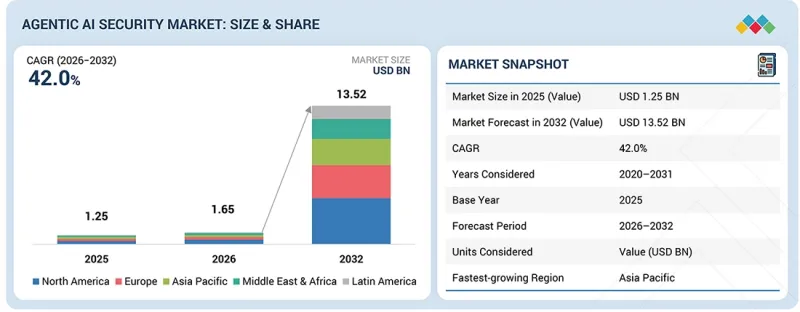
에이전트형 AI 보안 시장 규모는 2026년 16억 5,000만 달러에서 2032년에는 135억 2,000만 달러로 성장하며, 예측 기간 중 CAGR은 42.0%에 달할 것으로 전망되고 있습니다.
| 조사 범위 | |
|---|---|
| 조사 대상 기간 | 2019-2032년 |
| 기준연도 | 2025년 |
| 예측 기간 | 2026-2032년 |
| 대상 단위 | 금액(달러) |
| 부문 | 보안 기능, 제공, 배포 계층, 조직 규모, 산업별 |
| 대상 지역 | 북미, 유럽, 아시아태평양, 중동 및 아프리카, 라틴아메리카 |
서드파티 AI 툴과 플러그인 사용이 확대됨에 따라 에이전트형 AI 환경 전반에 걸쳐 안전한 통합의 필요성이 높아지고 있습니다. 이러한 컴포넌트들은 종종 기간계 시스템 및 데이터와 연동되므로 위협의 침입 경로가 될 수 있습니다. 조직들은 오용, 데이터 노출 및 무단 에이전트 활동을 방지하기 위해 이러한 통합을 검증, 모니터링 및 제어하는 보안 조치에 투자하고 있습니다.
"산업별로는 2026년 BFSI 부문이 가장 큰 시장 점유율을 차지합니다. "
BFSI(은행, 금융, 보험) 산업은 금융 업무에 AI 기반 시스템을 조기에 광범위하게 도입하여 시장에서 가장 큰 점유율을 차지할 것으로 예상됩니다. 은행과 금융기관은 부정행위 탐지, 리스크 평가, 거래, 고객 대응을 위해 자율 에이전트의 도입을 확대하고 있습니다. 이러한 첨단 자동화와 금융 데이터의 기밀성 및 엄격한 규제 요건과 함께 사이버 보안은 매우 중요한 우선순위가 되고 있습니다. 에이전트형 AI는 부정거래, 모델 변조, 데이터 유출 등의 새로운 리스크를 야기하므로 첨단 보안 솔루션에 대한 수요를 강력하게 견인하고 있습니다. 그 결과, BFSI 기업은 AI 에이전트, 데이터 흐름, 의사결정 프로세스의 보안을 확보하기 위해 지속적으로 많은 투자를 하고 있으며, 이는 시장에서 가장 큰 비중을 차지하고 있습니다.
"보안 기능별로는 AI 거버넌스 및 리스크 플랫폼 부문이 예측 기간 중 가장 높은 CAGR을 기록할 것으로 예상"
조직이 자율 시스템 전반의 통제, 책임, 컴플라이언스를 우선시하는 가운데, AI 거버넌스 리스크 플랫폼은 시장에서 가장 빠르게 성장할 것으로 예상됩니다. 에이전트형 환경에서는 AI 에이전트가 첨단 자율성을 가지고 작동하고 지속적으로 의사결정을 내리기 때문에 투명성, 정책 적용, 리스크 완화가 매우 중요합니다. 이러한 플랫폼을 통해 조직은 AI의 행동을 모니터링하고, 가드레일을 적용하고, 모델 리스크를 관리하고, 규제 및 윤리 표준을 준수할 수 있습니다.
기업이 멀티 에이전트 시스템 도입을 확대함에 따라 의사결정 드리프트, 부정행위, 데이터 오남용 등의 문제를 관리할 수 있는 중앙 집중식 거버넌스 프레임워크에 대한 요구가 증가하고 있습니다. AI 거버넌스 리스크 관리 플랫폼은 AI 파이프라인과 에이전트 워크플로우 전반에 걸쳐 감사 가능성, 실시간 정책 검증, 수명주기 리스크 관리를 지원합니다. 이러한 구조화된 거버넌스 및 리스크 관리에 대한 의존도가 높아지면서 이 부문의 급속한 보급과 성장을 주도하는 주요 요인이 되고 있습니다.
세계의 에이전트형 AI 보안 시장을 조사했으며, 시장 개요, 시장 성장에 영향을 미치는 각종 영향요인 분석, 기술ㆍ특허 동향, 법ㆍ규제 환경, 사례 분석, 시장 규모 추이 및 예측, 각종 부문별ㆍ지역별ㆍ주요 국가별 상세 분석, 경쟁 구도, 주요 기업 개요 등의 정보를 정리하여 전해드립니다.
자주 묻는 질문
목차
제1장 서론
제2장 개요
제3장 주요 인사이트
제4장 시장 개요
제5장 업계 동향
제6장 기술의 진보, AI에 의한 영향, 특허, 혁신, 향후 응용
제7장 규제 상황
제8장 소비자의 상황과 구매 행동
제9장 에이전트형 AI 보안 시장 : 제공별
제10장 에이전트형 AI 보안 시장 : 보안 기능별
제11장 에이전트형 AI 보안 시장 : 배포 계층별
제12장 에이전트형 AI 보안 시장 : 자율성 레벨별
제13장 에이전트형 AI 보안 시장 : 조직 규모별
제14장 에이전트형 AI 보안 시장 : 산업별
제15장 에이전트형 AI 보안 시장 : 지역별
제16장 경쟁 구도
제17장 기업 개요
제18장 조사 방법
제19장 부록
KSA 26.05.29The agentic AI security market is projected to grow from USD 1.65 billion in 2026 to USD 13.52 billion by 2032, at a CAGR of 42.0% during the forecast period.
| Scope of the Report | |
|---|---|
| Years Considered for the Study | 2019-2032 |
| Base Year | 2025 |
| Forecast Period | 2026-2032 |
| Units Considered | Value (USD Billion) |
| Segments | Security Function, Offering, Deployment Layer, Organization Size, and Vertical |
| Regions covered | North America, Europe, Asia Pacific, the Middle East & Africa, and Latin America |
The growing use of third-party AI tools and plugins is increasing the need for secure integration across agentic AI environments. These components often interact with core systems and data, creating potential entry points for threats. Organizations are investing in security measures to validate, monitor, and control these integrations to prevent misuse, data exposure, and unauthorized agent actions.
"By vertical, the BFSI segment is projected to hold the largest market share in 2026."
The BFSI vertical is expected to hold the largest share in the agentic AI security market due to the early and extensive adoption of AI-driven systems in financial operations. Banks and financial institutions are increasingly deploying autonomous agents for fraud detection, risk assessment, trading, and customer interactions. This high level of automation, combined with the sensitivity of financial data and strict regulatory requirements, makes cybersecurity a critical priority. Agentic AI introduces new risks, including unauthorized transactions, model manipulation, and data exposure, driving strong demand for advanced security solutions. As a result, BFSI organizations continue to invest heavily in securing AI agents, data flows, and decision-making processes, making it the largest segment in the market.
"By security function, the AI governance & risk platforms segment is expected to witness the highest CAGR during the forecast period."
AI governance & risk platforms are expected to experience the fastest growth in the agentic AI security market as organizations prioritize control, accountability, and compliance across autonomous systems. In agentic environments, AI agents operate with high levels of autonomy and make continuous decisions, making transparency, policy enforcement, and risk mitigation critical. These platforms enable organizations to monitor AI behavior, enforce guardrails, manage model risk, and ensure alignment with regulatory and ethical standards.
As enterprises scale the deployment of multi-agent systems, the need for centralized governance frameworks increases to manage issues such as decision drift, unauthorized actions, and data misuse. AI governance & risk platforms support auditability, real-time policy validation, and lifecycle risk management across AI pipelines and agent workflows. This growing reliance on structured governance and risk controls is a key factor driving rapid adoption and growth in this segment.
Breakdown of Primaries
The study draws insights from a range of industry experts, including component suppliers, Tier 1/2/3 companies, and OEMs. The break-up of the primaries is as follows:
- By Company Type: Tier 1 - 20%, Tier 2 - 32%, and Tier 3 - 48%
- By Designation: C-level - 40% and Managerial & Other Levels - 60%
- By Region: North America - 20%, Europe - 30%, Asia Pacific - 40%, Middle East and Africa - 5%, and Latin America - 5%
Major vendors in the agentic AI security market include Microsoft (US), Palo Alto Networks (US), CrowdStrike (US), Straiker (US), SentinelOne (US), Okta (US), Cloudflare (US), Cato Networks (Israel), Check Point Software Technologies (Israel), Securiti (US), HiddenLayer (US), Noma Security (Israel), Obsidian Security (US), Mindgard (UK), DeepKeep (Israel), Enkrypt AI (US), Pillar Security (US), Astrix Security (Israel), Natoma (US), Trufoundry (US), Descope (US), Zenity (Israel), Fiddler AI (US), Openlayer (US), Aembit (US), Lasso Security (Israel), Akto (US), Credo AI (US), Promptfoo (US), Strata Identity (US), Holistic AI (UK), Geordie AI (UK), NeuralTrust (Spain), and Usercentrics (Germany).
The study includes an in-depth competitive analysis of the key players in the agentic AI security market, their company profiles, recent developments, and key market strategies.
Research Coverage
The report segments the agentic AI security market and forecasts its size based on Security Function (Identity & Access Security, AI Governance & Risk Platforms, Threat Detection & Response, Data Security & Privacy, Vulnerability Assessment & Remediation, Security Orchestration, Automation & Response (SOAR), Security Posture Management (SPM), Deception Technology), Offering (Solutions (Software Platforms, Tools & Point Solutions [Prompt Security Tools, Guardrail Frameworks, AI Pen Testing & Red Teaming Tools]), Services (Managed Security Services [Managed AI Security Operations (AI SOC), Other Managed Security Services], Professional & Integration Services, Training & Certification Services)), Level of Autonomy (Semi-autonomous Systems (Human-in-the-Loop), Fully Autonomous Security Agents), Deployment Layer (Model Layer, Agent/Orchestration Layer, Application Layer, Data Layer, Infrastructure Layer, Integration Layer), Organization Size (Large Enterprises, SMEs), Vertical (BFSI, Healthcare & Life Sciences, Government, Defense, IT & ITES, Telecommunications, Retail & eCommerce, Energy & Utilities, Manufacturing, Other Verticals), and Region (North America, Europe, Asia Pacific, Middle East & Africa, and Latin America).
The study also includes an in-depth competitive analysis of the market's key players, including their company profiles, key observations on product and business offerings, recent developments, and key market strategies.
Key Benefits of Buying the Report
The report will help market leaders/new entrants by providing the closest approximations of revenue numbers for the overall agentic AI Security market and its subsegments. This report will help stakeholders understand the competitive landscape and gain valuable insights to better position their businesses and plan suitable go-to-market strategies. The report also helps stakeholders understand the market pulse and provides information on key market drivers, restraints, challenges, and opportunities.
The report provides insights on the following pointers:
- Analysis of critical drivers (rapid enterprise adoption of autonomous AI agents across critical workflows, increasing risk of AI-to-AI and adversarial attacks targeting agent ecosystems), restraints (limited standardization in securing agentic AI architectures and protocols, high complexity in securing dynamic, self-learning AI systems), opportunities (emergence of AI-native security platforms for agent monitoring and governance, integration of agentic AI security with zero trust and identity-first frameworks), and challenges (lack of visibility into autonomous agent decision-making and behavior, difficulty in detecting and mitigating real-time manipulation of AI agents (prompt injection, model drift))
- Product Development/Innovation: Detailed insights on upcoming technologies, research development activities, new products, and service launches in the agentic AI security market.
- Market Development: Comprehensive information about lucrative markets - the report analyses the agentic AI security market across varied regions.
- Market Diversification: Exhaustive information about new products and services, untapped geographies, recent developments, and investments in the agentic AI security market.
- Competitive Assessment: In-depth assessment of market shares, growth strategies, and service offerings of leading players such as Microsoft (US), Palo Alto Networks (US), CrowdStrike (US), Straiker (US), SentinelOne (US), Okta (US), Cloudflare (US), Cato Networks (Israel), Check Point Software Technologies (Israel), Securiti (US), HiddenLayer (US), Noma Security (Israel), Obsidian Security (US), Mindgard (UK), DeepKeep (Israel), Enkrypt AI (US), Pillar Security (US), Astrix Security (Israel), Natoma (US), Trufoundry (US), Descope (US), Zenity (Israel), Fiddler AI (US), Openlayer (US), Aembit (US), Lasso Security (Israel), Akto (US), Credo AI (US), Promptfoo (US), Strata Identity (US), Holistic AI (UK), Geordie AI (UK), NeuralTrust (Spain), and Usercentrics (Germany), among others, in the agentic AI security market.
TABLE OF CONTENTS
1 INTRODUCTION
- 1.1 STUDY OBJECTIVES
- 1.2 MARKET DEFINITION
- 1.3 STUDY SCOPE AND SEGMENTATION
- 1.3.1 MARKET SEGMENTATION
- 1.3.2 INCLUSIONS AND EXCLUSIONS
- 1.4 YEARS CONSIDERED
- 1.5 CURRENCY CONSIDERED
- 1.6 STAKEHOLDERS
- 1.7 SUMMARY OF CHANGES
2 EXECUTIVE SUMMARY
- 2.1 MARKET HIGHLIGHTS AND KEY INSIGHTS
- 2.2 KEY MARKET PARTICIPANTS: MAPPING OF STRATEGIC DEVELOPMENTS
- 2.3 DISRUPTIVE TRENDS SHAPING MARKET
- 2.4 HIGH-GROWTH SEGMENTS AND EMERGING FRONTIERS
- 2.5 REGIONAL SNAPSHOT: MARKET SIZE, GROWTH RATE, AND FORECAST
3 PREMIUM INSIGHTS
- 3.1 ATTRACTIVE OPPORTUNITIES FOR PLAYERS IN AGENTIC AI SECURITY MARKET
- 3.2 AGENTIC AI SECURITY MARKET, BY OFFERING
- 3.3 AGENTIC AI SECURITY MARKET, BY SOLUTION
- 3.4 AGENTIC AI SECURITY MARKET, BY TOOL & POINT SOLUTION
- 3.5 AGENTIC AI SECURITY MARKET, BY SERVICE
- 3.6 AGENTIC AI SECURITY MARKET, BY MANAGED SECURITY SERVICE
- 3.7 AGENTIC AI SECURITY MARKET, BY SECURITY FUNCTION
- 3.8 AGENTIC AI SECURITY MARKET, BY LEVEL OF AUTONOMY
- 3.9 AGENTIC AI SECURITY MARKET, BY DEPLOYMENT LAYER
- 3.10 AGENTIC AI SECURITY MARKET, BY ORGANIZATION SIZE
- 3.11 AGENTIC AI SECURITY MARKET, BY VERTICAL
- 3.12 AGENTIC AI SECURITY MARKET, BY REGION
4 MARKET OVERVIEW
- 4.1 INTRODUCTION
- 4.2 MARKET DYNAMICS
- 4.2.1 DRIVERS
- 4.2.1.1 Rapid enterprise adoption of autonomous AI agents across critical workflows
- 4.2.1.2 Increasing risk of AI-to-AI and adversarial attacks targeting agent ecosystems
- 4.2.1.3 Expansion of AI attack surface via APIs, tool integrations, and multi-agent systems
- 4.2.2 RESTRAINTS
- 4.2.2.1 Limited standardization in agentic AI architectures and security protocols
- 4.2.2.2 High complexity in securing dynamic, self-learning AI systems
- 4.2.2.3 Shortage of skilled professionals in agentic AI security implementation
- 4.2.3 OPPORTUNITIES
- 4.2.3.1 Emergence of AI-native security platforms for agent monitoring and governance
- 4.2.3.2 Integration of agentic AI security with zero-trust and identity-first frameworks
- 4.2.3.3 Growing demand for agent observability and auditability solutions
- 4.2.4 CHALLENGES
- 4.2.4.1 Lack of visibility into autonomous agent decision-making and behavior
- 4.2.4.2 Limited explainability and traceability for auditing and compliance
- 4.2.1 DRIVERS
- 4.3 UNMET NEEDS AND WHITE SPACES
- 4.4 INTERCONNECTED MARKETS AND CROSS-SECTOR OPPORTUNITIES
- 4.4.1 INTERCONNECTED MARKETS
- 4.4.2 CROSS-SECTOR OPPORTUNITIES
- 4.5 STRATEGIC MOVES BY TIER -1/2/3 PLAYERS
- 4.5.1 STRATEGIC TRENDS
- 4.5.1.1 Rise of execution-layer security in agentic AI
- 4.5.1.2 Emergence of agent governance and control frameworks
- 4.5.2 AGENTIC AI SECURITY THREATS
- 4.5.2.1 Autonomous decision drift
- 4.5.2.2 Prompt injection and instruction hijacking
- 4.5.2.3 Tool abuse and unauthorized actions
- 4.5.2.4 Data poisoning in learning loops
- 4.5.2.5 Identity and privilege escalation
- 4.5.2.6 Multi-agent collusion risks
- 4.5.2.7 Model exploitation and jailbreaking
- 4.5.2.8 Lack of explainability and auditability
- 4.5.2.9 Over-automation without human oversight
- 4.5.2.10 Supply chain vulnerabilities in models, plugins, and APIs
- 4.5.1 STRATEGIC TRENDS
5 INDUSTRY TRENDS
- 5.1 PORTER'S FIVE FORCES ANALYSIS
- 5.1.1 THREAT OF NEW ENTRANTS
- 5.1.2 BARGAINING POWER OF SUPPLIERS
- 5.1.3 BARGAINING POWER OF BUYERS
- 5.1.4 THREAT OF SUBSTITUTES
- 5.1.5 INTENSITY OF COMPETITIVE RIVALRY
- 5.2 MACROECONOMIC INDICATORS
- 5.2.1 INTRODUCTION
- 5.2.2 GDP TRENDS AND FORECAST
- 5.2.3 TRENDS IN GLOBAL ICT INDUSTRY
- 5.2.4 TRENDS IN GLOBAL CYBERSECURITY INDUSTRY
- 5.3 VALUE CHAIN ANALYSIS
- 5.3.1 RESEARCH & DEVELOPMENT
- 5.3.2 AGENTIC AI SECURITY PLATFORM DEVELOPMENT
- 5.3.3 AGENT RUNTIME SECURITY & MONITORING
- 5.3.4 PLANNING & DESIGNING
- 5.3.5 INFRASTRUCTURE DEPLOYMENT & SYSTEM INTEGRATION
- 5.3.6 END USER VERTICALS
- 5.4 ECOSYSTEM ANALYSIS
- 5.5 PRICING ANALYSIS
- 5.5.1 AVERAGE SELLING PRICE OF KEY VENDORS, BY SECURITY FUNCTION, 2026
- 5.5.2 INDICATIVE PRICING ANALYSIS, BY VENDOR, 2026
- 5.6 KEY CONFERENCES AND EVENTS, 2026
- 5.7 TRENDS/DISRUPTIONS IMPACTING CUSTOMER BUSINESS
- 5.8 INVESTMENT AND FUNDING SCENARIO
- 5.9 CASE STUDY ANALYSIS
- 5.9.1 DROPBOX STRENGTHENS GENAI SECURITY AGAINST PROMPT INJECTION USING LAKERA
- 5.9.2 ADDRESSING ENTERPRISE AI RISK AND COMPLIANCE CHALLENGES AT SCALE
- 5.9.3 PROTECT AI SECURES ML PIPELINES AND AGENTIC WORKFLOWS (HUNTR PLATFORM)
- 5.10 IMPACT OF 2025 US TARIFF - AGENTIC AI SECURITY MARKET
- 5.10.1 INTRODUCTION
- 5.10.2 KEY TARIFF RATES
- 5.10.3 PRICE IMPACT ANALYSIS
- 5.10.4 IMPACT ON COUNTRIES/REGIONS
- 5.10.4.1 North America
- 5.10.4.2 Europe
- 5.10.4.3 Asia Pacific
- 5.10.5 IMPACT ON END-USE INDUSTRIES
6 TECHNOLOGICAL ADVANCEMENTS, AI-DRIVEN IMPACT, PATENTS, INNOVATIONS, AND FUTURE APPLICATIONS
- 6.1 TECHNOLOGY ANALYSIS
- 6.1.1 KEY EMERGING TECHNOLOGIES
- 6.1.1.1 Agent runtime security and monitoring
- 6.1.1.2 AI governance & policy enforcement
- 6.1.1.3 Adversarial AI & prompt security
- 6.1.2 COMPLEMENTARY TECHNOLOGIES
- 6.1.2.1 Identity & access management (IAM)
- 6.1.2.2 Extended detection & response (XDR)
- 6.1.2.3 Security information & event management (SIEM)
- 6.1.3 ADJACENT TECHNOLOGIES
- 6.1.3.1 Data security & privacy technologies (DSPM/Encryption)
- 6.1.3.2 AI/ML platforms & MLOps
- 6.1.1 KEY EMERGING TECHNOLOGIES
- 6.2 TECHNOLOGY/PRODUCT ROADMAP
- 6.2.1 SHORT-TERM (2026-2027) | FOUNDATION & EARLY COMMERCIALIZATION
- 6.2.2 MID-TERM (2027-2030) | SCALING, INTELLIGENCE & ECOSYSTEM EXPANSION
- 6.2.3 LONG-TERM (2030-2035+) | AUTONOMOUS, REAL-TIME & PREDICTIVE CYBER DEFENSE
- 6.3 PATENT ANALYSIS
- 6.4 FUTURE APPLICATIONS
- 6.4.1 AUTONOMOUS AGENT SECURITY OPERATIONS (SOC)
- 6.4.2 AGENT RUNTIME MONITORING & CONTROL
- 6.4.3 AI GOVERNANCE AND POLICY ENFORCEMENT
- 6.4.4 ADVERSARIAL AI AND PROMPT SECURITY
- 6.4.5 NON-HUMAN IDENTITY (NHI) SECURITY
- 6.5 IMPACT OF AI/GEN AI ON AGENTIC AI SECURITY MARKET
- 6.5.1 BEST PRACTICES IN AGENTIC AI SECURITY MARKET
- 6.5.2 CASE STUDIES OF AI IMPLEMENTATION IN AGENTIC AI SECURITY MARKET
- 6.5.3 INTERCONNECTED ADJACENT ECOSYSTEM AND IMPACT ON MARKET PLAYERS
- 6.5.4 CLIENTS' READINESS TO ADOPT GENERATIVE AI IN AGENTIC AI SECURITY MARKET
- 6.6 SUCCESS STORIES AND REAL-WORLD APPLICATIONS
- 6.6.1 LAKERA: ENTERPRISE LLM APPLICATION SECURITY IMPLEMENTATION
- 6.6.2 PROTECT AI: SECURING AI/ML PIPELINES AND AGENT WORKFLOWS
7 REGULATORY LANDSCAPE
- 7.1 REGIONAL REGULATIONS AND COMPLIANCE
- 7.1.1 REGULATORY BODIES, GOVERNMENT AGENCIES, AND OTHER ORGANIZATIONS
- 7.1.2 INDUSTRY STANDARDS
8 CONSUMER LANDSCAPE AND BUYER BEHAVIOR
- 8.1 DECISION-MAKING PROCESS
- 8.2 KEY STAKEHOLDERS INVOLVED IN BUYING PROCESS AND THEIR EVALUATION CRITERIA
- 8.2.1 KEY STAKEHOLDERS IN BUYING PROCESS
- 8.2.2 BUYING CRITERIA
- 8.3 ADOPTION BARRIERS AND INTERNAL CHALLENGES
- 8.4 UNMET NEEDS IN VARIOUS END-USE INDUSTRIES
9 AGENTIC AI SECURITY MARKET, BY OFFERING
- 9.1 INTRODUCTION
- 9.1.1 OFFERING: AGENTIC AI SECURITY MARKET DRIVERS
- 9.2 SOLUTIONS
- 9.2.1 SOFTWARE PLATFORMS
- 9.2.1.1 Increasing preference for unified platforms to secure entire AI lifecycle
- 9.2.2 TOOLS & POINT SOLUTIONS
- 9.2.2.1 Rising demand for specialized tools to address AI-specific security risks
- 9.2.2.2 Prompt security tools
- 9.2.2.3 Guardrail frameworks
- 9.2.2.4 AI pen testing & red teaming tools
- 9.2.1 SOFTWARE PLATFORMS
- 9.3 SERVICES
- 9.3.1 MANAGED SECURITY SERVICES
- 9.3.1.1 Rising need for continuous monitoring of AI-driven environments to drive demand
- 9.3.1.2 Managed AI security operations
- 9.3.1.3 Other managed security services
- 9.3.2 PROFESSIONAL & INTEGRATION SERVICES
- 9.3.2.1 Increasing need to integrate AI security into enterprise ecosystems to drive demand
- 9.3.3 TRAINING & CERTIFICATION SERVICES
- 9.3.3.1 Growing demand for skilled workforce in AI security domain to drive demand
- 9.3.1 MANAGED SECURITY SERVICES
10 AGENTIC AI SECURITY MARKET, BY SECURITY FUNCTION
- 10.1 INTRODUCTION
- 10.1.1 SECURITY FUNCTION: AGENTIC AI SECURITY MARKET DRIVERS
- 10.2 IDENTITY & ACCESS SECURITY
- 10.2.1 RISING NEED TO SECURE IDENTITIES ACROSS AUTONOMOUS AI AGENTS TO DRIVE MARKET
- 10.3 AI GOVERNANCE & RISK PLATFORMS
- 10.3.1 GROWING DEMAND FOR ACCOUNTABILITY AND COMPLIANCE IN AI-DRIVEN SYSTEMS TO DRIVE MARKET
- 10.4 THREAT DETECTION & RESPONSE
- 10.4.1 INCREASING SOPHISTICATION OF AI-POWERED THREATS TARGETING AUTONOMOUS SYSTEMS TO DRIVE MARKET
- 10.5 DATA SECURITY & PRIVACY
- 10.5.1 RISING CONCERNS OVER SENSITIVE DATA EXPOSURE IN AI WORKFLOWS TO DRIVE MARKET
- 10.6 VULNERABILITY ASSESSMENT & REMEDIATION
- 10.6.1 GROWING NEED TO IDENTIFY AND FIX AI-SPECIFIC SECURITY WEAKNESSES TO DRIVE MARKET
- 10.7 SECURITY ORCHESTRATION, AUTOMATION, & RESPONSE (SOAR)
- 10.7.1 INCREASING DEMAND FOR AUTOMATED SECURITY OPERATIONS IN AI ENVIRONMENTS TO DRIVE MARKET
- 10.8 SECURITY POSTURE MANAGEMENT (SPM)
- 10.8.1 NEED FOR CONTINUOUS VISIBILITY INTO AI SYSTEMS AND AGENT SECURITY POSTURE TO DRIVE MARKET
- 10.9 DECEPTION TECHNOLOGY
- 10.9.1 INCREASING NEED TO DETECT SOPHISTICATED ATTACKERS TARGETING AI SYSTEMS TO DRIVE MARKET
11 AGENTIC AI SECURITY MARKET, BY DEPLOYMENT LAYER
- 11.1 INTRODUCTION
- 11.1.1 DEPLOYMENT LAYER: AGENTIC AI SECURITY MARKET DRIVERS
- 11.2 MODEL LAYER
- 11.2.1 INCREASING NEED TO SECURE MODELS AGAINST ADVERSARIAL MANIPULATION RISKS TO DRIVE DEMAND
- 11.3 AGENT/ORCHESTRATION LAYER
- 11.3.1 RISING RISKS FROM AUTONOMOUS AGENTS COORDINATING COMPLEX WORKFLOWS TO DRIVE DEMAND
- 11.4 APPLICATION LAYER
- 11.4.1 EXPANDING ATTACK SURFACE ACROSS AI-POWERED APPLICATIONS AND APIS
- 11.5 DATA LAYER
- 11.5.1 RISING CONCERNS OVER SENSITIVE DATA EXPOSURE ACROSS AI PIPELINES TO DRIVE DEMAND
- 11.6 INFRASTRUCTURE LAYER
- 11.6.1 GROWING NEED TO SECURE CLOUD AND RUNTIME ENVIRONMENTS FOR AI TO DRIVE DEMAND
- 11.7 INTEGRATION LAYER
- 11.7.1 INCREASING NEED TO SECURE INTERCONNECTED AI AND ENTERPRISE SYSTEMS TO DRIVE DEMAND
12 AGENTIC AI SECURITY MARKET, BY LEVEL OF AUTONOMY
- 12.1 INTRODUCTION
- 12.1.1 LEVEL OF AUTONOMY: AGENTIC AI SECURITY MARKET DRIVERS
- 12.2 SEMI-AUTONOMOUS SYSTEMS (HUMAN-IN-THE-LOOP)
- 12.2.1 INCREASING NEED FOR HUMAN OVERSIGHT IN CRITICAL AI DECISIONS TO DRIVE MARKET
- 12.3 FULLY AUTONOMOUS SECURITY AGENTS
- 12.3.1 GROWING ADOPTION OF INDEPENDENT AI AGENTS FOR SECURITY OPERATIONS TO DRIVE MARKET
13 AGENTIC AI SECURITY MARKET, BY ORGANIZATION SIZE
- 13.1 INTRODUCTION
- 13.1.1 ORGANIZATION SIZE: AGENTIC AI SECURITY MARKET DRIVERS
- 13.2 LARGE ENTERPRISES
- 13.2.1 INCREASING INVESTMENTS IN COMPREHENSIVE SECURITY FOR LARGE-SCALE AI DEPLOYMENTS TO DRIVE MARKET
- 13.3 SMES
- 13.3.1 GROWING DEMAND FOR COST-EFFECTIVE AND MANAGED AI SECURITY SOLUTIONS TO DRIVE MARKET
14 AGENTIC AI SECURITY MARKET, BY VERTICAL
- 14.1 INTRODUCTION
- 14.1.1 VERTICAL: AGENTIC AI SECURITY MARKET DRIVERS
- 14.2 BANKING, FINANCIAL SERVICES, AND INSURANCE (BFSI)
- 14.2.1 SECURING AUTONOMOUS FINANCIAL AGENTS AND HIGH-VALUE DATA IN REGULATED BFSI ENVIRONMENTS
- 14.3 HEALTHCARE & LIFE SCIENCES
- 14.3.1 PROTECTING AGENT-DRIVEN CLINICAL SYSTEMS AND SENSITIVE PATIENT DATA IN HEALTHCARE
- 14.4 GOVERNMENT
- 14.4.1 GROWING DEMAND TO SECURE AI-DRIVEN PUBLIC SECTOR SYSTEMS AND DIGITAL GOVERNANCE FRAMEWORKS
- 14.5 DEFENSE
- 14.5.1 RISING NEED TO PROTECT AI-ENABLED MISSION-CRITICAL AND INTELLIGENCE OPERATIONS
- 14.6 IT & ITES
- 14.6.1 SECURING AGENT-LED ENTERPRISE OPERATIONS AND API-DRIVEN WORKFLOWS IN IT & ITES
- 14.7 TELECOMMUNICATIONS
- 14.7.1 RISING NEED TO PROTECT AGENTIC AI-DRIVEN TELECOM NETWORKS AND REAL-TIME SERVICE ORCHESTRATION
- 14.8 RETAIL & E-COMMERCE
- 14.8.1 INCREASING NEED TO PROTECT CUSTOMER DATA IN AI-DRIVEN COMMERCE
- 14.9 MANUFACTURING
- 14.9.1 GROWING NEED TO SECURE AI-DRIVEN INDUSTRIAL AUTOMATION ENVIRONMENTS
- 14.10 OTHER VERTICALS
15 AGENTIC AI SECURITY MARKET, BY REGION
- 15.1 INTRODUCTION
- 15.2 NORTH AMERICA
- 15.2.1 NORTH AMERICA: AGENTIC AI SECURITY MARKET DRIVERS
- 15.2.2 US
- 15.2.2.1 Accelerating enterprise adoption of autonomous AI to fuel market growth
- 15.2.3 CANADA
- 15.2.3.1 Strong regulatory push and rising cyber threats to drive market
- 15.3 EUROPE
- 15.3.1 EUROPE: AGENTIC AI SECURITY MARKET DRIVERS
- 15.3.2 UK
- 15.3.2.1 Rising enterprise adoption and governance gaps to drive demand
- 15.3.3 GERMANY
- 15.3.3.1 Customer experience transformation and compliance pressures to fuel market growth
- 15.3.4 FRANCE
- 15.3.4.1 Sovereign AI initiatives and rising cyber threat complexity to drive market
- 15.3.5 REST OF EUROPE
- 15.4 ASIA PACIFIC
- 15.4.1 ASIA PACIFIC: AGENTIC AI SECURITY MARKET DRIVERS
- 15.4.2 CHINA
- 15.4.2.1 Rapid AI expansion, platform fragmentation, and control-led regulation to drive market
- 15.4.3 JAPAN
- 15.4.3.1 Expansion of autonomous AI systems to drive demand for agentic AI security
- 15.4.4 INDIA
- 15.4.4.1 Sovereign AI expansion and autonomous systems adoption to drive market
- 15.4.5 REST OF ASIA PACIFIC
- 15.5 MIDDLE EAST & AFRICA
- 15.5.1 MIDDLE EAST & AFRICA: AGENTIC AI SECURITY MARKET DRIVERS
- 15.5.2 GCC
- 15.5.2.1 Expansion of agentic AI in critical sectors to drive demand for secure frameworks
- 15.5.2.2 UAE
- 15.5.2.2.1 Sovereign and edge-driven innovation to drive agentic AI security demand
- 15.5.2.3 KSA
- 15.5.2.3.1 Regulatory maturity and Vision 2030 initiatives to strengthen market
- 15.5.2.4 Rest of GCC
- 15.5.3 REST OF MIDDLE EAST & AFRICA
- 15.6 LATIN AMERICA
- 15.6.1 LATIN AMERICA: AGENTIC AI SECURITY MARKET DRIVERS
16 COMPETITIVE LANDSCAPE
- 16.1 KEY PLAYER STRATEGIES/RIGHT TO WIN, 2024-2026
- 16.2 REVENUE ANALYSIS, 2025-2026
- 16.3 MARKET SHARE ANALYSIS, 2025
- 16.4 BRAND COMPARISON
- 16.5 COMPANY VALUATION AND FINANCIAL METRICS, 2026
- 16.5.1 COMPANY VALUATION
- 16.5.2 FINANCIAL METRICS USING EV/EBIDTA, 2026
- 16.6 COMPANY EVALUATION MATRIX: ESTABLISHED TECHNOLOGY PLAYERS, 2025
- 16.6.1 STARS
- 16.6.2 EMERGING LEADERS
- 16.6.3 PERVASIVE PLAYERS
- 16.6.4 PARTICIPANTS
- 16.6.5 COMPANY FOOTPRINT: ESTABLISHED TECHNOLOGY PLAYERS, 2025
- 16.6.5.1 Company footprint
- 16.6.5.2 Solution type footprint
- 16.6.5.3 Deployment layer footprint
- 16.6.5.4 Vertical footprint
- 16.6.5.5 Regional footprint
- 16.7 COMPANY EVALUATION MATRIX: AI SECURITY SPECIALISTS/STARTUPS, 2025
- 16.7.1 STARS
- 16.7.2 EMERGING LEADERS
- 16.7.3 PERVASIVE PLAYERS
- 16.7.4 PARTICIPANTS
- 16.7.5 COMPETITIVE BENCHMARKING: AI SECURITY SPECIALISTS/STARTUPS, 2025
- 16.7.5.1 Detailed list of key AI security specialists/startups
- 16.7.5.2 Competitive benchmarking of key AI security specialists/startups
- 16.8 COMPETITIVE SCENARIO
- 16.8.1 PRODUCT LAUNCHES AND ENHANCEMENTS
- 16.8.2 DEALS
17 COMPANY PROFILE
- 17.1 KEY PLAYERS
- 17.1.1 MICROSOFT
- 17.1.1.1 Business overview
- 17.1.1.2 Products/Solutions/Services offered
- 17.1.1.3 Recent developments
- 17.1.1.3.1 Product launches/enhancements
- 17.1.1.3.2 Deals
- 17.1.1.3.3 Expansions
- 17.1.1.4 MnM view
- 17.1.1.4.1 Key strengths
- 17.1.1.4.2 Strategic choices
- 17.1.1.4.3 Weaknesses and competitive threats
- 17.1.2 SENTINELONE
- 17.1.2.1 Business overview
- 17.1.2.2 Products/Solutions/Services offered
- 17.1.2.3 Recent developments
- 17.1.2.3.1 Product launches/enhancements
- 17.1.2.3.2 Deals
- 17.1.2.4 MnM view
- 17.1.2.4.1 Key strengths
- 17.1.2.4.2 Strategic choices
- 17.1.2.4.3 Weaknesses and competitive threats
- 17.1.3 PALO ALTO NETWORKS
- 17.1.3.1 Business overview
- 17.1.3.2 Products/Solutions/Services offered
- 17.1.3.3 Recent developments
- 17.1.3.3.1 Product launches/enhancements
- 17.1.3.3.2 Deals
- 17.1.3.4 MnM view
- 17.1.3.4.1 Key strengths
- 17.1.3.4.2 Strategic choices
- 17.1.3.4.3 Weaknesses and competitive threats
- 17.1.4 OKTA
- 17.1.4.1 Business overview
- 17.1.4.2 Products/Solutions/Services offered
- 17.1.4.3 Recent developments
- 17.1.4.3.1 Product launches/enhancements
- 17.1.4.3.2 Deals
- 17.1.4.3.3 Expansions
- 17.1.4.4 MnM view
- 17.1.4.4.1 Key strengths
- 17.1.4.4.2 Strategic choices
- 17.1.4.4.3 Weaknesses and competitive threats
- 17.1.5 CLOUDFLARE
- 17.1.5.1 Business overview
- 17.1.5.2 Products/Solutions/Services offered
- 17.1.5.3 Recent developments
- 17.1.5.3.1 Product launches/enhancements
- 17.1.5.3.2 Deals
- 17.1.5.3.3 Expansions
- 17.1.5.4 MnM view
- 17.1.5.4.1 Key strengths
- 17.1.5.4.2 Strategic choices
- 17.1.5.4.3 Weaknesses and competitive threats
- 17.1.6 NEURALTRUST
- 17.1.6.1 Business overview
- 17.1.6.2 Products/Solutions/Services offered
- 17.1.6.3 Recent developments
- 17.1.6.3.1 Product launches/enhancements
- 17.1.6.4 MnM view
- 17.1.6.4.1 Key strengths
- 17.1.6.4.2 Strategic choices
- 17.1.6.4.3 Weaknesses and competitive threats
- 17.1.7 STRAIKER
- 17.1.7.1 Business overview
- 17.1.7.2 Products/Solutions/Services offered
- 17.1.7.3 Recent developments
- 17.1.7.3.1 Product launches/enhancements
- 17.1.7.3.2 Deals
- 17.1.8 CROWDSTRIKE
- 17.1.8.1 Business overview
- 17.1.8.2 Products/Solutions/Services offered
- 17.1.8.3 Recent developments
- 17.1.8.3.1 Product launches/enhancements
- 17.1.8.3.2 Deals
- 17.1.9 CATO NETWORKS
- 17.1.9.1 Business overview
- 17.1.9.2 Products/Solutions/Services offered
- 17.1.9.3 Recent developments
- 17.1.9.3.1 Product launches/enhancements
- 17.1.9.3.2 Deals
- 17.1.9.3.3 Expansions
- 17.1.10 CHECK POINT
- 17.1.10.1 Business overview
- 17.1.10.2 Products/Solutions/Services offered
- 17.1.10.3 Recent developments
- 17.1.10.3.1 Product launches/enhancements
- 17.1.10.3.2 Deals
- 17.1.10.3.3 Expansions
- 17.1.11 SECURITI
- 17.1.11.1 Business overview
- 17.1.11.2 Products/Solutions/Services offered
- 17.1.11.3 Recent developments
- 17.1.11.3.1 Product launches/enhancements
- 17.1.11.3.2 Deals
- 17.1.12 HIDDENLAYER
- 17.1.12.1 Business overview
- 17.1.12.2 Products/Solutions/Services offered
- 17.1.12.3 Recent developments
- 17.1.12.3.1 Product launches/enhancements
- 17.1.12.3.2 Deals
- 17.1.13 USERCENTRICS
- 17.1.13.1 Business overview
- 17.1.13.2 Products/Solutions/Services offered
- 17.1.13.3 Recent developments
- 17.1.13.3.1 Product launches/enhancements
- 17.1.13.3.2 Deals
- 17.1.14 NOMA SECURITY
- 17.1.14.1 Business overview
- 17.1.14.2 Products/Solutions/Services offered
- 17.1.14.3 Recent developments
- 17.1.14.3.1 Product launches/enhancements
- 17.1.14.3.2 Deals
- 17.1.15 OBSIDIAN SECURITY
- 17.1.15.1 Business overview
- 17.1.15.2 Products/Solutions/Services offered
- 17.1.15.3 Recent developments
- 17.1.15.3.1 Product launches/enhancements
- 17.1.15.3.2 Deals
- 17.1.16 SAILPOINT
- 17.1.17 F5
- 17.1.18 SNYK
- 17.1.19 IBM
- 17.1.1 MICROSOFT
- 17.2 OTHER PLAYERS
- 17.2.1 MINDGARD
- 17.2.2 DEEEPKEEP
- 17.2.3 ENKRYPT AI
- 17.2.4 PILLAR SECURITY
- 17.2.5 ASTRIX SECURITY
- 17.2.6 NATOMA
- 17.2.7 TRUEFOUNDRY
- 17.2.8 DESCOPE
- 17.2.9 ZENITY
- 17.2.10 FIDDLER AI
- 17.2.11 OPENLAYER
- 17.2.12 AEMBIT
- 17.2.13 LASSO SECURITY
- 17.2.14 AKTO
- 17.2.15 CREDO AI
- 17.2.16 PROMPTFOO
- 17.2.17 STRATA IDENTITY
- 17.2.18 HOLISTIC AI
- 17.2.19 GEORDIE AI
- 17.2.20 WITNESSAI
- 17.2.21 ONYX AI
18 RESEARCH METHODOLOGY
- 18.1 RESEARCH DATA
- 18.1.1 SECONDARY DATA
- 18.1.2 PRIMARY DATA
- 18.1.2.1 Breakup of primary profiles
- 18.1.2.2 Key industry insights
- 18.2 DATA TRIANGULATION
- 18.3 MARKET SIZE ESTIMATION
- 18.3.1 TOP-DOWN APPROACH
- 18.3.2 BOTTOM-UP APPROACH
- 18.4 FACTOR ANALYSIS
- 18.5 RESEARCH ASSUMPTIONS
- 18.6 RESEARCH LIMITATIONS
19 APPENDIX
- 19.1 DISCUSSION GUIDE
- 19.2 KNOWLEDGESTORE: MARKETSANDMARKETS' SUBSCRIPTION PORTAL
- 19.3 CUSTOMIZATION OPTIONS
- 19.4 RELATED REPORTS
- 19.5 AUTHOR DETAILS