
|
시장보고서
상품코드
2058129
핸드헬드형 열화상 카메라 시장 : 직종별, 가격대별, 유통 채널별, 용도별, 업계별, 지역별 - 세계 예측(-2032년)Handheld Thermal Camera Market by Profession Type (Electricians, HVAC, Building Inspectors), Distribution Channel (Manufacturer Direct, Wholesalers, Specialist Trade Channel), Application (Electrical Inspection, Energy Audits) - Global Forecast to 2032 |
||||||

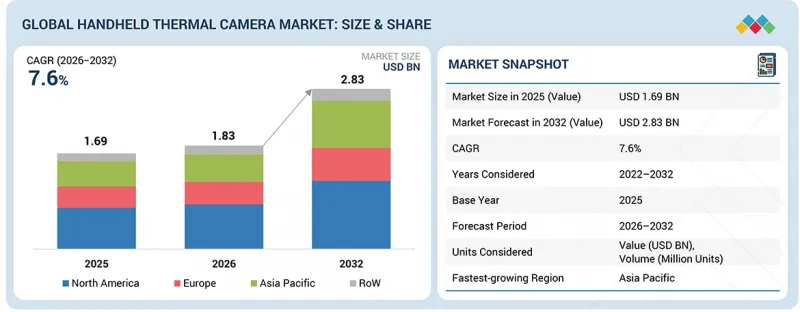
세계의 핸드헬드형 열화상 카메라 시장 규모는 2026년 18억 3,000만 달러에서 2032년까지 28억 3,000만 달러로 성장할 것으로 예상되며, CAGR은 7.6%에 달할 것으로 예측됩니다.
제조, 에너지, 자동차, 공공사업 등의 업계에서 예측 유지보수 도입이 확대됨에 따라 핸드헬드형 열화상 카메라에 대한 수요가 크게 증가하고 있습니다.
| 조사 범위 | |
|---|---|
| 조사 대상 기간 | 2021-2032년 |
| 기준 연도 | 2025년 |
| 예측 기간 | 2026-2032년 |
| 대상 단위 | 금액(10억 달러) |
| 부문 | 직종별, 가격대별, 유통 채널별, 용도별, 업계별, 지역별 |
| 대상 지역 | 북미, 유럽, 아시아태평양, 기타 지역 |
기업에서는 고장이 발생하기 전에 장비의 상태를 모니터링하고, 모터, 변압기, 전기반, 베어링, 기계 시스템의 온도 이상을 감지하기 위해 핸드헬드형 열화상 카메라의 사용이 점점 더 늘어나고 있습니다. 이러한 장비들은 비접촉 방식의 실시간 검사를 가능하게 하여, 산업 분야에서 예기치 못한 가동 중단 시간의 감소, 유지보수 비용의 최소화, 업무 효율의 향상, 그리고 작업자의 안전성 제고에 기여하고 있습니다. 산업 분야가 자산의 신뢰성, 에너지 효율, 예방 유지보수 전략에 지속적으로 주력하는 가운데, 예측 유지보수 용도로 핸드헬드형 열화상 카메라의 도입이 전 세계적으로 급속히 증가하고 있습니다.
"직종별로는 건축 검사원 및 에너지 감사 부문이 예측 기간 동안 가장 높은 연평균 성장률(CAGR)을 기록할 것으로 예상됩니다."
에너지 효율, 인프라 현대화 및 지속가능한 건물 관리에 대한 관심이 높아짐에 따라, 건물 검사 및 에너지 감사 부문은 핸드헬드형 열화상 카메라 시장에서 가장 빠른 성장세를 보일 것으로 예상됩니다. 핸드헬드형 열화상 카메라는 주택, 상업용 및 산업용 건물에서 열 손실, 단열 불량, 습기 침투, 공기 누출 및 전기적 문제를 감지하기 위해 건물 검사관이나 에너지 감사관들이 널리 사용하고 있습니다. 에너지 절약에 관한 정부 규제의 강화, 그린 빌딩 기준의 확대 적용, 그리고 에너지 비용 절감에 대한 인식 제고가 건물 검사 및 에너지 감사 분야에서 열화상 솔루션에 대한 수요를 크게 견인하고 있습니다. 또한, 건설 업계의 성장과 리모델링 활동의 활성화도 이 부문의 성장을 뒷받침하고 있습니다.
"예측 기간 동안 산업별로는 비산업용 부문이 가장 빠르게 성장할 것으로 예상됩니다."
비산업용 부문은 주택, 상업, 의료, 보안, 소방 및 실외 용도에서의 채택이 확대됨에 따라 핸드헬드형 열화상 카메라 시장에서 가장 빠른 성장세를 보일 것으로 예상됩니다. 비접촉식 온도 모니터링, 주택 검사, 에너지 감사 및 개인 안전에 대한 인식이 높아짐에 따라, 소비자와 중소기업에서 핸드헬드형 열화상 카메라의 사용이 증가하고 있습니다. 또한, 합리적인 가격의 스마트폰 호환 열화상 카메라, 소형 휴대용 기기, 그리고 사용자 친화적인 열화상 솔루션의 접근성이 높아짐에 따라, 기존 산업 분야 사용자 외에도 도입이 확대되고 있습니다. 건축 진단, 모니터링, 긴급 대응 및 자동차 고장 진단 분야의 활용 증가가 비산업용 부문의 성장을 더욱 가속화하고 있습니다.
"2025년, 중국은 아시아태평양의 핸드헬드형 열화상 카메라 시장에서 가장 큰 점유율을 차지했습니다."
중국은 견고한 제조 기반, 급속한 산업화, 그리고 전자, 자동차, 에너지, 제조 등 다양한 산업 분야에서 예측 유지보수 및 산업 자동화 기술이 광범위하게 도입됨에 따라, 아시아태평양의 핸드헬드형 열화상 카메라 시장에서 가장 큰 점유율을 차지하고 있습니다. 이 나라에는 여러 열화상 카메라 제조사와 전자기기 생산 거점이 있어, 핸드헬드형 열화상 카메라의 대규모 생산과 비용 효율적인 공급을 뒷받침하고 있습니다. 또한, 인프라 개발, 스마트 제조, 감시 시스템, 에너지 관리 솔루션에 대한 투자 확대가 중국 내 열화상 장치 수요를 크게 견인하고 있습니다.
본 보고서에서 다루고 있는 주요 기업으로는 Teledyne FLIR(미국), Fluke Corporation(미국), Hikmicro(중국), Testo SE & Co KGaA(독일), Guide Sensmart(중국), Infiray(중국), Seek Thermal(미국) 등이 포함됩니다.
조사 범위:
본 보고서에서는 직종(전기 기술자, HVAC/R 기술자, 건축 검사관·에너지 감사원, 배관공·상수도·누수 탐지 전문가, 소방관·소방 공무원, 기타), 가격대(엔트리 레벨(799달러 미만), 미드레인지(800-2,999달러), 프리미엄(3,000달러 이상)), 판매 채널(제조사 직판/웹 스토어, 도매업체/산업용 유통업체, 전문 판매 채널(전기, HVAC), DIY 대형 매장/소매, E-Commerce), 용도(전기 검사, 건물 진단·에너지 감사, HVAC 및 기계 유지보수, 건설(습기·단열), DIY·스마트폰용 플러그인), 업종(산업용, 비산업용), 및 지역(북미, 유럽, 아시아태평양, 기타)입니다. 본 보고서에서는 시장 성장에 영향을 미치는 촉진요인, 제약요인, 기회 및 과제에 대한 상세한 정보를 제공합니다. 또한 인수, 제품 출시, 사업 확장 및 시장 내 성장을 위한 주요 기업의 노력 등 경쟁 환경의 동향에 대해서도 분석하고 있습니다.
이 보고서를 구매해야 하는 이유:
본 보고서는 핸드헬드형 열화상 카메라 시장 전체 및 그 하위 부문의 매출에 관한 가장 정확한 추정치를 제공하여, 시장 선도 기업과 신규 진입 기업에게 유용한 정보를 제공합니다. 또한, 이해관계자들이 경쟁 구도를 파악하고 자사의 비즈니스를 더 유리한 위치에 두며, 적절한 시장 진입 전략을 수립하는 데 필요한 인사이트를 얻는 데 도움이 됩니다. 또한, 시장 동향을 파악하고 주요 촉진요인, 제약요인, 기회 및 과제에 관한 정보를 제공합니다.
본 보고서에서는 다음 사항에 대한 인사이트를 제공합니다:
- 주요 DROC(시장 성장요인) 분석 : 촉진요인(전 산업 분야에서의 예측 유지보수 도입 확대, 비접촉식 체온 모니터링 및 전기 검사 애플리케이션에 대한 수요 증가), 제약요인(고급 고해상도 핸드헬드형 열화상 카메라의 높은 비용, 저비용 대체 검사·진단 기술과의 경쟁), 기회(소비자 간 스마트폰 호환형 및 DIY용 열화상 카메라의 보급 확대, 산업화와 인프라 개발에 힘입은 아시아태평양 신흥 시장의 성장 기회), 및 과제(가혹한 환경 조건 하에서 열화상 정확도와 성능 유지, 개발도상 지역에서의 열화상 분석에 대한 낮은 인지도 및 숙련된 전문가 부족)
- 제품 개발 및 혁신 : 핸드헬드형 열화상 카메라 시장의 향후 기술, 연구 개발 활동 및 신제품 출시에 대한 심층 분석
- 시장 개발 : 수익성이 높은 시장에 대한 종합적인 정보(본 보고서에서는 각 지역의 핸드헬드형 열화상 카메라 시장을 분석하고 있습니다)
- 시장의 다각화 : 핸드헬드형 열화상 카메라 시장의 신제품 출시, 미개척 지역, 최근 동향 및 투자에 관한 종합적인 정보
- 경쟁사 분석 : Teledyne FLIR(미국), Fluke Corporation(미국), Hikmicro(중국), Testo SE & Co KGaA(독일), Guide Sensmart(중국) 등, 핸드헬드형 열화상 카메라 시장의 주요 기업들의 시장 점유율, 성장 전략 및 제품·서비스에 대한 상세한 평가
자주 묻는 질문
목차
제1장 소개
제2장 주요 요약
제3장 주요 인사이트
제4장 시장 개요
제5장 업계 동향
제6장 기술 진보, AI에 의한 영향, 특허, 혁신, 그리고 향후 응용
제7장 규제 상황
제8장 고객 상황과 구매 행동
제9장 핸드헬드형 열화상 카메라 시장, 직종별(시장 규모 및 2032년까지 예측 - 100만 달러)
제10장 핸드헬드형 열화상 카메라 시장, 가격대별(시장 규모 및 2032년까지 예측 - 100만 달러)
제11장 핸드헬드형 열화상 카메라 시장, 유통 채널별(시장 규모 및 2032년까지 예측 - 100만 달러)
제12장 핸드헬드형 열화상 카메라 시장, 용도별(시장 규모 및 2032년까지 예측 - 100만 달러)
제13장 핸드헬드형 열화상 카메라 시장, 업계별(시장 규모 및 2032년까지 예측 - 100만 달러)
제14장 핸드헬드형 열화상 카메라 시장, 지역별
제15장 핸드헬드형 열화상 카메라 시장, 경쟁 구도
제16장 핸드헬드형 열화상 카메라 시장, 기업 개요
제17장 조사 방법
제18장 부록
KSM 26.06.19The global handheld thermal camera market is projected to grow from USD 1.83 billion in 2026 to USD 2.83 billion by 2032, registering a CAGR of 7.6%. The demand for handheld thermal cameras is growing significantly due to the increasing adoption of predictive maintenance across industries such as manufacturing, energy, automotive, and utilities.
| Scope of the Report | |
|---|---|
| Years Considered for the Study | 2021-2032 |
| Base Year | 2025 |
| Forecast Period | 2026-2032 |
| Units Considered | Value (USD Billion) |
| Segments | By Profession Type, Application and Region |
| Regions covered | North America, Europe, APAC, RoW |
Companies are increasingly using handheld thermal cameras to monitor equipment conditions and detect temperature abnormalities in motors, transformers, electrical panels, bearings, and mechanical systems before failures occur. These devices enable non-contact and real-time inspection, helping industries reduce unplanned downtime, minimize maintenance costs, improve operational efficiency, and enhance worker safety. As industries continue to focus on asset reliability, energy efficiency, and preventive maintenance strategies, the adoption of handheld thermal cameras for predictive maintenance applications is rapidly increasing globally.
"Building inspectors & energy audits, by profession type, is expected to record the highest CAGR during the forecast period."
The building inspection & energy audit segment is expected to witness the fastest growth in the handheld thermal camera market due to increasing focus on energy efficiency, infrastructure modernization, and sustainable building management. Handheld thermal cameras are widely used by building inspectors and energy auditors to detect heat leakage, insulation defects, moisture intrusion, air leakage, and electrical issues in residential, commercial, and industrial buildings. Growing government regulations related to energy conservation, rising adoption of green building standards, and increasing awareness regarding energy cost reduction are significantly driving the demand for thermal imaging solutions in building inspection and energy auditing applications. Additionally, the growing construction industry and renovation activities are further supporting segment growth.
"The non-industrial segment is expected to grow fastest, by vertical, during the forecast period."
The non-industrial segment is expected to witness the fastest growth in the handheld thermal camera market due to increasing adoption across residential, commercial, healthcare, security, firefighting, and outdoor applications. Rising awareness regarding non-contact temperature monitoring, home inspection, energy auditing, and personal safety is driving the use of handheld thermal cameras among consumers and small businesses. In addition, the growing availability of affordable smartphone-compatible thermal cameras, compact portable devices, and user-friendly thermal imaging solutions is expanding adoption beyond traditional industrial users. Increasing use in building diagnostics, surveillance, emergency response, and automotive troubleshooting is further accelerating the growth of the non-industrial segment.
"China secured the largest share of the Asia Pacific handheld thermal camera market in 2025."
China holds the largest share in the Asia Pacific handheld thermal camera market due to its strong manufacturing base, rapid industrialization, and extensive adoption of predictive maintenance and industrial automation technologies across industries such as electronics, automotive, energy, and manufacturing. The country is home to several thermal imaging manufacturers and electronics production hubs, which supports large-scale production and cost-effective availability of handheld thermal cameras. In addition, rising investments in infrastructure development, smart manufacturing, surveillance systems, and energy management solutions are significantly driving demand for thermal imaging devices in China.
- By Company Type: Tier 1 - 30%, Tier 2 - 50%, and Tier 3 - 20%
- By Designation: Directors - 40%, C-level Executives - 30%, and Others - 30%
- By Region: North America - 20%, Europe - 30%, Asia Pacific - 40%, and RoW - 10%
Prominent players profiled in this report include Teledyne FLIR (US), Fluke Corporation (US), Hikmicro (China), Testo SE & Co KGaA (Germany), Guide Sensmart (China), Infiray (China), and Seek Thermal (US) among others.
Research Coverage:
The report defines, describes, and forecasts the handheld thermal camera market based on profession type (Electricians, HVAC/R Technicians, Building Inspectors & Energy Auditors, Plumbers & Water/Leak Detection Specialists, Firefighters & Fire Service Personnel, Others), price tier (Entry Level (Below 799), Mid Range (800-2,999), Premium (Above 3,000)), distribution channel (Manufacturer Direct/Web Store, Wholesalers/Industrial Distributors, Specialist Trade Channels (Electrical, HVAC), DIY Superstores/Retail, E-Commerce), application (Electrical Inspection, Building Diagnostics/Energy Audits, HVAC & Mechanical Maintenance, Construction (Moisture & Insulation), DIY/Smartphone Plugins), vertical (Industrial, Non-Industrial), and region (North America, Europe, Asia Pacific, and RoW). It provides detailed information regarding drivers, restraints, opportunities, and challenges influencing the market's growth. It also analyzes competitive developments, including acquisitions, product launches, expansions, and actions taken by key players to grow in the market.
Reasons to Buy this Report:
The report will help market leaders/new entrants with information on the closest approximations of the revenue for the overall handheld thermal camera market and its subsegments. The report will help stakeholders understand the competitive landscape and gain more insight to position their business better and plan suitable go-to-market strategies. The report also helps stakeholders understand the market's pulse and provides information on key drivers, restraints, opportunities, and challenges.
The report will provide insights into the following points:
- Analysis of Key DROCs: Drivers (Increasing adoption of predictive maintenance across industrial sectors, Rising demand for non-contact temperature monitoring and electrical inspection applications), restraints (High cost of advanced high-resolution handheld thermal cameras, Competition from low-cost alternative inspection and diagnostic technologies), opportunities (Growing adoption of smartphone-compatible and DIY thermal cameras among consumers, Expansion opportunities in emerging Asia Pacific markets driven by industrialization and infrastructure development), and challenges (Maintaining thermal imaging accuracy and performance in harsh environmental conditions, Limited awareness and shortage of skilled professionals for thermal image analysis in developing regions) of the handheld thermal camera market
- Product Development/Innovation: Detailed insights into upcoming technologies, research & development activities, and product launches in the handheld thermal camera market
- Market Development: Comprehensive information about lucrative markets (The report analyzes the handheld thermal camera market across various regions)
- Market Diversification: Exhaustive information about new products launched, untapped geographies, recent developments, and investments in the handheld thermal camera market
- Competitive Assessment: In-depth assessment of market share, growth strategies, and offerings of leading players, including Teledyne FLIR (US), Fluke Corporation (US), Hikmicro (China), Testo SE & Co KGaA (Germany), Guide Sensmart (China), in the handheld thermal camera market
TABLE OF CONTENTS
1. Introduction
- 1.1. Study Objectives
- 1.2. Market Definition
- 1.3. Market Scope
- 1.3.1. Market Segmentation and Regional Scope
- 1.3.2. Inclusions and Exclusions
- 1.3.3. Years Considered
- 1.4. Currency Considered
- 1.5. Unit Considered
- 1.6. Limitations
- 1.7. Stakeholders
- 1.8. Summary of Changes
2. Executive Summary
- 2.1. Key Insights and Market Highlights
- 2.2. Key Market Participants: Mapping of Strategic Developments
- 2.3. Disruptive Trends in the Handheld Thermal Camera Market
- 2.4. High-Growth Segments
- 2.5. Regional Snapshot: Market Size, Growth Rate, and Forecast
3. Premium Insights
4. Market Overview
- 4.1. Introduction
- 4.2. Market Dynamics
- 4.2.1. Drivers
- 4.2.1.1. Rising demand for predictive maintenance and industrial inspection
- 4.2.1.2. Increasing adoption in defense, security, and firefighting applications
- 4.2.2. Restraints
- 4.2.2.1. Limited awareness and slow adoption in small and medium enterprises (SMEs)
- 4.2.2.2. Performance limitations in extreme environmental conditions,
- 4.2.3. Opportunities
- 4.2.3.1. Growing integration with AI and IoT platforms
- 4.2.3.2. Expanding use in automotive diagnostics and consumer electronics repair markets
- 4.2.4. Challenges
- 4.2.4.1. High device cost and expensive thermal sensor components
- 4.2.4.2. Technical complexity in image resolution and calibration
- 4.2.1. Drivers
- 4.3. Interconnected Markets and Cross-Sector Opportunities
- 4.4. Strategic Moves by Tier-1/2/3 Players
5. Industry Trends
- 5.1. Introduction
- 5.2. Porters Five Force Analysis
- 5.2.1. Threat from New Entrants
- 5.2.2. Threat of Substitutes
- 5.2.3. Bargaining Power of Suppliers
- 5.2.4. Bargaining Power of Buyers
- 5.2.5. Intensity of Competitive Rivalry
- 5.3. Macroeconomics Indicators
- 5.3.1. Introduction
- 5.3.2. GDP Trends and Forecast
- 5.3.3. Trends in Global Manufacturing Industry
- 5.3.4. Trends in Global Defense Industry
- 5.4. Value Chain Analysis
- 5.5. Ecosystem Analysis
- 5.6. Pricing Analysis
- 5.6.1. Average Selling Price Trend of Vertical, By Key Players, 2025
- 5.6.2. Average Selling Price Trend, By Application, 2025
- 5.6.3. Average Selling Price Trend, By Region, 2022-2025
- 5.7. Trade Analysis
- 5.7.1. Import Scenario (HS Code 9027)
- 5.7.2. Export Scenario (HS Code 9027)
- 5.8. Key Conferences and Events, 2026-2027
- 5.9. Trends/Disruptions Impacting Customer Business
- 5.10. Investment and Funding Scenario
- 5.11. Case Study Analysis
- 5.12. Impact of 2025 US Tariff - Handheld Thermal Camera Market
- 5.12.1. Introduction
- 5.12.1.1. Key Tariff Rates
- 5.12.1.2. Price Impact Analysis
- 5.12.2. Impact on Countries/Regions
- 5.12.2.1. US
- 5.12.2.2. Europe
- 5.12.2.3. APAC
- 5.12.3. Impact on End-use Industries
- 5.12.1. Introduction
6. Technological Advancements, AI-Driven Impact, Patents, Innovations, and Future Applications
- 6.1. Key Technologies
- 6.1.1. Uncooled microbolometer infrared sensors
- 6.1.2. Thermal image processing
- 6.2. Complementary Technologies
- 6.2.1. AI-based analytics software
- 6.2.2. Wireless connectivity modules
- 6.3. Adjacent Technologies
- 6.3.1. Visible-light imaging
- 6.3.2. Laser distance measurement
- 6.4. Technology/Product Roadmap
- 6.5. Patent Analysis
- 6.6. Impact of AI/Gen AI on Handheld Thermal Camera Market
- 6.6.1. Top Use Cases and Market Potential
- 6.6.2. Best Practices Followed by Manufacturers / OEMs in the Handheld Thermal Camera Market
- 6.6.3. Case Studies Related to AI Implementation in the Handheld Thermal Camera Market
- 6.6.4. Interconnected Ecosystem and Impact on Market Players
- 6.6.5. Clients' Readiness to Adopt AI-Integration in Handheld Thermal Camera
7. Regulatory Landscape
- 7.1. Regional Regulations and Compliance
- 7.1.1. Regulatory Bodies, Government Agencies, And Other Organizations
- 7.1.2. Industry Standards
8. Customer Landscape & Buyer Behavior
- 8.1. Introduction
- 8.2. Decision-Making Process
- 8.3. Key Stakeholders Involved in Buying Process and their Evaluation Criteria
- 8.3.1. Key Stakeholders in Buying Process
- 8.3.2. Buying Criteria
- 8.4. Adoption Barriers & Internal Challenges
- 8.5. Unmet Needs of Various End-use Industries
9. Handheld Thermal Camera Market, By Profession Type (Market Size & Forecast to 2032 - USD Million)
- 9.1. Introduction
- 9.2. Electricians
- 9.3. HVAC/R Technicians
- 9.4. Building Inspectors & Energy Auditors
- 9.5. Plumbers & Water/Leak Detection Specialists
- 9.6. Firefighters & Fire Service Personnel
- 9.7. Others
10. Handheld Thermal Camera Market, By Price Tier (Market Size & Forecast to 2032 - USD Million)
- 10.1. Introduction
- 10.2. Entry Level (Below 799)
- 10.3. Mid-Range (800-2,999)
- 10.4. Premium (Above 3,000)
11. Handheld Thermal Camera Market, By Distribution Channel (Market Size & Forecast to 2032 - USD Million)
- 11.1. Introduction
- 11.2. Manufacturer Direct / Web Store
- 11.3. Wholesalers / Industrial Distributors
- 11.4. Specialist Trade Channels (Electrical, HVAC)
- 11.5. DIY Superstores / Retail
- 11.6. E-Commerce (Amazon, etc.)
12. Handheld Thermal Camera Market, By Application (Market Size & Forecast to 2032 - USD Million)
- 12.1. Introduction
- 12.2. Electrical Inspection
- 12.3. Building Diagnostics / Energy Audits
- 12.4. HVAC & Mechanical Maintenance
- 12.5. Construction (Moisture & Insulation)
- 12.6. DIY / Smartphone Plugins
13. Handheld Thermal Camera Market, By Vertical (Market Size & Forecast to 2032 - USD Million)
- 13.1. Introduction
- 13.2. Industrial
- 13.3. Non-Industrial
14. Handheld Thermal Camera Market, By Region
- 14.1. Introduction
- 14.2. North America
- 14.2.1. US
- 14.2.2. Canada
- 14.2.3. Mexico
- 14.3. Europe
- 14.3.1. Germany
- 14.3.2. UK
- 14.3.3. France
- 14.3.4. Spain
- 14.3.5. Italy
- 14.3.6. Netherlands
- 14.3.7. Belgium
- 14.3.8. Nordics
- 14.3.9. Rest of Europe
- 14.4. Asia Pacific
- 14.4.1. China
- 14.4.2. Australia
- 14.4.3. Japan
- 14.4.4. India
- 14.4.5. South Korea
- 14.4.6. Rest of Asia Pacific
- 14.5. Rest of the World (RoW)
- 1.1.1. Middle East
- 14.5.1. Bahrain
- 14.5.2. Kuwait
- 14.5.3. Oman
- 14.5.4. Qatar
- 14.5.5. Saudi Arabia
- 14.5.6. UAE
- 14.5.7. Rest of Middle East
- 14.5.8. Africa
- 14.5.8.1. South Africa
- 14.5.8.2. Rest of Africa
- 14.5.9. South America
- 14.5.9.1. Brazil
- 14.5.9.2. Argentina
- 14.5.9.3. Rest of South America
15. Handheld Thermal Camera Market, Competitive Landscape
- 15.1. Overview
- 15.2. Key Player Competitive Strategies/Right to Win
- 15.3. Revenue Analysis, 2022-2025
- 15.4. Market Share Analysis, 2025
- 15.5. Brand/Product/Technology Comparison
- 15.6. Company Evaluation Matrix: Key Players, 2025
- 15.6.1. Stars
- 15.6.2. Emerging Leaders
- 15.6.3. Pervasive Players
- 15.6.4. Participants
- 15.6.5. Company Footprint: Key Players, 2025
- 15.6.5.1. Company Footprint
- 15.6.5.2. Region Footprint
- 15.6.5.3. Vertical Footprint
- 15.6.5.4. Profession Type Footprint
- 15.6.5.5. Distribution Channel Footprint
- 15.6.5.6. Application Footprint
- 15.7. Company Evaluation Matrix: Startups/SMEs, 2025
- 15.7.1. Progressive Companies
- 15.7.2. Responsive Companies
- 15.7.3. Dynamic Companies
- 15.7.4. Starting Blocks
- 15.7.5. Competitive Benchmarking: Startups/SMEs, 2025
- 15.7.5.1. Detailed List of Key Startups/SMEs
- 15.7.5.2. Competitive Benchmarking of Key Startups/SMEs
- 15.8. Company Valuation and Financial Metrics
- 15.9. Competitive Scenario
- 15.9.1. Product Launches
- 15.9.2. Deals
- 15.9.3. Expansions
16. Handheld Thermal Camera Market, Company Profiles
- 16.1. Key Players
- 16.1.1. Teledyne FLIR
- 16.1.2. Fluke Corporation
- 16.1.3. Hikmirco
- 16.1.4. Testo SE & Co KGaA
- 16.1.5. Guide Sensmart
- 16.1.6. Infiray
- 16.1.7. Seek Thermal
- 16.1.8. Bosch
- 16.1.9. Optris
- 16.1.10. Dali Technology
- 16.2. Other Players
- 16.2.1. Topdon
- 16.2.2. Thermal Master
- 16.2.3. SATIR
- 16.2.4. HT Instruments
- 16.2.5. Klein Tools
- 16.2.6. Milwaukee Tools
- 16.2.7. Perfect Prime
- 16.2.8. Bullard
- 16.2.9. L3Harris Technologies
- 16.2.10. Leonardo DRS
- 16.2.11. Dahua Technology
- 16.2.12. Workswell
- 16.2.13. Jenoptik
- 16.2.14. Opgal Electronics
- 16.2.15. Axis Communications
17. Research Methodology
- 17.1. Research Data
- 17.1.1. Secondary Data
- 17.1.1.1. Key Data from Secondary Sources
- 17.1.2. Primary Data
- 17.1.2.1. Key data from primary sources
- 17.1.2.2. Key primary participants
- 17.1.2.3. Breakdown of primary interviews
- 17.1.2.4. Key industry insights
- 17.1.1. Secondary Data
- 17.2. Market Size Estimation
- 17.2.1. Bottom-Up Approach
- 17.2.2. Top-Down Approach
- 17.2.3. Base Number Calculation
- 17.3. Market Forecast Approach
- 17.3.1. Supply Side
- 17.3.2. Demand Side
- 17.4. Data Triangulation
- 17.5. Factor Analysis
- 17.6. Research Assumptions
- 17.7. Research Limitations and Risk Assessment
18. Appendix
- 18.1. Discussion Guide
- 18.2. Knowledge Store: MarketsandMarkets' Subscription Portal
- 18.3. Customization Options
- 18.4. Related Reports
- 18.5. Author Details


