|
시장보고서
상품코드
2092400
해상 풍력발전 시장 예측(-2035년) : 컴포넌트별, 수심별, 기초 유형별, 터빈 정격별, 지역별Offshore Wind Market by Component (Turbines, Substructures, Electrical Infrastructure), Water Depth (Shallow Water, Transitional Water, Deep Water), Foundation Type (Fixed, Floating), Turbine Rating, and Region - Global Forecast to 2035 |
||||||

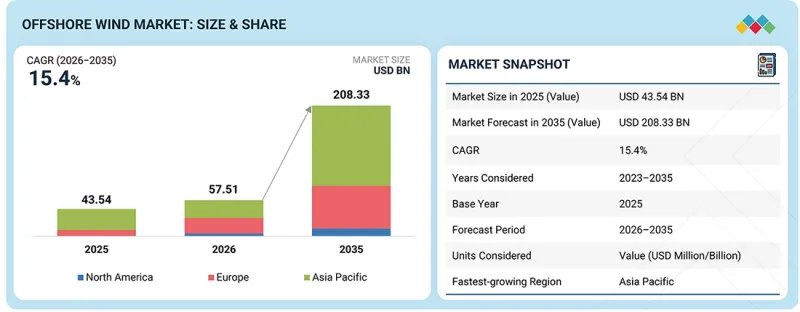
해상 풍력발전 시장 규모는 2026년 575억 1,000만 달러에서 2035년까지 2,083억 3,000만 달러로 성장하며, 예측 기간 중 CAGR은 15.4%에 달할 것으로 추정되고 있습니다.
재생에너지 발전의 급속한 확대, 에너지 안보에 대한 우려 고조, 야심 찬 탈탄소화 목표, 그리고 해상 재생에너지 인프라에 대한 투자 증가가 세계 시장에서 해상 풍력발전 프로젝트에 대한 수요를 크게 견인하고 있습니다.
| 조사 범위 | |
|---|---|
| 조사 대상 기간 | 2023-2035년 |
| 기준연도 | 2025년 |
| 예측 기간 | 2026-2035년 |
| 산정 단위 | 금액(10억 달러) |
| 부문 | 컴포넌트별, 수심별, 기초 유형별, 터빈 정격별, 지역별 |
| 대상 지역 | 북미, 아시아태평양, 유럽 |
각국이 저탄소 에너지 시스템으로의 전환을 가속화하는 가운데, 해상 풍력발전은 높은 설비 가동률, 풍부한 풍력 자원, 그리고 장기적인 에너지 지속가능성 목표를 지원하는 능력을 바탕으로 대규모 재생 전력 생산의 중요한 원천으로 자리매김하고 있습니다. 터빈 설계, 기초 공학, 해상 송전 시스템 및 디지털 자산 관리 솔루션의 발전에 힘입어, 해상 풍력발전 기술은 대규모 재생에너지 프로젝트에서 점점 더 널리 도입되고 있습니다.
최신 해상 풍력발전소에서는 15MW를 초과하는 대형 터빈 플랫폼, 첨단 모노파일 및 재킷식 기초, 부유식 해상 풍력발전 기술, 고전압 직류 송전 시스템이 도입되어 발전 효율과 프로젝트의 경제성 향상을 도모하고 있습니다. 이러한 프로젝트에서는 발전량 최적화, 설치 비용 절감, 그리고 가혹한 해상 환경 조건 하에서도 신뢰성 높은 운영을 보장하기 위해 첨단 엔지니어링 역량이 요구됩니다. 부유식 기초, 디지털 트윈, AI를 활용한 예측 유지보수 시스템, 자율형 점검 드론, 실시간 자산 성과 분석 등 차세대 기술의 도입이 확대됨에 따라 첨단 해상 풍력발전 솔루션에 대한 수요가 가속화되고 있습니다. 개발업체와 전력회사는 디지털화 및 지능형 자산 관리 플랫폼을 통해 에너지 생산량 극대화, 가동 중단 시간 단축, 자산 신뢰성 향상, 그리고 프로젝트 수명 주기 연장에 점점 더 주력하고 있습니다. 이러한 혁신 기술을 통해 해상 풍력발전소 전체의 터빈 성능, 구조적 건전성, 기상 조건 및 유지보수 요건을 효율적으로 모니터링할 수 있게 됩니다.
"구성 요소별로는 예측 기간 중 터빈 부문이 해상 풍력발전 시장에서 가장 큰 비중을 차지할 것으로 예상됩니다."
터빈 부문은 예측 기간 중 해상 풍력발전 시장에서 가장 큰 점유율을 차지할 것으로 예상됩니다. 이는 주로 유틸리티 규모의 재생에너지 프로젝트 전반에 걸쳐 대용량 해상 풍력발전 터빈의 도입이 증가하고 있기 때문입니다. 해상 풍력발전 터빈은 해상 풍력발전소의 핵심 발전 설비이며, 프로젝트 총 설비 투자액의 대부분을 차지합니다. 개발업체와 전력회사는 발전량을 극대화하고, 설비 가동률을 높이며, 균등화 발전 원가(LCOE)를 절감하기 위해 10MW 및 15MW를 초과하는 첨단 터빈 플랫폼에 대한 투자를 확대하고 있습니다. 이 터빈들은 더 큰 로터 직경, 첨단 블레이드 소재, 다이렉트 드라이브 발전기 기술 및 지능형 제어 시스템을 채택하여 변화하는 해상 풍황에서도 성능을 최적화합니다. 차세대 터빈 기술의 도입이 확대됨에 따라 개발 사업자는 설치 대수를 줄이면서도 더 많은 전력을 생산할 수 있게 되며, 그 결과 기초 공사, 케이블 매설, 설치 및 유지보수 비용을 절감할 수 있습니다. 해상 풍력발전 터빈은 효율적인 에너지 변환을 지원하며, 프로젝트의 경제성, 운전 신뢰성 및 장기적인 자산 성과를 극대화하는 데 있으며, 매우 중요한 역할을 수행하고 있습니다. 블레이드의 공기역학적 특성, 구동계 시스템, 전력 전자 장치 및 디지털 모니터링 플랫폼 분야의 지속적인 발전 덕분에 터빈의 효율과 가동 수명이 더욱 향상되고 있습니다. 유럽, 아시아태평양, 북미 전역에서 대규모 해상 풍력발전 단지의 개발이 확대됨에 따라 첨단 해상 풍력발전 터빈에 대한 수요가 크게 증가하고 있습니다. 각 터빈 제조사들은 프로젝트의 전체 수명 주기에 걸쳐 발전량을 향상시키고, 가동 중지 시간을 줄이며, 유지보수 전략을 최적화하기 위해 디지털 트윈, AI 기반 예측 유지보수 시스템, 상태 모니터링 기술 및 실시간 자산 분석을 점점 더 통합하고 있습니다.
"터빈 정격 출력별로 살펴보면, 예측 기간 중 15MW를 초과하는 부문이 해상 풍력발전 시장에서 가장 빠른 성장세를 보일 것으로 전망됩니다."
15MW를 초과하는 부문은 발전량 증가, 프로젝트 경제성 향상, 그리고 균등화 발전 원가(LCOE) 절감에 대한 수요 증가를 배경으로, 예측 기간 중 해상 풍력발전 시장에서 가장 빠른 성장을 이룰 것으로 전망됩니다. 해상 풍력발전 개발업체와 전력 회사는 발전량을 극대화하고, 프로젝트당 터빈 설치 대수를 줄이며, 설치 및 유지보수 비용을 최적화하기 위해 15MW를 초과하는 차세대 터빈 플랫폼의 도입을 점점 더 확대하고 있습니다. 주요 터빈 제조사들은 해상 환경에서 뛰어난 성능을 발휘하기 위해 더 큰 로터 직경, 첨단 블레이드 기술, 그리고 대용량 발전기 개발에 막대한 투자를 하고 있습니다. 현대 해상 풍력발전 프로젝트에서는 설비 가동률 향상, 프로젝트 수익성 강화, 그리고 대규모 재생에너지 도입을 지원하기 위해 초대형 터빈에 대한 의존도가 높아지고 있습니다. 이 터빈들은 더 많은 풍력에너지를 확보하고, 연간 발전량을 늘리며, 기초, 케이블 및 설치와 관련된 발전소 부대 설비(BOP) 비용을 절감하도록 설계되었습니다. 15MW를 초과하는 터빈의 도입은 특히 유럽, 중국, 대만, 한국 및 신흥 해상 풍력발전 시장에서 탄력을 받고 있으며, 이들 지역에서는 정부와 개발 사업자들이 더 높은 효율과 낮은 수명 주기 비용을 실현하는 대규모 프로젝트를 추진하고 있습니다. 또한 해상 풍력발전 프로젝트 파이프라인의 확대, 해상 송전 인프라에 대한 투자 증가, 정부의 지원적 입찰 프로그램, 그리고 야심 찬 탈탄소화 목표가 전 세계에서 15MW를 초과하는 터빈의 도입을 지원하고 있습니다. 이러한 차세대 터빈 플랫폼을 통해 개발 사업자는 프로젝트 비용을 절감하고, 재생에너지 도입을 가속화하며, 프로젝트 전반의 경쟁력을 높일 수 있습니다.
"지역별로 보면 예측 기간 중 유럽이 두 번째로 큰 시장 점유율을 차지할 것으로 추정됩니다."
유럽은 성숙한 해상 풍력발전 산업, 야심 찬 탈탄소화 목표, 지원적인 규제 체계, 그리고 재생에너지 인프라에 대한 지속적인 투자에 힘입어, 예측 기간 중 해상 풍력발전 시장에서 2위의 점유율을 차지할 것으로 예상됩니다. 영국, 독일, 네덜란드, 노르웨이, 덴마크, 프랑스, 벨기에 등의 국가들은 장기적인 에너지 전환 전략, 경쟁력 있는 입찰 메커니즘, 그리고 유리한 정부 정책에 힘입어 해상 풍력발전 도입 분야에서 세계적인 선도국으로서의 위상을 확립하고 있습니다. 이 지역에는 해상 풍력발전 개발 사업자, 터빈 제조사, 기초 공급업체, 송전 사업자, 엔지니어링 기업, 서비스 제공업체로 구성된 잘 갖춰진 생태계가 형성되어 있으며, 프로젝트의 효율성, 신뢰성 및 발전량 향상을 도모하기 위해 첨단 해상 풍력발전 기술에 지속적으로 투자하고 있습니다.
대규모 해상 풍력발전소, 15MW를 초과하는 차세대 터빈 플랫폼, 그리고 해상 송전 인프라의 도입 확대에 힘입어 유럽 전역에서 시장 성장이 현저히 가속화되고 있습니다. 해상 풍력발전 기술은 재생에너지를 통한 발전, 에너지 안보 목표, 그리고 이산화탄소 배출 감축 노력을 지원하기 위해 널리 활용되고 있습니다. '유럽 그린딜(European Green Deal)'이나 'REPowerEU', 각국의 해상 풍력발전 확대 목표와 같은 정부 프로그램 역시 해당 지역 전체의 시장 성장에 더욱 기여하고 있습니다. 부유식 해상 풍력발전 기술, 해상 변전소, HVDC 송전 시스템, 해저 케이블 네트워크 및 항만 인프라 현대화에 대한 투자는 시장에 진출한 기업에게 큰 비즈니스 기회를 창출하고 있습니다. 또한 녹색 수소 생산, 해상 에너지 허브, 국경을 초월한 전력 상호 연결에 대한 관심이 높아짐에 따라 대규모 해상 재생에너지 프로젝트에 대한 수요가 증가하고 있습니다.
중요한 정성적·정량적 정보를 수집·검증하고, 향후 시장 전망을 평가하기 위해 주요 업계 관계자, 각 분야의 전문가, 주요 시장 참여 기업의 경영진, 업계 컨설턴트 등을 대상으로 상세한 인터뷰를 시행했습니다. 1차 인터뷰의 내역은 다음과 같습니다. :
Siemens Energy(독일), Mingyang Smart Energy Group(중국), Vestas(덴마크), Goldwind(중국), Envision Group(중국)은 해상 풍력발전 시장의 주요 기업 중 일부입니다. 본 조사에서는 이러한 주요 기업에 대해 기업 개요, 최근 동향, 주요 시장 전략 등을 포함한 상세한 경쟁 분석을 수행하고 있습니다.
조사 범위:
이 보고서에서는 구성 요소, 터빈 정격, 수심, 기초 유형 및 지역별로 전 세계 해상 풍력발전 시장을 정의, 설명 및 예측하고 있습니다. 또한 시장에 대한 상세한 정성적·정량적 분석도 제공하고 있습니다. 이 보고서에서는 주요 시장 촉진요인과 과제를 포괄적으로 분석하고 있습니다. 또한 시장의 다양한 중요한 측면에 대해서도 다루고 있습니다. 여기에는 경쟁 환경 분석, 시장 역학, 금액 기준 시장 규모 추산, 그리고 해상 풍력발전 시장의 향후 동향이 포함됩니다.
이 보고서를 구매할 때의 주요 이점
- 이 보고서에서는 해상 풍력발전 시장의 성장에 영향을 미치는 주요 촉진요인(해상 풍력발전 용량 증가 및 재생에너지에 대한 투자 확대, 전력 수요 증가 및 탈탄소화 노력), 제약 요인(높은 설비 투자 및 프로젝트 개발 비용), 기회(부유식 해상 풍력발전 기술의 부상, 신흥 시장에서의 해상 풍력발전 프로젝트 확대), 과제(해상 프로젝트 개발에 따른 환경 및 해양 생태계에 대한 우려)에 대해 분석하고 있습니다.
- 시장 동향: 수익성이 높은 시장에 대한 포괄적인 정보 - 이 보고서에서는 다양한 지역의 해상 풍력발전 시장을 분석하고 있습니다.
- 시장의 다양화: 해상 풍력발전 시장의 신제품 및 서비스, 미개발 지역, 최근 동향, 그리고 신제품 출시에 관한 포괄적인 정보.
- 경쟁사 분석: Goldwind(중국), Envision Group(중국), Ocean Winds(캐나다), Ming Yang Smart Energy Group(중국), Vestas(덴마크), Siemens Energy(독일), Prysmian(이탈리아), GE Vernova(미국), Nexans(프랑스), Sif Group(네덜란드), EEW Group(독일), Schneider Electric(프랑스), Dongfang Electric Wind Power(중국), Doosan(한국), Hitachi Energy(스위스), Orsted(덴마크), Northland Power Inc.(캐나다), CRRC Shandong Power(중국), Principle Power(미국), Shanghai Electric Wind Power Group(중국), SSE Renewables(영국), EDF(프랑스), Aker Solutions(노르웨이), Vattenfall(스웨덴), Equinor ASA(노르웨이) 등, 해상 풍력발전 시장의 주요 기업이 제공하는 제품 및 서비스 현황을 분석하고 있습니다.
- 제품 혁신 및 개발: 제품 혁신과 기술 발전은 해상 풍력발전 시장의 성장을 가속화하는 데 중요한 역할을 하고 있습니다. 특히 고출력 터빈 수요 증가, 발전 효율 향상, 그리고 균등화 발전 원가(LCOE)의 절감이 꼽힙니다. 업계 관계자들은 발전 출력을 극대화하고 프로젝트의 경제성을 높이기 위해 15MW를 초과하는 터빈, 첨단 복합 소재 블레이드, 더 큰 로터 직경, 강화된 구동계 시스템 등 차세대 해상 풍력발전 기술을 지속적으로 도입하고 있습니다. 부유식 해상 풍력발전 기술의 도입 확대는 반잠수식 플랫폼, 스파 부이 구조, 텐션 레그 플랫폼과 같은 혁신적인 기초 솔루션의 개발을 더욱 촉진하고 있으며, 이러한 솔루션들은 고정식 기초를 적용할 수 없는 심해 지역에서 풍력발전 단지를 설치할 수 있게 해줍니다.
선도적인 해상 풍력발전 프로젝트에서는 디지털 트윈 플랫폼, AI를 활용한 예측 유지보수 시스템, 상태 모니터링 센서, 실시간 성능 분석을 통합하는 추세가 점점 더 확산되고 있으며, 이를 통해 프로젝트의 전체 수명 주기 동안 자산의 신뢰성을 높이고, 운영 효율을 최적화하며, 유지보수 비용을 절감하고 있습니다. 이러한 솔루션은 에너지 생산량을 극대화하고 가동 중지 시간을 최소화하는 것이 극히 중요한 유틸리티 규모의 해상 풍력발전소, 하이브리드 재생에너지 프로젝트, 해상 에너지 허브 및 청정 수소 생산 시설에서 널리 활용되고 있습니다.
자주 묻는 질문
목차
제1장 서론
제2장 개요
제3장 주요 인사이트
제4장 시장 개요
제5장 업계 동향
제6장 기술 진보, AI에 의한 영향, 특허, 혁신, 향후 응용
제7장 규제 상황과 지속가능성 구상
제8장 고객 상황과 구매 행동
제9장 해상 풍력발전 시장(컴포넌트별)
제10장 해상 풍력발전 시장(수심별)
제11장 해상 풍력발전 시장(기초 유형별)
제12장 해상 풍력발전 시장(터빈 정격별)
제13장 해상 풍력발전 시장(지역별)
제14장 경쟁 구도
제15장 기업 개요
제16장 조사 방법
제17장 부록
KSA 26.07.23The offshore wind market is estimated to grow from USD 57.51 billion in 2026 to USD 208.33 billion by 2035, at a CAGR of 15.4% during the forecast period. The rapid expansion of renewable energy generation, growing energy security concerns, ambitious decarbonization targets, and increasing investments in offshore renewable infrastructure are significantly driving demand for offshore wind projects across global markets.
| Scope of the Report | |
|---|---|
| Years Considered for the Study | 2023-2035 |
| Base Year | 2025 |
| Forecast Period | 2026-2035 |
| Units Considered | Value (USD BN) |
| Segments | by Component, Water Depth, Foundation Type, Turbine Rating |
| Regions covered | North America, Asia Pacific, Europe |
As countries accelerate the transition toward low-carbon energy systems, offshore wind is becoming a critical source of large-scale renewable electricity generation due to its high capacity factors, abundant wind resources, and ability to support long-term energy sustainability goals. Offshore wind technologies are increasingly being deployed across utility-scale renewable energy projects, supported by advancements in turbine design, foundation engineering, offshore transmission systems, and digital asset management solutions.
Modern offshore wind farms are utilizing larger turbine platforms exceeding 15 MW, advanced monopile and jacket foundations, floating offshore wind technologies, and high-voltage direct current transmission systems to improve energy production efficiency and project economics. These projects require sophisticated engineering capabilities to optimize energy generation, reduce installation costs, and ensure reliable operation under demanding offshore environmental conditions. The growing adoption of next-generation technologies, including floating foundations, digital twins, AI-enabled predictive maintenance systems, autonomous inspection drones, and real-time asset performance analytics, accelerates the demand for advanced offshore wind solutions. Developers and utilities are increasingly focused on maximizing energy yield, reducing operational downtime, improving asset reliability, and extending project lifecycles through digitalization and intelligent asset management platforms. These innovations enable efficient monitoring of turbine performance, structural integrity, weather conditions, and maintenance requirements across offshore wind farms.
"By component, the turbines segment is expected to be the largest type segment in the offshore wind market during the forecast period."
The turbines segment is expected to account for the largest share of the offshore wind market during the forecast period, primarily driven by the increasing deployment of high-capacity offshore wind turbines across utility-scale renewable energy projects. Offshore wind turbines represent the core power-generating component of offshore wind farms and account for a significant portion of total project capital expenditure. Developers and utilities are increasingly investing in advanced turbine platforms exceeding 10 MW and 15 MW to maximize energy production, improve capacity factors, and reduce the levelized cost of electricity. These turbines incorporate larger rotor diameters, advanced blade materials, direct-drive generator technologies, and intelligent control systems to optimize performance under varying offshore wind conditions. The growing adoption of next-generation turbine technologies is enabling developers to generate more electricity with fewer installations, thereby reducing foundation, cabling, installation, and maintenance costs. Offshore wind turbines support efficient energy conversion and play a critical role in maximizing project economics, operational reliability, and long-term asset performance. Continuous advancements in blade aerodynamics, drivetrain systems, power electronics, and digital monitoring platforms are further enhancing turbine efficiency and operational lifespan. The increasing development of large-scale offshore wind farms across Europe, Asia Pacific, and North America is significantly accelerating demand for advanced offshore turbines. Turbine manufacturers are increasingly integrating digital twins, AI-enabled predictive maintenance systems, condition monitoring technologies, and real-time asset analytics to improve energy yield, reduce downtime, and optimize maintenance strategies throughout the project lifecycle.
"By turbine rating, the above 15 MW segment is projected to register the fastest growth in the offshore wind market during the forecast period."
The above 15 MW segment is expected to witness the fastest growth in the offshore wind market during the forecast period, driven by increasing demand for higher energy generation, improved project economics, and lower levelized cost of electricity. Offshore wind developers and utilities are increasingly adopting next-generation turbine platforms exceeding 15 MW to maximize energy output, reduce the number of turbines required per project, and optimize installation and maintenance costs. Leading turbine manufacturers are investing heavily in developing larger rotor diameters, advanced blade technologies, and high-capacity generators to deliver superior performance in offshore environments. Modern offshore wind projects increasingly rely on ultra-large turbines to improve capacity factors, enhance project profitability, and support large-scale renewable energy deployment. These turbines are designed to capture more wind energy, increase annual energy production, and reduce balance-of-plant costs associated with foundations, cabling, and installation. The deployment of turbines above 15 MW is particularly gaining momentum across Europe, China, Taiwan, South Korea, and emerging offshore wind markets where governments and developers are pursuing utility-scale projects with greater efficiency and lower lifecycle costs. Furthermore, expanding offshore wind project pipelines, increasing investments in offshore transmission infrastructure, supportive government auction programs, and ambitious decarbonization targets are driving the adoption of turbines above 15 MW globally. These next-generation turbine platforms enable developers to reduce project costs, accelerate renewable energy deployment, and improve overall project competitiveness.
"By region, Europe is estimated to account for the second-largest market share during the forecast period."
Europe is expected to account for the second-largest share of the offshore wind market during the forecast period, driven by its mature offshore wind industry, ambitious decarbonization targets, supportive regulatory frameworks, and continuous investments in renewable energy infrastructure. Countries such as the UK, Germany, the Netherlands, Norway, Denmark, France, and Belgium have established themselves as global leaders in offshore wind deployment, supported by long-term energy transition strategies, competitive auction mechanisms, and favorable government policies. The region has a well-developed ecosystem of offshore wind developers, turbine manufacturers, foundation suppliers, transmission operators, engineering firms, and service providers that continuously invest in advanced offshore wind technologies to improve project efficiency, reliability, and energy generation.
The increasing deployment of utility-scale offshore wind farms, next-generation turbine platforms exceeding 15 MW, and offshore transmission infrastructure is significantly accelerating market growth across Europe. Offshore wind technologies are widely used to support renewable electricity generation, energy security objectives, and carbon emissions reduction initiatives. Government programs such as the European Green Deal, REPowerEU, and national offshore wind expansion targets are further contributing to market growth across the region. Investments in floating offshore wind technologies, offshore substations, HVDC transmission systems, subsea cable networks, and port infrastructure modernization are creating substantial opportunities for market participants. In addition, the growing focus on green hydrogen production, offshore energy hubs, and cross-border electricity interconnections is increasing demand for large-scale offshore renewable energy projects.
In-depth interviews have been conducted with key industry participants, subject-matter experts, C-level executives of leading market players, and industry consultants, among others, to obtain and verify critical qualitative and quantitative information and to assess future market prospects. The distribution of primary interviews is as follows:
By Company Type: Tier 1 - 45%, Tier 2 - 30%, and Tier 3 - 25%
By Designation: C-level Executives - 35%, Directors - 25%, and Others - 40%
By Region: Asia Pacific - 51%, Europe - 39%, and North America - 10%
Notes: The tiers of the companies are defined based on their total revenues as of 2025. Tier 1: > USD 1 billion, Tier 2: USD 500 million to USD 1 billion, and Tier 3: < USD 500 million.
Other designations include sales managers, engineers, and regional managers.
Siemens Energy (Germany), Mingyang Smart Energy Group Co., Ltd (China), Vestas (Denmark), Goldwind (China), and Envision Group (China) are some of the major players in the offshore wind market. The study includes an in-depth competitive analysis of these key players, including their company profiles, recent developments, and key market strategies.
Research Coverage:
The report defines, describes, and forecasts the global offshore wind market by component, turbine rating, water depth, foundation type, and region. It also offers a detailed qualitative and quantitative analysis of the market. The report comprehensively reviews the major market drivers, restraints, opportunities, and challenges. It also covers various important aspects of the market. These include an analysis of the competitive landscape, market dynamics, market estimates in terms of value, and future trends in the offshore wind market.
Key Benefits of Buying the Report
- It provides an analysis of key drivers (Increasing offshore wind capacity additions and renewable energy investments, Growing electricity demand and decarbonization initiatives), restraints (High capital expenditure and project development costs), opportunities (Emergence of floating offshore wind technology, Expansion of offshore wind projects in emerging markets), challenges (Environmental and marine ecosystem concerns associated with offshore project development) influencing the growth of the offshore wind market.
- Market Development: Comprehensive information about lucrative markets - the report analyzes the offshore wind market across varied regions.
- Market Diversification: Exhaustive information about new products and services, untapped geographies, recent developments, and product launches in the offshore wind market.
- Competitive Assessment: In-depth assessment of market shares, growth strategies, and service offerings of leading players like Goldwind (China), Envision Group (China), Ocean Winds (Canada), Ming Yang Smart Energy Group Co., Ltd. (China), Vestas (Denmark), Siemens Energy (Germany), Prysmian (Italy), GE Vernova (US), Nexans (France), Sif Group (Netherlands), EEW Group (Germany), Schneider Electric (France), Dongfang Electric Wind Power Co., Ltd. (China), Doosan (South Korea), Hitachi Energy (Switzerland), Orsted (Denmark), Northland Power Inc. (Canada), CRRC Shandong Power Co., Ltd. (China), Principle Power (US), Shanghai Electric Wind Power Group (China), SSE Renewables (UK), EDF (France), Aker Solutions (Norway), Vattenfall (Sweden), Equinor ASA (Norway) among others, in the offshore wind market.
- Product Innovation/Development: Product innovation and technological advancement are playing a major role in accelerating the growth of the offshore wind market, particularly with the increasing demand for higher-capacity turbines, improved energy generation efficiency, and reduced levelized cost of electricity. Industry participants are continuously introducing next-generation offshore wind technologies, including turbines exceeding 15 MW, advanced composite blade materials, larger rotor diameters, and enhanced drivetrain systems to maximize power output and improve project economics. The growing adoption of floating offshore wind technologies is further driving the development of innovative foundation solutions such as semi-submersible platforms, spar-buoy structures, and tension-leg platforms that enable wind farm deployment in deep-water environments where fixed-bottom foundations are not feasible.
Advanced offshore wind projects are increasingly integrating digital twin platforms, AI-enabled predictive maintenance systems, condition monitoring sensors, and real-time performance analytics to improve asset reliability, optimize operational efficiency, and reduce maintenance costs throughout the project lifecycle. These solutions are finding widespread applications across utility-scale offshore wind farms, hybrid renewable energy projects, offshore energy hubs, and green hydrogen production facilities, where maximizing energy yield and minimizing downtime are critical.
TABLE OF CONTENTS
1 INTRODUCTION
- 1.1 STUDY OBJECTIVES
- 1.2 MARKET DEFINITION
- 1.3 STUDY SCOPE
- 1.3.1 MARKETS COVERED AND REGIONAL SCOPE
- 1.3.2 INCLUSIONS AND EXCLUSIONS
- 1.3.3 YEARS CONSIDERED
- 1.4 CURRENCY CONSIDERED
- 1.5 LIMITATIONS
- 1.6 STAKEHOLDERS
- 1.7 SUMMARY OF CHANGES
2 EXECUTIVE SUMMARY
- 2.1 MARKET HIGHLIGHTS AND KEY INSIGHTS
- 2.2 KEY MARKET PARTICIPANTS: MAPPING OF STRATEGIC DEVELOPMENTS
- 2.3 DISRUPTIVE TRENDS IN OFFSHORE WIND MARKET
- 2.4 HIGH GROWTH SEGMENTS
- 2.5 REGIONAL SNAPSHOT: MARKET SIZE, GROWTH RATE, AND FORECAST
3 PREMIUM INSIGHTS
- 3.1 ATTRACTIVE OPPORTUNITIES FOR PLAYERS IN OFFSHORE WIND MARKET
- 3.2 OFFSHORE WIND MARKET, BY COMPONENT AND REGION
- 3.3 OFFSHORE WIND MARKET, BY TURBINE RATING
- 3.4 OFFSHORE WIND MARKET, BY COMPONENT
- 3.5 OFFSHORE WIND MARKET, BY FOUNDATION TYPE
- 3.6 OFFSHORE WIND MARKET, BY WATER DEPTH
- 3.7 OFFSHORE WIND MARKET, BY COUNTRY
4 MARKET OVERVIEW
- 4.1 INTRODUCTION
- 4.2 MARKET DYNAMICS
- 4.2.1 DRIVERS
- 4.2.1.1 Increasing implementation of renewable energy policies to support decarbonization
- 4.2.1.2 Growing electricity demand amid rapid urbanization and industrial expansion
- 4.2.2 RESTRAINTS
- 4.2.2.1 High capital expenditure and project development costs
- 4.2.3 OPPORTUNITIES
- 4.2.3.1 Emergence of floating offshore wind technology
- 4.2.3.2 High emphasis on diversifying energy sources and strengthening energy security
- 4.2.4 CHALLENGES
- 4.2.4.1 Environmental and marine ecosystem concerns in offshore project development
- 4.2.1 DRIVERS
- 4.3 UNMET NEEDS AND WHITE SPACES
- 4.4 INTERCONNECTED MARKETS AND CROSS-SECTOR OPPORTUNITIES
- 4.5 STRATEGIC MOVES BY TIER-1/2/3 PLAYERS
5 INDUSTRY TRENDS
- 5.1 PORTER'S FIVE FORCES ANALYSIS
- 5.1.1 THREAT OF NEW ENTRANTS
- 5.1.2 THREAT OF SUBSTITUTES
- 5.1.3 BARGAINING POWER OF SUPPLIERS
- 5.1.4 BARGAINING POWER OF BUYERS
- 5.1.5 INTENSITY OF COMPETITIVE RIVALRY
- 5.2 MACROECONOMIC OUTLOOK
- 5.2.1 INTRODUCTION
- 5.2.2 GDP TRENDS AND FORECAST
- 5.2.3 TRENDS IN GLOBAL RENEWABLE ENERGY INDUSTRY
- 5.2.4 TRENDS IN GLOBAL ELECTRICAL EQUIPMENT INDUSTRY
- 5.3 VALUE CHAIN ANALYSIS
- 5.4 ECOSYSTEM ANALYSIS
- 5.5 PRICING ANALYSIS
- 5.5.1 AVERAGE CAPITAL EXPENDITURE OF OFFSHORE WIND COMPONENTS, BY TYPE, 2025
- 5.6 TRADE ANALYSIS
- 5.6.1 IMPORT SCENARIO (HS CODE 850231)
- 5.6.2 EXPORT SCENARIO (HS CODE 850231)
- 5.7 KEY CONFERENCES AND EVENTS, 2026-2027
- 5.8 TRENDS/DISRUPTIONS IMPACTING CUSTOMER BUSINESS
- 5.9 INVESTMENT AND FUNDING SCENARIO
- 5.10 CASE STUDY ANALYSIS
- 5.10.1 ORSTED AND SIEMENS GAMESA DEPLOY HORNSEA 2 USING HIGH-CAPACITY TURBINES TO IMPROVE RENEWABLE ENERGY GENERATION
- 5.10.2 EQUINOR DEPLOYS HYWIND SCOTLAND TO COMMERCIALIZE FLOATING OFFSHORE WIND
- 5.10.3 DOGGER BANK OFFSHORE WIND FARM UTILIZES GE VERNOVA'S HALIADE-X TURBINES TO GENERATE LARGE-SCALE CLEAN ENERGY
- 5.11 IMPACT OF US TARIFFS - OFFSHORE WIND MARKET
- 5.11.1 INTRODUCTION
- 5.11.2 KEY TARIFF RATES
- 5.11.3 PRICE IMPACT ANALYSIS
- 5.11.4 IMPACT ON COUNTRIES/REGIONS
- 5.11.4.1 US
- 5.11.4.2 Europe
- 5.11.4.3 Asia Pacific
- 5.12 IMPACT ON COMPONENTS
- 5.13 IMPACT OF ONGOING GEOPOLITICAL DEVELOPMENTS ON MIDDLE EAST OFFSHORE WIND MARKET
6 TECHNOLOGICAL ADVANCEMENTS, AI-DRIVEN IMPACT, PATENTS, INNOVATIONS, AND FUTURE APPLICATIONS
- 6.1 KEY TECHNOLOGIES
- 6.1.1 LARGE-CAPACITY OFFSHORE WIND TURBINES
- 6.1.2 FLOATING OFFSHORE WIND TECHNOLOGY
- 6.2 COMPLEMENTARY TECHNOLOGIES
- 6.2.1 ADVANCED CONDITION MONITORING SYSTEMS
- 6.3 TECHNOLOGY/PRODUCT ROADMAP
- 6.3.1 SHORT-TERM (2025-2027) | FOUNDATION & EARLY COMMERCIALIZATION
- 6.3.2 MID-TERM (2027-2030) | EXPANSION & STANDARDIZATION
- 6.3.3 LONG-TERM (2030+) | MASS COMMERCIALIZATION & DISRUPTION
- 6.4 PATENT ANALYSIS
- 6.5 FUTURE APPLICATIONS
- 6.6 IMPACT OF AI/GEN AI ON OFFSHORE WIND MARKET
- 6.6.1 TOP USE CASES AND MARKET POTENTIAL
- 6.6.2 BEST PRACTICES FOLLOWED BY OEMS IN OFFSHORE WIND MARKET
- 6.6.3 CASE STUDIES RELATED TO AI/GEN AI IMPLEMENTATION IN OFFSHORE WIND MARKET
- 6.6.4 INTERCONNECTED ECOSYSTEM AND IMPACT ON MARKET PLAYERS
- 6.6.5 CLIENTS' READINESS TO ADOPT AI/GEN AI-INTEGRATED OFFSHORE WIND SOLUTIONS
- 6.7 SUCCESS STORIES AND REAL-WORLD APPLICATIONS
- 6.7.1 SIEMENS GAMESA: AI-ENABLED DIGITAL TWIN FOR OFFSHORE TURBINES
- 6.7.2 GE VERNOVA: AI-BASED ASSET PERFORMANCE MANAGEMENT
- 6.7.3 VESTAS: AI-DRIVEN OFFSHORE WIND FARM OPTIMIZATION
7 REGULATORY LANDSCAPE AND SUSTAINABILITY INITIATIVES
- 7.1 REGIONAL REGULATIONS AND COMPLIANCE
- 7.1.1 REGULATORY BODIES, GOVERNMENT AGENCIES, AND OTHER ORGANIZATIONS
- 7.1.2 INDUSTRY STANDARDS
- 7.2 SUSTAINABILITY INITIATIVES
- 7.2.1 CARBON IMPACT AND ECO-APPLICATIONS OF OFFSHORE WIND SOLUTIONS
- 7.3 IMPACT OF REGULATORY POLICIES ON SUSTAINABILITY INITIATIVES
- 7.4 CERTIFICATIONS, LABELING, AND ECO-STANDARDS
8 CUSTOMER LANDSCAPE AND BUYER BEHAVIOR
- 8.1 DECISION-MAKING PROCESS
- 8.2 KEY STAKEHOLDERS INVOLVED IN BUYING PROCESS AND THEIR EVALUATION CRITERIA
- 8.2.1 KEY STAKEHOLDERS IN BUYING PROCESS
- 8.2.2 BUYING CRITERIA
- 8.3 ADOPTION BARRIERS AND INTERNAL CHALLENGES
- 8.4 MARKET PROFITABILITY
- 8.4.1 REVENUE POTENTIAL
- 8.4.2 COST DYNAMICS
9 OFFSHORE WIND MARKET, BY COMPONENT
- 9.1 INTRODUCTION
- 9.2 TURBINES
- 9.3 SUBSTRUCTURES
- 9.4 ELECTRICAL INFRASTRUCTURE
10 OFFSHORE WIND MARKET, BY WATER DEPTH
- 10.1 INTRODUCTION
- 10.2 SHALLOW WATER
- 10.2.1 FAVORABLE SEABED CONDITIONS AND RELATIVELY LOWER ENGINEERING COMPLEXITY TO ACCELERATE SEGMENTAL GROWTH
- 10.3 TRANSITIONAL WATER
- 10.3.1 EMPHASIS ON MAXIMIZING ENERGY OUTPUT AND IMPROVING PROJECT ECONOMICS TO BOLSTER SEGMENTAL GROWTH
- 10.4 DEEP WATER
- 10.4.1 HIGH ENERGY GENERATION POTENTIAL AND IMPROVED CAPACITY TO FACILITATE SEGMENTAL GROWTH
11 OFFSHORE WIND MARKET, BY FOUNDATION TYPE
- 11.1 INTRODUCTION
- 11.2 FIXED
- 11.2.1 PROVEN RELIABILITY, TECHNOLOGICAL MATURITY, AND WIDESPREAD COMMERCIAL ADOPTION TO FOSTER SEGMENTAL GROWTH
- 11.3 FLOATING
- 11.3.1 INVESTMENTS IN DEEP-WATER OFFSHORE WIND PROJECTS TO CONTRIBUTE TO SEGMENTAL GROWTH
12 OFFSHORE WIND MARKET, BY TURBINE RATING
- 12.1 INTRODUCTION
- 12.2 BELOW 5 MW
- 12.2.1 CONTINUED OPERATION OF LEGACY OFFSHORE WIND FARMS TO SUPPORT SEGMENTAL GROWTH
- 12.3 5-10 MW
- 12.3.1 MATURE SUPPLY CHAINS, STANDARDIZED INSTALLATION PRACTICES, AND EXTENSIVE OPERATIONAL EXPERTISE TO FUEL SEGMENTAL GROWTH
- 12.4 11-15 MW
- 12.4.1 ABILITY TO MAXIMIZE ENERGY GENERATION AND REDUCE TURBINE REQUIREMENTS TO BOLSTER SEGMENTAL GROWTH
- 12.5 ABOVE 15 MW
- 12.5.1 INCORPORATION OF CUTTING-EDGE TECHNOLOGIES TO AUGMENT SEGMENTAL GROWTH
13 OFFSHORE WIND MARKET, BY REGION
- 13.1 INTRODUCTION
- 13.2 ASIA PACIFIC
- 13.2.1 CHINA
- 13.2.1.1 Substantial investments in transmission infrastructure and renewable energy targets to fuel market growth
- 13.2.2 TAIWAN
- 13.2.2.1 High commitment to energy diversification and favorable offshore wind resource to expedite market growth
- 13.2.3 JAPAN
- 13.2.3.1 Ambitious carbon neutrality goals and growing electricity demand to bolster market growth
- 13.2.4 SOUTH KOREA
- 13.2.4.1 Government support for renewable energy deployment to accelerate market growth
- 13.2.5 REST OF ASIA PACIFIC
- 13.2.1 CHINA
- 13.3 EUROPE
- 13.3.1 GERMANY
- 13.3.1.1 Increasing investment in domestic manufacturing and port infrastructure to boost market growth
- 13.3.2 UK
- 13.3.2.1 Strong policy framework and abundant wind resources to contribute to market growth
- 13.3.3 DENMARK
- 13.3.3.1 Government-led initiatives to achieve carbon neutrality to support market growth
- 13.3.4 FRANCE
- 13.3.4.1 Accelerating renewable energy deployment and investment in floating wind projects to bolster market growth
- 13.3.5 POLAND
- 13.3.5.1 Rising emphasis on energy diversification, decarbonization, and reduced dependence on fossil fuels to drive market
- 13.3.6 NETHERLANDS
- 13.3.6.1 Ambitious climate and energy transition objectives to expedite market growth
- 13.3.7 REST OF EUROPE
- 13.3.1 GERMANY
- 13.4 NORTH AMERICA
- 13.4.1 US
- 13.4.1.1 Increasing investment in clean energy infrastructure and favorable federal policies to expedite market growth
- 13.4.1 US
14 COMPETITIVE LANDSCAPE
- 14.1 OVERVIEW
- 14.2 KEY PLAYER COMPETITIVE STRATEGIES/ RIGHT TO WIN, 2021-2026
- 14.3 MARKET SHARE ANALYSIS, 2025
- 14.4 REVENUE ANALYSIS, 2021-2025
- 14.5 PRODUCT COMPARISON
- 14.5.1 SIEMENS ENERGY (GERMANY)
- 14.5.2 MING YANG SMART ENERGY GROUP CO., LTD. (CHINA)
- 14.5.3 VESTAS (DENMARK)
- 14.5.4 GOLDWIND (CHINA)
- 14.5.5 ENVISION GROUP (CHINA)
- 14.6 COMPANY EVALUATION MATRIX: KEY PLAYERS, 2025
- 14.6.1 STARS
- 14.6.2 EMERGING LEADERS
- 14.6.3 PERVASIVE PLAYERS
- 14.6.4 PARTICIPANTS
- 14.6.5 COMPANY FOOTPRINT: KEY PLAYERS, 2025
- 14.6.5.1 Company footprint
- 14.6.5.2 Region footprint
- 14.6.5.3 Component footprint
- 14.6.5.4 Water depth footprint
- 14.6.5.5 Turbine rating footprint
- 14.7 COMPANY EVALUATION MATRIX: STARTUPS/SMES, 2025
- 14.7.1 PROGRESSIVE COMPANIES
- 14.7.2 RESPONSIVE COMPANIES
- 14.7.3 DYNAMIC COMPANIES
- 14.7.4 STARTING BLOCKS
- 14.7.5 COMPETITIVE BENCHMARKING: STARTUPS/SMES, 2025
- 14.7.5.1 Detailed list of key startups/SMEs
- 14.7.5.2 Competitive benchmarking of key startups/SMEs
- 14.8 COMPANY VALUATION AND FINANCIAL METRICS
- 14.9 COMPETITIVE SCENARIO
- 14.9.1 PRODUCT LAUNCHES
- 14.9.2 DEALS
- 14.9.3 EXPANSIONS
- 14.9.4 OTHER DEVELOPMENTS
15 COMPANY PROFILES
- 15.1 KEY PLAYERS
- 15.1.1 SIEMENS ENERGY
- 15.1.1.1 Business overview
- 15.1.1.2 Products/Solutions/Services offered
- 15.1.1.3 Recent developments
- 15.1.1.3.1 Deals
- 15.1.1.3.2 Other developments
- 15.1.1.4 MnM view
- 15.1.1.4.1 Key strengths/Right to win
- 15.1.1.4.2 Strategic choices
- 15.1.1.4.3 Weaknesses/Competitive threats
- 15.1.2 MING YANG SMART ENERGY GROUP CO., LTD.
- 15.1.2.1 Business overview
- 15.1.2.2 Products/Solutions/Services offered
- 15.1.2.3 Recent developments
- 15.1.2.3.1 Product launches
- 15.1.2.3.2 Deals
- 15.1.2.3.3 Expansions
- 15.1.2.4 MnM view
- 15.1.2.4.1 Key strengths/Right to win
- 15.1.2.4.2 Strategic choices
- 15.1.2.4.3 Weaknesses/Competitive threats
- 15.1.3 VESTAS
- 15.1.3.1 Business overview
- 15.1.3.2 Products/Solutions/Services offered
- 15.1.3.3 Recent developments
- 15.1.3.3.1 Deals
- 15.1.3.3.2 Other developments
- 15.1.3.4 MnM view
- 15.1.3.4.1 Key strengths/Right to win
- 15.1.3.4.2 Strategic choices
- 15.1.3.4.3 Weaknesses/Competitive threats
- 15.1.4 GOLDWIND
- 15.1.4.1 Business overview
- 15.1.4.2 Products/Solutions/Services offered
- 15.1.4.3 Recent developments
- 15.1.4.3.1 Product launches
- 15.1.4.3.2 Deals
- 15.1.4.3.3 Expansions
- 15.1.4.4 MnM view
- 15.1.4.4.1 Key strengths/Right to win
- 15.1.4.4.2 Strategic choices
- 15.1.4.4.3 Weaknesses/Competitive threats
- 15.1.5 ENVISION GROUP
- 15.1.5.1 Business overview
- 15.1.5.2 Products/Solutions/Services offered
- 15.1.5.3 Recent developments
- 15.1.5.3.1 Product launches
- 15.1.5.3.2 Deals
- 15.1.5.3.3 Expansions
- 15.1.5.3.4 Other developments
- 15.1.5.4 MnM view
- 15.1.5.4.1 Key strengths/Right to win
- 15.1.5.4.2 Strategic choices
- 15.1.5.4.3 Weaknesses/Competitive threats
- 15.1.6 PRYSMIAN
- 15.1.6.1 Business overview
- 15.1.6.2 Products/Solutions/Services offered
- 15.1.7 GE VERNOVA
- 15.1.7.1 Business overview
- 15.1.7.2 Products/Solutions/Services offered
- 15.1.7.3 Recent developments
- 15.1.7.3.1 Deals
- 15.1.7.3.2 Expansions
- 15.1.8 NEXANS
- 15.1.8.1 Business overview
- 15.1.8.2 Products/Solutions/Services offered
- 15.1.9 SIF GROUP
- 15.1.9.1 Business overview
- 15.1.9.2 Products/Solutions/Services offered
- 15.1.9.3 Recent developments
- 15.1.9.3.1 Product launches
- 15.1.9.3.2 Expansions
- 15.1.9.3.3 Other developments
- 15.1.10 SCHNEIDER ELECTRIC
- 15.1.10.1 Business overview
- 15.1.10.2 Products/Solutions/Services offered
- 15.1.11 DONGFANG ELECTRIC WIND POWER CO., LTD.
- 15.1.11.1 Business overview
- 15.1.11.2 Products/Solutions/Services offered
- 15.1.11.3 Recent developments
- 15.1.11.3.1 Product launches
- 15.1.11.3.2 Expansions
- 15.1.12 DOOSAN CORPORATION
- 15.1.12.1 Business overview
- 15.1.12.2 Products/Solutions/Services offered
- 15.1.12.3 Recent developments
- 15.1.12.3.1 Deals
- 15.1.13 HITACHI ENERGY LTD
- 15.1.13.1 Business overview
- 15.1.13.2 Products/Solutions/Services offered
- 15.1.13.3 Recent developments
- 15.1.13.3.1 Deals
- 15.1.13.3.2 Other developments
- 15.1.14 ORSTED
- 15.1.14.1 Business overview
- 15.1.14.2 Products/Solutions/Services offered
- 15.1.14.3 Recent developments
- 15.1.14.3.1 Deals
- 15.1.15 NORTHLAND POWER INC.
- 15.1.15.1 Business overview
- 15.1.15.2 Products/Solutions/Services offered
- 15.1.15.3 Recent developments
- 15.1.15.3.1 Developments
- 15.1.16 SHANGHAI SMEC ENTERPRISE CO., LTD.
- 15.1.16.1 Business overview
- 15.1.16.2 Products/Solutions/Services offered
- 15.1.17 AKER SOLUTIONS
- 15.1.17.1 Business overview
- 15.1.17.2 Products/Solutions/Services offered
- 15.1.17.3 Recent developments
- 15.1.17.3.1 Product launches
- 15.1.17.3.2 Other developments
- 15.1.18 EQUINOR ASA
- 15.1.18.1 Business overview
- 15.1.18.2 Products/Solutions/Services offered
- 15.1.18.3 Recent developments
- 15.1.18.3.1 Deals
- 15.1.19 OCEANWINDS
- 15.1.19.1 Business overview
- 15.1.19.2 Products/Solutions/Services offered
- 15.1.19.3 Recent developments
- 15.1.19.3.1 Deals
- 15.1.19.3.2 Other developments
- 15.1.1 SIEMENS ENERGY
- 15.2 OTHER PLAYERS
- 15.2.1 EEW GROUP
- 15.2.2 CRRC SHANDONG WIND POWER CO., LTD.
- 15.2.3 PRINCIPLE POWER
- 15.2.4 SSE PLC
- 15.2.5 EDF
- 15.2.6 VATTENFALL
16 RESEARCH METHODOLOGY
- 16.1 RESEARCH DATA
- 16.2 SECONDARY AND PRIMARY RESEARCH
- 16.2.1 SECONDARY DATA
- 16.2.1.1 List of key secondary sources
- 16.2.1.2 Key data from secondary sources
- 16.2.2 PRIMARY DATA
- 16.2.2.1 List of primary interview participants
- 16.2.2.2 Key industry insights
- 16.2.2.3 Breakdown of primaries
- 16.2.2.4 Key data from primary sources
- 16.2.1 SECONDARY DATA
- 16.3 MARKET SIZE ESTIMATION
- 16.3.1 BOTTOM-UP APPROACH
- 16.3.2 TOP-DOWN APPROACH
- 16.4 MARKET FORECAST APPROACH
- 16.4.1 DEMAND SIDE
- 16.4.1.1 Demand-side assumptions
- 16.4.1.2 Demand-side calculations
- 16.4.2 SUPPLY SIDE
- 16.4.2.1 Supply-side assumptions
- 16.4.2.2 Supply-side calculations
- 16.4.1 DEMAND SIDE
- 16.5 FORECAST
- 16.6 DATA TRIANGULATION
- 16.7 RESEARCH LIMITATIONS
- 16.8 RISK ANALYSIS
17 APPENDIX
- 17.1 DISCUSSION GUIDE
- 17.2 KNOWLEDGESTORE: MARKETSANDMARKETS' SUBSCRIPTION PORTAL
- 17.3 CUSTOMIZATION OPTIONS
- 17.4 RELATED REPORTS
- 17.5 AUTHOR DETAILS