|
시장보고서
상품코드
2098109
라벨 식별 시장 예측(-2031년) : 제품별(라벨, 바코드, RFID, 레이저, 프린터, 스캐너), 기술(감열 인쇄, 잉크젯), Throughput(고, 중), 용도별(바이오뱅크, High Throughput Screening, 유전체학)Label Identification Market by Product (Label, Barcode, RFID, Laser, Printer, Scanner), Technology (Direct Thermal Printing, Inkjet), Throughput (High, Mid), Application (Biobanking, High Throughput Screening, Genomics) - Global Forecast to 2031 |
||||||

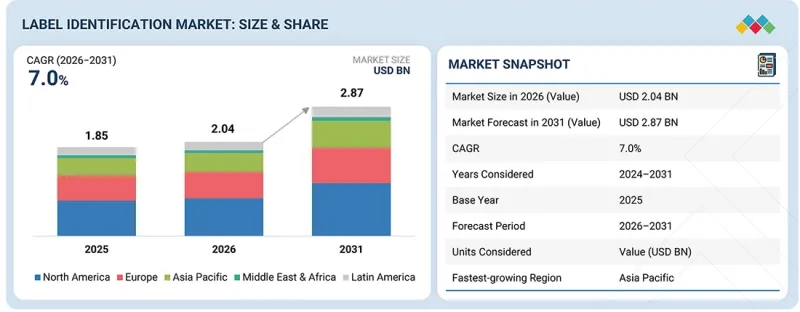
세계의 라벨 식별 시장 규모는 2026년 20억 4,000만 달러에서 2031년에는 28억 7,000만 달러에 달할 것으로 예측되고 있으며, 2026-2031년까지 CAGR은 7.0%에 달할 전망입니다.
| 조사 범위 | |
|---|---|
| 조사 대상 기간 | 2026-2031년 |
| 기준연도 | 2025년 |
| 예측 기간 | 2026-2031년 |
| 단위 | 금액(달러) |
| 부문 | 제품 유형, 기술, 처리량, 용도, 지역 |
| 대상 지역 | 북미, 유럽, 아시아태평양, 라틴아메리카, 중동 및 아프리카 |
라벨 식별 시장은 식별 정확도를 높이고 검사 소요 시간을 대폭 단축하는 AI, 자동화, 첨단 분자 진단 기술의 도입을 원동력으로 삼아 급속한 변화를 겪고 있습니다. MALDI-TOF 질량분석법은 신속하고 정확한 미생물 동정을 가능하게 하는 능력 덕분에 여전히 주요 식별 플랫폼으로서의 위상을 유지하고 있습니다. 각 제조사는 미생물 데이터베이스 확충, 시료 처리 자동화, AI를 활용한 데이터 분석 툴을 통해 이러한 시스템의 강화에 박차를 가하고 있습니다. 최근 혁신에는 더 대규모의 스펙트럼 라이브러리, 혈액 배양부터 식별에 이르는 워크플로우의 효율화, 스펙트럼 시그니처를 통해 잠재적인 항생제 내성 패턴을 직접 탐지할 수 있는 기계학습 모델 등이 포함됩니다. 이와 동시에, 실험실에서는 효율성을 높이고 인력 부족 문제를 해결하기 위해 미생물 동정, 항생제 감수성 검사, 실험실 정보 관리를 통합된 워크플로우 내에서 결합한 통합 솔루션의 도입이 점점 더 확대되고 있습니다.
시장을 형성하는 또 다른 중요한 동향은 병원체 검출 및 항생제 내성 분석을 위한 차세대 염기서열 분석(NGS), 다중 PCR, 디지털 PCR, CRISPR 기반 진단 플랫폼 등 첨단 분자 기술의 도입이 확대되고 있다는 점입니다. 업계는 기존의 식별 기법에서 포괄적인 유전체 프로파일링, 집단 감염 추적, 실시간 질병 감시로 전환되고 있습니다. AI를 활용한 분석, 클라우드 기반 실험실 정보 시스템, 예측 미생물학 플랫폼은 실험실이 동정 데이터를 통해 더 심층적인 인사이트를 도출하고, 보다 정확한 의사결정을 내릴 수 있도록 지원합니다.
"라벨 부문이 라벨 식별 시장에서 가장 큰 점유율을 차지했습니다."
제품 유형별로 살펴보면, 제약, 생명공학, 임상 진단, 연구소 분야에서 정확한 시료 식별, 추적성, 규제 준수에 대한 수요가 높아짐에 따라 라벨 부문이 인상적인 성장을 달성하고 있습니다. 연구소에서는 극저온 보관, 초저온, 오토클레이브 처리, 원심 분리, 용매 및 화학 물질에 대한 노출과 같은 조건을 견디면서도 바코드 판독성을 유지할 수 있는 고성능 라벨이 요구되고 있습니다. 생체 시료 처리량의 증가, 품질 기준의 강화, 실험실 자동화의 발전에 따라 식별 오류를 최소화하고 워크플로우의 효율을 높여주는 내구성이 뛰어난 바코드 및 RFID 지원 라벨에 대한 수요가 증가하고 있습니다.
이러한 수요에 부응하기 위해 제조사들은 내화학성, 접착 성능, 자동 라벨링 시스템 및 열전사 인쇄 기술과의 호환성을 강화한 실험실 전용 라벨을 잇달아 출시하고 있습니다. 또 다른 새로운 동향으로는 2D 바코드, QR코드, RFID, 실험실 정보 관리 시스템(LIMS)을 라벨에 통합하여 시료의 실시간 추적과 디지털 데이터 관리를 가능하게 하는 움직임이 있습니다. 랩 자동화, 정밀 의료, 바이오 뱅킹, 유전체학 워크플로우의 도입이 확대됨에 따라 스마트하고 내구성이 뛰어나며 자동화에 대응할 수 있는 라벨에 대한 수요는 더욱 증가할 것으로 예상되며, 이는 신뢰성 높은 종단 간 시료 식별 및 규제 준수를 지원할 것으로 전망됩니다.
"중간 처리량 부문이 라벨 식별 시장에서 가장 큰 점유율을 차지했습니다."
처리량별로 살펴보면, 실험실에서 더 많은 검체량을 더 빠르고 정확하게 처리하며 업무 효율을 높이려는 가운데, 중간 처리량 용도가 라벨 식별 시장의 주요 성장 요인으로 부상하고 있습니다. 주요 동향으로, 대규모 검사 워크플로우를 지원하기 위해 로봇 공학, 바코드 및 RFID 기술, 실험실 정보 관리 시스템(LIMS), 첨단 분석 기기와 통합된 자동화된 검체 식별·추적 시스템의 도입이 확대되고 있습니다. 중간 처리량의 유전체학, 단백체학, 신약 개발, 임상 진단, 의약품 스크리닝을 수행하는 연구실에서는 수작업 개입을 최소화하고 오류를 줄이기 위해 자동화된 시료 처리, 마이크로플레이트 추적, 실시간 데이터 관리 솔루션에 대한 투자가 활발히 이루어지고 있습니다. AI, 기계학습, 클라우드 기반 분석 기술의 통합을 통해 워크플로우 최적화, 데이터 해석, 예측적 품질관리가 한층 더 강화되고 있습니다. 또한 대규모 유전체 연구, 바이오마커 발견, 정밀 의료, 대규모 감염병 감시에 대한 수요가 증가함에 따라 규제 준수와 데이터 무결성을 유지하면서 지속적이고 대량의 검체 처리를 지원할 수 있는 확장성이 뛰어난 라벨 식별 기술의 도입이 가속화되고 있습니다.
"2025년에는 북미가 라벨 식별 시장에서 가장 큰 점유율을 차지했습니다."
북미는 확립된 의료 인프라, 높은 실험실 자동화 보급률, 주요 생명공학 기업 및 제약 기업의 강력한 입지에 힘입어 라벨 식별 시장을 독점하고 있습니다. 이 지역에서는 정밀 의료, 유전체학, 분자 진단, 임상 연구에 막대한 투자가 이루어지고 있으며, 이것이 첨단 라벨 식별 기술 솔루션에 대한 수요를 지원하고 있습니다. 바코드 및 RFID를 활용한 검체 추적 시스템, AI 기반 식별 플랫폼, 실험실 정보 관리 시스템(LIMS), 클라우드 기반 실험실 분석 툴의 광범위한 도입을 통해 업무 효율성, 검체의 추적성, 규정 준수가 향상되고 있습니다. 또한 규제 당국의 엄격한 품질 기준 시행, 연구개발 활동의 활성화, 차세대 염기서열 분석(NGS), 다중 PCR, 고처리량 검사 워크플로우의 도입 확대 역시 시장 성장을 지속적으로 견인하고 있습니다. 바이오뱅크, 의약품 개발 수탁 기관(CRO), 의약품 제조 시설의 확장에 따라 해당 지역 전체에서 신뢰성이 높은 자동화된 라벨 식별에 대한 수요가 더욱 증가하고 있습니다.
이 보고서에서는 전 세계 라벨 인식 시장을 조사하여, 시장 개요, 시장 성장에 영향을 미치는 다양한 요인에 대한 분석, 기술 및 특허 동향, 법규제 환경, 사례 연구, 시장 규모 추이 및 전망, 각종 분류·지역/주요 국가별 상세 분석, 경쟁 현황, 주요 기업 개요 등을 정리하여 전해드립니다.
자주 묻는 질문
목차
제1장 서론
제2장 개요
제3장 주요 인사이트
제4장 시장 개요
제5장 업계 동향
제6장 기술, 특허, 디지털 기술, AI의 도입에 의한 전략적 디스럽션
제7장 고객 상황과 구매 행동
제8장 규제 상황
제9장 라벨 식별 시장 : 제품 유형별
제10장 라벨 식별 시장 : 기술별
제11장 라벨 식별 시장 : 처리량별
제12장 라벨 식별 시장 : 용도별
제13장 라벨 식별 시장 : 지역별
제14장 경쟁 구도
제15장 기업 개요
제16장 조사 방법
제17장 부록
KSA 26.07.30The global label identification market is projected to reach USD 2.87 billion by 2031 from USD 2.04 billion in 2026, at a CAGR of 7.0% from 2026 to 2031.
| Scope of the Report | |
|---|---|
| Years Considered for the Study | 2026-2031 |
| Base Year | 2025 |
| Forecast Period | 2026-2031 |
| Units Considered | Value (USD billion) |
| Segments | Product Type, Technology, Throughput Volume, Application, and Region |
| Regions covered | North America, Europe, the Asia Pacific, Latin America, and the Middle East & Africa |
The label identification market is undergoing rapid transformation, driven by the adoption of artificial intelligence (AI), automation, and advanced molecular diagnostic technologies that enhance identification accuracy and significantly reduce turnaround times. MALDI-TOF mass spectrometry remains the leading identification platform for its ability to provide rapid, precise microbial identification. Manufacturers are strengthening these systems through expanded microorganism databases, automated sample-processing capabilities, and AI-based data analysis tools. Recent innovations include larger spectral libraries, streamlined blood-culture-to-identification workflows, and machine-learning models capable of detecting potential antimicrobial resistance patterns directly from spectral signatures. At the same time, laboratories are increasingly implementing integrated solutions that combine microbial identification, antimicrobial susceptibility testing, and laboratory informatics within a unified workflow to improve efficiency and address workforce constraints.
Another key trend shaping the market is the growing adoption of advanced molecular technologies, including next-generation sequencing (NGS), multiplex PCR, digital PCR, and emerging CRISPR-based diagnostic platforms for pathogen detection and antimicrobial resistance analysis. The industry is shifting beyond traditional identification methods toward comprehensive genomic profiling, outbreak tracking, and real-time disease surveillance. AI-driven analytics, cloud-enabled laboratory information systems, and predictive microbiology platforms are helping laboratories generate deeper insights from identification data and support more informed decision-making.
"The labels segment accounted for the largest share of the label identification market."
By product type, the market for label identification is categorized into labels, label printers, barcode printers, barcode scanners, engravers, RFID readers, and laser marking systems. The labels segment is experiencing significant growth in the label identification market due to the increasing need for accurate sample identification, traceability, and regulatory compliance across pharmaceutical, biotechnology, clinical diagnostics, and research laboratories. Laboratories require high-performance labels that can withstand challenging conditions such as cryogenic storage, ultra-low temperatures, autoclaving, centrifugation, and exposure to solvents and chemicals while maintaining barcode readability. The growing volume of biological samples, stricter quality standards, and the increasing adoption of laboratory automation are driving demand for durable barcode and RFID-compatible labels that minimize identification errors and improve workflow efficiency.
Building on this demand, manufacturers are introducing specialized laboratory labels with enhanced chemical resistance, adhesive performance, and compatibility with automated labeling systems and thermal transfer printing technologies. Another emerging trend is the integration of labels with 2D barcodes, QR codes, RFID, and laboratory information management systems (LIMS) to enable real-time sample tracking and digital data management. As laboratories continue to adopt automation, precision medicine, biobanking, and genomics workflows, the demand for smart, high-durability, and automation-compatible labels is expected to grow, supporting reliable end-to-end sample identification and regulatory compliance.
"The medium-throughput segment accounted for the largest share of the label identification market."
By throughput volume, the label identification market is segmented into high-, medium-, and low-throughput. Medium-throughput applications are a major growth driver in the label identification market as laboratories seek to process larger sample volumes with greater speed, accuracy, and operational efficiency. A key trend is the increasing adoption of automated sample identification and tracking systems integrated with robotics, barcode and RFID technologies, laboratory information management systems (LIMS), and advanced analytical instruments to support large-scale testing workflows. Medium-throughput genomics, proteomics, drug discovery, clinical diagnostics, and pharmaceutical screening laboratories are investing in automated specimen handling, microplate tracking, and real-time data management solutions to minimize manual intervention and reduce errors. The integration of artificial intelligence (AI), machine learning, and cloud-based analytics is further enhancing workflow optimization, data interpretation, and predictive quality control. Additionally, growing demand for population-scale genomic studies, biomarker discovery, precision medicine, and large-scale infectious disease surveillance is accelerating the deployment of scalable label identification technologies capable of supporting continuous, high-volume sample processing while maintaining regulatory compliance and data integrity.
"North America accounted for the largest share of the label identification market in 2025."
The label identification market is segmented across five regions: North America, Europe, Asia Pacific, Latin America, and the Middle East & Africa. North America dominates the label identification market, driven by its well-established healthcare infrastructure, high adoption of laboratory automation, and strong presence of leading biotechnology and pharmaceutical companies. The region is witnessing significant investments in precision medicine, genomics, molecular diagnostics, and clinical research, fueling demand for advanced label identification technology solutions. Widespread implementation of barcode and RFID-based sample tracking systems, AI-enabled identification platforms, laboratory information management systems (LIMS), and cloud-based laboratory analytics is improving operational efficiency, sample traceability, and regulatory compliance. In addition, stringent quality standards enforced by regulatory agencies, increasing research and development activities, and the growing adoption of next-generation sequencing (NGS), multiplex PCR, and high-throughput laboratory workflows continue to drive market growth. The expansion of biobanks, contract research organizations (CROs), and pharmaceutical manufacturing facilities further increases demand for reliable, automated label identification across the region.
A breakdown of the primary participants referred to for this report is provided below:
- By Company Type: Tier 1 (35%), Tier 2 (45%), and Tier 3 (20%)
- By Designation: C-level Executives (35%), Directors (25%), and Others (40%)
- By Region: North America (40%), Europe (30%), Asia Pacific (20%), Latin America (5%), and the Middle East & Africa (5%)
The major players in the label identification market include Agaram Technologies (India), Azenta Life Sciences (US), Brady Corporation (US), Brooks Automation (US), Cognex Corporation (US), Eppendorf (Germany), Honeywell (US), and Thermo Fisher Scientific (US), among others.
Research Coverage
The research report examines the label identification market by product type, technology, throughput, application, and region. This research covers factors that are driving market expansion, analyzing prospects and parameters faced by industries in the present time, and provides specifics on the competitive landscape, considering market leaders and small and medium enterprises. This research also estimates the revenue of different market segments by considering five regions and micromarket analysis.
Reasons to Buy the Report
The report will provide market leaders and new entrants with valuable information regarding the revenue estimates for the overall label identification market and its subsegments. It will help stakeholders understand the competitive landscape, allowing them to position their businesses more effectively and develop appropriate go-to-market strategies. Additionally, the report offers insights into the market dynamics, including key drivers, restraints, challenges, and opportunities.
This report provides insightful data on the following pointers:
- Market Penetration: In-depth coverage of product portfolios offered by the top players in the label identification market
- Product Development/Innovation: In-depth coverage of product portfolios offered by the top players in the label identification market
- Market Development: Insightful data on profitable developing areas
- Market Diversification: Details about recent developments and advancements in the label identification market
- Competitive Assessment: Extensive assessment of the products, growth tactics, revenue projections, and market categories of the top competitors
TABLE OF CONTENTS
1 INTRODUCTION
- 1.1 STUDY OBJECTIVES
- 1.2 MARKET DEFINITION
- 1.3 STUDY SCOPE
- 1.3.1 INCLUSIONS & EXCLUSIONS
- 1.4 YEARS CONSIDERED
- 1.5 CURRENCY CONSIDERED
- 1.6 STAKEHOLDERS
- 1.7 SUMMARY OF CHANGES
2 EXECUTIVE SUMMARY
- 2.1 MARKET HIGHLIGHTS AND KEY INSIGHTS
- 2.2 DISRUPTIVE TRENDS IN LABEL IDENTIFICATION MARKET
- 2.3 HIGH GROWTH SEGMENTS
- 2.4 REGIONAL SNAPSHOT: MARKET SIZE, GROWTH RATE, AND FORECAST
3 PREMIUM INSIGHTS
- 3.1 LABEL IDENTIFICATION MARKET OVERVIEW
- 3.2 NORTH AMERICA: LABEL IDENTIFICATION MARKET, BY THROUGHPUT & COUNTRY
- 3.3 LABEL IDENTIFICATION MARKET: GEOGRAPHIC GROWTH OPPORTUNITIES
- 3.4 REGIONAL MIX: LABEL IDENTIFICATION MARKET, 2024-2031
4 MARKET OVERVIEW
- 4.1 INTRODUCTION
- 4.2 MARKET DYNAMICS
- 4.2.1 DRIVERS
- 4.2.1.1 Rising adoption of laboratory automation and digital workflows
- 4.2.1.2 Growing testing volumes in clinical diagnostics, biobanking, genomics, proteomics, pharmaceutical QC, and high-throughput screening
- 4.2.1.3 Increasing shift from traditional barcodes to RFID-based tracking
- 4.2.1.4 Growing integration with cloud-based LIMS and laboratory informatics platforms
- 4.2.2 RESTRAINTS
- 4.2.2.1 Technical limitations of RFID technology in laboratory environments
- 4.2.2.2 High implementation and infrastructure costs
- 4.2.3 OPPORTUNITIES
- 4.2.3.1 Adoption of AI-powered laboratory automation
- 4.2.3.2 Growth of cell and gene therapy and NGS-driven demand
- 4.2.3.3 Rising investments in biobanking and precision medicine
- 4.2.4 CHALLENGES
- 4.2.4.1 Complexity of integrating multiple digital technologies
- 4.2.4.2 Increasing data privacy and regulatory compliance requirements
- 4.2.4.3 Cybersecurity and data integrity risks
- 4.2.1 DRIVERS
5 INDUSTRY TRENDS
- 5.1 PORTER'S FIVE FORCES ANALYSIS
- 5.1.1 THREAT OF NEW ENTRANTS
- 5.1.2 THREAT OF SUBSTITUTES
- 5.1.3 BARGAINING POWER OF BUYERS
- 5.1.4 BARGAINING POWER OF SUPPLIERS
- 5.1.5 INTENSITY OF COMPETITIVE RIVALRY
- 5.2 MACROECONOMIC INDICATORS
- 5.2.1 INTRODUCTION
- 5.2.2 GDP TRENDS AND FORECAST
- 5.2.3 TRENDS IN GLOBAL HEALTHCARE INDUSTRY
- 5.2.4 TRENDS IN GLOBAL LABEL IDENTIFICATION INDUSTRY
- 5.3 SUPPLY CHAIN ANALYSIS
- 5.3.1 RAW MATERIAL
- 5.3.2 MANUFACTURING
- 5.3.3 SALES & DISTRIBUTION
- 5.3.4 APPLICATIONS
- 5.4 VALUE CHAIN ANALYSIS
- 5.4.1 RESEARCH & DEVELOPMENT
- 5.4.2 RAW MATERIAL PROCUREMENT
- 5.4.3 MANUFACTURING
- 5.4.4 DISTRIBUTION
- 5.4.5 MARKETING & SALES
- 5.4.6 POST-SALE SERVICES
- 5.5 ECOSYSTEM ANALYSIS
- 5.6 PRICING ANALYSIS
- 5.6.1 INDICATIVE PRICE FOR LABEL IDENTIFICATION, BY PRODUCT (2025)
- 5.6.2 INDICATIVE PRICE FOR LABEL IDENTIFICATION MARKET, BY REGION (2025)
- 5.7 TRADE ANALYSIS
- 5.8 KEY CONFERENCES AND EVENTS (2026-2027)
- 5.9 TRENDS IMPACTING CUSTOMER BUSINESS
- 5.10 INVESTMENT & FUNDING SCENARIO
- 5.11 CASE STUDY ANALYSIS
- 5.12 IMPACT OF 2025 US TARIFF
- 5.12.1 INTRODUCTION
- 5.12.2 KEY TARIFF RATES
- 5.12.3 KEY TARIFF RATES
- 5.12.4 PRICE IMPACT ANALYSIS
- 5.12.5 IMPACT ON COUNTRY/REGION
- 5.12.5.1 US
- 5.12.5.2 Europe
- 5.12.5.3 Asia Pacific
- 5.12.6 IMPACT ON END USERS
6 STRATEGIC DISRUPTION THROUGH TECHNOLOGY, PATENTS, DIGITAL, AND AI ADOPTION
- 6.1 TECHNOLOGY ANALYSIS
- 6.1.1 KEY TECHNOLOGIES
- 6.1.1.1 Barcode technology (1D & 2D)
- 6.1.1.2 Radio frequency identification (RFID)
- 6.1.1.3 Near field communication (NFC)
- 6.1.2 COMPLEMENTARY TECHNOLOGIES
- 6.1.2.1 Optical character recognition (OCR)
- 6.1.2.2 Laboratory information management systems (LIMS)
- 6.1.3 ADJACENT TECHNOLOGIES
- 6.1.3.1 Laboratory execution systems (LES)
- 6.1.1 KEY TECHNOLOGIES
- 6.2 PATENT ANALYSIS
- 6.3 IMPACT OF AI ON LABEL IDENTIFICATION MARKET
- 6.3.1 TOP USE CASES AND MARKET POTENTIAL
- 6.3.2 BEST PRACTICES IN LABEL IDENTIFICATION MARKET
- 6.3.3 INTERCONNECTED ADJACENT ECOSYSTEMS AND IMPACT ON MARKET PLAYERS
- 6.3.4 CLIENTS' READINESS TO ADOPT GENERATIVE AI IN LABEL IDENTIFICATION TECHNOLOGIES
- 6.4 SUCCESS STORIES AND REAL-WORLD APPLICATIONS
7 CUSTOMER LANDSCAPE & BUYER BEHAVIOR
- 7.1 INTRODUCTION
- 7.2 DECISION-MAKING PROCESS
- 7.3 BUYER STAKEHOLDERS & BUYING EVALUATION CRITERIA
- 7.3.1 KEY STAKEHOLDERS IN BUYING PROCESS
- 7.4 BUYER STAKEHOLDERS & BUYING EVALUATION CRITERIA
- 7.5 ADOPTION BARRIERS & INTERNAL CHALLENGES
- 7.6 UNMET NEEDS FROM VARIOUS END-USE INDUSTRIES
8 REGULATORY LANDSCAPE
- 8.1 REGIONAL REGULATIONS AND COMPLIANCE
- 8.1.1 REGULATORY BODIES, GOVERNMENT AGENCIES, AND OTHER ORGANIZATIONS
- 8.1.2 REGULATORY ANALYSIS
- 8.1.2.1 North America
- 8.1.2.2 Europe
- 8.1.2.3 Asia pacific
- 8.1.2.4 Latin America and Middle East & Africa
- 8.1.3 INDUSTRY STANDARDS
9 LABEL IDENTIFICATION MARKET, BY PRODUCT TYPE
- 9.1 INTRODUCTION
- 9.2 LABELS
- 9.2.1 INCREASING REGULATORY COMPLIANCE, PRODUCT TRACEABILITY, AND SMART LABEL ADOPTION DRIVE GROWTH
- 9.3 LABEL PRINTERS
- 9.3.1 WAREHOUSE AUTOMATION AND E-COMMERCE GROWTH ACCELERATE INDUSTRIAL LABEL PRINTER ADOPTION
- 9.4 BARCODE PRINTERS
- 9.4.1 GROWING ADOPTION OF 2D BARCODE STANDARDS AND PRODUCT TRACEABILITY DRIVE DEMAND
- 9.5 BARCODE SCANNERS
- 9.5.1 GROWING OMNICHANNEL RETAIL OPERATIONS AND PRODUCT TRACEABILITY BOOST ADOPTION
- 9.6 ENGRAVERS
- 9.6.1 INCREASING PERMANENT PRODUCT IDENTIFICATION AND INDUSTRIAL TRACEABILITY DRIVE ADOPTION
- 9.7 RFID READERS
- 9.7.1 ACCELERATED ITEM-LEVEL TRACEABILITY THROUGH RFID-BASED LABEL IDENTIFICATION TO PROPEL GROWTH
- 9.8 LASER MARKING SYSTEMS
- 9.8.1 PERMANENT PRODUCT TRACEABILITY THROUGH HIGH-PRECISION LASER MARKING SYSTEMS TO DRIVE SEGMENT
10 LABEL IDENTIFICATION MARKET, BY TECHNOLOGY
- 10.1 INTRODUCTION
- 10.2 THERMAL TRANSFER PRINTING
- 10.2.1 ADVANCED DURABLE INDUSTRIAL LABELING TO DRIVE MARKET
- 10.3 DIRECT THERMAL PRINTING
- 10.3.1 SUSTAINABLE AND COST-EFFECTIVE LABEL IDENTIFICATION TO BOOST DEMAND
- 10.4 INKJET PRINTING
- 10.4.1 HIGH DEMAND FROM PHARMA COMPANIES TO BOOST SEGMENT
- 10.5 DIRECT INKJET PRINTING
- 10.5.1 ACCELERATED SUSTAINABLE PRODUCT IDENTIFICATION TO DRIVE SEGMENT
- 10.6 LASER ENGRAVING/MARKING
- 10.6.1 INCREASING DEMAND FOR PERMANENT PRODUCT IDENTIFICATION TO BOOST SEGMENT
- 10.7 RFID IDENTIFICATION
- 10.7.1 ACCELERATED INTELLIGENT PRODUCT IDENTIFICATION TO DRIVE SEGMENT
- 10.8 1D & 2D BARCODE TECHNOLOGIES
- 10.8.1 SEGMENT DRIVEN BY SMART PRODUCT IDENTIFICATION THROUGH NEXT-GENERATION BARCODE TECHNOLOGIES
11 LABEL IDENTIFICATION MARKET, BY THROUGHPUT VOLUME
- 11.1 INTRODUCTION
- 11.2 HIGH THROUGHPUT (>1,000 SAMPLES PER DAY)
- 11.2.1 GROWING ADOPTION OF HIGH-THROUGHPUT PROCESSING DRIVES DEMAND
- 11.3 MEDIUM THROUGHPUT (100-1,000 SAMPLES PER DAY)
- 11.3.1 INCREASING INVESTMENTS IN R&D TO STRENGTHEN THERAPEUTIC DRUG PIPELINES BOOST MARKET GROWTH
- 11.4 LOW THROUGHPUT (<100 SAMPLES PER DAY)
- 11.4.1 ONGOING DIGITAL TRANSFORMATION IN LABORATORIES TO BOOST MARKET GROWTH
12 LABEL IDENTIFICATION MARKET, BY APPLICATION
- 12.1 INTRODUCTION
- 12.2 SAMPLE IDENTIFICATION
- 12.2.1 LABORATORY AUTOMATION AND REGULATORY COMPLIANCE DRIVE SEGMENT
- 12.3 SPECIMEN TRACKING
- 12.3.1 ENHANCED END-TO-END SPECIMEN TRACEABILITY AND CHAIN-OF-CUSTODY THROUGH INTELLIGENT TRACKING TECHNOLOGIES TO BOOST MARKET
- 12.4 TUBE/VIAL/PLATE LABELING
- 12.4.1 CRYOGENIC BIOBANK EXPANSION AND AUTOMATED SAMPLE MANAGEMENT DRIVE DEMAND
- 12.5 BIOBANKING
- 12.5.1 EXPANSION OF POPULATION GENOMICS AND PRECISION MEDICINE PROGRAMS PROPELS GROWTH
- 12.6 GENOMICS & PROTEOMICS
- 12.6.1 NGS SCALE-UP, SINGLE-CELL GENOMICS, AND MULTI-OMIC INTEGRATION INCREASE DEMAND
- 12.7 HIGH-THROUGHPUT SCREENING
- 12.7.1 AI-ACCELERATED DRUG DISCOVERY AND DEL/FBDD PLATFORMS INCREASE HTS COMPOUND IDENTIFICATION REQUIREMENTS
- 12.8 PHARMA QC LABS
- 12.8.1 FDA DATA INTEGRITY ENFORCEMENT AND PAPERLESS QC LABORATORY TRANSFORMATION DRIVES INVESTMENT
- 12.9 OTHER APPLICATIONS
13 LABEL IDENTIFICATION MARKET, BY REGION
- 13.1 INTRODUCTION
- 13.2 NORTH AMERICA
- 13.2.1 US
- 13.2.1.1 DSCSA compliance accelerates adoption of advanced label identification solutions
- 13.2.2 CANADA
- 13.2.2.1 Close alignment with US laboratory standards boost market
- 13.2.1 US
- 13.3 EUROPE
- 13.3.1 GERMANY
- 13.3.1.1 Accelerated RFID-enabled laboratory identification and pharmaceutical digitalization to drive market
- 13.3.2 UK
- 13.3.2.1 RFID expansion and healthcare modernization drive growth
- 13.3.3 FRANCE
- 13.3.3.1 Biobank expansion and pharmaceutical compliance strengthen market
- 13.3.4 ITALY
- 13.3.4.1 Laboratory digitalization and pharmaceutical compliance drive growth
- 13.3.5 SPAIN
- 13.3.5.1 Pharmaceutical Manufacturing Expansion Drives Label Identification Demand
- 13.3.6 REST OF EUROPE
- 13.3.1 GERMANY
- 13.4 ASIA PACIFIC
- 13.4.1 CHINA
- 13.4.1.1 Digital GMP modernization accelerates adoption of advanced label identification solutions in China
- 13.4.2 JAPAN
- 13.4.2.1 Rising diagnostic testing and biomedical research support market growth
- 13.4.3 INDIA
- 13.4.3.1 Increasing healthcare infrastructure and biopharma research boost market
- 13.4.4 AUSTRALIA
- 13.4.4.1 Laboratory automation and genomics initiatives accelerate label identification adoption
- 13.4.5 SOUTH KOREA
- 13.4.5.1 Samsung biologics capacity expansion and national genomics programs accelerate label identification adoption
- 13.4.6 REST OF ASIA PACIFIC
- 13.4.1 CHINA
- 13.5 LATIN AMERICA
- 13.6 MIDDLE EAST & AFRICA
14 COMPETITIVE LANDSCAPE
- 14.1 INTRODUCTION
- 14.2 KEY PLAYER STRATEGIES/RIGHT TO WIN
- 14.2.1 OVERVIEW OF STRATEGIES ADOPTED BY PLAYERS IN LABEL IDENTIFICATION MARKET
- 14.3 REVENUE ANALYSIS, 2022-2025
- 14.4 MARKET SHARE ANALYSIS, 2025
- 14.5 MARKET RANKING ANALYSIS, 2025
- 14.6 COMPANY EVALUATION MATRIX: KEY PLAYERS, 2025
- 14.6.1 STARS
- 14.6.2 EMERGING LEADERS
- 14.6.3 PERVASIVE PLAYERS
- 14.6.4 PARTICIPANTS
- 14.6.5 COMPANY FOOTPRINT: KEY PLAYERS, 2025
- 14.6.5.1 Company footprint
- 14.6.5.2 Region footprint
- 14.6.5.3 Product type footprint
- 14.6.5.4 Technology footprint
- 14.6.5.5 Application footprint
- 14.7 COMPANY EVALUATION MATRIX: STARTUPS/SMES, 2025
- 14.7.1 PROGRESSIVE COMPANIES
- 14.7.2 RESPONSIVE COMPANIES
- 14.7.3 DYNAMIC COMPANIES
- 14.7.4 STARTING BLOCKS
- 14.7.5 COMPETITIVE BENCHMARKING OF STARTUPS/SMES, 2025
- 14.7.5.1 Detailed list of key startups/SMEs
- 14.7.5.2 Competitive benchmarking of key startups/SMEs
- 14.8 COMPETITIVE SCENARIO
- 14.8.1 PRODUCT LAUNCHES & APPROVALS
- 14.8.2 DEALS
- 14.8.3 EXPANSIONS
- 14.9 COMPANY VALUATION & FINANCIAL METRICS
- 14.10 BRAND/PRODUCT COMPARISON
15 COMPANY PROFILES
- 15.1 KEY PLAYERS
- 15.1.1 BRADY CORPORATION
- 15.1.1.1 Business overview
- 15.1.1.2 Products offered
- 15.1.1.3 Recent developments
- 15.1.1.3.1 Product launches and approvals
- 15.1.1.3.2 Deals
- 15.1.1.4 MnM view
- 15.1.1.4.1 Right to win
- 15.1.1.4.2 Strategic choices
- 15.1.1.4.3 Weaknesses and competitive threats
- 15.1.2 ZEBRA TECHNOLOGIES CORPORATION
- 15.1.2.1 Business overview
- 15.1.2.2 Products offered
- 15.1.2.3 Recent developments
- 15.1.2.3.1 Deals
- 15.1.2.4 MnM view
- 15.1.2.4.1 Right to win
- 15.1.2.4.2 Strategic choices
- 15.1.2.4.3 Weaknesses and competitive threats
- 15.1.3 THERMO FISHER SCIENTIFIC INC.
- 15.1.3.1 Business overview
- 15.1.3.2 Products offered
- 15.1.3.3 Recent developments
- 15.1.3.3.1 Deals
- 15.1.3.3.2 Expansions
- 15.1.3.4 MnM view
- 15.1.3.4.1 Right to win
- 15.1.3.4.2 Strategic choices
- 15.1.3.4.3 Weaknesses and competitive threats
- 15.1.4 HONEYWELL INTERNATIONAL INC
- 15.1.4.1 Business overview
- 15.1.4.2 Products offered
- 15.1.4.3 MnM view
- 15.1.4.3.1 Right to win
- 15.1.4.3.2 Strategic choices
- 15.1.4.3.3 Weaknesses and competitive threats
- 15.1.5 DATALOGIC S.P.A.
- 15.1.5.1 Business overview
- 15.1.5.2 Products offered
- 15.1.5.3 Recent developments
- 15.1.5.3.1 Product launches and approvals
- 15.1.5.4 MnM view
- 15.1.5.4.1 Right to win
- 15.1.5.4.2 Strategic choices
- 15.1.5.4.3 Weaknesses and competitive threats
- 15.1.6 TSC AUTO ID TECHNOLOGY CO., LTD
- 15.1.6.1 Business overview
- 15.1.6.2 Products offered
- 15.1.7 COGNEX
- 15.1.7.1 Business overview
- 15.1.7.2 Products offered
- 15.1.7.3 Recent developments
- 15.1.7.3.1 Product launches and approvals
- 15.1.8 GA INTERNATIONAL
- 15.1.8.1 Business overview
- 15.1.8.2 Products offered
- 15.1.9 SATO HOLDINGS CORPORATION
- 15.1.9.1 Business overview
- 15.1.9.2 Products offered
- 15.1.9.3 Recent developments
- 15.1.9.3.1 Product launches and approvals
- 15.1.9.3.2 Deals
- 15.1.10 TOSHIBA TEC
- 15.1.10.1 Business overview
- 15.1.10.2 Products offered
- 15.1.10.3 Recent developments
- 15.1.10.3.1 Product launches and approvals
- 15.1.11 BIO-RAD LABORATORIES, INC
- 15.1.11.1 Business overview
- 15.1.11.2 Products offered
- 15.1.12 KEYENCE CORPORATION
- 15.1.12.1 Business overview
- 15.1.12.2 Products offered
- 15.1.12.3 Recent developments
- 15.1.12.3.1 Product launches and approvals
- 15.1.13 BIXOLON CO., LTD
- 15.1.13.1 Business overview
- 15.1.13.2 Products offered
- 15.1.13.3 Recent developments
- 15.1.13.3.1 Product launches and approvals
- 15.1.14 SIRIUS AUTOMATION INC
- 15.1.14.1 Business overview
- 15.1.14.2 Products offered
- 15.1.1 BRADY CORPORATION
- 15.2 OTHER PLAYERS
- 15.2.1 MICRONIC
- 15.2.2 RMS OMEGA
- 15.2.3 CAB PRODUKTTECHNIK GMBH & CO. KG.
- 15.2.4 DOMINO PRINTING SCIENCES PLC
- 15.2.5 GRAVOTECH
- 15.2.6 XIAMEN HANIN CO., LTD
- 15.2.7 FOBA
- 15.2.8 SEIKO INSTRUMENTS INC
- 15.2.9 VIDEOJET TECHNOLOGIES PVT. LTD
- 15.2.10 MODUL-BIO.
16 RESEARCH METHODOLOGY
- 16.1 RESEARCH DATA
- 16.1.1 SECONDARY DATA
- 16.1.1.1 Objectives of secondary research
- 16.1.1.2 List of secondary sources
- 16.1.2 PRIMARY DATA
- 16.1.2.1 Primary sources
- 16.1.2.2 Key industry insights
- 16.1.1 SECONDARY DATA
- 16.2 MARKET SIZE ESTIMATION
- 16.2.1 BOTTOM-UP APPROACH
- 16.2.2 REVENUE MAPPING-BASED MARKET ESTIMATION
- 16.2.2.1 Approach 2: Customer-based market estimation
- 16.2.3 PRIMARY RESEARCH VALIDATION
- 16.2.4 TOP-DOWN APPROACH
- 16.3 DATA TRIANGULATION
- 16.4 RESEARCH ASSUMPTIONS
- 16.5 RESEARCH LIMITATIONS
- 16.6 RISK ASSESSMENT
17 APPENDIX
- 17.1 KNOWLEDGESTORE: MARKETSANDMARKETS' SUBSCRIPTION PORTAL
- 17.2 CUSTOMIZATION OPTIONS
- 17.3 RELATED REPORTS
- 17.4 AUTHOR DETAILS