

|
시장보고서
상품코드
2101333
폴리우레탄 접착제 시장 : 기술별, 유형별, 최종 이용 산업별, 지역별 - 세계 예측(-2031년)Polyurethane Adhesives Market by Type (Thermoset, Thermoplastic), Technology (Solvent-borne, 100% Solids, Dispersion), End-use Industry (Automotive, Building & Construction, Packaging, General Industrial), and Region - Global Forecast to 2031 |
||||||

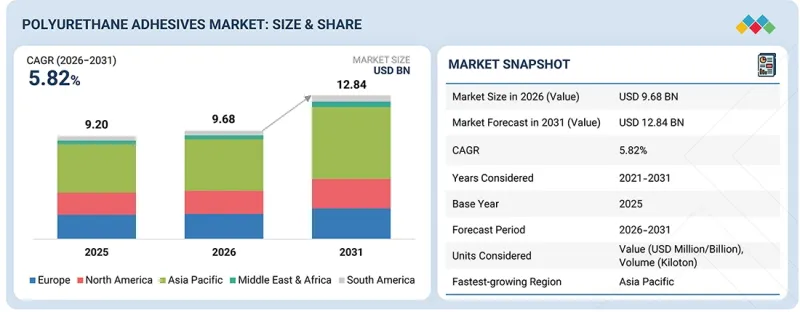
폴리우레탄 접착제 시장 규모는 2026년 96억 8,000만 달러에서 2031년까지 128억 4,000만 달러로, CAGR 5.82%로 확대될 것으로 추정됩니다.
지속적인 연구 개발 활동으로 인해 폴리우레탄 접착제의 성능은 지속적으로 향상되고 있습니다. 각 제조사는 경화 특성 개선, 접착 강도 향상, 유연성 증대, 그리고 습기, 화학제품, 온도 변화에 대한 내성 강화를 실현한 첨단 배합을 잇달아 도입하고 있습니다.
| 조사 범위 | |
|---|---|
| 조사 대상 기간 | 2021-2031년 |
| 기준 연도 | 2025년 |
| 예측 기간 | 2026-2031년 |
| 산정 단위 | 금액(100만/10억 달러) 및 킬로톤 |
| 부문 | 기술별, 유형별, 최종 이용 산업별, 지역별 |
| 대상 지역 | 아시아태평양, 유럽, 북미, 중동 및 아프리카, 남미 |
제품의 혁신으로 인해 다양한 제조 공정 및 기판 조합과의 호환성도 향상되고 있습니다. 이러한 발전으로 인해 폴리우레탄 접착제는 더욱 폭넓은 용도에서 지속적으로 진화하는 성능 요건을 충족할 수 있게 되었습니다. 배합 기술의 향상으로 제조사는 일관된 제품 품질을 유지하면서 생산 효율을 더욱 높일 수 있습니다. 접착제 혁신을 위한 지속적인 투자는 신제품 개발 기회를 창출하고 용도의 가능성을 확대하고 있습니다. 이러한 지속적인 기술적 진보는 시장 성장의 중요한 요인으로 자리 잡고 있습니다.
"2025년, 폴리우레탄 접착제 시장에서 열가소성 부문이 두 번째로 큰 점유율을 차지했습니다."
2025년, 열가소성 부문은 폴리우레탄 접착제 시장에서 두 번째로 큰 점유율을 차지했습니다. 가구 제조업체들은 장식용 라미네이트, 엣지 밴드, 덮개재, 발포체 및 접합 목재 부품의 접착에 열가소성 폴리우레탄 접착제를 점점 더 많이 활용하고 있습니다. 이러한 접착제는 주거용, 사무용, 호텔·리조트용 및 상업용 가구 제품에서 내구성 있는 접착과 매력적인 마감면을 실현하는 동시에 효율적인 생산을 뒷받침하고 있습니다. 주택 개발, 사무실 건설, 호텔·리조트 프로젝트 및 인테리어 리모델링에 대한 투자 확대에 힘입어 전 세계 가구 생산량은 지속적으로 증가하고 있습니다. 또한, 각 제조사들은 조립 효율을 높이고 대량 생산 체제를 뒷받침할 수 있는 접착 기술을 요구하고 있습니다. 이처럼 가구 및 인테리어 부품의 제조가 꾸준히 확대됨에 따라, 전 세계적으로 열가소성 폴리우레탄 접착제에 대한 수요가 지속적으로 증가하고 있습니다.
"2025년 시점에서, 분산형 부문은 금액 기준으로 3위의 시장 점유율을 차지했습니다."
2025년, 분산 기술은 금액 기준으로 3위의 시장 점유율을 차지했습니다. 저VOC(휘발성 유기 화합물) 접착제 시스템에 대한 수요 증가는 다양한 산업 분야에서 폴리우레탄 분산 기술의 채택을 촉진하는 주요 요인이 되고 있습니다. 각 제조사는 보다 깨끗한 생산 공정을 지원하고 진화하는 환경 기준을 충족하기 위해 기존의 용제 함유 접착제 시스템에서 수성 분산형 배합으로의 전환을 가속화하고 있습니다. 이러한 전환은 지속가능한 생산이 중요한 경쟁 우위가 되는 가구, 신발, 섬유, 건설자재, 자동차 부품 제조 분야에서 특히 두드러집니다. 폴리우레탄 분산형 접착제는 신뢰할 수 있는 접착 성능을 발휘하는 동시에 제조 공정에서의 배출량 감소에도 기여합니다. 각 업계가 친환경 생산 기술과 지속가능한 제품 포트폴리오에 대한 투자를 지속하는 가운데, 폴리우레탄 분산형 접착제에 대한 수요는 계속 확대되고 있으며, 이는 해당 기술 분야의 장기적인 성장을 뒷받침하고 있습니다.
"2025년, 건축·건설 부문은 시장 규모(금액 기준)에서 3위를 차지했습니다."
2025년, 건축·건설 부문은 시장 규모(금액 기준)에서 3위를 차지했습니다. 에너지 효율이 높은 건물에서는 단열 성능을 향상시키기 위해 설계된 첨단 단열 시스템, 샌드위치 패널, 파사드 요소 및 유리 조립 부품이 점점 더 많이 채택되고 있습니다. 폴리우레탄 접착제는 건축 외피 시스템 전체의 무결성을 유지하면서 이러한 자재를 확실하게 접착하는 데 중요한 역할을 하고 있습니다. 다양한 기판에 접착할 수 있는 이 특성은 건물의 효율성과 장기적인 운영 성능 향상에 초점을 맞춘 현대적인 건설 기법을 뒷받침하고 있습니다. 건축가와 개발업자들은 효과적인 시공을 위해 신뢰할 수 있는 접착 기술이 필요한 첨단 건축자재를 계속해서 지정하고 있습니다. 전 세계적으로 지속가능한 건설 기준이 지속적으로 확대됨에 따라, 에너지 절약형 건축 프로젝트에서 폴리우레탄 접착제의 채택이 점점 더 확대되고 있습니다.
"2025년, 북미는 금액 기준으로 전 세계 폴리우레탄 접착제 시장에서 3위의 점유율을 차지했습니다."
2025년, 북미는 금액 기준으로 폴리우레탄 접착제 시장 전체에서 3위의 점유율을 차지했습니다. 북미에서는 자동차 조립 공장, 배터리 생산 시설, 자동차 부품 제조에 대한 투자를 통해 전기자동차(EV) 제조 생태계를 지속적으로 강화하고 있습니다. 폴리우레탄 접착제는 배터리 팩, 배터리 모듈, 실내 트림, 시트 시스템, 도어 패널, 헤드라이너, 경량 복합재 부품의 접착에 널리 사용되고 있습니다. 이러한 접착제는 견고하고 내구성 있는 접착을 실현함과 동시에, 차량의 수명 기간 동안 내진동성, 내충격성 및 긴 수명을 제공합니다. 자동차 제조사들은 생산 효율 향상과 일관된 제품 품질 확보를 위해 자동화된 조립 공정에 폴리우레탄 접착제의 도입을 점점 더 확대하고 있습니다. 배터리 생산능력 확대와 현지화된 공급망에 힘입은 국내 전기자동차 생산 증가는 북미 자동차 산업 전반에 걸쳐 폴리우레탄 접착제에 대한 꾸준한 수요를 지속적으로 견인하고 있습니다.
본 보고서에서 다루고 있는 주요 기업 개요에는 Henkel AG & Co. KGaA(독일), H.B. Fuller Company(미국), Sika AG(스위스), Dow Inc.(미국), 3M Company(미국), Arkema S.A.(프랑스), Huntsman International LLC(미국), Jowat SE(독일), Parker-Hannifin Corporation(미국), 및 Illinois Tool Works Inc.(미국)이 포함됩니다.
조사 범위
본 보고서에서는 폴리우레탄 접착제 시장을 종류, 기술, 최종 이용 산업 및 지역별로 세분화하여, 각 지역의 시장 규모 및 추정치(단위 - 100만 달러)와 수량(단위 - 킬로톤)을 제공합니다. 주요 기업에 대한 상세한 분석을 통해 폴리우레탄 접착제 시장과 관련된 각 기업의 사업 개요, 서비스 및 주요 전략에 대한 인사이트를 제공합니다.
본 보고서를 구매해야 하는 이유
본 조사 보고서는 업계 분석(업계 동향), 주요 기업의 시장 점유율 분석, 기업 개요 등 다각적인 분석에 초점을 맞추고 있으며, 이를 종합하여 폴리우레탄 접착제 시장의 경쟁 구도, 신흥 및 고성장 부문, 고성장 지역, 그리고 시장 촉진요인, 억제요인 및 성장 기회에 대한 전체적인 그림을 제공합니다.
본 보고서는 다음 사항에 대한 인사이트를 제공합니다:
- 시장 침투도 : 세계 시장에서 주요 기업이 제공하는 폴리우레탄 접착제에 관한 종합적인 정보.
- 주요 촉진요인(자동차의 전동화 및 경량화 가속화, 전 세계 건설 수요 확대 및 도시화에 따른 수요, 규제상 수성 및 저VOC 배합으로의 전환), 제약요인(석유화학 원료 가격 변동 및 공급망 불안정, 규제 부담 증가?디이소시아네이트 및 VOC 규제), 기회(반응성 및 고성능 접착제 시스템의 기술적 진보, 산업 전반에 걸친 복합재료 사용 확대), 그리고 과제(첨단 경량 소재의 성능 요건 대응)에 대해 폴리우레탄 접착제 시장의 성장에 영향을 미치는 요인을 분석하고 있습니다.
- 제품 개발 및 혁신 : 폴리우레탄 접착제 시장의 향후 기술, 연구 개발 활동, 그리고 신제품 및 서비스 출시에 대한 상세한 분석.
- 시장 개발 : 수익성이 높은 신흥 시장에 대한 종합적인 정보 ? 본 보고서에서는 지역별 폴리우레탄 접착제 시장을 분석하고 있습니다.
- 시장 다각화 : 신제품, 미개척 지역 및 전 세계 폴리우레탄 접착제 시장의 최근 동향에 대한 종합적인 정보.
- 경쟁 분석 : 폴리우레탄 접착제 시장에서 주요 기업의 시장 점유율, 전략, 제품 및 생산능력에 대한 상세한 평가.
자주 묻는 질문
목차
제1장 소개
제2장 주요 요약
제3장 주요 인사이트
제4장 시장 개요
제5장 업계 동향
제6장 기술 진보, AI에 의한 영향, 특허, 혁신, 그리고 향후 응용
제7장 규제 상황과 지속가능성에 대한 대처
제8장 고객 상황과 구매 행동
제9장 폴리우레탄 접착제 시장(기술별)
제10장 폴리우레탄 접착제 시장(유형별)
제11장 폴리우레탄 접착제 시장(최종 이용 산업별)
제12장 폴리우레탄 접착제 시장(지역별)
제13장 경쟁 구도
제14장 기업 개요
제15장 조사 방법
제16장 부록
KSM 26.08.03The polyurethane adhesives market is estimated to grow from USD 9.68 billion in 2026 to USD 12.84 billion by 2031, at a CAGR of 5.82%. Continuous research and development activities are expanding the capabilities of polyurethane adhesives. Manufacturers are introducing advanced formulations with improved curing characteristics, higher bond strength, better flexibility, and enhanced resistance to moisture, chemicals, and temperature variations.
| Scope of the Report | |
|---|---|
| Years Considered for the Study | 2021-2031 |
| Base Year | 2025 |
| Forecast Period | 2026-2031 |
| Units Considered | Value (USD Million/Billion) and Volume (Kiloton) |
| Segments | Type, Technology, End-use Industry, and Region |
| Regions covered | Asia Pacific, Europe, North America, Middle East & Africa, and South America |
Product innovation is also improving compatibility with different manufacturing processes and substrate combinations. These developments allow polyurethane adhesives to meet evolving performance requirements across a wider range of applications. Improved formulation technology enables manufacturers to achieve greater production efficiency while maintaining consistent product quality. Ongoing investment in adhesive innovation is creating opportunities for new product development and expanding application possibilities. This continuous technological progress remains an important contributor to market growth.
"The thermoplastic segment accounted for the second-largest share of the polyurethane adhesives market in 2025."
The thermoplastic segment accounted for the second-largest share of the polyurethane adhesives market in 2025. Furniture manufacturers increasingly rely on thermoplastic polyurethane adhesives for bonding decorative laminates, edge bands, upholstery materials, foams, and engineered wood components. These adhesives support efficient production while providing durable bonding and attractive finished surfaces across residential, office, hospitality, and commercial furniture products. Growing investments in housing development, office construction, hospitality projects, and interior renovation continue increasing global furniture production. Manufacturers also seek adhesive technologies that improve assembly efficiency and support high-volume manufacturing operations. This steady expansion of furniture and interior component manufacturing continues strengthening demand for thermoplastic polyurethane adhesives worldwide.
"The dispersion segment held the third-largest market share, in terms of value, in 2025."
The dispersion technology held the third-largest market share, in terms of value, in 2025. The growing preference for low VOC adhesive systems is a major factor driving the adoption of polyurethane dispersion technology across multiple industries. Manufacturers are increasingly replacing conventional solvent-containing adhesive systems with water-based dispersion formulations to support cleaner production processes and align with evolving environmental standards. This transition is particularly evident in furniture, footwear, textiles, construction materials, and automotive component manufacturing, where sustainable production has become an important competitive advantage. Polyurethane dispersion adhesives deliver reliable bonding performance while supporting reduced emissions during manufacturing operations. As industries continue investing in environmentally responsible production technologies and sustainable product portfolios, the demand for dispersion polyurethane adhesives continues to expand, strengthening the long-term growth of this technology segment.
"The building & construction segment accounted for the third-largest market, in terms of value, in 2025."
The building & construction segment accounted for the third-largest market by value in 2025. Energy-efficient buildings increasingly incorporate advanced insulation systems, sandwich panels, facade elements, and glazing assemblies designed to improve thermal performance. Polyurethane adhesives play an important role in securely bonding these materials while maintaining the integrity of complete building envelope systems. Their ability to adhere to a broad range of substrates supports modern construction practices focused on improving building efficiency and long-term operational performance. Architects and developers continue specifying advanced building materials that require dependable adhesive technologies for effective installation. As sustainable construction standards continue expanding globally, polyurethane adhesives are experiencing increasing adoption across energy-efficient building projects.
"North America accounted for the third-largest share of the global polyurethane adhesives market, in terms of value, in 2025."
North America held the third-largest share of the overall polyurethane adhesives market, in terms of value, in 2025. North America continues to strengthen its electric vehicle manufacturing ecosystem through investments in vehicle assembly plants, battery production facilities, and automotive component manufacturing. Polyurethane adhesives are widely used to bond battery packs, battery modules, interior trims, seating systems, door panels, headliners, and lightweight composite parts. These adhesives provide strong, durable bonding while delivering vibration resistance, impact performance, and long service life throughout vehicle operation. Automotive manufacturers increasingly integrate polyurethane adhesives into automated assembly processes to improve production efficiency and achieve consistent product quality. The expansion of domestic electric vehicle production, supported by growing battery manufacturing capacity and localized supply chains, continues driving steady demand for polyurethane adhesives across North America's automotive industry.
- By Company Type: Tier 1 - 55%, Tier 2 - 25%, and Tier 3 - 20%
- By Designation: Directors - 50%, Managers - 30%, and Others - 20%
- By Region: North America - 40%, Europe - 35%, Asia Pacific - 20%, and RoW- 5%
The key players profiled in the report include Henkel AG & Co. KGaA (Germany), H.B. Fuller Company (US), Sika AG (Switzerland), Dow Inc. (US), 3M Company (US), Arkema S.A. (France), Huntsman International LLC (US), Jowat SE (Germany), Parker-Hannifin Corporation (US), and Illinois Tool Works Inc. (US).
Study Coverage
This report segments the market for polyurethane adhesives based on type, technology, end-use industry, and region, and provides estimations of value (in USD Million) and volume (in Kiloton) for the overall market size across various regions. A detailed analysis of key industry players has been conducted to provide insights into their business overviews, services, and key strategies associated with the polyurethane adhesives market.
Reasons to Buy this Report
This research report is focused on various levels of analysis-industry analysis (industry trends), market share analysis of top players, and company profiles, which together provide an overall view of the competitive landscape, emerging and high-growth segments of the polyurethane adhesives market, high-growth regions, and market drivers, restraints, and opportunities.
The report provides insights into the following points:
- Market Penetration: Comprehensive information on polyurethane adhesives offered by top players in the global market.
- Analysis of key drivers (accelerating automotive electrification and lightweighting imperatives, global construction expansion and urbanization-driven demand, regulatory-driven shift toward waterborne and low-VOC formulations), restraints (petrochemical feedstock price volatility and supply chain instability, escalating regulatory burden - diisocyanate and VOC restrictions), opportunities (technological advancements in reactive and high-performance adhesive systems, increasing use of composite materials across industries), and challenges (meeting performance requirements for advanced lightweight materials) influencing the growth of polyurethane adhesives market.
- Product Development/Innovation: Detailed insights on upcoming technologies, research & development activities, and new product & service launches in the polyurethane adhesives market.
- Market Development: Comprehensive information about lucrative emerging markets-the report analyzes the market for polyurethane adhesives across regions.
- Market Diversification: Exhaustive information about new products, untapped regions, and recent developments in the global polyurethane adhesives market.
- Competitive Assessment: In-depth assessment of market shares, strategies, products, and manufacturing capabilities of leading players in the polyurethane adhesives market.
TABLE OF CONTENTS
1 INTRODUCTION
- 1.1 STUDY OBJECTIVES
- 1.2 MARKET DEFINITION
- 1.3 STUDY SCOPE
- 1.3.1 MARKETS COVERED AND REGIONAL SCOPE
- 1.3.2 INCLUSIONS AND EXCLUSIONS OF STUDY
- 1.3.3 MARKET DEFINITION AND INCLUSIONS, BY TYPE
- 1.3.4 MARKET DEFINITION AND INCLUSIONS, BY TECHNOLOGY
- 1.3.5 MARKET DEFINITION AND INCLUSIONS, BY END-USE INDUSTRY
- 1.3.6 YEARS CONSIDERED
- 1.3.7 CURRENCY CONSIDERED
- 1.3.8 UNITS CONSIDERED
- 1.4 STAKEHOLDERS
- 1.5 SUMMARY OF CHANGES
2 EXECUTIVE SUMMARY
- 2.1 MARKET HIGHLIGHTS AND KEY INSIGHTS
- 2.2 KEY MARKET PARTICIPANTS: MAPPING OF STRATEGIC DEVELOPMENTS
- 2.3 DISRUPTIVE TRENDS IN POLYURETHANE ADHESIVES MARKET
- 2.4 HIGH-GROWTH SEGMENTS
- 2.5 REGIONAL SNAPSHOT: MARKET SIZE, GROWTH RATE, AND FORECAST
3 PREMIUM INSIGHTS
- 3.1 ATTRACTIVE OPPORTUNITIES FOR PLAYERS IN POLYURETHANE ADHESIVES MARKET
- 3.2 POLYURETHANE ADHESIVES MARKET, BY TECHNOLOGY AND REGION
- 3.3 POLYURETHANE ADHESIVES MARKET, BY TYPE
- 3.4 POLYURETHANE ADHESIVES MARKET, BY COUNTRY
4 MARKET OVERVIEW
- 4.1 INTRODUCTION
- 4.2 MARKET DYNAMICS
- 4.2.1 DRIVERS
- 4.2.1.1 Accelerating automotive electrification and lightweighting
- 4.2.1.2 Global construction expansion and urbanization-driven demand
- 4.2.1.3 Regulatory-driven shift toward waterborne and low-VOC formulations
- 4.2.2 RESTRAINTS
- 4.2.2.1 Petrochemical feedstock price volatility and supply chain instability
- 4.2.2.2 Escalating regulatory burden - diisocyanate and VOC restrictions
- 4.2.3 OPPORTUNITIES
- 4.2.3.1 Technological advancements in reactive and high-performance adhesive systems
- 4.2.3.2 Increasing use of composite materials across industries
- 4.2.4 CHALLENGES
- 4.2.4.1 Meeting performance requirements for advanced lightweight materials
- 4.2.1 DRIVERS
- 4.3 INTERCONNECTED MARKETS AND CROSS-SECTOR OPPORTUNITIES
- 4.3.1 INTERCONNECTED MARKETS
- 4.3.2 CROSS-SECTOR OPPORTUNITIES
- 4.4 STRATEGIC MOVES BY TIER-1/2/3 PLAYERS
- 4.4.1 KEY MOVES AND STRATEGIC FOCUS
5 INDUSTRY TRENDS
- 5.1 PORTER'S FIVE FORCES ANALYSIS
- 5.1.1 THREAT OF NEW ENTRANTS
- 5.1.2 THREAT OF SUBSTITUTES
- 5.1.3 BARGAINING POWER OF SUPPLIERS
- 5.1.4 BARGAINING POWER OF BUYERS
- 5.1.5 INTENSITY OF COMPETITIVE RIVALRY
- 5.2 MACROECONOMIC OUTLOOK
- 5.2.1 INTRODUCTION
- 5.2.2 GDP TRENDS AND FORECAST
- 5.2.3 TRENDS IN AUTOMOTIVE INDUSTRY
- 5.3 SUPPLY CHAIN ANALYSIS
- 5.3.1 RAW MATERIAL SUPPLIERS
- 5.3.2 MANUFACTURERS
- 5.3.3 DISTRIBUTION NETWORKS
- 5.3.4 END USERS
- 5.4 ECOSYSTEM ANALYSIS
- 5.5 PRICING ANALYSIS
- 5.5.1 AVERAGE SELLING PRICE OF POLYURETHANE ADHESIVES OFFERED KEY PLAYERS, BY END-USE INDUSTRY, 2025
- 5.5.2 AVERAGE SELLING PRICE TREND OF POLYURETHANE ADHESIVES, BY REGION, 2021-2025
- 5.6 TRADE ANALYSIS
- 5.6.1 IMPORT SCENARIO (HS CODE 3506)
- 5.6.2 EXPORT SCENARIO (HS CODE 3506)
- 5.7 KEY CONFERENCES & EVENTS, 2026-2027
- 5.8 TRENDS/DISRUPTIONS IMPACTING CUSTOMER BUSINESS
- 5.8.1 REVENUE SHIFTS & REVENUE POCKETS FOR POLYURETHANE ADHESIVES MARKET
- 5.9 INVESTMENT AND FUNDING SCENARIO
- 5.10 CASE STUDY ANALYSIS
- 5.10.1 IMPROVING ELECTRIC VEHICLE BATTERY ASSEMBLY EFFICIENCY
- 5.10.2 IMPROVING WOOD FURNITURE DURABILITY WITH POLYURETHANE ADHESIVE BONDING
- 5.11 IMPACT OF 2025 US TARIFF - OVERVIEW
- 5.11.1 INTRODUCTION
- 5.11.2 KEY TARIFF RATES
- 5.11.3 PRICE IMPACT ANALYSIS
- 5.11.4 IMPACT ON COUNTRIES/REGIONS
- 5.11.4.1 US
- 5.11.4.2 Europe
- 5.11.4.3 Asia Pacific
- 5.11.5 IMPACT ON END-USE INDUSTRIES
6 TECHNOLOGICAL ADVANCEMENTS, AI-DRIVEN IMPACT, PATENTS, INNOVATIONS, AND FUTURE APPLICATIONS
- 6.1 KEY EMERGING TECHNOLOGIES
- 6.1.1 ONE-COMPONENT MOISTURE-CURED POLYURETHANE ADHESIVES
- 6.1.2 TWO-COMPONENT POLYURETHANE ADHESIVES
- 6.1.3 REACTIVE HOT MELT POLYURETHANE ADHESIVES (RHM/PUR HOT MELTS)
- 6.2 COMPLEMENTARY TECHNOLOGIES
- 6.2.1 PRIMER & SURFACE TREATMENT TECHNOLOGIES
- 6.3 TECHNOLOGY/PRODUCT ROADMAP
- 6.3.1 SHORT-TERM (2026-2027) | FORMULATION OPTIMIZATION & EARLY MARKET EXPANSION
- 6.3.2 MID-TERM (2027-2030) | PERFORMANCE ADVANCEMENT & APPLICATION STANDARDIZATION
- 6.3.3 LONG-TERM (2030-2035+) | ADVANCED ADHESIVE SYSTEMS & SUSTAINABLE INDUSTRY TRANSITION
- 6.4 PATENT ANALYSIS
- 6.4.1 APPROACH
- 6.4.2 DOCUMENT TYPES
- 6.4.3 TOP APPLICANTS
- 6.4.4 JURISDICTION ANALYSIS
- 6.5 IMPACT OF AI/GEN AI ON POLYURETHANE ADHESIVES MARKET
- 6.5.1 TOP USE CASES AND MARKET POTENTIAL
- 6.5.2 BEST PRACTICES IN POLYURETHANE ADHESIVES PROCESSING
- 6.5.3 CASE STUDIES OF AI IMPLEMENTATION IN POLYURETHANE ADHESIVES MARKET
- 6.5.4 INTERCONNECTED ADJACENT ECOSYSTEM AND IMPACT ON MARKET PLAYERS
- 6.5.5 CLIENTS' READINESS TO ADOPT GENERATIVE AI IN POLYURETHANE ADHESIVES MARKET
7 REGULATORY LANDSCAPE AND SUSTAINABILITY INITIATIVES
- 7.1 REGIONAL REGULATIONS AND COMPLIANCE
- 7.1.1 REGULATORY BODIES, GOVERNMENT AGENCIES, AND OTHER ORGANIZATIONS
- 7.1.2 INDUSTRY STANDARDS
- 7.2 SUSTAINABILITY INITIATIVES
- 7.2.1 RESOURCE AND EMISSION OPTIMIZATION
- 7.2.2 SUSTAINABLE END USE ENABLEMENT
- 7.3 SUSTAINABILITY IMPACT AND REGULATORY POLICY INITIATIVES
- 7.4 CERTIFICATIONS, LABELING, AND ECO-STANDARDS
8 CUSTOMER LANDSCAPE & BUYER BEHAVIOR
- 8.1 DECISION-MAKING PROCESS
- 8.2 BUYER STAKEHOLDERS AND BUYING EVALUATION CRITERIA
- 8.2.1 KEY STAKEHOLDERS IN BUYING PROCESS
- 8.2.2 BUYING CRITERIA
- 8.3 ADOPTION BARRIERS & INTERNAL CHALLENGES
- 8.4 UNMET NEEDS IN VARIOUS END-USE INDUSTRIES
9 POLYURETHANE ADHESIVES MARKET, BY TECHNOLOGY
- 9.1 INTRODUCTION
- 9.2 SOLVENT-BORNE
- 9.2.1 STRONG ADHESION ON DIVERSE SUBSTRATES TO DRIVE MARKET
- 9.3 100% SOLIDS
- 9.3.1 INCREASING PREFERENCE FOR HIGH-BOND-STRENGTH FORMULATIONS TO BOOST DEMAND
- 9.4 DISPERSION
- 9.4.1 INCREASING DEMAND FOR LOW-EMISSION ADHESIVE SYSTEMS TO ACCELERATE MARKET GROWTH
- 9.5 OTHER TECHNOLOGIES
10 POLYURETHANE ADHESIVES MARKET, BY TYPE
- 10.1 INTRODUCTION
- 10.2 THERMOSET
- 10.2.1 GROWING DEMAND FOR DURABLE STRUCTURAL BONDING TO DRIVE MARKET
- 10.3 THERMOPLASTIC
- 10.3.1 INCREASING ADOPTION OF FLEXIBLE MANUFACTURING PROCESSES TO BOOST DEMAND
11 POLYURETHANE ADHESIVES MARKET, BY END-USE INDUSTRY
- 11.1 INTRODUCTION
- 11.2 AUTOMOTIVE
- 11.2.1 GROWING ELECTRIC VEHICLE PRODUCTION TO DRIVE MARKET
- 11.3 BUILDING & CONSTRUCTION
- 11.3.1 INCREASING ADOPTION OF ENERGY-EFFICIENT BUILDINGS TO BOOST DEMAND
- 11.4 PACKAGING
- 11.4.1 GROWING DEMAND FOR FLEXIBLE PACKAGING SOLUTIONS TO ACCELERATE MARKET GROWTH
- 11.5 LEATHER & FOOTWEAR
- 11.5.1 EXPANSION OF PREMIUM FOOTWEAR MANUFACTURING TO STRENGTHEN DEMAND
- 11.6 GENERAL INDUSTRIAL
- 11.6.1 INCREASING INDUSTRIAL AUTOMATION TO SUPPORT MARKET EXPANSION
- 11.7 FURNITURE & DECORATION
- 11.7.1 RISING DEMAND FOR ENGINEERED WOOD FURNITURE TO FUEL MARKET GROWTH
- 11.8 OTHER END-USE INDUSTRIES
12 POLYURETHANE ADHESIVES MARKET, BY REGION
- 12.1 INTRODUCTION
- 12.2 ASIA PACIFIC
- 12.2.1 CHINA
- 12.2.1.1 Growing industrial activities to drive market
- 12.2.2 INDIA
- 12.2.2.1 Rapid industrialization to drive demand
- 12.2.3 JAPAN
- 12.2.3.1 Growing adoption of advanced medical device manufacturing to propel market
- 12.2.4 SOUTH KOREA
- 12.2.4.1 Growth in premium automotive interior manufacturing to fuel growth
- 12.2.5 THAILAND
- 12.2.5.1 Expansion of footwear manufacturing to drive market
- 12.2.6 TAIWAN
- 12.2.6.1 Expansion of fiber processing industries to fuel growth
- 12.2.7 MALAYSIA
- 12.2.7.1 Expansion of furniture manufacturing exports to fuel market
- 12.2.1 CHINA
- 12.3 NORTH AMERICA
- 12.3.1 US
- 12.3.1.1 Strong industrial infrastructure to fuel growth
- 12.3.2 CANADA
- 12.3.2.1 Focus on advanced research and development to drive demand
- 12.3.3 MEXICO
- 12.3.3.1 Increasing production of commercial vehicle components to drive market
- 12.3.1 US
- 12.4 EUROPE
- 12.4.1 GERMANY
- 12.4.1.1 Expansion of high-value automotive manufacturing to propel demand
- 12.4.2 FRANCE
- 12.4.2.1 Expansion of aerospace interior manufacturing to propel market
- 12.4.3 UK
- 12.4.3.1 Growing adoption of modular interior construction methods to propel market
- 12.4.4 ITALY
- 12.4.4.1 Growing investment in premium furniture manufacturing to drive market
- 12.4.5 SPAIN
- 12.4.5.1 Expansion of residential renovation activities to fuel demand
- 12.4.6 RUSSIA
- 12.4.6.1 Expansion of domestic building material production to propel market
- 12.4.1 GERMANY
- 12.5 MIDDLE EAST & AFRICA
- 12.5.1 SAUDI ARABIA
- 12.5.1.1 Expansion of hospitality construction projects to drive market
- 12.5.2 SOUTH AFRICA
- 12.5.2.1 Expansion of commercial building refurbishment to fuel growth
- 12.5.1 SAUDI ARABIA
- 12.6 SOUTH AMERICA
- 12.6.1 BRAZIL
- 12.6.1.1 Economic momentum drives adoption across sectors
- 12.6.2 ARGENTINA
- 12.6.2.1 Expansion of packaging manufacturing activities to propel market
- 12.6.1 BRAZIL
13 COMPETITIVE LANDSCAPE
- 13.1 INTRODUCTION
- 13.2 KEY PLAYER STRATEGIES/RIGHT TO WIN, JANUARY 2021-MAY 2026
- 13.3 MARKET SHARE ANALYSIS, 2025
- 13.4 REVENUE ANALYSIS, 2021-2025
- 13.5 COMPANY EVALUATION MATRIX: KEY PLAYERS, 2025
- 13.5.1 STARS
- 13.5.2 EMERGING LEADERS
- 13.5.3 PERVASIVE PLAYERS
- 13.5.4 PARTICIPANTS
- 13.5.5 COMPANY FOOTPRINT: KEY PLAYERS, 2025
- 13.5.5.1 Company footprint
- 13.5.5.2 Region footprint
- 13.5.5.3 Type footprint
- 13.5.5.4 Technology footprint
- 13.5.5.5 End-use industry footprint
- 13.6 COMPANY EVALUATION MATRIX: STARTUPS/SMES, 2025
- 13.6.1 PROGRESSIVE COMPANIES
- 13.6.2 RESPONSIVE COMPANIES
- 13.6.3 DYNAMIC COMPANIES
- 13.6.4 STARTING BLOCKS
- 13.6.5 COMPETITIVE BENCHMARKING: STARTUPS/SMES
- 13.6.5.1 Detailed list of key startups/SMES
- 13.6.5.2 Competitive benchmarking of key startups/SMEs
- 13.7 PRODUCT COMPARISON ANALYSIS
- 13.8 COMPANY VALUATION AND FINANCIAL METRICS
- 13.9 COMPETITIVE SCENARIO
- 13.9.1 PRODUCT LAUNCHES
- 13.9.2 DEALS
- 13.9.3 EXPANSIONS
- 13.9.4 OTHER DEVELOPMENTS
14 COMPANY PROFILES
- 14.1 KEY PLAYERS
- 14.1.1 HENKEL AG & CO. KGAA
- 14.1.1.1 Business overview
- 14.1.1.2 Products/Solutions/Services offered
- 14.1.1.3 Recent developments
- 14.1.1.3.1 Product launch
- 14.1.1.3.2 Deals
- 14.1.1.3.3 Expansions
- 14.1.1.3.4 Other developments
- 14.1.1.4 Strategic Intelligence
- 14.1.1.4.1 Position in Market
- 14.1.1.4.2 Financial Strategy
- 14.1.1.4.3 Operational Strategy
- 14.1.1.5 MnM view
- 14.1.1.5.1 Right to win
- 14.1.1.5.2 Strategic choices
- 14.1.1.5.3 Weaknesses and competitive threats
- 14.1.2 H.B. FULLER COMPANY
- 14.1.2.1 Business overview
- 14.1.2.2 Products/Solutions/Services offered
- 14.1.2.3 Recent developments
- 14.1.2.3.1 Deals
- 14.1.2.3.2 Expansions
- 14.1.2.4 Strategic Intelligence
- 14.1.2.4.1 Position in Market
- 14.1.2.4.2 Financial Strategy
- 14.1.2.4.3 Operational Strategy
- 14.1.2.5 MnM view
- 14.1.2.5.1 Right to win
- 14.1.2.5.2 Strategic choices
- 14.1.2.5.3 Weaknesses and competitive threats
- 14.1.3 SIKA AG
- 14.1.3.1 Business overview
- 14.1.3.2 Products/Solutions/Services offered
- 14.1.3.3 Recent developments
- 14.1.3.3.1 Deals
- 14.1.3.3.2 Expansions
- 14.1.3.4 Strategic Intelligence
- 14.1.3.4.1 Position in Market
- 14.1.3.4.2 Financial Strategy
- 14.1.3.4.3 Operational Strategy
- 14.1.3.5 MnM view
- 14.1.3.5.1 Right to win
- 14.1.3.5.2 Strategic choices
- 14.1.3.5.3 Weaknesses and competitive threats
- 14.1.4 3M COMPANY
- 14.1.4.1 Business overview
- 14.1.4.2 Products/Solutions/Services offered
- 14.1.4.3 Strategic Intelligence
- 14.1.4.3.1 Position in Market
- 14.1.4.3.2 Financial Strategy
- 14.1.4.3.3 Operational Strategy
- 14.1.4.4 MnM view
- 14.1.4.4.1 Right to win
- 14.1.4.4.2 Strategic choices
- 14.1.4.4.3 Weaknesses and competitive threats
- 14.1.5 DOW INC.
- 14.1.5.1 Business overview
- 14.1.5.2 Products/Solutions/Services offered
- 14.1.5.3 Strategic Intelligence
- 14.1.5.3.1 Position in Market
- 14.1.5.3.2 Financial Strategy
- 14.1.5.3.3 Operational Strategy
- 14.1.5.4 MnM view
- 14.1.5.4.1 Right to win
- 14.1.5.4.2 Strategic choices
- 14.1.5.4.3 Weaknesses and competitive threats
- 14.1.6 HUNTSMAN INTERNATIONAL LLC
- 14.1.6.1 Business overview
- 14.1.6.2 Products/Solutions/Services offered
- 14.1.7 ILLINOIS TOOL WORKS INC.
- 14.1.7.1 Business overview
- 14.1.7.2 Products/Solutions/Services offered
- 14.1.7.3 Recent developments
- 14.1.7.3.1 Product Launches
- 14.1.8 ARKEMA S.A.
- 14.1.8.1 Business overview
- 14.1.8.2 Products/Solutions/Services offered
- 14.1.8.3 Recent developments
- 14.1.8.3.1 Deals
- 14.1.9 JOWAT SE
- 14.1.9.1 Business overview
- 14.1.9.2 Products/Solutions/Services offered
- 14.1.10 PARKER-HANNIFIN CORPORATION
- 14.1.10.1 Business overview
- 14.1.10.2 Products/Solutions/Services offered
- 14.1.10.3 Recent developments
- 14.1.10.3.1 Expansion
- 14.1.1 HENKEL AG & CO. KGAA
- 14.2 STARTUP/SMES
- 14.2.1 DYMAX CORPORATION
- 14.2.2 FRANKLIN INTERNATIONAL
- 14.2.3 HEXCEL CORPORATION
- 14.2.4 SCOTT BADER COMPANY LTD.
- 14.2.5 MAPEI CORPORATION
- 14.2.6 MASTER BOND
- 14.2.7 PIDILITE INDUSTRIES LIMITED
- 14.2.8 DELO INDUSTRIE KLEBSTOFFE GMBH & CO. KGAA
- 14.2.9 PERMABOND LLC
- 14.2.10 PARSON ADHESIVES, INC.
- 14.2.11 SOUDAL N.V.
- 14.2.12 DAUBERT CHEMICAL COMPANY
- 14.2.13 IMAWELL GMBH
- 14.2.14 AKZONOBEL N.V.
- 14.2.15 HELMITIN ADHESIVES
15 RESEARCH METHODOLOGY
- 15.1 RESEARCH DATA
- 15.1.1 SECONDARY DATA
- 15.1.1.1 Key data from secondary sources
- 15.1.2 PRIMARY DATA
- 15.1.2.1 Key data from primary sources
- 15.1.2.2 Primary interview - demand side and supply side
- 15.1.2.3 Breakdown of primary interviews
- 15.1.2.4 Key industry insights
- 15.1.1 SECONDARY DATA
- 15.2 MARKET SIZE ESTIMATION
- 15.2.1 BOTTOM-UP APPROACH
- 15.2.2 TOP-DOWN APPROACH
- 15.3 GROWTH FORECAST
- 15.3.1 SUPPLY SIDE
- 15.3.2 DEMAND SIDE
- 15.4 DATA TRIANGULATION
- 15.5 FACTOR ANALYSIS
- 15.6 RESEARCH ASSUMPTIONS
- 15.7 RESEARCH LIMITATIONS
- 15.8 RISK ASSESSMENT
16 APPENDIX
- 16.1 DISCUSSION GUIDE
- 16.2 KNOWLEDGESTORE: MARKETSANDMARKETS' SUBSCRIPTION PORTAL
- 16.3 CUSTOMIZATION OPTIONS
- 16.4 RELATED REPORTS
- 16.5 AUTHOR DETAILS


