

|
시장보고서
상품코드
2129353
히트 펌프 시장 : 기술별, 냉매별, 유형별, 정격 용량별, 최종사용자별, 용도별, 지역별 - 세계 예측(-2031년)Heat Pump Market by Technology, Refrigerant, Type, Rated Capacity, End User, Application, and Region - Global Forecast to 2031 |
||||||

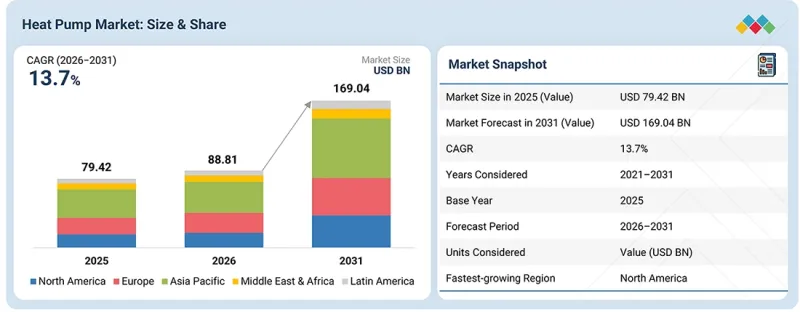
세계의 히트 펌프 시장 규모는 2026년 888억 1,000만 달러에서 2031년에는 1,690억 4,000만 달러로, CAGR 13.7%로 확대될 것으로 예측됩니다.
이 시장의 성장은 건물 전기화 프로그램의 급속한 확대, 정부의 보조금 및 우대 조치 확충, 주택 및 상업용 건물에서 노후화된 화석 연료 보일러의 교체 수요 증가에 힘입고 있습니다.
| 조사 범위 | |
|---|---|
| 조사 대상 기간 | 2022-2031년 |
| 기준 연도 | 2025년 |
| 예측 기간 | 2026-2031년 |
| 단위 | 금액(달러) |
| 부문 | 유형별, 기술별, 최종사용자별 |
| 대상 지역 | 북미, 라틴아메리카, 유럽, 아시아태평양, 중동 및 아프리카 |
각 제조사는 에너지 효율 향상, 냉난방 양쪽 기능 지원, 재생에너지 시스템과의 통합을 도모하기 위해 공기열원, 수열원, 지열원을 활용하는 히트 펌프 방식의 도입을 추진하고 있습니다. 하이브리드 히트 펌프 시스템, 스마트 온도 조절기, 수요 반응 프로그램, 축전지를 결합한 가정용 에너지 관리의 보급 확대에 따라, 첨단 히트 펌프 및 제어 플랫폼에 대한 수요가 가속화되고 있습니다.
지구 온난화 지수(GWP)가 낮은 냉매, 인버터 구동 가변속 압축기, 지능형 그리드 에지 기술에 대한 투자 확대로 인해, 제조사 및 전력회사에 의한 전기화가 진행되는 난방 부하 관리 방식도 변화하고 있습니다. AI를 활용한 진단, 커넥티드/IoT 대응 제어, 클라우드 기반 모니터링 플랫폼, 실시간 성능 최적화 분야의 발전으로 인해 한랭 지역에서의 도입이 가속화되는 동시에 운영 비용 절감과 시스템 효율 향상이 도모되고 있습니다. 전력 회사와 정부가 건물의 전기화를 추진하고 재생에너지 도입률 향상을 지속적으로 지원하는 가운데, 히트 펌프 솔루션은 탄력적이고 저탄소이며 디지털로 연결된 난방 인프라 구축에 있어 점점 더 중요한 역할을 할 것으로 예상됩니다.
“기술별로는 공기·물 히트 펌프가 예측 기간 동안 선두를 유지할 전망”
공기·물 히트 펌프는 공간 난방 및 가정용 온수 공급의 전기화가 가속화되는 가운데, 특히 유럽에서 강력한 성장이 예상됩니다. 이러한 시스템은 화석 연료 보일러를 대체할 뿐만 아니라 난방, 냉방, 온수 공급 기능을 제공할 수 있어 신축 및 리모델링 모두에 적합합니다. IEA는 유럽을 온수식 히트 펌프의 주요 시장 중 하나로 꼽으며, 건물 내 히트 펌프 도입이 세계 시장의 단기적 성장을 견인하는 주요 요인이 될 것이라고 밝혔습니다. 또한, R290 및 R32를 포함한 저GWP 냉매의 채택 확대가 제품 개발을 더욱 촉진하여 공기·물 시스템의 잠재 시장을 확대시키고 있습니다.
“상업 부문은 예측 기간 동안 강력한 성장을 보일 전망”
상업 시설에서는 공간 난방·냉방의 전기화, 화석 연료 소비 감축, 건물의 에너지 효율 향상을 목적으로 히트 펌프 도입이 확대될 것으로 예상됩니다. 히트 펌프는 동일한 시스템으로 냉난방을 모두 제공할 수 있을 뿐만 아니라, 대규모 시스템의 경우 빌딩 제어 시스템이나 축열 솔루션과 통합할 수 있어 상업용도로 특히 매력적입니다. IEA는 건물 분야를 히트 펌프 시장의 단기적 주요 성장 분야로 규정하고 있으며, 상업 시설, 지역 난방 및 기타 용도의 대형 히트 펌프 시스템에도 계속해서 큰 성장 기회가 있을 것으로 전망하고 있습니다.
본 보고서에서는 전 세계 히트 펌프 시장을 조사하여 시장 개요, 시장 성장에 영향을 미치는 각종 요인 분석, 기술·특허 동향, 법규제 환경, 사례 연구, 시장 규모 추정 및 전망, 각종 분류·지역/주요 국가별 상세 분석, 경쟁 구도, 주요 기업 개요 등을 정리하고 있습니다.
자주 묻는 질문
목차
제1장 소개
제2장 주요 요약
제3장 주요 인사이트
제4장 시장 개요
제5장 업계 동향
제6장 기술의 진보, AI의 영향, 특허, 혁신, 향후 용도
제7장 규제 상황과 지속가능성에 대한 대처
제8장 고객 상황과 구매 행동
제9장 히트 펌프 시장 : 유형별
제10장 히트 펌프 시장 : 정격 용량별
제11장 히트 펌프 시장 : 냉매별
제12장 히트 펌프 시장 : 기술별
제13장 히트 펌프 시장 : 용도별
제14장 히트 펌프 시장 : 최종사용자별
제15장 히트 펌프 시장 : 지역별
제16장 경쟁 구도
제17장 기업 개요
제18장 조사 방법
제19장 부록
KSM 26.09.17The global heat pump market is projected to grow from USD 88.81 billion in 2026 to USD 169.04 billion by 2031, at a CAGR of 13.7%. Market growth is supported by the rapid expansion of building electrification programs, increasing government subsidies and incentive schemes, and rising replacement of aging fossil fuel boilers across residential and commercial buildings.
| Scope of the Report | |
|---|---|
| Years Considered for the Study | 2022-2031 |
| Base Year | 2025 |
| Forecast Period | 2026-2031 |
| Units Considered | Value (USD Million/Billion) |
| Segments | By Type, By Technology, By End User |
| Regions covered | North America, Latin America, Europe , Asia Pacific, Middle East & Africa |
Manufacturers are deploying air-source, water-source, and ground-source heat pump architectures to improve energy efficiency, enable dual heating-cooling functionality, and integrate with renewable energy systems. Increasing adoption of hybrid heat pump systems, smart thermostats, demand response programs, and battery-backed home energy management is further accelerating demand for advanced heat pump and control platforms.
Growing investments in low-global warming potential (GWP) refrigerants, inverter-driven variable-speed compressors, and intelligent grid-edge technologies are transforming the way manufacturers and utilities manage increasingly electrified heating loads. Advances in AI-driven diagnostics, connected/IoT-enabled controls, cloud-based monitoring platforms, and real-time performance optimization are enabling faster cold climate adoption while reducing operating costs and improving system efficiency. As utilities and governments continue to push building electrification and support higher levels of renewable energy penetration, heat pump solutions are expected to play an increasingly important role in building resilient, low-carbon, and digitally connected heating infrastructure.
"Air-to-water heat pumps, by technology, are expected to maintain their leading position throughout the forecast period."
Air-to-water heat pumps are expected to witness strong growth as electrification of space heating and domestic hot water accelerates, particularly in Europe. These systems can replace fossil fuel boilers while providing heating, cooling, and hot-water functions, making them suitable for both new construction and retrofit applications. The IEA identifies Europe as a major market for hydronic heat pumps and notes that heat pump deployment in buildings is the near-term engine of global growth. The increasing adoption of low-GWP refrigerants, including R290 and R32, is further supporting product development and expanding the addressable market for air-to-water systems.
"The commercial segment is expected to witness strong growth during the forecast period."
Commercial buildings are expected to experience increasing heat-pump adoption as businesses seek to electrify space heating and cooling, reduce fossil fuel consumption, and improve building energy efficiency. Heat pumps are particularly attractive in commercial applications because the same system can provide heating and cooling, while larger systems can integrate with building controls and thermal storage solutions. The IEA identifies buildings as the primary near-term growth engine for heat pumps, and highlights continued opportunities for larger heat pump systems in commercial buildings, district heating, and other applications.
Breakdown of Primaries:
In-depth interviews with key industry participants, subject-matter experts, C-level executives of key market players, and directors, among other experts, were conducted to obtain and verify critical qualitative and quantitative information, as well as to assess future market prospects. The primary interviews were distributed as follows:
By Company Type: Tier 1 - 65%, Tier 2 - 24%, and Tier 3 - 11%
By Designation: C-Level Executives - 30%, Directors - 25%, Others - 45%
By Region: North America - 20%, Europe - 25%, Asia Pacific - 30%, Middle East & Africa - 10%, South and Central America - 15%.
Well-established technology companies and heat pump manufacturers predominantly govern the heat pump market. Key players profiled in the report include Daikin (Japan), Mitsubishi Electric (Japan), Panasonic (Japan), Bosch Home Comfort Group (Germany), Vaillant Group (Germany), Stiebel Eltron (Germany), NIBE Group (Sweden), Ariston Holding N.V. (Italy), Midea Building Technologies (China), Carrier Global (US), A.O. Smith Corporation (US), Aira/Vargas Group (Sweden), Dandelion Energy (US), and EVO Energy Technologies (Australia). Their strong manufacturing footprints, refrigerant technology leadership, and continued investments in low-GWP transition and regional capacity expansion continue to shape the competitive landscape.
Research Coverage:
The report provides a comprehensive definition, description, and forecast of the heat pump market by technology (air-to-air heat pumps, air-to-water heat pumps, water source heat pumps, ground source (geothermal) heat pumps, hybrid heat pumps, and photovoltaic-thermal (PVT) heat pumps),
by type (reversible heat pumps, non-reversible heat pumps),
by refrigerant (r410a, r407c, r744, r290, R717 and other refrigerants),
by rated capacity (up to 10 kW, 10-20 kW, 20-30 kW, and above 30 kW),
by end user (residential, commercial, and industrial),
by application (heating (water heating, district and space heating), heating and cooling), and
by region (North America, Europe, Asia Pacific, Latin America, and Middle East & Africa). It delivers qualitative and quantitative analysis of market drivers, restraints, opportunities, and challenges. The study also includes competitive landscape assessment, market sizing and forecasts, technology trends, ecosystem analysis, commercial use cases, company benchmarking, and recent developments to provide a comprehensive view of the heat pump market.
Key Benefits of Buying the Report
The report is designed to support OEMs, installers, utilities, policymakers, investors, and other stakeholders in understanding the evolving heat pump market. It provides reliable market forecasts across all major segments and regions while delivering insights into technology adoption, competitive positioning, and future growth opportunities. The report enables stakeholders to make informed business decisions through detailed market intelligence and strategic analysis.
- Analysis of key market dynamics: Covers the major drivers (Rising decarbonization mandates, Government subsidies and incentive programs, and Increasing replacement of fossil-fuel boilers), restraints (High upfront installation costs, Cold-climate performance limitations, and Electrician/installer shortages), opportunities (Smart home energy integration, Hybrid heat pump systems, and Emerging markets in Asia Pacific and North America), and challenges (F-Gas regulatory transitions, Grid capacity constraints, and Supply chain dependencies for compressors and refrigerants) influencing market growth
- Technology and Product Innovation: Examines advancements in low-GWP refrigerants (R-290, R-32), inverter-driven variable-speed compressors, hybrid heat pump systems, and AI-enabled smart controls that are transforming residential and commercial heating
- Market Development: Highlights how building electrification programs, EU F-Gas phase-down regulations, rising energy costs, and utility electrification incentives are accelerating heat pump adoption across global heating markets
- Market Diversification: Evaluates expanding heat pump applications beyond traditional residential heating into industrial process heat, data center thermal management, district heating networks, and combined heat-and-power integration, creating new revenue opportunities for market participants
- Competitive Assessment: Provides detailed analysis of leading companies, including DAIKIN INDUSTRIES, Ltd. (Japan), Mitsubishi Electric Corporation (Japan), Panasonic Holdings Corporation (Japan), Bosch Thermotechnology Corp. (Germany), Vaillant Group International GmbH (Germany), NIBE Industrier AB (Sweden), Ariston Holding N.V. (Italy), Midea Group Co., Ltd. (China), Carrier Global Corporation (US), A.O. Smith Corporation (US), Dandelion Energy, Inc. (US), and EVO Energy Technologies (Australia), covering their product portfolios, strategic initiatives, technological capabilities, and competitive positioning.
TABLE OF CONTENTS
1 INTRODUCTION
- 1.1 STUDY OBJECTIVES
- 1.2 MARKET DEFINITION
- 1.3 STUDY SCOPE
- 1.3.1 MARKETS COVERED AND REGIONAL SCOPE
- 1.3.2 INCLUSIONS AND EXCLUSIONS
- 1.3.3 YEARS CONSIDERED
- 1.4 CURRENCY CONSIDERED
- 1.5 UNIT CONSIDERED
- 1.6 LIMITATIONS
- 1.7 STAKEHOLDERS
- 1.8 SUMMARY OF CHANGES
2 EXECUTIVE SUMMARY
- 2.1 MARKET HIGHLIGHTS AND KEY INSIGHTS
- 2.2 KEY MARKET PARTICIPANTS: MAPPING OF STRATEGIC DEVELOPMENTS
- 2.3 DISRUPTIVE TRENDS IN HEAT PUMP MARKET
- 2.4 HIGH-GROWTH SEGMENTS
- 2.5 REGIONAL SNAPSHOT: MARKET SIZE, GROWTH RATE, AND FORECAST
3 PREMIUM INSIGHTS
- 3.1 ATTRACTIVE OPPORTUNITIES FOR PLAYERS IN HEAT PUMP MARKET
- 3.2 HEAT PUMP MARKET, BY APPLICATION AND REGION
- 3.3 HEAT PUMP MARKET, BY TECHNOLOGY
- 3.4 HEAT PUMP MARKET, BY RATED CAPACITY
- 3.5 HEAT PUMP MARKET, BY END USER
- 3.6 HEAT PUMP MARKET, BY APPLICATION
- 3.7 HEAT PUMP MARKET, BY TYPE
- 3.8 HEAT PUMP MARKET, BY REFRIGERANT
- 3.9 HEAT PUMP MARKET, BY COUNTRY
4 MARKET OVERVIEW
- 4.1 INTRODUCTION
- 4.2 MARKET DYNAMICS
- 4.2.1 DRIVERS
- 4.2.1.1 Rising electrification of space and water heating
- 4.2.1.2 Increasing government initiatives to enhance building efficiency and decarbonization
- 4.2.2 RESTRAINTS
- 4.2.2.1 High upfront and installation costs
- 4.2.2.2 Unfavorable electricity-to-gas price ratio
- 4.2.3 OPPORTUNITIES
- 4.2.3.1 Enhanced performance of CO2 heat pumps amid technological advances
- 4.2.3.2 Rapid transition toward low-GWP refrigerants
- 4.2.4 CHALLENGES
- 4.2.4.1 Development and compliance requirements of low-GWP refrigerants
- 4.2.4.2 Volatility in heat pump demand due to policy uncertainty
- 4.2.4.3 Technical and regulatory complexities
- 4.2.1 DRIVERS
- 4.3 INTERCONNECTED MARKETS AND CROSS-SECTOR OPPORTUNITIES
- 4.4 STRATEGIC MOVES BY TIER-1/2/3 PLAYERS
5 INDUSTRY TRENDS
- 5.1 PORTER'S FIVE FORCES ANALYSIS
- 5.1.1 THREAT OF NEW ENTRANTS
- 5.1.2 THREAT OF SUBSTITUTES
- 5.1.3 BARGAINING POWER OF SUPPLIERS
- 5.1.4 BARGAINING POWER OF BUYERS
- 5.1.5 INTENSITY OF COMPETITIVE RIVALRY
- 5.2 MACROECONOMIC OUTLOOK
- 5.2.1 INTRODUCTION
- 5.2.2 GDP TRENDS AND FORECAST
- 5.2.3 TRENDS IN GLOBAL COMMERCIAL SECTOR
- 5.2.4 TRENDS IN GLOBAL INDUSTRIAL SECTOR
- 5.3 SUPPLY CHAIN ANALYSIS
- 5.4 ECOSYSTEM ANALYSIS
- 5.5 PRICING ANALYSIS
- 5.5.1 PRICING RANGE OF HEAT PUMPS, BY TECHNOLOGY, 2025
- 5.5.2 AVERAGE SELLING PRICE TREND OF HEAT PUMPS, BY REGION, 2023-2025
- 5.6 TRADE ANALYSIS
- 5.6.1 IMPORT SCENARIO (HS CODE 841861)
- 5.6.2 EXPORT SCENARIO (HS CODE 841861)
- 5.7 KEY CONFERENCES AND EVENTS, 2026-2027
- 5.8 TRENDS/DISRUPTIONS IMPACTING CUSTOMER BUSINESS
- 5.9 INVESTMENT AND FUNDING SCENARIO
- 5.10 CASE STUDY ANALYSIS
- 5.10.1 ECOCUTE HEAT-PUMP WATER HEATER DEPLOYMENT TO REDUCE ENERGY CONSUMPTION AND FOSSIL-FUEL DEPENDENCE
- 5.10.2 LARGE HEAT PUMP CONSTRUCTION IN HAMBURG, GERMANY TO SUPPORT DECARBONIZATION
- 5.10.3 US DOE'S HIGH-TEMPERATURE HEAT-PUMP SYSTEM DEVELOPMENT FOR COMMERCIAL BUILDINGS
- 5.11 IMPACT OF US TARIFF - HEAT PUMP MARKET
- 5.11.1 INTRODUCTION
- 5.11.2 KEY TARIFF RATES
- 5.11.3 PRICE IMPACT ANALYSIS
- 5.11.4 IMPACT ON COUNTRIES/REGIONS
- 5.11.4.1 US
- 5.11.4.2 Europe
- 5.11.4.3 Asia Pacific
- 5.11.5 IMPACT ON END USERS
6 TECHNOLOGICAL ADVANCEMENTS, AI-DRIVEN IMPACT, PATENTS, INNOVATIONS, AND FUTURE APPLICATIONS
- 6.1 KEY TECHNOLOGIES
- 6.1.1 PHOTOVOLTAIC-THERMAL SOLAR-ASSISTED HEAT PUMP SYSTEMS
- 6.1.2 HYBRID HEAT PUMPS
- 6.1.3 AIR-TO-AIR HEAT PUMPS
- 6.1.4 AIR-TO-WATER HEAT PUMPS
- 6.1.5 WATER-SOURCE HEAT PUMPS
- 6.1.6 GROUND-SOURCE HEAT PUMPS
- 6.1.7 SOLID-STATE HEAT PUMPS
- 6.2 COMPLEMENTARY TECHNOLOGIES
- 6.2.1 THERMAL STORAGE SYSTEMS
- 6.2.2 SMART CONTROLS AND AUTOMATION
- 6.3 ADJACENT TECHNOLOGIES
- 6.3.1 HEAT RECOVERY VENTILATION SYSTEMS
- 6.3.2 INTERNET OF THINGS DEVICES
- 6.4 TECHNOLOGY ROADMAP
- 6.4.1 REFRIGERANT TRANSITION
- 6.4.2 HIGH-TEMPERATURE HEAT PUMPS
- 6.4.3 INVERTER AND VARIABLE-SPEED TECHNOLOGY
- 6.4.4 INTEGRATED HEATING, COOLING, AND HOT-WATER SYSTEMS
- 6.4.5 SMART AND CONNECTED HEAT PUMPS
- 6.4.6 GRID-INTERACTIVE HEAT PUMPS
- 6.4.7 AI-ENABLED AUTONOMOUS OPERATION
- 6.5 PATENT ANALYSIS
- 6.6 FUTURE APPLICATIONS
- 6.7 IMPACT OF AI/GEN AI ON HEAT PUMP MARKET
- 6.7.1 TOP USE CASES AND MARKET POTENTIAL
- 6.7.2 BEST PRACTICES FOLLOWED BY MANUFACTURERS/OEMS IN HEAT PUMP MARKET
- 6.7.3 CASE STUDIES RELATED TO AI/GEN AI IMPLEMENTATION IN HEAT PUMP MARKET
- 6.7.4 INTERCONNECTED ECOSYSTEMS AND IMPACT ON MARKET PLAYERS
- 6.7.5 CLIENTS' READINESS TO ADOPT AI/GEN AI-INTEGRATED HEAT PUMPS
7 REGULATORY LANDSCAPE AND SUSTAINABILITY INITIATIVES
- 7.1 REGIONAL REGULATIONS AND COMPLIANCE
- 7.1.1 REGULATORY BODIES, GOVERNMENT AGENCIES, AND OTHER ORGANIZATIONS
- 7.1.2 GLOBAL F-GAS REGULATIONS AND REFRIGERANT POLICIES
- 7.1.3 EUROPEAN F-GAS REGULATIONS AND REFRIGERANT POLICIES
- 7.1.4 EUROPEAN REGULATIONS, SUBSIDIES, AND POLICIES
- 7.1.5 ASIA PACIFIC REGULATIONS, SUBSIDIES, AND POLICIES
- 7.1.6 NORTH AMERICAN REGULATIONS, SUBSIDIES, AND POLICIES
- 7.1.7 MIDDLE EAST & AFRICAN REGULATIONS, SUBSIDIES, AND POLICIES
- 7.1.8 LATIN AMERICAN REGULATIONS, SUBSIDIES, AND POLICIES
- 7.1.9 EUROPEAN HEAT PUMP POLICIES
- 7.2 SUSTAINABILITY INITIATIVES
- 7.3 IMPACT OF REGULATORY POLICIES ON SUSTAINABILITY INITIATIVES
8 CUSTOMER LANDSCAPE AND BUYER BEHAVIOR
- 8.1 DECISION-MAKING PROCESS
- 8.1.1 REPLACEMENT NEED AND HEATING-SYSTEM ASSESSMENT
- 8.1.2 HEATING AND COOLING PERFORMANCE REQUIREMENT ASSESSMENT
- 8.1.3 TECHNICAL PRODUCT EVALUATION
- 8.1.4 ECONOMIC AND TOTAL-COST-OF-OWNERSHIP EVALUATION
- 8.1.5 INSTALLER VALIDATION AND SYSTEM DESIGN
- 8.1.6 INCENTIVE, REGULATORY, AND TARIFF ASSESSMENT
- 8.2 KEY STAKEHOLDERS INVOLVED IN BUYING PROCESS AND THEIR EVALUATION CRITERIA
- 8.2.1 KEY STAKEHOLDERS IN BUYING PROCESS
- 8.2.2 BUYING CRITERIA
- 8.3 ADOPTION BARRIERS AND INTERNAL CHALLENGES
- 8.3.1 HIGH UPFRONT COST AND RETROFIT EXPENDITURE
- 8.3.2 OPERATING COST AND ELECTRICITY-TO-GAS PRICE ECONOMICS
- 8.3.3 HEATING CAPACITY AND COLD-CLIMATE PERFORMANCE
- 8.3.4 RETROFIT COMPATIBILITY AND INSTALLATION COMPLEXITY
- 8.3.5 ENERGY EFFICIENCY AND TOTAL COST OF OWNERSHIP
- 8.3.6 REFRIGERANT SELECTION AND REGULATORY COMPLIANCE
- 8.3.7 RELIABILITY, SERVICE AVAILABILITY, AND WARRANTY
- 8.3.8 SMART CONTROLS AND CONNECTIVITY
- 8.3.9 INCENTIVES AND PAYBACK PERIOD
- 8.3.10 INSTALLER EXPERTISE AND PRODUCT AVAILABILITY
- 8.4 UNMET NEEDS OF VARIOUS END USERS
- 8.5 MARKET PROFITABILITY
9 HEAT PUMP MARKET, BY TYPE
- 9.1 INTRODUCTION
- 9.2 REVERSIBLE
- 9.2.1 SUITABILITY FOR BUILDINGS WITH VARYING THERMAL REQUIREMENTS TO BOOST SEGMENTAL GROWTH
- 9.3 NON-REVERSIBLE
- 9.3.1 USE IN DEDICATED HEATING AND HOT-WATER APPLICATIONS TO EXPEDITE SEGMENTAL GROWTH
10 HEAT PUMP MARKET, BY RATED CAPACITY
- 10.1 INTRODUCTION
- 10.2 UP TO 10 KW
- 10.2.1 INCREASING REPLACEMENT OF CONVENTIONAL BOILERS AND RESIDENTIAL ELECTRIFICATION TO FOSTER SEGMENTAL GROWTH
- 10.3 10-20 KW
- 10.3.1 GROWING SPACE-HEATING REQUIREMENTS IN LARGE RESIDENTIAL AND LIGHT-COMMERCIAL PROPERTIES TO SPUR DEMAND
- 10.4 20-30 KW
- 10.4.1 RISING NEED FOR EFFICIENT CLIMATE CONTROL IN HYBRID ENVIRONMENTS TO FUEL SEGMENTAL GROWTH
- 10.5 ABOVE 30 KW
- 10.5.1 INCREASING COMMERCIAL BUILDING ELECTRIFICATION, DISTRICT HEATING, AND WASTE-HEAT RECOVERY TO DRIVE MARKET
11 HEAT PUMP MARKET, BY REFRIGERANT
- 11.1 INTRODUCTION
- 11.2 R410A
- 11.2.1 ESTABLISHED ARCHITECTURE, COMPONENT AVAILABILITY, AND PROVEN OPERATING PERFORMANCE TO SPUR DEMAND
- 11.3 R407C
- 11.3.1 CUSTOMER FOCUS ON EXTENDING EQUIPMENT OPERATING LIFE TO ACCELERATE SEGMENTAL GROWTH
- 11.4 R744
- 11.4.1 ABILITY TO DELIVER HIGH-TEMPERATURE HOT WATER TO CONTRIBUTE TO SEGMENTAL GROWTH
- 11.5 R290
- 11.5.1 TRANSITION FROM HIGH-GWP REFRIGERANTS TOWARD NATURAL ALTERNATIVES TO BOLSTER SEGMENTAL GROWTH
- 11.6 R717
- 11.6.1 STRONG THERMODYNAMIC PERFORMANCE AND SUITABILITY FOR HIGH-TEMPERATURE PROCESS HEATING TO DRIVE MARKET
- 11.7 OTHER REFRIGERANTS
12 HEAT PUMP MARKET, BY TECHNOLOGY
- 12.1 INTRODUCTION
- 12.2 AIR-TO-AIR
- 12.2.1 SIMPLE INSTALLATION AND LIMITED DEPENDENCE ON HYDRONIC INFRASTRUCTURE TO AUGMENT SEGMENTAL GROWTH
- 12.3 AIR-TO-WATER
- 12.3.1 ELECTRIFICATION OF HYDRONIC HEATING SYSTEMS TO CONTRIBUTE TO SEGMENTAL GROWTH
- 12.4 WATER-SOURCE
- 12.4.1 DEMAND FOR LOW-CARBON CENTRALIZED HEATING TO EXPEDITE SEGMENTAL GROWTH
- 12.5 GROUND-SOURCE (GEOTHERMAL)
- 12.5.1 STABLE GROUND TEMPERATURES AND LONG-TERM EFFICIENCY TO FACILITATE SEGMENTAL GROWTH
- 12.6 HYBRID
- 12.6.1 RETROFIT FLEXIBILITY AND TRANSITIONAL HEATING POLICIES TO SUPPORT ADOPTION
- 12.7 PHOTOVOLTAIC-THERMAL (PVT)
- 12.7.1 INTEGRATION OF SOLAR ENERGY WITH ELECTRIFIED HEATING AND COOLING SYSTEMS TO BOOST SEGMENTAL GROWTH
13 HEAT PUMP MARKET, BY APPLICATION
- 13.1 INTRODUCTION
- 13.2 HEATING
- 13.2.1 WATER HEATING
- 13.2.1.1 Mounting demand for high-efficiency heat-pump systems to bolster segmental growth
- 13.2.2 DISTRICT & SPACE HEATING
- 13.2.2.1 Increasing implementation of increasingly stringent building energy-performance requirements to fuel segmental growth
- 13.2.1 WATER HEATING
- 13.3 HEATING & COOLING
- 13.3.1 REQUIREMENT FOR INTEGRATED SYSTEMS ADDRESSING SEASONAL THERMAL REQUIREMENTS TO FACILITATE SEGMENTAL GROWTH
14 HEAT PUMP MARKET, BY END USER
- 14.1 INTRODUCTION
- 14.2 RESIDENTIAL
- 14.2.1 INCREASING REPLACEMENT OF GAS AND OIL BOILERS, HOUSEHOLD ELECTRIFICATION, AND GOVERNMENT INCENTIVES TO DRIVE MARKET
- 14.3 COMMERCIAL
- 14.3.1 GROWING RELIANCE ON RENEWABLE ENERGY SOURCES FOR HEATING TO ACCELERATE SEGMENTAL GROWTH
- 14.4 INDUSTRIAL
- 14.4.1 RISING EFFORTS TO ENHANCE SUSTAINABILITY AND LOWER CARBON EMISSIONS TO EXPEDITE SEGMENTAL GROWTH
15 HEAT PUMP MARKET, BY REGION
- 15.1 INTRODUCTION
- 15.2 ASIA PACIFIC
- 15.2.1 CHINA
- 15.2.1.1 Rising industrial electrification and government-led decarbonization strategies to accelerate market growth
- 15.2.2 INDIA
- 15.2.2.1 Increasing electricity consumption, cooling requirements, and expanding commercial infrastructure to fuel market growth
- 15.2.3 JAPAN
- 15.2.3.1 Growing focus on high-efficiency heating in manufacturing sector to bolster market growth
- 15.2.4 SOUTH KOREA
- 15.2.4.1 High emphasis on electrifying building thermal energy and advanced HVAC manufacturing ecosystem to drive market
- 15.2.5 AUSTRALIA
- 15.2.5.1 Mounting demand for energy-efficient systems and rooftop-solar penetration to contribute to market growth
- 15.2.6 REST OF ASIA PACIFIC
- 15.2.1 CHINA
- 15.3 EUROPE
- 15.3.1 FRANCE
- 15.3.1.1 Rising building-renovation activity and replacement of conventional heating systems to expedite market growth
- 15.3.2 ITALY
- 15.3.2.1 Growing focus on replacing fossil-fuel heating systems with electric counterparts to augment market growth
- 15.3.3 GERMANY
- 15.3.3.1 Increasing replacement of conventional heating systems and retrofit applications to facilitate market growth
- 15.3.4 UK
- 15.3.4.1 Rising financial incentives and decarbonization policies to accelerate market growth
- 15.3.5 SPAIN
- 15.3.5.1 High emphasis on renovating buildings and renewable energy strategies to drive market
- 15.3.6 REST OF EUROPE
- 15.3.1 FRANCE
- 15.4 NORTH AMERICA
- 15.4.1 US
- 15.4.1.1 Large HVAC equipment installed base and replacement of conventional heating systems to support market growth
- 15.4.2 CANADA
- 15.4.2.1 Government programs to replace conventional oil- and gas-fired heating systems with electric heat pumps to fuel market growth
- 15.4.1 US
- 15.5 MIDDLE EAST & AFRICA
- 15.5.1 GCC
- 15.5.1.1 Saudi Arabia
- 15.5.1.1.1 Strong focus on strengthening energy-efficiency standards to support market growth
- 15.5.1.2 UAE
- 15.5.1.2.1 Extensive air-conditioning requirements across residential and commercial buildings to foster market growth
- 15.5.1.3 Rest of GCC
- 15.5.1.1 Saudi Arabia
- 15.5.2 SOUTH AFRICA
- 15.5.2.1 Greater emphasis on building energy performance to contribute to market growth
- 15.5.3 REST OF MIDDLE EAST & AFRICA
- 15.5.1 GCC
- 15.6 LATIN AMERICA
- 15.6.1 BRAZIL
- 15.6.1.1 Continued focus on energy efficiency and electrification to accelerate market growth
- 15.6.2 MEXICO
- 15.6.2.1 Strong focus on energy-efficiency standards for air-conditioning equipment to expedite market growth
- 15.6.3 REST OF LATIN AMERICA
- 15.6.1 BRAZIL
16 COMPETITIVE LANDSCAPE
- 16.1 OVERVIEW
- 16.2 KEY PLAYER COMPETITIVE STRATEGIES/RIGHT TO WIN, 2023-2026
- 16.3 MARKET SHARE ANALYSIS, 2025
- 16.4 MARKET EVALUATION FRAMEWORK, 2021-2025
- 16.5 REVENUE ANALYSIS, 2021-2025
- 16.6 PRODUCT COMPARISON
- 16.6.1 PANASONIC HOLDINGS CORPORATION (JAPAN)
- 16.6.2 MITSUBISHI ELECTRIC CORPORATION (JAPAN)
- 16.6.3 MIDEA (CHINA)
- 16.6.4 SAMSUNG (SOUTH KOREA)
- 16.6.5 DENSO CORPORATION (JAPAN)
- 16.7 COMPANY VALUATION AND FINANCIAL METRICS
- 16.8 COMPANY EVALUATION MATRIX: KEY PLAYERS, 2025
- 16.8.1 STARS
- 16.8.2 EMERGING LEADERS
- 16.8.3 PERVASIVE PLAYERS
- 16.8.4 PARTICIPANTS
- 16.8.5 COMPANY FOOTPRINT: KEY PLAYERS, 2025
- 16.8.5.1 Company footprint
- 16.8.5.2 Region footprint
- 16.8.5.3 Technology footprint
- 16.8.5.4 Type footprint
- 16.8.5.5 Rated capacity footprint
- 16.8.5.6 Refrigerant footprint
- 16.8.5.7 Application footprint
- 16.8.5.8 End user footprint
- 16.9 COMPANY EVALUATION MATRIX: STARTUPS/SMES, 2025
- 16.9.1 PROGRESSIVE COMPANIES
- 16.9.2 RESPONSIVE COMPANIES
- 16.9.3 DYNAMIC COMPANIES
- 16.9.4 STARTING BLOCKS
- 16.9.5 COMPETITIVE BENCHMARKING: STARTUPS/SMES, 2025
- 16.9.5.1 Detailed list of key startups/SMEs
- 16.9.5.2 Competitive benchmarking of key startups/SMEs
- 16.10 COMPETITIVE SCENARIO
- 16.10.1 PRODUCT LAUNCHES
- 16.10.2 DEALS
- 16.10.3 EXPANSIONS
- 16.10.4 OTHER DEVELOPMENTS
17 COMPANY PROFILES
- 17.1 KEY PLAYERS
- 17.1.1 PANASONIC HOLDINGS CORPORATION
- 17.1.1.1 Business overview
- 17.1.1.2 Products/Solutions/Services offered
- 17.1.1.3 Recent developments
- 17.1.1.3.1 Product launches
- 17.1.1.3.2 Deals
- 17.1.1.3.3 Expansions
- 17.1.1.3.4 Other developments
- 17.1.1.4 MnM view
- 17.1.1.4.1 Key strengths/Right to win
- 17.1.1.4.2 Strategic choices
- 17.1.1.4.3 Weaknesses/Competitive threats
- 17.1.2 MITSUBISHI ELECTRIC CORPORATION
- 17.1.2.1 Business overview
- 17.1.2.2 Products/Solutions/Services offered
- 17.1.2.3 Recent developments
- 17.1.2.3.1 Product launches
- 17.1.2.3.2 Expansions
- 17.1.2.3.3 Other developments
- 17.1.3 SAMSUNG
- 17.1.3.1 Business overview
- 17.1.3.2 Products/Solutions/Services offered
- 17.1.3.3 Recent developments
- 17.1.3.3.1 Product launches
- 17.1.3.3.2 Deals
- 17.1.3.3.3 Expansions
- 17.1.3.3.4 Other developments
- 17.1.3.4 MnM view
- 17.1.3.4.1 Key strengths/Right to win
- 17.1.3.4.2 Strategic choices
- 17.1.3.4.3 Weaknesses/Competitive threats
- 17.1.4 MIDEA
- 17.1.4.1 Business overview
- 17.1.4.2 Products/Solutions/Services offered
- 17.1.4.3 Recent developments
- 17.1.4.3.1 Product launches
- 17.1.4.3.2 Deals
- 17.1.4.3.3 Expansions
- 17.1.4.3.4 Other developments
- 17.1.4.4 MnM view
- 17.1.4.4.1 Key strengths/Right to win
- 17.1.4.4.2 Strategic choices
- 17.1.4.4.3 Weaknesses/Competitive threats
- 17.1.5 DENSO CORPORATION
- 17.1.5.1 Business overview
- 17.1.5.2 Products/Solutions/Services offered
- 17.1.5.3 Recent developments
- 17.1.5.3.1 Expansions
- 17.1.5.3.2 Other developments
- 17.1.5.4 MnM view
- 17.1.5.4.1 Key strengths/Right to win
- 17.1.5.4.2 Strategic choices
- 17.1.5.4.3 Weaknesses/Competitive threats
- 17.1.6 DAIKIN
- 17.1.6.1 Business overview
- 17.1.6.2 Products/Solutions/Services offered
- 17.1.6.3 Recent developments
- 17.1.6.3.1 Product launches
- 17.1.6.3.2 Deals
- 17.1.6.3.3 Other developments
- 17.1.7 CARRIER
- 17.1.7.1 Business overview
- 17.1.7.2 Products/Solutions/Services offered
- 17.1.7.3 Recent developments
- 17.1.7.3.1 Product launches
- 17.1.7.3.2 Expansions
- 17.1.7.3.3 Other developments
- 17.1.8 TRANE TECHNOLOGIES PLC
- 17.1.8.1 Business overview
- 17.1.8.2 Products/Solutions/Services offered
- 17.1.8.3 Recent developments
- 17.1.8.3.1 Product launches
- 17.1.8.3.2 Deals
- 17.1.8.3.3 Expansions
- 17.1.8.3.4 Other developments
- 17.1.9 JOHNSON CONTROLS
- 17.1.9.1 Business overview
- 17.1.9.2 Products/Solutions/Services offered
- 17.1.9.3 Recent developments
- 17.1.9.3.1 Product launches
- 17.1.9.3.2 Deals
- 17.1.9.3.3 Expansions
- 17.1.9.3.4 Other developments
- 17.1.10 BOSCH THERMOTECHNOLOGY LTD.
- 17.1.10.1 Business overview
- 17.1.10.2 Products/Solutions/Services offered
- 17.1.10.3 Recent developments
- 17.1.10.3.1 Product Launches
- 17.1.10.3.2 Deals
- 17.1.10.3.3 Expansions
- 17.1.10.3.4 Other developments
- 17.1.11 LG ELECTRONICS
- 17.1.11.1 Business overview
- 17.1.11.2 Products/Solutions/Services offered
- 17.1.11.3 Recent developments
- 17.1.11.3.1 Product launches
- 17.1.11.3.2 Deals
- 17.1.11.3.3 Expansions
- 17.1.11.3.4 Other developments
- 17.1.12 FUJITSU GENERAL
- 17.1.12.1 Business overview
- 17.1.12.2 Products/Solutions/Services offered
- 17.1.12.3 Recent developments
- 17.1.12.3.1 Product launches
- 17.1.12.3.2 Deals
- 17.1.13 THERMAX LIMITED
- 17.1.13.1 Business overview
- 17.1.13.2 Products/Solutions/Services offered
- 17.1.13.3 Recent developments
- 17.1.13.3.1 Deals
- 17.1.14 GEA GROUP AKTIENGESELLSCHAFT
- 17.1.14.1 Business overview
- 17.1.14.2 Products/Solutions/Services offered
- 17.1.14.3 Recent developments
- 17.1.14.3.1 Deals
- 17.1.14.3.2 Other developments
- 17.1.15 LENNOX INTERNATIONAL INC
- 17.1.15.1 Business overview
- 17.1.15.2 Products/Solutions/Services offered
- 17.1.15.3 Recent developments
- 17.1.15.3.1 Product launches
- 17.1.15.3.2 Deals
- 17.1.1 PANASONIC HOLDINGS CORPORATION
- 17.2 OTHER PLAYERS
- 17.2.1 GUANGZHOU SPRSUN NEW ENERGY TECHNOLOGY DEVELOPMENT CO., LTD.
- 17.2.2 GLEN DIMPLEX GROUP
- 17.2.3 NIBE LIMITED
- 17.2.4 RHEEM MANUFACTURING COMPANY
- 17.2.5 DANDELION ENERGY
- 17.2.6 ZEALUX ELECTRIC LIMITED
- 17.2.7 VAILLANT GROUP
- 17.2.8 EVO ENERGY TECHNOLOGIES
- 17.2.9 ARISTON HOLDING N.V.
- 17.2.10 A. O. SMITH
- 17.2.11 ENERGEN HYBRID SYSTEMS LIMITED
- 17.2.12 NAMMASWADESHI
- 17.2.13 ECOTECH SOLUTIONS
18 RESEARCH METHODOLOGY
- 18.1 RESEARCH DATA
- 18.1.1 SECONDARY DATA
- 18.1.1.1 List of key secondary sources
- 18.1.1.2 Key data from secondary sources
- 18.1.2 PRIMARY DATA
- 18.1.2.1 List of primary interview participants
- 18.1.2.2 Key industry insights
- 18.1.2.3 Breakdown of primaries
- 18.1.2.4 Key data from primary sources
- 18.1.1 SECONDARY DATA
- 18.2 DATA TRIANGULATION
- 18.3 MARKET SIZE ESTIMATION
- 18.3.1 BOTTOM-UP APPROACH
- 18.3.2 TOP-DOWN APPROACH
- 18.4 MARKET FORECAST APPROACH
- 18.4.1 DEMAND-SIDE
- 18.4.1.1 Demand-side assumptions
- 18.4.1.2 Demand-side calculations
- 18.4.2 SUPPLY-SIDE
- 18.4.2.1 Supply-side assumptions
- 18.4.2.2 Supply-side calculations
- 18.4.1 DEMAND-SIDE
- 18.5 INDUSTRY CONCENTRATION
- 18.6 GROWTH FORECAST ASSUMPTIONS
- 18.7 RESEARCH LIMITATIONS
- 18.8 RISK ANALYSIS
19 APPENDIX
- 19.1 INSIGHTS FROM INDUSTRY EXPERTS
- 19.2 DISCUSSION GUIDE
- 19.3 KNOWLEDGESTORE: MARKETSANDMARKETS' SUBSCRIPTION PORTAL
- 19.4 CUSTOMIZATION OPTIONS
- 19.5 RELATED REPORTS
- 19.6 AUTHOR DETAILS


