

|
시장보고서
상품코드
2138090
프로젝트 포트폴리오 관리 시장 : 소프트웨어 유형별 - 세계 예측(-2031년)Project Portfolio Management Market by Software Type -Global Forecast to 2031 |
||||||

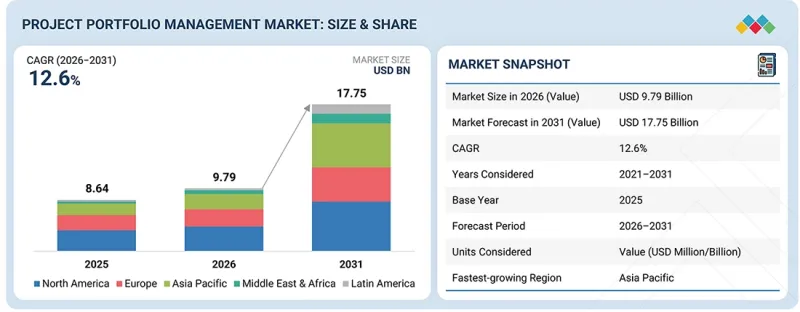
세계의 프로젝트 포트폴리오 관리 시장은 급속히 확대되고 있으며, 시장 규모는 2026년 약 97억 9,000만 달러에서 2031년에는 177억 5,000만 달러로 확대될 것으로 예상되며, 예측 기간 동안 연평균 성장률(CAGR)은 12.6%에 달할 것으로 전망됩니다.
기술, 금융 서비스, 정부 기관 등 각 부문의 기업들은 전략적 우선순위 설정을 통합하고, 수작업 보고 업무를 줄이며, 포트폴리오 투자의 측정 가능한 수익을 입증하기 위해 AI를 활용한 포트폴리오 계획, 자원 관리, 재무 거버넌스 플랫폼에 대한 투자를 점점 더 늘리고 있습니다.
전략적 계획, 자원 배분, 재무 거버넌스가 탑다운 전략과 바텀업 실행 데이터를 연결하는 통합 플랫폼으로 점점 더 융합됨에 따라 시장은 재편되고 있습니다. 자본 배분에 대한 이사회 감시가 엄격해짐에 따라, 조직은 스프레드시트를 통한 추적 방식에서 벗어나, 경영진을 위한 실시간 보고서를 생성할 수 있는, 거버넌스가 확립되고 감사 가능한 포트폴리오 플랫폼으로의 전환을 요구받고 있습니다.
| 조사 범위 | |
|---|---|
| 조사 대상 기간 | 2021-2031년 |
| 기준 연도 | 2025년 |
| 예측 기간 | 2026-2031년 |
| 단위 | 금액(달러) |
| 부문 | 제공, 소프트웨어 유형, 도입 구분, 조직 규모, 포트폴리오 유형, 업계 |
| 대상 지역 | 북미, 유럽, 아시아태평양, 중동 및 아프리카, 라틴아메리카 |
동시에, 사모펀드 투자와 플랫폼 중심의 인수를 배경으로 포트폴리오 관리 소프트웨어 공급업체 간의 통합이 가속화되며 경쟁 환경이 변화하고 있습니다. 기업들은 개별 용도에 특화된 분산형 솔루션 대신, 업무 전반을 일관되게 관리할 수 있는 간소화된 거버넌스 기반을 요구하고 있습니다. 이러한 동향에 따라 프로젝트 포트폴리오 관리 소프트웨어는 자본 규율, 성과에 대한 설명 책임, 대규모 플랫폼 통합 간의 균형을 유지하면서 기업 거버넌스의 전략적 축으로서의 입지를 확립해 가고 있습니다.
“소프트웨어 유형별로는 전략적 포트폴리오 관리 소프트웨어가 예측 기간 동안 견조한 성장을 이룰 것으로 전망됩니다.”
전략적 포트폴리오 관리 소프트웨어는 경영진과 PMO 리더가 기업 전략을 우선순위가 지정된 일련의 투자로 전환할 수 있도록 지원하며, 하향식 목표와 자금 확보를 경쟁하는 프로젝트, 프로그램, 제품 포트폴리오를 연계합니다. 이 소프트웨어는 2031년까지 시장에서 가장 빠르게 성장하는 소프트웨어 카테고리 중 하나로 자리매김할 것으로 예상됩니다.
이 카테고리 내에서 포트폴리오 계획이 매출의 가장 큰 비중을 차지하고 있습니다. 이 기능을 통해 PMO 팀은 수요를 파악하고, 경쟁 관계에 있는 이니셔티브를 전략적 기준에 비추어 평가하며, 정해진 계획 기간을 위한 승인된 포트폴리오를 구축할 수 있습니다. 이는 많은 기업과 조직이 고급 기능을 도입하기 전에 체계적인 계획 수립부터 전략적 포트폴리오 관리에 착수하고 있음을 반영합니다. 반면, 새로운 프로젝트나 제품 아이디어를 체계화된 접수 및 평가 워크플로를 통해 처리하는 수요·혁신 관리 도구는, 조직이 핵심 운영 포트폴리오와 병행하여 혁신 파이프라인을 점점 더 공식화하고 있기 때문에 이 카테고리 내에서 가장 빠른 성장세를 기록하고 있습니다.
전략과 자본 배분의 보다 긴밀한 연계를 요구하는 이사회 차원의 수요가 증가하는 데 더해,AI 기반 투자 평가가 핵심 계획 워크플로우에 통합되는 추세가 강화됨에 따라, 기업들이 정기적인 연간 계획에서 지속적으로 갱신되는 AI 지원형 포트폴리오 거버넌스로 전환해 나가는 과정에서 전략적 포트폴리오 관리 소프트웨어의 견조한 성장세는 지속될 것으로 예상됩니다.
본 보고서에서는 전 세계 프로젝트 포트폴리오 관리 시장을 조사하여, 시장 개요, 시장 성장에 영향을 미치는 다양한 요인에 대한 분석, 기술 및 특허 동향, 법규제 환경, 사례 연구, 시장 규모 추정 및 전망, 각종 분류·지역/주요 국가별 상세 분석, 경쟁 구도, 주요 기업 개요 등을 정리하고 있습니다.
자주 묻는 질문
목차
제1장 소개
제2장 주요 요약
제3장 주요 인사이트
제4장 시장 개요
제5장 업계 동향
제6장 기술, 특허, 디지털 기술, AI의 도입에 의한 전략적 디스럽션
제7장 규제 상황
제8장 고객 상황과 구매 행동
제9장 프로젝트 포트폴리오 관리 시장 : 제공별
제10장 프로젝트 포트폴리오 관리 시장 : 소프트웨어별
제11장 프로젝트 포트폴리오 관리 시장 : 도입 방식별
제12장 프로젝트 포트폴리오 관리 시장 : 조직 규모별
제13장 프로젝트 포트폴리오 관리 시장 : 포트폴리오 유형별
제14장 프로젝트 포트폴리오 관리 시장 : 업계별
제15장 프로젝트 포트폴리오 관리 시장 : 지역별
제16장 경쟁 구도
제17장 기업 개요
제18장 조사 방법
제19장 부록
KSM 26.10.08The global project portfolio management market is expanding rapidly, with a projected market size anticipated to rise from about USD 9.79 billion in 2026 to USD 17.75 billion by 2031, at a CAGR of 12.6% during the forecast period. Enterprises across technology, financial services, and government sectors are increasingly investing in AI-enabled portfolio planning, resource management, and financial governance platforms to centralize strategic prioritization, reduce manual reporting effort, and demonstrate measurable return on portfolio investment. The market is being reshaped by the growing convergence of strategic planning, resource allocation, and financial governance into unified platforms that connect top-down strategy with bottom-up execution data. Rising boardroom scrutiny of capital allocation is pushing organizations to move beyond spreadsheet-based tracking toward governed, auditable portfolio platforms capable of producing real-time executive reporting.
| Scope of the Report | |
|---|---|
| Years Considered for the Study | 2021-2031 |
| Base Year | 2025 |
| Forecast Period | 2026-2031 |
| Units Considered | Value (USD Million/Billion) |
| Segments | Offering, Software Type, Deployment Type, Organization Size, Portfolio Type, Vertical |
| Regions covered | North America, Europe, Asia Pacific, Middle East & Africa, Latin America |
At the same time, accelerating consolidation among portfolio software vendors, supported by private equity investment and platform-led acquisitions, is reshaping the competitive landscape as enterprises seek simplified, end-to-end governance stacks in place of fragmented point solutions. Together, these dynamics are positioning project portfolio management software as a strategic pillar of enterprise governance, balancing capital discipline, delivery accountability, and platform consolidation at scale.
"By software type, strategic portfolio management software to witness robust growth during the forecast period."
Strategic portfolio management software helps executives and PMO leaders translate corporate strategy into a prioritized set of investments, connecting top-down objectives with the portfolio of projects, programs, and products competing for funding, and it is expected to remain one of the fastest-growing software type categories in the project portfolio management market through 2031. Within this category, portfolio planning capabilities, which let PMO teams capture demand, score competing initiatives against strategic criteria, and build an approved portfolio for a given planning cycle, account for the largest share of category revenue, reflecting how most organizations begin their strategic portfolio journey with structured planning before adopting more advanced capabilities. Demand and innovation management tools, which route new project and product ideas through structured intake and evaluation workflows, are recording the fastest growth within the category as organizations increasingly formalize innovation pipelines alongside core operational portfolios. Rising board-level demand for tighter linkage between strategy and capital allocation, combined with growing integration of AI-based investment scoring into core planning workflows, is expected to sustain strong momentum for strategic portfolio management software as enterprises shift from periodic annual planning toward continuously updated, AI-assisted portfolio governance.
"By Offering, Software segment to hold the largest market share during the forecast period"
Software forms the foundational layer of the project portfolio management market, providing the core planning, resource, financial, and governance capabilities through which PMOs and executives manage enterprise portfolios, and it is expected to hold the largest market share throughout the forecast period. Unlike services, which are delivered by vendor or partner teams during implementation and ongoing operation, software is designed for portfolio and PMO teams to configure and operate largely on their own, with vendors providing the underlying platform and periodic feature releases. The segment's leadership is being reinforced by the growing integration of AI directly into core portfolio workflows, with leading vendors embedding predictive analytics, automated risk flagging, and AI-generated status narratives directly within their core platforms rather than as bolt-on modules. Services, comprising professional and managed services, complement this core platform by supporting implementation, integration, and ongoing administration, and are growing at a faster rate as enterprises increasingly require specialized expertise to translate portfolio strategy into working governance configuration. Even so, software is expected to remain the anchor investment and the largest, most foundational component of the overall project portfolio management market.
"North America leads the project portfolio management market with strong enterprise digital adoption, widespread cloud infrastructure, and dense concentration of large technology, financial services, and government organizations."
North America is expected to dominate the project portfolio management market, driven by the rising adoption of AI-enabled portfolio governance tools among large enterprises, sustained capital investment in digital transformation programs, and the region's mature enterprise software ecosystem spanning technology, financial services, and government sectors. The region's dense concentration of large organizations running extensive, multi-year portfolios across IT modernization, product development, and capital investment continues to drive demand for unified governance platforms capable of managing strategic prioritization, resource capacity, and financial reporting across dozens of concurrent programs. Leading vendors headquartered in the region continue to concentrate new product investment, including AI-driven forecasting and decision-support capabilities, within platforms serving North American enterprise customers first, reinforcing the region's position as the largest and most mature market for project portfolio management software.
Breakdown of Primaries
In-depth interviews were conducted with Chief Executive Officers (CEOs), innovation and technology directors, PMO leaders, and other executives from key organizations operating in the project portfolio management market.
- By Company: Tier 1 - 10%, Tier 2 - 25%, and Tier 3 - 65%
- By Designation: C-level Executives - 50%, Directors - 30%, and Others - 20%
- By Region: North America - 40%, Europe - 30%, Asia Pacific - 20%, RoW - 10%
The report includes a study of key players offering project portfolio management products. It profiles major vendors in the market, including Planview (US), Broadcom (US), Smartsheet (US), ServiceNow (US), Microsoft (US), Oracle (US), SAP (Germany), Atlassian (Australia), Asana (US), and monday.com (Israel). The overall market is segmented based on offering, software type, deployment type, organization size, portfolio type, vertical, and region.
Research Coverage
This research report categorizes the project portfolio management market, which has been segmented based on offering (software and services), software type (strategic portfolio management software, project, program & resource management, financial portfolio management, governance, risk & compliance management, agile & collaborative work management, and portfolio analytics & AI intelligence), deployment type (cloud, on-premises, and hybrid), organization size (large enterprises and small & medium-sized enterprises), portfolio type (IT & digital portfolio, product innovation & NPD portfolio, capital project portfolio, strategic initiative & transformation portfolio, and other portfolios), vertical (BFSI, IT & telecommunications, healthcare & life sciences, manufacturing, automotive, energy & utilities, construction & heavy industries, government & public sector, retail & consumer goods, transportation & logistics, and others), and region (North America, Europe, Asia Pacific, Middle East & Africa, and Latin America). The report includes an in-depth competitive analysis of key market players, along with their company profiles, key observations related to product and business offerings, recent developments, and key market strategies.
Reasons to buy this report
The report would provide market leaders and new entrants with information on the closest approximations of the revenue numbers for the overall project portfolio management market and its subsegments. This report would help stakeholders understand the competitive landscape and gain more insights to better position their business and plan suitable go-to-market strategies. It also helps stakeholders understand the pulse of the market and provides them with information on key market drivers, restraints, challenges, and opportunities.
The report provides insights on the following pointers:
- Analysis of key drivers (increasing enterprise investment in AI-enabled portfolio governance, growing emphasis on capital allocation transparency, rising adoption of cloud-based portfolio platforms, and expanding regulatory scrutiny of large capital programs), restraints (data integration complexity across legacy systems, and internal change-management resistance), opportunities (growing demand for predictive portfolio analytics, and expansion into small and medium-sized enterprises), and challenges (talent shortages in portfolio governance skills, and inconsistent portfolio data quality) influencing the growth of the project portfolio management market
- Product Development/Innovation: Detailed insights on upcoming technologies, research & development activities, and new product & service launches in the project portfolio management market
- Market Development: Comprehensive information about lucrative markets - the report analyses the project portfolio management market across regions
- Market Diversification: Exhaustive information about new products & services, untapped geographies, recent developments, and investments in the project portfolio management market
Competitive Assessment: In-depth assessment of market shares, growth strategies, and service offerings of leading players in the project portfolio management market
TABLE OF CONTENTS
1 INTRODUCTION
- 1.1 STUDY OBJECTIVES
- 1.2 MARKET DEFINITION
- 1.3 MARKET SCOPE
- 1.3.1 MARKET SEGMENTATION AND REGIONAL SCOPE
- 1.3.2 INCLUSIONS AND EXCLUSIONS
- 1.3.3 YEARS CONSIDERED
- 1.4 CURRENCY CONSIDERED
- 1.5 LIMITATIONS
- 1.6 STAKEHOLDERS
- 1.7 SUMMARY OF CHANGES
2 EXECUTIVE SUMMARY
- 2.1 MARKET HIGHLIGHTS AND KEY INSIGHTS
- 2.2 KEY MARKET PARTICIPANTS: MAPPING OF STRATEGIC DEVELOPMENTS
- 2.3 DISRUPTIVE TRENDS IN PROJECT PORTFOLIO MANAGEMENT MARKET
- 2.4 HIGH-GROWTH SEGMENTS
- 2.5 REGIONAL SNAPSHOT: MARKET SIZE, GROWTH RATE, AND FORECAST
3 PREMIUM INSIGHTS
- 3.1 ATTRACTIVE OPPORTUNITIES FOR PLAYERS IN PROJECT PORTFOLIO MANAGEMENT MARKET
- 3.2 PROJECT PORTFOLIO MANAGEMENT MARKET, BY OFFERING
- 3.3 PROJECT PORTFOLIO MANAGEMENT MARKET, BY SOFTWARE TYPE
- 3.4 PROJECT PORTFOLIO MANAGEMENT MARKET, BY VERTICAL
- 3.5 PROJECT PORTFOLIO MANAGEMENT MARKET, BY REGION
4 MARKET OVERVIEW
- 4.1 INTRODUCTION
- 4.2 MARKET DYNAMICS
- 4.2.1 DRIVERS
- 4.2.1.1 AI-driven agentic portfolio automation enabling outcome-based decision-making
- 4.2.1.2 ERP-integrated portfolio ecosystems accelerating enterprise-wide adoption
- 4.2.1.3 Rising cross-functional governance complexity strengthening demand for unified portfolio platforms
- 4.2.1.4 Growth of enterprise agile and hybrid delivery models driving ppm software adoption
- 4.2.2 RESTRAINTS
- 4.2.2.1 Shortage of skilled PMO and portfolio management talent
- 4.2.2.2 High integration complexity with legacy ERP and finance systems
- 4.2.3 OPPORTUNITIES
- 4.2.3.1 AI-powered predictive portfolio analytics expansion
- 4.2.3.2 Industry-specific PPM bundles for project-based industries
- 4.2.3.3 Cloud-native, Low-code PPM platforms expanding access among SMEs
- 4.2.4 CHALLENGES
- 4.2.4.1 Balancing platform standardization with portfolio flexibility across business units
- 4.2.4.2 Multi-tool interoperability across agile, waterfall, and finance systems
- 4.2.1 DRIVERS
- 4.3 UNMET NEEDS AND WHITE SPACES
- 4.3.1 UNMET NEEDS IN THE PROJECT PORTFOLIO MANAGEMENT MARKET
- 4.3.2 WHITE SPACE OPPORTUNITIES
- 4.4 INTERCONNECTED MARKETS AND CROSS-SECTOR OPPORTUNITIES
- 4.4.1 INTERCONNECTED MARKETS
- 4.4.2 CROSS-SECTOR OPPORTUNITIES
- 4.5 EMERGING BUSINESS MODELS AND ECOSYSTEM SHIFTS
- 4.5.1 EMERGING BUSINESS MODELS
- 4.5.1.1 PPM business models
- 4.5.2 ECOSYSTEM SHIFTS
- 4.5.1 EMERGING BUSINESS MODELS
- 4.6 STRATEGIC MOVES BY TIER-1/2/3 PLAYERS
- 4.6.1 KEY MOVES AND STRATEGIC FOCUS
5 INDUSTRY TRENDS
- 5.1 PORTER'S FIVE FORCES ANALYSIS
- 5.1.1 THREAT OF NEW ENTRANTS
- 5.1.2 THREAT OF SUBSTITUTES
- 5.1.3 BARGAINING POWER OF BUYERS
- 5.1.4 BARGAINING POWER OF SUPPLIERS
- 5.1.5 INTENSITY OF COMPETITIVE RIVALRY
- 5.2 MACROECONOMIC INDICATORS
- 5.2.1 INTRODUCTION
- 5.2.2 GDP TRENDS & FORECASTS
- 5.2.3 TRENDS IN THE GLOBAL ENTERPRISE AGILE PLANNING MARKET
- 5.2.4 TRENDS IN THE GLOBAL IT FINANCIAL MANAGEMENT (ITFM) AND FINOPS MARKET
- 5.3 SUPPLY CHAIN ANALYSIS
- 5.4 ECOSYSTEM ANALYSIS
- 5.5 PRICING ANALYSIS
- 5.5.1 AVERAGE SELLING PRICE TRENDS OF VENDORS, BY REGION, 2025
- 5.5.1.1 North America
- 5.5.1.2 Europe
- 5.5.1.3 Asia Pacific
- 5.5.1.4 Middle East & Africa
- 5.5.1.5 Latin America
- 5.5.2 PRICING LANDSCAPE FOR PROJECT PORTFOLIO MANAGEMENT MARKET, 2025
- 5.5.3 INDICATIVE PRICING TRENDS, BY KEY VENDOR, 2025
- 5.5.1 AVERAGE SELLING PRICE TRENDS OF VENDORS, BY REGION, 2025
- 5.6 KEY CONFERENCES AND EVENTS, 2026-2027
- 5.7 TRENDS/DISRUPTIONS IMPACTING CUSTOMER BUSINESS
- 5.8 INVESTMENT AND FUNDING SCENARIO
- 5.9 CASE STUDY ANALYSIS
- 5.9.1 PLANVIEW AND ASTON MARTIN LAGONDA STRENGTHEN PORTFOLIO GOVERNANCE FOR PRODUCT PROGRAMS
- 5.9.2 SERVICENOW AND WESTERN GOVERNORS UNIVERSITY IMPROVE DEMAND AND VALUE STREAM MANAGEMENT
- 5.9.3 SERVICENOW AND JUNIPER NETWORKS ENHANCE DEMAND MANAGEMENT ACROSS TECHNOLOGY PORTFOLIOS
- 5.9.4 MONDAY.COM AND MOTOROLA SOLUTIONS DRIVE MEASURABLE ROI THROUGH WORK OS ADOPTION
- 5.10 IMPACT OF 2025 INDIRECT TARIFF - PROJECT PORTFOLIO MANAGEMENT MARKET
- 5.10.1 INTRODUCTION
- 5.10.2 PRICE IMPACT ANALYSIS
- 5.10.3 IMPACT ON COUNTRY/REGION
- 5.10.3.1 North America
- 5.10.3.2 Europe
- 5.10.3.3 Asia Pacific
- 5.10.4 IMPACT ON VERTICALS
- 5.10.4.1 Construction & Engineering
- 5.10.4.2 Aerospace & Defense
- 5.10.4.3 Manufacturing
- 5.10.4.4 Government & Public Sector
6 STRATEGIC DISRUPTION THROUGH TECHNOLOGY, PATENTS, DIGITAL, AND AI ADOPTION
- 6.1 TECHNOLOGY ANALYSIS
- 6.1.1 KEY EMERGING TECHNOLOGIES
- 6.1.1.1 Artificial intelligence & generative AI
- 6.1.1.2 Enterprise agile & adaptive planning technologies
- 6.1.1.3 Portfolio data analytics and predictive intelligence
- 6.1.2 COMPLEMENTARY TECHNOLOGIES
- 6.1.2.1 ERP & financial management system integration
- 6.1.2.2 Time tracking & resource capacity management technologies
- 6.1.2.3 Mobile PPM applications & stakeholder engagement technologies
- 6.1.3 ADJACENT TECHNOLOGIES
- 6.1.3.1 Enterprise performance management & strategic planning technologies
- 6.1.3.2 Benefits realization & value management technologies
- 6.1.3.3 Workforce engagement & learning management technologies
- 6.1.1 KEY EMERGING TECHNOLOGIES
- 6.2 TECHNOLOGY/PRODUCT ROADMAP
- 6.2.1 SHORT-TERM (2026-2028) | AI-ASSISTED PORTFOLIO AUTOMATION & DATA DIGITIZATION
- 6.2.2 MID-TERM (2029-2031) | PREDICTIVE PORTFOLIO INTELLIGENCE & CONNECTED STRATEGY-TO-VALUE WORKFLOWS
- 6.2.3 LONG-TERM (2032-2035+) | AUTONOMOUS PORTFOLIO ORCHESTRATION & AGENTIC DELIVERY ECOSYSTEMS
- 6.3 PATENT ANALYSIS
- 6.4 IMPACT OF AI/GENERATIVE AI ON THE PROJECT PORTFOLIO MANAGEMENT MARKET
- 6.4.1 TOP USE CASES AND MARKET POTENTIAL
- 6.4.2 BEST PRACTICES IN PROJECT PORTFOLIO MANAGEMENT SOFTWARE MANAGEMENT
- 6.4.3 CASE STUDY OF AI IMPLEMENTATION IN THE PROJECT PORTFOLIO MANAGEMENT MARKET
- 6.4.4 INTERCONNECTED ADJACENCY ECOSYSTEM AND IMPACT ON MARKET PLAYERS
- 6.4.5 CLIENT READINESS TO ADOPT GENERATIVE AI IN THE PROJECT PORTFOLIO MANAGEMENT MARKET
7 REGULATORY LANDSCAPE
- 7.1 REGULATORY BODIES, GOVERNMENT AGENCIES, AND OTHER ORGANIZATIONS
- 7.1.1 REGULATIONS, BY REGION
- 7.1.1.1 North America
- 7.1.1.2 Europe
- 7.1.1.3 Asia Pacific
- 7.1.1.4 Middle East & Africa
- 7.1.1.5 Latin America
- 7.1.2 INDUSTRY STANDARDS, BY REGION
- 7.1.2.1 North America
- 7.1.2.2 Europe
- 7.1.2.3 Asia Pacific
- 7.1.2.4 Rest of the world
- 7.1.1 REGULATIONS, BY REGION
8 CUSTOMER LANDSCAPE AND BUYER BEHAVIOR
- 8.1 DECISION-MAKING PROCESS
- 8.2 BUYER STAKEHOLDERS AND BUYING EVALUATION CRITERIA
- 8.2.1 KEY STAKEHOLDERS IN BUYING PROCESS
- 8.2.2 BUYING CRITERIA
- 8.3 ADOPTION BARRIERS AND INTERNAL CHALLENGES
- 8.4 UNMET NEEDS IN VARIOUS END-USER INDUSTRIES
- 8.5 MARKET PROFITABILITY
- 8.5.1 REVENUE POTENTIAL
- 8.5.2 COST DYNAMICS
- 8.5.3 MARGIN OPPORTUNITIES IN KEY APPLICATIONS
9 PROJECT PORTFOLIO MANAGEMENT MARKET, BY OFFERING
- 9.1 INTRODUCTION
- 9.1.1 OFFERING: PROJECT PORTFOLIO MANAGEMENT MARKET DRIVERS
- 9.2 SOFTWARE
- 9.2.1 UNIFIED, AI-ENABLED PORTFOLIO PLATFORMS TO DRIVE SOFTWARE SEGMENT DOMINANCE
- 9.3 SERVICES
- 9.3.1 RISING PORTFOLIO GOVERNANCE COMPLEXITY TO DRIVE DEMAND FOR PROJECT PORTFOLIO MANAGEMENT SERVICES
- 9.3.2 PROFESSIONAL SERVICES
- 9.3.3 MANAGED SERVICES
10 PROJECT PORTFOLIO MANAGEMENT MARKET, BY SOFTWARE
- 10.1 INTRODUCTION
- 10.1.1 SOFTWARE: PROJECT PORTFOLIO MANAGEMENT MARKET DRIVERS
- 10.2 STRATEGIC PORTFOLIO MANAGEMENT SOFTWARE
- 10.2.1 BOARD-LEVEL STRATEGY-TO-EXECUTION ALIGNMENT TO DRIVE ADOPTION OF STRATEGIC PORTFOLIO MANAGEMENT SOFTWARE
- 10.2.2 PORTFOLIO PLANNING
- 10.2.3 INVESTMENT PLANNING
- 10.2.4 DEMAND & INNOVATION MANAGEMENT
- 10.2.5 OTHER STRATEGIC PORTFOLIO MANAGEMENT SOFTWARE
- 10.3 PROJECT, PROGRAM, AND RESOURCE MANAGEMENT
- 10.3.1 RISING CROSS-PROJECT RESOURCE CONTENTION TO DRIVE ADOPTION OF INTEGRATED PROGRAM AND RESOURCE MANAGEMENT SOFTWARE
- 10.3.2 RESOURCE PLANNING & SCHEDULING
- 10.3.3 PROJECT & PROGRAM DEPENDENCY MANAGEMENT
- 10.3.4 SKILLS & WORKFORCE MANAGEMENT
- 10.3.5 OTHER PROJECT, PROGRAM, AND RESOURCE MANAGEMENT SOFTWARE
- 10.4 FINANCIAL PORTFOLIO MANAGEMENT
- 10.4.1 TIGHTENING CAPITAL DISCIPLINE TO DRIVE ADOPTION OF FINANCIAL PORTFOLIO MANAGEMENT SOFTWARE
- 10.4.2 BUDGET PLANNING & CONTROL
- 10.4.3 COST MANAGEMENT
- 10.4.4 FINANCIAL FORECASTING
- 10.4.5 OTHER FINANCIAL PORTFOLIO MANAGEMENT SOFTWARE
- 10.5 GOVERNANCE, RISK, AND COMPLIANCE MANAGEMENT
- 10.5.1 EXPANDING REGULATORY SCRUTINY OF CAPITAL PROGRAMS TO DRIVE ADOPTION OF GOVERNANCE, RISK, AND COMPLIANCE MANAGEMENT SOFTWARE
- 10.5.2 RISK & CHANGE MANAGEMENT
- 10.5.3 COMPLIANCE MANAGEMENT
- 10.5.4 AUDIT & APPROVAL WORKFLOWS
- 10.5.5 OTHER GOVERNANCE, RISK, AND COMPLIANCE MANAGEMENT SOFTWARE
- 10.6 AGILE AND COLLABORATIVE WORK MANAGEMENT SOFTWARE
- 10.6.1 ENTERPRISE-WIDE SHIFT TOWARD AGILE DELIVERY TO DRIVE ADOPTION OF AGILE & COLLABORATIVE WORK MANAGEMENT SOFTWARE
- 10.6.2 AGILE PLANNING & DELIVERY
- 10.6.3 COLLABORATIVE WORK MANAGEMENT (CWM)
- 10.6.4 VALUE STREAM MANAGEMENT
- 10.6.5 OTHER AGILE & COLLABORATIVE WORK MANAGEMENT SOFTWARE
- 10.7 PORTFOLIO ANALYTICS & AI INTELLIGENCE
- 10.7.1 AI-ASSISTED FORECASTING TO DRIVE FASTEST GROWTH IN PORTFOLIO ANALYTICS & AI INTELLIGENCE SOFTWARE
- 10.7.2 PREDICTIVE PORTFOLIO ANALYTICS & INTELLIGENCE
- 10.7.3 AI-ASSISTED PORTFOLIO DECISION SUPPORT
- 10.7.4 EXECUTIVE DASHBOARDS & PERFORMANCE REPORTING
- 10.7.5 OTHER PORTFOLIO ANALYTICS & AI INTELLIGENCE SOFTWARE
11 PROJECT PORTFOLIO MANAGEMENT MARKET, BY DEPLOYMENT TYPE
- 11.1 INTRODUCTION
- 11.1.1 DEPLOYMENT TYPE: PROJECT PORTFOLIO MANAGEMENT MARKET DRIVERS
- 11.2 CLOUD
- 11.2.1 REDUCED INFRASTRUCTURE OVERHEAD AND FASTER AI FEATURE ACCESS TO DRIVE CLOUD ADOPTION IN PROJECT PORTFOLIO MANAGEMENT
- 11.3 ON-PREMISES
- 11.3.1 PERSISTENT DATA RESIDENCY REQUIREMENTS TO SUSTAIN ON-PREMISES DEPLOYMENT IN REGULATED SECTORS
12 PROJECT PORTFOLIO MANAGEMENT MARKET, BY ORGANIZATION SIZE
- 12.1 INTRODUCTION
- 12.1.1 ORGANIZATION SIZE: PROJECT PORTFOLIO MANAGEMENT MARKET DRIVERS
- 12.2 LARGE ENTERPRISES
- 12.2.1 ENTERPRISE-WIDE GOVERNANCE CONSOLIDATION TO DRIVE PORTFOLIO SOFTWARE ADOPTION AMONG LARGE ORGANIZATIONS
- 12.3 SMALL & MEDIUM-SIZED ENTERPRISES
- 12.3.1 ACCESSIBLE, CLOUD-BASED PRICING MODELS TO ACCELERATE PORTFOLIO SOFTWARE ADOPTION AMONG SMES
13 PROJECT PORTFOLIO MANAGEMENT MARKET, BY PORTFOLIO TYPE
- 13.1 INTRODUCTION
- 13.1.1 PORTFOLIO TYPE: PROJECT PORTFOLIO MANAGEMENT MARKET DRIVERS
- 13.2 IT & DIGITAL PORTFOLIO
- 13.2.1 CONTINUED DIGITAL TRANSFORMATION INVESTMENT TO SUSTAIN IT & DIGITAL PORTFOLIO LEADERSHIP
- 13.3 PRODUCT INNOVATION & NPD PORTFOLIO
- 13.3.1 COMPETITIVE PRESSURE TO ACCELERATE TIME-TO-MARKET TO DRIVE FORMAL GOVERNANCE OF PRODUCT INNOVATION PORTFOLIOS
- 13.4 CAPITAL PROJECT PORTFOLIO
- 13.4.1 PERSISTENT INFLATION IN CONSTRUCTION AND INFRASTRUCTURE COSTS TO INCREASE CAPITAL PROJECT PORTFOLIO GOVERNANCE
- 13.5 STRATEGIC INITIATIVE & TRANSFORMATION PORTFOLIO
- 13.5.1 ENTERPRISE RESTRUCTURING TO EXPAND STRATEGIC INITIATIVE AND TRANSFORMATION PORTFOLIO CATEGORY
- 13.6 OTHER PORTFOLIO TYPES
14 PROJECT PORTFOLIO MANAGEMENT MARKET, BY VERTICAL
- 14.1 INTRODUCTION
- 14.1.1 VERTICAL: PROJECT PORTFOLIO MANAGEMENT MARKET DRIVERS
- 14.2 BFSI
- 14.2.1 RISING REGULATORY REPORTING REQUIREMENTS TO DRIVE PORTFOLIO GOVERNANCE ADOPTION WITHIN BFSI
- 14.3 IT & TELECOMMUNICATIONS
- 14.3.1 GROWING 5G AND NETWORK MODERNIZATION INVESTMENT TO DRIVE PORTFOLIO GOVERNANCE ACROSS IT & TELECOM
- 14.4 HEALTHCARE & LIFE SCIENCES
- 14.4.1 EXPANDING CLINICAL AND DIGITAL HEALTH INVESTMENT TO DRIVE COMPLIANT PORTFOLIO GOVERNANCE IN HEALTHCARE & LIFE SCIENCES
- 14.5 MANUFACTURING
- 14.5.1 RISING FACTORY AUTOMATION INVESTMENT TO DRIVE PORTFOLIO SOFTWARE ADOPTION IN MANUFACTURING
- 14.6 AUTOMOTIVE
- 14.6.1 ACCELERATING ELECTRIFICATION AND SOFTWARE-DEFINED VEHICLE INVESTMENT TO DRIVE PORTFOLIO GOVERNANCE IN AUTOMOTIVE
- 14.7 ENERGY & UTILITIES
- 14.7.1 GRID MODERNIZATION AND ELECTRIFICATION INVESTMENT TO EXPAND PORTFOLIO GOVERNANCE NEEDS IN ENERGY & UTILITIES
- 14.8 CONSTRUCTION & HEAVY INDUSTRIES
- 14.8.1 PERSISTENT INFRASTRUCTURE INVESTMENT AND COST INFLATION TO DRIVE PORTFOLIO SOFTWARE ADOPTION IN CONSTRUCTION & HEAVY INDUSTRIES
- 14.9 GOVERNMENT & PUBLIC SECTOR
- 14.9.1 PUBLIC-SECTOR DIGITAL MODERNIZATION MANDATES TO EXPAND PORTFOLIO GOVERNANCE REQUIREMENTS
- 14.10 RETAIL & CONSUMER GOODS
- 14.10.1 RISING OMNICHANNEL INVESTMENT TO DRIVE PORTFOLIO SOFTWARE ADOPTION ACROSS RETAIL & CONSUMER GOODS
- 14.11 TRANSPORTATION & LOGISTICS
- 14.11.1 RISING SUPPLY CHAIN INVESTMENT TO DRIVE PORTFOLIO SOFTWARE ADOPTION IN TRANSPORTATION & LOGISTICS
- 14.12 OTHER VERTICALS
15 PROJECT PORTFOLIO MANAGEMENT MARKET, BY REGION
- 15.1 INTRODUCTION
- 15.2 NORTH AMERICA
- 15.2.1 US
- 15.2.1.1 Enterprise portfolio governance and AI-driven resource planning to accelerate PPM software growth in the US
- 15.2.2 CANADA
- 15.2.2.1 Public sector portfolio modernization and bilingual compliance requirements to drive PPM software adoption in Canada
- 15.2.1 US
- 15.3 EUROPE
- 15.3.1 UK
- 15.3.1.1 Financial services transformation programs and data governance requirements to accelerate PPM software adoption in the UK
- 15.3.2 GERMANY
- 15.3.2.1 Industrial engineering program complexity and manufacturing digitalization to accelerate PPM software adoption in Germany
- 15.3.3 FRANCE
- 15.3.3.1 Aerospace program complexity and digital sovereignty priorities to drive PPM software adoption in France
- 15.3.4 ITALY
- 15.3.4.1 SME digital transformation and industrial machinery program growth to drive PPM software adoption in Italy
- 15.3.5 SPAIN
- 15.3.5.1 Digital public administration modernization and renewable energy program growth to drive PPM software adoption in Spain
- 15.3.6 NETHERLANDS
- 15.3.6.1 Logistics hub coordination and financial services innovation to accelerate PPM software adoption in the Netherlands
- 15.3.7 REST OF EUROPE
- 15.3.1 UK
- 15.4 ASIA PACIFIC
- 15.4.1 CHINA
- 15.4.1.1 Manufacturing digitalization and domestic platform localization to accelerate PPM software adoption in China
- 15.4.2 INDIA
- 15.4.2.1 IT services portfolio growth and government digitalization programs to drive PPM software adoption in India
- 15.4.3 JAPAN
- 15.4.3.1 Precision manufacturing program complexity and enterprise digitalization to drive PPM software adoption in Japan
- 15.4.4 AUSTRALIA & NEW ZEALAND
- 15.4.4.1 Public infrastructure investment and enterprise agile adoption to support PPM software adoption in ANZ
- 15.4.5 SOUTH KOREA
- 15.4.5.1 Technology R&D portfolio density and smart manufacturing investment to accelerate PPM software adoption in South Korea
- 15.4.6 SINGAPORE
- 15.4.6.1 Regional headquarters concentration and smart nation digital government initiatives to drive PPM software adoption in Singapore
- 15.4.7 REST OF ASIA PACIFIC
- 15.4.1 CHINA
- 15.5 MIDDLE EAST & AFRICA
- 15.5.1 GCC COUNTRIES
- 15.5.1.1 Saudi Arabia
- 15.5.1.1.1 Vision 2030 Giga-project governance to accelerate PPM software adoption in Saudi Arabia
- 15.5.1.2 UAE
- 15.5.1.2.1 Global business hub status and innovation-led diversification to position UAE as a PPM growth Market
- 15.5.1.3 Other GCC countries
- 15.5.1.1 Saudi Arabia
- 15.5.2 SOUTH AFRICA
- 15.5.2.1 Financial services transformation programs and regional business hub status to drive PPM software adoption in South Africa
- 15.5.3 REST OF MIDDLE EAST & AFRICA
- 15.5.1 GCC COUNTRIES
- 15.6 LATIN AMERICA
- 15.6.1 BRAZIL
- 15.6.1.1 Financial services transformation density and infrastructure program digitalization to drive PPM software adoption in Brazil
- 15.6.2 MEXICO
- 15.6.2.1 Nearshoring-Led corporate expansion to accelerate PPM software adoption in Mexico
- 15.6.3 REST OF LATIN AMERICA
- 15.6.1 BRAZIL
16 COMPETITIVE LANDSCAPE
- 16.1 INTRODUCTION
- 16.2 KEY PLAYERS' STRATEGIES/RIGHT TO WIN
- 16.3 REVENUE ANALYSIS, 2021-2025
- 16.4 MARKET SHARE ANALYSIS, 2025
- 16.4.1 ORACLE
- 16.4.2 SERVICENOW
- 16.4.3 MICROSOFT
- 16.4.4 SMARTSHEET
- 16.4.5 BROADCOM
- 16.5 COMPANY EVALUATION MATRIX: KEY PLAYERS, 2026
- 16.5.1 STARS
- 16.5.2 EMERGING LEADERS
- 16.5.3 PERVASIVE PLAYERS
- 16.5.4 PARTICIPANTS
- 16.5.5 COMPANY FOOTPRINT: KEY PLAYERS, 2026
- 16.5.5.1 Company footprint
- 16.5.5.2 Regional footprint
- 16.5.5.3 Offering footprint
- 16.5.5.4 Deployment Type Footprint
- 16.5.5.5 Vertical footprint
- 16.6 COMPANY EVALUATION MATRIX: STARTUPS/SMES, 2026
- 16.6.1 PROGRESSIVE COMPANIES
- 16.6.2 RESPONSIVE COMPANIES
- 16.6.3 DYNAMIC COMPANIES
- 16.6.4 STARTING BLOCKS
- 16.6.5 COMPETITIVE BENCHMARKING: STARTUPS/SMES, 2026
- 16.6.5.1 Detailed list of key startups/SMEs
- 16.6.5.2 Competitive benchmarking of key startups/SMEs
- 16.7 COMPANY VALUATION AND FINANCIAL METRICS
- 16.7.1 COMPANY VALUATION OF KEY VENDORS
- 16.7.2 FINANCIAL METRICS OF KEY VENDORS
- 16.8 COMPETITIVE SCENARIO
- 16.8.1 PRODUCT LAUNCHES/ENHANCEMENTS
- 16.8.2 DEALS
17 COMPANY PROFILES
- 17.1 INTRODUCTION
- 17.2 MAJOR PLAYERS
- 17.2.1 ORACLE
- 17.2.1.1 Business overview
- 17.2.1.2 Products/Solutions/Services offered
- 17.2.1.3 Recent developments
- 17.2.1.3.1 Product/Service launches and enhancements
- 17.2.1.3.2 Deals
- 17.2.1.4 MnM view
- 17.2.1.4.1 Right to win
- 17.2.1.4.2 Strategic choices
- 17.2.1.4.3 Weaknesses and competitive threats
- 17.2.2 SERVICENOW
- 17.2.2.1 Business overview
- 17.2.2.2 Products/Solutions/Services offered
- 17.2.2.3 Recent developments
- 17.2.2.3.1 Product/Service launches and enhancements
- 17.2.2.3.2 Deals
- 17.2.2.4 MnM view
- 17.2.2.4.1 Right to win
- 17.2.2.4.2 Strategic choices
- 17.2.2.4.3 Weaknesses and competitive threats
- 17.2.3 MICROSOFT
- 17.2.3.1 Business overview
- 17.2.3.2 Products/Solutions/Services offered
- 17.2.3.3 Recent developments
- 17.2.3.3.1 Product/Service launches and enhancements
- 17.2.3.3.2 Deals
- 17.2.3.4 MnM view
- 17.2.3.4.1 Right to win
- 17.2.3.4.2 Strategic choices
- 17.2.3.4.3 Weaknesses and competitive threats
- 17.2.4 SMARTSHEET
- 17.2.4.1 Business overview
- 17.2.4.2 Products/Solutions/Services offered
- 17.2.4.3 Recent developments
- 17.2.4.3.1 Product/Service launches and enhancements
- 17.2.4.3.2 Deals
- 17.2.4.4 MnM view
- 17.2.4.4.1 Right to win
- 17.2.4.4.2 Strategic choices
- 17.2.4.4.3 Weaknesses and competitive threats
- 17.2.5 BROADCOM
- 17.2.5.1 Business overview
- 17.2.5.2 Products/Solutions/Services offered
- 17.2.5.3 Recent developments
- 17.2.5.3.1 Product/Service launches and enhancements
- 17.2.5.3.2 Deals
- 17.2.5.4 MnM view
- 17.2.5.4.1 Right to win
- 17.2.5.4.2 Strategic choices
- 17.2.5.4.3 Weaknesses and competitive threats
- 17.2.6 PLANVIEW
- 17.2.6.1 Business overview
- 17.2.6.2 Products/Solutions/Services offered
- 17.2.6.3 Recent developments
- 17.2.6.3.1 Product/Service launches and enhancements
- 17.2.6.3.2 Deals
- 17.2.7 ATLASSIAN
- 17.2.7.1 Business overview
- 17.2.7.2 Products/Solutions/Services offered
- 17.2.7.3 Recent developments
- 17.2.7.3.1 Product launches and enhancements
- 17.2.8 SAP
- 17.2.8.1 Business overview
- 17.2.8.2 Products/Solutions/Services offered
- 17.2.8.3 Recent developments
- 17.2.8.3.1 Product/Service launches and enhancements
- 17.2.8.3.2 Deals
- 17.2.9 ASANA
- 17.2.9.1 Business overview
- 17.2.9.2 Products/Solutions/Services offered
- 17.2.9.3 Recent developments
- 17.2.9.3.1 Product/Service launches and enhancements
- 17.2.9.3.2 Deals
- 17.2.10 MONDAY.COM
- 17.2.10.1 Business overview
- 17.2.10.2 Products/Solutions/Services offered
- 17.2.10.3 Recent developments
- 17.2.10.3.1 Product/Service launches and enhancements
- 17.2.10.3.2 Deals
- 17.2.1 ORACLE
- 17.3 OTHER PLAYERS
- 17.3.1 ADOBE
- 17.3.2 HEXAGON
- 17.3.3 OPENTEXT
- 17.3.4 NORTH HIGHLAND
- 17.3.5 PLANISWARE
- 17.3.6 WRIKE
- 17.3.7 AIRTABLE 364 17.3.8 UPLAND
- 17.3.9 CORA SYSTEMS
- 17.3.10 WELLSPRING
- 17.3.11 BIZZDESIGN
- 17.3.12 SHIBUMI
- 17.3.13 GFT TECHNOLOGIES
- 17.3.14 TEAMWORK.COM
- 17.3.15 CELOXIS
- 17.3.16 UPPWISE
- 17.3.17 COMPLETIX
- 17.3.18 ELECOSOFT (BESTOUTCOME)
- 17.3.19 CERRI
- 17.3.20 PRISM PPM
- 17.3.21 CORPORATER
- 17.3.22 CLICKUP
- 17.3.23 ZOHO
- 17.3.24 EOS SOFTWARE
- 17.3.25 ONEPLAN
- 17.3.26 QUICKBASE
- 17.3.27 DRAGONBOAT
- 17.3.28 MEISTERPLAN BY ITDESIGN
- 17.3.29 WORKDAY
- 17.3.30 IVANTI
18 RESEARCH METHODOLOGY
- 18.1 RESEARCH APPROACH
- 18.1.1 SECONDARY DATA
- 18.1.1.1 Key data from secondary sources
- 18.1.1.2 Breakup of primary profiles
- 18.1.1.3 Key industry insights
- 18.1.1 SECONDARY DATA
- 18.2 MARKET BREAKUP AND DATA TRIANGULATION
- 18.3 MARKET SIZE ESTIMATION
- 18.4 MARKET FORECAST
- 18.5 RESEARCH ASSUMPTIONS
- 18.6 RESEARCH LIMITATIONS
19 APPENDIX
- 19.1 DISCUSSION GUIDE
- 19.2 KNOWLEDGESTORE: MARKETSANDMARKETS' SUBSCRIPTION PORTAL
- 19.3 CUSTOMIZATION OPTIONS
- 19.4 RELATED REPORTS
- 19.5 AUTHOR DETAILS


