

|
시장보고서
상품코드
2116019
클라우드 프로젝트 포트폴리오 관리 : 시장 점유율 분석, 업계 동향과 통계, 성장 예측(2026-2031년)Cloud Project Portfolio Management - Market Share Analysis, Industry Trends & Statistics, Growth Forecasts (2026 - 2031) |
||||||
 Mordor Intelligence
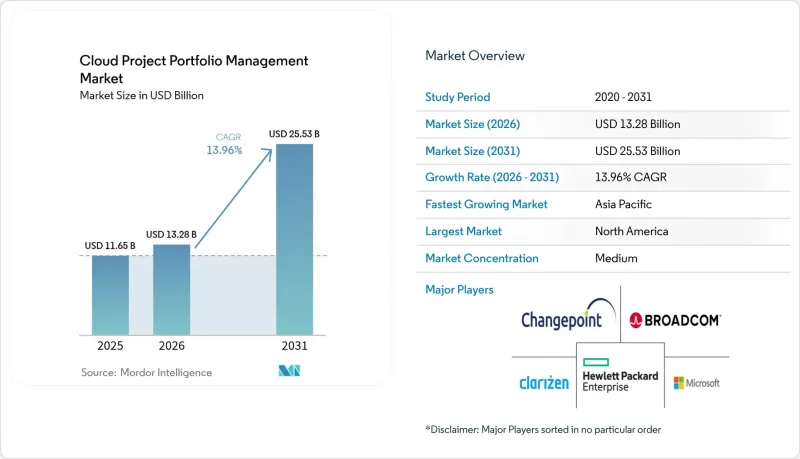
에 따르면 클라우드 프로젝트 포트폴리오 관리 시장 규모는 2025년에 116억 5,000만 달러로 평가되며, 2026년 132억 8,000만 달러에서 2031년까지 255억 3,000만 달러에 달할 것으로 예측되며, 예측 기간(2026-2031년) 동안 CAGR은 13.96%가 될 전망입니다.
본 보고서는 도입 모델(퍼블릭 클라우드, 프라이빗 클라우드, 하이브리드 클라우드), 용도(포트폴리오 관리, 수요 관리, 프로젝트 관리 등), 조직 규모(대기업 및 중소기업(SME)), 업종(BFSI, 헬스케어·생명과학, IT·통신, 제조 등), 및 지역별로 분류되어 있습니다.
세계 클라우드 프로젝트 포트폴리오 관리 시장의 동향 및 인사이트
확대되는 BYOD 및 모바일 퍼스트 인력
현재 프로젝트 관리 전문가의 61%가 적어도 파트타임으로 원격 근무를 하고 있습니다. 이에 따라 모바일 접근은 단순한 편의성에서 필수 요건으로 변화했습니다. 데스크톱 중심 도구에서 전환하는 기업들은 출장 시나 저대역폭 환경에서도 업무 연속성을 확보하기 위해 반응형 인터페이스,생체 인증, 오프라인 동기화를 우선시하고 있습니다. 기술 기업 및 전문 서비스 기업은 청구 가능한 근무 시간이 즉각적인 상태 업데이트에 좌우되기 때문에 모바일에 최적화된 솔루션 제품군을 가장 신속하게 도입하고 있습니다. 푸시 알림이나 음성 명령을 통합한 벤더들은 현장 엔지니어나 컨설턴트가 노트북을 열지 않고도 즉시 대응할 수 있도록함으로써 타사와의 차별화를 꾀하고 있습니다. 기기의 다양화가 진행되는 가운데, 플랫폼 호환성은 IT 조달 담당자에게 결정적인 구매 기준이 되고 있습니다.
클라우드 분석 도입 확대
조직은 과거 프로젝트 산출물을 분석하여 완료 확률을 예측하고, 리소스 병목 현상을 파악하며, 위험 정도를 정량화하고 있습니다. 클라우드형 프로젝트 포트폴리오 관리 솔루션에 통합된 머신러닝 모듈은 단순한 상황 설명형 대시보드에서 예측적 인사이트로의 전환을 가속화하고 있습니다. 수년에 걸친 변혁 프로그램을 추진 중인 기업은 통계 모델을 통해 스프레드시트에 숨겨진 상호 의존 관계가 드러나기 때문에 가장 큰 혜택을 얻습니다. 또한, 내장형 분석 기능을 통해 실제 인건비 및 인프라 사용 현황을 추적함으로써 비용 배분의 정확도가 향상됩니다. 이를 통해 경영진은 직관이 아닌 실증적인 성과에 기반하여 우선순위를 결정할 수 있게 되어, 포트폴리오의 처리 능력과 예산 준수율이 향상됩니다.
뿌리 깊은 보안 및 개인정보 보호에 대한 우려
독일 클라우드 담당 임원의 71%는 프로젝트 데이터를 온프레미스 외부로 이전할 때 사이버 보안에 대한 강한 불안을 제기하고 있습니다. 지적 재산권이나 환자 기록을 다루는 업계에서는 기밀성이 높은 데이터를 온프레미스에 보관하고 외부 접근을 제한하는 하이브리드 구성을 채택하는 경우가 많습니다. GDPR과 같은 파편화된 국제 규제는 규정 준수 부담을 가중시키고, 포트폴리오 계획 단계에서 데이터 소재지를 확인하도록 강요합니다. 주요 벤더들이 제로 트러스트 아키텍처나 지역별 전용 데이터센터에 투자하고 있음에도 불구하고, 정보 유출 관련 뉴스 헤드라인은 여전히 위험을 회피하려는 성향의 이사회에 영향을 미치고 있습니다. 그 결과, 금융 서비스 및 의료 업계에서는 조달 주기가 길어지고 시범 프로젝트의 범위가 좁아지고 있습니다.
부문 분석
기업들이 주권과 탄력성 사이의 균형을 모색하는 가운데, 하이브리드 아키텍처는 연평균 성장률(CAGR) 15.05%를 기록하며 다른 모델들을 능가하는 성장을 이어가고 있습니다. 하이브리드 배포에 따른 클라우드 프로젝트 포트폴리오 관리 시장 규모는 2031년까지 100억 6,000만 달러에 달할 것으로 예상되며, 이는 이 부문의 전략적 중요성을 반영합니다. 규제 대상 산업에서는 기밀성이 높은 데이터를 온프레미스에서 처리하는 한편, 익명화된 텔레메트리 데이터를 클라우드 분석 엔진으로 스트리밍하여 용량 계획을 수립하는 것을 선호합니다. 하이브리드 제품군은 VPN 오케스트레이션, 정책 기반 워크로드 배치, AI를 활용한 지연 시간 최적화를 통합하여, 프로젝트 팀이 규정 준수 및 비용 목표를 모두 달성할 수 있는 위치에 데이터를 배치할 수 있도록 지원합니다.
벤더의 로드맵을 통해 간헐적으로 동기화를 수행하면서도 연결이 끊긴 상황에서도 완벽한 기능을 유지하는 엣지 노드에 대한 보다 심층적인 지원이 드러나고 있습니다. 예를 들어, 자동차 업계 및 방위 관련 계약업체들은 ‘오프라인 우선’ 기능을 활용하여 안전한 시설 내에서 시뮬레이션을 실행한 후, 진행 상황을 전 세계의 이해관계자들에게 동기화하고 있습니다. 퍼블릭 클라우드는 여전히 가장 광범위한 생태계와 54.70%의 매출 점유율을 유지하고 있지만, 하이브리드 클라우드의 성장 궤적은 혼합 테넌트 모델로의 전환을 부각시키고 있습니다. 완전한 테넌트 분리가 필요한 기업에게는 프라이빗 클라우드가 여전히 중요한 선택지이지만, 자본 투자 및 인력 수요가 도입을 저해하고 있습니다. 클라우드의 성숙도가 높아짐에 따라, 클라우드 프로젝트 포트폴리오 관리 시장에서는 워크로드의 최적 분산을 자동화하는 정책 엔진에 대한 수요가 증가하고 있습니다.
리소스 관리 소프트웨어는 연평균 성장률(CAGR) 14.65%로 성장하며 포트폴리오 거버넌스 모듈을 앞지르고 있습니다. 2025년에는 포트폴리오 관리가 매출의 45.20%를 차지했으나, 용량 계획의 과제로 인해 구매 기준에서 리소스 중심 기능이 중요시되고 있습니다. 클라우드 프로젝트 포트폴리오 관리 시장에서 리소스 관리 솔루션의 점유율은 2025년에 22.10%에 달할 것으로 예상되며, 앞으로도 꾸준히 상승할 것으로 전망됩니다. 예측형 인력 배치 알고리즘은 기술과 스프린트 산출물을 대조함으로써 유휴 시간을 줄이고, 비용이 많이 드는 외부 업체에 대한 의존도를 최소화합니다. 전문 서비스 기업들은 확률 가중치 기반 이용 시나리오를 정량화하는 AI 기반 배분을 도입한 결과, 이익률 향상을 보였다고 보고하고 있습니다.
통합된 기술 매트릭스와 학습 경로 제안을 통해 인재 개발과 성과 달성이 더욱 밀접하게 연결됩니다. 수요 관리, 공수 관리, 재무 관리 각 모듈이 통합된 제품군으로 집약되어, 인재 및 비용 데이터에 관한 유일하고 신뢰할 수 있는 정보원이 구축되었습니다. 자연어 처리 기능을 갖춘 챗봇을 도입한 공급업체는 기술적 지식이 없는 관리자의 자원 배분 의사결정을 간소화하고 있습니다. 한편, 특히 수백 개의 병행 이니셔티브에 자금을 지원하는 복합 기업에서는 전략적 일관성을 확보하기 위해 포트폴리오 거버넌스가 여전히 필수적입니다. 그러나 자원이 부족한 팀이 영향력이 큰 마일스톤을 향해 신속하게 인력을 재배치할 때 가장 빠르게 가치를 창출할 수 있는 경우가 많으며, 이것이 이 부문의 성장세를 설명해 줍니다.
지역별 분석
2025년, 북미는 37.10%의 점유율로 클라우드 프로젝트 포트폴리오 관리 시장을 주도했습니다. 미국의 금융, 항공우주, 기술 분야 기업들은 고부가가치 엔터프라이즈 도입을 주도하고 있는 반면, 캐나다의 천연자원 기업들은 자본 집약적인 프로젝트를 관리하기 위해 클라우드 제품군을 도입하고 있습니다. 멕시코의 제조업 집적지에서는 미국 바이어와의 니어쇼어 생산 일정을 조정하기 위해 이 소프트웨어가 채택되고 있습니다. SaaS의 확산, 5G의 견고한 커버리지, 그리고 충실한 재교육 프로그램이 이 지역의 수요를 뒷받침하고 있습니다. 다만, 데이터 상주에 대한 감시가 강화됨에 따라 하이브리드 클라우드나 주권 클라우드 옵션이 계속해서 주목받고 있습니다.
아시아태평양은 2031년까지 연평균 성장률(CAGR)이 14.40%로 가장 빠르게 성장하고 있는 지역입니다. 중국의 정부 주도 디지털 경제 프로그램은 현지 제조업체들이 엔지니어링 워크플로우를 클라우드로 이전하도록 장려하고 있습니다. 인도의 서비스 통합업체들은 프로젝트 포트폴리오 관리를 고객 제공 프레임워크에 통합하여 툴체인 표준화를 가속화하고 있습니다. 일본 및 한국의 대기업들은 공장 현장의 IoT 원격 측정 데이터를 포트폴리오 대시보드와 통합하여 전자기기의 시장 출시 기간을 단축하고 있습니다. 해저 케이블의 급속한 확장과 하이퍼스케일러의 데이터센터 투자로 지연 시간이 줄어들면서, 아세안 지역 프로젝트 팀 간의 실시간 협업이 촉진되고 있습니다.
유럽에서는 한 자릿수 중반대의 꾸준한 성장을 유지하고 있습니다. 독일의 대형 자동차 제조사는 지역 공급업체 및 하이브리드 배포를 우선시하는 엄격한 데이터 주권 관리를 시행하고 있습니다. 영국의 생명과학 기업은 MHRA의 감독 하에 다단계 임상시험을 추적하기 위해 클라우드 제품군 도입을 추진하고 있습니다. 프랑스, 이탈리아, 스페인에서는 공공 부문 현대화 기금을 통해 추진력이 강화되고 있습니다. 북유럽 기업들은 선진적인 디지털 정부 구상에 따라 AI를 활용한 자원 스케줄링의 조기 도입 주체가 되고 있습니다. GDPR 및 향후 시행될 AI법 등 규제의 복잡화로 인해 벤더 인증 주기는 장기화되고 있지만, 궁극적으로는 규정 준수를 충족하는 제품 및 서비스에 대한 프리미엄 가격 책정을 뒷받침하게 될 것입니다.
기타 혜택:
- 엑셀 형식의 시장 예측(ME) 시트
- 3개월간의 애널리스트 지원
자주 묻는 질문
목차
제1장 소개
제2장 조사 방법
제3장 주요 요약
제4장 시장 구도
제5장 시장 규모와 성장 예측
제6장 경쟁 구도
제7장 시장 기회와 향후 전망
KSM 26.08.26According to Mordor Intelligence, the cloud project portfolio management market size was valued at USD 11.65 billion in 2025 and estimated to grow from USD 13.28 billion in 2026 to reach USD 25.53 billion by 2031, at a CAGR of 13.96% during the forecast period (2026-2031).
This report is Segmented by Deployment Model (Public Cloud, Private Cloud and Hybrid Cloud), Application (Portfolio Management, Demand Management, Project Management, and More), Organization Size (Large Enterprises and Small and Medium Enterprises (SMEs)), Industry Vertical (BFSI, Healthcare and Life Sciences, IT and Telecommunication, Manufacturing, and More), and Geography.
Global Cloud Project Portfolio Management Market Trends and Insights
Growing BYOD and mobile-first workforce
Sixty-one percent of project management professionals now operate remotely at least part-time. Mobile access has therefore shifted from convenience to a baseline requirement. Enterprises migrating from desktop-centric tools prioritize responsive interfaces, biometric security, and offline sync to ensure continuity in travel or low-bandwidth scenarios. Technology and professional-services firms adopt mobile-optimized suites fastest because billable time hinges on instantaneous status updates. Vendors that embed push notifications and voice commands differentiate by allowing field engineers and consultants to react without opening laptops. As device diversity grows, platform compatibility becomes a decisive buying criterion for IT procurement leaders.
Higher adoption of cloud analytics
Organizations analyze historical project artifacts to forecast completion probabilities, flag resource bottlenecks, and quantify risk exposure. Machine-learning modules embedded in cloud project portfolio management market offerings accelerate this shift from descriptive dashboards to predictive insights. Enterprises running multi-year transformation programs benefit most, because statistical models surface interdependencies hidden in spreadsheets. Moreover, cost allocation accuracy improves when embedded analytics trace actual labor and infrastructure usage. Executives thus base prioritization decisions on empirical performance rather than intuition, which raises portfolio throughput and budget fidelity.
Persistent security and privacy concerns
Seventy-one percent of German cloud executives cite high cybersecurity anxiety when shifting project data off-premise. Industries handling intellectual property or patient records often keep sensitive artifacts on-site, resorting to hybrid configurations that restrict external access. Fragmented international regulations such as GDPR add compliance overhead and force data-residency checks during portfolio planning. Though major vendors invest in zero-trust architectures and region-specific data centers, breach headlines still sway risk-averse boards. Consequently, procurement cycles elongate and pilot scopes narrow in financial services and healthcare.
Other drivers and restraints analyzed in the detailed report include:
- Shift toward hybrid/remote work models
- Need for real-time portfolio visibility and ROI optimization
- Vendor lock-in across multi-cloud ecosystems
For complete list of drivers and restraints, kindly check the Table Of Contents.
Segment Analysis
Hybrid architectures recorded a 15.05% CAGR and continue to outpace other models as enterprises balance sovereignty with elasticity. The cloud project portfolio management market size for hybrid deployments is forecast to represent USD 10.06 billion by 2031, reflecting the segment's strategic importance. Regulated industries prefer to process sensitive artifacts on-premise while streaming anonymized telemetry to cloud analytics engines for capacity planning. Hybrid suites integrate VPN orchestration, policy-based workload placement, and AI-assisted latency optimization, enabling project teams to place data where compliance and cost objectives align.
Vendor roadmaps reveal deeper support for edge nodes that synchronize intermittently yet preserve full functionality in disconnected scenarios. Automotive and defense contractors, for example, leverage offline-first capability to run simulations in secure facilities, later syncing progress to global stakeholders. Public cloud retains the broadest ecosystem and 54.70% revenue share, but hybrid's growth trajectory underscores a shift toward mixed tenancy. Private cloud remains relevant for firms requiring complete tenant isolation; however, capital expenditure and talent demands curb its uptake. As cloud maturity rises, the cloud project portfolio management market sees heightened demand for policy engines that automate optimal workload distribution.
Resource management software is expanding at a 14.65% CAGR, outstripping portfolio governance modules. In 2025, portfolio management commanded 45.20% of revenue, yet capacity-planning pain points elevate resource-centric features in buying criteria. The cloud project portfolio management market share for resource management solutions reached 22.10% in 2025 and is expected to climb steadily. Predictive staffing algorithms match skills with sprint deliverables, reducing idle time and minimizing expensive contractor reliance. Professional services firms report margin lifts after adopting AI-driven allocation that quantifies probability-weighted utilization scenarios.
Integrated skills matrices and learning-path suggestions further connect talent development with delivery outcomes. Demand management, time tracking, and financial control modules converge into unified suites, creating a single source of truth for workforce and cost data. Vendors embedding natural-language chatbots simplify resourcing decisions for non-technical managers. Meanwhile, portfolio governance remains essential for strategic alignment, especially in conglomerates funding hundreds of concurrent initiatives. Yet the fastest value capture often occurs when under-resourced teams promptly redeploy staff to high-impact milestones, explaining the segment's momentum.
Complete Report Scope:
- By Deployment Model
- Public Cloud
- Private Cloud
- Hybrid Cloud
- By Application
- Portfolio Management
- Demand Management
- Project Management
- Resource Management
- Other Applications
- By Organization Size
- Large Enterprises
- Small and Medium Enterprises (SMEs)
- By Industry Vertical
- BFSI
- Healthcare and Life Sciences
- IT and Telecommunications
- Manufacturing
- Government and Public Sector
- Other Industry Verticals
- By Geography
- North America
- United States
- Canada
- Mexico
- Europe
- Germany
- United Kingdom
- France
- Italy
- Spain
- Rest of Europe
- Asia-Pacific
- China
- Japan
- India
- South Korea
- Australia and New Zealand
- Rest of Asia-Pacific
- South America
- Brazil
- Argentina
- Rest of South America
- Middle East and Africa
- Middle East
- Saudi Arabia
- United Arab Emirates
- Turkey
- Rest of Middle East
- Africa
- South Africa
- Egypt
- Nigeria
- Rest of Africa
- Middle East
- North America
Geography Analysis
North America led the cloud project portfolio management market with a 37.10% share in 2025. United States operators in finance, aerospace, and technology anchor high-value enterprise rollouts, while Canada's natural-resources firms implement cloud suites to manage capital-intensive projects. Mexico's manufacturing corridors adopt the software to coordinate near-shore production schedules with US buyers. Mature SaaS penetration, robust 5G coverage, and deep reskilling programs sustain regional demand; nonetheless, heightened scrutiny on data residency keeps hybrid and sovereign-cloud options in focus.
Asia-Pacific is the fastest-growing theatre at a 14.40% CAGR through 2031. China's state-backed digital-economy programs incentivize local manufacturers to migrate engineering workflows to the cloud. Indian service integrators embed project portfolio management into client delivery frameworks, accelerating toolchain standardization. Japanese and South Korean conglomerates integrate factory-floor IoT telemetry with portfolio dashboards to compress time-to-market for electronics. Rapid submarine-cable expansion and hyperscaler datacenter investment lower latency, encouraging real-time collaboration across ASEAN project teams.
Europe maintains steady mid-single-digit growth. German automotive giants enforce stringent data-sovereignty controls that favor regional providers and hybrid deployment. United Kingdom enterprises in life sciences pursue cloud suites to track multistage clinical trials under MHRA oversight. France, Italy, and Spain add momentum via public-sector modernization funds. Nordic firms prove early adopters of AI-infused resource scheduling, aligning with their advanced digital-government agendas. Regulatory complexity, including GDPR and forthcoming AI Act provisions, extends vendor qualification cycles but ultimately drives premium pricing for compliant offerings.
- Broadcom (Clarity)
- Hewlett Packard Enterprise
- Changepoint
- Clarizen
- Microsoft
- Mavenlink
- Oracle
- Planisware
- ServiceNow
- SAP
- Upland Software
- Workfront (Adobe)
- Planview
- Atlassian
- Smartsheet
- monday.com
- Wrike (Citrix)
- Asana
- WorkOtter
- Sciforma
Additional Benefits:
- The market estimate (ME) sheet in Excel format
- 3 months of analyst support
TABLE OF CONTENTS
1 INTRODUCTION
- 1.1 Study Assumptions and Market Definition
- 1.2 Scope of the Study
2 RESEARCH METHODOLOGY
3 EXECUTIVE SUMMARY
4 MARKET LANDSCAPE
- 4.1 Market Overview
- 4.2 Market Drivers
- 4.2.1 Growing BYOD and mobile-first workforce
- 4.2.2 Higher adoption of cloud analytics
- 4.2.3 Shift toward hybrid/remote work models
- 4.2.4 Need for real-time portfolio visibility and ROI optimisation
- 4.2.5 FinOps-driven cost-governance integration
- 4.2.6 AI-powered predictive project-health scoring
- 4.3 Market Restraints
- 4.3.1 Persistent security and privacy concerns
- 4.3.2 Vendor lock-in across multi-cloud ecosystems
- 4.3.3 Lack of unified data taxonomies for AI models
- 4.3.4 Emerging ESG-reporting complexity
- 4.4 Value Chain Analysis
- 4.5 Regulatory Landscape
- 4.6 Technological Outlook
- 4.7 Porter's Five Forces Analysis
- 4.7.1 Bargaining Power of Suppliers
- 4.7.2 Bargaining Power of Consumers
- 4.7.3 Threat of New Entrants
- 4.7.4 Threat of Substitute Products
- 4.7.5 Intensity of Competitive Rivalry
- 4.8 Assessment of the Impact of Macroeconomic Trends on the Market
5 MARKET SIZE AND GROWTH FORECASTS (VALUE)
- 5.1 By Deployment Model
- 5.1.1 Public Cloud
- 5.1.2 Private Cloud
- 5.1.3 Hybrid Cloud
- 5.2 By Application
- 5.2.1 Portfolio Management
- 5.2.2 Demand Management
- 5.2.3 Project Management
- 5.2.4 Resource Management
- 5.2.5 Other Applications
- 5.3 By Organization Size
- 5.3.1 Large Enterprises
- 5.3.2 Small and Medium Enterprises (SMEs)
- 5.4 By Industry Vertical
- 5.4.1 BFSI
- 5.4.2 Healthcare and Life Sciences
- 5.4.3 IT and Telecommunications
- 5.4.4 Manufacturing
- 5.4.5 Government and Public Sector
- 5.4.6 Other Industry Verticals
- 5.5 By Geography
- 5.5.1 North America
- 5.5.1.1 United States
- 5.5.1.2 Canada
- 5.5.1.3 Mexico
- 5.5.2 Europe
- 5.5.2.1 Germany
- 5.5.2.2 United Kingdom
- 5.5.2.3 France
- 5.5.2.4 Italy
- 5.5.2.5 Spain
- 5.5.2.6 Rest of Europe
- 5.5.3 Asia-Pacific
- 5.5.3.1 China
- 5.5.3.2 Japan
- 5.5.3.3 India
- 5.5.3.4 South Korea
- 5.5.3.5 Australia and New Zealand
- 5.5.3.6 Rest of Asia-Pacific
- 5.5.4 South America
- 5.5.4.1 Brazil
- 5.5.4.2 Argentina
- 5.5.4.3 Rest of South America
- 5.5.5 Middle East and Africa
- 5.5.5.1 Middle East
- 5.5.5.1.1 Saudi Arabia
- 5.5.5.1.2 United Arab Emirates
- 5.5.5.1.3 Turkey
- 5.5.5.1.4 Rest of Middle East
- 5.5.5.2 Africa
- 5.5.5.2.1 South Africa
- 5.5.5.2.2 Egypt
- 5.5.5.2.3 Nigeria
- 5.5.5.2.4 Rest of Africa
- 5.5.5.1 Middle East
- 5.5.1 North America
6 COMPETITIVE LANDSCAPE
- 6.1 Market Concentration
- 6.2 Strategic Moves
- 6.3 Market Share Analysis
- 6.4 Company Profiles (includes Global level Overview, Market level overview, Core Segments, Financials as available, Strategic Information, Market Rank/Share for key companies, Products and Services, and Recent Developments)
- 6.4.1 Broadcom (Clarity)
- 6.4.2 Hewlett Packard Enterprise
- 6.4.3 Changepoint
- 6.4.4 Clarizen
- 6.4.5 Microsoft
- 6.4.6 Mavenlink
- 6.4.7 Oracle
- 6.4.8 Planisware
- 6.4.9 ServiceNow
- 6.4.10 SAP
- 6.4.11 Upland Software
- 6.4.12 Workfront (Adobe)
- 6.4.13 Planview
- 6.4.14 Atlassian
- 6.4.15 Smartsheet
- 6.4.16 monday.com
- 6.4.17 Wrike (Citrix)
- 6.4.18 Asana
- 6.4.19 WorkOtter
- 6.4.20 Sciforma
7 MARKET OPPORTUNITIES AND FUTURE OUTLOOK
- 7.1 White-space and Unmet-need Assessment


