

|
시장보고서
상품코드
2124793
프로젝트 포트폴리오 관리 : 시장 점유율 분석, 업계 동향 및 통계, 성장 예측(2026-2031년)Project Portfolio Management - Market Share Analysis, Industry Trends & Statistics, Growth Forecasts (2026 - 2031) |
||||||
 Mordor Intelligence
에 의하면, 프로젝트 포트폴리오 관리 시장 규모는 2025년 69억 달러로 평가되었습니다. 2026년에는 76억 9,000만 달러로 확대되어 2026-2031년에 걸쳐 CAGR 11.43%로 성장을 지속하여, 2031년에는 132억 1,000만 달러에 이를 것으로 예측됩니다.

본 보고서는 배포 유형(클라우드, On-Premise, 기타), 최종 사용자 산업(IT 및 통신, 헬스케어, 기타), 구성 요소(솔루션, 서비스), 조직 규모(대기업, 기타), 용도(프로젝트 관리, 기타), 지역별로 분류되어 있습니다. 시장 예측은 금액(달러) 기준으로 제시되어 있습니다.
세계의 프로젝트 포트폴리오 관리 시장 동향 및 인사이트
하이브리드/원격 근무의 가속화에 따른 자원 가시화의 통합 필요성
분산형 업무 방식은 이제 기업 운영 모델의 기반이 되었습니다. 지식 근로자의 79%가 시차를 넘어 협업하고 있으며, 기업은 이용률 격차를 가시화하고, 병목 현상을 예측하며, 책임 소재를 명확히 하는 실시간 대시보드를 요구하고 있습니다. 기존의 간트 차트 중심 모니터링으로는 비동기적인 업무 부하를 추적할 수 없기 때문에 전사적 규모의 리소스 관리 엔진 도입이 급증하고 있습니다. 이러한 플랫폼은 포트폴리오 전반에 걸친 우선순위의 즉각적인 재설정을 지원하여, 관리자가 납기 약속을 저해하지 않으면서도 희소 기술을 재배치할 수 있도록 합니다. 단일하고 신뢰할 수 있는 정보원을 구축함으로써, 조직은 생산성을 향상시키는 동시에 투명한 근무 시간 보고를 요구하는 규제 감사에 따른 위험을 완화할 수 있습니다.
클라우드 네이티브 및 AI 기반 PPM 제품군의 부상
클라우드 도입은 분기 단위가 아닌 몇 주 만에 완료되며, 하드웨어에 대한 자본 지출을 제거함으로써 40-80%의 비용 절감을 실현하는 동시에 IT 인력을 더 높은 부가가치를 창출하는 업무에 배정할 수 있습니다. 내장된 머신러닝 모델은 위험을 예측하고, 작업을 자동으로 일정 관리하며, 리소스 재조합을 권장함으로써 납기 준수율을 향상시키고 전략적 일관성을 높입니다. 프로젝트 관리자의 21%는 이미 AI를 빈번하게 활용하고 있으며, 경영진의 82%는 5년 이내에 업무에 실질적인 영향이 미칠 것으로 예상하고 있습니다. 이사회 차원에서 의사 결정의 신속화가 과제로 대두되는 가운데, AI를 활용한 포트폴리오 최적화를 통해 PPM은 사후 보고에서 미래를 내다보는 조정으로 전환되고 있습니다.
멀티 클라우드 배포 시 발생하는 섀도 IT 및 데이터 주권 위험
사업 부서가 독자적으로 클라우드 서비스를 구축함에 따라, 중복된 PPM 인스턴스로 인해 데이터가 파편화되고 거버넌스가 복잡해지고 있습니다. 권한 설정 오류로 인해 사이버 공격의 표적 범위가 확대되는 한편, 지역의 개인정보 보호 관련 법규가 국경을 넘는 데이터 흐름을 제한하고 있습니다. 기업은 페더레이티드 아키텍처의 이점을 최대한 누리기 전에, 엄격한 프로비저닝 정책을 수립하고 통합된 ID 관리에 투자해야 합니다.
부문별 분석
클라우드 도입은 2025년 매출의 69.45%를 차지하며, 프로젝트 포트폴리오 관리 시장 규모에서 가장 큰 점유율을 기록했으며, 연평균 성장률(CAGR) 16.85%로 확대되고 있습니다. 기업들은 웹 기반 액세스, 탄력적인 용량, 지루한 패치 적용 주기를 없애주는 자동 업그레이드를 선호합니다. 하이브리드 모델은 On-Premise에서 데이터 분리가 필요하면서도 협업을 위해 클라우드의 탄력성을 활용하고자 하는 조직에 적합합니다. 멀티테넌트 아키텍처가 성숙해짐에 따라 총 소유 비용(TCO)이 감소하고, 레거시 환경에서의 추가적인 마이그레이션이 촉진되고 있습니다. 하이퍼스케일 제공업체의 지속적인 보안 업데이트는 취약점에 대한 노출을 줄여줍니다. 이는 데이터 침해로 인한 비용 급증을 배경으로, 더욱 견고한 사이버 보안 체계를 요구하는 이사회에 설득력 있는 근거가 되고 있습니다.
On-Premise 도입은 데이터의 위치나 에어갭 환경이 현대화의 속도보다 우선시되는 국방, 정부, 규제가 엄격한 금융 분야에서 여전히 일정한 입지를 유지하고 있습니다. 이러한 분야에서도 컨테이너화를 통해 선택된 워크로드는 시간이 지남에 따라 외부로 이전될 수 있게 되어, 순수한 On-Premise 환경은 점차 축소될 것으로 예측됩니다. 2031년까지 애널리스트들은 클라우드가 전략적 프로그램 거버넌스의 상당 부분을 뒷받침하게 될 것으로 예측하고 있으며, SaaS 벤더는 인접한 분석 및 자동화 도구의 자연스러운 통합자로서의 입지를 확립하게 될 것입니다.
2025년 지출의 68.40%를 솔루션이 차지했으며, 스케줄링, 리소스 및 재무 관리 기능을 단일 작업 공간에 통합한 스위트형 솔루션에 대한 구매자의 선호도가 두드러지고 있습니다. 이러한 플랫폼은 여러 화면을 오가며 발생하는 비효율을 줄이고, 사업 부서 간 보고서 정의를 표준화합니다. AI 모듈이 핵심 코드에 깊이 통합됨에 따라, 솔루션 매출은 계속해서 프로젝트 포트폴리오 관리 시장의 핵심 축이 될 것으로 보입니다.
한편, 서비스 부문은 연평균 성장률(CAGR) 11.74%로 성장의 원동력이 되고 있는데, 이는 기업들이 프로세스 재설계, 시스템 통합, 변경 관리에 관한 자문 지원을 요구하고 있기 때문입니다. 고도화된 도입 사례에서는 가치 흐름 매핑, 예측 알고리즘 설정, 대시보드와 ESG 프레임워크의 통합 등이 이루어지고 있으며, 이는 전문 컨설턴트가 필요한 업무입니다. 매니지드 서비스 계약은 본가동 후에도 벤더의 영향력을 확대하여, 고객이 변혁을 통해 가치를 극대화할 수 있도록 돕는 동시에 지속적인 수익을 창출합니다.
지역별 분석
북미는 성숙한 클라우드 생태계, 견실한 자본 예산, 주요 벤더의 집중을 배경으로 2025년 매출의 39.40%를 차지했습니다. AI를 활용한 인사이트와 ESG 보고에 대한 이사회 요청이 라이선스 갱신 및 모듈 추가 도입을 안정적으로 뒷받침하고 있습니다. 디지털 회복력에 대한 정부의 인센티브는 중요 인프라, 의료, 국방 분야에서의 도입을 더욱 촉진하고 있습니다.
유럽에서는 제조업 및 유틸리티자가 ‘그린 딜’의 목표와 상세한 데이터 주권 관련 법규를 충족하기 위해 업무 현대화를 추진하는 가운데, 견조한 성장이 나타나고 있습니다. 클라우드 도입은 엄격한 개인정보 보호 체계 하에서 진행되고 있으며, 지역별 호스팅 옵션과 제품 내 규정 준수 지원 기능을 갖춘 플랫폼에 대한 수요가 증가하고 있습니다. 전자 병원 프레임워크 및 국경 간 연구 컨소시엄에 대한 의료 시스템 투자가 이러한 성장세를 뒷받침하고 있습니다.
아시아태평양은 연평균 성장률(CAGR) 10.95%로 가장 빠르게 성장하고 있는 지역이며, 이는 막대한 인프라 투자, 모바일 우선의 업무 문화, 디지털 인재 확보를 둘러싼 경쟁 심화를 반영합니다. 중국과 인도의 기업들은 PPM 제품군을 확장하여 다지역에 걸친 프로그램을 총괄하고, 공급망의 변동 위험을 완화하고 있습니다. 동남아시아의 중소기업을 위한 디지털화 지원 정책 또한 새로운 개발 기회를 창출하고 있으며, 이 지역은 세계 확장 전략에서 매우 중요한 위치를 차지하고 있습니다.
기타 혜택
- 엑셀 형식 시장 예측(ME) 시트
- 3개월간의 애널리스트 지원
자주 묻는 질문
목차
제1장 서론
제2장 조사 방법
제3장 주요 요약
제4장 시장 구도
제5장 시장 규모 및 성장 예측(금액, 10억 달러)
제6장 경쟁 구도
제7장 시장 기회 및 향후 전망
KTH 26.09.14According to Mordor Intelligence, the project portfolio management market size is expected to grow from USD 6.90 billion in 2025 to USD 7.69 billion in 2026 and is forecast to reach USD 13.21 billion by 2031 at 11.43% CAGR over 2026-2031.
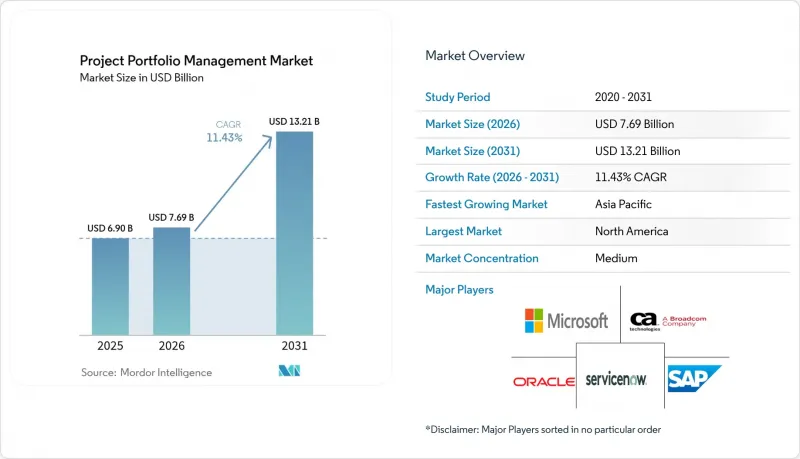
This report Segments Into by Deployment Type (Cloud, On-Premises and More), Type (Solution, Services), by End-User Verticals (IT and Telecom, Healthcare, and More), by Component (Solutions, Services), by Organization Size (Large Enterprises, and More), by Application (Project Management, and More) and by Geography. The Market Forecasts are Provided in Terms of Value (USD)
Global Project Portfolio Management Market Trends and Insights
Hybrid/Remote-Work Acceleration Requires Centralized Resource Visibility
Distributed work now anchors corporate operating models. Seventy-nine percent of knowledge workers collaborate across time zones, forcing enterprises to seek real-time dashboards that surface utilization gaps, predict bottlenecks, and maintain accountability. Traditional Gantt-centric oversight cannot track asynchronous workloads, so adoption of enterprise-wide resource engines is surging. These platforms support instant cross-portfolio re-prioritization, enabling managers to redeploy scarce skills without disrupting delivery commitments. By creating a single source of truth, organizations both improve productivity and de-risk regulatory audits that demand transparent labor reporting.
Rise of Cloud-Native, AI-Augmented PPM Suites
Cloud implementations provision in weeks rather than quarters and eliminate capital hardware outlays, generating 40-80% cost savings while releasing IT staff for higher-value tasks . Embedded machine-learning models predict risk, auto-schedule tasks, and recommend resource swaps, lifting on-time delivery rates and sharpening strategic alignment. Twenty-one percent of project managers already use AI frequently, and 82% of executives expect material operational impact within five years . As decision velocity becomes a board-level mandate, AI-enabled portfolio optimization shifts PPM from retrospective reporting to forward-looking orchestration.
Shadow-IT & Data-Sovereignty Risks in Multi-Cloud Roll-outs
As business units spin up cloud services independently, duplicate PPM instances fragment data and complicate governance. Misconfigured permissions enlarge cyber-attack surfaces, while regional privacy statutes limit cross-border data flows. Enterprises must institute strict provisioning policies and invest in unified identity management before reaping the full benefits of federated architectures.
Other drivers and restraints analyzed in the detailed report include:
- Integration of Agile & DevOps with Strategic Portfolio Planning
- Demand for Real-Time Project Financial Governance Amid Cost Inflation
- Long Pay-Back Periods in SME Segment
For complete list of drivers and restraints, kindly check the Table Of Contents.
Segment Analysis
Cloud deployments accounted for 69.45% of 2025 revenue, generating the largest slice of the project portfolio management market size and expanding at a 16.85% CAGR. Enterprises favor web-based access, elastic capacity, and automatic upgrades that eliminate lengthy patch cycles. Hybrid models serve organizations needing on-premise data segregation while tapping cloud elasticity for collaboration. As multi-tenant architectures mature, total cost of ownership declines, fueling further migration from legacy instances. Continuous security updates from hyperscale providers mitigate vulnerability exposure, a persuasive argument for boards seeking stronger cyber postures amid rising breach costs.
On-premise installations retain footholds in defense, government, and heavily regulated finance where data residency or air-gapped environments trump modernization speed. Even here, containerization allows selective workloads to move outward over time, signaling that pure on-premise footprints will contract. By 2031, analysts expect cloud to underpin the majority of strategic program governance, positioning SaaS vendors as natural consolidators of adjacent analytics and automation tools.
Solutions contributed 68.40% of 2025 spending, underscoring buyer preference for integrated suites that bundle scheduling, resource, and financial controls into a single workspace. These platforms reduce swivel-chair inefficiencies and standardize reporting semantics across business units. As AI modules embed deeper into core code, solutions revenue will remain the anchor of the project portfolio management market.
Services, however, are the growth catalyst at a 11.74% CAGR as enterprises seek advisory support for process redesign, system integration, and change management. Advanced implementations now involve mapping value streams, configuring predictive algorithms, and aligning dashboards with ESG frameworks-tasks that demand specialized consultants. Managed-service agreements extend vendor influence post-go-live, yielding recurring revenue while ensuring the client extracts full transformational value.
Complete Report Scope:
- By Deployment Type
- Cloud
- On-premise
- Hybrid
- By Component
- Solutions
- Services
- By Organization Size
- Large Enterprises
- Small and Mid-sized Enterprises (SMEs)
- By Application
- Project Management
- Portfolio and Demand Management
- Resource and Capacity Management
- Financial and Risk Management
- Others (Collaboration, Reporting)
- By End-user Vertical
- IT and Telecom
- Healthcare and Life Sciences
- Manufacturing
- Construction and Engineering
- Retail and Consumer Goods
- BFSI
- Government and Public Sector
- Others
- By Geography
- North America
- United States
- Canada
- Mexico
- South America
- Brazil
- Argentina
- Rest of South America
- Europe
- Germany
- United Kingdom
- France
- Italy
- Spain
- Netherlands
- Rest of Europe
- Asia
- China
- Japan
- India
- South Korea
- Australia and New Zealand
- Southeast Asia
- Rest of APAC
- Middle East and Africa
- Middle East
- GCC
- Turkey
- Israel
- Rest of Middle East
- Africa
- South Africa
- Nigeria
- Rest of Africa
- Middle East
- North America
Geography Analysis
North America generated 39.40% of 2025 revenue, underpinned by mature cloud ecosystems, robust capital budgets, and a concentration of leading vendors. Board mandates for AI-driven insight and ESG reporting fuel steady license renewals and module add-ons. Government incentives for digital resilience further support adoption across critical infrastructure, healthcare, and defense.
Europe shows healthy expansion as manufacturers and utilities modernize operations to meet Green Deal objectives and granular data-sovereignty statutes. Cloud adoption proceeds under strict privacy frameworks, prompting demand for platforms offering regional hosting options and in-product compliance accelerators. Health-system investments in e-hospital frameworks and cross-border research consortia sustain momentum.
APAC is the fastest-growing region at an 10.95% CAGR, reflecting massive infrastructure spending, mobile-first work cultures, and intensifying competition for digital talent. Chinese and Indian enterprises scale PPM suites to orchestrate multiregional programs and mitigate supply-chain volatility. SME digitalization incentives in Southeast Asia also unlock green-field opportunities, making the region pivotal to global expansion strategies.
- Oracle Corporation
- Microsoft Corporation
- SAP SE
- ServiceNow Inc.
- Broadcom (CA PPM)
- Atlassian Corporation plc
- Planview Inc.
- Workday Inc.
- Monday.com Ltd.
- Smartsheet Inc.
- Wrike (Citrix)
- Asana Inc.
- Upland Software Inc.
- Adobe (Workfront)
- Clarizen
- Celoxis Technologies
- KeyedIn Solutions
- Sciforma
- Micro Focus (OpenText)
- Hexagon AB (EcoSys)
- Procore Technologies
Additional Benefits:
- The market estimate (ME) sheet in Excel format
- 3 months of analyst support
TABLE OF CONTENTS
1 INTRODUCTION
- 1.1 Study Assumptions & Market Definition
- 1.2 Scope of the Study
2 RESEARCH METHODOLOGY
3 EXECUTIVE SUMMARY
4 MARKET LANDSCAPE
- 4.1 Market Overview
- 4.2 Market Drivers
- 4.2.1 Hybrid/Remote-work acceleration requires centralized resource visibility
- 4.2.2 Rise of cloud-native, AI-augmented PPM suites
- 4.2.3 Integration of Agile & DevOps with strategic portfolio planning
- 4.2.4 Demand for real-time project financial governance amid cost inflation
- 4.2.5 Vertical-specific compliance (e.g., FDA 21 CFR Part 11) boosting niche PPM uptake
- 4.2.6 ESG-driven capital-allocation scrutiny forcing portfolio optimisation tools
- 4.3 Market Restraints
- 4.3.1 Shadow-IT & data-sovereignty risks in multi-cloud PPM roll-outs
- 4.3.2 Long pay-back periods in SME segment
- 4.3.3 Vendor-lock-in concerns with single-stack ecosystems
- 4.3.4 Skills shortage in value-realisation offices (VROs)
- 4.4 Value / Supply-Chain Analysis
- 4.5 Regulatory Landscape
- 4.6 Technological Outlook
- 4.7 Porters Five Forces
- 4.7.1 Bargaining Power of Suppliers
- 4.7.2 Bargaining Power of Buyers
- 4.7.3 Threat of New Entrants
- 4.7.4 Threat of Substitutes
- 4.7.5 Intensity of Competitive Rivalry
5 MARKET SIZE & GROWTH FORECASTS (VALUE, USD BN)
- 5.1 By Deployment Type
- 5.1.1 Cloud
- 5.1.2 On-premise
- 5.1.3 Hybrid
- 5.2 By Component
- 5.2.1 Solutions
- 5.2.2 Services
- 5.3 By Organization Size
- 5.3.1 Large Enterprises
- 5.3.2 Small and Mid-sized Enterprises (SMEs)
- 5.4 By Application
- 5.4.1 Project Management
- 5.4.2 Portfolio and Demand Management
- 5.4.3 Resource and Capacity Management
- 5.4.4 Financial and Risk Management
- 5.4.5 Others (Collaboration, Reporting)
- 5.5 By End-user Vertical
- 5.5.1 IT and Telecom
- 5.5.2 Healthcare and Life Sciences
- 5.5.3 Manufacturing
- 5.5.4 Construction and Engineering
- 5.5.5 Retail and Consumer Goods
- 5.5.6 BFSI
- 5.5.7 Government and Public Sector
- 5.5.8 Others
- 5.6 By Geography
- 5.6.1 North America
- 5.6.1.1 United States
- 5.6.1.2 Canada
- 5.6.1.3 Mexico
- 5.6.2 South America
- 5.6.2.1 Brazil
- 5.6.2.2 Argentina
- 5.6.2.3 Rest of South America
- 5.6.3 Europe
- 5.6.3.1 Germany
- 5.6.3.2 United Kingdom
- 5.6.3.3 France
- 5.6.3.4 Italy
- 5.6.3.5 Spain
- 5.6.3.6 Netherlands
- 5.6.3.7 Rest of Europe
- 5.6.4 Asia
- 5.6.4.1 China
- 5.6.4.2 Japan
- 5.6.4.3 India
- 5.6.4.4 South Korea
- 5.6.4.5 Australia and New Zealand
- 5.6.4.6 Southeast Asia
- 5.6.4.7 Rest of APAC
- 5.6.5 Middle East and Africa
- 5.6.5.1 Middle East
- 5.6.5.1.1 GCC
- 5.6.5.1.2 Turkey
- 5.6.5.1.3 Israel
- 5.6.5.1.4 Rest of Middle East
- 5.6.5.2 Africa
- 5.6.5.2.1 South Africa
- 5.6.5.2.2 Nigeria
- 5.6.5.2.3 Rest of Africa
- 5.6.5.1 Middle East
- 5.6.1 North America
6 COMPETITIVE LANDSCAPE
- 6.1 Market Concentration
- 6.2 Strategic Moves
- 6.3 Market Share Analysis
- 6.4 Company Profiles (includes Global level Overview, Market level overview, Core Segments, Financials as available, Strategic Information, Market Rank/Share, Products & Services, Recent Developments)
- 6.4.1 Oracle Corporation
- 6.4.2 Microsoft Corporation
- 6.4.3 SAP SE
- 6.4.4 ServiceNow Inc.
- 6.4.5 Broadcom (CA PPM)
- 6.4.6 Atlassian Corporation plc
- 6.4.7 Planview Inc.
- 6.4.8 Workday Inc.
- 6.4.9 Monday.com Ltd.
- 6.4.10 Smartsheet Inc.
- 6.4.11 Wrike (Citrix)
- 6.4.12 Asana Inc.
- 6.4.13 Upland Software Inc.
- 6.4.14 Adobe (Workfront)
- 6.4.15 Clarizen
- 6.4.16 Celoxis Technologies
- 6.4.17 KeyedIn Solutions
- 6.4.18 Sciforma
- 6.4.19 Micro Focus (OpenText)
- 6.4.20 Hexagon AB (EcoSys)
- 6.4.21 Procore Technologies
7 MARKET OPPORTUNITIES AND FUTURE OUTLOOK
- 7.1 White-space and Unmet-need Assessment


