|
시장보고서
상품코드
1683432
독일의 세라믹 타일 시장 : 점유율 분석, 산업 동향, 성장 예측(2025-2030년)Germany Ceramic Tiles - Market Share Analysis, Industry Trends & Statistics, Growth Forecasts (2025 - 2030) |
||||||
 Mordor Intelligence
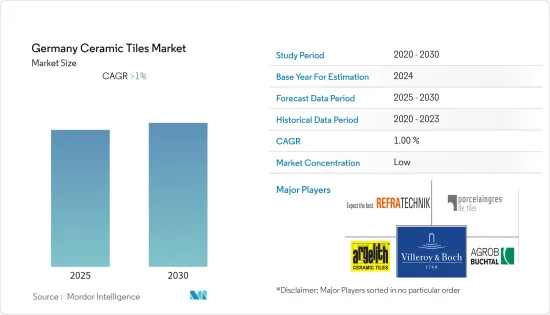
독일의 세라믹 타일 시장은 예측 기간 동안 1% 이상의 CAGR을 나타낼 것으로 예상됩니다.
독일은 유럽 세라믹 타일의 주요 시장 중 하나입니다. 이 나라는 기와, 벽돌, 위생 도자기 등 고도로 개발된 최첨단 세라믹 제품의 혜택을 누리고 있습니다. 또한 주택건설에 대한 소비자의 지출이 큰 것도 시장의 성장을 가속하는 요인이 되고 있습니다. 건설 부문의 호황은 국가 투자와 저금리로 인한 것입니다. 새로운 주택 인프라에 대한 수요 증가는 독일 세라믹 타일 시장의 성장에 영향을 미치는 주요 요인입니다. 독일은 유럽에서 카올린의 중요한 생산국 중 하나입니다.
독일에서는 세라믹 타일 시장도 마찬가지로 성장하고 있습니다. 2020년 타일 수입량은 9.8% 증가하여 총 1억 1,360만 제곱미터가 되었습니다. 통계에 따르면 평균 수입 가격은 평방미터당 4.00-13.85유로입니다. 종종 더 저렴한 가격으로 더 많은 양이 구입됩니다. 이탈리아의 수입량은 약 6,020만 평방미터로 안정적이며, 터키(1,470만 평방미터), 스페인(1,120만 평방미터), 폴란드(1,120만 평방미터), 체코 공화국(750만 평방미터) 순입니다. 수입 증가는 자국 시장이 붕괴된 후 타국 제조업체들이 안정된 독일 시장으로 옮겨가는 것으로 설명할 수 있습니다. 동시에, 이러한 변화는 제품의 약 3분의 1을 수출하는 독일 제조 업체가 상황에 따라 중요한 수출 시장을 잃었습니다는 것을 의미합니다.
독일 세라믹 타일 시장 동향
건설활동 증가로 시장 견인
건설 지출 증가는 독일 세라믹 타일 시장을 견인하고 있습니다. 인테리어 건설 산업에서의 세라믹 타일의 높은 채용률과 바닥 타일로부터의 높은 수익은 독일 세라믹 타일 시장의 성장을 뒷받침할 것으로 예상됩니다. 독일에서는 건설 산업이 유망하기 때문에 세라믹 타일 수요는 예측 기간 동안 가속될 것으로 예상됩니다. 급속한 산업화와 도시화로 주택, 상업 및 산업 건설 활동이 증가하고 세라믹 타일에 대한 수요가 증가하고 있습니다. 독일에서는 2007-2020년까지 주택 건설 허가의 총수가 증가했습니다. 이 기간 동안 허가증 발행 총수는 18만 2,000건에서 36만 8,000건 이상으로 증가하여 100% 이상의 성장을 보였습니다.
시장을 견인하는 플로어 부문
세라믹 타일은 미세하고 고밀도의 점토로 만들어져 극단적인 온도에서 소성되기 때문에 사람의 왕래가 많은 바닥재에 뛰어난 내구성을 기재하고 있습니다. 신제품의 개발과 번거로움이 없는 시공 기술이, 업무용 바닥재의 세라믹 타일 시장을 크게 견인하고 있습니다. 세라믹 바닥재는 항균성, 방활성, 내수성을 갖추고 있기 때문에 의료 및 시설 건축물 등 다양한 부문에서 비용 효율적이고 친환경 솔루션으로 대두하고 있습니다. 세련되고 저렴한 바닥재를 요구하는 소비자와 고품질 바닥 타일에 대한 수요 증가 등의 요인이 독일 세라믹 타일 시장의 성장에 기여하고 있습니다.
독일 세라믹 타일 산업 개요
이 보고서는 독일의 세라믹 타일 시장에서 사업을 전개하는 주요 국제 기업을 다룹니다. 시장 점유율에 관해서는 현재 몇몇 선두 기업이 시장을 독점하고 있습니다. 그러나 기술진보와 제품혁신에 따라 중견에서 중소기업은 신규계약의 획득과 새로운 시장의 개척에 의해 시장에서의 존재감을 높이고 있습니다.
기타 혜택
- 엑셀 형식 시장 예측(ME) 시트
- 3개월간의 애널리스트 서포트
목차
제1장 서론
- 조사의 전제조건과 시장 정의
- 조사 범위
제2장 조사 방법
제3장 주요 요약
제4장 시장 역학
- 시장 개요
- 시장 성장 촉진요인
- 시장 성장 억제요인
- 밸류체인/서플라이체인 분석
- Porter's Five Forces 분석
- 신규 참가업체의 위협
- 구매자/소비자의 협상력
- 공급기업의 협상력
- 대체품의 위협
- 경쟁 기업간 경쟁 관계
- 산업의 기술 동향에 관한 통찰
- 시장에 대한 COVID-19의 영향
제5장 시장 세분화
- 제품
- 유약
- 도자기
- 스크래치 방지
- 기타
- 용도
- 바닥 타일
- 벽 타일
- 기타 타일
- 건축 유형
- 신축
- 교체 및 리폼
- 최종 사용자
- 주택용
- 상업
제6장 경쟁 구도
- 시장 집중도 개요
- 기업 프로파일
- Villeroy & Boch
- Agrob Buchtal
- Argelith Ceramic Tiles Inc
- Porcelaingres GmbH
- Refratechnik Ceramics GmbH
- Golem
- Alois Korzilius Interbau.
- klingenberg dekoramik gmbh
- Tonality gmbh
- Steuler Fliesen GmbH*
제7장 시장 기회와 앞으로의 동향
제8장 면책사항과 출판사에 대해서
JHS 25.04.01The Germany Ceramic Tiles Market is expected to register a CAGR of greater than 1% during the forecast period.
Germany is one of the European region's major markets for ceramic tiles. The country has the benefits of highly developed and most advanced ceramic products like roof tiles, bricks, sanitary ware, etc. The significant consumer expenditure on residential and housing construction is another factor that benefits the market growth. The booming prospects of the construction sector are attributed to state investments and low-interest rates. The rising demand for new residential infrastructures is the principal factor influencing the German ceramic tiles market growth. Germany is one of the significant producers of kaolin in the European region.
In Germany, the ceramic tile market has grown similarly. Imports of tiles in 2020 climbed by 9.8%, totaling 113.6 million square meters. According to statistics, average import prices range from 4.00 to 13.85 euros per square meter. Frequently, a larger volume was purchased at a lower price. Italy's imports remain stable at roughly 60.2 million square meters, followed by Turkey (14.7 million square meters), Spain (11.2 million square meters), Poland (11.2 million square meters), and the Czech Republic (7.5 million square meters). The increased imports can be explained by the fact that after their home market collapsed, manufacturers in other countries shifted to the stable German market. At the same time, this shift means that German manufacturers, who export around a third of their products, have lost a significant export market in some situations.
Germany Ceramic Tiles Market Trends
Rising Construction Activities are Driving the Market
Increasing construction spending is the key factor in driving the ceramic tiles market in Germany. The high adoption rate of ceramic tiles in the interior construction industry and high revenue generation from the floor tiles are anticipated to boost the German ceramic tiles market growth. Due to the promising construction industry in Germany, the demand for ceramic tiles is expected to accelerate over the projected period. Rapid industrialization and urbanization have resulted in increased residential, commercial, and industrial construction activities, thereby escalating the demand for ceramic tiles. Germany had a general increase in the total number of permits issued for residential property construction between 2007 and 2020. In that period, the total number of permits issued increased from 182 thousand to over 368 thousand, an increase of over 100%.
Floor Segment is Driving the Market
Ceramic tiles are made from fine, denser clay and fired at extreme temperatures, offering superior durability to the flooring with exposure to high traffic. Developing new products and hassle-free installation techniques have considerably driven the ceramic tiles market in commercial flooring. Ceramic floorings are emerging as cost-effective and eco-friendly solutions in various sectors, including healthcare and institutional buildings, owing to the product's antibacterial, anti-slip, and water-resistant properties. Factors such as consumers seeking stylish and less expensive flooring options and escalating demand for high-quality floor tiles will contribute to the growth of the German ceramic tiles market.
Germany Ceramic Tiles Industry Overview
The report covers major international players operating in the German Ceramic Tiles Market. Regarding market share, some of the major players currently dominate the market. However, with technological advancement and product innovation, mid-size to smaller companies are increasing their market presence by securing new contracts and tapping new markets.
Additional Benefits:
- The market estimate (ME) sheet in Excel format
- 3 months of analyst support
TABLE OF CONTENTS
1 INTRODUCTION
- 1.1 Study Assumptions and Market Definition
- 1.2 Scope of the Study
2 RESEARCH METHODOLOGY
3 EXECUTIVE SUMMARY
4 MARKET DYNAMICS
- 4.1 Market Overview
- 4.2 Market Drivers
- 4.3 Market Restraints
- 4.4 Value Chain / Supply Chain Analysis
- 4.5 Porter's Five Forces Analysis
- 4.5.1 Threat of New Entrants
- 4.5.2 Bargaining Power of Buyers/Consumers
- 4.5.3 Bargaining Power of Suppliers
- 4.5.4 Threat of Substitute Products
- 4.5.5 Intensity of Competitive Rivalry
- 4.6 Insights on Technological Trends in the Industry
- 4.7 Impact of COVID-19 on the Market
5 MARKET SEGMENTATION
- 5.1 Product
- 5.1.1 Glazed
- 5.1.2 Porcelain
- 5.1.3 Scratch Free
- 5.1.4 Others
- 5.2 Application
- 5.2.1 Floor Tiles
- 5.2.2 Wall Tiles
- 5.2.3 Other Tiles
- 5.3 Construction Type
- 5.3.1 New Construction
- 5.3.2 Replacement and Renovation
- 5.4 End User
- 5.4.1 Residential
- 5.4.2 Commercial
6 COMPETITIVE LANDSCAPE
- 6.1 Market Concentration Overview
- 6.2 Company Profiles
- 6.2.1 Villeroy & Boch
- 6.2.2 Agrob Buchtal
- 6.2.3 Argelith Ceramic Tiles Inc
- 6.2.4 Porcelaingres GmbH
- 6.2.5 Refratechnik Ceramics GmbH
- 6.2.6 Golem
- 6.2.7 Alois Korzilius Interbau.
- 6.2.8 klingenberg dekoramik gmbh
- 6.2.9 Tonality gmbh
- 6.2.10 Steuler Fliesen GmbH*