|
시장보고서
상품코드
1910587
인도네시아의 세라믹 타일 시장 : 점유율 분석, 업계 동향 및 통계, 성장 예측(2026-2031년)Indonesia Ceramic Tiles - Market Share Analysis, Industry Trends & Statistics, Growth Forecasts (2026 - 2031) |
||||||
 Mordor Intelligence
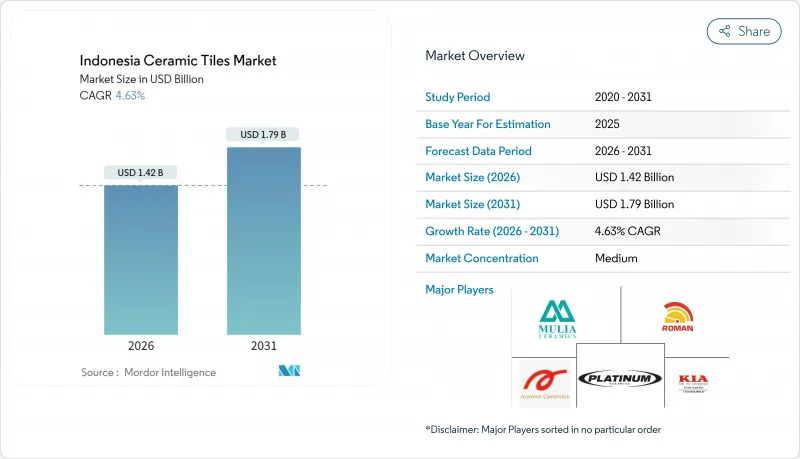
인도네시아의 세라믹 타일 시장은 2025년 13억 6,000만 달러로 평가되었으며, 2026년 14억 2,000만 달러에서 2031년까지 17억 9,000만 달러에 이를 것으로 예측됩니다. 예측 기간 중(2026-2031년) CAGR은 4.63%로 예상됩니다.
수요의 기세는 정부의 가스 보조금 정책, 저비용 수입품에 대한 100-200%의 관세 장벽, 그리고 대규모 주택 300만호 건설 계획에 기인하고 있어, 이들 모두가 주택, 상업 및 공공 프로젝트에서 신규 수주를 견인하고 있습니다. 2027년까지의 견조한 GDP 성장률 5.1%, 꾸준한 도시로의 인구 이동, 중소득 가구에서의 보수 지출 증가가 건설 활동에 여러 강인성을 부가하고 있습니다. 제조업체는 도자기의 내구성에 뒷받침된 매력을 활용해, 디지털 판매 채널은 지리적 범위를 확대하는 것과 동시에, 인도네시아의 높은 섬간 수송 비용을 일부 상쇄하고 있습니다. 현지 생산자는 또한 수입업체의 진입 장벽을 높이고 고급 제품 분야에서 가격 결정력을 보호하는 SNI 품질 기준 의무화로 혜택을 누리고 있습니다.
인도네시아의 세라믹 타일 시장 동향과 통찰
에너지 집약형 세라믹 산업용 가스 가격 상한
특정 천연가스 가격정책에 근거한 MMBTU당 6.75달러의 상한 가격은 타일 공장의 가마 가동 비용을 약 30% 절감하고 국내 생산자에게 결정적인 비용 우위를 부여하고 있습니다. 보조금이 2025년까지 계속되기 때문에 공장은 원료의 확보나 설비 갱신의 계획을 세우기 쉬워져, 생산 능력 계획의 확신이 높아지고 있습니다. 이 혜택은 전국적인 공급 부족에도 불구하고 파이프라인 인프라가 가동률을 지원하는 자바 섬과 수마트라 섬에 집중되어 있습니다. 보조대상가스는 수입원료에 대한 루피아 약세의 영향을 공장이 흡수하는 데 도움이 됩니다. 그러나 공급량은 계약량의 65-70%에 머물러 있으며 연료의 이용가능성이 단기적인 생산 확대의 제약 요인이 되고 있습니다. 에너지 보조금을 활용하여 국내 제조업을 지원하는 정부의 종합적 전략은 인도네시아의 산업 정책 목표와 일치하며, 세라믹 타일을 수입 대체 및 수출 확대 노력의 전략적 부문으로 자리매김하고 있습니다.
자바 섬과 발리 섬에서 팬데믹 후 주택 붐
주택융자 금리우대책과 세제 우대조치로 이동제한 완화 이후 정체하던 주택 프로젝트가 재개되어 신규 분양도 활발해졌습니다. 자바 섬 도시에는 인구의 60%, GDP의 58%가 집중되어 있으며, 타일 수요의 대부분은 고밀도 아파트와 단독 주택용입니다. 발리 섬의 고급 별장 개발에서는 대형이며 디자인성이 뛰어난 타일이 채용되어 평균 판매 가격을 밀어 올리고 있습니다. 재택근무가 정착해, 주택 소유자가 주방이나 욕실의 개수를 추진하는 리노베이션 수요도 견조하게 추이하고 있습니다. 이러한 요인이 결합되어 2027년까지 총 수요 증가량의 절반 이상을 지원할 전망입니다. 신규 주택 개발의 스마트 홈 기술과 지속 가능한 건축 기법의 통합은 세라믹 타일 제조업체에게 진화하는 소비자 요구와 에너지 절약 건축에 대한 규제 요구 사항을 충족하는 혁신적인 제품을 개발할 수있는 기회를 창출합니다.
산업용 가스 공급 병목
파이프라인 네트워크의 제약으로 인해 많은 가마가 설계 부하의 70% 미만에서 작동할 수 없으며 규모의 경제가 손상되었습니다. 빈번한 압력 강하는 소성 사이클을 중단시키고 불량품률을 증가시킵니다. 분배 프로세스에서의 렌트 추구 행동은 생산 계획에 추가적인 불확실성을 추가합니다. 듀얼 연료 능력이 없는 제조업체는 유휴 비용을 흡수하거나 납기를 늦추어야 합니다. 투자자는 송전망 업그레이드로 안정적인 공급량이 보장될 때까지 생산 능력 확대를 연기합니다. Asaki가 보고한 바와 같이 외국인 투자자들이 세라믹 산업에 대한 투자를 검토하고 있다는 것은 공급 신뢰성에 대한 우려가 시장 확대와 경쟁력 향상을 지원할 수 있는 자본 형성과 기술 업그레이드의 감소로 이어진다는 것을 보여줍니다.
부문 분석
2025년 시점에서 도자기 타일은 인도네시아 세라믹 타일 시장의 46.58%를 차지하며, 높은 내마모성이 요구되는 쇼핑몰, 호텔, 교통 거점에서의 광범위한 채용을 반영하고 있습니다. 자카르타와 수라바야에서 상업용 부동산이 급속히 확대됨에 따라 인도네시아의 세라믹 타일 시장 규모가 확대될 것으로 예측됩니다. 모자이크 타일은 베이스가 작지만, 주택 소유자가 욕실이나 주방의 개조로 디자인의 개성을 중시하는 경향으로부터, 5.28%의 최고 CAGR을 나타내고 있습니다. 국내 기업은 잉크젯 인쇄와 대형 프레스 기술을 활용하여 대리석과 목재를 모방하여 기존 천연석으로 넘어가던 지출을 획득하고 있습니다. 낮은 VOC 유약에 대한 규제 강화도 생산자를 친환경 배합으로 이끌어 세라믹 타일의 프리미엄성을 강화하고 있습니다.
대형 모듈(60X120cm, 80X80cm)로의 가치 전환은 건축가가 요구하는 효율적인 시공과 현대적인 미관에 기여하고 있습니다. 무유약 및 미끄럼 방지 사양은 기능적 안전성이 시각적 기호를 웃도는 산업용 바닥재나 옥외 파티오로 보급이 진행되고 있습니다. 발리 섬의 고급 리조트에서는 수제 장인기 타일이 틈새 시장을 유지하고 소규모이면서 높은 이익률을 유지하고 있습니다. 인도네시아의 세라믹 타일 시장에서는 기술적 특성과 동향의 디자인을 융합할 수 있는 공급업체가 계속 우위를 유지하고 있습니다. 특히 SNI 인증을 취득한 경우, 내구성 기준에 대한 구매자의 신뢰를 얻을 수 있기 때문에 유리합니다. 에너지 절약형 고속 소성 가마는 평방미터당 비용을 더욱 절감하고 연료 가격 변동 하에서도 경쟁력있는 가격 설정을 가능하게하고 있습니다.
2025년 현재 바닥재는 인도네시아 세라믹 타일 시장의 61.48%를 차지했습니다. 열대의 습기 속에서 방수성과 청소의 용이함이 가정에서 중시되기 때문입니다. 개발자는 유동인구가 많은 소매점에서 매끄러운 시각 효과를 실현하기 위해 3mm 그라우트와 리파인 엣지를 지정하는 경향이 강해지고 있습니다. 지붕 타일은 CAGR 5.44%로 확대되어, 악천후에 휩쓸리기 쉬운 지방 도시에 있어서의 내열성 및 사이클론 내성이 있는 지붕재에 수요 증가에 대응하고 있습니다. 벽면재는 세척 가능한 표면이 필수적인 병원과 교육 시설에서 위생 기준을 강화함으로써 혜택을 누리고 있습니다. 인도네시아의 세라믹 타일 업계는 미래를 지향하는 오피스 타워를 위해 기류와 배선을 통합한 모듈식 고층 시스템에도 성장의 여지를 발견하고 있습니다.
항균 유약과 같은 지속적인 디자인 혁신으로 병원과 식품 가공 시설에서 수요가 확대되고 있습니다. 옥외 데크에는 목재보다 고보행 부하나 우기의 호우에 견디는 도자기 포장재가 채용되고 있습니다. 바닥 난방 대응 기능은 한때 온대 지역에 한정되어 있었지만, 현재는 인도네시아의 고급 별장에도 도입되어 세라믹의 중요성을 높이고 있습니다. OECD의 내성 가이드라인에 대한 적합성으로 타일 지붕은 공공 주택 리노베이션에서 아연 도금 강판을 대체하는 우선 옵션으로 자리매김하고 있습니다. 이 세분화는 기능적 필요성과 진화하는 건축 기준이 다양한 응용 분야에서 성장 경로를 지원한다는 것을 보여줍니다.
기타 혜택:
- 엑셀 형식 시장 예측(ME) 시트
- 애널리스트에 의한 3개월간의 지원
자주 묻는 질문
목차
제1장 서론
- 조사의 전제조건과 시장의 정의
- 조사 범위
제2장 조사 방법
제3장 주요 요약
제4장 시장 상황
- 시장 개요
- 시장 성장 촉진요인
- 에너지 집약형 세라믹 산업용 가스 가격 상한
- 팬데믹 후 자바와 발리의 주택 붐
- 중국으로부터의 수입품에 대한 관세 인상
- 정부의 '주택 백만호' 계획
- 지방도시의 급속한 도시화
- 증가하는 중산계급의 리폼 지출
- 시장 성장 억제요인
- 산업용 가스 공급의 병목
- 루피아 약세로 수입 원재료 비용 상승
- 국내의 과잉 생산 능력이 가격 경쟁 촉진
- 군도 전체에 있어서의 높은 섬간 물류 비용
- 업계 밸류체인 분석
- Porter's Five Forces 분석
- 신규 참가업체의 위협
- 공급기업의 협상력
- 구매자의 협상력
- 대체품의 위협
- 경쟁 기업간 경쟁 관계
- 시장의 최신 동향과 혁신에 관한 통찰
- 업계의 최근 동향(신제품 발매, 전략적 이니셔티브, 투자, 제휴, 합작 사업, 사업 확대, M&A 등)에 관한 통찰
제5장 시장 규모와 성장 예측(금액은 미화)
- 제품 유형별
- 세라믹 타일
- 글레이즈드 세라믹 타일
- 언글레이즈드 세라믹 타일
- 모자이크 타일
- 기타(장식 타일, 무늬 타일, 핸드메이드 타일)
- 용도별
- 바닥재
- 벽재
- 지붕재
- 최종 사용자별
- 주택용
- 상업용
- 접객(호텔, 리조트)
- 소매 점포
- 오피스 및 공공시설
- 헬스케어
- 교육시설
- 교통 거점(공항, 지하철, 버스 터미널)
- 기타 상업 사용자
- 건축 유형별
- 신축
- 개수 및 교체
- 유통 채널별
- 타일 및 석재 전문점
- 홈 센터 및 DIY 전문점
- 온라인 소매
- 계약자에게 직접 판매
- 지역별
- 자바
- 수마트라
- 칼리만탄
- 술라웨시
- 발리 및 누사텡가라
- 파푸아 및 서파푸아
- 말루쿠 제도
제6장 경쟁 구도
- 시장 집중도
- 전략적 동향
- 시장 점유율 분석
- 기업 프로파일
- Arwana Citramulia Tbk
- Mulia Keramik Indahraya
- Roman Ceramic International
- Platinum Ceramics Industry
- KIA Keramik Tbk
- Granito(PT Citra Granito)
- Diamond Keramik Indonesia
- Indogress(PT Inti Keramik Sejahtera)
- Indopenta Sakti Teguh
- Sun Power Ceramics
- Satyaraya Keramindo Indah(SRK)
- Candra Jaya Surya
- Royalboard Ceramics
- Sandimas Intimitra
- Terracotta Indonesia
- Muliakeramik Industri Indah
- Intikeramik Alamasri Industri Tbk
- Surya Toto Indonesia Tbk(Tile division)
- Dekkson Ceramics
- Madana Tiles Surabaya
제7장 시장 기회와 미래 전망
SHW 26.01.26The Indonesia ceramic tiles market was valued at USD 1.36 billion in 2025 and estimated to grow from USD 1.42 billion in 2026 to reach USD 1.79 billion by 2031, at a CAGR of 4.63% during the forecast period (2026-2031).
Demand momentum stems from the government's subsidized-gas policy, a 100-200% duty wall against low-cost imports, and the massive 3 Million Houses program, all of which drive fresh orders across residential, commercial, and public projects. Robust GDP growth of 5.1% through 2027, steady urban migration, and higher renovation spending among middle-income households add multiple layers of resilience to construction activity. Manufacturers capitalize on porcelain's durability-driven appeal, while digital sales channels widen geographic reach and partly offset Indonesia's high inter-island freight costs. Local producers also benefit from mandatory SNI quality standards that raise compliance hurdles for importers and protect pricing power in premium product niches.
Indonesia Ceramic Tiles Market Trends and Insights
Gas-price cap for energy-intensive ceramics
The USD 6.75 per MMBTU ceiling under the Certain Natural Gas Price Policy trims roughly 30% of kiln operating costs for tile plants, granting domestic producers a decisive cost edge. Capacity-planning confidence rises because the subsidy runs through 2025, enabling factories to lock in feedstock and schedule equipment upgrades. The benefit concentrates in Java and Sumatra, where pipeline infrastructure supports high utilization despite national supply gaps. Subsidized gas helps plants counter rupiah depreciation impacts on imported raw materials. However, deliveries cover only 65-70% of contracted volumes, turning fuel availability into a gating constraint for near-term output growth. The government's broader strategy of using energy subsidies to support domestic manufacturing aligns with Indonesia's industrial policy objectives, positioning ceramic tiles as a strategic sector for import substitution and export development initiatives.
Post-pandemic residential boom in Java & Bali
Mortgage rate incentives and tax relief revived stalled housing projects and spurred new launches once mobility restrictions eased. Java's urban centers account for 60% of population and 58% of GDP, funneling a large portion of tile demand into high-density apartment and landed-housing schemes. Bali's premium villa pipeline favors large-format, design-rich tiles that lift average selling prices. The renovation wave also stays strong as remote work habits push home-owners to upgrade kitchens and bathrooms. Collectively, these drivers underpin more than half of all volume additions through 2027. The integration of smart home technologies and sustainable building practices in new residential developments creates opportunities for ceramic tile manufacturers to develop innovative products that meet evolving consumer expectations and regulatory requirements for energy-efficient construction.
Industrial gas-supply bottlenecks
Pipeline network limits force many kilns to operate below 70% of design loads, eroding economies of scale. Frequent pressure drops interrupt firing cycles and raise reject rates. Rent-seeking behavior in allocation processes adds further uncertainty to production planning. Manufacturers without dual-fuel capability must absorb idle costs or delay deliveries. Investors defer capacity expansion until transmission upgrades assure steady volume. Foreign investors' reconsideration of ceramic industry investments, as reported by Asaki, demonstrates how supply reliability concerns translate into reduced capital formation and technological upgrading that could otherwise support market expansion and competitiveness improvements.
Other drivers and restraints analyzed in the detailed report include:
- Duty hike on Chinese imports
- Government "One Million Houses" program
- Depreciating rupiah inflates imported raw-material costs
For complete list of drivers and restraints, kindly check the Table Of Contents.
Segment Analysis
Porcelain tiles held a 46.58% share of the Indonesia ceramic tiles market in 2025, reflecting widespread acceptance in malls, hotels, and transit hubs where high abrasion resistance is crucial. The Indonesia ceramic tiles market size for porcelain is projected to widen alongside rapid commercial real-estate expansion in Jakarta and Surabaya. Mosaic formats, though starting at a smaller base, exhibit the highest 5.28% CAGR as homeowners embrace design individuality in bathroom and kitchen revamps. Domestic firms leverage ink-jet printing and large-slab presses to mimic marble and wood, capturing spend that once flowed to natural stone. Regulatory emphasis on low-VOC glazes also nudges producers toward eco-friendlier formulations, reinforcing porcelain's premium tag.
Value migration toward larger modules (60X120 cm and 80X80 cm) benefits efficient installation and modern aesthetics sought by architects. Unglazed and anti-slip variants gain traction in industrial floors and outdoor patios where functional safety tops visual preference. Handmade artisanal tiles retain a niche among luxury resorts in Bali, commanding high margins despite limited scale. The Indonesia ceramic tiles market continues to reward suppliers able to mesh technical attributes with on-trend looks, especially when backed by SNI certification that reassures buyers on durability benchmarks. Energy-efficient fast-firing kilns further lower cost per square meter, allowing competitive pricing even under fuel volatility.
Flooring captured 61.48% of the Indonesia ceramic tiles market share in 2025 because households value waterproofing and ease of cleaning amid tropical humidity. Developers increasingly specify 3-mm grout lines and rectified edges to achieve seamless visuals in high-traffic retail settings. Roofing tiles, expanding at 5.44% CAGR, meet rising demand for thermally stable, cyclone-resistant coverings in secondary cities prone to severe weather. Wall cladding benefits from heightening hygiene requirements in hospitals and educational premises where washable surfaces are mandatory. The Indonesia ceramic tiles industry also finds upside in modular raised-floor systems integrating airflow and cabling for future-ready office towers.
Continuous design innovation such as antibacterial glazes widens hospital and food-processing appeal. Outdoor decks adopt porcelain pavers that tolerate heavy footfall and monsoon deluges better than timber. Underfloor-heating compatibility, once limited to temperate markets, now appears in premium Indonesian villas, boosting ceramic relevance. Compliance with OECD resilience guidelines positions tile roofing as a preferred alternative to galvanized sheets in public housing upgrades. The segmentation underscores how functional imperatives and evolving building codes sustain diversified growth paths across applications.
The Indonesia Ceramic Tiles Market Report is Segmented by Product Type (Porcelain Tiles and More), Application (Floor, Wall, Roofing), End-User (Residential, Commercial), Construction Type (New Construction, Renovation and Replacement), Distribution Channel (Specialty Tile & Stone Stores, Home Improvement & DIY Stores, and More) and Geography (Java, Sumatra and More). The Market Forecasts are Provided in Terms of Value (USD).
List of Companies Covered in this Report:
- Arwana Citramulia Tbk
- Mulia Keramik Indahraya
- Roman Ceramic International
- Platinum Ceramics Industry
- KIA Keramik Tbk
- Granito (PT Citra Granito)
- Diamond Keramik Indonesia
- Indogress (PT Inti Keramik Sejahtera)
- Indopenta Sakti Teguh
- Sun Power Ceramics
- Satyaraya Keramindo Indah (SRK)
- Candra Jaya Surya
- Royalboard Ceramics
- Sandimas Intimitra
- Terracotta Indonesia
- Muliakeramik Industri Indah
- Intikeramik Alamasri Industri Tbk
- Surya Toto Indonesia Tbk (Tile division)
- Dekkson Ceramics
- Madana Tiles Surabaya
Additional Benefits:
- The market estimate (ME) sheet in Excel format
- 3 months of analyst support
TABLE OF CONTENTS
1 Introduction
- 1.1 Study Assumptions & Market Definition
- 1.2 Scope of the Study
2 Research Methodology
3 Executive Summary
4 Market Landscape
- 4.1 Market Overview
- 4.2 Market Drivers
- 4.2.1 Gas-price cap for energy-intensive ceramics
- 4.2.2 Post-pandemic residential boom in Java & Bali
- 4.2.3 Duty hike on Chinese imports
- 4.2.4 Government "One Million Houses" program
- 4.2.5 Rapid urbanisation of secondary cities
- 4.2.6 Rising middle-class renovation spending
- 4.3 Market Restraints
- 4.3.1 Industrial gas-supply bottlenecks
- 4.3.2 Depreciating rupiah inflates imported raw-material costs
- 4.3.3 Domestic over-capacity drives price wars
- 4.3.4 High inter-island logistics costs across the archipelago
- 4.4 Industry Value Chain Analysis
- 4.5 Porter's Five Forces Analysis
- 4.5.1 Threat of New Entrants
- 4.5.2 Bargaining Power of Suppliers
- 4.5.3 Bargaining Power of Buyers
- 4.5.4 Threat of Substitutes
- 4.5.5 Competitive Rivalry
- 4.6 Insights into the Latest Trends and Innovations in the Market
- 4.7 Insights on Recent Developments (New Product Launches, Strategic Initiatives, Investments, Partnerships, JVs, Expansion, M&As, etc.) in the Industry
5 Market Size & Growth Forecasts (Value in USD)
- 5.1 By Product Type
- 5.1.1 Porcelain Tiles
- 5.1.2 Glazed Ceramic Tiles
- 5.1.3 Unglazed Ceramic Tiles
- 5.1.4 Mosaic Tiles
- 5.1.5 Others (Decorative, Patterned, Handmade)
- 5.2 By Application
- 5.2.1 Floor
- 5.2.2 Wall
- 5.2.3 Roofing
- 5.3 By End-User
- 5.3.1 Residential
- 5.3.2 Commercial
- 5.3.2.1 Hospitality (Hotels, Resorts)
- 5.3.2.2 Retail Spaces
- 5.3.2.3 Offices & Institutions
- 5.3.2.4 Healthcare
- 5.3.2.5 Educational Facilities
- 5.3.2.6 Transport Hubs (Airports, Metro, Bus Terminals)
- 5.3.2.7 Other Commercial Users
- 5.4 By Construction Type
- 5.4.1 New Construction
- 5.4.2 Renovation and Replacement
- 5.5 By Distribution Channel
- 5.5.1 Specialty Tile & Stone Stores
- 5.5.2 Home Improvement & DIY Stores
- 5.5.3 Online Retail
- 5.5.4 Direct Sales to Contractors
- 5.6 By Geography
- 5.6.1 Java
- 5.6.2 Sumatra
- 5.6.3 Kalimantan
- 5.6.4 Sulawesi
- 5.6.5 Bali & Nusa Tenggara
- 5.6.6 Papua & West Papua
- 5.6.7 Maluku Islands
6 Competitive Landscape
- 6.1 Market Concentration
- 6.2 Strategic Moves
- 6.3 Market Share Analysis
- 6.4 Company Profiles (includes Global level Overview, Market level overview, Core Segments, Financials as available, Strategic Information, Market Rank/Share for key companies, Products & Services, and Recent Developments)
- 6.4.1 Arwana Citramulia Tbk
- 6.4.2 Mulia Keramik Indahraya
- 6.4.3 Roman Ceramic International
- 6.4.4 Platinum Ceramics Industry
- 6.4.5 KIA Keramik Tbk
- 6.4.6 Granito (PT Citra Granito)
- 6.4.7 Diamond Keramik Indonesia
- 6.4.8 Indogress (PT Inti Keramik Sejahtera)
- 6.4.9 Indopenta Sakti Teguh
- 6.4.10 Sun Power Ceramics
- 6.4.11 Satyaraya Keramindo Indah (SRK)
- 6.4.12 Candra Jaya Surya
- 6.4.13 Royalboard Ceramics
- 6.4.14 Sandimas Intimitra
- 6.4.15 Terracotta Indonesia
- 6.4.16 Muliakeramik Industri Indah
- 6.4.17 Intikeramik Alamasri Industri Tbk
- 6.4.18 Surya Toto Indonesia Tbk (Tile division)
- 6.4.19 Dekkson Ceramics
- 6.4.20 Madana Tiles Surabaya
7 Market Opportunities & Future Outlook
- 7.1 Rapid-set thin-tile technology for high-rise retrofits
- 7.2 "Smart-surface" IoT-embedded floor tiles