
|
시장보고서
상품코드
1906141
말레이시아의 세라믹 타일 시장 : 점유율 분석, 업계 동향 및 통계, 성장 예측(2026-2031년)Malaysia Ceramic Tiles - Market Share Analysis, Industry Trends & Statistics, Growth Forecasts (2026 - 2031) |
||||||
 Mordor Intelligence
말레이시아의 세라믹 타일 시장은 2025년에 9억 9,000만 달러로 평가되었으며, 2026년 10억 4,000만 달러에서 2031년까지 13억 1,000만 달러에 이를 것으로 예측됩니다.
예측기간(2026-2031년)의 CAGR은 4.74%로 전망됩니다.
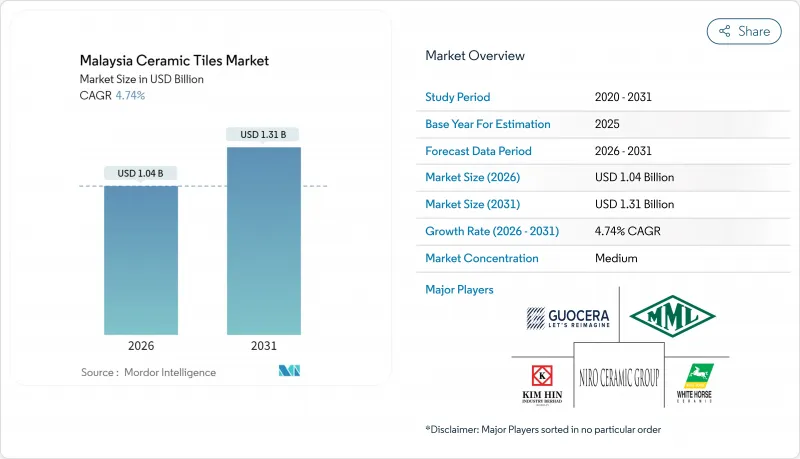
이 수치는 말레이시아의 세라믹 타일 시장이 안정적인 중성장 건축자재 분야에 위치하고 있으며, 그 전망은 클랑 밸리의 메가프로젝트, 사바주 및 사라왁의 인프라 정비와 소매 채널의 급속한 디지털화의 영향을 점점 강하게 받고 있음을 보여줍니다. 2024년에는 역대 최고인 1,837억 링깃 상당의 건설계약이 체결되면서, 주택용 및 상업용 모두에서 타일의 다운스트림 수요를 뒷받침하고 있습니다. 특히 잉크젯 인쇄 기술을 탑재한 대형 도자기 슬래브 생산 라인의 급속한 기술 도입이 프리미엄화를 뒷받침하는 한편, 정부 주도의 저렴한 주택 할당 제도가 기준선 수요량을 확보하고 있습니다. 중국과 베트남의 수입품에 의한 경쟁압력으로 현지 제조업체는 지속가능성에 대한 대처, 첨단 유약기술, 옴니채널 유통 전략을 통한 차별화를 요구받고 있습니다.
말레이시아의 세라믹 타일 시장의 동향 및 분석
도시 지역 중산층의 수요 증가
쿠알라룸푸르, 셀랑고르, 페낭의 가처분 소득 증가는 1인당 바닥재 지출을 계속 끌어올리고 있으며, 말레이시아의 세라믹 타일 시장은 주요 수혜자가 되고 있습니다. 장식용 표면재에 대한 가계 지출은 2018년 5억 3,060만 링깃에서 2022년에는 6억 4,020만 링깃으로 증가하였고, 2026년까지 7억 6,000만 링깃에 이를 것으로 예측되며, CAGR은 4.4%를 나타낼 전망입니다. 2024년에는 주택 부동산 거래량이 6.2% 증가했고, 거래액도 14.4% 상승했으며, 이는 고급 도자기 타일을 선호하는 견조한 리폼 수요를 보여주고 있습니다. 중산층 구매자는 오픈 컨셉 레이아웃의 내구성과 미적 통일성을 더욱 중시하고 이는 프로젝트당 평균 구매 면적을 밀어 올리고 있습니다. 또한 도시 지역의 소비자가 타일 패턴을 선택하기 전에 디지털 시각화 도구를 선호하는 경향이 커지고 있기 때문에 인구 역학의 변화도 소매업체에게 온라인 카탈로그를 확대하도록 촉구합니다.
정부 주도의 저가 주택 프로젝트
MyHome, PR1MA, Rumah Selangorku 등 연방정부프로그램에서는 주방, 욕실, 공용지역에 세라믹 타일을 지정하고 있어, 제조업체는 예측 가능한 주문량을 확보하고 있습니다. MyHome 프로그램에서는 개발업자에게 1호당 최대 30,000 링깃을 제공해 타일 조달에 직결되는 건설 파이프라인을 창출하고 있습니다. Sim Darby Properties의 Seed Homes 구상은 민간 건설 회사가 내구성있는 타일 표면을 갖춘 저렴한 아파트를 공급하는 국가 목표와 부합한다는 것을 보여줍니다. 설계 및 단위 크기가 표준화되어 공급업체는 대량 구매 계약을 통해 비용 효율성을 추구할 수 있으며 가격이 압축되었음에도 불구하고 이익률을 유지합니다. 합리적인 가격의 주택에 관한 규정은 현지 조달도 의무화하고 있으며, 말레이시아의 세라믹 타일 시장에서 국내 기업을 수입품과의 가격 경쟁으로부터 보호하고 있습니다. 이러한 프로그램은 일반적으로 습기가 많은 지역과 사람이 왕래하는 지역에 세라믹 타일을 지정하며 경제 사이클에 관계없이 일관된 기준 수요를 보장합니다. 저렴한 주택 프로젝트의 표준화된 특성은 대량 조달의 이점을 이용하고 경쟁력 있는 가격 구조를 유지하면서 세라믹 타일 공급업체의 이익률을 향상시킬 수 있습니다.
변화하는 천연 가스 및 전력 비용
타일 가마는 1,150°C를 넘는 고온에서 대량의 천연 가스를 소비하기 때문에 생산자는 스팟 가격의 급등에 매우 취약합니다. 풀 바디 도자기 라인에서는 이미 광열비가 공장 출하 가격의 30% 이상을 차지하고 있으며, 디지털 프린터의 전력 요금도 상승 압력을 가하고 있습니다. 2035년까지 동남아시아가 세계 에너지 수요 증가의 25%를 차지할 것으로 예상되는 가운데 말레이시아 공장은 지속적인 비용 예측의 어려움에 직면하고 있습니다. 중소기업은 헤지 수단이 부족하여 이익률의 저하를 흡수할 지 아니면 가격전가에 의해 말레이시아의 세라믹 타일 시장에서 판매량 감소 위험을 감수할 지에 대한 선택에 놓여 있습니다. 이 지역에서는 에너지 수요의 약 80%를 화석연료가 차지하고 있으며, 이 지속적인 의존이 세계 상품 가격 변동에 대한 노출을 낳고 있습니다. 이는 제조업자에게 있어서 업무 효율의 개선만으로는 완전히 제어할 수 없는 과제입니다. 에너지 집약형 세라믹 타일 생산은 수요 피크 시에 전력 회사가 수요 기반 요금 체계를 도입하는 시기에 특히 과제에 직면합니다. 따라서 제조업체는 에너지 비용 변동주기에 맞게 생산 일정을 최적화해야 합니다.
부문 분석
2025년 말레이시아의 세라믹 타일 시장에서 도자기 타일은 매출액의 41.62%를 차지하였으며 2031년까지 연평균 복합 성장률(CAGR) 5.15%로 확대될 것으로 전망되고 있습니다. 따라서 도자기 타일은 말레이시아의 세라믹 타일 시장의 규모에서 업계의 건전성을 측정하는 주요 지표로 계속되고 있습니다. 이 성장은 도자기 타일의 흡수율이 0.5% 미만임을 뒷받침하며, 도자기 타일은 말레이시아의 고습도 기후 하에서도 높은 내구성을 발휘합니다. 건식 프레스 기술과 디지털 유약 기술의 진보에 의해 천연석과 직접 경쟁하는 대리석 마무리가 가능하게 되어, 고급 주택 소유자의 업그레이드 수요를 환기하고 있습니다.
유약 세라믹 타일은 일반 주택의 욕실 벽면에서 중요성을 유지하는 한편, 무유약 산업용 도자기는 미끄럼 저항성이 중요한 산업 시설이나 교통 공간의 바닥재로서 활용됩니다. 모자이크 타일은 소형 로트 소성에 의한 특별 주문 색조를 살려, 호텔 업계의 악센트 벽이나 수영장에서 틈새 가치를 확립하고 있습니다. 손으로 그린 뇨냐 스타일 타일을 포함한 장식용 "기타"제품은 전통적인 모티브와 현대적인 기하학적 패턴을 융합시키는 부티크 개발회사들 사이에서 높은 이익률을 유지하고 있습니다. 시암 시멘트 그룹의 생산 능력 확장에 따라 대형 도자기 타일 공급이 완화되고 말레이시아의 세라믹 타일 시장의 장기적인 프리미엄화 동향을 지원할 것으로 예측됩니다.
2025년 시점에서 바닥용 타일은 말레이시아의 세라믹 타일 시장의 58.72%를 차지했으며, 쇼핑몰이나 단독 주택에서의 내구성 요구가 기반이 되고 있습니다. 쿠알라룸푸르의 신축 아파트 1호당 평균 바닥 면적은 2023년부터 2025년에 걸쳐 6% 증가하여 절대적인 수요량을 밀어 올렸습니다. 한편, 벽면 용도는 4.84%의 연평균 복합 성장률(CAGR)이 예상되며 이는 전체 용도 중에서 가장 높은 성장률입니다. 욕실 리폼은 위생면에서 뛰어나고 닦아내기 쉬운 표면이 우선시되기 때문입니다. 지붕 용도는 특수한 시장 포지션을 유지하고 있으며, 특히 밝은 색의 세라믹 지붕 타일이 말레이시아의 열대 기후에서 최고 기온을 최대 16°C 낮춰, 연간 에너지 비용을 13.14% 절감할 수 있다는 조사 결과가 원동력이 되고 있습니다.
말레이시아의 세라믹 타일 시장에서 벽재 부문의 규모는 열대 지역의 욕실에서 자주 발생하는 습기 문제 없이 벽지를 모방하는 잉크젯 텍스처 기술의 혜택을 누리고 있습니다. 지붕재 분야에서는 밝은 색의 세라믹 타일이 다락방의 온도를 16°C 낮추고 연간 냉방비를 13.14% 저감할 수 있음이 조사를 통해 나타났습니다. 상업시설에서는 유지보수의 수고가 적은 그라우트 시스템이 높이 평가되고 있으며, 벽에서 바닥까지 연속적인 디자인으로 통일감을 높이고 있습니다. 이를 통해 공급업체는 여러 형식에 해당하는 SKU를 패키징하여 디자이너가 수직 및 수평면에서 동일한 그래픽을 적용할 수 있도록 합니다. 이 기술은 말레이시아의 세라믹 타일 업계에서 주목을 받고 있습니다.
기타 혜택
- 시장 예측(ME) 엑셀 시트
- 3개월 애널리스트 서포트
자주 묻는 질문
목차
제1장 서론
제2장 조사 방법
제3장 주요 요약
제4장 시장 상황
- 시장 개요
- 촉진요인
- 도시에서의 중산층 수요 증가
- 정부 주도의 저소득자용 주택 프로젝트
- 대형 도자기 슬래브의 도입 확대
- 친환경 저탄소 타일 생산으로의 전환
- 디지털 잉크젯 인쇄에 의한 대량 맞춤 생산의 실현
- 정부 자금에 의한 인프라 대형 프로젝트의 가속화
- 억제요인
- 변동하는 천연 가스 및 전력 비용
- 저비용 수입품(중국, 베트남)과의 경쟁
- 고도 제조업에서 부족한 숙련 노동자
- 말레이시아의 중견 건축 시장에서 빌딩 정보 모델링(BIM) 요구사항의 보급 지연
- 업계 밸류체인 분석
- Porter's Five Forces 분석
- 신규 참가업체의 위협
- 공급자의 협상력
- 구매자의 협상력
- 대체품의 위협
- 경쟁 기업 간 경쟁 관계
- 시장의 최신 동향과 혁신에 관한 인사이트
- 업계의 최근 동향(신제품 출시, 전략적 이니셔티브, 투자, 제휴, 합작 사업, 사업 확대, M&A 등)에 대한 인사이트
제5장 시장 규모 및 성장 예측
- 제품 유형별
- 도자기 타일
- 유약 세라믹 타일
- 무유약 세라믹 타일
- 모자이크 타일
- 기타(장식 타일, 무늬 타일, 핸드메이드 타일)
- 용도별
- 바닥재
- 벽재
- 지붕재
- 최종 사용자별
- 주택
- 상업
- 접객(호텔, 리조트)
- 소매점포
- 사무실 및 공공시설
- 의료
- 교육시설
- 수송 허브(공항, 지하철, 버스 터미널)
- 기타 상업 사용자
- 건축 유형별
- 신축
- 개보수 및 교환
- 유통채널별
- 타일 및 석재 전문점
- 홈 센터 및 DIY 전문점
- 온라인 소매
- 계약자 직접 판매
- 지역별
- 북말레이시아
- 중앙말레이시아(클랑 밸리)
- 남말레이시아
- 말레이시아 동해안
- 동말레이시아(사바 및 사라왁)
제6장 경쟁 구도
- 시장 집중도
- 전략적 동향
- 시장 점유율 분석
- 기업 프로파일
- Guocera Holdings Sdn Bhd
- White Horse Ceramic Industries Sdn Bhd
- Niro Ceramic Group
- Kim Hin Industry Berhad
- Yi-Lai Industry Berhad(Alpha Tiles)
- Seacera Group Berhad
- Malaysia Mosaic Sdn Bhd(MML)
- Claytan Group
- Venus Ceramic Industry Sdn Bhd
- Perfect Ceramic Tiles Sdn Bhd
- RAK Ceramics PJSC
- Kajaria Ceramics Ltd
- Siam Cement Group(SCG Tiles)
- Mohawk Industries Inc.
- Roca Tile Group
- Dongpeng Ceramic Co., Ltd.
- Johnson Tiles(Norcos plc)
- Somany Ceramics Ltd
- Monalisa Group Co., Ltd.
- Panaria Group Industrie Ceramiche SpA
제7장 시장 기회 및 미래 전망
CSM 26.01.28The Malaysia ceramic tiles market was valued at USD 0.99 billion in 2025 and estimated to grow from USD 1.04 billion in 2026 to reach USD 1.31 billion by 2031, at a CAGR of 4.74% during the forecast period (2026-2031).
These figures position the Malaysia ceramic tiles market as a stable, mid-growth building-materials arena whose outlook is increasingly influenced by Klang Valley megaprojects, Sabah-Sarawak infrastructure upgrades, and rapid digitalization in retail channels. A record RM 183.7 billion worth of construction contracts was awarded in 2024, reinforcing downstream demand for tiles in both residential and commercial settings. Rapid technology adoption, especially large-format porcelain slab lines equipped with ink-jet printing, supports premiumization, while state-led affordable-housing quotas safeguard baseline volume. Competitive pressures from Chinese and Vietnamese imports are forcing local manufacturers to differentiate through sustainability credentials, advanced glazing, and omnichannel distribution strategies.
Malaysia Ceramic Tiles Market Trends and Insights
Rising Urban Middle-Class Demand
Rising disposable incomes in Kuala Lumpur, Selangor, and Penang continue to lift per-capita floor-covering expenditures, making the Malaysia ceramic tiles market a prime beneficiary. Household spending on decorative surfaces climbed from RM 530.6 million in 2018 to RM 640.2 million in 2022, and is projected to reach RM 760.0 million by 2026, a 4.4% CAGR. Transaction volumes for residential property grew 6.2%, with values up 14.4% in 2024, signaling robust renovation activity that favors premium porcelain formats. Middle-class buyers place higher value on durability and aesthetic coherence across open-plan layouts, driving up average square-meter purchases per project. The demographic trend also pushes retailers to widen online catalogs as urban consumers increasingly prefer digital visualization tools before selecting tile patterns.
Government-Led Affordable Housing Projects
Federal schemes such as MyHome, PR1MA, and Rumah Selangorku specify ceramic tiles for kitchens, bathrooms, and common areas, ensuring predictable order volumes for manufacturers. MyHome offers developers up to RM 30,000 per unit, unlocking a construction pipeline that directly feeds tile procurement. Sime Darby Property's Seed Homes initiative shows private builders aligning with state goals to supply budget apartments furnished with durable tile surfaces. Because designs and unit sizes are standardized, suppliers capture cost efficiencies through bulk purchase agreements, protecting margins despite compressed price points. Affordable-housing rules also compel local sourcing, shielding domestic players from import price warfare in this segment of the Malaysia ceramic tiles market. These programs typically specify ceramic tiles for wet areas and high-traffic zones, ensuring consistent baseline demand regardless of economic cycles. The standardized nature of affordable housing projects enables bulk procurement advantages, potentially improving profit margins for ceramic tile suppliers while maintaining competitive pricing structures.
Volatile Natural-Gas & Electricity Costs
Tile kilns consume large volumes of natural gas at temperatures exceeding 1,150 °C, leaving producers highly exposed to spot-price spikes. Utility bills already account for more than 30% of ex-factory cost on full-body porcelain lines, and electricity charges for digital printers add upward pressure. With Southeast Asia expected to represent 25% of global energy-demand growth by 2035, Malaysian plants face continued cost unpredictability. Smaller companies lack hedging instruments, forcing them either to absorb margin erosion or pass on price increases that risk volume loss in the Malaysia ceramic tiles market. The region's continued reliance on fossil fuels, which meet nearly 80% of energy demand, creates ongoing exposure to global commodity price volatility that manufacturers cannot fully control through operational efficiency improvements. Energy-intensive ceramic tile production faces particular challenges during peak demand periods when utility companies implement demand-based pricing structures, forcing manufacturers to optimize production scheduling around energy cost cycles.
Other drivers and restraints analyzed in the detailed report include:
- Increasing Adoption of Large-Format Porcelain Slabs
- Shift Toward Eco-Friendly Low-Carbon Tile Production
- Competition from Low-Cost Imports
For complete list of drivers and restraints, kindly check the Table Of Contents.
Segment Analysis
Porcelain accounted for 41.62% of 2025 revenue in the Malaysia ceramic tiles market, while the segment is projected to accelerate at a 5.15% CAGR through 2031. The Malaysia ceramic tiles market size for porcelain therefore, remains the primary barometer of industry health. These gains rest on porcelain's sub-0.5% water-absorption rate, making it more durable in Malaysia's high-humidity climate. Advancements in dry-pressing and digital glazing now permit marble-look finishes that compete directly with natural stone, persuading upscale homeowners to upgrade.
Glazed ceramic tiles retain importance in mass-housing bathroom walls, whereas unglazed technical porcelain targets industrial and transit flooring where slip resistance is critical. Mosaic tiles secure niche value in hospitality accent walls and pools, capitalizing on bespoke color blends enabled by small-batch firing. Decorative "others," including hand-painted Nyonya-style tiles, command high margins among boutique developers who marry heritage motifs with modern geometry. As capacity expansions by Siam Cement Group come online, the supply of large-format porcelain is expected to ease, supporting the Malaysia ceramic tiles market's long-term premiumization trend.
Floor installations held a 58.72% share of the Malaysia ceramic tiles market in 2025, anchored by durability needs in retail malls and landed houses. Average floor areas per new condominium in Kuala Lumpur rose 6% between 2023 and 2025, lifting absolute volume demand. Wall applications, however, are penciled in for a 4.84% CAGR, the fastest within overall applications, as bathroom remodels prioritize hygienic, easy-wipe surfaces. Roofing applications maintain a specialized market position, particularly benefiting from research demonstrating that lighter-colored ceramic roof tiles can reduce peak temperatures by up to 16°C and achieve 13.14% annual energy cost savings in Malaysia's tropical climate.
The Malaysia ceramic tiles market size for wall coverings is benefiting from ink-jet textures that mimic wallpaper without the moisture issues common in tropical bathrooms. On the roofing side, research shows lighter-colored ceramic tiles can reduce attic temperatures by 16 °C and cut annual cooling bills by 13.14%. Commercial sectors appreciate low-maintenance grout systems, prompting wall-to-floor continuity to improve design coherence. Consequently, suppliers package multi-format SKUs that allow designers to run identical graphics across vertical and horizontal planes, an approach gaining traction in the Malaysia ceramic tiles industry.
The Malaysia Ceramic Tiles Market Report is Segmented by Product Type (Porcelain Tiles, Glazed Ceramic Tiles, and More), Application (Floor, Wall, Roofing), End-User (Residential, Commercial), Construction Type (New Construction, Renovation and Replacement), Distribution Channel (Specialty Stores, DIY Stores, Online Retail, Direct Sales), and Geography. The Market Forecasts are Provided in Terms of Value (USD).
List of Companies Covered in this Report:
- Guocera Holdings Sdn Bhd
- White Horse Ceramic Industries Sdn Bhd
- Niro Ceramic Group
- Kim Hin Industry Berhad
- Yi-Lai Industry Berhad (Alpha Tiles)
- Seacera Group Berhad
- Malaysia Mosaic Sdn Bhd (MML)
- Claytan Group
- Venus Ceramic Industry Sdn Bhd
- Perfect Ceramic Tiles Sdn Bhd
- RAK Ceramics PJSC
- Kajaria Ceramics Ltd
- Siam Cement Group (SCG Tiles)
- Mohawk Industries Inc.
- Roca Tile Group
- Dongpeng Ceramic Co., Ltd.
- Johnson Tiles (Norcos plc)
- Somany Ceramics Ltd
- Monalisa Group Co., Ltd.
- Panaria Group Industrie Ceramiche S.p.A.
Additional Benefits:
- The market estimate (ME) sheet in Excel format
- 3 months of analyst support
TABLE OF CONTENTS
1 Introduction
2 Research Methodology
3 Executive Summary
4 Market Landscape
- 4.1 Market Overview
- 4.2 Market Drivers
- 4.2.1 Rising Urban Middle-Class Demand
- 4.2.2 Government-Led Affordable Housing Projects
- 4.2.3 Increasing Adoption of Large-Format Porcelain Slabs
- 4.2.4 Shift Toward Eco-Friendly Low-Carbon Tile Production
- 4.2.5 Digital Ink-Jet Printing Enabling Mass Customization
- 4.2.6 Acceleration of Government-Funded Infrastructure Megaprojects
- 4.3 Market Restraints
- 4.3.1 Volatile Natural-Gas & Electricity Costs
- 4.3.2 Competition From Low-Cost Imports (China, Vietnam)
- 4.3.3 Skilled-Labour Shortages In Advanced Manufacturing
- 4.3.4 Slow Diffusion of Building-Information-Modelling (Bim) Requirements In Malaysia's Mid-Tier Architectural Community
- 4.4 Industry Value Chain Analysis
- 4.5 Porter's Five Forces Analysis
- 4.5.1 Threat of New Entrants
- 4.5.2 Bargaining Power of Suppliers
- 4.5.3 Bargaining Power of Buyers
- 4.5.4 Threat of Substitutes
- 4.5.5 Competitive Rivalry
- 4.6 Insights into the Latest Trends and Innovations in the Market
- 4.7 Insights on Recent Developments (New Product Launches, Strategic Initiatives, Investments, Partnerships, JVs, Expansion, M&As, etc.) in the Industry
5 Market Size & Growth Forecasts (Value)
- 5.1 By Product Type
- 5.1.1 Porcelain Tiles
- 5.1.2 Glazed Ceramic Tiles
- 5.1.3 Unglazed Ceramic Tiles
- 5.1.4 Mosaic Tiles
- 5.1.5 Others (Decorative, Patterned, Handmade)
- 5.2 By Application
- 5.2.1 Floor
- 5.2.2 Wall
- 5.2.3 Roofing
- 5.3 By End-User
- 5.3.1 Residential
- 5.3.2 Commercial
- 5.3.2.1 Hospitality (Hotels, Resorts)
- 5.3.2.2 Retail Spaces
- 5.3.2.3 Offices & Institutions
- 5.3.2.4 Healthcare
- 5.3.2.5 Educational Facilities
- 5.3.2.6 Transport Hubs (Airports, Metro, Bus Terminals)
- 5.3.2.7 Other Commercial Users
- 5.4 By Construction Type
- 5.4.1 New Construction
- 5.4.2 Renovation and Replacement
- 5.5 By Distribution Channel
- 5.5.1 Specialty Tile & Stone Stores
- 5.5.2 Home Improvement & DIY Stores
- 5.5.3 Online Retail
- 5.5.4 Direct Sales to Contractors
- 5.6 By Geography
- 5.6.1 Northern Malaysia
- 5.6.2 Central Malaysia (Klang Valley)
- 5.6.3 Southern Malaysia
- 5.6.4 East Coast Malaysia
- 5.6.5 East Malaysia (Sabah & Sarawak)
6 Competitive Landscape
- 6.1 Market Concentration
- 6.2 Strategic Moves
- 6.3 Market Share Analysis
- 6.4 Company Profiles (includes Global level Overview, Market level overview, Core Segments, Financials as available, Strategic Information, Market Rank/Share for key companies, Products & Services, and Recent Developments)
- 6.4.1 Guocera Holdings Sdn Bhd
- 6.4.2 White Horse Ceramic Industries Sdn Bhd
- 6.4.3 Niro Ceramic Group
- 6.4.4 Kim Hin Industry Berhad
- 6.4.5 Yi-Lai Industry Berhad (Alpha Tiles)
- 6.4.6 Seacera Group Berhad
- 6.4.7 Malaysia Mosaic Sdn Bhd (MML)
- 6.4.8 Claytan Group
- 6.4.9 Venus Ceramic Industry Sdn Bhd
- 6.4.10 Perfect Ceramic Tiles Sdn Bhd
- 6.4.11 RAK Ceramics PJSC
- 6.4.12 Kajaria Ceramics Ltd
- 6.4.13 Siam Cement Group (SCG Tiles)
- 6.4.14 Mohawk Industries Inc.
- 6.4.15 Roca Tile Group
- 6.4.16 Dongpeng Ceramic Co., Ltd.
- 6.4.17 Johnson Tiles (Norcos plc)
- 6.4.18 Somany Ceramics Ltd
- 6.4.19 Monalisa Group Co., Ltd.
- 6.4.20 Panaria Group Industrie Ceramiche S.p.A.
7 Market Opportunities & Future Outlook
- 7.1 Smart Anti-Microbial Glazed Tiles With Iot Sensors
- 7.2 Carbon-Neutral Kiln Technologies Leveraging Hydrogen Fuel