
|
시장보고서
상품코드
1906958
북미의 농업기계 시장 : 시장 점유율 분석, 업계 동향 및 통계, 성장 예측(2026-2031년)North America Agricultural Machinery - Market Share Analysis, Industry Trends & Statistics, Growth Forecasts (2026 - 2031) |
||||||
 Mordor Intelligence
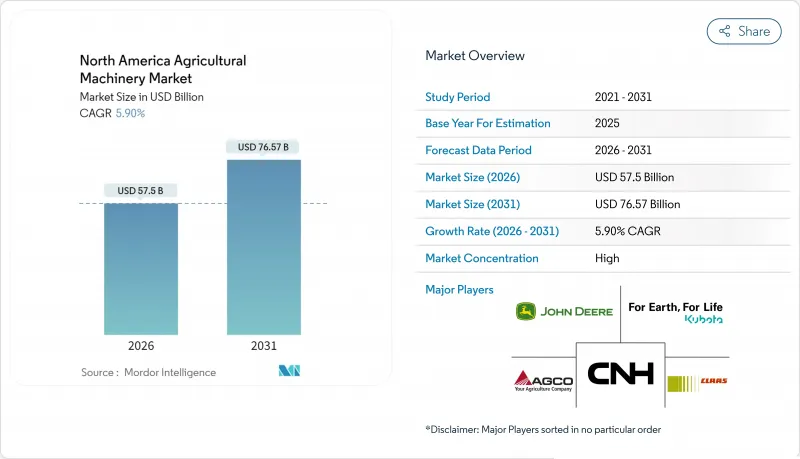
북미의 농업기계 시장은 2025년 543억 달러에서 2026년 575억 달러로 성장해 2026년에서 2031년까지 연평균 복합 성장률(CAGR) 5.9%를 나타낼 전망입니다. 2031년까지 765억 7,000만 달러에 달할 것으로 예측됩니다.
이 확대는 2024년 자본 지출을 억제한 고금리 및 상품 가격 변동에도 불구하고 지속적인 기계화 수요를 반영합니다. 구조적 노동력 부족, 장비 갱신을 촉진하는 연방 보조금 프로그램, 정밀 농업의 급속한 보급이 계속 설비 수주를 지원하고 있습니다. 2025년 가전 쇼(CES)에서 선보인 자율기능은 농가가 마력과 동등하게 소프트웨어 호환성을 중시하게 되었기 때문에 조기 구매 사이클을 가속화하고 있습니다. 동시에, 특히 물 스트레스의 심각한 멕시코에서 관개 시설의 현대화는 전문 장비 제조업체의 잠재 고객 기반을 확대하고 있습니다. 주요 OEM 제조업체가 임베디드 금융 서비스, 소프트웨어 구독, 딜러 지원을 패키징하고 고객 유지 및 수익 안정화를 도모하면서 경쟁 환경은 여전히 치열한 상황이 계속되고 있습니다.
북미의 농업기계 시장 동향과 인사이트
견조한 농업소득 전망 및 보조금 프로그램
연방정부의 감가상각우대조치와 직접조성금이 자본예산의 회복력을 지원하고 있습니다. 미국 농무부(USDA)의 '기후 스마트 상품 프로그램'만으로도 2024년 이후 배출량 감축과 효율 향상을 도모하는 설비용으로 30억 달러 이상이 배분되고 있습니다. 섹션 179 규칙은 과세 연도당 최대 116만 달러의 공제를 가능하게 하고 차입 비용 상승을 상쇄합니다. 중규모 생산자는 보조금과 세금 우대를 모두 얻기 때문에 구매를 앞당기는 움직임을 보이고 있습니다. 딜러의 피드백에 따르면 보조금 수급 요건인 지속가능성 지표를 기록하는 텔레매틱스 기능을 탑재한 중마력 트랙터에 대한 수요가 높아지고 있습니다. 그 결과, 북미의 농업기계 시장은 보조금을 수반하는 수주라는 예측 가능한 기반을 누리고 수요의 주기적인 침체를 완화하고 있습니다.
노동력 부족과 임금 상승 진행
농촌의 노동력 참가율은 하락을 계속하고 있어, 기존 수작업으로 행해지고 있던 작업의 기계화를 농장에 다가가고 있습니다. 2024년 멕시코에서 수확량이 떨어지면 노동력 부족이 생산을 저해할 수 있는 가능성이 돋보였습니다. 자율 분무기와 로봇 수확 보조 장치는 현장 작업자를 줄이고 일반 물가 상승률을 초과하는 임금 상승을 억제합니다. OEM의 입증은 통합 머신 비전이 농약 사용량을 줄이고 인건비를 상쇄하는 것으로 입증되었습니다. 곡물 엘리베이터 사업자도, AI 탑재 센서에 의한 자동화를 진행해, 야간에도 스탭의 감시 없이 시설을 가동시키고 있습니다. 따라서 지속적인 노동력 부족은 지역 전반에 걸친 첨단 장비에 대한 장기적인 수요를 지속적으로 지원하고 있습니다.
고급 기계의 고가의 초기 비용 및 유지비
2024년에는 고출력 트랙터의 가격이 40만 달러를 넘어 정밀화 개조에는 1대당 5만-10만 달러가 추가로 필요합니다. 현대적인 엔진과 소프트웨어에는 전문 기술자가 필수적이지만, 그 인력은 여전히 부족하여 총 소유 비용이 더욱 상승합니다. 대리점의 약 87%가 자격 서비스 직원 확보에 어려움을 겪고 있습니다. 연장 보증 및 서비스 계약은 불확실성을 줄일 수 있지만, 구입 가격에 1만 5000-2만 5,000달러가 추가됩니다. 그 때문에 많은 생산자는 10년 이상의 오래된 기계를 개수해, 기술 업그레이드를 선송하는 것과 동시에, 중요한 농 작업 기간중의 연료 소비량을 증가시키고 있습니다. 그 결과 중소규모 농장은 시즌 종반의 할인이 이루어질 때까지 구매를 늦추는 경우가 많아 딜러의 이익률을 압박하고 갱신 사이클을 연장하고 있습니다.
부문 분석
트랙터는 2025년 시점에서 북미 농업기계 시장의 47.30%의 점유율을 유지해 작물 재배 전반에 있어서 핵심적인 역할을 뒷받침했습니다. 이 부문은 5만 에이커로 시험된 자율운전 개조의 혜택을 받고 있으며, 가동시간의 유효성이 입증되어 무인경작에 대한 회의적인 견해가 희미해지고 있습니다. 그러나 물 부족 완화 프로젝트에 뒷받침된 관개 기계는 2031년까지 연평균 복합 성장률(CAGR) 13.4%로 성장을 지속하고, 다른 모든 장비 등급을 뛰어넘는 성장이 예상됩니다. 멕시코의 중앙 피벗식 관개 설비로의 전환이 가속화되는 가운데, 북미의 관개 장비 시장 규모는 해당 기간 동안 현저한 성장을 보일 것으로 예측됩니다.
반면에, 쟁기와 컬티베이터와 같은 2차 범주는 정밀농업기술이 가변율 시비에 대한 수요를 변화시키기 때문에 완만한 성장에 머물고 있습니다. 수확 분야에서는 곡물 품질 센서와 수율 매핑의 통합으로 기존 6년 주기였던 콤바인의 갱신이 앞당겨지고 있습니다. 목초·사료용 기계는 미국 중서부 북부 및 캐나다 대평원지대에서 낙농·축산 확대의 혜택을 받고 있습니다. 한편, 「기타」카테고리에는 제초·스폿 살포·토양 모니터링을 실시하는 자율형 로봇이 새롭게 분류되었습니다. 쿠보타의 KATR 로봇은 기존 장비의 경계를 모호하게 만드는 다기능 설계의 좋은 예입니다.
기타 혜택 :
- 엑셀 형식 시장 예측(ME) 시트
- 애널리스트 지원(3개월간)
자주 묻는 질문
목차
제1장 서론
- 조사 전제조건 및 시장 정의
- 조사 범위
제2장 조사 방법
제3장 주요 요약
제4장 시장 상황
- 시장 개요
- 시장 성장 촉진요인
- 견조한 농업소득 전망과 보조금 프로그램
- 노동력 부족의 심각화와 임금 상승 압력
- 정밀 농업의 도입이 가속해, 설비 갱신이 진행
- OEM 임베디드 금융에 의한 구매력 향상
- 구독형 기계 이용 모델
- 미국 농무부(USDA)의 기후 스마트 보조금에 의한 저배출 설비 추진
- 시장 성장 억제요인
- 첨단기계의 고액인 초기비용 및 유지비
- 변동하는 상품 가격이 설비 투자 사이클을 억제
- 농장 레벨에서의 금리 주도의 신용 계약
- 전기 트랙터용 배터리 등급 반도체 공급 제약
- 규제 상황
- 기술의 전망
- Porter's Five Forces
- 공급기업의 협상력
- 구매자의 협상력
- 신규 참가업체의 위협
- 대체품의 위협
- 경쟁 기업 간 경쟁 관계
제5장 시장 규모와 성장 예측
- 유형별
- 트랙터
- 40마력 미만
- 40-100마력
- 100마력 초과
- 4WD 트랙터
- 농기구
- 쟁기
- 해로우
- 경운기 및 틸러
- 기타 장비
- 관개 기계
- 스프링클러
- 점적 관개
- 기타 관개
- 수확 기계
- 콤바인
- 사료 수확 장비
- 기타 수확 장비
- 건초 및 사료 기계
- 낫
- 베일러
- 기타 건초 및 사료 장비
- 기타 유형
- 트랙터
- 지역별
- 미국
- 캐나다
- 멕시코
- 기타 북미
제6장 경쟁 구도
- 시장 집중도
- 전략적 동향
- 시장 점유율 분석
- 기업 프로파일
- Deere & Company
- CNH Industrial NV
- AGCO Corporation
- Kubota Corporation
- CLAAS KGaA mbH
- Mahindra & Mahindra Limited
- Netafim USA Inc.
- Lindsay Corporation
- Trimble Inc.
- Horsch Maschinen GmbH
- KUHN SAS
- Bernard Krone Holding SE & Co. KG
- The Toro Company
- Vermeer Corporation
- JC Bamford Excavators Ltd.
제7장 시장 기회와 향후 전망
KTH 26.01.20The North America agricultural machinery market is expected to grow from USD 54.3 billion in 2025 to USD 57.5 billion in 2026 and is forecast to reach USD 76.57 billion by 2031 at 5.9% CAGR over 2026-2031.
The expansion reflects persistent mechanization demand despite elevated interest rates and commodity price swings that limited capital spending in 2024. Structural labor shortages, federal subsidy programs that encourage fleet renewal, and rapid precision-ag adoption continue to underpin equipment orders. Autonomous capabilities showcased at Consumer Electronics Show (CES) 2025 are accelerating early replacement cycles because farms now weigh software compatibility on par with horsepower. Simultaneously, irrigation modernization, especially in water-stressed Mexico, widens the addressable base for specialized equipment makers. Competitive dynamics remain intense as leading OEMs bundle embedded finance, software subscriptions, and dealer support to retain customers and stabilize revenue.
North America Agricultural Machinery Market Trends and Insights
Robust Farm-Income Outlook and Subsidy Programs
Federal depreciation allowances and direct grants keep capital budgets resilient. The USDA Climate-Smart Commodities program alone has allocated more than USD 3 billion since 2024 for equipment that lowers emissions and improves efficiency. Section 179 rules allow deductions up to USD 1.16 million per tax year, offsetting higher borrowing costs. Mid-sized growers respond by front-loading purchases to capture both grant and tax benefits. Dealer feedback indicates stronger demand for mid-horsepower tractors equipped with telematics that document sustainability metrics required for grant compliance. As a result, the North America agricultural machinery market enjoys a predictable baseline of subsidized orders that cushions cyclical demand dips.
Rising Labor Scarcity and Wage Inflation
Rural workforce participation keeps falling, which pushes farms to mechanize tasks once handled manually. Mexico's crop yield setbacks in 2024 underscore how labor shortages can throttle production. Autonomous sprayers and robotic harvest aids reduce field crews and curb escalating wages that now outstrip general inflation. OEM demonstrations prove that integrated machine-vision lowers chemical use, which further offsets labor costs. Grain-elevator operators also automate with AI-enabled sensors that let facilities run at night without staff oversight. Persistent worker scarcity, therefore, sustains long-term demand for advanced equipment across the region.
High Upfront and Maintenance Costs of Advanced Machinery
A high-horsepower tractor exceeded USD 400,000 in 2024, while precision retrofits add USD 50,000-100,000 per unit. Total ownership costs climb further because modern engines and software demand specialized technicians that remain scarce. Nearly 87% of dealers struggle to hire qualified service staff. Extended warranties and service contracts ease uncertainty, yet they add another USD 15,000-25,000 to the purchase price. Many producers, therefore, refurbish decade-old machines, which postpones technology upgrades and raises fuel consumption during critical field windows. As a result, small and mid-sized farms often delay purchases until late-season discounting emerges, compressing dealer margins and extending replacement cycles.
Other drivers and restraints analyzed in the detailed report include:
- Precision-Agriculture Adoption Accelerating Equipment Replacement
- USDA Climate-Smart Grants Driving Low-Emission Equipment
- Volatile Commodity Prices Curbing CAPEX Cycles
For complete list of drivers and restraints, kindly check the Table Of Contents.
Segment Analysis
Tractors maintained a 47.30% share of the North America agricultural machinery market in 2025, underscoring their central role across crop operations. The segment benefits from autonomous retrofits tested on 50,000 acres, validating real-world uptime and lowering skepticism about driverless tillage. Yet irrigation machinery, supported by water-scarcity mitigation projects, is projected to register a 13.4% CAGR through 2031, outpacing every other equipment class. The North America agricultural machinery market size for irrigation equipment is forecast to show a significant growth during the period as center-pivot conversions accelerate in Mexico.
Secondary categories such as plows and cultivators grow modestly because precision tech shifts demand toward variable-rate applications. In harvesting, integrated grain-quality sensors and yield mapping push farms to upgrade combines earlier than the traditional 6-year cycle. Haying and forage machinery benefits from dairy and beef expansion in the Upper Midwest and Canadian Prairies, while the other types bucket now covers autonomous robots that perform weeding, spot spraying, and soil monitoring. Kubota's KATR robot exemplifies a multifunctional design that blurs traditional equipment lines.
The North America Agricultural Machinery Market Report is Segmented by Type (Tractor, Equipment, Irrigation Machinery, Harvesting Machinery, Haying and Forage Machinery, Other Types) and Geography (United States, Canada, Mexico, Rest of North America). The Market Forecasts are Provided in Terms of Value (USD).
List of Companies Covered in this Report:
- Deere & Company
- CNH Industrial N.V.
- AGCO Corporation
- Kubota Corporation
- CLAAS KGaA mbH
- Mahindra & Mahindra Limited
- Netafim USA Inc.
- Lindsay Corporation
- Trimble Inc.
- Horsch Maschinen GmbH
- KUHN SAS
- Bernard Krone Holding SE & Co. KG
- The Toro Company
- Vermeer Corporation
- J.C. Bamford Excavators Ltd.
Additional Benefits:
- The market estimate (ME) sheet in Excel format
- 3 months of analyst support
TABLE OF CONTENTS
1 Introduction
- 1.1 Study Assumptions and Market Definition
- 1.2 Scope of the Study
2 Research Methodology
3 Executive Summary
4 Market Landscape
- 4.1 Market Overview
- 4.2 Market Drivers
- 4.2.1 Robust farm-income outlook and subsidy programs
- 4.2.2 Rising labor scarcity and wage inflation
- 4.2.3 Precision-ag adoption accelerating equipment replacement
- 4.2.4 OEM embedded-finance boosting purchasing power
- 4.2.5 Subscription-based machinery access models (under-reported)
- 4.2.6 USDA Climate-Smart grants driving low-emission equipment (under-reported)
- 4.3 Market Restraints
- 4.3.1 High upfront and maintenance costs of advanced machinery
- 4.3.2 Volatile commodity prices curbing CAPEX cycles
- 4.3.3 Interest-rate-driven credit tightening at farm level
- 4.3.4 Battery-grade semiconductor supply constraints for e-tractors (under-reported)
- 4.4 Regulatory Landscape
- 4.5 Technological Outlook
- 4.6 Porter's Five Forces
- 4.6.1 Bargaining Power of Suppliers
- 4.6.2 Bargaining Power of Buyers
- 4.6.3 Threat of New Entrants
- 4.6.4 Threat of Substitute Products
- 4.6.5 Intensity of Competitive Rivalry
5 Market Size and Growth Forecasts (Value)
- 5.1 By Type
- 5.1.1 Tractor
- 5.1.1.1 Less Than 40 HP
- 5.1.1.2 40 to 100 HP
- 5.1.1.3 More than 100 HP
- 5.1.1.4 4WD Tractors
- 5.1.2 Equipment
- 5.1.2.1 Plows
- 5.1.2.2 Harrows
- 5.1.2.3 Cultivators and Tillers
- 5.1.2.4 Other Equipment
- 5.1.3 Irrigation Machinery
- 5.1.3.1 Sprinkler
- 5.1.3.2 Drip
- 5.1.3.3 Other Irrigation
- 5.1.4 Harvesting Machinery
- 5.1.4.1 Combine Harvesters
- 5.1.4.2 Forage Harvesters
- 5.1.4.3 Other Harvesting
- 5.1.5 Haying and Forage Machinery
- 5.1.5.1 Mowers
- 5.1.5.2 Balers
- 5.1.5.3 Other Haying and Forage
- 5.1.6 Other Types
- 5.1.1 Tractor
- 5.2 By Geography
- 5.2.1 United States
- 5.2.2 Canada
- 5.2.3 Mexico
- 5.2.4 Rest of North America
6 Competitive Landscape
- 6.1 Market Concentration
- 6.2 Strategic Moves
- 6.3 Market Share Analysis
- 6.4 Company Profiles (includes Global-level Overview, Market-level Overview, Core Segments, Financials as available, Strategic Information, Market Rank/Share for key companies, Products and Services, Recent Developments)
- 6.4.1 Deere & Company
- 6.4.2 CNH Industrial N.V.
- 6.4.3 AGCO Corporation
- 6.4.4 Kubota Corporation
- 6.4.5 CLAAS KGaA mbH
- 6.4.6 Mahindra & Mahindra Limited
- 6.4.7 Netafim USA Inc.
- 6.4.8 Lindsay Corporation
- 6.4.9 Trimble Inc.
- 6.4.10 Horsch Maschinen GmbH
- 6.4.11 KUHN SAS
- 6.4.12 Bernard Krone Holding SE & Co. KG
- 6.4.13 The Toro Company
- 6.4.14 Vermeer Corporation
- 6.4.15 J.C. Bamford Excavators Ltd.