
|
시장보고서
상품코드
1910896
라틴아메리카의 윤활유 시장 : 점유율 분석, 업계 동향 및 통계, 성장 예측(2026-2031년)Latin America Lubricants - Market Share Analysis, Industry Trends & Statistics, Growth Forecasts (2026 - 2031) |
||||||
 Mordor Intelligence
라틴아메리카의 윤활유 시장은 2025년 36억 4,000만 리터에서 2026년에는 37억 6,000만 리터로 성장해 2026년부터 2031년에 걸쳐 CAGR 3.28%를 나타낼 전망입니다. 2031년까지 44억 2,000만 리터에 달할 것으로 예상됩니다.
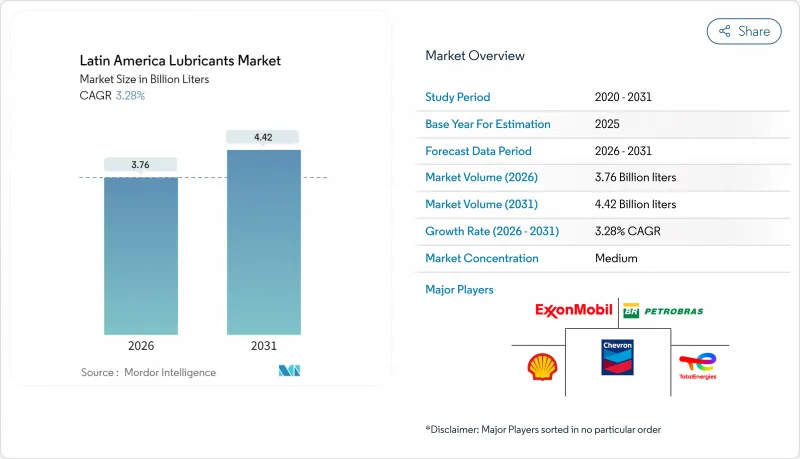
이 확대는 산업의 회복, 자동차 보유 대수 증가, 광업·전력·니어 쇼어링 주도의 제조업에 있어서 자본 지출의 재개에 지지되고 있습니다. 페트로블라스의 1,110억 달러 규모의 투자 계획(그룹 II 기유 단위 포함)은 지역 원료 공급을 보장하고 수입 의존도를 낮춥니다. 멕시코의 니어 쇼어링 파도는 2029년까지 460억 달러의 투자를 불러올 것으로 예상되며 급성장하는 제조 클러스터에서 윤활유 수요를 가속화합니다. 한편, 대륙이 주요 해양 시추 거점으로 대두하고, 2024년에는 세계 36기의 고 영향력 유정 중 10기를 계획했기 때문에 특수한 시추액의 사용이 촉진되었습니다. 마지막으로, 화석연료는 총 에너지의 3분의 2를 공급하는 반면, 재생가능 에너지가 전력의 60%를 공급하는 이중 에너지 구조로 기존 윤활유와 고급 합성 윤활유 모두에 대한 수요가 겹쳐집니다.
라틴아메리카의 윤활유 시장 동향과 전망
자동차 보유 대수 확대와 노후화 차량 증가
브라질의 자동차 생산 대수는 2024년에 9.7% 증가해, 유행 전의 수준으로 회복했습니다. 이것은 윤활유 수요의 견조한 견인을 나타내고 있으며, 낡은 차량은 오일 교환 간격이 짧고 엔진 오일 소비량이 15-20% 많기 때문입니다. 멕시코의 수출 주도형 제조업 기반에서는 상용 트럭이 증가하여 유압 작동유 및 기어 오일에 대한 수요를 높이고 있습니다. 대륙 전체에서는 10년 이상의 차량이 총 차량 수의 절반 이상을 차지하고 있어 안정적인 서비스 충전 수요가 확보되고 있습니다. 따라서 전동화가 진행되고 있음에도 불구하고 라틴아메리카의 윤활유 시장은 15-20년에 걸친 갱신 사이클에 의해 지속적인 수요를 누리고 있습니다. 블렌더는 비용에 민감한 부문의 노후화된 엔진을 대상으로 한 중급 합성유의 조제를 증가시키고 있으며, 판매량을 유지하면서 성능의 업셀을 도모하고 있습니다.
제조과 산업설비 투자 회복
멕시코에서는 니어 쇼어링을 배경으로 한 산업 생산의 회복에 의해 공실률이 과거 최저 수준으로 저하되어 신설 플랜트용 금속 가공유 수요가 확대되고 있습니다. 브라질은 2025년에 액체 연료 수요가 1.4% 증가했으며, 공정 장비용 유압유를 필요로 하는 광범위한 산업 회복이 확인되었습니다. 라틴아메리카의 윤활유 시장은 석유화학, 시멘트, 철강의 각 프로젝트 계획으로부터 혜택을 누리고 있습니다. 각 프로젝트는 고점도 지수 기유에 의한 생산성 향상을 추구하고 있습니다. 브라질과 멕시코의 현지 조합의 우대 조치는 국내 첨가제 소비를 더욱 자극하고 리드 타임을 단축하고 세계 공급 충격을 완화합니다. 산업 사용자는 윤활유 총 지출에서 차지하는 합성유의 비율을 높이는 상태 모니터링 프로그램을 도입하고 있습니다.
EV 보급이 엔진 오일 수요를 억제
라틴아메리카 27개국은 파리 협정에 근거해 수송의 전동화 목표를 명문화해, 보고타나 멕시코 시티에서는 도시 버스 차량의 전환이 진행되고 있습니다. 전기 구동 시스템은 크랭크 케이스 오일을 사용하지 않기 때문에 도시의 정비 공장 수요량이 감소합니다. 그러나 새로운 틈새 시장인 배터리 냉각액과 감속기용 유체에서는 열을 방산하면서 전기 전도성을 최소화하는 합성 에스테르가 도입되어 수요 감소를 일부 상쇄하고 있습니다. 충전 인프라의 부족으로 대도시권 이외의 보급은 여전히 늦어지고 있으며, 금세기의 대부분에서 내연기관이 주류를 유지할 전망입니다. 이 때문에 라틴아메리카의 윤활유 시장에서는 EV 대응 유체로의 전환이 급격하지 않고 단계적이 될 것으로 예측됩니다.
부문 분석
2025년, 엔진 오일은 라틴아메리카의 윤활유 시장 점유율의 57.05%를 차지했습니다. 이는 내연기관의 지속적인 우위성과 평균사용연수가 12년을 넘는 차량군에 뒷받침된 것입니다. 판매량은 브라질 생산 증가와 멕시코의 트럭 운송 확대와 밀접한 관련이 있습니다. 한편, 멀티그레이드 제품은 저온 시동 보호 성능의 향상으로 모노그레이드 제품으로부터 점유율을 빼앗고 있습니다. 변속기 및 기어유는 상용차의 보급에 연동하고 유압 작동유는 칠레와 페루의 가혹한 고도 환경에서 작동하는 광업 부문에 공급됩니다. 금속가공유는 2019년 대비 멕시코 공업용지가 두배로 늘어나는 니어쇼어링 투자의 추풍을 받고 있습니다.
다른 제품 유형은 가장 빠르게 성장하는 카테고리이며 재생에너지 프로젝트와 정밀 제조가 틈새 배합을 요구하기 때문에 2031년까지 연평균 복합 성장률(CAGR) 3.74%를 나타낼 전망입니다. 풍력 터빈용 기어박스는 1만 시간 이상의 서비스 수명을 제공하는 PAO-에스테르 블렌드에 따라 달라지며, 태양광 추적기용 액추에이터에는 저온 그리스가 필요합니다. 비용과 성능면에서 리튬 프리 폴리우레아 및 칼슘 설폰산 복합 그리스가 주목을 받고 있습니다. 전기자동차용 냉각제의 성장은 초기 단계이면서 고유전율 유체에 대한 장래 수요의 종이 되고 있습니다. 따라서 설비가 복잡해짐에 따라 라틴아메리카 윤활유 시장의 특수 등급 규모는 전체 소비량을 초과하는 속도로 확대되고 있습니다.
라틴아메리카의 윤활유 보고서는 제품 유형별(엔진 오일, 변속기 기어 오일, 유압 작동유 등), 최종 사용자 산업별(자동차, 발전, 중기, 야금 및 금속 가공, 기타 최종 사용자 산업), 지역별(브라질, 멕시코, 아르헨티나, 콜롬비아, 칠레, 페루, 기타 라틴아메리카)로 분류되어 시장 예측은 수량(리터) 단위로 제공됩니다.
기타 혜택 :
- 엑셀 형식 시장 예측(ME) 시트
- 애널리스트 서포트(3개월간)
자주 묻는 질문
목차
제1장 서론
- 조사 전제조건과 시장 정의
- 조사 범위
제2장 조사 방법
제3장 주요 요약
제4장 시장 상황
- 시장 개요
- 시장 성장 촉진요인
- 차량 보유 대수의 확대와 노후화 차량 증가
- 제조 및 산업설비 투자 회복
- 광업·에너지용 고성능 합성유
- 전자상거래 라스트마일 배송 차량의 급증
- 현지 블렌드 플랜트에 대한 우대 조치
- 시장 성장 억제요인
- EV 보급이 엔진 오일 수요를 억제
- 프리미엄 윤활유의 교환 간격 연장
- 첨가제 패키지 공급의 병목
- 밸류체인 분석
- Porter's Five Forces
- 공급기업의 협상력
- 구매자의 협상력
- 신규 참가업체의 위협
- 대체품의 위협
- 경쟁도
제5장 시장 규모와 성장 예측
- 제품 유형별
- 엔진 오일
- 변속기 및 기어 오일
- 유압유
- 금속 가공 유체
- 그리스
- 기타 제품 유형
- 최종 사용자 업계별
- 자동차
- 발전
- 중장비
- 야금 및 금속 가공
- 기타 최종 사용자 산업
- 지역별
- 브라질
- 멕시코
- 아르헨티나
- 콜롬비아
- 칠레
- 페루
- 기타 라틴아메리카
제6장 경쟁 구도
- 시장 집중도
- 전략적 동향
- 시장 점유율(%)/순위 분석
- 기업 프로파일
- BP plc
- Chevron Corporation
- Exxon Mobil Corporation
- GULF OIL INTERNATIONAL LIMITED
- Motul
- Petrobras
- Repsol
- Roshfrans
- Shell plc
- TotalEnergies
- Valvoline Inc.
제7장 시장 기회와 향후 전망
KTH 26.01.26The Latin America Lubricants Market is expected to grow from 3.64 Billion liters in 2025 to 3.76 Billion liters in 2026 and is forecast to reach 4.42 Billion liters by 2031 at 3.28% CAGR over 2026-2031.
Expansion is anchored in industrial recovery, a rising vehicle parc, and renewed capital spending across mining, power, and nearshoring-led manufacturing. Petrobras' USD 111 billion investment plan, which includes a Group II base-oil unit, secures regional feedstock and lowers import reliance. Mexico's nearshoring wave, expected to draw USD 46 billion through 2029, accelerates lubricant demand in fast-growing manufacturing clusters. Meanwhile, the continent's emergence as a key offshore drilling arena, with 10 of 36 global high-impact wells slated for 2024, stimulates specialized drilling-fluid use. Lastly, a dual energy matrix, where fossil fuels supply two-thirds of total energy yet renewables deliver 60% of electricity, creates overlapping needs for both conventional and advanced synthetic lubricants.
Latin America Lubricants Market Trends and Insights
Vehicle-parc Expansion and Ageing Fleet
Brazilian auto production grew 9.7% in 2024, returning to pre-pandemic output and signaling robust lubricant pull-through as older vehicles require shorter drain intervals and consume 15-20% more engine oil. Mexico's export-led manufacturing base has added commercial trucks that heighten demand for hydraulic fluids and gear oils. Across the continent, vehicles older than 10 years already represent over half of the total fleet, locking in a steady service-fill requirement. The Latin America lubricants market therefore enjoys durable demand even as electrification gains momentum because turnover cycles span 15-20 years. Blenders increasingly formulate mid-tier synthetics aimed at aging engines in cost-sensitive segments, preserving volume while upselling performance.
Manufacturing and Industrial Capex Rebound
A nearshoring-fueled revival in Mexican industrial output is pushing vacancy rates to historic lows and inflating demand for metalworking fluids in newly commissioned plants. Brazil's 1.4% liquid-fuel demand upturn in 2025 confirms a broader industrial rebound that requires hydraulic oils for process equipment. The Latin America lubricants market benefits from project pipelines in petrochemicals, cement, and steel, each seeking productivity gains through high-viscosity-index base stocks. Local blending incentives in Brazil and Mexico further stimulate domestic additive consumption, shortening lead times and buffering global supply shocks. Industrial users, in turn, embrace condition-monitoring programs that raise the share of synthetics in total lubricant spend.
EV Penetration Curbing Engine-oil Demand
Twenty-seven Latin American nations have enshrined transport electrification targets under the Paris Agreement, triggering city-bus fleet conversions in Bogota and Mexico City. Electric drivetrains do not use crankcase oils, shaving volume off urban service bays. Yet the new battery-coolant and reduction-gear fluid niches partly compensate by introducing synthetic esters that must dissipate heat while conducting minimal electricity. Uptake outside large cities remains slow due to limited charging infrastructure, keeping internal-combustion engines dominant through most of this decade. Consequently, the Latin America lubricants market expects a gradual, not abrupt, transition toward EV-ready fluids.
Other drivers and restraints analyzed in the detailed report include:
- High-performance Synthetics for Mining and Energy
- Local Blending-plant Incentives
- Longer Drain-intervals for Premium Lubricants
For complete list of drivers and restraints, kindly check the Table Of Contents.
Segment Analysis
Engine oils accounted for 57.05% of the Latin America lubricants market share in 2025, propelled by sustained ICE dominance and a fleet whose average age tops 12 years. Volumes correlate closely with Brazil's production uptick and Mexico's trucking expansion, while multigrade formulations capture share from monogrades due to improved cold-start protection. Transmission and gear oils piggyback on commercial-vehicle proliferation, whereas hydraulic fluids supply a mining sector operating across harsh altitudes in Chile and Peru. Metalworking fluids enjoy a tailwind from nearshoring investments that double Mexican industrial space compared with 2019 levels.
Other Product Types represent the fastest-growing category, clocking a 3.74% CAGR to 2031 as renewable-energy projects and precision manufacturing seek niche formulations. Wind-turbine gearboxes rely on PAO-ester blends offering more than 10,000-hour service life, while solar-tracker actuators need low-temperature greases. Lithium-free polyurea and calcium-sulfonate complex greases gain traction on cost and performance grounds. Electric-vehicle coolant growth, though nascent, seeds future demand for high-dielectric fluids. The Latin America lubricants market size for specialty grades, therefore, advances faster than overall consumption as equipment complexity rises.
The Latin America Lubricants Report is Segmented by Product Type (Engine Oils, Transmission and Gear Oils, Hydraulic Fluids, and More), End-User Industry (Automotive, Power Generation, Heavy Equipment, Metallurgy and Metalworking, and Other End-User Industries), and Geography (Brazil, Mexico, Argentina, Colombia, Chile, Peru, and Rest of Latin America). The Market Forecasts are Provided in Terms of Volume (Liters).
List of Companies Covered in this Report:
- BP p.l.c.
- Chevron Corporation
- Exxon Mobil Corporation
- GULF OIL INTERNATIONAL LIMITED
- Motul
- Petrobras
- Repsol
- Roshfrans
- Shell plc
- TotalEnergies
- Valvoline Inc.
Additional Benefits:
- The market estimate (ME) sheet in Excel format
- 3 months of analyst support
TABLE OF CONTENTS
1 Introduction
- 1.1 Study Assumptions and Market Definition
- 1.2 Scope of the Study
2 Research Methodology
3 Executive Summary
4 Market Landscape
- 4.1 Market Overview
- 4.2 Market Drivers
- 4.2.1 Vehicle-Parc Expansion and Ageing Fleet
- 4.2.2 Manufacturing and Industrial Capex Rebound
- 4.2.3 High-Performance Synthetics for Mining and Energy
- 4.2.4 E-Commerce Last-Mile Fleet Boom
- 4.2.5 Local Blending-Plant Incentives
- 4.3 Market Restraints
- 4.3.1 EV Penetration Curbing Engine-Oil Demand
- 4.3.2 Longer Drain-Intervals for Premium Lubes
- 4.3.3 Additive-Package Supply Bottlenecks
- 4.4 Value Chain Analysis
- 4.5 Porter's Five Forces
- 4.5.1 Bargaining Power of Suppliers
- 4.5.2 Bargaining Power of Buyers
- 4.5.3 Threat of New Entrants
- 4.5.4 Threat of Substitutes
- 4.5.5 Degree of Competition
5 Market Size and Growth Forecasts (Volume)
- 5.1 By Product Type
- 5.1.1 Engine Oils
- 5.1.2 Transmission and Gear Oils
- 5.1.3 Hydraulic Fluids
- 5.1.4 Metalworking Fluids
- 5.1.5 Greases
- 5.1.6 Other Product Types
- 5.2 By End-User Industry
- 5.2.1 Automotive
- 5.2.2 Power Generation
- 5.2.3 Heavy Equipment
- 5.2.4 Metallurgy and Metalworking
- 5.2.5 Other End-user Industries
- 5.3 By Geography
- 5.3.1 Brazil
- 5.3.2 Mexico
- 5.3.3 Argentina
- 5.3.4 Colombia
- 5.3.5 Chile
- 5.3.6 Peru
- 5.3.7 Rest of Latin America
6 Competitive Landscape
- 6.1 Market Concentration
- 6.2 Strategic Moves
- 6.3 Market Share (%)/Ranking Analysis
- 6.4 Company Profiles (includes Global level Overview, Market level overview, Core Segments, Financials as available, Strategic Information, Market Rank/Share for key companies, Products and Services, and Recent Developments)
- 6.4.1 BP p.l.c.
- 6.4.2 Chevron Corporation
- 6.4.3 Exxon Mobil Corporation
- 6.4.4 GULF OIL INTERNATIONAL LIMITED
- 6.4.5 Motul
- 6.4.6 Petrobras
- 6.4.7 Repsol
- 6.4.8 Roshfrans
- 6.4.9 Shell plc
- 6.4.10 TotalEnergies
- 6.4.11 Valvoline Inc.
7 Market Opportunities and Future Outlook
- 7.1 White-space and Unmet-need Assessment