

|
시장보고서
상품코드
2099234
중국의 컨테이너 운송 시장 : 점유율 분석, 업계 동향 및 통계, 성장 예측(2026-2031년)China Container Shipping - Market Share Analysis, Industry Trends & Statistics, Growth Forecasts (2026 - 2031) |
||||||
 Mordor Intelligence
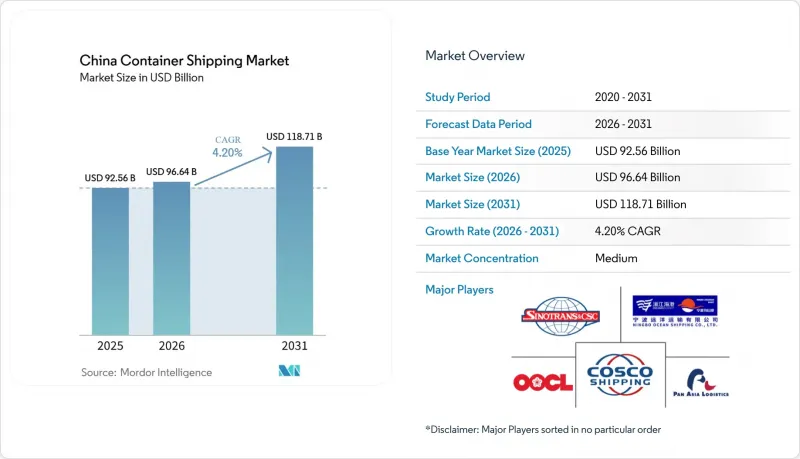
Mordor Intelligence에 의하면, 중국 컨테이너 운송 시장 규모는 2025년 925억 6,000만 달러에서 2026년에는 966억 4,000만 달러로 확대되어 2031년까지 1,187억 1,000만 달러에 이를 것으로 예측되며, 2026년부터 2031년까지 CAGR 4.20%로 성장할 전망입니다.
중국의 컨테이너 운송 시장은 주요 연안 클러스터로의 수출을 위한 제조업의 지속적인 집적에 힘입어, 이를 통해 국내 최대의 관문 항구를 통한 화물 흐름이 유지되고, 동일한 무역 시스템 내에서의 외항 및 피더 항로의 역할이 강화되고 있습니다. 본 보고서는 서비스 유형별(외항, 내항, 피더, 연안), 컨테이너 유형별(드라이 컨테이너, 리퍼 컨테이너), 컨테이너 크기별(20피트, 40피트, 기타 특수 크기), 화물 유형별(FCL, LCL), 최종 사용자(FMCG·소매, 제조·자동차, 기타), 지역(북부, 중부, 서부, 동부, 남부, 기타)별로 분류되어 있습니다. 시장 전망은 금액(달러) 기준으로 제시되어 있습니다.
중국 컨테이너 운송 시장 동향과 인사이트
연안 허브로의 수출 생산 거점 재배치가 가속화
중국 컨테이너 운송 시장에서는 연안 생산 벨트, 특히 양쯔강 삼각주 및 주강 삼각주 주변으로의 화물 집중이 더욱 심화되고 있습니다. 이러한 변화는 단순히 운송량을 늘리는 것뿐만 아니라, 해운사가 선박을 배치하는 방식, 터미널 기항을 관리하는 방식, 그리고 소규모 연안 항구에서 주요 게이트웨이 시스템으로 이어지는 피더 항로를 계획하는 방식에도 변화를 가져오기 때문에 중요한 의미를 지닙니다. 2026년 1월과 2월 중국의 항만 화물 처리량은 28억 7,000만 톤에 달했으며, 대외 무역 컨테이너 처리량은 13.7% 증가했습니다. 이는 주요 연안 관문 항만들이 여전히 자사 네트워크로 더 많은 수출 화물을 유치하고 있음을 보여줍니다. 2026년 3월 연안 항만의 컨테이너 처리량은 2,720만 TEU에 달하여 이러한 추세를 뒷받침하는 동시에, 주요 항만을 통과하는 간선 운송량의 집중도가 더욱 높아지고 있음을 보여줍니다. 실무적으로는 대형 해운사가 이러한 허브에서 규모의 경제 혜택을 누리는 한편, 중소 해운사는 동일한 연안 시스템 주변의 피더 운송이나 2차 노선에서 더 많은 활약의 기회를 찾고 있습니다.
전자상거래의 성장이 견인하는 단거리 국내 운송
중국의 컨테이너 운송 시장은 크로스보더 전자상거래의 보급에 힘입어 성장하고 있습니다. 이에 따라 화물의 특성이 대규모 혼합 화물에서 더 빈번하고 소량인 화물로 변화하고 있습니다. 중국 상무부에 따르면, 2025년 크로스보더 전자상거래의 수출입액은 2조 7,500억 위안(4,069억 달러)에 달하고, 2020년 대비 69.7% 증가했습니다. 이러한 성장에 따라 LCL 화물, 항만 인근에서의 혼적, 그리고 내륙 수출업체와 관문 항구를 더 빈번하게 연결하는 단거리 연안 항로의 역할이 확대되고 있습니다. 또한, 많은 수출업체가 미국으로의 수출뿐만 아니라 제3국 수요에도 대응하고 있기 때문에 제한된 기존의 장거리 항로에 대한 의존도가 낮아지고 있습니다. 그 결과, 중국의 컨테이너 운송 시장은 유연한 연안·피더 네트워크에 적합한 화물 패턴을 가진 중소규모 수출업체로부터 더 많은 화물을 유치하고 있습니다.
지역 서비스 네트워크공급 과잉 압력
중국의 컨테이너 운송 시장은 운임 규율 개선 속도를 앞지르는 선복 공급 증가로 인한 압박에 직면해 있습니다. 선사가 운항을 중단하거나 루프 간에 운송 능력을 재배치하더라도, 추가된 톤수는 여전히 중국발 주요 항로 전체의 운임에 큰 부담으로 작용하고 있습니다. 이는 이익률을 지키기 위해 운임 회복에 의존하고 있는 선사들에게 어려운 상황을 초래하고 있습니다. 또한, 선사들은 운임을 더 약화시키지 않으면서 선박의 적재율을 유지해야 하므로, 얼라이언스 구성 및 서비스 합리화가 더욱 중요해지고 있습니다. 그 결과, 공급 과잉은 여전히 중국 컨테이너 운송 시장의 수익성 질을 저해하는 가장 명백한 요인 중 하나입니다.
부문 분석
2025년 시점에서 중국 컨테이너 운송 시장 점유율 67.33%를 원양·외항 운송이 차지하고 있는 반면, 피더 및 연안 운송 서비스는 2031년까지 연평균 성장률(CAGR) 5.18%를 나타낼 것으로 예측됩니다. 중국은 여전히 장거리 항로를 통해 운송되는 제조품의 주요 수출 거점이기 때문에 중국의 컨테이너 운송 시장은 여전히 원양 항로에 크게 의존하고 있습니다. 이러한 입지는 게이트웨이 항구와 아시아-유럽 간 및 태평양 횡단 서비스를 뒷받침하는 세계 얼라이언스의 중요한 역할을 강화시키고 있습니다. 동시에 피더 및 연안 서비스의 성장 속도가 더 빠른 것은 동일한 네트워크 내에서 지역 간 물류가 점점 더 중요해지고 있음을 보여줍니다.
연안 허브, 내륙 연결 거점 및 인근 지역 목적지 간의 단거리 운송 수요가 증가함에 따라 중국의 피더 및 연안 운송 시장은 확대되고 있습니다. '일대일로' 관련 화물과 더 광범위한 아시아 역내 무역은 단일 장거리 운송이 아닌, 여러 기항지를 경유하는 노선을 통해 더 많은 화물을 운송함으로써 이러한 추세를 뒷받침하고 있습니다. 중소규모 해운사들은 이러한 호기를 포착하여 연안 순환 노선 및 2차 항구 기항을 중심으로 사업을 전개하고 있습니다. 원양 항로를 운항하는 해운사들은 여전히 최대의 수익 기반을 유지하고 있지만, 현재는 일정과 선박 운항을 유지하기 위해 통합된 피더 서비스 지원에 대한 의존도가 높아지고 있습니다. 이는 중국 컨테이너 운송 업계의 서비스 구성이 선종 간에 분절되지 않고, 더욱 긴밀하게 연계되고 있음을 의미합니다.
2025년 시점에서 드라이 컨테이너는 중국 컨테이너 운송 시장 규모의 75.63%를 차지하고 있는 반면, 리퍼 컨테이너는 2031년까지 연평균 성장률(CAGR) 7.80%를 나타낼 것으로 예측됩니다. 드라이 컨테이너의 기반이 큰 것은 제조품, 전자기기, 기계, 산업 화물 분야에서 중국의 광범위한 무역을 반영합니다. 이 핵심 부문은 여전히 중국의 컨테이너 수출량의 대부분을 차지하고 있어 중요한 위치를 유지하고 있습니다. 하지만 식품, 의약품 및 기타 신선 화물의 경우 더 엄격한 온도 관리와 전문적인 취급이 필요하기 때문에 냉장 컨테이너에 대한 수요는 더욱 빠르게 증가하고 있습니다.
이러한 변화는 단순히 설비 구성을 바꾸는 데 그치지 않습니다. 냉장용 플러그, 터미널의 운영 품질, 그리고 내륙 지역의 콜드체인 연계의 중요성도 높이고 있습니다. 이러한 화물을 확실하게 지원할 수 있는 해운사는 표준 건화물만을 취급하는 사업자보다 화물의 품질 향상과 고객과의 더욱 견고한 관계 구축을 실현할 가능성이 있습니다. 그 결과, 건화물 컨테이너가 여전히 가장 큰 점유율을 차지하고 있지만, 냉장 컨테이너의 성장은 중국 컨테이너 운송 시장에서 중요한 요소로 자리 잡고 있습니다. 향후 이를 통해 서비스 품질과 콜드체인 역량이 중국 컨테이너 운송 시장 전체에서 더욱 큰 경쟁의 초점이 될 것입니다.
기타 혜택:
- 엑셀 형식 시장 예측(ME) 시트
- 3개월간의 애널리스트 지원
자주 묻는 질문
목차
제1장 서론
제2장 조사 방법
제3장 주요 요약
제4장 시장 구도
제5장 시장 규모 및 성장 예측(금액, 2026-2031년)
제6장 경쟁 구도
제7장 시장 기회와 향후 전망
JHS 26.08.07According to Mordor Intelligence, the China container shipping market size is projected to grow from USD 92.56 billion in 2025 to USD 96.64 billion in 2026, and reach USD 118.71 billion by 2031, growing at a CAGR of 4.20% from 2026 to 2031.
The China container shipping market is being supported by the continued pull of export manufacturing toward major coastal clusters, which keeps cargo moving through the country's largest gateway ports and reinforces the role of deep-sea and feeder links within the same trade system. This report is Segmented by Service Type (Deep-Sea, Short-Sea, Feeder and Coastal), by Container Type (Dry and Reefer), by Container Size (20 Ft, 40 Ft, and Other Specialized Sizes), by Load Type (FCL and LCL), by End-User (FMCG and Retail, Manufacturing and Automotive, and More), and by Region (North, Central, West, East, South, and More). The Market Forecasts are Provided in Terms of Value (USD).
China Container Shipping Market Trends and Insights
Accelerating Export Manufacturing Re-Allocation To Coastal Hubs
The China container shipping market is seeing a stronger concentration of cargo around coastal production belts, especially in the Yangtze River Delta and the Pearl River Delta. This shift matters because it does more than lift volumes; it also changes how carriers deploy vessels, manage terminal calls, and plan feeder links from smaller coastal ports into the main gateway system. China's port cargo throughput reached 2.87 billion tons in January and February 2026, while foreign trade container throughput increased by 13.7%, indicating that the main coastal gateways are still attracting more export traffic into their networks. Coastal port container throughput reached 27.2 million TEUs in March 2026, reinforcing the same direction of travel and supporting a denser concentration of linehaul volumes through the leading ports. In practical terms, larger carriers benefit from better scale at these hubs, while smaller operators find more room in feeder distribution and secondary routing around the same coastal system.
Growth In E-Commerce Driven Short-Haul Domestic Movements
The China container shipping market is gaining support from the spread of cross-border e-commerce, which is changing the shipment profile from larger consolidated orders to more frequent, smaller lots. China's Ministry of Commerce stated that cross-border e-commerce import and export volume reached CNY 2.75 trillion (USD 406.9 billion) in 2025, up 69.7% from 2020. That growth is widening the role of LCL cargo, port-adjacent consolidation, and short-haul coastal services that connect inland exporters with gateway ports more often. It also reduces reliance on a narrow set of traditional long-haul lanes, as many of these sellers serve third-country demand rather than shipping only to the United States. As a result, the China container shipping market is drawing more volume from smaller exporters whose cargo patterns fit flexible coastal and feeder networks.
Overcapacity Pressure In Regional Service Networks
The China container shipping market is facing pressure from vessel supply growth that is outpacing the improvement in rate discipline. Even when carriers blank sailings or shift capacity between loops, the added tonnage still weighs on pricing across major China-origin lanes. This creates a difficult setting for operators that depend on freight rate recovery to protect margins. It also makes alliance design and service rationalization more important, as carriers need to keep ships full without further weakening rates. As a result, overcapacity remains one of the clearest checks on earnings quality in the China container shipping market.
Other drivers and restraints analyzed in the detailed report include:
- Network Upsizing To Improve Slot Utilization And Vessel Turnaround
- Higher Demand For Reefer Capacity From Food, Pharma, And Perishables
- Freight Rate Volatility And Contract-Renewal Compression
For complete list of drivers and restraints, kindly check the Table Of Contents.
Segment Analysis
Deep-sea and ocean shipping held 67.33% of the China container shipping market share in 2025, while feeder and coastal services are projected to grow at a 5.18% CAGR through 2031. The China container shipping market still leans heavily on deep-sea routes because the country remains a leading export base for manufactured goods moving on long-haul lanes. That position supports the large-scale role of gateway ports and the global alliances that anchor Asia-Europe and transpacific services. At the same time, the faster growth of feeder and coastal services shows that regional distribution is becoming more important within the same network.
The China container shipping market for feeder and coastal services is expanding as cargo increasingly requires short-haul movements between coastal hubs, inland connectors, and nearby regional destinations. Belt and Road traffic and broader intra-Asia trade are strengthening this pattern by moving more cargo through multi-stop routes rather than single, long-haul shipments. Smaller and mid-sized carriers are using this opening to position themselves around coastal loops and secondary port calls. Deep-sea operators still retain the largest revenue base, but they now depend more on integrated feeder support to maintain schedules and equipment flow. This means the service mix in the China container shipping industry is becoming more connected across vessel classes rather than more divided.
Dry containers accounted for 75.63% of the China container shipping market size in 2025, while reefer containers are projected to grow at a 7.80% CAGR through 2031. The large dry-container base reflects China's broad trade in manufactured goods, electronics, machinery, and industrial cargo. That core remains important because it still carries most of the country's containerized export volume. Even so, reefer demand is rising faster because food products, pharmaceuticals, and other perishable cargo require tighter temperature control and more specialized handling.
This shift changes more than the equipment mix. It also raises the importance of reefer plugs, terminal operating quality, and inland cold chain coordination. Carriers that can reliably support this cargo may achieve better cargo quality and stickier customer relationships than operators focused solely on standard dry freight. The result is that reefer growth is becoming a meaningful part of the China container shipping market, even though dry containers still account for the largest share. Over time, this should make service quality and cold chain capability a larger point of competition across the China container shipping market.
Complete Report Scope:
- By Service Type
- Deep-Sea/Ocean Container Shipping
- Short-Sea Container Shipping
- Feeder and Coastal/Domestic Container Shipping
- By Container Type
- Dry Containers (General Purpose)
- Reefer Containers
- By Container Size
- 20-foot Containers (20 ft)
- 40-foot Containers (40 ft)
- Other Specialized Sizes
- By Load Type
- Full-Container-Load (FCL)
- Less-Than-Container-Load (LCL)
- By End-User Industry
- FMCG and Retail
- Manufacturing and Automotive
- Healthcare and Pharmaceuticals
- Electronics and Electrical Equipment
- Industrial Chemicals and Raw Materials
- Others
- By Region
- North
- Northeast
- East
- Central
- South
- Southwest
- Northwest
List of Companies Covered in this Report:
- COSCO Shipping Lines
- Orient Overseas Container Line (OOCL)
- Shanghai Pan Asia Shipping (SPA)
- Sinotrans Container Lines
- Ningbo Ocean Shipping Co., Ltd. (NBOSCO)
- Antong Holdings Co., Ltd. (QASC)
- Tangshan Port Hede Shipping
- Mediterranean Shipping Company (MSC)
- A.P. Moller - Maersk A/S
- CMA CGM Group
- Hapag-Lloyd AG
- Ocean Network Express (ONE)
- Evergreen Marine Corporation
- HMM Co., Ltd.
- Yang Ming Marine Transport Corporation
- ZIM Integrated Shipping Services
- Wan Hai Lines Ltd.
- Pacific International Lines (PIL)
- SITC International Holdings
- X-Press Feeders
- Korea Marine Transport Co. (KMTC)
- Sinokor Merchant Marine
Additional Benefits:
- The market estimate (ME) sheet in Excel format
- 3 months of analyst support
TABLE OF CONTENTS
1 Introduction
- 1.1 Study Assumptions & Market Definition
- 1.2 Scope of the Study
2 Research Methodology
3 Executive Summary
4 Market Landscape
- 4.1 Market Overview and Role of Container Shipping in Logistics
- 4.2 Market Drivers
- 4.2.1 Accelerating Export Manufacturing Re-Allocation To Coastal Hubs
- 4.2.2 Growth In E-Commerce Driven Short-Haul Domestic Movements
- 4.2.3 Network Upsizing To Improve Slot Utilization And Vessel Turnaround
- 4.2.4 Higher Demand For Reefer Capacity From Food, Pharma, And Perishables
- 4.2.5 Port Digitalization And Schedule Reliability Improvements
- 4.2.6 Belt And Road-Linked Trade Diversification Supporting Carrier Volumes
- 4.3 Market Restraints
- 4.3.1 Overcapacity Pressure In Regional Service Networks
- 4.3.2 Freight Rate Volatility And Contract-Renewal Compression
- 4.3.3 Port Congestion, Weather Disruption, And Inland Bottlenecks
- 4.3.4 Stricter Emissions Compliance And Fuel Cost Pass-Through Risk
- 4.4 Regulatory Framework
- 4.5 Value Chain and Distribution Channel Architecture Analysis
- 4.6 Technology Innovations Outlook
- 4.7 Porter's Five Forces Analysis
- 4.7.1 Threat of New Entrants
- 4.7.2 Bargaining Power of Suppliers
- 4.7.3 Bargaining Power of Buyers
- 4.7.4 Threat of Substitutes
- 4.7.5 Rivalry Among Competitors
- 4.8 Evolution of Container Shipping Industry
- 4.9 Comparison: Container Shipping vs Other Freight Modes
- 4.10 Pricing Analysis
- 4.11 Nearshoring and Friend-Shoring Developments
- 4.12 Economic Indicators Influencing Container Demand
- 4.13 Impact of Geo-Political Events on Supply Chain Shifts
5 Market Size & Growth Forecasts (Value, 2026-2031)
- 5.1 By Service Type
- 5.1.1 Deep-Sea/Ocean Container Shipping
- 5.1.2 Short-Sea Container Shipping
- 5.1.3 Feeder and Coastal/Domestic Container Shipping
- 5.2 By Container Type
- 5.2.1 Dry Containers (General Purpose)
- 5.2.2 Reefer Containers
- 5.3 By Container Size
- 5.3.1 20-foot Containers (20 ft)
- 5.3.2 40-foot Containers (40 ft)
- 5.3.3 Other Specialized Sizes
- 5.4 By Load Type
- 5.4.1 Full-Container-Load (FCL)
- 5.4.2 Less-Than-Container-Load (LCL)
- 5.5 By End-User Industry
- 5.5.1 FMCG and Retail
- 5.5.2 Manufacturing and Automotive
- 5.5.3 Healthcare and Pharmaceuticals
- 5.5.4 Electronics and Electrical Equipment
- 5.5.5 Industrial Chemicals and Raw Materials
- 5.5.6 Others
- 5.6 By Region
- 5.6.1 North
- 5.6.2 Northeast
- 5.6.3 East
- 5.6.4 Central
- 5.6.5 South
- 5.6.6 Southwest
- 5.6.7 Northwest
6 Competitive Landscape
- 6.1 Market Concentration
- 6.2 Key Strategic Moves
- 6.3 Market Share Analysis
- 6.4 Company Profiles (includes Global level Overview, Market level overview, Core Segments, Financials as available, Strategic Information, Market Rank/Share for key companies, Products & Services, and Recent Developments)
- 6.4.1 COSCO Shipping Lines
- 6.4.2 Orient Overseas Container Line (OOCL)
- 6.4.3 Shanghai Pan Asia Shipping (SPA)
- 6.4.4 Sinotrans Container Lines
- 6.4.5 Ningbo Ocean Shipping Co., Ltd. (NBOSCO)
- 6.4.6 Antong Holdings Co., Ltd. (QASC)
- 6.4.7 Tangshan Port Hede Shipping
- 6.4.8 Mediterranean Shipping Company (MSC)
- 6.4.9 A.P. Moller - Maersk A/S
- 6.4.10 CMA CGM Group
- 6.4.11 Hapag-Lloyd AG
- 6.4.12 Ocean Network Express (ONE)
- 6.4.13 Evergreen Marine Corporation
- 6.4.14 HMM Co., Ltd.
- 6.4.15 Yang Ming Marine Transport Corporation
- 6.4.16 ZIM Integrated Shipping Services
- 6.4.17 Wan Hai Lines Ltd.
- 6.4.18 Pacific International Lines (PIL)
- 6.4.19 SITC International Holdings
- 6.4.20 X-Press Feeders
- 6.4.21 Korea Marine Transport Co. (KMTC)
- 6.4.22 Sinokor Merchant Marine
7 Market Opportunities & Future Outlook
- 7.1 White-space & Unmet-Need Assessment


