

|
시장보고서
상품코드
2099083
미국의 컨테이너 운송 시장 : 점유율 분석, 업계 동향 및 통계, 성장 예측(2026-2031년)United States Container Shipping - Market Share Analysis, Industry Trends & Statistics, Growth Forecasts (2026 - 2031) |
||||||
 Mordor Intelligence
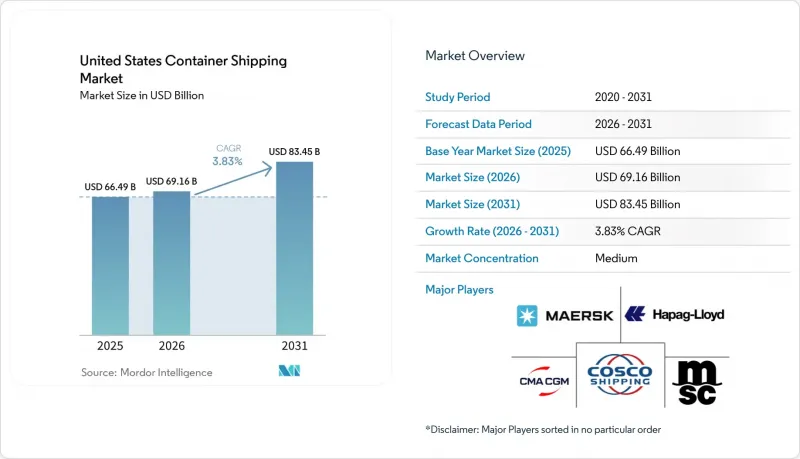
Mordor Intelligence에 의하면, 미국 컨테이너 운송 시장 규모는 2025년 664억 9,000만 달러, 2026년 691억 6,000만 달러에서 2031년까지 834억 5,000만 달러로 확대한다고 예측되고 있어 2026년부터 2031년까지 연평균 복합 성장률(CAGR)은 3.83%를 나타낼 전망입니다.
미국 컨테이너 운송 시장은 국내 전체 수입량 측면에서 두드러진 증가세를 보이지 않고 있으나, 화물이 동부 해안 및 멕시코만 연안의 게이트웨이로 꾸준히 재분배되고 있는 점이 시장 형성의 요인으로 작용하고 있습니다. 본 보고서는 서비스 유형별(외항, 근해 운송 등), 컨테이너 유형(드라이 컨테이너 및 리퍼 컨테이너), 컨테이너 크기(20피트, 40피트 등), 화물 유형(FCL 및 LCL), 최종 사용자 산업(FMCG 및 소매, 전자 및 전기 기기 등), 지역(북동부, 남동부, 중서부, 남서부, 서부)별로 분류되어 있습니다. 시장 전망은 금액(달러) 기준으로 제시되어 있습니다.
미국 컨테이너 운송 시장 동향과 인사이트
동부 해안 지역의 니어쇼어링 및 멕시코 무역 경로 변경
미국 컨테이너 해상 운송 시장에서는 조달처가 중국에서 멕시코 및 동남아시아 일부 지역으로 이동함에 따라 화물 운송 경로에 지속적인 변화가 나타나고 있습니다. 미국 컨테이너 수입 총량에서 중국이 차지하는 비중은 2024년 중반 40%에서 2025년 중반 28.8%로 하락한 반면, 같은 기간 인도네시아에서 미국으로의 수입은 34% 증가했고, 태국에서는 28% 증가를 기록했습니다. 이로 인해 일부 수입 화물의 평균 운송 거리가 단축되었으며, 해상 운송 구간의 단축과 멕시코만을 중시하는 항로의 경제성이 향상되었습니다. 북미 동부 해안 항만이 미국행 수입 컨테이너에서 차지하는 비중을 2025년 1분기 46%에서 2026년 1분기 46.8%로 끌어올린 것은 이러한 항로 전환이 이미 일시적인 대응에서 명확한 무역 패턴으로 전환되고 있음을 보여줍니다. 니어쇼어링이 성숙해짐에 따라, 미국 컨테이너 운송 시장에서는 멕시코 측 및 대서양 측공급망과 멕시코만 연안 및 동부 해안의 관문을 연결하는 회랑에 수요가 더욱 집중될 전망입니다.
미국 항만 현대화 및 자동화에 대한 투자
항만 현대화는 부두의 생산성, 크레인 처리 능력, 그리고 육상 화물 흐름을 개선함으로써 미국 컨테이너 운송 시장의 운영 기반을 강화하고 있습니다. 2025 회계연도에는 ‘항만 인프라 개발 프로그램’에 따라 37개 프로젝트에 7억 7,400만 달러가 배정되었으며, 이는 현재 자금 지원 기간이 종료되기 전에 항만 현대화에 대한 공공 지원의 규모를 반영하고 있습니다. 터미널 운영사들도 직접 투자를 진행하고 있으며, 포트 엘리자베스와 로스앤젤레스에서는 더 대형 선박을 수용하기 위해 높은 크레인을 도입하는 현대화가 추진되고 있을 뿐만 아니라, 롱비치의 피어 B 철도 지원 프로젝트를 통해 내륙 지역의 화물 처리 능력이 향상되고 있습니다. 이러한 현대화가 중요한 이유는 체류 시간을 단축하고, 선박 회전 효율을 높이며, 운영상의 제약을 완화함으로써 더 대형 컨테이너선을 처리할 수 있는 항만의 선택지를 넓혀주기 때문입니다. 향후 미국의 2차 항만의 신뢰성과 효율성이 향상됨에 따라, 미국 컨테이너 운송 시장은 더 많은 직항 노선의 기항과 미국 외 대체 항만으로의 재량 화물 유출 감소라는 혜택을 누리게 될 것입니다.
주요 태평양 횡단 및 대서양 횡단 노선의 선복 과잉
미국 컨테이너 운송 시장의 단기적인 최대 제약 요인은 전 세계 선박 용량의 과잉입니다. 2026년 3월까지 전 세계 정기 노선 선단은 3,360만 TEU를 초과할 전망이며, 2026년부터 2028년까지 누적된 수주 물량의 상당 부분이 초대형 선박에 집중되어 있어, 미국을 연결하는 장거리 노선에 대한 압박이 커지고 있습니다. 또한, 2024년 및 2025년의 선박 해체 건수가 적었던 점도 운송 능력 조정을 지연시켜, 공급 문제를 현재 예측 기간으로 이월시키는 요인이 되었습니다. 화주 입장에서는 이것이 단기적으로는 운임 하락을 부추길 가능성이 있지만, 한편으로는 운임이 계속 압박받는 상황에서는 경영 기반이 취약한 해운사가 시장 점유율을 잃거나 업계 재편에 나설 위험도 높아집니다. 따라서 미국 컨테이너 운송 시장은 운임 하락으로 인한 단기적인 고객 혜택이 있는 반면, 해운사의 수익성이나 항로 운영 규율에 대한 전략적 압박이 강화되는 등 상반된 영향에 직면해 있습니다.
부문 분석
2025년, 원양 컨테이너 운송은 미국 컨테이너 운송 시장 점유율의 58.44%를 차지하며, 광범위한 시스템 내에서 핵심적인 수익 기반이 되었습니다. 이러한 우위는 미국 항만과 아시아 및 유럽의 제조 거점을 연결하는 오랜 기간 확립되어 온 태평양 횡단 및 대서양 횡단 루트에서 비롯됩니다. 2025년에도 대형 소매업체, 산업용 구매자, 수입에 의존하는 제조업체들이 여전히 이러한 항로에 가장 많은 화물량을 의존했기 때문에 그 규모는 중요한 위치를 계속 차지했습니다. 반면, 관세 압박과 조달처의 다각화로 인해 그동안 미·중 간 주요 항로의 수익성을 뒷받침해 온 확실성이 약화되었습니다. 따라서 미국의 컨테이너 운송 시장은 여전히 원양 서비스에 의존하고 있었지만, 해당 부문 내 수요 구조는 단일 선적국에 대한 집중도가 낮아졌습니다.
이 부문에서 가장 빠른 성장이 예상되는 분야는 근해 운송으로, 2031년까지 연평균 성장률(CAGR) 4.81%로 확대될 것으로 전망됩니다. 이러한 성장은 멕시코로의 니어쇼어링, 카리브해 지역의 피더 노선 활성화, 그리고 멕시코만 연안 회랑의 개발과 밀접한 관련이 있으며, 이로 인해 단거리 및 중거리 해상 운송에서 보다 실질적인 화물량이 창출되고 있습니다. 2025년 및 2026년에 실시된 얼라이언스 재편으로 인해, 원양 네트워크를 이용하는 화주들을 위한 일정 설계와 항만 간 커버 범위가 변경되었습니다. 서비스 구조가 변화하는 가운데, 새로운 조달 거점과 지속적으로 성장하는 동부 해안 및 멕시코만 게이트웨이 간에 유연한 화물 인계가 가능하도록 하기 위해 근해 항로의 중요성이 높아지고 있습니다. 미국 컨테이너 운송 업계에서 이 부문은 더 이상 단순한 보조 역할에 그치지 않고, 근해 무역에 관여하는 항만 및 해운사들에게 보다 직접적인 성장 경로가 되고 있습니다.
2025년, 미국 컨테이너 운송 시장 규모의 76.40%를 일반 컨테이너가 차지하고 있으며, 이는 온도 관리가 필요 없는 다양한 표준 화물이 운송되고 있음을 반영합니다. 의류, 전자기기, 산업용 부품, 가정용품 및 일반 소매 화물의 운송이 이 부문을 확고한 선두 위치에 유지시켰습니다. 이러한 거대한 기반은 소매 수요나 제조 수주의 미세한 변동조차도 시장 전체의 수익에 눈에 띄는 영향을 미칩니다는 것을 의미합니다. 2025년 중국발 수입 감소로 인해 주요 태평양 횡단 항로의 드라이 컨테이너 이용률은 하락했으나, 국내 화물 물동량에서 이 부문이 차지하는 핵심적인 역할은 약화되지 않았습니다. 주로 표준 용량을 대상으로 한 신조선 수주 현황도 해운사들이 여전히 드라이 컨테이너를 미국 컨테이너 운송 시장의 주요 운송 플랫폼으로 간주하고 있음을 보여줍니다.
리퍼 컨테이너는 2031년까지 연평균 성장률(CAGR) 7.43%를 나타낼 것으로 예측되며, 컨테이너 유형 중 가장 빠른 성장세를 보일 것입니다. 이는 의약품 및 식품 물류에 대한 수요 증가를 반영한 것이지만, 의약품 분야의 경우 미국의 의약품 규제에 따른 추적성 및 취급 요건으로 인해 보다 지속적인 정책 지원을 받고 있습니다. 환경 규제가 강화됨에 따라 리퍼 대응 선단의 개조 및 장비 갱신 수요가 증가하고 있으며, 그 결과 이 부문의 자본 집약도가 높아지고 있습니다. 의료 및 생명과학 분야와 견고한 협력 관계를 구축하고 있는 동부 해안 항만은 이러한 화물에 필요한 규정 준수, 창고 보관, 그리고 취급 체제를 이미 갖추고 있어 가장 큰 혜택을 볼 것으로 전망됩니다. 따라서 미국 컨테이너 운송 업계에서 냉동 컨테이너의 성장은 총 컨테이너 취급량 그 자체보다 오히려 시설 전략, 터미널의 우선순위, 그리고 수익 구성에 큰 변화를 가져오고 있습니다.
기타 혜택:
- 엑셀 형식 시장 예측(ME) 시트
- 3개월간의 애널리스트 지원
자주 묻는 질문
목차
제1장 서론
제2장 조사 방법
제3장 주요 요약
제4장 시장 구도
제5장 시장 규모 및 성장 예측(금액, 2026-2031년)
제6장 경쟁 구도
제7장 시장 기회와 향후 전망
JHS 26.08.05According to Mordor Intelligence, the United States container shipping market size is projected to expand from USD 66.49 billion in 2025 and USD 69.16 billion in 2026 to USD 83.45 billion by 2031, registering a CAGR of 3.83% between 2026 and 2031.
The United States container shipping market is being shaped by a steady rerouting of cargo toward East Coast and Gulf Coast gateways, even though national import volumes have shown limited headline growth. This report is Segmented by Service Type (Deep-Sea, Short-Sea, and More), by Container Type (Dry and Reefer), by Container Size (20-Ft, 40-Ft, and More), by Load Type (FCL and LCL), by End-User Industry (FMCG and Retail, Electronic and Electrical Equipment, and More), and by Region (Northeast, Southeast, Midwest, Southwest, and West). The Market Forecasts are Provided in Terms of Value (USD).
United States Container Shipping Market Trends and Insights
East Coast Nearshoring and Mexico Trade Re-Routing
The United States container shipping market is seeing a durable change in cargo routing as sourcing shifts away from China and toward Mexico and parts of Southeast Asia. China's share of total United States containerized imports fell from 40% in mid-2024 to 28.8% by mid-2025, while Indonesia posted 34% import growth to the United States and Thailand posted 28% growth over the same period. This has shortened the average haul for part of the inbound cargo base and improved the economics of shorter sea legs and Gulf-oriented routing. North American East Coast ports raised their share of United States-laden import containers from 46% in Q1 2025 to 46.8% in Q1 2026, showing that the routing shift has already moved from a temporary response to a measurable trade pattern. As nearshoring matures, the United States container shipping market is likely to see more demand concentrated in corridors linking Gulf and East Coast gateways with Mexico-facing and Atlantic-facing supply chains.
United States Port Modernization and Automation Investments
Port modernization is strengthening the operating base of the United States container shipping market by improving berth productivity, crane capability, and landside cargo flow. FY 2025 distribution of USD 774 million across 37 projects under the Port Infrastructure Development Program, reflecting the scale of public support for port upgrades before the current funding window closes. Terminal operators are also investing directly, with modernization at Port Elizabeth and Los Angeles adding taller cranes for larger vessels, while the Pier B rail support project in Long Beach is improving inland cargo handling capacity. These upgrades matter because they reduce dwell time, improve turn efficiency, and widen the set of ports that can handle larger container ships with fewer operational constraints. Over time, the United States container shipping market should benefit from more direct port calls and less leakage of discretionary cargo to non-United States alternatives, where secondary United States ports become more reliable and more efficient.
Vessel Overcapacity on Major Transpacific and Transatlantic Loops
The largest near-term restraint on the United States container shipping market is a global vessel capacity overhang. Global cellular fleet exceeded 33.6 million TEU by March 2026 and that much of the 2026-2028 orderbook is concentrated in very large ships, which increases pressure on long-haul routes serving the United States. Low demolition activity in 2024 and 2025 also delayed capacity adjustment and pushed the supply issue into the current forecast window. For shippers, this can support softer rates in the near term, but it also increases the risk that weaker carriers lose ground or pursue consolidation when pricing remains under pressure. The United States container shipping market, therefore, faces mixed effects, with short-run customer benefits from lower freight rates but heavier strategic pressure on carrier profitability and route discipline.
Other drivers and restraints analyzed in the detailed report include:
- Refrigerated Cargo Growth from Healthcare and Food Imports
- Carrier Network Rebalancing Toward United States Gulf and East Coast Ports
- Port Congestion, Labor Disruption Risk, and Dwell-Time Volatility
For complete list of drivers and restraints, kindly check the Table Of Contents.
Segment Analysis
Deep-sea or ocean container shipping accounted for 58.44% of the United States container shipping market share in 2025, making it the core revenue base for the broader system. Its lead came from the long-established transpacific and transatlantic loops that connect United States ports with manufacturing centers in Asia and Europe. That scale remained important in 2025 because large retailers, industrial buyers, and import-dependent manufacturers still relied on these routes for the highest cargo volumes. At the same time, tariff pressure and sourcing diversification weakened the certainty that had previously supported the strongest China-United States mainline economics. The United States container shipping market, therefore, continued to depend on deep-sea services, but the shape of demand inside that segment became less concentrated around a single origin country.
The fastest growth in this category is shifting to short-sea shipping, which is expected to expand at a 4.81% CAGR through 2031. That growth is tied to Mexico nearshoring, Caribbean feeder activity, and Gulf Coast corridor development, which are creating more viable volumes for shorter and mid-distance maritime movements. Alliance reshuffling in 2025 and 2026, which changed schedule design and port pair coverage for shippers using deep-sea networks. As service structures change, short-sea routes are gaining importance because they support flexible cargo handoff between new sourcing points and growing East Coast and Gulf Coast gateways. Within the United States container shipping industry, this segment is no longer merely a secondary support layer, as it is becoming a more direct growth path for ports and carriers exposed to nearshore trade.
Dry containers accounted for 76.40% of the United States container shipping market size in 2025, which reflects the wide variety of standard cargo that moves without temperature control. Apparel, electronics, industrial parts, home goods, and general retail shipments all kept this segment firmly in the lead. Its large base also means that even small shifts in retail demand or manufacturing orders can move total market revenue in visible ways. The decline in Chinese-origin imports in 2025 weakened dry container utilization on major transpacific lanes, but it did not diminish the segment's central role in national cargo flows. Newbuild orders aimed mainly at standard capacity also show that carriers still view dry containers as the main throughput platform for the United States container shipping market.
Reefer containers are projected to grow at a 7.43% CAGR through 2031, making them the fastest-moving container type. This reflects stronger demand for pharmaceutical and food logistics, but the pharmaceutical side has more durable policy support due to traceability and handling requirements under the United States drug regulations. Environmental regulations are increasing retrofit and equipment-replacement needs for reefer-capable fleets, thereby increasing capital intensity in this segment. East Coast ports with established healthcare and life sciences links stand to gain the most, as they already support the compliance, warehousing, and handling routines required for these cargoes. In the United States container shipping industry, reefer growth is therefore changing equipment strategy, terminal priorities, and the value mix more than it is changing total box volume.
Complete Report Scope:
- By Service Type
- Deep-Sea/Ocean Container Shipping
- Short-Sea Container Shipping
- Feeder and Coastal/Domestic Container Shipping
- By Container Type
- Dry Containers (General Purpose)
- Reefer Containers
- By Container Size
- 20-foot Containers (20 ft)
- 40-foot Containers (40 ft)
- Other Specialized Sizes
- By Load Type
- Full-Container-Load (FCL)
- Less-Than-Container-Load (LCL)
- By End-User Industry
- FMCG and Retail
- Manufacturing and Automotive
- Healthcare and Pharmaceuticals
- Electronics and Electrical Equipment
- Industrial Chemicals and Raw Materials
- Others
- By Region
- Northeast
- Southeast
- Midwest
- Southwest
- West
List of Companies Covered in this Report:
- Mediterranean Shipping Company (MSC)
- A.P. Moller - Maersk A/S
- CMA CGM Group
- COSCO SHIPPING Holdings Co., Ltd.
- Hapag-Lloyd AG
- Ocean Network Express Pte. Ltd.
- Evergreen Marine Corporation (Taiwan) Ltd.
- ZIM Integrated Shipping Services Ltd.
- Seaboard Marine Ltd.
- Yang Ming Marine Transport Corp.
- SeaLead Shipping Pte. Ltd.
- Wan Hai Lines Ltd.
- Pacific International Lines Pte Ltd
- SM Line Corporation
- Matson, Inc.
- Crowley Maritime Corporation
- King Ocean Services Ltd.
- HMM Co., Ltd.
- TS Lines Ltd.
- Emirates Shipping Line
- X-Press Feeders
- Korea Marine Transport Co. (KMTC)
Additional Benefits:
- The market estimate (ME) sheet in Excel format
- 3 months of analyst support
TABLE OF CONTENTS
1 Introduction
- 1.1 Study Assumptions & Market Definition
- 1.2 Scope of the Study
2 Research Methodology
3 Executive Summary
4 Market Landscape
- 4.1 Market Overview and Role of Container Shipping in Logistics
- 4.2 Market Drivers
- 4.2.1 East Coast Nearshoring and Mexico Trade Re-Routing
- 4.2.2 US Port Modernization and Automation Investments
- 4.2.3 Refrigerated Cargo Growth from Healthcare and Food Imports
- 4.2.4 Carrier Network Rebalancing Toward US Gulf and East Coast Ports
- 4.2.5 Shipper Preference for FCL on Time-Sensitive Retail Lanes
- 4.2.6 Demand for Schedule Reliability and Data-Visible Ocean Contracts
- 4.3 Market Restraints
- 4.3.1 Vessel Overcapacity on Major Transpacific and Transatlantic Loops
- 4.3.2 Port Congestion, Labor Disruption Risk, and Dwell-Time Volatility
- 4.3.3 US Trade Policy Volatility and Tariff-Driven Booking Uncertainty
- 4.3.4 Equipment Imbalance, Especially Reefers and 40-Foot High Cubes
- 4.4 Regulatory Framework
- 4.5 Value Chain and Distribution Channel Architecture Analysis
- 4.6 Technology Innovations Outlook
- 4.7 Porter's Five Forces
- 4.7.1 Threat of New Entrants
- 4.7.2 Bargaining Power of Suppliers
- 4.7.3 Bargaining Power of Buyers
- 4.7.4 Threat of Substitutes
- 4.7.5 Rivalry Among Competitors
- 4.8 Evolution of Container Shipping Industry
- 4.9 Comparison: Container Shipping vs Other Freight Modes
- 4.10 Pricing Analysis
- 4.11 Nearshoring and Friend-Shoring Developments
- 4.12 Economic Indicators Influencing Container Demand
- 4.13 Impact of Geo-Political Events on Supply Chain Shifts
5 Market Size & Growth Forecasts (Value, 2026-2031)
- 5.1 By Service Type
- 5.1.1 Deep-Sea/Ocean Container Shipping
- 5.1.2 Short-Sea Container Shipping
- 5.1.3 Feeder and Coastal/Domestic Container Shipping
- 5.2 By Container Type
- 5.2.1 Dry Containers (General Purpose)
- 5.2.2 Reefer Containers
- 5.3 By Container Size
- 5.3.1 20-foot Containers (20 ft)
- 5.3.2 40-foot Containers (40 ft)
- 5.3.3 Other Specialized Sizes
- 5.4 By Load Type
- 5.4.1 Full-Container-Load (FCL)
- 5.4.2 Less-Than-Container-Load (LCL)
- 5.5 By End-User Industry
- 5.5.1 FMCG and Retail
- 5.5.2 Manufacturing and Automotive
- 5.5.3 Healthcare and Pharmaceuticals
- 5.5.4 Electronics and Electrical Equipment
- 5.5.5 Industrial Chemicals and Raw Materials
- 5.5.6 Others
- 5.6 By Region
- 5.6.1 Northeast
- 5.6.2 Southeast
- 5.6.3 Midwest
- 5.6.4 Southwest
- 5.6.5 West
6 Competitive Landscape
- 6.1 Market Concentration
- 6.2 Key Strategic Moves
- 6.3 Market Share Analysis
- 6.4 Company Profiles (includes Global level Overview, Market level overview, Core Segments, Financials as available, Strategic Information, Market Rank/Share for key companies, Products & Services, and Recent Developments)
- 6.4.1 Mediterranean Shipping Company (MSC)
- 6.4.2 A.P. Moller - Maersk A/S
- 6.4.3 CMA CGM Group
- 6.4.4 COSCO SHIPPING Holdings Co., Ltd.
- 6.4.5 Hapag-Lloyd AG
- 6.4.6 Ocean Network Express Pte. Ltd.
- 6.4.7 Evergreen Marine Corporation (Taiwan) Ltd.
- 6.4.8 ZIM Integrated Shipping Services Ltd.
- 6.4.9 Seaboard Marine Ltd.
- 6.4.10 Yang Ming Marine Transport Corp.
- 6.4.11 SeaLead Shipping Pte. Ltd.
- 6.4.12 Wan Hai Lines Ltd.
- 6.4.13 Pacific International Lines Pte Ltd
- 6.4.14 SM Line Corporation
- 6.4.15 Matson, Inc.
- 6.4.16 Crowley Maritime Corporation
- 6.4.17 King Ocean Services Ltd.
- 6.4.18 HMM Co., Ltd.
- 6.4.19 TS Lines Ltd.
- 6.4.20 Emirates Shipping Line
- 6.4.21 X-Press Feeders
- 6.4.22 Korea Marine Transport Co. (KMTC)
7 Market Opportunities & Future Outlook
- 7.1 White-space & Unmet-Need Assessment


