
|
시장보고서
상품코드
2099059
인도의 컨테이너 운송 시장 : 시장 점유율 분석, 업계 동향 및 통계, 성장 예측(2026-2031년)India Container Shipping - Market Share Analysis, Industry Trends & Statistics, Growth Forecasts (2026 - 2031) |
||||||
 Mordor Intelligence
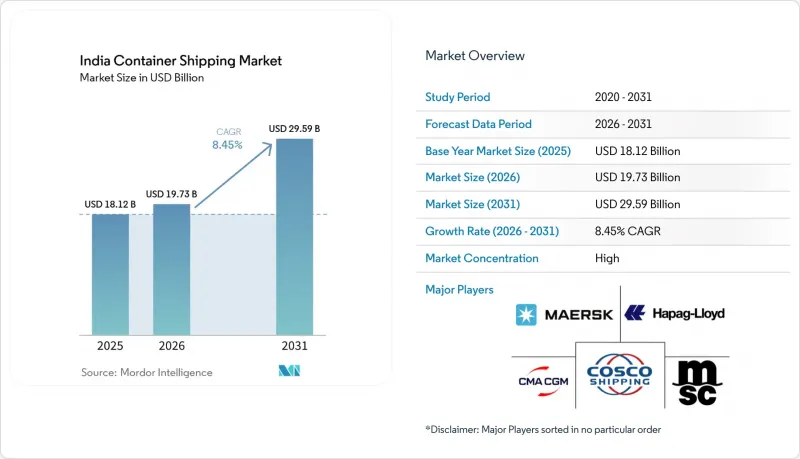
Mordor Intelligence에 의하면, 인도의 컨테이너 운송 시장 규모는 2025년 181억 2,000만 달러로 평가되었고, 2026년에는 197억 3,000만 달러로 확대될 것으로 추정되고, 2031년까지 295억 9,000만 달러에 이를 것으로 예상되며, 2026-2031년 CAGR 8.45%로 성장할 전망입니다.
인도의 화물 기반은 전자기기, 의약품, 자동차 부품 등의 제조 프로그램으로 인해, 기존에는 컨테이너 운송 경로를 통해 운송되지 않았던 수출 물량이 추가되면서 컨테이너 운송에 적합한 환경으로 변화하고 있습니다. 본 보고서는 서비스 유형별(외항, 내항, 피더, 연안), 컨테이너 유형별(드라이 컨테이너, 리퍼 컨테이너), 컨테이너 크기별(20피트, 40피트, 기타 특수 크기), 적재 유형별(FCL, LCL), 최종 사용자별(FMCG·소매, 제조·자동차, 기타), 지역별(북부, 중부, 서부, 동부, 남부)로 분류되어 있습니다. 시장 전망은 금액(달러) 기준으로 제시되어 있습니다.
인도의 컨테이너 운송 시장 동향 및 인사이트
주요 산업 회랑에서의 수출입 컨테이너화 진전
인도의 컨테이너 운송 시장은 주요 산업 회랑에서 컨테이너 이용이 꾸준히 증가하는 혜택을 받고 있습니다. 이는 인도 내에서 벌크 화물 및 기타 운송 수단에서 컨테이너로의 전환 여지가 여전히 남아 있기 때문입니다. 2025-26 회계연도에는 화물량의 전반적인 증가와 주요 관문에서의 활동 확대에 따라 인도 항만의 컨테이너 화물량도 증가했습니다. 이러한 변화는 구자라트주, 타밀나두주, 안드라프라데시주의 제조업 벨트에서 특히 두드러졌으며, 전자기기 및 자동차 부품 생산이 수출용 컨테이너 화물 물동량 증가를 주도하고 있습니다. JNPT(잠나가르 항)의 처리량이 사상 최고치를 기록한 것도 이러한 변화가 특정 화물 범주에 국한되지 않음을 보여주며, 해당 항구는 2025-26 회계연도에 817만 TEU를 처리하여 11.9%의 성장률을 기록했습니다. 이러한 추세는 인도의 컨테이너 운송 시장에 중요한 의미를 지닙니다. 이는 일시적인 수출 급증에 그치지 않고, 제조업 공급망에서 지속적인 수요를 창출하기 때문입니다. 또한, 향후 성장은 더 많은 지역과 품목에서 발생할 가능성이 높아, 해운사와 터미널 수요 기반이 확대될 것임을 의미합니다.
서부 전용 화물 회랑 개통과 항만·철도 연계
2025년에 전용 화물 회랑(DFCC) 네트워크가 완공됨에 따라 내륙 생산 지역과 항만 게이트가 보다 직접적으로 연결되어, 인도 컨테이너 운송 시장의 물류 기반이 개선되었습니다. DFCCIL에 따르면, 이 회랑의 화물 운송 서비스는 기존 철도 노선보다 훨씬 빠른 평균 속도로 운행되고 있으며, 열차 1편당 컨테이너 운송량도 기존 노선보다 대폭 많도록 설계되었습니다. 또한, 이 회랑은 예측 가능성이 높은 내륙 배송을 가능하게 하며, 이는 고정된 출항 기간이 필요한 수출업체와 선박 가동률 향상을 목표로 하는 해운사에게 중요한 요소입니다. CONCOR 네트워크를 통한 철도 컨테이너 운송량은 2025-26 회계연도에 387만 TEU에 달하고, 전년 대비 14.2% 증가했습니다. 이는 모달 시프트가 더 이상 정책 목표가 아니라 실제로 실천되고 있음을 보여줍니다. 2026년 6월 4일 상하이에서 출항한 마스쿠(Maersk)사의 FI2 서비스 첫 항해 역시 인도 북서부 화주들에게 피파바브가 철도와 연계된 관문으로서 수행하는 역할이 확대되고 있음을 여실히 보여주었습니다. 인도의 컨테이너 운송 시장에서 이러한 철도와 항만의 통합은 내륙 시장의 마찰을 완화하고, 수출입 수량측 모두에서 서해안 관문의 가치를 높이고 있습니다.
호르무즈 해협, 홍해, 파나마 운하 및 지정학적 요인으로 인한 항로 혼란
2026년 초, 호르무즈 해협의 혼란이 페르시아만 및 인근 항로와 관련된 무역 흐름에 영향을 미쳤을 때, 인도의 컨테이너 운송 시장은 심각한 운영상의 타격을 입었습니다. 이 혼란으로 인해 다수의 선박이 페르시아만에 발이 묶였고, 화주에게 부과되는 전쟁 관련 추가 요금이 급등하면서 운송 비용이 상승하고 선적이 지연되었습니다. 우회나 지연을 피할 수 없었던 컨테이너들이 하역 및 체류 시간에 추가적인 부담을 주었기 때문에 그 영향은 서부 해안 게이트웨이에서 특히 두드러지게 나타났습니다. 우회 경로의 연장으로 인해 연료 소비량이 증가했고, 유럽 및 미국으로의 운송 시간도 길어졌습니다. 이는 비상시 운임 조건에서 협상력이 약한 중소 수출업체들에게 더 큰 타격이 되었습니다. 비상 정책 지원이나 일시적인 운항 조정이 이루어졌음에도 불구하고, 인도의 컨테이너 운송 시장은 여전히 페르시아만 및 홍해 회랑을 따라 발생하는 혼란에 대한 명백한 위험을 안고 있습니다. 이로 인해 당분간 항로의 안정성은 해운사, 항만 및 수출업체에게 주요 위험 요인으로 남아 있을 것입니다.
부문 분석
2025년, 인도의 컨테이너 운송 시장에서 원양 컨테이너 운송은 68.17%의 점유율을 차지했으며, 인도 컨테이너 운송 시장의 중추를 이루고 있습니다. 이러한 위상은 유럽, 북미, 동아시아로 향하는 인도의 장거리 수출입 항로의 중요성을 반영하며, JNPT나 문드라와 같은 주요 관문 항구가 화물 경로 설정에 있어 여전히 중심적인 역할을 수행하고 있습니다. 이러한 서비스 형태는 규모의 경제, 확립된 일정, 그리고 주요 생산 및 소비 흐름에 의해 발생하는 화물 집중이라는 이점을 누리고 있습니다. 외항 수요는 항만 처리량의 지속적인 증가에 힘입어 뒷받침되고 있으며, 2025-26 회계연도에는 주요 항만의 처리량이 9억 1,500만 톤을 넘어섰고, JNPT에서는 같은 기간 동안 컨테이너 처리량이 사상 최고치를 기록했습니다. 인도 주변의 역내 무역 패턴은 동남아시아에서 볼 수 있는 것만큼 아직 밀접하지 않기 때문에 근해 항로의 처리량은 여전히 소규모에 그치고 있습니다.
피더 및 연안·국내 컨테이너 운송은 2031년까지 연평균 성장률(CAGR) 9.43%를 나타낼 것으로 예측되며, 인도 컨테이너 운송 시장에서 가장 빠르게 성장하는 서비스 유형이 될 전망입니다. 이러한 성장은 인도 내 환적 물동량 증가와, 국내 화물을 도로 운송 대신 연안 운송을 통해 더 많이 수송하려는 움직임이라는 상호 연관된 두 가지 변화에 의해 뒷받침되고 있습니다. 또한, 각 해운사가 인도 등록 선박이나 현지 파트너십을 활용하여 국내 항로에 대한 접근성을 개선하려 하고 있기 때문에 시장에서는 연안 및 피더 항로에 대한 직접적인 관심도 나타나고 있습니다. 이러한 변화는 메인라인 무역의 하위 계층으로 서비스 범위를 확장하고, 2차 항구 및 지역 화주에게 보다 안정적인 연결성을 제공한다는 점에서 중요합니다. 실용적인 관점에서 볼 때, 피더 항로의 성장은 인도 컨테이너 운송 시장이 소수의 직항 메인라인 기항지에 대한 의존도를 낮추고, 허브 항구와 지역 항구 간의 화물 운송에서 더 큰 유연성을 확보하게 할 것입니다. 또한, 심수항에서의 환적과 연안 배송을 연결할 수 있는 남부 인도 항만의 가치도 높아집니다.
2025년, 인도의 컨테이너 운송 시장 규모의 81.90%를 일반 컨테이너가 차지했으며, 최대 컨테이너 카테고리가 되었습니다. 이러한 우위는 FMCG(일용소비재), 제조품, 섬유 제품, 산업용 원자재 등 여전히 표준 드라이 컨테이너로 운송되는 광범위한 품목에 기인합니다. 많은 수출입 품목은 온도 관리가 필요하지 않기 때문에 드라이 컨테이너는 인도의 현재 무역 구조에 적합합니다. 또한, 장거리 노선에서 대규모 화주들에게 여전히 주요 적재 형태인 FCL(전체 컨테이너 적재) 운송의 규모와도 잘 부합합니다. 이러한 의미에서 드라이 컨테이너는 다양한 최종 용도 부문에 걸쳐 인도의 해상 컨테이너 운송 시장을 안정시키는 운송량의 기반 역할을 계속하고 있습니다.
리퍼 컨테이너는 2031년까지 연평균 성장률(CAGR) 12.05%를 나타낼 것으로 예측되며, 이는 인도 해상 컨테이너 운송 시장 전체의 성장 속도를 크게 상회하는 수치입니다. 이러한 급속한 성장은 의약품, 백신, 온도에 민감한 원자재, 그리고 농업의 계절성을 넘어 확대되는 콜드체인 수요의 확산과 관련이 있습니다. 2026년 5월 CONCOR와 공동으로 시작된 하이데라바드에서 나바 셰바로 향하는 마스크사의 주 1회 전용 냉장 철도 서비스는 이러한 콜드체인 확충이 더욱 체계화되고 상업적으로도 확장 가능해지고 있음을 보여줍니다. 의약품 수출 기반이 확대됨에 따라, 냉동 컨테이너의 이용은 틈새 수요에서 수출 계획의 보다 일반적인 요소로 확대될 가능성이 있습니다. 이러한 변화는 인도의 해상 컨테이너 운송 업계에 중요한 의미를 지닙니다. 왜냐하면 냉장 화물은 더 높은 수준의 서비스 복잡성, 전문 장비에 대한 수요 증가, 그리고 내륙 물류와 항만 하역 간의 보다 긴밀한 협력을 필요로 하기 때문입니다. 또한 전문적인 운송에는 더 높은 수준의 서비스 내용이 수반되므로, 이 부문에서는 향후 가치 증가율이 운송량 증가율을 상회할 가능성이 있음을 의미하기도 합니다.
기타 혜택 :
- 엑셀 형식 시장 예측(ME) 시트
- 3개월간의 애널리스트 지원
자주 묻는 질문
목차
제1장 서론
제2장 조사 방법
제3장 주요 요약
제4장 시장 구도
제5장 시장 규모 및 성장 예측(금액, 2026-2031년)
제6장 경쟁 구도
제7장 시장 기회 및 향후 전망
AJY 26.08.07According to Mordor Intelligence, the India container shipping market size is expected to increase from USD 18.12 billion in 2025 to USD 19.73 billion in 2026 and reach USD 29.59 billion by 2031, growing at a CAGR of 8.45% over 2026-2031.
India's cargo base is becoming more container-friendly as manufacturing programs in electronics, pharmaceuticals, and auto components are adding export volumes that previously did not move through container channels. This report is Segmented by Service Type (Deep-Sea, Short-Sea, Feeder and Coastal), by Container Type (Dry and Reefer), by Container Size (20 Ft, 40 Ft, and Other Specialized Sizes), by Load Type (FCL and LCL), by End-User (FMCG and Retail, Manufacturing and Automotive, and More), and by Region (North, Central, West, East, and South). The Market Forecasts are Provided in Terms of Value (USD).
India Container Shipping Market Trends and Insights
Rising EXIM Containerization Across Key Industrial Corridors
The India container shipping market is benefiting from a steady rise in container use across industrial corridors, as the country still has room to convert more cargo from breakbulk and other modes into containers. Container cargo at Indian ports rose in FY 2025-26, alongside broader cargo growth and rising activity at major gateways. The change is especially visible in manufacturing belts in Gujarat, Tamil Nadu, and Andhra Pradesh, where electronics and auto-component production are driving more export-ready container flows. Record throughput at JNPT also showed that the shift is not limited to one cargo category, as the port handled 8.17 million TEUs in FY 2025-26, posting 11.9% growth. This pattern matters for the India container shipping market because it creates recurring demand from manufacturing supply chains rather than one-time export spikes. It also means future growth is likely to come from more regions and more commodities, broadening the demand base for carriers and terminals.
Western Dedicated Freight Corridor Commissioning and Port Rail Integration
The completion of the Dedicated Freight Corridor network in 2025 improved the logistics base of the India container shipping market by connecting inland production zones more directly with port gates. DFCCIL stated that freight services on the corridor operate at much higher average speeds than legacy rail routes, and the corridor is designed to move far more containers per train than conventional lines. The corridor also supports more predictable inland delivery, which is important for exporters that need fixed sailing windows and for carriers that want stronger vessel utilization. Rail container movement through CONCOR's network rose to 3.87 million TEUs in FY 2025-26, up 14.2% year over year, indicating that the modal shift is now in practice rather than a policy goal. The first sailing of Maersk's FI2 service from Shanghai on June 4, 2026, also highlighted the growing role of Pipavav as a rail-linked gateway for North-West Indian shippers. In the India container shipping market, this rail and port integration is reducing friction in the inland market and strengthening the value of West Coast gateways for both imports and exports.
Strait of Hormuz, Red Sea, Panama Canal, and Geopolitical Route Disruptions
The India container shipping market faced a severe operating shock in early 2026 when the Strait of Hormuz disruption affected trade movement linked to the Gulf and nearby routes. The disruption trapped a large number of ships in the Persian Gulf and sharply raised war-related surcharges for cargo owners, thereby raising transport costs and delaying shipments. The effect was especially visible at West Coast gateways because rerouted and delayed containers increased pressure on handling and dwell times. Longer diversion routes also raised fuel use and extended transit times to Europe and the United States, which hit smaller exporters harder because they have less bargaining power on emergency freight terms. Even with emergency policy support and temporary operational adjustments, the India container shipping market still carries clear exposure to disruptions along the Gulf and Red Sea corridor. This keeps route stability as a major risk for carriers, ports, and exporters through the near term.
Other drivers and restraints analyzed in the detailed report include:
- Capacity Additions at Major West Coast and East Coast Ports
- Foreign Carrier Network Expansion and Service Frequency Uplift
- US Tariff Exposure on Containerized Export Sectors
For complete list of drivers and restraints, kindly check the Table Of Contents.
Segment Analysis
Deep-sea or ocean container shipping held 68.17% of the India container shipping market share in 2025, making it the anchor of the India container shipping market. This position reflects the weight of India's long-haul export and import lanes to Europe, North America, and East Asia, where large gateways such as JNPT and Mundra remain central to cargo routing. The service type benefits from scale, established schedules, and cargo concentration driven by major manufacturing and consumption flows. Deep-sea demand is also supported by the continued rise in port throughput, with major ports handling more than 915 million tons in FY 2025-26 and JNPT reaching record container activity in the same period. Short-sea activity is still smaller because intra-regional trade patterns around India are not yet as dense as those seen in Southeast Asia.
Feeder and coastal or domestic container shipping is projected to grow at a 9.43% CAGR through 2031, making it the fastest-growing service type in the India container shipping market. Its growth is supported by two linked changes: the rise in Indian transshipment handling and the push to move more domestic cargo by coast rather than road. The market is also seeing direct carrier interest in coastal and feeder activity, as operators look to use India-registered tonnage and local partnerships to improve access to domestic routes. This shift matters because it widens service layers below the mainline trade, giving secondary ports and regional cargo owners more consistent connectivity. In practical terms, feeder growth will make the India container shipping market less dependent on a few direct mainline calls and more flexible in the way cargo moves between hubs and regional ports. It also increases the value of South Indian ports that can connect deepwater transshipment with coastal distribution.
Dry containers accounted for 81.90% of the India container shipping market size in 2025, making them the largest container category. This dominance came from the wide range of goods that still move in standard dry units, including FMCG, manufactured products, textiles, and industrial inputs. Dry containers align with India's current trade structure, as many export and import categories do not require temperature control. They also align well with the scale of FCL movement, which remains the primary load format for larger shippers across long-haul routes. In that sense, dry boxes continue to provide the volume base that keeps the India container shipping market stable across many end-use sectors.
Reefer containers are projected to grow at a 12.05% CAGR through 2031, which is well above the overall pace of the India container shipping market. This faster rise is tied to pharmaceuticals, vaccines, temperature-sensitive ingredients, and a wider cold-chain requirement that is moving beyond agricultural seasonality. Maersk's dedicated weekly reefer rail service from Hyderabad to Nhava Sheva, launched in May 2026 with CONCOR, showed that this cold-chain buildout is becoming more structured and commercially scalable. As the pharmaceutical export base expands, reefer use is likely to spread from a niche requirement into a more regular part of export planning. That change matters for the Indian container shipping industry because reefer cargo requires higher service complexity, greater demand for specialized equipment, and tighter coordination between inland logistics and port handling. It also means that future value growth may outpace volume growth in this segment, as specialized movement entails higher service content.
Complete Report Scope:
- By Service Type
- Deep-Sea/Ocean Container Shipping
- Short-Sea Container Shipping
- Feeder and Coastal/Domestic Container Shipping
- By Container Type
- Dry Containers (General Purpose)
- Reefer Containers
- By Container Size
- 20-foot Containers (20 ft)
- 40-foot Containers (40 ft)
- Other Specialized Sizes
- By Load Type
- Full-Container-Load (FCL)
- Less-Than-Container-Load (LCL)
- By End-User Industry
- FMCG and Retail
- Manufacturing and Automotive
- Healthcare and Pharmaceuticals
- Electronics and Electrical Equipment
- Industrial Chemicals and Raw Materials
- Others
- By Region
- North
- Central
- West
- East
- South
List of Companies Covered in this Report:
- Mediterranean Shipping Company (MSC)
- A.P. Moller's Maersk
- CMA CGM Group
- COSCO SHIPPING Lines
- Hapag-Lloyd AG
- Ocean Network Express (ONE)
- Evergreen Marine Corporation
- HMM
- Yang Ming Marine Transport
- ZIM Integrated Shipping Services
- Wan Hai Lines
- Pacific International Lines (PIL)
- X-Press Feeders
- SITC International Holdings (SITC Container Lines)
- Unifeeder
- Korea Marine Transport Corporation (KMTC)
- Regional Container Lines (RCL)
- Emirates Shipping Line
- TS Lines
- Interasia Lines
- SM Line
- Shipping Corporation of India (SCI)
Additional Benefits:
- The market estimate (ME) sheet in Excel format
- 3 months of analyst support
TABLE OF CONTENTS
1 Introduction
- 1.1 Study Assumptions & Market Definition
- 1.2 Scope of the Study
2 Research Methodology
3 Executive Summary
4 Market Landscape
- 4.1 Market Overview and Role of Container Shipping in Logistics
- 4.2 Market Drivers
- 4.2.1 Rising EXIM Containerization Across Key Industrial Corridors
- 4.2.2 Western Dedicated Freight Corridor Commissioning and Port Rail Integration
- 4.2.3 Capacity Additions at Major West Coast and East Coast Ports
- 4.2.4 Transshipment Share Gains Through Coastal and Hub Port Routing
- 4.2.5 Foreign Carrier Network Expansion and Service Frequency Uplift
- 4.2.6 Public Sector Push for Indigenous Container Shipping Capacity
- 4.3 Market Restraints
- 4.3.1 Strait of Hormuz, Red Sea, Panama Canal, and Geopolitical Route Disruptions
- 4.3.2 US Tariff Exposure on Containerized Export Sectors
- 4.3.3 Rail Haulage Cost Pressure and Inland Dwell Time Inefficiency
- 4.3.4 West Coast Terminal Congestion and Vessel Slot Constraints
- 4.4 Regulatory Framework
- 4.5 Value Chain and Distribution Channel Architecture Analysis
- 4.6 Technology Innovations Outlook
- 4.7 Porter's Five Forces
- 4.7.1 Threat of New Entrants
- 4.7.2 Bargaining Power of Suppliers
- 4.7.3 Bargaining Power of Buyers
- 4.7.4 Threat of Substitutes
- 4.7.5 Rivalry Among Competitors
- 4.8 Evolution of Container Shipping Industry
- 4.9 Comparison: Container Shipping vs Other Freight Modes
- 4.10 Pricing Analysis
- 4.11 Nearshoring and Friend-Shoring Developments
- 4.12 Economic Indicators Influencing Container Demand
- 4.13 Impact of Geo-Political Events on Supply Chain Shifts
5 Market Size & Growth Forecasts (Value, 2026-2031)
- 5.1 By Service Type
- 5.1.1 Deep-Sea/Ocean Container Shipping
- 5.1.2 Short-Sea Container Shipping
- 5.1.3 Feeder and Coastal/Domestic Container Shipping
- 5.2 By Container Type
- 5.2.1 Dry Containers (General Purpose)
- 5.2.2 Reefer Containers
- 5.3 By Container Size
- 5.3.1 20-foot Containers (20 ft)
- 5.3.2 40-foot Containers (40 ft)
- 5.3.3 Other Specialized Sizes
- 5.4 By Load Type
- 5.4.1 Full-Container-Load (FCL)
- 5.4.2 Less-Than-Container-Load (LCL)
- 5.5 By End-User Industry
- 5.5.1 FMCG and Retail
- 5.5.2 Manufacturing and Automotive
- 5.5.3 Healthcare and Pharmaceuticals
- 5.5.4 Electronics and Electrical Equipment
- 5.5.5 Industrial Chemicals and Raw Materials
- 5.5.6 Others
- 5.6 By Region
- 5.6.1 North
- 5.6.2 Central
- 5.6.3 West
- 5.6.4 East
- 5.6.5 South
6 Competitive Landscape
- 6.1 Market Concentration
- 6.2 Key Strategic Moves
- 6.3 Market Share Analysis
- 6.4 Company Profiles (includes Global level Overview, Market level overview, Core Segments, Financials as available, Strategic Information, Market Rank/Share for key companies, Products & Services, and Recent Developments)
- 6.4.1 Mediterranean Shipping Company (MSC)
- 6.4.2 A.P. Moller's Maersk
- 6.4.3 CMA CGM Group
- 6.4.4 COSCO SHIPPING Lines
- 6.4.5 Hapag-Lloyd AG
- 6.4.6 Ocean Network Express (ONE)
- 6.4.7 Evergreen Marine Corporation
- 6.4.8 HMM
- 6.4.9 Yang Ming Marine Transport
- 6.4.10 ZIM Integrated Shipping Services
- 6.4.11 Wan Hai Lines
- 6.4.12 Pacific International Lines (PIL)
- 6.4.13 X-Press Feeders
- 6.4.14 SITC International Holdings (SITC Container Lines)
- 6.4.15 Unifeeder
- 6.4.16 Korea Marine Transport Corporation (KMTC)
- 6.4.17 Regional Container Lines (RCL)
- 6.4.18 Emirates Shipping Line
- 6.4.19 TS Lines
- 6.4.20 Interasia Lines
- 6.4.21 SM Line
- 6.4.22 Shipping Corporation of India (SCI)
7 Market Opportunities & Future Outlook
- 7.1 White-space & Unmet-Need Assessment