

|
시장보고서
상품코드
1940816
미국의 FTL 화물 중개 시장 : 시장 점유율 분석, 업계 동향과 통계, 성장 예측(2026-2031년)United States FTL Freight Brokerage - Market Share Analysis, Industry Trends & Statistics, Growth Forecasts (2026 - 2031) |
||||||
 Mordor Intelligence
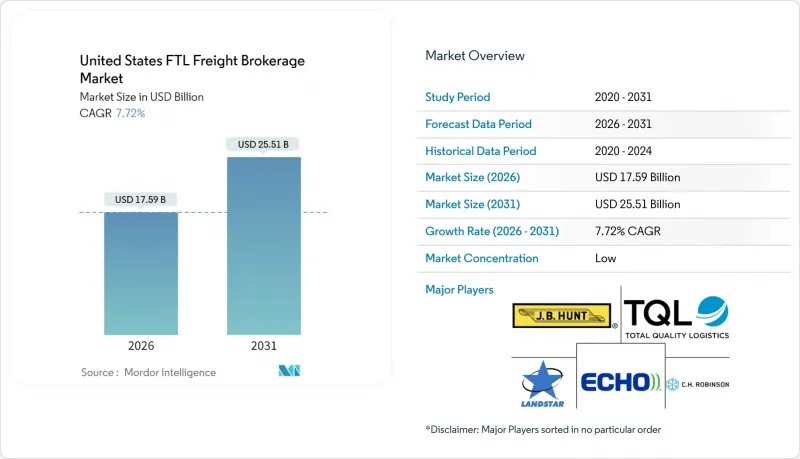
미국 풀 트럭 로드(FTL) 화물 중개 시장은 2025년에 163억 3,000만 달러로 평가되었고, 2026년 175억 9,000만 달러에서 2031년까지 255억 1,000만 달러에 이를 것으로 예측됩니다.
예측 기간(2026-2031년)의 CAGR은 7.72%로 예상됩니다.
이러한 규모와 성장 궤적은 전자상거래 수요 대응, 니어쇼어링, 인프라 투자의 필요성에 따라 화주들이 디지털화된 제3자 풀트럭로드 전문업체로 조달을 빠르게 전환하고 있는 현실을 잘 보여줍니다. 플랫폼 기반 중개업체는 예측 가격 책정, API 연결성, 자동화된 컴플라이언스 점검을 통합하여 수작업 접점을 줄이고 결제 주기를 단축하며 운송량을 통합하고 있습니다. 동시에, 집중된 구매력을 통해 상위 브로커는 운전자의 노동력 고령화, 변동하는 디젤 가격, 신용 수축에도 불구하고 운송 능력을 확보할 수 있습니다. 따라서 공급망의 디지털화, 국경 간 운송량 증가, 화주들의 화물 통합을 통한 비용절감 전략 추구로 인해 기술 리더십, 운송사와의 긴밀한 관계, 다양한 장비 포트폴리오가 결정적인 우위로 부상하고 있습니다.
미국의 FTL 화물 브로커리지 시장 동향과 인사이트
폭발적인 EC 풀필먼트 수요
분산형 재고 전략에는 기존 자산 보유형 운송회사가 효율적으로 대응할 수 없는 세밀한 수송력 관리가 요구됩니다. AI 기반 통합 엔진을 활용하는 브로커는 공회전 거리를 줄이고 운송 사이클 시간을 최대 35%까지 단축하여 옴니채널 소매업체의 서비스 제공 비용을 개선합니다. 밀집된 도시 지역의 마이크로 풀필먼트 허브는 빈번하고 소량의 풀트럭 적재 운송을 촉진하고, 신속한 용량 매칭이 가능한 중개업체에게 이익을 가져다줍니다. 고객에 대한 신속한 배송은 여전히 최우선 순위이며, 긴급 배송의 다기지 경로에 대한 프리미엄 가격 책정을 통해 미국의 FTL 화물 중개 시장을 전자상거래 네트워크의 신뢰할 수 있는 파트너로 강화하고 있습니다.
화주의 비용절감 전략과 FTL로의 운송모드 전환 전략
제조업체는 15,000파운드(약 6.8톤) 이상의 화물을 통합하여 터미널에서의 하역 작업을 피하고, 손해배상 청구를 줄이며, 운송 시간을 단축할 수 있습니다. 이를 통해 동급 LTL(소량화물) 운송 경로에 비해 12-18%의 비용 절감을 실현할 수 있습니다. 자동차 및 산업 공급망에서는 적시 재고 관리를 유지하기 위해 공장 직송을 선호합니다. 지역 집적 허브를 조정할 수 있는 브로커는 공급망 관리자가 최저 단가보다 속도에 우선순위를 두어 증분 물량을 확보하여 미국의 FTL 화물 브로커리지 시장으로의 물류량을 강화할 수 있습니다.
만성적인 운전자 부족과 고령화되는 노동력
비급여 트럭 운전사 고용은 2024년 16.3% 감소, 2009년 이후 가장 큰 폭으로 감소했습니다. 개인사업자는 보험 및 대출비용이 20% 상승하고, 일부는 폐업으로 내몰리고 있습니다. 약물 및 알코올 검사 위반과 2000년 이전 트럭에 대한 전자기록장치(ELD) 의무화 가능성으로 인해 운송능력이 더욱 감소할 수 있습니다. 신뢰할 수 있는 운송사 네트워크를 가진 브로커는 수익률을 향상시킬 수 있지만, 전체 운송량의 여지가 줄어들고 있어 미국의 FTL 화물 브로커 시장의 확장 가능성을 둔화시키고 있습니다.
부문 분석
유통업은 2025년 기준 미국의 FTL 화물 브로커 시장 점유율의 30.35%를 차지할 것으로 예상되며, 이는 전국 규모의 드라이밴 운송망에 의존하는 옴니채널 소매업체, 도매업체, EC 마켓플레이스를 반영하고 있습니다. 재고 분산에 따른 잦은 보충 수요가 안정적인 성장을 뒷받침하고 있습니다. 인프라 투자 고용법에 의한 자금 지원으로 가속화되는 건설업은 2031년까지 5.18%의 가장 빠른 CAGR을 나타낼 것으로 예측됩니다. 플랫베드 브로커는 철근, 조립식 벽체, 중장비를 수천 개의 작업 현장에 조정하고, 특수한 경로로 프리미엄 요금을 받고 있습니다. 제조 및 자동차 분야에서 니어쇼어링은 조립 공장과 공급업체 단지 간의 동기화를 촉진하고, 국경을 넘나드는 기회가 계속될 것입니다. 석유, 가스, 광업의 운송량은 상품 사이클에 따라 변동하는 반면, 농림수산업 운송은 계절적 예측가능성을 유지하며, 브로커는 수확기 회랑에 전략적 용량 배치를 통해 수익을 창출합니다.
최종 사용자 구성은 마진 다각화를 지원합니다. 소비지출 둔화는 2029년 예산까지 지속되는 인프라 지출로 상쇄할 수 있습니다. 데이터 분석을 활용하는 브로커는 상품 가격 변동성에 따라 화주를 세분화하고 가격 전략을 동적으로 조정하여 주기적으로 수익성을 유지합니다. FEMA와 관련된 갑작스러운 운송량 증가는 추가적인 수익 기회를 제공합니다. 이러한 최종 사용자 간의 균형 잡힌 포트폴리오가 미국의 FTL 화물 브로커 시장의 장기적인 회복력을 뒷받침하고 있습니다.
기타 특전:
- 엑셀 형식 시장 예측(ME) 시트
- 애널리스트 지원(3개월)
자주 묻는 질문
목차
제1장 서론
제2장 조사 방법
제3장 주요 요약
제4장 시장 구도
제5장 시장 규모와 성장 예측(금액 기준, 2019-2030년)
제6장 경쟁 구도
제7장 시장 기회와 향후 전망
LSH 26.03.11The United States FTL Freight Brokerage Market was valued at USD 16.33 billion in 2025 and estimated to grow from USD 17.59 billion in 2026 to reach USD 25.51 billion by 2031, at a CAGR of 7.72% during the forecast period (2026-2031).
The scale and trajectory underscore how rapidly shippers are migrating procurement toward digital, third-party full-truckload specialists in response to e-commerce fulfillment imperatives, nearshoring, and infrastructure spending. Platform-driven intermediaries are consolidating volumes by integrating predictive pricing, API connectivity, and automated compliance checks that shrink manual touch points and shorten settlement cycles. At the same time, concentrated buying power allows top brokers to secure capacity despite an aging driver workforce, volatile diesel prices, and tightening credit. Technology leadership, deep carrier relationships, and diversified equipment portfolios therefore emerge as decisive advantages as supply chains digitize, cross-border traffic grows, and shippers pursue cost-out strategies through load consolidation.
United States FTL Freight Brokerage Market Trends and Insights
Explosive E-commerce Fulfillment Demand
Distributed inventory strategies require granular capacity management that traditional asset-based carriers cannot meet efficiently. Brokers using AI-driven consolidation engines reduce empty miles and compress transportation cycle times by up to 35%, improving cost-to-serve for omnichannel retailers. Micro-fulfillment hubs in dense urban zones stimulate frequent, small-lot full-truckload moves that reward intermediaries capable of rapid capacity matching. Speed-to-customer remains paramount, enabling premium pricing on expedited multi-stop routes and reinforcing the US FTL freight brokerage market as a go-to partner for e-commerce networks.
Shippers' Cost-Out Agenda and Modal Shift to FTL
Manufacturers consolidating loads above 15,000 lb avoid terminal handling, lower damage claims, and cut transit times, realizing 12-18% savings versus comparable LTL routings. Automotive and industrial supply chains favor direct-to-plant deliveries to sustain just-in-time inventory disciplines. Brokers able to orchestrate regional consolidation hubs draw incremental volume as supply chain managers re-prioritize velocity over lowest unit cost, reinforcing volume flows into the US FTL freight brokerage market.
Chronic Driver Shortage and Aging Workforce
Non-payroll trucking employment shrank 16.3% in 2024, the sharpest retrenchment since 2009. Independent contractors face 20% higher insurance and financing costs, pushing some off the road. Drug and Alcohol Clearinghouse violations and potential ELD mandates on pre-2000 trucks trim further capacity. Brokers with dependable carrier pools can raise margins, yet overall volume headroom narrows, slowing expansion potential for the US FTL freight brokerage market.
Other drivers and restraints analyzed in the detailed report include:
- Digitization and API-Driven Freight-Matching Platforms
- US-Mexico Nearshoring Corridor Growth
- Diesel-Price Volatility Compressing Broker Margins
For complete list of drivers and restraints, kindly check the Table Of Contents.
Segment Analysis
Distributive trade accounted for 30.35% of the US FTL freight brokerage market share in 2025, reflecting omnichannel retailers, wholesalers, and e-commerce marketplaces that depend on nationwide dry-van networks. Growth remains stable as inventory decentralization favors frequent replenishment. Construction, accelerated by Infrastructure Investment and Jobs Act funding, registers the fastest 5.18% CAGR to 2031. Flatbed brokers coordinate rebar, prefabricated walls, and heavy equipment to thousands of work sites, capturing premium rates for specialized routings. Manufacturing and automotive continue to present cross-border opportunities as nearshoring drives synchronized flows between assembly plants and supplier parks. Oil, gas, and mining volumes fluctuate with commodity cycles, while agriculture, fishing, and forestry shipments retain seasonal predictability that brokers monetize through strategic positioning of capacity in harvest corridors.
The end-user mix supports margin diversification. A slowdown in consumer spending can be offset by infrastructure outlays that extend through 2029 appropriations. Brokers leveraging data analytics segment shippers by commodity volatility and adjust pricing strategies dynamically, sustaining profitability across cycles. FEMA-related episodic volume spikes provide additional upside. The balanced portfolio across end-users therefore underpins the long-run resilience of the US FTL freight brokerage market.
The US FTL Freight Brokerage Market Report is Segmented by End-User (Manufacturing and Automotive, Oil and Gas Mining and Quarrying, Agriculture Fishing and Forestry, Construction, Distributive Trade, and More), Equipment Type (Dry-Van, Refrigerated Reefer, Flatbed Heavy-Haul, Tanker Bulk, and More), Freight Type (General Freight, Refrigerated Freight), and Geography. The Market Forecasts are Provided in Terms of Value (USD).
List of Companies Covered in this Report:
- C.H. Robinson
- J.B. Hunt Transport Services
- Total Quality Logistics
- Echo Global Logistics
- Landstar System
- RXO
- Schneider
- WWEX Group (Worldwide Express)
- GlobalTranz
- Arrive Logistics
- Hub Group
- Mode Global
- Armstrong Transport Group
- Nolan Transportation Group
- Trinity Logistics
- PLS Logistics Services
- Allen Lund Company
- Werner Enterprises
- Kag Logistics Inc
- Scotlynn
Additional Benefits:
- The market estimate (ME) sheet in Excel format
- 3 months of analyst support
TABLE OF CONTENTS
1 Introduction
- 1.1 Study Assumptions and Market Definition
- 1.2 Scope of the Study
2 Research Methodology
3 Executive Summary
4 Market Landscape
- 4.1 Market Overview
- 4.2 Market Drivers
- 4.2.1 Explosive e-commerce fulfilment demand
- 4.2.2 Shippers' cost-out agenda and modal shift to FTL
- 4.2.3 Digitisation and API-driven freight-matching platforms
- 4.2.4 US-Mexico nearshoring corridor growth
- 4.2.5 IIJA infrastructure projects boosting flatbed miles
- 4.2.6 FEMA disaster-relief contracts creating episodic spikes
- 4.3 Market Restraints
- 4.3.1 Chronic driver shortage and ageing workforce
- 4.3.2 Diesel-price volatility compressing broker margins
- 4.3.3 Double-brokering and cargo-theft fraud tightening credit
- 4.3.4 Private-fleet insourcing by big shippers
- 4.4 Value / Supply-Chain Analysis
- 4.5 Regulatory Landscape
- 4.6 Technological Outlook
- 4.7 Porter's Five Forces
- 4.7.1 Threat of New Entrants
- 4.7.2 Bargaining Power of Buyers
- 4.7.3 Bargaining Power of Suppliers
- 4.7.4 Threat of Substitutes
- 4.7.5 Competitive Rivalry
- 4.8 Insights into Freight Rates
- 4.9 Key Government Initiatives
- 4.10 Insights on the FTL Brokerage Hotspots in the United states
- 4.11 Wage and Pay-structure Trends
5 Market Size and Growth Forecasts (Value, 2019-2030)
- 5.1 By End-User
- 5.1.1 Manufacturing And Automotive
- 5.1.2 Oil And Gas, Mining, And Quarrying
- 5.1.3 Agriculture, Fishing, And Forestry
- 5.1.4 Construction
- 5.1.5 Distributive Trade
- 5.1.6 Other End Users
- 5.2 By Equipment Type
- 5.2.1 Dry-Van
- 5.2.2 Refrigerated (Reefer)
- 5.2.3 Flatbed / Heavy-haul
- 5.2.4 Tanker / Bulk
- 5.2.5 Specialized / Over-dimension
- 5.3 By Freight Type
- 5.3.1 General Freight
- 5.3.2 Refrigerated Freight
- 5.4 By U.S. Region
- 5.4.1 Northeast
- 5.4.2 Midwest
- 5.4.3 South
- 5.4.4 West
6 Competitive Landscape
- 6.1 Market Concentration
- 6.2 Strategic Moves and MandA
- 6.3 Market Share Analysis
- 6.4 Company Profiles (includes Global level Overview, Market level overview, Core Segments, Financials as available, Strategic Information, Market Rank/Share for key companies, Products and Services, and Recent Developments)
- 6.4.1 C.H. Robinson
- 6.4.2 J.B. Hunt Transport Services
- 6.4.3 Total Quality Logistics
- 6.4.4 Echo Global Logistics
- 6.4.5 Landstar System
- 6.4.6 RXO
- 6.4.7 Schneider
- 6.4.8 WWEX Group (Worldwide Express)
- 6.4.9 GlobalTranz
- 6.4.10 Arrive Logistics
- 6.4.11 Hub Group
- 6.4.12 Mode Global
- 6.4.13 Armstrong Transport Group
- 6.4.14 Nolan Transportation Group
- 6.4.15 Trinity Logistics
- 6.4.16 PLS Logistics Services
- 6.4.17 Allen Lund Company
- 6.4.18 Werner Enterprises
- 6.4.19 Kag Logistics Inc
- 6.4.20 Scotlynn
7 Market Opportunities and Future Outlook
- 7.1 White-space and Unmet-Need Assessment


