|
시장보고서
상품코드
2044114
엔드포인트 보안 : 시장 점유율 분석, 업계 동향 및 통계, 성장 예측(2026-2031년)Endpoint Security - Market Share Analysis, Industry Trends & Statistics, Growth Forecasts (2026 - 2031) |
||||||
 Mordor Intelligence
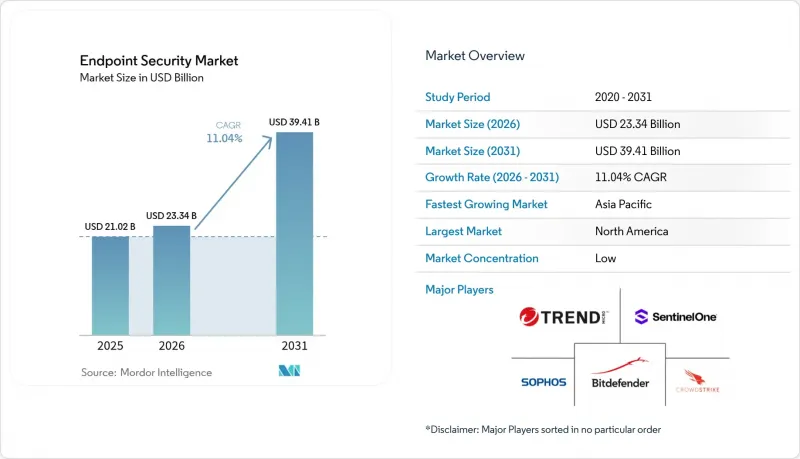
2026년 엔드포인트 보안 시장 규모는 233억 4,000만 달러로 추정되고 있고 2025년 210억 2,000만 달러에서 성장하여 2031년에는 394억 1,000만 달러에 이를 것으로 예측됩니다.
2026년부터 2031년까지 연평균 11.04%의 연평균 복합 성장률(CAGR)을 나타낼 것으로 예상됩니다.
엔드포인트 보안 시장의 강력한 수요는 원격근무 및 하이브리드 근무로의 꾸준한 전환, BYOD(Bring Your Own Device) 정책의 확대, RaaS(Ransomware-as-a-Service) 툴킷의 고도화 등에 기인합니다. 때문입니다. 또한, 기업은 IoT(Internet of Things)의 보급 확대에 직면하고 있으며, 이로 인해 IT 네트워크와 OT(Operational Technology) 네트워크의 경계가 모호해져 기존에는 사무기기를 표적으로 삼았던 것과 동일한 위협에 중요 산업 자산이 노출되고 있습니다. 중요한 산업 자산이 노출되고 있습니다. 따라서 클라우드를 통한 제어 기능, 제로 트러스트 액세스 정책, AI를 활용한 행동 분석은 현대 엔드포인트 보호 전략의 표준 구성 요소로 자리 잡고 있습니다. 플랫폼 제공업체들은 이에 대응하여 칩 수준의 보안 기능을 내장하고, 엔드포인트 보호 플랫폼(EPP) 및 엔드포인트 감지 및 대응(EDR) 기능을 SASE(Secure Access Service Edge) 솔루션에 통합하여 분산된 분산된 사용자 전체에 대한 정책 적용을 간소화합니다.
세계의 엔드포인트 보안 시장 동향 및 인사이트
BYOD 및 모바일 워크포스 급증
BYOD 정책으로 인해 기존 방화벽 밖에 위치한 약 47억 개의 모바일 엔드포인트가 노출되면서 기업 데이터와 개인용 앱을 분리하는 모바일 기기 관리 도구가 빠르게 도입되고 있으며, 엔드포인트 보안 시장이 강세를 보이고 있습니다. 현재 공격의 70%에서 ID 침해가 확인되고 있기 때문에 기업들은 네트워크 액세스를 허용하기 전에 장치의 상태를 확인하는 제로 트러스트 프레임워크에 의존하고 있습니다. 경영진은 사이버 보안을 이사회 차원의 우선순위로 인식하고 있으며, 91%는 사이버 보안을 단순한 컴플라이언스 대응이 아닌 전략적 자산으로 인식하고 있는 것으로 나타났습니다. 최신 엔드포인트 제품군에 탑재된 AI 기능은 실시간 행동 분석을 통해 다양한 디바이스 환경 전반에서 위험한 행동을 감지합니다.
서비스형 랜섬웨어(RaaS)의 고도화
서비스형 랜섬웨어는 진입장벽을 낮춰 2024년 초 감염 건수가 50% 급증했습니다. 의료 분야 정보 유출의 평균 피해액은 현재 1,010만 달러에 달하며, 병원들은 엔드포인트와 네트워크 텔레메트리를 상관관계 분석하는 확장형 감지 및 대응(EDR) 플랫폼을 도입하고 있습니다. 이중, 삼중 협박 전술은 백업도 표적으로 삼고 있으며, 기업들은 데이터 복구 계획을 재설계해야 합니다. 애널리스트들은 2031년까지 랜섬웨어로 인한 피해액이 연간 2,650억 달러를 넘어설 것으로 예상하고 있으며, 이로 인해 예방적 엔드포인트 방어에 대한 투자가 증가할 것으로 전망하고 있습니다.
SOC 및 사고 대응팀의 기술력 부족
세계적으로 300만 명의 사이버 보안 전문가가 부족한 상황에서 최고정보보안책임자(CISO)의 절반 가량이 대응체계의 허점을 우려하고 있습니다. 이에 따라 관리형 감지 및 대응(MDR) 도입이 가속화되고 있으며, 2025년까지 조직의 절반이 24시간 365일 모니터링 업무를 아웃소싱할 것으로 예측됩니다. 경보의 우선순위를 정하고 봉쇄 조치를 스크립팅하는 자동화 및 AI 도구는 인력 공급 체계가 개선될 때까지 임시방편으로 활용될 수 있는 실용적인 조치로 간주됩니다.
부문 분석
엔드포인트 감지 및 대응(EDR) 제품은 CAGR 15.52%로 성장하고 있으며, 기존 안티바이러스 툴을 쉽게 능가하고 있습니다. 조직은 제로데이 공격을 식별하는 행동 분석을 선호하지만, 방화벽/UTM 어플라이언스는 기존 네트워크 장비와의 긴밀한 통합을 통해 19.58%의 매출 점유율을 유지하고 있습니다. 또한, 기업들이 사내 보안 운영 센터를 구축하는 대신 외부에서 전문 지식을 조달하는 경향이 강해지면서 MDR(Managed Detection and Response) 구독도 증가하고 있습니다.
GDPR(EU 개인정보보호규정) 및 NIS2와 같은 규제가 입증 가능한 데이터 보호 조치를 요구함에 따라 규제 당국의 감시가 암호화 및 데이터 유출 방지(DLP) 모듈에 활기를 불어넣고 있습니다. 보안 업데이트 배포 기간은 여전히 평균 97일이며, 공격 대상 영역이 노출된 채로 남아있기 때문에 패치 관리 툴에 대한 투자가 활발히 이루어지고 있습니다. 악성 소프트웨어를 차단하는 용도 제어 도구는 기업 네트워크의 개인 기기에서 섀도우 IT의 위험을 억제하는 데 도움이 됩니다.
클라우드 플랫폼은 2025년 이미 엔드포인트 보안 시장 규모의 57.88%를 차지했으며, 2031년까지 연평균 15.01% 성장할 것으로 예측됩니다. 중앙 집중식 정책 엔진은 전 세계에 분산된 디바이스에 대한 배포를 가속화하고, 대량의 데이터를 실시간으로 AI 모델에 공급합니다. 데이터 주권 관련 규제와 전문 운영 기술(OT)의 제약에 직면한 기업에서는 하이브리드 아키텍처가 여전히 인기를 끌고 있습니다.
On-Premise 구축은 로컬 처리가 필수적인 국방 및 중요 인프라 분야에서 여전히 지속되고 있습니다. 이러한 분야에서도 많은 팀들이 관리를 간소화하기 위해 소프트웨어 정의 네트워크와 클라우드 기반 보안을 결합한 SASE 오버레이를 채택하고 있습니다. 클라우드에 통합된 EDR 분석 기능은 공격의 잠복 시간을 단축하고 평균 대응 시간을 개선합니다.
엔드포인트 보안 시장은 솔루션 유형(안티바이러스/안티멀웨어, 방화벽/UTM 등), 도입 형태(On-Premise, 클라우드, 하이브리드), 조직 규모(대기업, 중소기업), 최종 사용자 산업(은행, 금융서비스 및 보험(BFSI), 정부/국방, 헬스케어/생명과학 등), 지역별로 세분화되어 있습니다. 생명과학 등), 그리고 지역별로 세분화되어 있습니다. 시장 예측은 금액(USD) 기준으로 제공됩니다.
지역별 분석
북미는 2025년 33.12%의 매출 점유율을 유지했습니다. 넉넉한 보안 예산, 고도화되는 위협 상황, 그리고 AI의 조기 도입이 지속적인 업그레이드를 촉진하고 있습니다. 정부의 클라우드 보안 프로그램과 벤더들의 촘촘한 네트워크가 선순환적인 혁신 사이클을 만들어내고 있습니다.
유럽의 모멘텀은 2024년 10월 NIS2 지침이 전면 시행되는 것에 기인합니다. 이에 따라 16만 개 이상의 조직은 인증된 엔드포인트 제어를 도입해야 하며, 위반 시 최대 1,000만 유로의 벌금이 부과될 수 있습니다. 이러한 규제로 인해 중요 인프라, 제조업, 디지털 서비스 제공업체 전반에 걸쳐 높은 수준 수요가 유지되고 있습니다.
아시아태평양은 CAGR 12.22%로 가장 빠르게 성장하는 지역입니다. 이 지역 국가들은 사이버 복원력 프레임워크에 투자하고 있으며, 통신 사업자와 금융 기관에 대한 공격이 주목을 받으면서 경영진의 관심이 더욱 높아지고 있습니다. 중국 보안팀은 API 노출을 가장 큰 우려 사항으로 꼽았으며, 27%는 악성코드보다 API 노출을 우선순위로 꼽았습니다. 일본, 한국, 호주 및 아세안 국가들에서 정부 지원과 현지 벤더 생태계를 통해 도입이 가속화되고 있습니다.
중동 및 아프리카에서는 사이버 보험료 인상과 개인정보 보호법 강화로 인해 은행과 에너지 사업자들이 엔드포인트 통제 강화에 나서고 있습니다. 라틴아메리카에서는 특히 소매업과 디지털 뱅킹 기업에서 기존 On-Premise 환경을 뛰어넘는 형태로 클라우드 도입이 확대되고 있습니다.
기타 혜택 :
- 엑셀 형식 시장 예측(ME) 시트
- 3개월간 애널리스트 지원
자주 묻는 질문
목차
제1장 서론
제2장 조사 방법
제3장 주요 요약
제4장 시장 구도
제5장 시장 규모와 성장 예측
제6장 경쟁 구도
제7장 시장 기회와 향후 동향
KTH 26.05.29Endpoint Security Market size in 2026 is estimated at USD 23.34 billion, growing from 2025 value of USD 21.02 billion with 2031 projections showing USD 39.41 billion, growing at 11.04% CAGR over 2026-2031.
Strong demand in the endpoint security market stems from the steady shift toward remote and hybrid work, the expansion of bring-your-own-device (BYOD) policies, and the growing sophistication of ransomware-as-a-service toolkits. Enterprises also face an expanding Internet-of-Things (IoT) footprint that blurs the line between information-technology and operational-technology networks, exposing critical industrial assets to the same threats historically aimed at office devices. Cloud-delivered controls, zero-trust access policies, and AI-driven behavioural analytics are therefore becoming default components of modern endpoint protection strategies. Platform providers are responding by embedding chip-level security features and bundling endpoint protection platform (EPP) and endpoint detection and response (EDR) capabilities into secure-access-service-edge (SASE) offerings to simplify policy enforcement across distributed users.
Global Endpoint Security Market Trends and Insights
Surge in BYOD and Mobile Workforce
The endpoint security market is witnessing strong momentum as BYOD policies have exposed roughly 4.7 billion mobile endpoints that sit outside traditional firewalls, prompting rapid deployment of mobile-device-management tools that partition corporate data from personal apps. Identity compromise now appears in 70% of attacks, so firms lean on zero-trust frameworks that verify device posture before allowing network access. Executives increasingly view cybersecurity as a board-level priority, with 91% describing it as a strategic asset rather than a compliance exercise. AI features embedded in modern endpoint suites perform real-time behavioural analysis to flag risky actions across a diverse device ecosystem.
Escalating Sophistication of Ransomware-as-a-Service
Service-based ransomware lowered the barrier to entry, triggering a 50% spike in infections during early 2024. Healthcare breaches now cost USD 10.1 million on average, forcing hospitals to adopt extended-detection-and-response platforms that correlate endpoint and network telemetry. Double- and triple-extortion tactics also target backups, compelling enterprises to redesign data-recovery plans. Analysts expect ransomware damage to surpass USD 265 billion annually by 2031, funnelling more spend into proactive endpoint defences.
Skill Shortage in SOC and Incident-Response Teams
The global deficit of 3 million cyber professionals leaves roughly half of chief information security officers anxious about coverage gaps. Managed-detection-and-response (MDR) uptake is therefore accelerating, with half of organizations expected to outsource 24/7 monitoring by 2025. Automation and AI tools that triage alerts and script containment actions are seen as practical stopgaps until the workforce pipeline improves.
Other drivers and restraints analyzed in the detailed report include:
- Proliferation of IoT Endpoints Across OT Networks
- Wider Adoption of SASE Bundling EPP/EDR at Edge
- Budget Constraints Among SMBs
For complete list of drivers and restraints, kindly check the Table Of Contents.
Segment Analysis
Endpoint detection and response products are expanding at 15.52% CAGR, easily eclipsing legacy antivirus tools. Organizations favour behaviour analytics that spotlight zero-day exploits, while firewall/UTM appliances retain 19.58% revenue share thanks to deep integration with existing network gear. Managed-detection-and-response subscriptions are also gaining ground as firms lease expertise rather than build internal security operations centres.
Regulatory scrutiny is breathing life into encryption and data-loss-prevention modules as rules such as GDPR and NIS2 demand demonstrable data-protection controls. Patch-management utilities attract spend because security updates still average a 97-day rollout window, leaving attack surfaces exposed. Application-control tools that block unauthorized software help limit shadow-IT risks for personal devices on corporate networks.
Cloud platforms already command 57.88% of the endpoint security market size in 2025 and will compound 15.01% annually to 2031. Centralized policy engines accelerate rollout across globally distributed devices and feed AI models with large data volumes in real time. Hybrid architectures remain popular for firms facing data-sovereignty rules or specialist operational-technology constraints.
On-premises deployments persist in defence and critical-infrastructure verticals where local processing is mandated. Even there, many teams adopt SASE overlays that couple software-defined networking with cloud-delivered security to simplify administration. Integrated EDR analytics in the cloud reduce dwell time and enhance mean-time-to-respond statistics.
Endpoint Security Market is Segmented by Solution Type (Antivirus/Anti-malware, Firewall/UTM, and More), Deployment Mode (On-Premises, Cloud, and Hybrid), Organization Size (Large Enterprises and Small and Medium-Sized Enterprises), End-User Industry (BFSI, Government and Defense, Healthcare and Life Sciences, and More), and Geography. The Market Forecasts are Provided in Terms of Value (USD).
Geography Analysis
North America maintained 33.12% revenue share in 2025. Deep security budgets, an advanced threat landscape, and early AI adoption fuel ongoing upgrades. Government cloud-security programs and a dense network of vendors create a virtuous innovation cycle.
Europe's momentum is tied to the full enforcement of the NIS2 directive in October 2024, which compels more than 160,000 organizations to deploy certified endpoint controls or face fines up to EUR 10 million. The regulation keeps demand high across critical infrastructure, manufacturing, and digital services providers.
Asia-Pacific is the fastest-growing territory at 12.22% CAGR. Nations across the region pour investment into cyber-resilience frameworks, and high-profile attacks on telecoms and financial institutions have sharpened executive focus. Chinese security teams rank API exposure as their top concern, with 27% putting it ahead of malware. Government funding and local vendor ecosystems accelerate adoption across Japan, South Korea, Australia, and the ASEAN bloc.
The Middle East and Africa notice rising cyber-insurance premiums and tougher privacy laws, nudging banks and energy operators to upgrade endpoint controls. Latin America expands cloud deployments that leapfrog legacy on-premises estates, particularly in retail and digital-banking firms.
- Trend Micro Inc.
- CrowdStrike Holdings Inc.
- SentinelOne Inc.
- Sophos Ltd.
- Bitdefender LLC
- ESET Spol. s r.o.
- Kaspersky Lab JSC
- Trellix (Musarubra US LLC)
- OpenText (Cybersecurity & Carbonite Unit)
- WatchGuard Technologies Inc.
- Fortinet Inc.
- Cisco Systems Inc.
- Palo Alto Networks Inc.
- Broadcom Inc. (Symantec Endpoint)
- Microsoft Corporation (Defender for Endpoint)
- Deep Instinct Ltd
- Cybereason Inc.
- BlackBerry Ltd (Cylance)
- Malwarebytes Inc.
- AhnLab Inc.
- F-Secure Corp.
- Elastic NV (Security)
- ReaQta BV (IBM)
- Comodo Security Solutions Inc.
- Seqrite (Quick Heal Technologies)
Additional Benefits:
- The market estimate (ME) sheet in Excel format
- 3 months of analyst support
TABLE OF CONTENTS
1 INTRODUCTION
- 1.1 Study Assumptions and Market Definition
- 1.2 Scope of the Study
2 RESEARCH METHODOLOGY
3 EXECUTIVE SUMMARY
4 MARKET LANDSCAPE
- 4.1 Market Overview
- 4.2 Market Drivers
- 4.2.1 Surge in BYOD and mobile workforce
- 4.2.2 Escalating sophistication of ransomware-as-a-service
- 4.2.3 Proliferation of IoT endpoints across OT networks
- 4.2.4 Wider adoption of SASE bundling EPP/EDR at edge
- 4.2.5 Chip-level security IP integrated by OEMs
- 4.2.6 Cyber-insurance premium discounts for certified EDR
- 4.3 Market Restraints
- 4.3.1 Skill shortage in SOC & incident-response teams
- 4.3.2 Budget constraints among SMBs
- 4.3.3 Rising privacy backlash against continuous endpoint telemetry
- 4.3.4 Supply-chain risk of third-party security agents
- 4.4 Industry Value Chain Analysis
- 4.5 Regulatory Landscape
- 4.6 Technological Outlook
- 4.7 Industry Attractiveness - Porter's Five Forces Analysis
- 4.7.1 Bargaining Power of Suppliers
- 4.7.2 Bargaining Power of Buyers
- 4.7.3 Threat of New Entrants
- 4.7.4 Threat of Substitutes
- 4.7.5 Intensity of Competitive Rivalry
- 4.8 Impact of Macroeconomic Factors on the Market
5 MARKET SIZE AND GROWTH FORECASTS (VALUES)
- 5.1 By Solution Type
- 5.1.1 Antivirus / Anti-malware
- 5.1.2 Firewall / UTM
- 5.1.3 Endpoint Detection and Response (EDR)
- 5.1.4 Managed Detection and Response (MDR)
- 5.1.5 Encryption and Data Loss Prevention
- 5.1.6 Patch and Configuration Management
- 5.1.7 Application and Device Control
- 5.1.8 Others
- 5.2 By Deployment Mode
- 5.2.1 On-premises
- 5.2.2 Cloud
- 5.2.3 Hybrid
- 5.3 By Organization Size
- 5.3.1 Large Enterprises
- 5.3.2 Small and Medium-sized Enterprises (SME)
- 5.4 By End-user Industry
- 5.4.1 BFSI
- 5.4.2 Government and Defense
- 5.4.3 Healthcare and Life Sciences
- 5.4.4 Manufacturing
- 5.4.5 Energy and Utilities
- 5.4.6 Retail and e-Commerce
- 5.4.7 IT and Telecom
- 5.4.8 Education
- 5.4.9 Other End-User Industries
- 5.5 By Geography
- 5.5.1 North America
- 5.5.1.1 United States
- 5.5.1.2 Canada
- 5.5.1.3 Mexico
- 5.5.2 South America
- 5.5.2.1 Brazil
- 5.5.2.2 Argentina
- 5.5.2.3 Chile
- 5.5.2.4 Rest of South America
- 5.5.3 Europe
- 5.5.3.1 Germany
- 5.5.3.2 United Kingdom
- 5.5.3.3 France
- 5.5.3.4 Italy
- 5.5.3.5 Spain
- 5.5.3.6 Russia
- 5.5.3.7 Rest of Europe
- 5.5.4 Asia-Pacific
- 5.5.4.1 China
- 5.5.4.2 India
- 5.5.4.3 Japan
- 5.5.4.4 South Korea
- 5.5.4.5 Australia
- 5.5.4.6 Singapore
- 5.5.4.7 Malaysia
- 5.5.4.8 Rest of Asia-Pacific
- 5.5.5 Middle East and Africa
- 5.5.5.1 Middle East
- 5.5.5.1.1 United Arab Emirates
- 5.5.5.1.2 Saudi Arabia
- 5.5.5.1.3 Turkey
- 5.5.5.1.4 Rest of Middle East
- 5.5.5.2 Africa
- 5.5.5.2.1 South Africa
- 5.5.5.2.2 Nigeria
- 5.5.5.2.3 Rest of Africa
- 5.5.5.1 Middle East
- 5.5.1 North America
6 COMPETITIVE LANDSCAPE
- 6.1 Market Concentration
- 6.2 Strategic Moves
- 6.3 Market Share Analysis
- 6.4 Company Profiles (includes Global level Overview, Market level overview, Core Segments, Financials as available, Strategic Information, Market Rank/Share, Products and Services, Recent Developments)
- 6.4.1 Trend Micro Inc.
- 6.4.2 CrowdStrike Holdings Inc.
- 6.4.3 SentinelOne Inc.
- 6.4.4 Sophos Ltd.
- 6.4.5 Bitdefender LLC
- 6.4.6 ESET Spol. s r.o.
- 6.4.7 Kaspersky Lab JSC
- 6.4.8 Trellix (Musarubra US LLC)
- 6.4.9 OpenText (Cybersecurity & Carbonite Unit)
- 6.4.10 WatchGuard Technologies Inc.
- 6.4.11 Fortinet Inc.
- 6.4.12 Cisco Systems Inc.
- 6.4.13 Palo Alto Networks Inc.
- 6.4.14 Broadcom Inc. (Symantec Endpoint)
- 6.4.15 Microsoft Corporation (Defender for Endpoint)
- 6.4.16 Deep Instinct Ltd
- 6.4.17 Cybereason Inc.
- 6.4.18 BlackBerry Ltd (Cylance)
- 6.4.19 Malwarebytes Inc.
- 6.4.20 AhnLab Inc.
- 6.4.21 F-Secure Corp.
- 6.4.22 Elastic NV (Security)
- 6.4.23 ReaQta BV (IBM)
- 6.4.24 Comodo Security Solutions Inc.
- 6.4.25 Seqrite (Quick Heal Technologies)
7 MARKET OPPORTUNITIES AND FUTURE TRENDS
- 7.1 White-Space and Unmet-Need Assessment