|
시장보고서
상품코드
2044132
첨단 운전자 보조 시스템(ADAS) 시장 : 점유율 분석, 산업 동향 및 통계, 성장 예측(2026-2031년)Advanced Driver Assistance Systems - Market Share Analysis, Industry Trends & Statistics, Growth Forecasts (2026 - 2031) |
||||||
 Mordor Intelligence
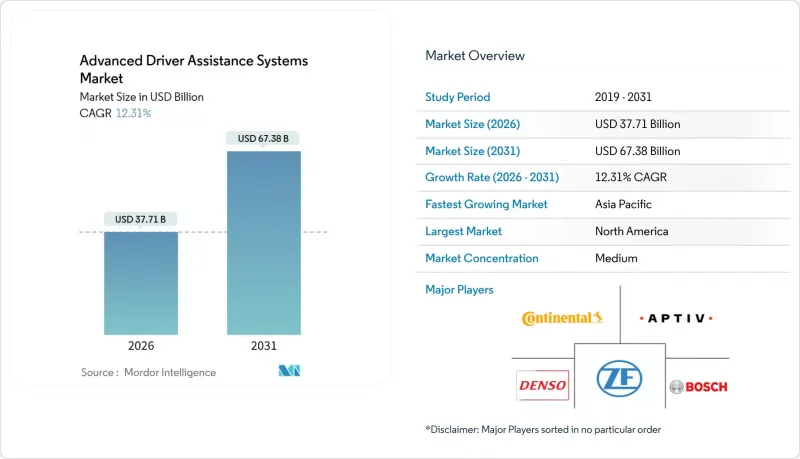
첨단 운전자 보조 시스템(ADAS) 시장 규모는 2026년에 377억 1,000만 달러 라고 추계되고 있어 예측 기간(2026-2031년)에서 CAGR 12.31%로 성장을 지속하여, 2031년에는 673억 8,000만 달러에 이를 전망입니다.
이러한 강력한 성장은 안전 규정의 통합, 센서 비용의 급격한 하락, 그리고 자동차 제조업체가 차량 인도 후 장기간에 걸쳐 구독 수익을 얻을 수 있는 소프트웨어 정의 차량 아키텍처를 반영하고 있습니다. AI 기반 센서 융합으로 하드웨어의 중복성이 줄어들면서 레벨 2+ 기능의 번들링이 하위 부문으로 확대되고 있으며, 신흥국의 SUV 및 고급차 수요 증가로 첨단 운전자 보조 시스템(ADAS) 시장의 잠재적 고객층이 확대되고 있습니다. 확대되고 있습니다. 북미의 보험 텔레매틱스 할인, Euro NCAP의 '안전운전' 평가 항목 및 중국의 C-NCAP 기준 준수가 장착 의무화를 가속화하고 있으며, OEM 업체들은 자동 긴급 제동, 차선 유지 지원, 보행자 감지 기능을 표준화해야 하는 상황입니다. 1티어 공급업체들이 도메인 컨트롤러 계약을 따내기 위해 경쟁하고, 반도체 파트너들이 컴퓨팅 스택의 설계 채택을 위해 경쟁하는 가운데, 경쟁의 강도는 여전히 높은 수준입니다.
세계 첨단 운전자 보조 시스템(ADAS) 시장 동향 및 인사이트
엄격한 안전 규정으로 도입 일정 단축
규제 당국은 현재 ADAS 기능을 별점 평가 및 형식인증 규정에 명문화하고 있으며, 과거 도입을 지연시켰던 자율적 허점을 없애고 있습니다. NHTSA의 2024년 개정안에서는 미국에서 판매되는 모든 신형 승용차에 보행자 감지 기능이 있는 자동 긴급 제동을 의무화하고 있으며, Euro NCAP의 '안전 운전' 영역에서는 엔트리급 등급이라도 적외선 운전자 모니터링 카메라 장착을 의무화하고 있습니다. 의무화되어 있습니다. 중국의 C-NCAP도 이러한 기준을 준수하고 있으며, 5성 등급을 획득하기 위해서는 차선 유지 지원 기능과 교통 표지판 인식 기능을 의무화하고 있습니다. 그 결과, 안전의 기준이 높아져 기본적인 안전 기능은 더 이상 차별화의 수단이 아니게 되었고, 경쟁사들은 더 충실한 레벨 2+ 패키지를 지향하며 첨단 운전자 보조 시스템(ADAS) 시장을 견인하고 있습니다.
AI를 활용한 센서 융합으로 레벨 2+ 패키지 실현
수백만 시간의 주행 데이터로 학습된 머신러닝 모델은 레이더, LiDAR, 카메라의 데이터를 융합하여 단일 센서로는 구현할 수 없는 강력한 360도 시야를 구축합니다. NVIDIA의 DRIVE Orin과 Mobileye의 SuperVision은 높은 연산 밀도가 고속도로에서 핸즈프리 주행, 차선 변경, 자동 주차를 어떻게 지원하는지 보여줍니다. 하드웨어 비용의 하락과 함께 이러한 패키지는 중급 차량에도 도입되어 지속적인 구독료를 창출함으로써 첨단 운전자 보조 시스템(ADAS) 시장에서의 대당 수익을 확대되고 있습니다.
고가의 센서가 보급의 걸림돌로 작용합니다.
최근 가격 하락에도 불구하고, 고급형 LiDAR 시스템은 세단의 가격을 크게 끌어올려 자동차 가격이 상당히 낮은 인도, 브라질, 인도네시아 등의 국가에서는 도입에 어려움이 있습니다. 마찬가지로, 이미징 그레이더도 눈에 띄는 비용 증가를 가져 오기 때문에 그 적용은 고급 차량 등급으로 제한됩니다. 이 문제는 이륜차에서 더욱 두드러지는데, 레이더 기술 비용이 차량 가격의 상당 부분을 차지하기 때문에 첨단 운전자 보조 시스템(ADAS) 시장에서의 보급이 더욱 지연되고 있습니다.
부문 분석
자동 비상 브레이크는 전 세계 규제에 따라 의무 장착이 확대되면서 2031년까지 연평균 성장률(CAGR)이 12.33%로 가장 높은 성장률을 보이며 ADAS(첨단 운전자 보조 시스템) 시장에서 가장 높은 성장세를 보일 것으로 예상되며, ADAS 시장에서의 중심적인 위치를 부각시키고 있습니다. 어댑티브 크루즈 컨트롤은 고급 제어 및 핸들링 개선으로 운전 경험을 향상시켜 2025년 기준 24.41%의 점유율을 유지했습니다.
초음파 센서와 서라운드 뷰 카메라가 결합된 주차 보조 시스템은 도심의 정체 속에서 보급이 진행되고 있으며, 사각지대 감지 및 차선 이탈 경고는 엔트리 모델에 기본 장착되어 있습니다. 나이트 비전, 교통 표지판 인식, 운전자 졸음 경보 등은 높은 센서 비용과 낮은 소비자 인지도로 인해 초기 보급에 어려움을 겪고 있어 틈새 수요에 머물러 있습니다. 전방충돌경보는 AEB 패키지에 포함되는 경향이 있으며, 단독 수요는 감소하고 있지만, 첨단 운전자 보조 시스템(ADAS) 시장 전체에서 시스템 번들링이 강화되고 있습니다.
레이더 센서는 전천후 신뢰성과 중간 가격대의 저렴한 가격으로 인해 2025년 첨단 운전자 보조 시스템(ADAS) 시장 점유율의 평균 45.54%를 차지했습니다. LiDAR는 중국 공급업체들이 단가를 500달러 미만으로 낮추면서 2031년까지 12.41%의 연평균 복합 성장률(CAGR)을 보일 것으로 예측되며, 중형 세단에서 레벨 2+의 도입을 촉진할 것으로 보입니다.
카메라는 800만 화소의 이미저가 기존 유닛을 대체해 막대한 비용 없이 저조도 환경에서의 검출 품질을 향상시켜 매출 점유율 30%대 중반을 차지하고 있습니다. 초음파 센서는 여전히 주차 보조 기능에 국한되어 있으며, 소형 레이더로 대체되고 있습니다. 적외선은 틈새 시장에 머물러 있으며, 고급 자동차의 야간 투시 및 운전자 모니터링 용도로만 제한적으로 사용되고 있습니다. 따라서 첨단 운전자 보조 시스템(ADAS) 시장에서 OEM 업체들이 캘리브레이션을 간소화하고 검증 주기를 단축하는 통합 솔루션을 찾는 가운데, 멀티센서퓨전(MultiSensorFusion)이 조달 로드맵을 결정하고 있습니다.
'첨단 운전자 보조 시스템(ADAS) 보고서'는 시스템 유형(주차보조시스템 등), 센서 유형(레이더, 라이더, 카메라 등), 차종(이륜차, 승용차, 상용차), 자율주행 레벨(레벨1 등), 판매 채널(OEM 순정 및 애프터마켓), 지역별로 구분하여 분석하였습니다. 및 지역별로 분류되어 있습니다. 시장 예측은 금액(USD) 및 수량(대수)으로 표시됩니다.
지역별 분석
북미는 NHTSA(미국 도로교통안전국)가 모든 신형 승용차에 보행자 감지 기능이 있는 자동 긴급제동장치를 의무화함에 따라 2025년 매출의 38.71%를 차지하며 첨단 운전자 보조 시스템(ADAS) 시장의 급속한 확장을 이끌었습니다. 또한, 보험사 프로그레시브와 스테이트 팜은 주행거리 기반 보험 제도를 도입하여 ADAS를 장착한 차량에 대해 매력적인 보험료 할인을 제공했습니다. 2025년 초, 캐나다는 미국과 규제를 일치시키고 형식 인증 장벽을 제거했습니다. 성숙한 텔레매틱스 인프라와 함께 캐나다의 보험사들은 안전 데이터로 수익을 창출하기 위해 발빠르게 움직였습니다.
아시아태평양은 2031년까지 연평균 복합 성장률(CAGR) 12.39%로 가장 높은 성장률을 나타낼 것으로 예측됩니다. 이러한 급격한 성장은 주로 중국, 인도, 일본이 레벨 2 이상의 기능을 주류 차종에 순차적으로 탑재하고 있기 때문입니다. 중국의 야심찬 지침은 2027년까지 모든 신차에 적응형 크루즈 컨트롤(ACC)과 교통 표지판 인식 기능을 탑재하도록 의무화하고 있습니다. 이 움직임은 시장의 상당 부분에 영향을 미칠 수 있습니다. 동시에 인도의 Bharat NCAP는 국내 제조업체에 전자식 안정성 제어(ESC)와 차선 유지 지원 기능을 표준으로 장착할 것을 요구하고 있습니다. 일본이 고속도로에서 레벨3 운전을 승인한 것은 이 규제의 추진력을 더욱 공고히 하고 ADAS(첨단 운전자 보조 시스템) 시장 가능성을 넓히고 있습니다.
2025년 유럽, 유럽, 중동 및 아프리카는 시장에서 두드러진 점유율을 차지했습니다. 이는 주로 Euro NCAP이 2024년에 시행한 이니셔티브에 따른 것으로, 이 기관은 '안전 운전' 분야에서 운전자 모니터링 시스템 평가를 중시했습니다. 중요한 움직임으로 독일은 메르세데스 벤츠의 "드라이브 파일럿"을 승인하여 레벨 3 책임 프레임워크의 시작을 알리고 OEM의 광범위한 도입을 위한 길을 열었습니다. 한편, 걸프협력회의(GCC) 회원국 정부는 2025년부터 관용차량에 자동긴급제동장치(AEB) 및 차선이탈경보장치 장착을 의무화하는 조치를 시작했습니다. 선구적인 움직임으로 브라질은 2028년을 목표로 ADAS 요건을 수립하고 있어, 도입이 늦었던 국가들 수요가 급증할 가능성을 시사하고 있습니다. 또한, 튀르키예의 생산기지는 서유럽에 버금가는 속도로 ADAS를 전개하고 있으며, 동시에 확대되는 ADAS(첨단 운전자 보조 시스템) 시장에 부품을 수출하고 있습니다.
기타 특전:
- 엑셀 형식 시장 예측(ME) 시트
- 3개월간 애널리스트 지원
자주 묻는 질문
목차
제1장 서론
제2장 조사 방법
제3장 주요 요약
제4장 시장 구도
제5장 시장 규모 및 성장 예측(금액(달러) 및 수량(대수))
제6장 경쟁 구도
제7장 시장 기회와 향후 전망
JHSThe Advanced Driver Assistance Systems Market size is estimated at USD 37.71 billion in 2026, and is expected to reach USD 67.38 billion by 2031, at a CAGR of 12.31% during the forecast period (2026-2031).
Buoyant growth reflects converging safety regulations, rapid sensor-cost deflation, and software-defined vehicle architectures that let automakers unlock subscription revenue long after delivery. Level 2+ feature bundling is moving down-segment as AI-based sensor fusion curbs hardware redundancy, while rising SUV and premium-car demand in emerging economies widens the total addressable pool for the advanced driver assistance system market. North American insurance-telematics discounts, Euro NCAP's Safe Driving domain, and China's C-NCAP alignment accelerate mandatory fitment, forcing OEMs to standardize automatic emergency braking, lane-keeping assist, and pedestrian detection. Competitive intensity remains high as Tier-1 suppliers vie for domain-controller contracts and semiconductor partners battle for design wins in the compute stack.
Global Advanced Driver Assistance Systems Market Trends and Insights
Stringent Safety Mandates Compress Adoption Timelines
Regulators now hard-code ADAS functions into star-rating and type-approval rules, eliminating voluntary loopholes that once slowed uptake. NHTSA's 2024 update requires automatic emergency braking with pedestrian detection on every new passenger vehicle sold in the United States, while Euro NCAP's "Safe Driving" domain forces infrared driver-monitoring cameras into even entry-level trims . China's C-NCAP aligns with these benchmarks, mandating lane-keeping assist and traffic-sign recognition for five-star status. The result is an elevated baseline that removes basic safety as a differentiation lever, steering competition toward richer Level 2+ packages that boost the advanced driver assistance system market.
AI-Based Sensor Fusion Unlocks Level 2+ Bundles
Machine-learning models trained on millions of driving hours fuse radar, LiDAR, and camera data into a 360-degree scene more robust than any single sensor can deliver. NVIDIA's DRIVE Orin and Mobileye's SuperVision illustrate how compute density supports highway hands-off capability, automated lane changes, and self-parking. These bundles migrate into mid-range vehicles as hardware costs fall, generating recurring subscription fees that enlarge revenue per unit within the advanced driver assistance system market .
High Sensor Cost Restricts Entry-Level Adoption
Despite recent price drops, a high-end LiDAR system significantly increases the cost of a sedan, making it challenging to adopt in countries like India, Brazil, and Indonesia, where car prices are considerably lower. Similarly, imaging radar adds a notable expense, restricting its application to premium car trims. The issue is even more pronounced for two-wheelers, where the cost of radar technology represents a substantial portion of the vehicle's price, further slowing its adoption in the advanced driver assistance system market.
Other drivers and restraints analyzed in the detailed report include:
- Rapid Sensor-Cost Deflation Broadens Access
- SDV and OTA Architectures Create Post-Sale Upside
- Poor-Weather Performance Constrains Operational Domains
For complete list of drivers and restraints, kindly check the Table Of Contents.
Segment Analysis
Automatic emergency braking recorded the fastest 12.33% CAGR outlook to 2031 as global rules convert it into mandatory equipment, underscoring its centrality to the advanced driver assistance system market. Adaptive cruise control retained a 24.41% share in 2025 because advanced control and handling improvements uplift the driving experience.
Parking-assist suites that blend ultrasonic sensors with surround-view cameras gain traction amid urban congestion, while blind-spot detection and lane-departure warning commoditize into entry trims. Night vision, traffic-sign recognition, and driver drowsiness alert linger at niche volumes as higher sensor costs and limited consumer awareness cap early uptake. Forward-collision warning subsumes into AEB packages, reducing standalone demand but strengthening system bundling across the advanced driver assistance system market.
Radar sensors averaged 45.54% of the advanced driver assistance system market share in 2025 owing to their all-weather reliability and mid-range affordability. LiDAR boasts a 12.41% CAGR to 2031 after Chinese suppliers pushed unit prices below USD 500, fueling Level 2+ deployment in mid-segment sedans.
Cameras occupy mid-30s revenue share as 8-megapixel imagers replace legacy units, raising low-light detection quality without prohibitive cost. Ultrasonic sensors remain relegated to parking assist and face substitution by compact radars. Infrared remains niche, reserved for night-vision and driver-monitoring applications in luxury vehicles. Multisensor fusion therefore defines the procurement roadmap as OEMs demand integrated suites that simplify calibration and shorten validation cycles in the advanced driver assistance system market.
The Advanced Driver Assistance System Report is Segmented by System Type (Parking Assist Systems and More), Sensor Type (Radar, Lidar, Camera, and More), Vehicle Type (Two-Wheelers, Passenger Cars, and Commercial Vehicles), Level of Autonomy (Level 1 and More), Sales Channel (OEM-Fitted and Aftermarket), and Geography. Market Forecasts are in Value (USD) and Volume (Units).
Geography Analysis
North America led with 38.71% of 2025 revenue after NHTSA mandated automatic emergency braking with pedestrian detection on every new passenger car, leading to a swift boost in the advanced driver assistance system market. Furthermore, insurance giants Progressive and State Farm rolled out usage-based insurance schemes, offering enticing premium discounts for vehicles equipped with ADAS. In early 2025, Canada harmonized its regulations with those of the U.S., eliminating homologation hurdles. Coupled with a mature telematics infrastructure, insurers in Canada swiftly capitalized on monetizing safety data.
Asia Pacific will post the fastest 12.39% CAGR through 2031. This surge is primarily attributed to China, India, and Japan, as they progressively integrate Level 2+ functions into mainstream vehicle segments. China's ambitious directive mandates that by 2027, all new cars must feature adaptive cruise control and traffic-sign recognition. This move potentially impacts a significant portion of the market. Simultaneously, India's Bharat NCAP is urging local manufacturers to adopt electronic stability control and lane-keeping assist as standard features. Japan's endorsement of Level 3 expressway driving further solidifies this regulatory momentum, expanding the market horizons for advanced driver assistance systems.
In 2025, Europe, the Middle East, and Africa collectively accounted for a notable share of the market. This was largely driven by Euro NCAP's 2024 initiative, which emphasized scoring driver-monitoring systems under its Safe Driving domain. In a significant move, Germany greenlit Mercedes-Benz's Drive Pilot, marking the dawn of Level 3 liability frameworks and paving the way for broader OEM introductions. Meanwhile, governments within the Gulf Cooperation Council began enforcing mandates for Automatic Emergency Braking (AEB) and lane-departure warnings on their state fleets starting in 2025. In a forward-looking gesture, Brazil is formulating ADAS requirements set for 2028, hinting at a potential surge from late adopters. Not to be overlooked, Turkey's production hubs are rolling out ADAS at rates comparable to Western Europe, simultaneously exporting components to the expansive advanced driver assistance system market.
- Continental AG
- Robert Bosch GmbH
- DENSO Corporation
- Aptiv PLC
- ZF Friedrichshafen AG
- Magna International
- Valeo SA
- Hyundai Mobis
- Aisin Corporation
- Mobileye (Intel)
- NVIDIA Corporation
- NXP Semiconductors
- Infineon Technologies
- Renesas Electronics
- ]ON Semiconductor
- STMicroelectronics
- Hitachi Astemo
- Autoliv Inc.
Additional Benefits:
- The market estimate (ME) sheet in Excel format
- 3 months of analyst support
TABLE OF CONTENTS
1 Introduction
- 1.1 Study Assumptions & Market Definition
- 1.2 Scope of the Study
2 Research Methodology
3 Executive Summary
4 Market Landscape
- 4.1 Market Overview
- 4.2 Market Drivers
- 4.2.1 Stringent Safety Mandates in United States, European Union, China
- 4.2.2 AI-Based Sensor Fusion Enabling L2+ Feature Bundling
- 4.2.3 Rapid Sensor-Cost Deflation & Module Integration
- 4.2.4 SDV/OTA Architectures Unlocking Post-Sale Revenue
- 4.2.5 Growing SUV & Premium-Car Penetration in Emerging Markets
- 4.2.6 Usage-Based-Insurance Discounts Accelerating OEM Fitment
- 4.3 Market Restraints
- 4.3.1 High Lidar/Radar System Cost
- 4.3.2 Functional Limitations in Poor Weather & Lighting
- 4.3.3 Mmwave Chipset & Substrate Supply Bottlenecks
- 4.3.4 Cyber-Security Liability & Data-Privacy Risk
- 4.4 Value / Supply-Chain Analysis
- 4.5 Regulatory Landscape
- 4.6 Technological Outlook
- 4.7 Porter's Five Forces
- 4.7.1 Bargaining Power of Suppliers
- 4.7.2 Bargaining Power of Buyers
- 4.7.3 Threat of New Entrants
- 4.7.4 Threat of Substitutes
- 4.7.5 Competitive Rivalry
5 Market Size & Growth Forecasts (Value (USD) and Volume (Units))
- 5.1 By System Type
- 5.1.1 Parking Assist Systems
- 5.1.2 Adaptive Front-Lighting
- 5.1.3 Night Vision Systems
- 5.1.4 Blind-Spot Detection
- 5.1.5 Automatic Emergency Braking
- 5.1.6 Forward Collision Warning
- 5.1.7 Driver Drowsiness Alert
- 5.1.8 Traffic Sign Recognition
- 5.1.9 Lane Departure Warning
- 5.1.10 Adaptive Cruise Control
- 5.2 By Sensor Type
- 5.2.1 Radar
- 5.2.2 LiDAR
- 5.2.3 Camera
- 5.2.4 Ultrasonic
- 5.2.5 Infra-red
- 5.3 By Vehicle Type
- 5.3.1 Two-Wheelers
- 5.3.2 Passenger Cars
- 5.3.3 Medium and Heavy Commercial Vehicles
- 5.4 By Level of Autonomy
- 5.4.1 Level 1
- 5.4.2 Level 2
- 5.4.3 Level 3
- 5.4.4 Level 4
- 5.4.5 Level 5
- 5.5 By Sales Channel
- 5.5.1 OEM-Fitted
- 5.5.2 Aftermarket Retrofit
- 5.6 By Geography
- 5.6.1 North America
- 5.6.1.1 United States
- 5.6.1.2 Canada
- 5.6.1.3 Rest of North America
- 5.6.2 South America
- 5.6.2.1 Brazil
- 5.6.2.2 Argentina
- 5.6.2.3 Rest of South America
- 5.6.3 Europe
- 5.6.3.1 Germany
- 5.6.3.2 United Kingdom
- 5.6.3.3 France
- 5.6.3.4 Italy
- 5.6.3.5 Spain
- 5.6.3.6 Rest of Europe
- 5.6.4 Asia Pacific
- 5.6.4.1 China
- 5.6.4.2 India
- 5.6.4.3 Japan
- 5.6.4.4 South Korea
- 5.6.4.5 Rest of Asia Pacific
- 5.6.5 Middle East and Africa
- 5.6.5.1 United Arab Emirates
- 5.6.5.2 Saudi Arabia
- 5.6.5.3 South Africa
- 5.6.5.4 Turkey
- 5.6.5.5 Rest of Middle East and Africa
- 5.6.1 North America
6 Competitive Landscape
- 6.1 Market Concentration
- 6.2 Strategic Moves
- 6.3 Market Share Analysis
- 6.4 Company Profiles (includes Global Level Overview, Market Level Overview, Core Segments, Financials as Available, Strategic Information, Market Rank/Share for Key Companies, Products and Services, SWOT Analysis, and Recent Developments)
- 6.4.1 Continental AG
- 6.4.2 Robert Bosch GmbH
- 6.4.3 DENSO Corporation
- 6.4.4 Aptiv PLC
- 6.4.5 ZF Friedrichshafen AG
- 6.4.6 Magna International
- 6.4.7 Valeo SA
- 6.4.8 Hyundai Mobis
- 6.4.9 Aisin Corporation
- 6.4.10 Mobileye (Intel)
- 6.4.11 NVIDIA Corporation
- 6.4.12 NXP Semiconductors
- 6.4.13 Infineon Technologies
- 6.4.14 Renesas Electronics
- 6.4.15 ]ON Semiconductor
- 6.4.16 STMicroelectronics
- 6.4.17 Hitachi Astemo
- 6.4.18 Autoliv Inc.
7 Market Opportunities & Future Outlook
- 7.1 White-space & Unmet-need Assessment