
|
시장보고서
상품코드
2063395
고유량 산소요법 기기 : 시장 점유율 분석, 업계 동향 및 통계, 성장 예측(2026-2031년)High Flow Oxygen Therapy Devices - Market Share Analysis, Industry Trends & Statistics, Growth Forecasts (2026 - 2031) |
||||||
 Mordor Intelligence
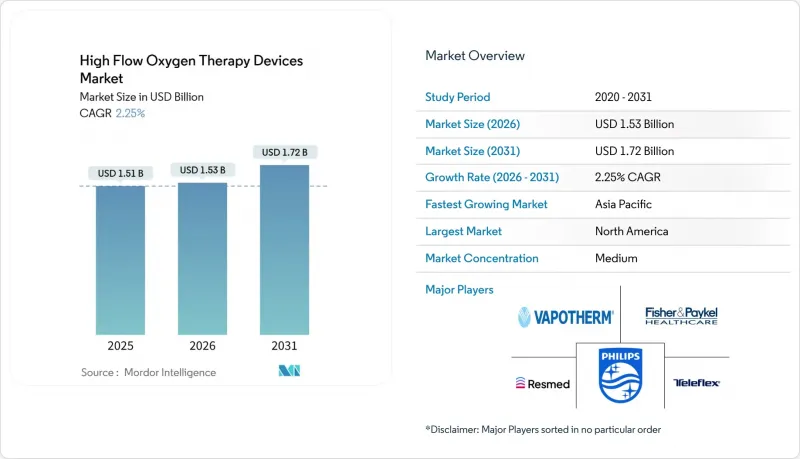
Mordor Intelligence에 의하면, 고유량 산소요법 기기 시장 규모는 2025년에 15억 1,000만 달러로 평가되었습니다. 2026년에 15억 3,000만 달러에서 2031년까지 17억 2,000만 달러에 이를 것으로 예측되며, 2026-2031년에 걸쳐 CAGR 2.25%로 성장할 전망입니다.
본 보고서는 제품 유형(고유량 비강 캐뉼라, 호흡 회로, 기타), 기기의 이동성(휴대용/가정용 고유량 비강 캐뉼라(HFNC) 시스템, 기타), 가습 기술(능동 가습식, 기타), 용도(급성 호흡부전, 기타), 최종 사용자(병원 및 클리닉, 기타), 지역(북미, 기타)별로 분류되어 있습니다. 시장 전망은 금액(달러) 기준으로 제시되어 있습니다.
세계의 고유량 산소요법 기기 시장 동향 및 인사이트
COPD와 폐렴 유병률 증가로 인해 비침습적 산소요법에 대한 수요가 높아지고 있습니다.
세계 COPD 환자 수는 약 3억 9,200만 명에 달하며, 계속 증가하는 추세로 호흡기 의료 자원에 지속적인 부담을 주고 있습니다. 미국에서 노년층의 폐렴으로 인한 입원 건수는 2020년부터 2024년 사이에 18% 증가했습니다. 2024년에 발표된 다기관 공동 연구에 따르면, 고유량 산소요법은 급성 저산소성 호흡부전 환자에서 기관 삽관율을 최대 20%까지 낮출 수 있는 것으로 나타났습니다. 이러한 결과는 COPD 악화에 대한 비강 캐뉼라의 조기 사용을 뒷받침하며, 소모품에 대한 지속적인 수요를 강화하고 있습니다. 산소 포화도를 90% 이상으로 유지하는 재택 사용 프로토콜은 현재 메디케어 적용 대상에 포함되어 있어, 환자들의 이용 기회가 확대되고 있습니다.
코로나19 이후의 프로토콜 : 응급실 및 병동에서의 HFOT 정착
2025년 미국 내 320개 병원을 대상으로 실시한 조사에 따르면, SpO2가 92% 미만으로 떨어졌을 때 첫 번째 선택으로 고유량 산소요법 시스템을 도입한 병원은 78%에 달하고, 팬데믹 이전 도입률의 거의 2배에 이릅니다. 지속적인 사용은 감염 예방 측면에서의 이점과 중환자실 이송 감소 효과가 인정되고 있음을 반영합니다. 2024년에 발표된 유럽호흡기학회 지침은 면역결핍 환자에 대한 권장 치료법으로 고유량 산소요법을 정립했습니다. 그러나 인프라 격차는 여전히 남아 있습니다. 미국 중서부에 위치한 한 지역 의료시설에서는 겨울철 정전으로 인해 고유량 산소 장비를 일시적으로 가동 중단할 수밖에 없었습니다.
팬데믹 이후의 장비 공급 과잉이 평균 판매 가격(ASP)을 끌어내렸습니다.
2024년, 미국 병원에서는 중환자실(ICU) 병상 1개당 2.8대의 고유량 산소요법 장비를 보유하고 있으며, 이는 팬데믹 이전 수준의 2배 이상에 해당합니다. 재고 과잉으로 인해 갱신 입찰 시 15-20%의 가격 인하를 피할 수 없게 되어, 이익률이 압박받고 있습니다. 독일의 한 대학병원에서는 재고를 무기로 삼아 2023년 가격보다 18% 낮은 가격으로 입찰을 따낸 사례가 있습니다. 고정식 시스템의 평균 판매 가격(ASP)은 2023년 4,200달러에서 2025년에는 3,500달러로 하락하여, 고유량 산소요법 기기 시장에 직접적인 타격을 주었습니다.
부문별 분석
고유량 비강 캐뉼라는 2025년 매출의 34.56%를 차지하며, 인터페이스 부문 내 고유량 산소요법 기기 시장 점유율을 뒷받침했습니다. 한편, 가온 가습기는 5.26%의 성장률을 기록하며, 임상적 쾌적성 전략에서 매우 중요한 역할을 하고 있습니다. 피셔 앤 페이켈의 MR850은 2025년에 미국 중환자실(ICU)의 표준 기기로 지정되었으며, 조사 대상 프로토콜의 68%에서 채택되었습니다. 호흡 회로, 수조, 프로브는 30일 치료 기간당 180-240달러의 수익원을 형성하고 있으며, 고유량 산소요법 기기 시장 규모를 지탱하는 주축이 되고 있습니다.
액세서리나 풀페이스 마스크는 소아 환자나 밀실공포증이 있는 환자 등 틈새 시장층을 대상으로 합니다. 레스메드사의 AirFit F30i는 오버랩 증후군 환자를 치료하는 유럽의 수면 센터들에서 호평을 받고 있습니다. 재택 간호용으로 묶음 판매되는 휴대용 키트는 병원용 판매에 비해 이익률을 12-15% 압박하지만, 의료용 내구성 기기 공급업체 입장에서는 조달 절차를 간소화해 줍니다. ISO 80601-2-90의 검사 요건은 여전히 인증된 실험실을 보유한 기존 제조업체에 유리하게 작용하고 있습니다.
2025년 매출의 61.21%는 고정형 병원용 시스템이 차지했지만, 보험사들이 조기 퇴원을 장려함에 따라 휴대형 플랫폼은 연평균 성장률(CAGR) 6.54%로 급속히 성장하고 있습니다. 메디케어의 2025년 규정 변경에 따라, Vapotherm의 Precision Flow Go와 같이 3kg 이하의 배터리 구동형 장치가 시장에 출시되었습니다. 휴대용 기기의 작동 시간은 50 L/min 기준 평균 4-6시간이며, 야간에 혼자 사용하는 데에는 제한이 있습니다. Hamilton의 T1은 스마트 블로어 제어 기능을 통해 작동 시간을 최대 8시간까지 연장할 수 있지만, 1,200달러의 가격 차이로 인해 판매량이 제한되고 있습니다.
ICU 팀이 인공호흡기 분리 과정을 가속화하는 가운데, 침습적 모드와 고유량 모드를 전환할 수 있는 인공호흡기 일체형 모듈 시장은 연평균 3.8%의 성장률을 보이고 있습니다. 고정식 시스템은 최대 80 L/min의 유량을 제공하며, 중앙 가스 공급구에 연결할 수 있기 때문에 수요가 급증하는 상황을 대비한 계획에서는 여전히 선호되고 있습니다. 다만, 팬데믹을 통해 얻은 교훈을 바탕으로 현장 투입용 휴대용 장비의 비축이 진행되고 있습니다.
지역별 분석
북미는 메디케어의 보상 제도와 확립된 중환자실(ICU) 프로토콜에 힘입어 2025년 매출의 36.67%를 차지했습니다. 그러나 팬데믹 이후공급 과잉으로 인해 2023년부터 2025년에 걸쳐 고정형 시스템의 평균 판매 가격(ASP)이 17% 하락하여 매출 성장세를 억제했습니다. FDA의 사이버 보안 규제로 인해 신제품의 수명 주기가 길어지면서, 커넥티드 기기의 보급이 주춤하고 있습니다.
유럽에서는 탄소 관세로 인해 병원들이 EU산 시스템을 선택하게 되면서, 드레이거웍스나 에어 리퀴드에는 유리하게 작용하는 반면, 수입 비용은 상승하고 있습니다. 아시아태평양은 연평균 성장률(CAGR) 4.32%로 가장 빠르게 성장하고 있으며, 중국과 인도의 국민건강보험 제도가 2세대 호흡기 시스템의 교체를 재정적으로 지원하고 있습니다. 그러나 지방의 전력망이 불안정하기 때문에 고유량 요법의 이용은 여전히 도시 지역의 거점에 집중되어 있습니다.
중동 및 아프리카와 남미에서는 석유 자금을 바탕으로 한 걸프 연안 국가들의 프로젝트가 서유럽의 보급 추세를 반영하고 있는 반면, 브라질의 2024년 지침에 따라 공립 병원에 고유량 요법이 도입되었습니다. 남아프리카공화국의 태양광 발전 시범 사업은 배터리 비용이 계획보다 더 많이 들었기 때문에 지체되었습니다. 아르헨티나의 환율 변동으로 인해 2025년 의료기기 수입이 23% 감소했습니다.
기타 혜택
- 엑셀 형식 시장 예측(ME) 시트
- 3개월간의 애널리스트 지원
자주 묻는 질문
목차
제1장 서론
제2장 조사 방법
제3장 주요 요약
제4장 시장 구도
제5장 시장 규모 및 성장 예측
제6장 경쟁 구도
제7장 시장 기회 및 향후 전망
KTH 26.06.26According to Mordor Intelligence, the high flow oxygen therapy devices market size is projected to be USD 1.51 billion in 2025, USD 1.53 billion in 2026, and reach USD 1.72 billion by 2031, growing at a CAGR of 2.25% from 2026 to 2031.
This report is Segmented by Product Type (High-Flow Nasal Cannulas, Breathing Circuits, and More), Device Mobility (Portable/Home HFNC Systems, and More), Humidification Technology (Active Heated, and More), Application (Acute Respiratory Failure, and More), End User (Hospitals & Clinics, and More), and Geography (North America, and More). Market Forecasts are Provided in Terms of Value (USD).
Global High Flow Oxygen Therapy Devices Market Trends and Insights
Growing COPD & Pneumonia Prevalence Elevating Non-Invasive Oxygen Demand
Global COPD cases stand near 392 million and continue to rise, putting sustained pressure on respiratory resources. Pneumonia admissions among U.S. seniors grew 18% between 2020 and 2024. Multicenter trials published in 2024 showed that high-flow therapy lowers intubation rates by up to 20% in acute hypoxemic failure. These outcomes encourage earlier use of nasal cannulas for COPD exacerbations, reinforcing recurring consumable demand. Home-use protocols that keep saturation above 90% now qualify for Medicare coverage, broadening patient access.
Post-COVID-19 Protocols Institutionalizing HFOT in Emergency Rooms & Wards
A 2025 survey of 320 U.S. hospitals revealed that 78% deploy high-flow systems as a first-line response when SpO2 dips below 92%, almost doubling pre-pandemic adoption. Continued use reflects perceived infection-control benefits and reduced ICU transfers. European Respiratory Society guidelines issued in 2024 cemented high-flow oxygen as preferred therapy for immunocompromised patients. Infrastructure gaps linger, however: rural facilities in the United States Midwest experienced winter power outages that forced temporary shutdowns of high-flow equipment.
Post-Pandemic Equipment Overcapacity Depressing ASPs
U.S. hospitals held 2.8 high-flow units per ICU bed in 2024, more than double pre-pandemic norms. Surplus stock forced 15%-20% discounts on replacement tenders, squeezing margins. German university hospitals cited inventory leverage to win bids 18% below 2023 prices. Average stationary-system ASP dropped from USD 4,200 in 2023 to USD 3,500 in 2025, a direct drag on the high flow oxygen therapy devices market.
Other drivers and restraints analyzed in the detailed report include:
- Shift to Home High-Flow Therapy Supported by Reimbursement Expansion
- Technological Advances in Humidification & Smart Flow Monitoring
- High Electricity Dependence Limiting Adoption in Rural Hospitals
For complete list of drivers and restraints, kindly check the Table Of Contents.
Segment Analysis
High-flow nasal cannulas generated 34.56% of 2025 sales, anchoring the high flow oxygen therapy devices market share within interfaces. Heated humidifiers, however, are growing at 5.26% and are pivotal to clinical comfort strategies. Fisher & Paykel's MR850 became the U.S. ICU reference unit in 2025, appearing in 68% of surveyed protocols. Breathing circuits, water chambers, and probes form an annuity worth USD 180-240 per 30-day episode, a prop for the high flow oxygen therapy devices market size.
Accessories and full-face masks cover niche cohorts such as pediatric or claustrophobic patients. ResMed's AirFit F30i found traction in European sleep centers treating overlap-syndrome cases. Portable kits bundled for home care compress margins 12%-15% versus hospital sales but simplify procurement for durable-medical-equipment suppliers. ISO 80601-2-90 testing obligations still favor incumbents with certified labs.
Stationary hospital systems controlled 61.21% of 2025 revenue, yet portable platforms are sprinting ahead at 6.54% CAGR as payers push for earlier discharge. Medicare's 2025 rule change unlocked battery-powered units under 3 kg like Vapotherm's Precision Flow Go. Portable runtime averages 4-6 hours at 50 L/min, limiting overnight independence. Hamilton's T1 extends to 8 hours via smart blower modulation, but the USD 1,200 premium curtails volume.
Ventilator-integrated modules that toggle between invasive and high-flow modes grow 3.8% annually as ICU teams accelerate weaning. Stationary systems remain favored in surge planning because they deliver up to 80 L/min and tie into central gas outlets, though pandemic lessons spurred stockpiling of portables for field deployment.
Geography Analysis
North America contributed 36.67% of 2025 revenue, buoyed by Medicare reimbursement and entrenched ICU protocols. Yet post-pandemic overcapacity trimmed stationary-system ASPs 17% between 2023 and 2025, limiting top-line lift. FDA cybersecurity rules elongate new-product cycles, slowing connected-device penetration.
In Europe, Carbon tariffs now steer hospitals toward EU-made systems, advantaging Draegerwerk and Air Liquide while inflating import costs. Asia-Pacific is the fastest-growing region at 4.32% CAGR as national insurance in China and India funds tier-2 respiratory upgrades. Rural grid instability, however, keeps high-flow use concentrated in urban hubs.
In Middle East & Africa and South America, Oil-funded Gulf projects mirror Western adoption curves, while Brazil's 2024 directive integrated high-flow therapy into public hospitals. South African solar pilots stalled when battery costs exceeded plan. Currency volatility in Argentina reduced device imports 23% in 2025.
- Air Liquide
- Besmed Health Business
- BMC Medical
- Dragerwerk
- Eakin Healthcare
- Fisher & Paykel Healthcare
- Flexicare Medical
- Great Group Medical
- Hamilton Medical
- Koninklijke Philips
- Masimo
- Micomme Medical
- Resmed
- RMS Medical
- Smiths Group
- Teijin Pharma Ltd.
- Teleflex Medical
- Vapotherm
- Vincent Medical
- Vyaire Medical
Additional Benefits:
- The market estimate (ME) sheet in Excel format
- 3 months of analyst support
TABLE OF CONTENTS
1 Introduction
- 1.1 Study Assumptions & Market Definition
- 1.2 Scope of the Study
2 Research Methodology
3 Executive Summary
4 Market Landscape
- 4.1 Market Overview
- 4.2 Market Drivers
- 4.2.1 Growing COPD & Pneumonia Prevalence Elevating Non-Invasive Oxygen Demand
- 4.2.2 Post-COVID-19 Protocols Institutionalizing HFOT In Emergency Rooms & Wards
- 4.2.3 Shift to Home High-Flow Therapy Supported by Reimbursement Expansion
- 4.2.4 Technological Advances in Humidification & Smart Flow Monitoring
- 4.2.5 Emergence of AI-Guided Flow Titration Improving Clinical Outcomes
- 4.2.6 Regional Carbon-Tariff Incentives Favoring Locally Sourced HFOT Hardware
- 4.3 Market Restraints
- 4.3.1 Post-Pandemic Equipment Overcapacity Depressing ASPs
- 4.3.2 High Electricity Dependence Limiting Adoption in Rural Hospitals
- 4.3.3 Stringent FDA/CE Cybersecurity Rules Delaying Connected Device Launches
- 4.3.4 Competition From Low-Cost NIV Kits In Price-Sensitive Markets
- 4.4 Value / Supply-Chain Analysis
- 4.5 Regulatory Landscape
- 4.6 Technological Outlook
- 4.7 Porter's Five Forces Analysis
- 4.7.1 Threat of New Entrants
- 4.7.2 Bargaining Power of Suppliers
- 4.7.3 Bargaining Power of Buyers
- 4.7.4 Threat of Substitutes
- 4.7.5 Intensity of Competitive Rivalry
5 Market Size & Growth Forecasts (Value in USD)
- 5.1 By Product Type
- 5.1.1 High-Flow Nasal Cannulas
- 5.1.2 Breathing Circuits
- 5.1.3 Heated Humidifiers
- 5.1.4 High-Flow Oxygen Masks
- 5.1.5 Accessories & Consumables
- 5.2 By Device Mobility
- 5.2.1 Portable / Home HFNC Systems
- 5.2.2 Stationary Hospital Systems
- 5.2.3 Ventilator-Integrated HFOT Modules
- 5.3 By Humidification Technology
- 5.3.1 Active Heated Humidification
- 5.3.2 Bubble Humidification
- 5.3.3 Passover / Passive Humidification
- 5.4 By Application
- 5.4.1 Acute Respiratory Failure
- 5.4.2 COPD Management
- 5.4.3 Neonatal & Pediatric Care
- 5.4.4 Post-Operative & Palliative Care
- 5.4.5 Others (e.g., CO toxicity)
- 5.5 By End User
- 5.5.1 Hospitals & Clinics
- 5.5.2 Home-Care Settings
- 5.5.3 Ambulatory & Long-Term Care Centers
- 5.6 By Geography
- 5.6.1 North America
- 5.6.1.1 United States
- 5.6.1.2 Canada
- 5.6.1.3 Mexico
- 5.6.2 Europe
- 5.6.2.1 Germany
- 5.6.2.2 France
- 5.6.2.3 United Kingdom
- 5.6.2.4 Italy
- 5.6.2.5 Spain
- 5.6.2.6 Rest of Europe
- 5.6.3 Asia-Pacific
- 5.6.3.1 China
- 5.6.3.2 Japan
- 5.6.3.3 India
- 5.6.3.4 South Korea
- 5.6.3.5 Australia
- 5.6.3.6 Rest of Asia-Pacific
- 5.6.4 Middle East & Africa
- 5.6.4.1 GCC
- 5.6.4.2 South Africa
- 5.6.4.3 Rest of Middle East & Africa
- 5.6.5 South America
- 5.6.5.1 Brazil
- 5.6.5.2 Argentina
- 5.6.5.3 Rest of South America
- 5.6.1 North America
6 Competitive Landscape
- 6.1 Market Concentration
- 6.2 Market Share Analysis
- 6.3 Company Profiles (includes Global level Overview, Market level overview, Core Segments, Financials as available, Strategic Information, Market Rank/Share for key companies, Products and Services, and Recent Developments)
- 6.3.1 Air Liquide Healthcare
- 6.3.2 Besmed Health Business Corp.
- 6.3.3 BMC Medical
- 6.3.4 Draegerwerk AG & Co. KGaA
- 6.3.5 Eakin Healthcare
- 6.3.6 Fisher & Paykel Healthcare
- 6.3.7 Flexicare Medical
- 6.3.8 Great Group Medical
- 6.3.9 Hamilton Medical
- 6.3.10 Koninklijke Philips N.V.
- 6.3.11 Masimo
- 6.3.12 Micomme Medical
- 6.3.13 ResMed
- 6.3.14 RMS Medical
- 6.3.15 Smiths Medical
- 6.3.16 Teijin Pharma Ltd.
- 6.3.17 Teleflex Medical
- 6.3.18 Vapotherm
- 6.3.19 Vincent Medical
- 6.3.20 Vyaire Medical
7 Market Opportunities & Future Outlook
- 7.1 White-space & Unmet-Need Assessment