
|
시장보고서
상품코드
2116767
호흡 곤란 치료 시장 : 점유율 분석, 업계 동향과 통계, 성장 예측(2026-2031년)Dyspnea Treatment - Market Share Analysis, Industry Trends & Statistics, Growth Forecasts (2026 - 2031) |
||||||
 Mordor Intelligence
Mordor Intelligence에 의하면, 호흡 곤란 치료 시장 규모는 2025년에 70억 2,000만 달러로 평가되었고 2026년 74억 6,000만 달러에서 2031년까지 101억 4,000만 달러에 이를 것으로 추정되고 있어 예측 기간(2026-2031년) CAGR은 6.32%를 나타낼 전망입니다.
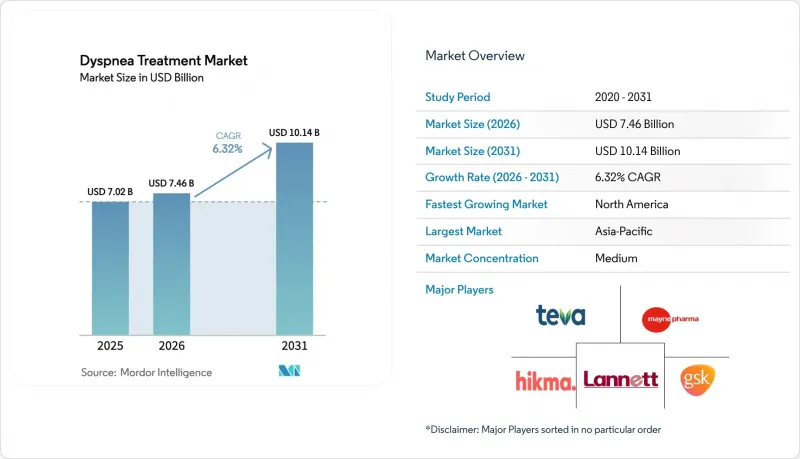
본 보고서는 치료 유형별(요법(보조 산소 요법, 이완·환기 요법), 약물 분류(항불안제, 항생제, 항콜린제 등)), 투여 경로별(경구, 흡입, 기타), 최종 사용자별(병원, 재택치료, 기타),지역별(북미, 유럽, 기타)로 분류되어 있습니다. 시장 예측은 금액(달러) 기준으로 제시되어 있습니다.
전 세계 호흡 곤란 치료 시장 동향 및 인사이트
COPD 유병률 증가 및 COVID-19 이후 호흡 곤란 증가
COVID-19 이후 기침은 호흡 곤란이 있는 환자의 48.1%에서 지속되고 있으며, 이로 인해 만성 호흡 곤란 관리를 위한 임상 경로에 진입하는 새로운 대규모 환자 집단이 생겨나고 있습니다. 가상 폐 재활 프로그램은 산소 공급이 필요한 COPD 환자들 사이에서 99%의 안전한 참여율을 보여주며, 기술을 활용한 중재의 실현 가능성을 입증하고 있습니다. 아시아태평양에서는 미세먼지 오염과 관련하여 15-49세 성인의 COPD 유병률이 우려할 정도로 증가하고 있어, 비용 대비 효과가 높은 호흡 곤란 치료법에 대한 향후 수요가 부각되고 있습니다. 경제 모델에 따른 추정에 따르면, 2020년부터 2050년까지 COPD와 관련된 직접 및 간접 비용의 총액은 4조 3,260억 달러에 달할 것으로 예상되어, 투자의 시급성이 더욱 강조되고 있습니다.
중소득 국가에서의 가정용 산소 농축기 급속한 보급
배관을 통한 산소 공급이나 실린더 물류 체계가 미비한 지역에서는 휴대용·태양광 발전식 산소 농축기가 급속히 보급되고 있습니다. 태양광 발전 시스템은 장애 조정 생명년(DALY) 1년당 20달러의 추가 비용으로 산소를 공급할 수 있어, 자원이 제한된 병원에 있어 매우 비용 대비 효과가 높은 비율을 보여줍니다. OXFO 밸브는 임상시험에서 산소 포화도를 저하시키지 않으면서 92.3%의 산소를 절약하여 운영 비용을 직접 절감했습니다. 케냐, 르완다, 에티오피아에서 시행된 종합적인 산소 생태계 프로그램은 치료를 받은 환자 1명당 7.34달러의 비용으로 조달량을 최대 220% 증가시켜, 확장 가능한 공급 허브 모델의 유효성을 입증했습니다. FlexO2와 같은 환자 제어형 유량 조절 장치는 자가 관리 점수를 14점에서 92점으로 향상시켜 환자의 역량 강화 효과를 부각시켰습니다.
저·중소득 국가(LMIC) 병원의 고유량 산소 시스템에 대한 높은 자본 비용
고급 산소 공급 인프라에는 막대한 설비 투자가 필요하며, 이는 자원이 제한된 의료 시스템에서 시장 침투의 큰 장벽이 되고 있습니다. 고급 고유량 산소 장치는 대당 5만 달러 이상으로, 자원이 부족한 시설의 예산을 초과합니다. 맥박 산소 측정기 도입에 있어서도 조달, 교육, 유지 관리 비용이 과제로 대두되어 지침의 보급을 저해하고 있습니다. 태양광 발전식 산소 농축 장치는 비용 대비 효과가 뛰어나지만, 초기 자금 조달이 여전히 장벽으로 작용하고 있습니다. 200달러 이하의 저비용 SpO2 통합형 신생아용 CPAP 장치와 같은 대안적 접근 방식은 유망하지만, 도입을 더욱 지연시키는 광범위한 검증 및 규제 당국의 승인 절차가 필요합니다.
부문 분석
보조 산소 요법은 2025년 매출의 68.74%를 차지하며, 이는 확립된 임상 프로토콜과 확실한 보험 환급을 반영합니다. 대규모 COPD 코호트 연구를 통한 증거는 특히 외래 및 야간 저산소혈증 관리 분야에서 지속적인 수요가 있음을 뒷받침합니다. 그러나 무작위 대조 시험을 통해 증상 완화가 입증되고, 가치 기반 의료가 비약물 요법을 장려함에 따라 이완 요법과 팬 요법은 연평균 성장률(CAGR) 5.98%로 확대되고 있습니다. 목표 포화도를 유지하면서 산소 소비량을 92.3% 절감하는 OXFO와 같은 비용 절감형 기기의 등장으로, 호흡 곤란 치료 시장 내 이완 및 팬 요법 시장 규모는 꾸준히 확대될 전망입니다.
약물 분류는 정밀의료와 환경적 지속가능성으로 전환되고 있습니다. 오랫동안 사용되어 온 코르티코스테로이드 및 항콜린제 카테고리는 여전히 폭넓은 유용성을 유지하고 있지만, 데페모키맙과 같은 생물학적 제제는 연 2회 투여로 충분하며, 질병 경과를 개선할 가능성도 내포하고 있습니다. 휴대용 팬에 대한 임상시험에서는 시각적 아날로그 척도(VAS)에서 유의미한 개선이 나타났으며, 의료 기관에서의 도입이 가속화되고 있습니다. 이러한 동향으로 볼 때, 저비용이며 증거에 기반한 대체 요법이 전 세계적으로 보급됨에 따라 호흡 곤란 치료 시장에서 산소 요법의 점유율이 점차 감소할 것으로 예측됩니다.
지역별 분석
북미는 충실한 보험 적용 범위, 확립된 재활 네트워크, 신규 치료에 대한 신속한 규제 승인을 배경으로 2025년 매출의 37.66%를 차지했습니다. CPT 94625 및 94626에 따라 폐 재활에 대한 보상 격차가 해소되었고, 온라인 프로그램 도입이 촉진되었습니다. OHTUVAYRE의 FDA 승인은 이 지역이 혁신을 주도하고 있음을 입증합니다. 베링거 인겔하임의 35달러 상한선 등 의약품 본인부담금 상한선 설정은 그렇지 않았다면 보급을 저해할 수 있었던 경제적 부담의 격차를 해소하고 있습니다.
아시아태평양은 연평균 성장률(CAGR) 7.78%로 가장 빠르게 성장하고 있습니다. 일본에서는 기류 폐쇄가 있는 사람 중 불과 8.4%만이 정식 진단을 받은 것으로 나타난 COPD 진단 미비 현상이 잠재적 수요를 부각시키고 있습니다. 태양광 발전식 농축기 및 PSA 플랜트는 신흥 경제국에 적합하며, DALY 기준 비용 효율성이 뛰어난 산소를 공급합니다. 중국에서는 학술적인 호흡 치료 프로그램과 3차 의료 기관을 연계하는 인재 양성 이니셔티브를 통해 증가하는 서비스 수요에 대응하는 것을 목표로 하고 있습니다.
유럽에서는 국민건강보험 제도와 엄격한 근거 기준 덕분에 꾸준한 진전이 이어지고 있습니다. 유럽호흡기학회(ERS)의 지침은 유효성이 입증된 중재 조치의 통일된 도입을 촉진하고 있습니다. 환경 규제로 인해 추진제 개혁이 진행되고 있으며, 이 지역은 저GWP 흡입기로의 전환을 주도하는 역할을 맡고 있습니다. 라틴아메리카, 아프리카, 중동은 규모는 작지만 전략적으로 중요한 지역으로, 태양광 집중기나 지역 산소 허브와 같은 혁신 기술을 활용하여 기존 인프라의 장벽을 극복하고자 하고 있습니다.
기타 혜택
- 엑셀 형식 시장 예측(ME) 시트
- 3개월간의 애널리스트 지원
자주 묻는 질문
목차
제1장 서론
제2장 조사 방법
제3장 개요
제4장 시장 구도
제5장 시장 규모와 성장 예측
제6장 경쟁 구도
제7장 시장 기회와 향후 전망
JHS 26.09.01According to Mordor Intelligence, the dyspnea treatment market size was valued at USD 7.02 billion in 2025 and estimated to grow from USD 7.46 billion in 2026 to reach USD 10.14 billion by 2031, at a CAGR of 6.32% during the forecast period (2026-2031).
This report is Segmented by Treatment Type (Therapy [Supplemental Oxygen Therapy, Relaxation/Fan Therapy], Drug Class [Antianxiety Agents, Antibiotics, Anticholinergic Agents, and More]), Route of Administration (Oral, Inhalation, Others), End User (Hospitals, Home Care Settings, and More), and Geography (North America, Europe, and More). The Market Forecasts are Provided in Terms of Value (USD).
Global Dyspnea Treatment Market Trends and Insights
Accelerating Prevalence of COPD and Post-COVID Breathlessness
Post-COVID-19 cough persists in 48.1% of patients with dyspnea, generating a sizeable new cohort that now enters clinical pathways for chronic breathlessness management. Virtual pulmonary rehabilitation programs demonstrate 99% safe engagement among COPD patients who need supplemental oxygen, proving the viability of tech-enabled interventions. Asia-Pacific markets face an alarming rise in COPD among adults aged 15-49 linked to particulate pollution, underscoring future demand for cost-effective dyspnea therapies. Economic modelling estimates COPD-linked direct and indirect costs could total USD 4.326 trillion from 2020-2050, reinforcing investment urgency.
Rapid Uptake of Home Oxygen Concentrators in Middle-Income Countries
Portable and solar-powered concentrators are proliferating where piped oxygen and cylinder logistics remain weak. Solar systems deliver oxygen at an incremental USD 20 per disability-adjusted life-year saved, a highly cost-effective ratio for resource-constrained hospitals. The OXFO valve conserved 92.3% oxygen without compromising saturation levels in clinical testing, directly lowering operating costs. Comprehensive oxygen ecosystem programs in Kenya, Rwanda, and Ethiopia boosted procurement volumes by up to 220% at USD 7.34 per patient treated, validating scalable supply-hub models. Patient-controlled flow devices such as FlexO2 raised self-management scores from 14 to 92 points, highlighting empowerment benefits.
High Capital Cost of High-Flow Oxygen Systems in LMIC Hospitals
The substantial capital requirements for advanced oxygen delivery infrastructure create significant barriers to market penetration in resource-constrained healthcare systems. Sophisticated high-flow units cost more than USD 50,000 each, exceeding budgets in low-resource facilities. Pulse-oximetry rollouts also struggle with procurement, training, and maintenance costs, limiting guideline uptake. Although solar concentrators show favourable cost-effectiveness, initial financing remains a hurdle. Alternative approaches like the low-cost SpO2 integrated neonatal CPAP device, costing under USD 200, show promise but require extensive validation and regulatory approval processes that further delay implementation.
Other drivers and restraints analyzed in the detailed report include:
- Pipeline Arrival of Once-Daily Triple-Combo Inhalers
- AI-Enabled Early-Warning Wearables Reducing ER Dyspnea Admissions
- Drug-Device Regulatory Mismatches Delaying Combo Launches
For complete list of drivers and restraints, kindly check the Table Of Contents.
Segment Analysis
Supplemental oxygen therapy represented 68.74% of 2025 revenue, reflecting entrenched clinical protocols and dependable reimbursement. Evidence from large COPD cohorts confirms sustained demand, particularly for ambulatory and nocturnal hypoxemia management. Yet relaxation and fan therapy is expanding at a 5.98% CAGR as randomized studies validate symptom relief and as value-based care incentivizes non-pharmacological tools. The dyspnea treatment market size for relaxation and fan modalities is on course to widen steadily, aided by cost-conservation devices such as OXFO that save 92.3% oxygen while maintaining target saturation levels.
Drug classes pivot toward precision medicine and environmental sustainability. Long-standing corticosteroid and anticholinergic categories retain broad utility, but biologics like depemokimab offer twice-yearly dosing and possible disease modification. Handheld fan trials reveal meaningful Visual Analogue Scale improvements, accelerating institutional acceptance. These dynamics suggest the dyspnea treatment market will witness gradual erosion of oxygen therapy's share as low-cost, evidence-backed alternatives scale globally.
Complete Report Scope:
- By Treatment Type
- Therapy
- Supplemental Oxygen Therapy
- Relaxation / Fan Therapy
- Drug Class
- Antianxiety Agents
- Antibiotics
- Anticholinergic Agents
- Corticosteroids
- Others
- Therapy
- By Route of Administration
- Oral
- Inhalation
- Others
- By End User
- Hospitals
- Home Care Settings
- Specialty and Pulmonary Rehab Centers
- Ambulatory Surgical Centers
- By Geography
- North America
- United States
- Canada
- Mexico
- Europe
- Germany
- United Kingdom
- France
- Italy
- Spain
- Rest of Europe
- Asia-Pacific
- China
- Japan
- India
- Australia
- South Korea
- Rest of Asia-Pacific
- Middle East and Africa
- GCC
- South Africa
- Rest of Middle East and Africa
- South America
- Brazil
- Argentina
- Rest of South America
- North America
Geography Analysis
North America generated 37.66% of 2025 revenue on the back of robust insurance coverage, established rehabilitation networks, and rapid regulatory clearance for novel therapeutics. CPT 94625 and 94626 improved pulmonary rehabilitation payment parity, fueling virtual program adoption. OHTUVAYRE's FDA approval confirms the region's innovation leadership. Pharmaceutical copay caps, such as Boehringer Ingelheim's USD 35 ceiling, address affordability gaps that could otherwise constrain uptake.
Asia-Pacific is the fastest growing with an 7.78% CAGR. COPD underdiagnosis in Japan, where only 8.4% of airflow-obstructed individuals receive a formal diagnosis, highlights latent demand. Solar-powered concentrators and PSA plants deliver oxygen at favourable DALY-based cost ratios suitable for emerging economies. Workforce initiatives in China that pair academic respiratory therapy programs with tertiary hospitals aim to meet escalating service needs.
Europe maintains steady progress owing to universal health systems and strict evidence thresholds. The European Respiratory Society's guidelines expedite uniform adoption of validated interventions. Environmental regulations advance propellant reforms, positioning the region as a catalyst for low-GWP inhaler transitions. Latin America, Africa, and the Middle East remain smaller but strategic, leveraging innovations such as solar concentrators and regional oxygen hubs to bypass legacy infrastructure barriers.
- GlaxoSmithKline
- AstraZeneca
- Novartis
- Teva Pharmaceutical Industries
- Boehringer Ingelheim
- Pfizer
- Viatris
- Sun Pharmaceuticals Industries
- Hikma Pharmaceuticals
- Lupin
- Amneal Pharmaceuticals
- Lannett Company Inc.
- Mayne Pharma
- Bausch Health
Additional Benefits:
- The market estimate (ME) sheet in Excel format
- 3 months of analyst support
TABLE OF CONTENTS
1 Introduction
- 1.1 Study Assumptions & Market Definition
- 1.2 Scope of the Study
2 Research Methodology
3 Executive Summary
4 Market Landscape
- 4.1 Market Overview
- 4.2 Market Drivers
- 4.2.1 Accelerating Prevalence of COPD and Post-COVID Breathlessness
- 4.2.2 Rapid Uptake of Home Oxygen Concentrators in Middle-Income Countries
- 4.2.3 Pipeline Arrival of Once-Daily Triple-Combo Inhalers
- 4.2.4 AI-Enabled Early-Warning Wearables Reducing ER Dyspnea Admissions
- 4.2.5 Reimbursement Expansion for Remote Pulmonary Rehab
- 4.3 Market Restraints
- 4.3.1 High Capital Cost of High-Flow Oxygen Systems in LMIC Hospitals
- 4.3.2 Drug-Device Regulatory Mismatches Delaying Combo Launches
- 4.3.3 Low Clinician Adoption of Non-Pharma Dyspnea Scoring Tools
- 4.3.4 Patent Expiration Pressures on Established Therapies
- 4.4 Regulatory Landscape
- 4.5 Pipeline Analysis
- 4.6 Porter's Five Forces Analysis
- 4.6.1 Threat of New Entrants
- 4.6.2 Bargaining Power of Buyers
- 4.6.3 Bargaining Power of Suppliers
- 4.6.4 Threat of Substitute Products
- 4.6.5 Intensity of Competitive Rivalry
5 Market Size & Growth Forecasts (Value)
- 5.1 By Treatment Type
- 5.1.1 Therapy
- 5.1.1.1 Supplemental Oxygen Therapy
- 5.1.1.2 Relaxation / Fan Therapy
- 5.1.2 Drug Class
- 5.1.2.1 Antianxiety Agents
- 5.1.2.2 Antibiotics
- 5.1.2.3 Anticholinergic Agents
- 5.1.2.4 Corticosteroids
- 5.1.2.5 Others
- 5.1.1 Therapy
- 5.2 By Route of Administration
- 5.2.1 Oral
- 5.2.2 Inhalation
- 5.2.3 Others
- 5.3 By End User
- 5.3.1 Hospitals
- 5.3.2 Home Care Settings
- 5.3.3 Specialty and Pulmonary Rehab Centers
- 5.3.4 Ambulatory Surgical Centers
- 5.4 By Geography
- 5.4.1 North America
- 5.4.1.1 United States
- 5.4.1.2 Canada
- 5.4.1.3 Mexico
- 5.4.2 Europe
- 5.4.2.1 Germany
- 5.4.2.2 United Kingdom
- 5.4.2.3 France
- 5.4.2.4 Italy
- 5.4.2.5 Spain
- 5.4.2.6 Rest of Europe
- 5.4.3 Asia-Pacific
- 5.4.3.1 China
- 5.4.3.2 Japan
- 5.4.3.3 India
- 5.4.3.4 Australia
- 5.4.3.5 South Korea
- 5.4.3.6 Rest of Asia-Pacific
- 5.4.4 Middle East and Africa
- 5.4.4.1 GCC
- 5.4.4.2 South Africa
- 5.4.4.3 Rest of Middle East and Africa
- 5.4.5 South America
- 5.4.5.1 Brazil
- 5.4.5.2 Argentina
- 5.4.5.3 Rest of South America
- 5.4.1 North America
6 Competitive Landscape
- 6.1 Market Concentration
- 6.2 Market Share Analysis
- 6.3 Company Profiles (includes Global level Overview, Market level overview, Core Segments, Financials as available, Strategic Information, Market Rank/Share for key companies, Products & Services, and Recent Developments)
- 6.3.1 GlaxoSmithKline plc
- 6.3.2 AstraZeneca plc
- 6.3.3 Novartis AG
- 6.3.4 Teva Pharmaceutical Industries Ltd.
- 6.3.5 Boehringer Ingelheim International GmbH
- 6.3.6 Pfizer Inc.
- 6.3.7 Viatris Inc. (Mylan N.V.)
- 6.3.8 Sun Pharmaceutical Industries Ltd.
- 6.3.9 Hikma Pharmaceuticals plc
- 6.3.10 Lupin Limited
- 6.3.11 Amneal Pharmaceuticals LLC
- 6.3.12 Lannett Company Inc.
- 6.3.13 Mayne Pharma Group Limited
- 6.3.14 Bausch Health Companies Inc.
7 Market Opportunities & Future Outlook
- 7.1 White-space & Unmet-Need Assessment