
|
시장보고서
상품코드
2123265
산소 요법 장비 시장 : 점유율 분석, 업계 동향과 통계, 성장 예측(2026-2031년)Oxygen Therapy Equipment - Market Share Analysis, Industry Trends & Statistics, Growth Forecasts (2026 - 2031) |
||||||
 Mordor Intelligence
산소 요법 장비 시장 규모는 2025년 38억 5,000만 달러에서 2026년에는 41억 1,000만 달러로 확대되어 2026년부터 2031년까지 CAGR 6.77%로 성장을 지속하여, 2031년까지 57억 달러에 이를 것으로 예측됩니다.
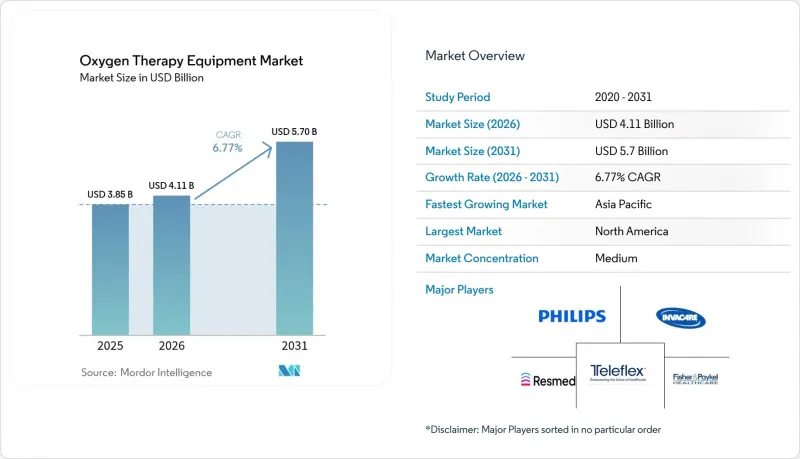
본 보고서는 제품별(산소 공급 장치 등), 휴대성별(고정형 장비 및 휴대형 장비), 용도별(천식, 폐쇄성 수면 무호흡증, 만성 폐쇄성 폐질환(COPD) 등), 최종 사용자별(병원 및 재택치료), 그리고 지역별로 분류되어 있습니다. 시장 규모 및 전망은 금액(달러) 단위로 제시되어 있습니다.
전 세계 산소 요법 장비 시장 동향 및 인사이트
COPD 및 기타 호흡기 질환 유병률 증가
COPD, 천식, 간질성 폐질환의 유병률 증가는 산소 요법 장비 시장 수요를 견인하는 중요한 요인이 되고 있습니다. COPD 관련 사망의 90% 가까이가 저·중소득 국가에서 발생하고 있으며, 이는 충족되지 않은 치료 수요를 여실히 드러내고 있습니다. 젊은 층의 COPD 위험 요인 중 환경 오염이 41.79%를 차지하고, 흡연이 19.81%를 차지하고 있는데, 이는 담배 소비 동향과는 별개로 구조적인 수요가 존재함을 보여줍니다. 세계 인구의 고령화에 따라, 특히 급속한 인구 구조 변화를 겪고 있는 아시아태평양 경제권에서 유병률은 이에 따라 상승하고 있습니다.
재택 산소 요법 및 휴대용 장비로의 전환
의료비 억제 필요성과 환자의 자립에 대한 희망으로 인해, 시설 기반 치료에서 재택 치료로의 전환이 가속화되고 있습니다. 2024년, 미국의 메디케어 수급자 300만 명에 대한 재택치료 지출은 총 1,252억 달러에 달했습니다. ‘가정 의료 가치 기반 구매 모델’에서는 지불액이 치료 결과의 질과 연동되도록 되어, 실시간 모니터링이 가능한 네트워크 연결형 휴대용 산소 농축기의 도입이 촉진되고 있습니다. 이노젠(Inogen)사의 ‘Rove 4’는 무게가 1.36kg 미만임에도 분당 840ml의 산소를 공급하는 제품으로, 설계의 진보를 통해 이동상의 장벽이 어떻게 해소되는지를 잘 보여줍니다.
엄격한 세계 규제 승인 및 규정 준수 비용
유럽연합(EU)의 의료장비 규정(EU 2017/745)에 따르면, 2027년부터 2028년까지 더 광범위한 임상 증거,시판 후 조사, 그리고 고유 의료장비 식별번호(UDI)의 도입이 의무화되어, 이로 인해 규정 준수 관련 지출이 대폭 증가하고 있습니다. 중소 제조업체들은 불균형한 부담에 직면해 있으며, 업계 재편이 가속화될 가능성이 있습니다. 미국에서는 2025년 12월에 시행될 FDA의 의료용 가스 규정 개정에 따라 CGMP 기준 및 안전성 보고 의무가 재검토되어, 산소 공급업체에 대한 문서화 부담이 증가하게 될 것입니다.
부문 분석
2025년, 산소 공급 장비는 산소 요법 장비 시장 점유율의 64.78%를 차지했습니다. 이 부문을 주도하고 있는 것은 압력 스윙 흡착(PSA) 기술을 통해 효율성을 높인 농축 장치인 반면, 액체 시스템은 고순도 치료라는 틈새 시장을 공략하고 있습니다. 압축 실린더는 특히 응급 의료 서비스(EMS) 차량에서 비상 시 백업 수단으로서 여전히 필수적입니다. 산소 요법 장비 시장 중 공급 장치 부문 시장 규모는 피셔 앤 페이켈(Fisher & Paykel)의 습도 제어 기능이 내장된 ‘F&P Nova’ 비강 마스크 등, 환자의 편의성을 높이는 혁신 기술의 뒷받침을 받아 연평균 성장률(CAGR) 7.02%로 확대되고 있습니다. 포화도 센서가 탑재된 스마트 캐뉼라는 치료 준수 데이터를 전송하여, 새로운 삶의 질(QOL) 지표에 기반한 규제 준수 향상에 기여하고 있습니다. 이러한 변화를 뒷받침하듯, 집중적인 공급 차질-특히 Philips 레스피로닉스(Philips Respironics)가 2024년에 19유형의 호흡기 관련 SKU 생산을 중단한 점이 두드러집니다-으로 인해 병원과 유통업체는 공급 인터페이스의 조달처를 다각화하도록 촉구받고 있습니다.
대체 인터페이스에 대한 규제 당국의 신속한 승인으로 제품 포트폴리오의 다각화가 가속화되었습니다. 디지털 핏 테스트, 3D 프린팅 어댑터 옵션, 항균 튜브 코팅 등이 미국 병원 그룹의 조달 논의에서 주류를 이루고 있습니다.
소비자의 관심이 휴대성에 쏠리고 있음에도 불구하고, 2025년에도 고정형 농축기는 산소 요법 장비 시장 규모의 53.10%를 차지했습니다. 이 장비의 신뢰성과 지속적인 고유량 공급 능력은 중증 저산소혈증을 동반한 COPD 환자에게 적합하며, 보험사들도 상한선이 있는 렌탈 모델에서 이러한 장비를 우선적으로 보상하는 경우가 많습니다. Caire사의 ‘IntenOxy 5’와 같은 최근 출시된 제품은 5 LPM에서 95.5%의 순도를 실현하면서도 소비 전력을 330 W 미만으로 억제하여, 고정 소득을 가진 고령자의 전기 요금을 절감해 줍니다. 또한, 각 제조업체는 주택의 전력 부하를 균형 있게 조절하고 지속가능성 크레딧을 획득하기 위해 스마트 그리드 인터페이스를 추가하고 있습니다.
휴대용 장비는 나머지 시장 점유율을 차지하며, 시장 전체에서 가장 높은 절대 매출 성장률을 보이고 있습니다. 산소 요법 장비 시장에서 배터리 에너지 밀도가 향상됨에 따라 초휴대용 장비의 연평균 성장률(CAGR)은 8.42%로 성장을 지속하고, 있으며, 펄스 설정 3에서 작동 시간이 6시간을 초과하게 되었습니다. 각 기업은 소모품, 펌웨어 업그레이드, 원격 모니터링 분석을 포괄하는 서비스 구독 모델을 패키지로 제공합니다. 각 통합 업체들은 교체 가능한 시브 카트리지를 사용하여 침대 옆 스테이션과 배낭 크기의 농축기를 결합한 모듈형 생태계의 시범 운영을 진행하고 있으며, 여행 중이나 정전 시에도 지속적인 사용을 보장하고 있습니다.
지역별 분석
북미는 견실한 환급 제도, 높은 COPD 유병률, 그리고 성숙한 유통 네트워크에 힘입어 2025년 매출의 43.05%를 차지했습니다. FDA의 2025년 12월 의료용 가스 규제에 따라 미국 제조업체들 사이에서는 감사 준비가 가속화되고 있는 반면, 캐나다의 연방 및 주 의약품 보험 제도에서는 휴대용 농축기를 급여 대상에 포함시키는 작업이 진행되고 있습니다. 멕시코에서는 ‘세그로 포풀라르(Seguro Popular)’의 확대에 따라, 수입 관세를 인하하기 위한 현지 조립 파트너십이 추진되고 있습니다. 아시아태평양은 의료비 증가, 국민건강보험 도입 및 고령화를 배경으로 연평균 성장률(CAGR) 8.66%를 기록하며 가장 빠르게 성장하고 있는 지역입니다. 중국 의료장비 시장은 2027년까지 1,380억 달러에 달할 것으로 예측됩니다. COPD 유병률은 안정화 추세를 보이고 있지만, 환자 수는 여전히 막대한 규모를 유지하고 있습니다. 인도에서는 민관 파트너십을 통해 지역 병원에 산소 제조 설비가 도입되면서 수요가 두 자릿수 성장세를 보이고 있습니다. 일본 및 한국공급업체들은 국내 연구개발을 활용하여 ASEAN 시장에 커넥티드형 산소 농축기를 수출하고 있는 반면, 호주의 원격의료 프레임워크는 국경을 초월한 RPM(원격 환자 모니터링) 도입을 가속화하고 있습니다. 유럽에서는 MDR(의료장비 규정)을 준수하는 제품의 업데이트 주기와 고령화를 배경으로 꾸준한 성장을 유지하고 있습니다. 독일의 건강보험 기금은 복약 순응도 모니터링 앱과 함께 사용될 경우 휴대용 산소 농축기의 비용을 환급해 주고 있어, 스마트 장비의 보급을 촉진하고 있습니다. 영국 NHS 커뮤니티 산소 서비스에서는 진료소 방문 횟수를 줄이는 것을 목적으로 한 원격 농도 조절 시범 사업을 전개하고 있습니다. 남유럽 국가들에서는 조달 기준을 EU의 의료용 가스 기준에 부합하도록 조정하여, 가치를 중시하는 공급업체에게 비즈니스 기회를 확대되고 있습니다. 중동 및 아프리카에서는 코로나19로 인한 공급 부족에 대응해 각국 정부가 압력 스윙 흡착(PSA) 플랜트를 구축함에 따라, 낮은 기준에서 두 자릿수 성장을 기록하고 있습니다. MedAccess와 개발은행은 제조 허브에 자금을 지원함으로써 체(sieve)의 현지 생산을 촉진하고, 지역의 자급자족률을 높이고 있습니다. 라틴아메리카의 동향은 제각각입니다. 브라질의 통합 보건 시스템(SUS)은 2차 의료 기관에 산소 농축기를 도입하고 있지만, 아르헨티나와 콜롬비아에서는 통화 변동이 수입업체의 이익률을 압박하고 있습니다.
기타 혜택:
- 엑셀 형식 시장 예측(ME) 시트
- 3개월간의 애널리스트 지원
자주 묻는 질문
목차
제1장 서론
제2장 조사 방법
제3장 주요 요약
제4장 시장 구도
제5장 시장 규모와 성장 예측
제6장 경쟁 구도
제7장 시장 기회와 향후 전망
JHS 26.09.09According to Mordor Intelligence, the oxygen therapy equipment market size is expected to grow from USD 3.85 billion in 2025 to USD 4.11 billion in 2026 and is forecast to reach USD 5.7 billion by 2031 at 6.77% CAGR over 2026-2031.
This report is Segmented by Product (Oxygen Source Equipment and More), Portability (Stationary Devices and Portable Devices), Application (Asthma, Obstructive Sleep Apnea, Chronic Obstructive Pulmonary Disorder (COPD), and More), End User (Hospitals and Home Healthcare) and Geography. The Market Sizes and Forecasts are Provided in Terms of Value (USD).
Global Oxygen Therapy Equipment Market Trends and Insights
Rising COPD & Other Respiratory Disease Prevalence
The escalating incidence of COPD, asthma, and interstitial lung diseases is a critical demand driver for the oxygen therapy equipment market. Nearly 90% of COPD-related deaths occur in low- and middle-income countries, underscoring unmet therapeutic needs . Environmental pollution accounts for 41.79% of COPD risk factors among younger cohorts, while smoking contributes 19.81%, indicating structural demand independent of tobacco trends. As global populations age, prevalence rises in tandem, particularly across Asia-Pacific economies experiencing rapid demographic shifts.
Shift Toward Home-Based Oxygen Therapy & Portable Devices
Cost-containment imperatives and patient preference for independence are accelerating the transition from facility-based to home-based therapy. US home healthcare expenditures for 3 million Medicare beneficiaries totaled USD 125.2 billion in 2024. The Home Health Value-Based Purchasing Model now links payments to quality outcomes, stimulating adoption of connected portable concentrators that support real-time monitoring. Inogen's Rove 4-which delivers 840 ml/min oxygen at under 1.36 kg-exemplifies how design advances eliminate mobility barriers.
Stringent Global Regulatory Approvals & Compliance Costs
The European Union Medical Device Regulation (EU 2017/745) mandates broader clinical evidence, post-market surveillance, and Unique Device Identification by 2027-2028, materially escalating compliance spending . Smaller manufacturers face disproportionate burdens, potentially hastening consolidation. In the United States, the FDA's updated medical gas regulations effective December 2025 revise CGMP standards and safety reporting obligations, adding documentation layers for oxygen suppliers .
Other drivers and restraints analyzed in the detailed report include:
- Rapid Device Miniaturization & IoT-Enabled Monitoring
- Next-Gen Lithium-Sulfur Batteries Enabling Ultra-Light POCs
- High Capital/Reimbursement Burden for Long-Term Therapy
For complete list of drivers and restraints, kindly check the Table Of Contents.
Segment Analysis
Oxygen Source Equipment held 64.78% of the oxygen therapy equipment market share in 2025. Concentrators drive this segment through pressure-swing adsorption efficiency gains, while liquid systems cater to high-purity therapeutic niches. Compressed cylinders remain vital for emergency back-up, particularly in EMS fleets. The oxygen therapy equipment market size for delivery devices is refining at a 7.02% CAGR, fueled by patient comfort innovations such as Fisher & Paykel's F&P Nova Nasal mask with integrated humidity control. Smart cannulas fitted with saturation sensors relay adherence data, improving regulatory compliance with emerging quality-of-life metrics.Supporting this shift, concentric supply disruptions-most notably Philips Respironics' 2024 discontinuation of 19 respiratory SKUs-have encouraged hospitals and distributors to dual-source delivery interfaces.
Rapid regulatory approvals for alternative interfaces accelerated portfolio diversification. Digital fit-testing, 3-D-printed adapter options, and antimicrobial tubing coatings have entered mainstream procurement discussions across US hospital groups.
Stationary concentrators still captured 53.10% of the oxygen therapy equipment market size in 2025 even as consumer discourse focuses on portability. Reliability and continuous high-flow capabilities suit severe hypoxemic COPD patients, and payers often reimburse these devices preferentially under capped rental models. Recent releases like Caire's IntenOxy 5 deliver 95.5% purity at 5 LPM while drawing under 330 W, reducing electricity costs for seniors on fixed incomes. Manufacturers also add smart-grid interfaces to balance residential power loads and claim sustainability credits.
Portable devices account for the remaining share but post the market's fastest absolute revenue gains. The oxygen therapy equipment market demonstrates 8.42% CAGR for ultra-portable devices as battery energy densities climb, extending run-time beyond 6 hours at pulse setting 3. Companies are bundling service subscription models that cover consumables, firmware upgrades, and telemonitoring analytics. Integrators experiment with modular ecosystems pairing a bedside station with a backpack-size concentrator using interchangeable sieve cartridges, ensuring continuity during travel or outages.
Complete Report Scope:
- By Product
- Oxygen Source Equipment
- Oxygen Cylinders
- Oxygen Concentrators
- Liquid Oxygen Devices
- Others
- Oxygen Delivery Devices
- Oxygen Masks
- Nasal Cannula
- Venturi Masks
- Non-Rebreather Masks
- Others
- Oxygen Source Equipment
- By Portability
- Stationary Devices
- Portable Devices
- By Application
- Asthma
- Obstructive Sleep Apnea
- Chronic Obstructive Pulmonary Disease (COPD)
- Respiratory Distress Syndrome
- Others
- By End User
- Hospitals
- Home Healthcare
- Ambulatory Surgical Centers
- Others
- By Geography
- North America
- United States
- Canada
- Mexico
- Europe
- Germany
- United Kingdom
- France
- Italy
- Spain
- Rest of Europe
- Asia-Pacific
- China
- Japan
- India
- Australia
- South Korea
- Rest of Asia-Pacific
- Middle East & Africa
- GCC
- South Africa
- Rest of Middle East & Africa
- South America
- Brazil
- Argentina
- Rest of South America
- North America
Geography Analysis
North America generated 43.05% of 2025 revenue, supported by robust reimbursement systems, high COPD prevalence, and mature distribution networks. The FDA's December 2025 medical gas mandate intensifies audit preparation among US manufacturers, while Canada's federal-provincial drug plans continue to integrate portable concentrator benefits. Mexico's Seguro Popular expansion drives localized assembly partnerships to reduce import duties.Asia-Pacific is the fastest-growing territory, posting 8.66% CAGR thanks to healthcare spending growth, universal insurance rollouts, and aging demographics. China's medical device market is projected to reach USD 138 billion by 2027. Though COPD prevalence is stabilizing, absolute patient volumes remain huge. India witnesses double-digit demand growth as public-private partnerships upgrade district hospitals with oxygen plants. Japanese and South Korean suppliers leverage domestic R&D to export connected concentrators across ASEAN markets, while Australian telehealth frameworks accelerate cross-border RPM adoption.Europe maintains steady growth underpinned by MDR-compliant product refresh cycles and aging populations. Germany's sickness funds reimburse portable concentrators when paired with adherence-monitoring apps, boosting smart device uptake. The United Kingdom's NHS Community Oxygen Service deploys remote titration pilots aimed at reducing clinic visits. Southern European economies align procurement criteria with EU medical gas standards, expanding opportunities for value-focused vendors. The Middle East & Africa region records double-digit growth from a low base as governments establish pressure swing adsorption plants following COVID-19 shortages. MedAccess and development banks finance manufacturing hubs to localize sieve production, enhancing regional self-sufficiency. Latin America's trajectory is mixed: Brazil's Unified Health System rolls out oxygen concentrators to secondary hospitals, yet currency volatility challenges importer margins in Argentina and Colombia.
- Koninklijke Philips
- Caire
- Invacare
- Drive DeVilbiss Healthcare
- Resmed
- Fisher & Paykel Healthcare
- Teleflex
- Smiths Group
- Linde Healthcare
- Dragerwerk
- Chart Industries (AirSep)
- Inogen Inc.
- Nidek Medical Products
- Air Liquide
- Allied Healthcare Products
- GCE Group
- Hersill S.L.
- TECNO-GAZ
- OxyGo LLC
- BPL
- Precision Medical
- Besco Medical
Additional Benefits:
- The market estimate (ME) sheet in Excel format
- 3 months of analyst support
TABLE OF CONTENTS
1 Introduction
- 1.1 Study Assumptions & Market Definition
- 1.2 Scope of the Study
2 Research Methodology
3 Executive Summary
4 Market Landscape
- 4.1 Market Overview
- 4.2 Market Drivers
- 4.2.1 Rising COPD & Other Respiratory Disease Prevalence
- 4.2.2 Shift Toward Home-Based Oxygen Therapy & Portable Devices
- 4.2.3 Rapid Device Miniaturisation & Iot-Enabled Monitoring
- 4.2.4 Next-Gen Lithium-Sulfur Batteries Enabling Ultra-Light Pocs
- 4.2.5 Stricter Hospital Accreditation Standards
- 4.2.6 Telehealth-Integrated Remote Oxygen Management Demand
- 4.3 Market Restraints
- 4.3.1 Stringent Global Regulatory Approvals & Compliance Costs
- 4.3.2 High Capital/Reimbursement Burden For Long-Term Therapy
- 4.3.3 Supply-Chain Fragility Of Zeolite Molecular-Sieves
- 4.3.4 Rising Fire-Safety & Insurance Restrictions In Home Use
- 4.4 Value / Supply-Chain Analysis
- 4.5 Regulatory Landscape
- 4.6 Technological Outlook
- 4.7 Porter's Five Forces Analysis
- 4.7.1 Threat of New Entrants
- 4.7.2 Bargaining Power of Buyers
- 4.7.3 Bargaining Power of Suppliers
- 4.7.4 Threat of Substitutes
- 4.7.5 Intensity of Competitive Rivalry
5 Market Size & Growth Forecasts
- 5.1 By Product
- 5.1.1 Oxygen Source Equipment
- 5.1.1.1 Oxygen Cylinders
- 5.1.1.2 Oxygen Concentrators
- 5.1.1.3 Liquid Oxygen Devices
- 5.1.1.4 Others
- 5.1.2 Oxygen Delivery Devices
- 5.1.2.1 Oxygen Masks
- 5.1.2.2 Nasal Cannula
- 5.1.2.3 Venturi Masks
- 5.1.2.4 Non-Rebreather Masks
- 5.1.2.5 Others
- 5.1.1 Oxygen Source Equipment
- 5.2 By Portability
- 5.2.1 Stationary Devices
- 5.2.2 Portable Devices
- 5.3 By Application
- 5.3.1 Asthma
- 5.3.2 Obstructive Sleep Apnea
- 5.3.3 Chronic Obstructive Pulmonary Disease (COPD)
- 5.3.4 Respiratory Distress Syndrome
- 5.3.5 Others
- 5.4 By End User
- 5.4.1 Hospitals
- 5.4.2 Home Healthcare
- 5.4.3 Ambulatory Surgical Centers
- 5.4.4 Others
- 5.5 By Geography
- 5.5.1 North America
- 5.5.1.1 United States
- 5.5.1.2 Canada
- 5.5.1.3 Mexico
- 5.5.2 Europe
- 5.5.2.1 Germany
- 5.5.2.2 United Kingdom
- 5.5.2.3 France
- 5.5.2.4 Italy
- 5.5.2.5 Spain
- 5.5.2.6 Rest of Europe
- 5.5.3 Asia-Pacific
- 5.5.3.1 China
- 5.5.3.2 Japan
- 5.5.3.3 India
- 5.5.3.4 Australia
- 5.5.3.5 South Korea
- 5.5.3.6 Rest of Asia-Pacific
- 5.5.4 Middle East & Africa
- 5.5.4.1 GCC
- 5.5.4.2 South Africa
- 5.5.4.3 Rest of Middle East & Africa
- 5.5.5 South America
- 5.5.5.1 Brazil
- 5.5.5.2 Argentina
- 5.5.5.3 Rest of South America
- 5.5.1 North America
6 Competitive Landscape
- 6.1 Market Concentration
- 6.2 Market Share Analysis
- 6.3 Company Profiles {(includes Global level Overview, Market level overview, Core Segments, Financials as available, Strategic Information, Market Rank/Share for key companies, Products & Services, and Recent Developments)}
- 6.3.1 Koninklijke Philips N.V.
- 6.3.2 CAIRE Inc.
- 6.3.3 Invacare Corporation
- 6.3.4 Drive DeVilbiss Healthcare
- 6.3.5 ResMed
- 6.3.6 Fisher & Paykel Healthcare
- 6.3.7 Teleflex Incorporated
- 6.3.8 Smiths Medical
- 6.3.9 Linde Healthcare
- 6.3.10 Dragerwerk AG & Co. KGaA
- 6.3.11 Chart Industries (AirSep)
- 6.3.12 Inogen Inc.
- 6.3.13 Nidek Medical Products
- 6.3.14 Air Liquide Healthcare
- 6.3.15 Allied Healthcare Products
- 6.3.16 GCE Group
- 6.3.17 Hersill S.L.
- 6.3.18 TECNO-GAZ SpA
- 6.3.19 OxyGo LLC
- 6.3.20 BPL Medical Technologies
- 6.3.21 Precision Medical Inc.
- 6.3.22 Besco Medical
7 Market Opportunities & Future Outlook
- 7.1 White-Space & Unmet-Need Assessment