|
시장보고서
상품코드
2063430
독일의 전사적 자원 계획(ERP) 시장 : 시장 점유율 분석, 업계 동향 및 통계, 성장 예측(2026-2031년)Germany Enterprise Resource Planning - Market Share Analysis, Industry Trends & Statistics, Growth Forecasts (2026 - 2031) |
||||||
 Mordor Intelligence
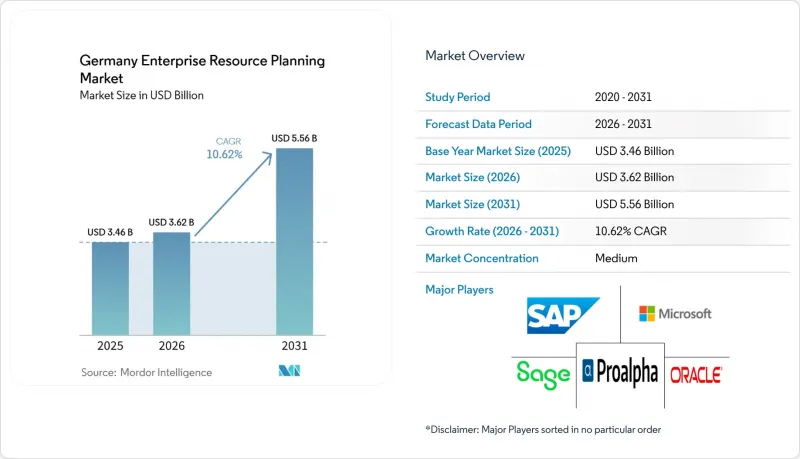
Mordor Intelligence에 의하면, 독일의 전사적 자원 계획(ERP) 시장 규모는 2025년 34억 6,000만 달러로 평가되었고, 2026년에는 36억 2,000만 달러로 추정되고, 2031년까지 55억 6,000만 달러에 이를 것으로 예측됩니다. 2026-2031년 CAGR 6.58%로 성장할 전망입니다.
본 보고서는 아키텍처별(클라우드 네이티브 스위트, 모바일 퍼스트 ERP 등), 업무 기능별(재무 및 회계 등), 도입 모델별(온프레미스, 클라우드), 조직 규모별(대기업, 중소기업) 및 업종별(제조업 등)로 분류되어 있습니다. 시장 전망은 금액(달러) 기준으로 제시되어 있습니다.
독일의 기업 자원 계획(ERP) 시장 동향 및 인사이트
독일 중견 기업의 클라우드 도입 가속화
미텔슈탄트 기업들은 지난 2년 동안 핵심 시스템의 3분의 2를 개편했으며, 벤더의 로드맵에 따라 원격 근무를 지원하는 클라우드 네이티브 및 하이브리드 모델을 선호하여 도입하고 있습니다. 2025년 BITMi 조사에 따르면, 82%의 기업이 2026년 IT 예산 증액을 계획하고 있으며, 이 중 53%는 클라우드 인프라에 할당될 예정입니다. Azure 기반 클라우드 ERP(기업용)인 SAP-Microsoft 99.95% SLA는 가동 시간 관련 위험을 줄여주며, Copilot 및 Teams와 통합되는 서비스의 훌륭한 사례입니다. 그러나 역외 적용되는 데이터 접근법을 회피하기 위해 많은 구매자들은 여전히 프라이빗 클라우드나 소버린 클라우드를 선호하고 있으며, proALPHA와 같은 벤더들은 MES를 온프레미스로 유지하면서 CRM을 SaaS로 전환하는 하이브리드 옵션을 출시하고 있습니다.
엄격한 데이터 보호 규제가 규정 준수형 ERP 수요를 견인하고 있습니다.
일반 데이터 보호 규정(GDPR(EU 개인정보보호규정)), 독일 연방 데이터 보호법 및 EU 데이터법은 개방형 인터페이스, 표준화된 내보내기 형식, 그리고 2027년까지의 전환 수수료 폐지를 의무화하고 있습니다. 기업의 42%가 퍼블릭 클라우드 도입의 걸림돌로 데이터 보호를 꼽고 있습니다. 이에 대해 SAP와 마이크로소프트는 CLOUD법에 대한 우려를 해소하기 위해, 독일 관할 하에 있는 데이터센터에서 워크로드를 호스팅하는 Delos Cloud GmbH와 제휴를 맺었습니다. 은행 업계에서는 '디지털 운영 복원력법'에 따라 컴플라이언스 대상이 제3자 리스크 관리까지 확대됨에 따라, ERP 공급업체에 대한 엄격한 감사가 의무화되었습니다.
레거시 시스템의 복잡성과 높은 전환 비용
현재 2026년 5월의 전환 기한이 다가오고 있음에도 불구하고, SAP 고객의 71%는 여전히 ECC HCM을 계속 사용하고 있습니다. 이러한 추세는 급여 계산의 맞춤화가 초래하는 문제점을 여실히 드러내고 있으며, 이러한 맞춤화 때문에 신속한 재도입이 어려워지는 경우가 많습니다. 예를 들어, 한 중견 제조업체는 1,000만 유로(1,130만 달러)가 넘는 전환 비용과 최대 36개월에 달하는 프로젝트 기간에 직면해 있습니다. 타사 유지보수 서비스는 업그레이드를 미루는 방식으로 일시적인 해결책을 제공할 수는 있지만, 혁신을 저해하기도 합니다. 이러한 접근 방식은 조직이 구식 시스템에 의존하게 만드는 경향이 있으며, 그 결과 귀중한 기술 인력이 미래를 내다보는 업무에 집중하기보다는 레거시 기술 부채 관리에 얽매이게 됩니다.
부문별 분석
2031년까지 2계층형 솔루션 시장은 연평균 15.12%의 성장률을 보일 것으로 예상되지만, 클라우드 네이티브 스위트 부문이 48.21%로 가장 큰 점유율을 차지하고 있습니다. 다국적 중견 기업(미텔슈탄트)은 핵심 시스템인 S/4HANA 및 Oracle 원장 위에 경량화된 지역 인스턴스를 중첩하여 구축하고 있습니다. 독일의 전사적 자원 관리(ERP) 시장에서 2계층 아키텍처 시장 규모는 법적 보고 요건 및 철저한 비용 관리의 필요성을 반영하여 다른 어떤 부문보다 빠르게 확대될 것으로 전망됩니다. ProALPHA의 하이브리드 지원 9.5 버전 출시로, 제조업체는 지연 시간에 민감한 MES를 온프레미스 환경에 유지하면서 CRM을 클라우드와 동기화할 수 있게 되었으며, 이를 통해 전사적 가시성을 저해하지 않으면서도 노조의 요구 사항도 충족할 수 있습니다. 각 계층에 걸친 데이터 복제 및 ID 관리를 자동화할 수 있는 벤더는 경쟁사를 앞설 것입니다.
부수적인 영향으로는 인터페이스의 복잡화 및 통합 관리 콘솔에 대한 수요 증가를 들 수 있습니다. proALPHA와 같은 벤더들은 현재, 시스템의 분산화를 해결하고 사용자 경험을 향상시키기 위해 싱글 사인온(SSO) 및 다단계 인증(MFA) 기능을 제공합니다. EU 데이터법이 오픈 API 사용을 의무화함에 따라, 고객들은 에지 인스턴스와 코어 시스템 간의 원활한 전환을 점점 더 기대하고 있습니다. 이러한 변화로 인해 메시지 큐 시스템이나 이벤트 스트리밍 아키텍처와 같은 고급 통합 패턴의 도입이 가속화되고 있으며, 이는 실시간 데이터 교환과 업무 효율 향상을 가능하게 합니다.
인적 자본 관리(HCM) 시장은 연평균 성장률(CAGR) 13.28%를 나타낼 것으로 예측되지만, 재무 및 회계 분야는 예측 기간 동안 34.97%의 성장률을 보였습니다. 이는 각 조직이 SAP의 H4S4 전환 기한에 대한 대응을 서두르고 있기 때문입니다. 독일의 HCM(인적 자원 관리)용 ERP 시장 점유율은 단체교섭 규정의 복잡성으로 인해 클라우드 급여 계산 시스템 도입률이 여전히 낮은 상황인 만큼, 크게 확대될 것으로 예측됩니다. 재무는 여전히 핵심적인 기능이지만, 임베디드 분석의 통합이 진행되고 전자 청구서 발행에 관한 법규가 시행됨에 따라 기업 전반에 걸쳐 기능 업그레이드가 진행되고 있습니다. 치열한 경쟁 구도 속에서 차별화를 꾀하기 위해, 각 벤더사는 AI를 활용한 후보자 평가, 이직 예측 분석, 감정 분석 등의 고도화된 기능을 자사 제품에 탑재하고 있습니다.
유럽 전역에서 약 10만 명의 SAP 전문가가 만성적으로 부족한 상황은 로우코드 워크플로 빌더에 대한 수요를 더욱 높이고 있습니다. 현재 기업들은 ABAP 코딩에 대한 전문 지식이 필요 없이 인사 및 재무 팀이 자체적으로 규칙을 변경할 수 있는 솔루션을 더욱 중요하게 여기고 있습니다. 이러한 변화는 출시 주기를 단축할 뿐만 아니라, 제한된 전문 컨설턴트에 대한 의존도를 낮추고, 조직이 변화하는 비즈니스 요구에 더욱 신속하게 대응할 수 있도록 합니다.
기타 혜택 :
- 엑셀 형식 시장 예측(ME) 시트
- 3개월간의 애널리스트 지원
자주 묻는 질문
목차
제1장 서론
제2장 조사 방법
제3장 주요 요약
제4장 시장 구도
제5장 시장 규모 및 성장 예측
제6장 경쟁 구도
제7장 시장 기회 및 향후 전망
AJY 26.06.22According to Mordor Intelligence, the germany enterprise resource planning market size is expected to increase from USD 3.46 billion in 2025 to USD 3.62 billion in 2026 and reach USD 5.56 billion by 2031, growing at a CAGR of 6.58% over 2026-2031.
This report is Segmented by Architecture (Cloud-Native Suite, Mobile-First ERP, and More), Business Function (Finance and Accounting, and More), Deployment Model (On-Premise, and Cloud), Organization Size (Large Enterprises, and Small and Medium Enterprises), and Industry Vertical (Manufacturing, and More). The Market Forecasts are Provided in Terms of Value (USD).
Germany Enterprise Resource Planning Market Trends and Insights
Accelerated Cloud Adoption Among German Mid-Market Firms
Mittelstand companies have replaced two-thirds of their core systems within two years, favoring cloud-native and hybrid models that align with vendor roadmaps and support remote work. A 2025 BITMi survey showed 82% of firms planning higher IT budgets for 2026, with 53% earmarked for cloud infrastructure. The SAP-Microsoft 99.95% SLA for Cloud ERP Private on Azure exemplifies offerings that de-risk uptime and integrate with Copilot and Teams. Yet many buyers still prefer private or sovereign clouds to avoid extraterritorial data-access laws, prompting vendors such as proALPHA to release hybrid options that keep MES on-premise while moving CRM to SaaS.
Stringent Data Protection Regulations Driving Demand for Compliant ERP
The General Data Protection Regulation, the German Federal Data Protection Act, and the EU Data Act mandate open interfaces, standardized export formats, and the abolition of switching fees by 2027. 42% of enterprises cite data protection as a barrier to public cloud adoption. SAP and Microsoft responded by partnering with Delos Cloud GmbH, which hosts workloads in German-controlled data centers to mitigate CLOUD Act concerns. For banks, the Digital Operational Resilience Act extends compliance to third-party risk management, forcing rigorous audits of ERP providers.
Legacy System Complexity and High Migration Costs
Currently, 71% of SAP customers continue to operate on ECC HCM, even as the May 2026 migration deadline approaches. This trend highlights the challenges posed by payroll customizations, which often make rapid re-implementation difficult. For instance, a mid-sized manufacturer is facing migration costs exceeding EUR 10 million (USD 11.3 million) and project timelines extending up to 36 months. While third-party maintenance services can provide a temporary solution by deferring upgrades, they also hinder innovation. This approach often results in organizations becoming reliant on outdated systems, which in turn locks valuable technical talent into managing legacy technical debt rather than focusing on forward-looking initiatives.
Other drivers and restraints analyzed in the detailed report include:
- Industry 4.0 Push Within German Manufacturing
- Rising Need for Real-Time Supply Chain Visibility
- Stringent Data Residency Concerns Limiting Public Cloud Uptake
For complete list of drivers and restraints, kindly check the Table Of Contents.
Segment Analysis
Two-tier deployments are forecast to grow at 15.12% annually through 2031, while the Cloud-Native Suite segment captured the largest share of 48.21%. As multinational Mittelstand firms overlay lightweight regional instances atop core S/4HANA or Oracle ledgers. The Germany enterprise resource planning market size for two-tier architecture is projected to expand faster than any other segment, reflecting statutory reporting demands and cost discipline. ProALPHA's hybrid-ready 9.5 release lets manufacturers keep latency-sensitive MES on-premises while syncing CRM to the cloud, preserving works council requirements without forfeiting global visibility. Vendors able to automate data replication and identity management across tiers will outpace competitors.
Second-order impacts include growing interface complexity and rising demand for unified admin consoles. Vendors such as proALPHA now bundle single sign-on (SSO) and multi-factor authentication (MFA) to address fragmentation and improve the user experience. As the EU Data Act enforces the use of open APIs, customers are increasingly expecting a seamless transition between edge instances and the core systems. This shift is driving the accelerated adoption of advanced integration patterns, such as message-queue systems and event-streaming architectures, which enable real-time data exchange and improved operational efficiency.
Human capital management is projected to log a 13.28% CAGR; however, finance and accounting generated 34.97% over the forecast period. As organizations accelerate efforts to meet SAP's H4S4 deadline. The Germany enterprise resource planning market share for HCM is expected to grow significantly, as cloud payroll adoption remains low due to the complexities of collective-bargaining rules. While finance remains the core function, the growing integration of embedded analytics and the enforcement of e-invoicing legislation are driving functional upgrades across enterprises. To stand out in the competitive landscape, vendors are incorporating advanced features such as AI-driven candidate scoring, predictive attrition analysis, and sentiment analysis into their offerings.
The persistent shortage of approximately 100,000 SAP specialists across Europe further amplifies the demand for low-code workflow builders. Enterprises are now placing greater emphasis on solutions that empower HR and finance teams to modify rules independently, without requiring ABAP coding expertise. This shift not only shortens release cycles but also reduces dependency on the limited pool of specialized consultants, enabling organizations to adapt more quickly to evolving business needs.
List of Companies Covered in this Report:
- SAP SE
- Oracle Corporation
- Microsoft Corporation
- Infor Inc.
- Sage Group plc
- proALPHA Business Solutions GmbH
- Abas Software GmbH
- IFS AB
- Unit4 NV
- Epicor Software Corporation
- Workday Inc.
- Deltek Inc.
- DATEV eG
- Haufe-Lexware GmbH & Co. KG
- Exact Holding B.V.
- SYSPRO (Pty) Ltd
- Priority Software Ltd
- Acumatica Inc.
- Forterro Group
Additional Benefits:
- The market estimate (ME) sheet in Excel format
- 3 months of analyst support
TABLE OF CONTENTS
1 INTRODUCTION
- 1.1 Study Assumptions and Market Definition
- 1.2 Scope of the Study
2 RESEARCH METHODOLOGY
3 EXECUTIVE SUMMARY
4 MARKET LANDSCAPE
- 4.1 Market Overview
- 4.2 Market Drivers
- 4.2.1 Accelerated Cloud Adoption Among German Mid-Market Firms
- 4.2.2 Stringent Data Protection Regulations Driving Demand for Compliant ERP
- 4.2.3 Industry 4.0 Push Within German Manufacturing
- 4.2.4 Rising Need for Real-Time Supply Chain Visibility
- 4.2.5 De-carbonization Reporting Mandates Fueling ERP Sustainability Modules
- 4.2.6 Shortage of Skilled SAP ABAP Developers Pushing Low-Code ERP Adoption
- 4.3 Market Restraints
- 4.3.1 Legacy System Complexity and High Migration Costs
- 4.3.2 Stringent Data Residency Concerns Limiting Public Cloud Uptake
- 4.3.3 Economic Uncertainty Curbing IT Budgets Among SMEs
- 4.3.4 Rising Energy Prices Increasing On-Premise TCO and Hindering Upgrades
- 4.4 Impact of Macroeconomic Factors on the Market
- 4.5 Industry Value Chain Analysis
- 4.6 Regulatory Landscape
- 4.7 Technological Outlook
- 4.8 Porter's Five Forces Analysis
- 4.8.1 Bargaining Power of Suppliers
- 4.8.2 Bargaining Power of Buyers
- 4.8.3 Threat of New Entrants
- 4.8.4 Threat of Substitutes
- 4.8.5 Intensity of Competitive Rivalry
5 MARKET SIZE AND GROWTH FORECASTS (VALUE)
- 5.1 By Architecture
- 5.1.1 Cloud-Native Suite
- 5.1.2 Mobile-First ERP
- 5.1.3 Social / Collaborative ERP
- 5.1.4 Two-Tier / Edge ERP
- 5.2 By Business Function
- 5.2.1 Finance and Accounting
- 5.2.2 Supply-Chain and Operations
- 5.2.3 Human Capital Management
- 5.2.4 Customer Relationship and Commerce
- 5.2.5 Manufacturing Execution and Quality
- 5.3 By Deployment Model
- 5.3.1 On-Premise
- 5.3.2 Cloud
- 5.4 By Organization Size
- 5.4.1 Large Enterprises
- 5.4.2 Small and Medium Enterprises
- 5.5 By Industry Vertical
- 5.5.1 Manufacturing
- 5.5.2 Retail and E-commerce
- 5.5.3 BFSI
- 5.5.4 Government and Public Sector
- 5.5.5 IT and Telecom
- 5.5.6 Healthcare and Life Sciences
- 5.5.7 Others Industry Verticals
6 COMPETITIVE LANDSCAPE
- 6.1 Market Concentration
- 6.2 Strategic Moves
- 6.3 Market Share Analysis
- 6.4 Company Profiles (includes Global Level Overview, Market Level Overview, Core Segments, Financials as available, Strategic Information, Market Rank/Share, Products and Services, Recent Developments)
- 6.4.1 SAP SE
- 6.4.2 Oracle Corporation
- 6.4.3 Microsoft Corporation
- 6.4.4 Infor Inc.
- 6.4.5 Sage Group plc
- 6.4.6 proALPHA Business Solutions GmbH
- 6.4.7 Abas Software GmbH
- 6.4.8 IFS AB
- 6.4.9 Unit4 NV
- 6.4.10 Epicor Software Corporation
- 6.4.11 Workday Inc.
- 6.4.12 Deltek Inc.
- 6.4.13 DATEV eG
- 6.4.14 Haufe-Lexware GmbH & Co. KG
- 6.4.15 Exact Holding B.V.
- 6.4.16 SYSPRO (Pty) Ltd
- 6.4.17 Priority Software Ltd
- 6.4.18 Acumatica Inc.
- 6.4.19 Forterro Group
7 MARKET OPPORTUNITIES AND FUTURE OUTLOOK
- 7.1 White-Space and Unmet-Need Assessment