

|
시장보고서
상품코드
2063511
장기 이식 거부반응 치료제 시장 : 점유율 분석, 업계 동향과 통계, 성장 예측(2026-2031년)Organ Transplant Rejection Medication - Market Share Analysis, Industry Trends & Statistics, Growth Forecasts (2026 - 2031) |
||||||
 Mordor Intelligence
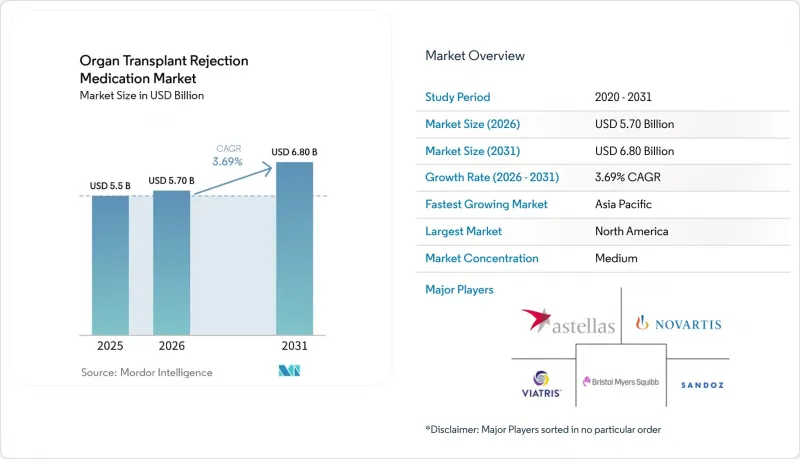
Mordor Intelligence에 의하면, 장기 이식 거부반응 치료제 시장 규모는 2025년에 55억 달러로 평가되었고 2026년 57억 달러에서 2031년까지 68억 달러에 이를 것으로 예측되며, 예측 기간(2026-2031년) CAGR은 3.69%를 나타낼 전망입니다.
본 보고서는 약물 분류별(칼시뉴린 억제제, 항증식제 등), 이식 장기별(신장, 간, 심장 등), 분자 유형(저분자 화합물, 생물학적 제제), 유통 채널(이식 센터 등), 지역(북미, 유럽, 아시아태평양, 중동 및 아프리카, 남미)별로 분류되어 있습니다. 시장 전망은 금액(달러) 기준으로 제시되어 있습니다.
전 세계 장기 이식 거부반응 치료제 시장 동향 및 인사이트
이식 건수 증가가 만성 면역억제요법에 대한 수요를 뒷받침하고 있습니다.
신장 이식은 2025년 매출에서 큰 비중을 차지하고 있으며, 2025년 미국에서 2만 7,573건, 2023년 중국에서 2만 2,814건의 신장 이식이 시행된 것으로 보아, 간 및 심장 부문을 능가하는 성장을 이어가고 있습니다. 메디케어 급여 개혁에 따라 36개월간의 급여 정지 기간이 폐지됨에 따라, 복약 순응도 부족으로 인한 이식편 상실률이 약 15% 감소했을 뿐만 아니라, 치료 대상이 되는 환자층도 확대되었습니다. 인도 국립 장기·조직 이식 기구(NOTO)의 보고서에 따르면, 연간 1만 5,000-2만 건의 신장 이식이 이루어지고 있으며, 이는 장기 이식 거부반응 치료제 시장에서 아시아태평양이 차지하는 매우 중요한 역할을 여실히 보여주고 있습니다. 일본에서는 사망 기증자 비율이 인구 100만 명당 고작 1.7명에 불과하기 때문에 연간 약 2,000건의 신장 이식에 그치고 있어 여전히 공급이 부족한 상황입니다. 따라서 이식 건수 증가는 2031년까지의 연평균 성장률(CAGR) 전망에서 가장 큰 긍정적 요인이 될 것입니다.
타크롤리무스 계열의 CNI 요법이 전 세계적으로 주류 치료법으로 자리매김하고 있습니다.
2025년 현재 칼시뉴린 억제제(CNI)가 시장 점유율의 상당 부분을 차지하고 있으며, 타크로리무스가 CNI 처방량의 대부분을 차지하고 있습니다. 제네릭 의약품의 보급률은 크게 상승했으나, 2023년 FDA가 타크로리무스를 함유한 특정 제네릭 의약품을 AB 등급에서 BX 등급으로 하향 조정함에 따라 신규 대체 처방이 주춤해졌고, 제제 간 편차를 피하기 위해 미국의 대부분의 프로그램이 단일 공급원 계약을 체결하게 되었습니다. 엠버서스 XR이라는 이름으로 판매되고 있는 서방형 타크롤리무스는 높은 생체이용률을 자랑하며 하루 1회 투여가 가능하지만, 높은 가격에 대한 지불 주체의 소극적인 태도로 인해 광범위한 보급이 제한되고 있습니다. 이러한 가격과 판매량 양쪽을 모두 중시하는 전략이 시장의 연평균 성장률(CAGR) 확대에 기여하고 있습니다.
가격 하락으로 인해 환자 1인당 수익이 압박받고 있습니다.
2025년까지 제네릭 의약품이 미코페놀산 부문의 대부분을 차지하는 반면, 타크로리무스의 가격은 특허 만료 이후 대폭 하락하여, 로슈사의 셀셉트의 매출액은 2010년 24억 달러에서 2026년에는 약 3억 5,000만 달러로 감소했습니다. 여러 제네릭 의약품이 출시됨에 따라, 시롤리무스와 에베롤리무스에서도 유사한 경향이 나타납니다. 단일 공급처 계약은 대체 가능성을 제한하는 한편, 할인 가격을 고정시키는 결과로 이어져 연평균 성장률(CAGR)에 미치는 부정적 영향을 더욱 확대시키고 있습니다.
부문별 분석
2025년 장기 이식 거부반응 치료제 시장에서 CNI(칼시모듈 계열 면역억제제)는 매출의 41.68%를 차지했으나, 제네릭 의약품의 광범위한 보급으로 인해 단위당 매출은 크게 감소했습니다. 한편, mTOR 억제제는 신독성을 완화하기 위해 의사가 시롤리무스나 에베로리무스의 용량을 줄인 타크롤리무스와 병용하는 경향이 있어, 연평균 3.98%의 성장률이 예상됩니다. 미코페놀산 등의 항증식제를 포함한 3제 병용 요법은 여전히 시장 매출의 상당 부분을 차지하고 있으며, 이는 임상 현장에서 이 요법이 얼마나 확고히 자리 잡았는지를 여실히 보여주고 있습니다. 공동자극 억제제와 IL-2 수용체 길항제는 합쳐서 소폭 시장 점유율을 차지하고 있는데, 이는 주로 베라타셉트의 전년 대비 큰 폭의 성장에 힘입은 결과입니다.
신장 이식은 2025년 매출의 48.19%를 차지할 것으로 예상되며, 2031년까지 연평균 성장률(CAGR) 4.05%로 성장할 것으로 전망되어, 간 및 심장 부문의 성장률을 상회하는 속도입니다. 메디케어의 적용 범위 확대와 인도에서 진행 중인 대규모 생체 기증 프로그램이 이러한 성장세를 뒷받침하고 있습니다. 2025년 시장 규모에서 거의 동등한 점유율을 차지할 것으로 예상되는 간 이식은 비알코올성 지방간염(NASH)의 유병률 증가로 인해 수혜를 보고 있지만, 면역억제 요법의 강도가 다소 낮다는 과제에 직면해 있습니다. 심장 및 폐 부위의 이식 건수는 전체에서 차지하는 비중이 적지만, 거부반응 예방을 위한 엄격한 치료로 인해 환자 1인당 의료비는 높은 임베디드니다.
신장 이식은 시술 건수 측면에서 선도적인 위치를 유지함으로써, 사체 기증 제도가 확립된 지역이나 생체 기증 프로그램이 확대되고 있는 지역에서 장기 이식 거부반응 치료제 시장의 기반을 계속해서 공고히할 것입니다. 현재 연구 중인 새로운 내성 유도 요법으로 인해, 2030년 이후에는 각 부문의 비중이 재조정될 가능성이 있습니다.
지역별 분석
북미는 2025년 매출의 43.19%를 차지하고 있으며, 이는 신장 이식 환자에게 면역억제제 비용을 영구적으로 부담하는 메디케어의 정책 변경에 힘입은 결과입니다. 이번 개혁을 통해, 약물 복용 미준수로 인한 이식편 기능 부전이 15% 감소했습니다. CVS Specialty, Accredo 및 Walgreens Specialty는 고가의 생물학적 제제 조제의 대부분을 관리하고 있으며, 보험금 지급을 복약 순응도 지표 모니터링과 연계하고 있습니다. 따라서 전문 약국의 성장은 생물학적 제제의 보급과 병행하고 있으며, 이에 따라 지불 주체의 감독 체제가 더욱 공고해지고 있습니다.
유럽은 Eurotransplant 및 Scandiatransplant를 통한 협력적 조달을 활용하여 전 세계 매출의 상당 부분을 차지하고 있습니다. 그러나 타크롤리무스 및 미코페놀산 모페틸의 제네릭 의약품 보급률이 높아, 단가는 북미 수준보다 낮습니다. EMA의 2025년판 단일클론 항체 바이오시밀러에 관한 지침은 여전히 rATG를 제외하고 있으며, 이로 인해 기존 브랜드는 초기 치료제 분야의 가격 수준을 유지할 수 있게 되었습니다.
아시아태평양은 가장 빠르게 성장하는 지역으로, 2031년까지 연평균 3.91%의 성장률을 기록하고 있습니다. 중국에서는 2023년에 2만 2,814건의 신장 이식이 이루어졌으며, 인도에서도 연간 최대 2만 건이 시행되고 있지만, 일본은 뇌사 기증자 비율이 낮아 시장 점유율 확대에 제약을 받고 있습니다. 규제의 불균일성과 현지 제네릭 제약사의 적극적인 시장 진입으로 인해 환자 1인당 수익은 억제되고 있지만, 절대적인 수술 건수 증가로 인해 해당 지역 전체의 장기 이식 거부반응 치료제 시장의 기준선은 상승할 전망입니다.
기타 혜택:
- 엑셀 형식 시장 예측(ME) 시트
- 3개월간의 애널리스트 지원
자주 묻는 질문
목차
제1장 서론
제2장 조사 방법
제3장 주요 요약
제4장 시장 구도
제5장 시장 규모와 성장 예측
제6장 경쟁 구도
제7장 시장 기회와 향후 전망
JHS 26.06.23According to Mordor Intelligence, the organ transplant rejection medication market size was valued at USD 5.5 billion in 2025 and is estimated to grow from USD 5.70 billion in 2026 to reach USD 6.80 billion by 2031, at a CAGR of 3.69% during the forecast period (2026-2031).
This report is Segmented by Drug Class (Calcineurin Inhibitors, Antiproliferatives, and More), Transplant Type (Kidney, Liver, Heart, and More), Molecule Type (Small Molecules, Biologics), Distribution Channel (Transplant Centers, and More), and Geography (North America, Europe, Asia-Pacific, Middle East & Africa, South America). The Market Forecasts are Provided in Terms of Value (USD).
Global Organ Transplant Rejection Medication Market Trends and Insights
Rising Transplant Volumes Anchor Chronic Immunosuppression Demand
Kidney transplantation accounted for a significant share of 2025 revenue and continues to outpace the liver and heart segments, as 27,573 kidney procedures were performed in the United States in 2025 and 22,814 in China in 2023. Medicare's coverage reforms eliminated the 36-month payment cliff, cutting non-adherence-driven graft loss by roughly 15% and expanding the treated population. India's National Organ and Tissue Transplant Organization reports 15,000-20,000 annual kidney transplants, underscoring Asia-Pacific's pivotal role in the organ transplant rejection medication market. Japan remains supply-constrained with only about 2,000 kidney transplants per year because its deceased-donor rate is just 1.7 per million people. Volume growth thus delivers the single-largest positive increment to CAGR forecasts through 2031.
Tacrolimus-Based CNI Regimens Remain the Global Workhorse
Calcineurin inhibitors held a significant share in 2025, with tacrolimus accounting for the majority of CNI prescriptions. Although generic penetration surged significantly, the FDA's 2023 downgrade of one tacrolimus generic from AB to BX slowed new substitutions, prompting most U.S. programs to sign single-source agreements to avoid formulation variability. Extended-release tacrolimus, marketed as Envarsus XR, offers higher bioavailability and once-daily dosing, yet payer reluctance toward its price premium limits broad adoption. This mixed pricing-and-volume strategy contributes to the market's growing CAGR.
Price Erosion Compresses Per-Patient Revenue
Generics seized the majority of the mycophenolate segment by 2025, while tacrolimus prices fell significantly since patent expiry, cutting Roche's CellCept sales from USD 2.4 billion in 2010 to roughly USD 350 million in 2026 . Similar patterns afflict sirolimus and everolimus following multiple generic launches. Although single-source contracts curb interchangeability, they also lock in discounted rates, amplifying the negative CAGR contribution.
Other drivers and restraints analyzed in the detailed report include:
- North American Coverage Keeps Adherence High
- Extended-Release Tacrolimus Boosts Adherence, Faces Cost Barriers
- Infection and Malignancy Concerns Drive Minimization
For complete list of drivers and restraints, kindly check the Table Of Contents.
Segment Analysis
CNIs accounted for 41.68% of 2025 revenue in the organ transplant rejection medication market, yet widespread generic availability slashed per-unit revenue. Meanwhile, mTOR inhibitors are forecast to rise at 3.98% annually as physicians pair sirolimus or everolimus with reduced-dose tacrolimus to mitigate nephrotoxicity. Triple-therapy protocols involving antiproliferatives such as mycophenolate still account for a notable share of market revenue, highlighting the entrenched nature of clinical practice. Co-stimulation blockade and IL-2 receptor antagonists together hold a modest share, largely driven by belatacept's significant year-over-year gains.
Kidney transplants accounted for 48.19% of 2025 revenue and are projected to grow at a 4.05% CAGR through 2031, outpacing the liver and heart segments. Medicare's coverage extension and sizable living-donor programs in India reinforce this trajectory. Liver transplantation, roughly ntable share of the 2025 value, benefits from rising non-alcoholic steatohepatitis prevalence but faces marginally lower immunosuppression intensity. Heart and lung segments account for a combined modest share but command higher per-patient spending due to stringent rejection prophylaxis.
By maintaining volume leadership, kidney transplantation will keep the organ transplant rejection medication market anchored in regions where deceased-donor systems are robust or living-donor programs expand. Novel tolerance-induction regimens under study may eventually rebalance segment weightings past 2030.
Geography Analysis
North America held 43.19% of 2025 revenue, underpinned by Medicare's policy change that permanently funds immunosuppressants for kidney recipients, a reform that slashed graft failure due to non-adherence by 15%. CVS Specialty, Accredo, and Walgreens Specialty manage the majority of high-cost biologic dispensing, linking reimbursement to monitoring adherence metrics. Specialty-pharmacy growth thus parallels biologic uptake, further entrenching payer oversight.
Europe contributed a significant share of global sales, leveraging coordinated procurement through Eurotransplant and Scandiatransplant. However, high generic penetration for tacrolimus and mycophenolate mofetil unit prices are below North American levels. EMA's 2025 biosimilar guidance for monoclonal antibodies still excludes rATG, allowing incumbent brands to defend price points on induction agents.
Asia-Pacific is the fastest-growing geography, expanding at 3.91% annually through 2031. China conducted 22,814 kidney transplants in 2023, and India performs up to 20,000 each year, yet Japan's low deceased-donor rate constrains its share of the market. Regulatory heterogeneity and aggressive local generic manufacturers temper per-patient revenue, but absolute volume gains will raise the baseline for the organ transplant rejection medication market across the region.
- Accord Healthcare
- Asahi Kasei
- Astellas Pharma
- Aurobindo Pharma
- Bristol-Myers Squibb
- Cipla
- CSL Behring
- Dr. Reddy's Laboratories
- Roche
- Fresenius
- Grifols
- Novartis
- Octapharma
- Pfizer
- Sandoz Group
- Sanofi
- Takeda Pharmaceuticals
- Teva Pharmaceutical Industries
- Viatris
- Zydus Lifesciences
Additional Benefits:
- The market estimate (ME) sheet in Excel format
- 3 months of analyst support
TABLE OF CONTENTS
1 Introduction
- 1.1 Study Assumptions & Market Definition
- 1.2 Scope of the Study
2 Research Methodology
3 Executive Summary
4 Market Landscape
- 4.1 Market Overview
- 4.2 Market Drivers
- 4.2.1 Rising Transplant Volumes; Kidney Accounts for the Majority of Solid Organ Procedures
- 4.2.2 Tacrolimus-Based CNI Regimens Remain the Maintenance Backbone Across Sots
- 4.2.3 North America Leads Revenue Share; Coverage Expansions Sustain Chronic Therapy Adherence
- 4.2.4 Oral Maintenance Dominance; Hospital/Specialty Channels Anchor Dispensing
- 4.2.5 Extended-Release Tacrolimus Adoption Improves Exposure Stability and Adherence
- 4.2.6 AMR Management Intensifies Use of IVIG And Complement-Targeted Adjuncts
- 4.3 Market Restraints
- 4.3.1 Price Erosion from Widespread Generics Across Tacrolimus/MMF/Sirolimus
- 4.3.2 Infection, Malignancy, and Metabolic Risks Drive Minimization and Regimen Switches
- 4.3.3 Regulatory/Quality Frictions (E.G., TE-Rating Changes) Slow Generic Substitution in Some Markets
- 4.3.4 IV Infusion Logistics And EBV-Serostatus Limits Cap Uptake of Certain Biologics
- 4.4 Supply-Chain Analysis
- 4.5 Regulatory Landscape
- 4.6 Technological Outlook
- 4.7 Porter's Five Forces
- 4.7.1 Threat of New Entrants
- 4.7.2 Bargaining Power of Suppliers
- 4.7.3 Bargaining Power of Buyers
- 4.7.4 Threat of Substitutes
- 4.7.5 Competitive Rivalry
5 Market Size & Growth Forecasts (Value, USD)
- 5.1 By Drug Class / Mechanism
- 5.1.1 Calcineurin inhibitors (tacrolimus, cyclosporine)
- 5.1.2 Antiproliferatives (mycophenolate mofetil, mycophenolic acid, azathioprine)
- 5.1.3 mTOR inhibitors (sirolimus, everolimus)
- 5.1.4 Corticosteroids
- 5.1.5 Co-stimulation blockers / IL-2R antagonists (belatacept, basiliximab)
- 5.1.6 Lymphocyte-depleting antibodies (rATG/ATG-F, alemtuzumab where used)
- 5.1.7 IVIG/plasmapheresis adjuncts
- 5.2 By Transplant Type
- 5.2.1 Kidney
- 5.2.2 Liver
- 5.2.3 Heart
- 5.2.4 Lung
- 5.2.5 Pancreas
- 5.2.6 Hematopoietic stem cell (HSCT)
- 5.3 By Molecule Type
- 5.3.1 Small molecules
- 5.3.2 Biologics
- 5.4 By Distribution Channel
- 5.4.1 Transplant centers / hospital pharmacies
- 5.4.2 Specialty pharmacies
- 5.4.3 Retail / online pharmacies
- 5.5 By Geography
- 5.5.1 North America
- 5.5.1.1 United States
- 5.5.1.2 Canada
- 5.5.1.3 Mexico
- 5.5.2 Europe
- 5.5.2.1 Germany
- 5.5.2.2 United Kingdom
- 5.5.2.3 France
- 5.5.2.4 Italy
- 5.5.2.5 Spain
- 5.5.2.6 Rest of Europe
- 5.5.3 Asia-Pacific
- 5.5.3.1 China
- 5.5.3.2 India
- 5.5.3.3 Japan
- 5.5.3.4 South Korea
- 5.5.3.5 Australia
- 5.5.3.6 Rest of Asia-Pacific
- 5.5.4 Middle East and Africa
- 5.5.4.1 GCC
- 5.5.4.2 South Africa
- 5.5.4.3 Rest of Middle East and Africa
- 5.5.5 South America
- 5.5.5.1 Brazil
- 5.5.5.2 Argentina
- 5.5.5.3 Rest of South America
- 5.5.1 North America
6 Competitive Landscape
- 6.1 Market Concentration
- 6.2 Market Share Analysis
- 6.3 Company Profiles {(includes Global level Overview, Market level overview, Core Segments, Financials as available, Strategic Information, Market Rank/Share for key companies, Products & Services, and Recent Developments)}
- 6.3.1 Accord Healthcare
- 6.3.2 Asahi Kasei
- 6.3.3 Astellas Pharma
- 6.3.4 Aurobindo Pharma
- 6.3.5 Bristol Myers Squibb
- 6.3.6 Cipla
- 6.3.7 CSL Behring
- 6.3.8 Dr. Reddy's Laboratories
- 6.3.9 F. Hoffmann-La Roche
- 6.3.10 Fresenius Kabi
- 6.3.11 Grifols
- 6.3.12 Novartis AG
- 6.3.13 Octapharma
- 6.3.14 Pfizer
- 6.3.15 Sandoz
- 6.3.16 Sanofi
- 6.3.17 Takeda
- 6.3.18 Teva Pharmaceutical Industries
- 6.3.19 Viatris
- 6.3.20 Zydus Lifesciences
7 Market Opportunities & Future Outlook
- 7.1 White-space & unmet-need assessment


