|
시장보고서
상품코드
2063650
아시아태평양의 골판지 포장 시장 : 점유율 분석, 업계 동향과 통계, 성장 예측(2026-2031년)Asia-Pacific Corrugated Packaging - Market Share Analysis, Industry Trends & Statistics, Growth Forecasts (2026 - 2031) |
||||||
 Mordor Intelligence
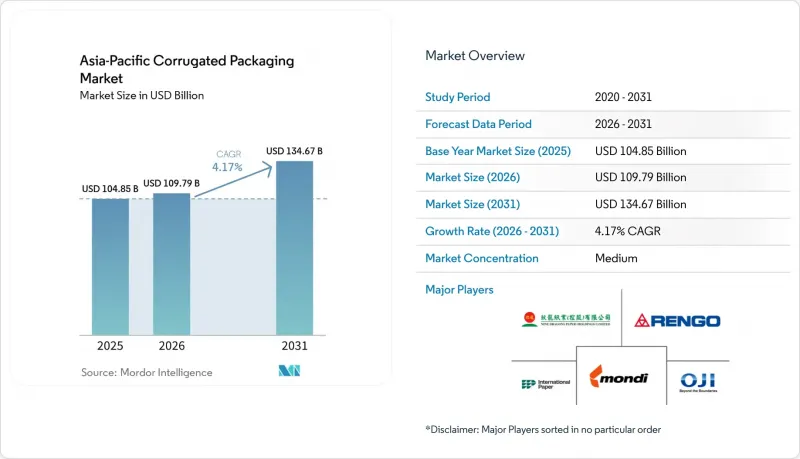
Mordor Intelligence에 의하면, 아시아태평양 골판지 포장 시장 규모는 2025년 1,048억 5,000만 달러에서 2026년에는 1,097억 9,000만 달러로 확대되어 2026년부터 2031년까지 CAGR 4.17%로 성장을 지속하여, 2031년에는 1,346억 7,000만 달러에 이를 것으로 예측됩니다.
본 보고서는 원료(버진 크라프트 라이너보드 등), 플루트 유형(A 플루트, B 플루트 등), 포장 유형(레귤러 슬롯 컨테이너 등), 벽 구조(싱글월, 더블월 등), 인쇄 기술(플렉소 인쇄 등), 최종 사용자 산업(가공식품 등) 및 지역별로 분류되어 있습니다. 시장 전망은 금액(달러) 기준으로 제시되어 있습니다.
아시아태평양 골판지 포장 시장 동향 및 분석
아시아 신흥 경제국에서의 식품 및 음료 소비 확대
중국, 인도 및 주요 아세안(ASEAN) 국가들의 도시 지역에서 소득이 증가함에 따라, 포장된 농산물, 가공식품 및 음료의 1인당 구매량이 증가하고 있습니다. 신선식품 수출에는 복합 일괄 운송 중 발생하는 온도 변동으로부터 제품을 보호할 수 있는 통기성과 내습성을 갖춘 운송용 상자가 필요하기 때문에 골판지 수요는 이에 직접적인 혜택을 보고 있습니다. 중국의 택배 네트워크는 2024년에 1,750억 개 이상의 소포를 처리할 전망이며, 이러한 급증은 온라인 식품 소매업체들이 당일 배송 범위를 확대함에 따라 과일 및 식사 키트용 운송 상자에 대한 2차 수요로 이어지고 있습니다. 인도네시아의 SNI 8218:2024나 태국의 TIS 규격과 같은 엄격한 식품 접촉 규제로 인해 규정 준수 비용이 상승하고 있어, 각 변환 업체들은 고급 SKU를 버진 크라프트지로 전환하기 시작하고 있습니다. 인도가 2025년에 실시할 수입 판지 대상 반보조금 조사는 이미 공급망을 국내 제지 공장으로 전환시키고, 재생 섬유 시장공급 부족을 초래하며, 고평량 용지 제조 설비에 대한 투자를 촉진하고 있습니다.
지속 가능하고 재활용 가능한 포장재로 전환
일본과 한국의 확대 생산자 책임(EPR) 제도에서는 브랜드 소유자에게 재생 소재의 함유량 및 사용 후 처리 경로를 문서화할 것을 요구하고 있으며, 이러한 제도는 광범위한 지역의 구매 부서에 급속히 영향을 미치고 있습니다. 2025년에는 재활용 라이너보드 시장 점유율이 이미 54.12%에 달했지만, 식품 및 의약품 브랜드들은 전 세계 감사 요건을 충족하기 위해 인증된 생산 이력(CoC)을 갖춘 버진 등급 제품에 추가 비용을 지불하고 있습니다. 메인 대학은 Trametes versicolor 균에서 유래한 코팅이 내습성을 유지하면서 재펄프화성을 향상시켜, 폴리에틸렌 라이너를 대체할 수 있음을 입증했습니다. Mondi와 같은 다국적 기업들은 기계적 강도를 저해하지 않으면서 재생 섬유의 활용률을 높이기 위해 12억 유로(13억 달러)를 투자해 제지 공장의 설비를 현대화하고 있으며, 조달 결정 시 단위 비용과 마찬가지로 탄소 배출량 및 재활용성이 중요시될 미래를 내다보며 크라프트 제품 포트폴리오를 구축하고 있습니다.
판지 원료 가격의 변동
북미의 총 250만 톤에 달하는 생산 능력 감축과 파나마 운하에서의 물류 혼란으로 인해 크래프트 라이너 보드의 현물 가격이 급등락하며, 가공업체들의 이익률이 압박을 받았습니다. 나인 드래곤즈나 리 앤 맨과 같은 통합형 대기업들은 자체 조달한 원자재 덕분에 가격 급등의 영향을 받지 않아 2025년에 세 자릿수의 이익 증가를 기록했지만, 현물 계약으로 운영되는 중소 가공업체들은 운전자금 회수 주기가 위험할 정도로 길어졌습니다. 중국 및 인도네시아산 판지에 대한 인도의 반보조금 조사는 아시아태평양의 무역 흐름을 재편하고 있지만, 국내의 신규 제지 공장이 가동되는 것은 2027년 이후가 될 전망이므로, 단기적으로는 가격의 급등락이 계속될 것으로 보입니다.
부문별 분석
비용에 민감한 전자상거래 사업자와 산업용 사용자들이 운송 예산을 최적화함에 따라, 2025년에는 재활용 라이너 보드가 아시아태평양 골판지 포장 시장 점유율의 54.12%를 차지했습니다. 버진크래프트는 연평균 성장률(CAGR) 5.62%로 성장하고 있으며, 식품과의 직접 접촉 및 의약품 수준의 순도 기준에 따라 인증된 섬유 공급망이 요구되는 고수익성 틈새 시장을 선점하고 있습니다. 이러한 분화로 인해 공급업체의 전문화가 진행되고 있습니다. 인도네시아의 제지 공장은 원료 생산 능력을 확대하고 있는 반면, 중국의 가공업체들은 수입 규제의 영향을 피하기 위해 재생 섬유 조달 경로를 강화하고 있습니다.
재활용 등급에 의존하는 가공업체들은 2025년 12월에 시행될 중국의 GB/T 6543-2025 규격(평탄도 및 압축 강도에 관한 요건)을 충족하기 위해 광학 선별기 및 습도 관리 시스템에 대한 투자를 서둘러야 하는 상황에 처해 있습니다. 한편, 고급 수산물 및 신선식품 수출업체들은 태평양 횡단 운송 중 습도 내성을 확보하기 위해 버진 크래프트지 다년 계약을 체결하고 있으며, 이로 인해 범용 등급과 특수 등급 간의 가격 차이가 확대되고 있습니다.
C-플루트는 2025년 기준 53.78%의 시장 점유율을 유지하며, 일반적인 운송 수요에 필요한 완충성과 압축 강도의 균형을 유지하고 있지만, 소매업체들이 적재 효율을 높이고 운송 시 배출량을 줄이기 위해 얇은 두께의 제품을 추구하는 가운데, E-플루트는 연평균 성장률(CAGR) 5.23%로 시장 점유율을 확대되고 있습니다. DS Smith사가 2026년에 Gopfert사의 로터리 다이커터에 투자한 것은 산업 규모에서 마이크로 플루트의 정밀도를 실현하기 위한 경쟁을 상징합니다. 이는 화장품, 전자기기, 퍼스널케어 브랜드들이 골판지 기판 위에서 오프셋 인쇄에 필적하는 인쇄 정밀도를 요구하고 있기 때문입니다. F 플루트는 생산량은 적지만, 고급 선물 세트나 구독 박스에서 인기를 얻고 있습니다. 이러한 분야에서는 개봉 시의 촉각적 경험과 낙하 시험을 통한 내구성이 양립되어야 합니다.
마이크로 플루트로의 전환에 따라, 제지 제조업체들은 더욱 엄격한 두께 공차를 충족할 수 있는 매끄럽고 강성이 높은 라이너 보드를 공급해야 할 필요가 있습니다. 이 또한 동일한 기계로 원목 펄프와 재생 펄프를 혼합할 수 있는 통합형 제조업체에 유리하게 작용합니다. 변환기는 미세 플루트 골판지 제조기에 대한 고액의 설비 투자와, 가볍고 평평한 상자로 인해 트럭 적재 효율이 향상되어 고객이 실현할 수 있는 물류 비용 절감 효과를 저울질해야 합니다. 전자상거래 알고리즘이 부피 중량 과금을 최적화함에 따라, 브랜드 소유주들은 골판지 제조업체에 더 얇은 제품을 개발하도록 촉구할 것입니다. 이로 인해 향후 5년 동안 아시아태평양의 골판지 포장 시장에서 E-플루트와 F-플루트가 가장 빠르게 성장하는 틈새 시장으로 자리매김하게 될 것입니다.
기타 혜택:
- 엑셀 형식 시장 예측(ME) 시트
- 3개월간의 애널리스트 지원
자주 묻는 질문
목차
제1장 서론
제2장 조사 방법
제3장 주요 요약
제4장 시장 구도
제5장 시장 규모와 성장 예측
제6장 경쟁 구도
제7장 시장 기회와 향후 전망
JHS 26.06.23According to Mordor Intelligence, the asia-Pacific corrugated packaging market size is expected to grow from USD 104.85 billion in 2025 to USD 109.79 billion in 2026 and is forecast to reach USD 134.67 billion by 2031 at 4.17% CAGR over 2026-2031.
This report is Segmented by Material (Virgin Kraft Linerboard, and More), Flute Type (A Flute, B Flute, and More), Packaging Type (Regular Slotted Containers, and More), Wall Type (Single-Wall, Double-Wall, and More), Printing Technology (Flexographic Printing, and More), End-User Industry (Processed Foods, and More), and Geography. The Market Forecasts are Provided in Terms of Value (USD).
Asia-Pacific Corrugated Packaging Market Trends and Insights
Growing Food and Beverage Consumption in Emerging Asian Economies
Rising urban incomes across China, India, and core ASEAN nations are boosting per capita purchases of packaged produce, processed foods, and beverages. Corrugated demand benefits directly because perishable exports require ventilated, moisture-resistant shippers that protect against temperature swings during multimodal transport. China's express-delivery network handled over 175 billion parcels in 2024, a surge that is translating into secondary demand for fruit and meal-kit shippers as e-grocers widen same-day coverage. Stringent food-contact rules, such as Indonesia's SNI 8218:2024 and Thailand's TIS standards, have raised compliance costs, prompting converters to migrate premium SKUs to virgin kraft. India's 2025 anti-subsidy probe on imported paperboards is already shifting supply chains toward domestic mills, tightening recovered-fiber markets, and incentivizing investment in high-basis-weight machines.
Shift Toward Sustainable and Recyclable Packaging Materials
Extended producer responsibility schemes in Japan and South Korea require brand owners to document recycled content and end-of-life pathways, a structure that is quickly influencing purchasing teams across the wider region. Recycled linerboard already held 54.12% share in 2025, yet food and pharma brands are paying premiums for virgin grades with certified chain-of-custody to meet global audit requirements. The University of Maine demonstrated that Trametes versicolor fungus-derived coatings can replace polyethylene liners while maintaining moisture resistance and improving repulpability. Multinationals such as Mondi are responding with EUR 1.2 billion (USD 1.3 billion) in mill upgrades that raise recovered-fiber utilization without sacrificing mechanical strength, positioning their kraft portfolio for a future in which carbon and recyclability scores sit alongside unit cost in sourcing decisions.
Volatility in Paperboard Raw Material Prices
Capacity closures totaling 2.5 million tons in North America and logistics snarls in the Panama Canal have whipsawed kraft linerboard spot prices, compressing converter margins. Integrated giants such as Nine Dragons and Lee and Man posted triple-digit profit jumps in 2025 because captive fiber insulated them from spikes, while small converters operating on spot contracts saw working-capital cycles stretch dangerously. India's anti-subsidy probe on Chinese and Indonesian boards is reshaping Asia-Pacific trade flows, yet new domestic mills will not come online until 2027, meaning price turbulence will persist in the near term.
Other drivers and restraints analyzed in the detailed report include:
- Rapid Expansion of E-Commerce and Omni-Channel Retail
- Increasing Pharmaceutical Production and Healthcare Spending
- Competition from Flexible Packaging Formats
For complete list of drivers and restraints, kindly check the Table Of Contents.
Segment Analysis
Recycled linerboard secured 54.12% of the Asia-Pacific corrugated packaging market share in 2025 as cost-sensitive e-commerce and industrial users optimize transportation budgets. Virgin Kraft is expanding at 5.62% CAGR, capturing high-margin niches where direct food contact and pharmaceutical purity standards dictate certified fiber chains. This divergence is sharpening supplier specialization; Indonesian mills are adding virgin capacity, while Chinese converters deepen recovered-fiber loops to insulate against import curbs.
Converters reliant on recycled grades must now invest in optical sorters and moisture-control systems to meet China's GB/T 6543-2025 squareness and compression mandates, which come into force in December 2025. Meanwhile, premium exporters of seafood and fresh produce are locking in multi-year virgin kraft contracts to secure moisture tolerance during trans-Pacific voyages, widening the price delta between commodity and specialty grades.
C flute retained 53.78% share in 2025, balancing cushioning and compression strength for general shipping needs, but E flute is advancing at 5.23% CAGR as retailers pursue thinner profiles that slash cube utilization and freight emissions. DS Smith's 2026 investment in a Gopfert rotary die-cutter illustrates the race to deliver micro-flute accuracy at an industrial scale, as cosmetics, electronics, and personal-care brands demand litho-like print fidelity on corrugated substrates. F-flute, though smaller in volume, is gaining traction in luxury gift packs and subscription boxes, where tactile unboxing experiences must coexist with drop-test robustness.
The pivot toward micro-flutes obliges mills to supply smoother, high-stiffness linerboard that tolerates tighter caliper tolerances, again favoring integrated producers that can blend virgin and recovered fibers on the same machine. Converters must weigh the higher capital outlay for fine-flute corrugators against the logistical savings clients achieve via lighter, flatter boxes that fill truck decks more efficiently. As e-commerce algorithms optimize dimensional weight billing, brand owners will push box makers toward ever-thinner profiles, cementing E flute and F flute as the fastest-growing niches within the Asia-Pacific corrugated packaging market over the next five years.
List of Companies Covered in this Report:
- Nine Dragons Paper (Holdings) Limited
- Oji Holdings Corporation
- Rengo Co., Ltd.
- Lee & Man Paper Manufacturing Ltd.
- International Paper Company
- Mondi plc
- Nippon Paper Industries Co., Ltd.
- Orora Limited
- Visy Industries Holdings Pty Ltd.
- Thai Containers Group Co., Ltd.
- Zhejiang Jingxing Paper Joint Stock Co., Ltd.
- YFY Inc.
- Smurfit WestRock plc
- Shenzhen Rongda Printing and Packaging Co., Ltd.
- Shenzhen BHL Paper Co., Ltd.
Additional Benefits:
- The market estimate (ME) sheet in Excel format
- 3 months of analyst support
TABLE OF CONTENTS
1 INTRODUCTION
- 1.1 Study Assumptions and Market Definition
- 1.2 Scope of the Study
2 RESEARCH METHODOLOGY
3 EXECUTIVE SUMMARY
4 MARKET LANDSCAPE
- 4.1 Market Overview
- 4.2 Market Drivers
- 4.2.1 Growing Food and Beverage Consumption in Emerging Asian Economies
- 4.2.2 Shift Toward Sustainable and Recyclable Packaging Materials
- 4.2.3 Rapid Expansion of E-Commerce and Omni-Channel Retail
- 4.2.4 Increasing Pharmaceutical Production and Healthcare Spending
- 4.2.5 Government-Led Subsidies for High-Color Digital Carton Printing in Export Hubs
- 4.2.6 Adoption of Fungus-Based Barrier Coatings Replacing Plastic Liners
- 4.3 Market Restraints
- 4.3.1 Volatility in Paperboard Raw Material Prices
- 4.3.2 Competition from Flexible Packaging Formats
- 4.3.3 Tightening Regional Water-Use Regulations Increasing Mill Operating Costs
- 4.3.4 Shortage of Skilled Technicians for High-Speed Folding-Gluing Lines
- 4.4 Industry Value Chain Analysis
- 4.5 Regulatory Landscape
- 4.6 Technological Outlook
- 4.7 Porter's Five Forces Analysis
- 4.7.1 Threat of New Entrants
- 4.7.2 Bargaining Power of Suppliers
- 4.7.3 Bargaining Power of Buyers
- 4.7.4 Threat of Substitutes
- 4.7.5 Competitive Rivalry
5 MARKET SIZE AND GROWTH FORECASTS (VALUE)
- 5.1 By Material
- 5.1.1 Virgin Kraft Linerboard
- 5.1.2 Recycled Linerboard
- 5.1.3 Corrugating Medium
- 5.1.4 Semi-Chemical Fluting
- 5.1.5 Other Materials
- 5.2 By Flute Type
- 5.2.1 A Flute
- 5.2.2 B Flute
- 5.2.3 C Flute
- 5.2.4 E Flute
- 5.2.5 F Flute
- 5.3 By Packaging Type
- 5.3.1 Regular Slotted Containers
- 5.3.2 Die-Cut Custom Boxes
- 5.3.3 Folding Cartons
- 5.3.4 Point-of-Purchase Displays
- 5.3.5 Pallet Boxes
- 5.3.6 Other Packaging Types
- 5.4 By Wall Type
- 5.4.1 Single-Wall
- 5.4.2 Double-Wall
- 5.4.3 Triple-Wall
- 5.4.4 Single Face
- 5.5 By Printing Technology
- 5.5.1 Flexographic Printing
- 5.5.2 Digital Inkjet Printing
- 5.5.3 Litho-Lamination
- 5.5.4 Screen Printing
- 5.5.5 Other Printing Technologies
- 5.6 By End-User Industry
- 5.6.1 Processed Foods
- 5.6.2 Fresh Food and Produce
- 5.6.3 Beverages
- 5.6.4 Electrical Products
- 5.6.5 Personal Care and Cosmetics
- 5.6.6 E-commerce Fulfillment Centers
- 5.6.7 Pharmaceuticals
- 5.6.8 Other End-User Industries
- 5.7 By Geography
- 5.7.1 China
- 5.7.2 India
- 5.7.3 Japan
- 5.7.4 South Korea
- 5.7.5 Australia and New Zealand
- 5.7.6 Rest of Asia-Pacific
6 COMPETITIVE LANDSCAPE
- 6.1 Market Concentration
- 6.2 Strategic Moves
- 6.3 Market Share Analysis
- 6.4 Company Profiles (includes Global level Overview, Market level overview, Core Segments, Financials as available, Strategic Information, Market Rank/Share for key companies, Products and Services, and Recent Developments)
- 6.4.1 Nine Dragons Paper (Holdings) Limited
- 6.4.2 Oji Holdings Corporation
- 6.4.3 Rengo Co., Ltd.
- 6.4.4 Lee & Man Paper Manufacturing Ltd.
- 6.4.5 International Paper Company
- 6.4.6 Mondi plc
- 6.4.7 Nippon Paper Industries Co., Ltd.
- 6.4.8 Orora Limited
- 6.4.9 Visy Industries Holdings Pty Ltd.
- 6.4.10 Thai Containers Group Co., Ltd.
- 6.4.11 Zhejiang Jingxing Paper Joint Stock Co., Ltd.
- 6.4.12 YFY Inc.
- 6.4.13 Smurfit WestRock plc
- 6.4.14 Shenzhen Rongda Printing and Packaging Co., Ltd.
- 6.4.15 Shenzhen BHL Paper Co., Ltd.
7 MARKET OPPORTUNITIES AND FUTURE OUTLOOK
- 7.1 White-Space and Unmet-Need Assessment