|
시장보고서
상품코드
2063785
의료 워크플로우 최적화 분야 인공지능(AI) : 시장 점유율 분석, 업계 동향 및 통계, 성장 예측(2026-2031년)AI In Healthcare Workflow Optimization - Market Share Analysis, Industry Trends & Statistics, Growth Forecasts (2026 - 2031) |
||||||
 Mordor Intelligence
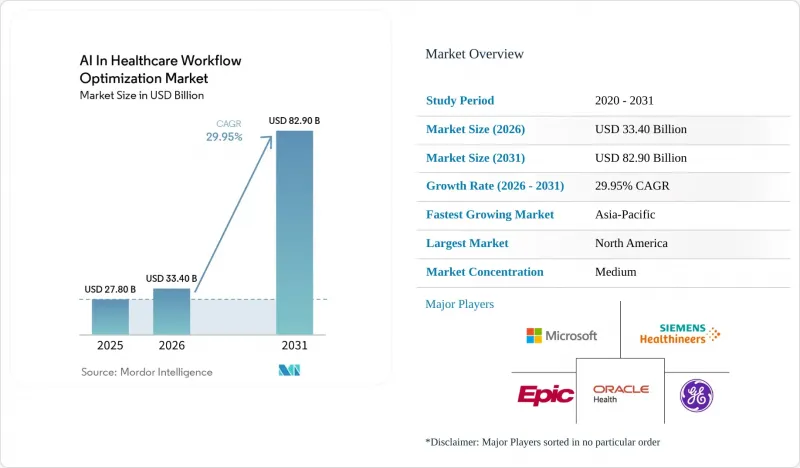
Mordor Intelligence에 의하면, 의료 워크플로우 최적화 분야 인공지능(AI) 시장 규모는 2025년 278억 달러로 평가되었습니다. 2026년 334억 달러에서 2031년까지 829억 달러로 확대되어 2026년부터 2031년까지 연평균 복합 성장률(CAGR)은 29.95%를 나타낼 것으로 예측됩니다.
본 보고서는 용도(임상 문서, 영상 진단 워크플로우, 입원 환자 수용 능력, 일정 관리, 기타), 최종 사용자(병원, 외래 진료소, 영상 진단센터, ASC, 보험사, 기타), 배포 방식(클라우드, On-Premise, 하이브리드), 기술(NLP/LLM, 컴퓨터 비전 등), 지역(북미 등)별로 분류되어 있습니다. 시장 전망치는 금액(달러) 단위로 제시되어 있습니다.
세계의 의료 워크플로우 최적화 분야 인공지능(AI) 시장 동향 및 인사이트
앰비언트 AI와 NLP가 임상의의 문서 작성 부담을 줄여줍니다.
임상의와 환자의 상호작용을 기록하고 구조화된 진료 기록을 생성하도록 설계된 앰비언트 AI 스크립은 대규모 다기관 공동 연구에서 문서 작성 시간을 33%에서 40%까지 단축했습니다. 이러한 발전 덕분에 임상의들은 1교대당 2-3시간의 시간을 확보할 수 있게 되었으며, 근무 시간 외의 진료 기록 작성 시간도 대폭 단축되었습니다. 2025년 중반까지 Epic에 연결된 미국 내 병원의 62.6%가 이러한 앰비언트 문서화 도구를 도입했으며, 이는 의료 현장에서의 급속한 보급을 반영했습니다. Microsoft DAX Copilot, Abridge, Ambience Healthcare 등, 이러한 솔루션 도입에 참여하는 벤더들의 존재는 혁신 주기를 가속화하는 치열한 경쟁 시장을 여실히 보여주고 있습니다. 2027년 1월로 다가온 CMS 사전 승인 API의 기한은 앰비언트 노트의 중요성을 더욱 부각시키고 있습니다. 구조화된 요약 정보를 통해 신청 절차의 효율화, 수동 데이터 입력의 감소, 승인 절차의 신속화가 가능하기 때문입니다. 또한, ONC의 HTI-1 규정은 의사결정 지원 과정에서 AI가 생성한 컨텐츠에 대해 출처 정보 및 신뢰도 지표를 통한 투명성을 의무화했습니다. 이로 인해 신뢰성이 향상되는 한편, 벤더와 IT 팀에 대한 개발 요구 사항도 높아지고 있습니다.
수요가 증가함에 따라 병원들은 처리 능력과 수용 능력을 최적화하고 있습니다.
병원은 물리적 수용 능력을 확대하지 않고도 증가하는 입원 환자 수요에 대응하기 위해 AI를 활용하고 있으며, 수술실과 병상의 이용률에서 상당한 개선을 이루고 있습니다. 그 개선 폭은 한 자릿수 후반에서 두 자릿수 초반에 이릅니다. 사례 연구에서는 간더센 헬스 시스템의 수술실 이용률이 8포인트 상승한 사례나, 이노바 헬스 시스템에서 막바지 빈 시간대의 46%가 채워진 사례 등 성공 사례가 제시되어 있으며, 유휴 시간대를 수익을 창출하는 사례로 전환하고 있습니다. 아리나 헬스에서는 자동화된 수술 순서 결정 및 블록 해제 도구가 18개월 이내에 투자 수익률(ROI) 11배를 달성하여, 18-24개월의 회수 기간이라는 CFO의 기대에 부응하는 결과를 얻었습니다. 이러한 플랫폼들은 거버넌스 프로토콜에 따라 인력을 재배치하고 수술 전 업무를 신속하게 처리할 수 있는 반자율형 시스템으로 진화하고 있으며, 단순한 분석 도구에서 필수적인 운영 인프라로 전환되고 있습니다. 대규모 지역 의료 센터와 대학 병원에서는 이러한 솔루션을 확대하여 일일 진료 건수를 늘리고, 재무 마진을 유지하며, 초과근무 수당을 절감하고 있습니다.
EHR 플랫폼 소유자가 기능을 활용하여 시장 역학을 강화
EHR 플랫폼 소유자들은 앰비언트 문서화 및 임상 의사결정 지원과 같은 기능을 자사의 핵심 시스템에 전략적으로 통합하고 있습니다. 이러한 접근 방식은 자사가 제공하는 서비스를 강화하는 한편, 제3자의 가격 책정 및 유통 경로에 압박을 가하고 있습니다. 2025년까지 Epic은 자사 플랫폼에 네이티브 앰비언트 스크라이브 기능을 통합함으로써, 독립 문서화 벤더 시장을 사실상 축소시키는 동시에 경쟁 구도를 멀티 EHR 상호운용성 쪽으로 전환시켰습니다. Oracle Health가 구 Cerner의 스택을 자사의 AI 로드맵에 통합함에 따라, 특히 EHR 통합에 의존하는 영상 진단 및 수용 능력 관리 도구 분야에서 명확한 데이터 접근 계약의 필요성이 대두되고 있습니다.
부문별 분석
의료 워크플로우 최적화 분야 인공지능(AI) 시장에서 2025년 매출의 31.24%를 임상 문서 작성 자동화가 차지했습니다. 이러한 성장은 주로 앰비언트 스크라이브의 광범위한 도입에 힘입은 것입니다. Ambient Scribe는 대규모 도입 사례를 통해 문서 작성 시간을 33%에서 40%까지 단축할 수 있는 능력을 입증했습니다. 이러한 첨단 도구는 전자건강기록(EHR) 내에 구조화된 기록을 자동으로 생성하여, 근무 시간 외의 차트 작성 시간을 대폭 줄여줍니다. 이를 통해 일과 삶의 균형이 개선될 뿐만 아니라, 환자에게 직접적인 돌봄을 제공하는 데 할애하는 시간을 늘릴 수 있게 됩니다. 문서 작성 자동화를 조기에 도입한 의료 시스템에서는 특히 EHR 공급업체가 기본 기능을 포함하고 있는 경우, 보다 신속한 확장 사례가 보고되고 있습니다. 이러한 번들화를 통해 추가 라이선스 비용이 발생하지 않으며, 조달 프로세스도 효율화됩니다. 입원 환자 수용 능력 및 환자 흐름 관리 도구는 절대적인 매출 규모는 작지만, 2031년까지 연평균 23.17%라는 견실한 성장세를 보이고 있습니다. 병원에서는 가동률 향상, 환자 입원 일수 단축, 그리고 수술 취소 건수 최소화에 점점 더 주력하고 있습니다.
2025년 지출 중 병원 및 의료 시스템이 47.68%를 차지했습니다. 이러한 지출 수준은 심각한 인력 부족, 외과 진료 부문의 높은 기여 이익률, 그리고 ONC의 HTI-1 규정에 따라 EHR에 통합된 거버넌스 요건과 일치합니다. 이 기관들은 앰비언트 스크라이빙, 수술 전후 관리 최적화, 그리고 영상 진단 분류의 표준화를 추진하고 있습니다. 이러한 대책은 처리 능력을 향상시킬 뿐만 아니라, 임상의의 시간을 확보하고, 수익을 유지하며, 번아웃을 완화합니다. 주요 EHR 내의 벤더 파트너십 및 마켓플레이스는 연결을 간소화함으로써 이러한 도입을 더욱 가속화하고 있으며, 이를 통해 가치 실현까지 걸리는 시간을 대폭 단축하고 있습니다. 통합 트리아지 플랫폼을 도입한 영상진단센터 및 서비스 라인은 보다 신속한 진료를 제공함으로써 차별화를 꾀하고 있으며, 이를 통해 초과근무 시간 단축과 판독실의 효율성 제고에 기여하고 있습니다. 외래 진료 및 통원 진료 클리닉 시장은 2031년까지 연평균 22.43%의 성장률을 보일 것으로 전망됩니다. 이러한 성장은 가치 기반 계약 하에서 위험이 소규모 진료소로 이전되고 있는 데 기인하며, 이러한 계약에서는 예약 관리 및 사전 승인 자동화가 점점 더 중요하게 여겨지고 있습니다.
지역별 분석
2025년, 북미는 의료 워크플로우 최적화 분야 인공지능(AI) 시장에서 매출 점유율의 42.16%를 차지했습니다. 이러한 성장은 EHR의 광범위한 도입, 앰비언트 스크라이빙의 확대, 그리고 사전 승인 API와 관련된 2027년 마감 기한이 다가오고 있는 점 등이 요인으로 작용하고 있습니다. 2025년 중반까지 주요 EHR 공급업체를 이용하는 미국 병원 고객 중 62.6%가 앰비언트 문서화 도구를 도입하여, 주요 의료 시스템 내에서 이 도구가 널리 보급되었음을 보여주었습니다. 2026년 8월로 예정된 의사결정 지원 개입의 의무화에 따라, 출처(프로방스), 신뢰도 라벨링, 그리고 AI 컨텐츠 내보내기 기능에 대한 투자가 가속화되고 있습니다. 거버넌스 체제가 지속적으로 발전함에 따라, 이러한 동향은 의료 워크플로우 최적화 분야 인공지능(AI) 시장에서 앰비언트 문서화, 수술 전후 과정 최적화, 그리고 트리아지 오케스트레이션의 도입을 가속화하고 있습니다.
아시아태평양은 중국 일부 지역에서 AI 기반 환자 분류의 의무화와 인도에서 상호 운용 가능한 의료 기록의 확대에 힘입어, 2031년까지 연평균 성장률(CAGR) 24.78%라는 견조한 성장이 예상됩니다. 중국 보건 당국은 1급 도시 이외의 병원에 AI 트리아지 도입을 추진하고 있으며, 이에 따라 영상 진단의 통합 관리 및 급성기 의료 조정의 활용이 증가하고 있습니다. 인도에서는 ‘아유슈만 바라트 디지털 미션’을 통해 광범위한 의료시설 네트워크 전반에 걸쳐 환자 연계형 전자 건강 기록이 확대되고 있으며, 기록 작성 및 예약 관리 분야에서 AI의 유용성이 향상되고 있습니다. 또한, 인도의 한 병원 그룹은 전문의 부족 문제를 해결하기 위해 방사선과용 AI를 도입하여, 환자 수가 집중되는 의료기관에서의 트리아지 가치를 강화하고 있습니다. 일본에서는 규제 당국이 신속 승인 절차를 통해 내시경 검사 및 안과용 AI 도구를 승인하고 있지만, 보험 급여 문제와 IT 인프라의 제약으로 인해 도입은 여전히 학술 기관에 집중되어 있습니다.
기타 혜택 :
- 엑셀 형식 시장 예측(ME) 시트
- 3개월간의 애널리스트 지원
자주 묻는 질문
목차
제1장 서론
제2장 조사 방법
제3장 주요 요약
제4장 시장 구도
제5장 시장 규모 및 성장 예측
제6장 경쟁 구도
제7장 시장 기회 및 향후 전망
KTH 26.06.26According to Mordor Intelligence, the aI in healthcare workflow optimization market size is projected to expand from USD 27.80 billion in 2025 and USD 33.40 billion in 2026 to USD 82.90 billion by 2031, registering a CAGR of 29.95% between 2026 to 2031.
This report is Segmented by Application (Clinical Documentation, Imaging Workflow, Inpatient Capacity, or Scheduling, Others), End User (Hospitals, Ambulatory Clinics, Imaging Centers, Ascs, Payers, Others), Deployment (Cloud, On-Premises, Hybrid), Technology (NLP/LLMs, Computer Vision, and More), and Geography (North America, and More). Market Forecasts are Provided in Value (USD).
Global AI In Healthcare Workflow Optimization Market Trends and Insights
Ambient AI and NLP Alleviate Clinician Documentation Burden
Ambient AI scribes, designed to capture clinician-patient interactions and generate structured notes, have reduced documentation time by 33% to 40% in large-scale, multi-site trials. This advancement has allowed clinicians to reclaim 2 to 3 hours per shift while significantly reducing after-hours charting. By mid-2025, 62.6% of U.S. hospitals connected to Epic had implemented these ambient documentation tools, reflecting their rapid adoption in mainstream healthcare. Vendor participation in these deployments, including Microsoft DAX Copilot, Abridge, and Ambience Healthcare, highlights a competitive market driving faster innovation cycles. The January 2027 CMS deadline for the Prior Authorization API further emphasizes the importance of ambient notes, as structured summaries can streamline requests, reduce manual data entry, and expedite approval processes. Additionally, ONC's HTI-1 rule mandated transparency through provenance and confidence indicators for AI-generated content in decision support, enhancing trust while increasing development requirements for vendors and IT teams.
Hospitals Optimize Throughput and Capacity Amid Rising Demand
Hospitals are leveraging AI to address rising inpatient demand without expanding physical capacity, achieving significant improvements in operating room and bed utilization. These gains range from high single to low double digits. Case studies demonstrate success, such as an 8-percentage-point increase in operating room utilization at Gundersen Health System and a 46% fill rate for last-minute openings at Inova Health System, converting idle blocks into revenue-generating cases. At Allina Health, automated sequencing and block-release tools delivered an 11-times return on investment within 18 months, aligning with CFO expectations for an 18 to 24-month payback period. These platforms are evolving into semi-autonomous systems capable of reallocating staff and expediting pre-operative tasks under governance protocols, transitioning from analytics tools to essential operational infrastructure. Large community and academic medical centers are scaling these solutions to boost daily case volumes, protect financial margins, and reduce overtime expenses.
EHR Platform Owners Leverage Features, Tightening Market Dynamics
EHR platform owners are strategically integrating features like ambient documentation and clinical decision support into their core systems. This approach enhances their offerings while exerting pressure on third-party pricing and distribution routes. By 2025, Epic embedded native ambient scribes into its platform, effectively narrowing the market for independent documentation vendors and shifting the competitive landscape towards multi-EHR interoperability.Oracle Health's integration of the former Cerner stack into its AI roadmap has increased the need for clear data-access agreements, particularly for imaging and capacity tools reliant on EHR integration.
Other drivers and restraints analyzed in the detailed report include:
- AI Enhances Imaging Workflow and Acute Care Coordination
- Cloud-EHR Integration Paves the Way for AI-Enhanced Workflows
- Providers Tighten Budgets Amidst Shrinking Margins in 2024
For complete list of drivers and restraints, kindly check the Table Of Contents.
Segment Analysis
Clinical documentation automation accounted for 31.24% of the 2025 revenue in the AI-driven healthcare workflow optimization market. This growth is primarily driven by the widespread adoption of ambient scribes, which have demonstrated the ability to reduce documentation time by 33% to 40% in large-scale implementations. These advanced tools automatically generate structured notes within Electronic Health Records (EHR), significantly reducing after-hours charting. This not only enhances work-life balance but also allows more time for direct patient care. Health systems that adopted documentation automation early have reported faster scaling, particularly when EHR vendors bundle native functionality. Such bundling eliminates additional licensing costs and streamlines procurement processes. Inpatient capacity and patient flow tools, while generating smaller absolute revenues, are experiencing strong annual growth of 23.17% through 2031. Hospitals are increasingly focusing on improving utilization rates, reducing patient stays, and minimizing canceled cases.
Hospitals and health systems accounted for 47.68% of spending in 2025. This level of expenditure aligns with acute labor shortages, high contribution margins from surgical lines, and governance mandates embedded within EHRs under ONC's HTI-1 rule. These institutions are standardizing on ambient scribing, perioperative optimization, and imaging triage. Such measures not only enhance throughput but also recover clinician time, safeguarding revenue and reducing burnout. Vendor partnerships and marketplaces within leading EHRs are further accelerating these deployments by simplifying connections, which significantly reduce time-to-value. Imaging centers and service lines that adopt unified triage platforms differentiate themselves by delivering faster care, which helps reduce overtime and improve efficiency in reading rooms. Ambulatory and outpatient clinics are projected to grow at an annual rate of 22.43% through 2031. This growth is driven by the shift of risk to smaller practices under value-based contracts, which increasingly reward automation in scheduling and prior authorizations.
Geography Analysis
In 2025, North America accounted for 42.16% of the revenue share in the AI-driven healthcare workflow optimization market. This growth was driven by extensive EHR adoption, the scaling of ambient scribing, and the upcoming 2027 deadline for prior-authorization APIs. By mid-2025, 62.6% of U.S. hospital clients using a leading EHR provider had implemented ambient documentation tools, indicating widespread adoption in major health systems. The implementation of decision support intervention mandates in August 2026 is accelerating investments in provenance, confidence labeling, and AI content exportability. These developments are expediting the deployment of ambient documentation, perioperative optimization, and triage orchestration within the AI healthcare workflow optimization market as governance structures continue to evolve.
Asia-Pacific is projected to grow at a strong CAGR of 24.78% through 2031, supported by regional AI triage mandates in parts of China and the expansion of interoperable health records in India. Health authorities in China are promoting the adoption of AI triage in hospitals outside tier-1 cities, driving increased use of imaging orchestration and acute care coordination. In India, the Ayushman Bharat Digital Mission is scaling patient-linked health records across a wide network of facilities, enhancing the utility of AI in documentation and scheduling. Additionally, corporate hospital groups in India are deploying radiology AI to address specialist shortages, strengthening the triage value proposition in high-volume centers. In Japan, while regulators have approved AI-enabled tools for endoscopy and ophthalmology through expedited pathways, adoption remains concentrated in academic institutions due to reimbursement challenges and IT infrastructure limitations.
- Abridge
- Aidoc
- Augmedix
- Automation Anywhere
- Cohere Health
- Edifecs
- Epic Systems
- GE Healthcare
- Innovaccer
- InterSystems
- LeanTaaS
- Microsoft
- Notable
- Oracle Health
- Koninklijke Philips
- Qventus
- Siemens Healthineers
- Suki
- UiPath
- Validic
- Viz.ai
Additional Benefits:
- The market estimate (ME) sheet in Excel format
- 3 months of analyst support
TABLE OF CONTENTS
1 Introduction
- 1.1 Study Assumptions & Market Definition
- 1.2 Scope of the Study
2 Research Methodology
3 Executive Summary
4 Market Landscape
- 4.1 Market Overview
- 4.2 Market Drivers
- 4.2.1 Clinician Documentation Burden Reduction Via Ambient AI and NLP
- 4.2.2 Throughput, Capacity, and Perioperative Optimization Priorities
- 4.2.3 Imaging Workflow Orchestration and Acute Care Coordination
- 4.2.4 Cloud-EHR Integration Enabling Embedded AI in Workflows
- 4.2.5 CMS Prior Authorization APIs and Interoperability Deadlines (2026-2027)
- 4.2.6 ONC HTI-1 DSI Transparency Driving AI Governance Inside Certified EHRs
- 4.3 Market Restraints
- 4.3.1 EHR Integration Complexity and Platform Gatekeeping Risks
- 4.3.2 Capital Constraints and Cautious Procurement Cycles at Providers
- 4.3.3 FDA PCCP and Lifecycle Governance Increasing Compliance Workload
- 4.3.4 Change Management and Clinician Adoption Hurdles
- 4.4 Value / Supply-Chain Analysis
- 4.5 Regulatory Landscape
- 4.6 Technological Outlook
- 4.7 Porter's Five Forces Analysis
- 4.7.1 Threat of New Entrants
- 4.7.2 Bargaining Power of Suppliers
- 4.7.3 Bargaining Power of Buyers
- 4.7.4 Threat of Substitutes
- 4.7.5 Competitive Rivalry
5 Market Size & Growth Forecasts (Value, USD)
- 5.1 By Application
- 5.1.1 Clinical Documentation Automation
- 5.1.2 Imaging Workflow & Orchestration
- 5.1.3 Inpatient Capacity & Patient Flow
- 5.1.4 Operating Room Scheduling & Perioperative Optimization
- 5.1.5 Revenue Cycle & Prior Authorization Automation
- 5.1.6 Others
- 5.2 By End User
- 5.2.1 Hospitals & Health Systems
- 5.2.2 Ambulatory & Outpatient Clinics
- 5.2.3 Imaging Centers
- 5.2.4 Ambulatory Surgery Centers
- 5.2.5 Payers
- 5.2.6 Others
- 5.3 By Deployment
- 5.3.1 Cloud-based
- 5.3.2 On-premises
- 5.3.3 Hybrid
- 5.4 By Technology / AI Modality
- 5.4.1 NLP / LLMs
- 5.4.2 Computer Vision
- 5.4.3 Optimization & Simulation
- 5.4.4 Predictive Analytics
- 5.4.5 RPA / Intelligent Process Automation
- 5.5 By Geography
- 5.5.1 North America
- 5.5.1.1 United States
- 5.5.1.2 Canada
- 5.5.1.3 Mexico
- 5.5.2 Europe
- 5.5.2.1 Germany
- 5.5.2.2 United Kingdom
- 5.5.2.3 France
- 5.5.2.4 Italy
- 5.5.2.5 Spain
- 5.5.2.6 Rest of Europe
- 5.5.3 Asia-Pacific
- 5.5.3.1 China
- 5.5.3.2 India
- 5.5.3.3 Japan
- 5.5.3.4 South Korea
- 5.5.3.5 Australia
- 5.5.3.6 Rest of Asia-Pacific
- 5.5.4 Middle East & Africa
- 5.5.4.1 GCC
- 5.5.4.2 South Africa
- 5.5.4.3 Rest of Middle East and Africa
- 5.5.5 South America
- 5.5.5.1 Brazil
- 5.5.5.2 Argentina
- 5.5.5.3 Rest of South America
- 5.5.1 North America
6 Competitive Landscape
- 6.1 Market Concentration
- 6.2 Market Share Analysis
- 6.3 Company Profiles (includes Global level Overview, Market-level Overview, Core Segments, Financials, Strategic Information, Market Rank/Share, Products & Services, Recent Developments)
- 6.3.1 Abridge
- 6.3.2 Aidoc
- 6.3.3 Augmedix
- 6.3.4 Automation Anywhere
- 6.3.5 Cohere Health
- 6.3.6 Edifecs
- 6.3.7 Epic Systems
- 6.3.8 GE HealthCare
- 6.3.9 Innovaccer
- 6.3.10 InterSystems
- 6.3.11 LeanTaaS
- 6.3.12 Microsoft
- 6.3.13 Notable
- 6.3.14 Oracle Health
- 6.3.15 Philips
- 6.3.16 Qventus
- 6.3.17 Siemens Healthineers
- 6.3.18 Suki
- 6.3.19 UiPath
- 6.3.20 Validic
- 6.3.21 Viz.ai
7 Market Opportunities & Future Outlook
- 7.1 White-space & unmet-need assessment