

|
시장보고서
상품코드
2063823
Power Over Ethernet(PoE) 스위치 시장 : 점유율 분석, 업계 동향과 통계, 성장 예측(2026-2031년)Power Over Ethernet (PoE) Switch - Market Share Analysis, Industry Trends & Statistics, Growth Forecasts (2026 - 2031) |
||||||
 Mordor Intelligence
Mordor Intelligence에 의하면, Power over Ethernet(PoE) 스위치 시장 규모는 2025년 56억 7,000만 달러, 2026년 63억 1,000만 달러에서 2031년까지 107억 3,000만 달러로 확대되어 2026년부터 2031년까지 연평균 복합 성장률(CAGR)은 11.21%를 나타낼 것으로 예측됩니다.
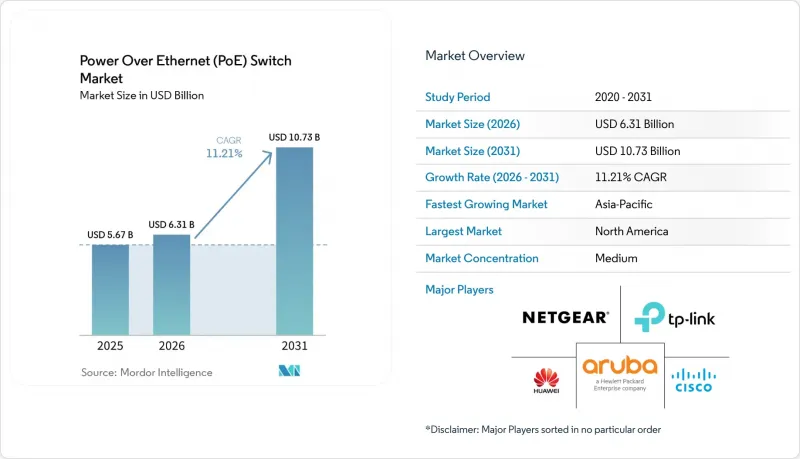
본 보고서는 관리 기능(관리형, 비관리형, 스마트), 전력 등급(최대 15.4W 이하, 30W 이하, 60W 이하, 90W 이하, 90W 초과), 포트 수(4-8, 9-16, 17-24, 기타), 최종 이용 산업(주거, 상업, 산업, 기타), 용도(IP 감시, 무선 AP, 기타), 지역별로 분류되어 있습니다. 시장 전망은 금액(달러) 기준으로 제공됩니다.
전 세계 Power Over Ethernet(PoE) 스위치 시장 동향 및 인사이트
IoT 기반의 스마트 빌딩 도입
상업시설 소유주들은 독자적인 빌딩 자동화 제어 시스템에서 점유 현황, 온도, 실내 공기질을 모니터링하는 이더넷 기반 센서로 전환하고 있습니다. 이러한 변화로 인해 층당 필요한 PoE(Power over Ethernet) 포트 수가 3배에서 5배로 증가함에 따라, 시설 관리자들은 섀시의 전력 예산이 740와트를 초과하는 802.3bt 스위치를 도입해야 하는 상황에 직면해 있습니다. 운영 기술(OT) 장치를 기업의 IP 네트워크에 통합하는 것은 해당 장치를 사이버 위협에 노출시키는 결과를 초래합니다. 따라서 구매 부서는 임베디드 방화벽이나 제로 트러스트 세분화 기능을 갖춘 스위치를 점점 더 많이 지정하고 있습니다. 지멘스는 2025년 실적 발표에서 독일 및 영국의 스마트 빌딩 입찰에 있어 향후 시행될 EU 사이버 복원력법의 요건을 충족하는 온보드 보안 엔진이 필수로 요구된다고 보고했습니다. 따라서, 높은 PoE(Power over Ethernet) 공급 능력과 기본 보안 기능을 모두 갖춘 공급업체는 보안 대책을 옵션 라이선스로 취급하는 경쟁사보다 한 발 앞서 입찰에서 승리하고 있습니다.
IP 영상 감시 확대
지자체나 대규모 캠퍼스에서는 아날로그 CCTV를 4K 및 8K IP 카메라로 교체하고 있으며, 이 카메라들은 25-90와트의 전력을 소비합니다. 이는 이전 기기의 15와트라는 사양을 훨씬 뛰어넘는 수치입니다. 뉴욕시의 2024년 교통 모니터링 카메라 계약에서는 약 2만 개의 PoE(Power over Ethernet) 포트가 사용될 예정이며, 이는 단일 스마트시티 프로젝트가 지역 수요를 얼마나 끌어올릴 수 있는지를 보여줍니다. Hikvision이나 Dahua와 같은 카메라 제조업체들은 2025년에 온보드 AI 분석 기능을 갖춘 Type 4 대응 모델을 출시할 예정이며, 이로 인해 시스템 통합사업자들은 90와트 대응 스위치를 선택할 수밖에 없게 되었고, 그렇지 않을 경우 전압 강하 위험을 감수해야 하는 상황이 되었습니다. 보험사들은 암호화 및 변조 방지 기능을 갖춘 IP 감시 시스템이 도입될 경우 보험료 할인을 제공하기 시작했으며, 이로 인해 예산이 제한된 분야에서도 시스템 교체 주기를 단축할 수 있는 경제적 지원이 더해지고 있습니다.
초기 하드웨어 비용의 높음
기업은 모든 기능을 갖춘 48포트 802.3bt 스위치(가격 1만 5,000달러), 이중화 전원 공급 장치, UPS 시스템 및 지원 계약을 고려할 때, 포트당 800-1,200달러의 비용이 발생할 수 있습니다. 이러한 고액의 초기 비용은 특히 소규모 조직이나 예산에 제약이 있는 분야에서는 큰 장벽이 됩니다. 가격에 민감한 중소기업은 집중 관리 기능을 갖추지 않은 미드스팬 인젝터에 의존하는 경우가 많으며, 그 결과 운영 효율성이 제한되고 맙니다. 미국의 E-Rate 지침에 묶여 있는 공립학교는 최저 입찰가 규정을 준수해야 하므로, 첨단 PoE(Power over Ethernet) 스위치 솔루션에 대한 투자 능력이 더욱 제한받고 있습니다. 이러한 과제를 해결하기 위해 각 벤더사는 리스 및 구독 프로그램을 도입하여 설비 투자(CapEx)를 운영 비용(OpEx)으로 효과적으로 전환하고 있습니다. 이러한 프로그램은 비용을 장기간에 걸쳐 분산함으로써 Power over Ethernet(PoE) 스위치의 활용도를 높이는 것을 목표로 하고 있습니다. 특히, 시스코의 ‘2025 PoE-as-a-service’ 서비스는 초기 비용을 최대 70%까지 절감할 수 있다고 알려져 있어, 첨단 Power over Ethernet(PoE) 기술을 도입하면서도 예산 관리를 원하는 조직에게 현실적인 선택지가 되고 있습니다.
부문별 분석
매니지드 스위치는 2025년 매출의 45.61%를 차지하며, 네트워크 팀이 SNMP 모니터링, VLAN 세분화 및 서비스 품질(QoS)에 의존하여 실시간 트래픽에 우선순위를 부여하고 있음을 여실히 보여줍니다. 기업들이 액세스 제어 목록(ACL) 및 제로 트러스트 정책을 배포 계층에 직접 통합함에 따라, 관리형 파워 오버 이더넷(PoE) 스위치 시장 규모가 비관리형 제품을 넘어설 것으로 전망됩니다. 이와 동시에 산업용 등급 모델이 부상하고 있다는 사실은 특히 모션 제어 로봇이나 고속 카메라가 설치된 공장 현장에서 견고한 외장, 넓은 온도 범위에서의 작동, 그리고 IEC 61850 준수가 포트 수와 마찬가지로 중요하게 여겨지게 되었음을 보여줍니다. 스마트 스위치는 브라우저 기반의 설정 기능과 제한적인 분석 기능을 결합하여 중견 기업의 요구를 충족시키고 있으며, 공인 엔지니어를 보유하지 않은 기업이나 플러그 앤 플레이 이상의 가시성을 원하는 중소기업으로부터 지지를 받고 있습니다. Power over Ethernet(PoE) 스위치 시장도 클라우드 도입을 적극적으로 추진하고 있습니다. Extreme Networks가 2025년에 발표한 제로 터치 프로비저닝을 통해 지점에서는 전문 인력이 없어도 장비를 설치할 수 있게 되어, 도입에 소요되는 시간을 몇 시간에서 몇 분으로 단축할 수 있습니다.
산업용 PoE(Power over Ethernet) 시장 규모는 연평균 성장률(CAGR) 13.23%로 확대되고 있으며, 이 부문 내에서 가장 빠른 성장률을 보이고 있습니다. 이러한 성장을 주도하고 있는 것은 각 조립 라인에 수백 개의 진동·온도 센서를 추가하는 예측 유지보수 프로젝트이며, 각 센서는 15-25와트의 전력을 소비합니다. Moxa나 Advantech와 같은 공급업체들은 -40°C에서 75°C의 환경 조건을 지원하며, 5g의 충격에도 견딜 수 있는 DIN 레일 스위치를 통해 이러한 요구에 부응하고 있습니다. 이러한 특성 덕분에 지게차의 왕래나 오일 미스트에 대한 노출로부터 전자 기기를 보호합니다. 비용이 기능보다 우선시되는 가정이나 소규모 사무실에서는 여전히 비관리형 장비가 판매되고 있지만, 클라우드 대시보드가 관리형 장비의 저렴한 또는 무료 부가 기능으로 자리 잡으면서 PoE 스위치 시장에서의 점유율은 점차 줄어들고 있습니다. 장기적으로는 Lantronix가 2026년에 예고한 바와 같이, 내장형 AI 엔진으로 인해 네트워크 하드웨어와 엣지 컴퓨팅 노드 간의 경계가 모호해질 것이며, 향후 관리형 스위치가 감시 영상이나 생산 지표에 대한 추론 가속기 역할도 수행할 가능성이 시사되고 있습니다.
2025년 출하 대수에서 최대 30와트 모델이 49.94%를 차지했는데, 이는 기존의 802.3at 지원 카메라와 Wi-Fi 6 액세스 포인트가 여전히 도입 기반의 대부분을 차지하고 있기 때문입니다. 그러나 Wi-Fi 7 무선 및 AI 지원 PTZ 카메라 등 60와트 이상의 전력을 필요로 하는 기기들이 2031년까지 유형 4 스위치의 연간 성장률을 15.81%로 끌어올리고 있습니다. 각 벤더들이 100Mb/s 업링크를 폐지하고 기가비트 인터페이스를 채택함에 따라, 15.4와트급 802.3af PoE 스위치 시장 점유율은 줄어들고 있습니다. 60와트급 과도 전력은 디지털 사이니지나 인터랙티브 키오스크에 활용되고 있지만, 시스코의 100와트 Universal Power over Ethernet(PoE)과 같은 초고출력 독자 규격이 널리 보급된다면 그 존재감은 희미해질 가능성이 있습니다.
미래를 내다보면, 캠퍼스 및 의료 분야의 고객들은 현재 사용하는 기기의 전력 소비량이 25-45와트에 불과하더라도 90와트의 여유분을 감안하여 예산을 책정하고 있습니다. 이는 10년 전 15와트에서 30와트로 전환했을 때 얻은 교훈을 반영한 것입니다. 미국 NEC 제840조 등 업계 기준에 따라, 저전압 시공업체는 마스터 전기기사 면허가 없어도 100와트 미만의 케이블을 다룰 수 있기 때문에 사무실 리모델링 공사에서 이러한 방식의 도입이 가속화되고 있습니다. 한편, 유럽의 저전압 지침에서는 여전히 인증된 작업자의 투입이 의무화되어 있어, 이로 인해 비용이 증가하게 되므로 90와트로의 전환을 저해하는 요인이 되고 있습니다. 반도체 공급업체들은 DC-DC 변환 시 발생하는 손실을 줄이고 있으며, 스위치 제조업체들은 2028년까지 100와트 대응 반도체가 출하될 것으로 전망하고 있습니다. 이에 따라 PoE(Power over Ethernet) 스위치 시장은 공급 와트수 측면에서 또 한 번의 세대적 도약을 맞이할 것으로 보입니다.
지역별 분석
북미는 2025년 매출의 38.12%를 차지했습니다. 이는 기업이 10년 가까이 사용해 온 Catalyst 3,750 장비를 교체하고, Wi-Fi 6E를 지원하는 배포 계층으로 전환했기 때문입니다. 연방 정부의 E-Rate 자금은 K-12(유치원부터 고등학교까지)의 장비 교체를 지원하고 있으며, 국방 공급망 분야의 사이버 보안 성숙도 모델 인증(CMMC)은 주요 계약업체들이 하드웨어 기반의 신뢰 기반(Root of Trust)을 갖춘 스위치를 도입하도록 장려하고 있습니다. 캐나다는 미국의 동향과 유사하지만, 주요 대학들의 스마트 캠퍼스 프로그램이 추가적인 호재로 작용하고 있습니다.
아시아태평양은 2031년까지 연평균 성장률(CAGR)이 13.87%에 달하며, 급속한 성장의 원동력이 되고 있습니다. 중국과 인도에서는 운영 기술과 정보 기술을 통합하는 인더스트리 4.0 개조 공사에 PoE(Power over Ethernet)를 도입하여 각 회선의 포트 밀도를 3배에서 5배로 확대되고 있습니다. 동남아시아 국가들에서는 전자기기 조립 거점이 급증함에 따라 비슷한 양상을 보이고 있는 반면, 호주의 병원과 대학에서는 디지털 포용 지원금의 일환으로 Wi-Fi 6E 액세스 포인트와 90와트 조명 드라이버가 도입되고 있습니다.
유럽에서는 중요 인프라 사업자 및 은행을 대상으로 Power over Ethernet(PoE) 엔드포인트의 세분화을 의무화하는 NIS2 및 DORA 규제로 인해 시장이 한 자릿수 중반대의 성장률을 보이고 있습니다. 또한, ‘건축물의 에너지 성능에 관한 지침(EPBD)’에 따라 상업시설 전체의 PoE 조명으로의 개조가 촉진되고 있습니다. 라틴아메리카는 여전히 규모가 작으며, 브라질의 금융 업계와 아르헨티나의 농산물 수출에 집중되어 있고, 곡물 저장 시설에서는 도난 방지를 위해 IP 감시 시스템이 도입되어 있습니다. 중동 및 아프리카는 프로젝트 주도형이며, 사우디아라비아의 NEOM이나 두바이 스마트시티에서는 PoE 도로 인프라가 지정되어 있지만, 도입은 공공 부문의 입찰 주기에 좌우됩니다.
기타 혜택:
- 엑셀 형식 시장 예측(ME) 시트
- 3개월간의 애널리스트 지원
자주 묻는 질문
목차
제1장 서론
제2장 조사 방법
제3장 주요 요약
제4장 시장 구도
제5장 시장 규모와 성장 예측
제6장 경쟁 구도
제7장 시장 기회와 향후 전망
JHS 26.06.23According to Mordor Intelligence, the power over Ethernet (PoE) switch market size is projected to expand from USD 5.67 billion in 2025 and USD 6.31 billion in 2026 to USD 10.73 billion by 2031, registering a CAGR of 11.21% between 2026 to 2031.
This report is Segmented by Management Capability (Managed, Unmanaged, and Smart), Power Class (Up To 15. 4W, Up To 30W, Up To 60W, Up To 90W, and Above 90W), Port Count (4-8, 9-16, 17-24, and More), End-Use Industry (Residential, Commercial, Industrial, and More), Application (IP Surveillance, Wireless APs, and More), and Geography. The Market Forecasts are Provided in Terms of Value (USD).
Global Power Over Ethernet (PoE) Switch Market Trends and Insights
IoT-Driven Smart-Building Deployments
Commercial property owners are migrating from proprietary building-automation controllers to Ethernet-based sensors that monitor occupancy, temperature, and indoor air quality. That change multiplies the number of Power over Ethernet (PoE) ports required per floor by three to five, pushing facility managers toward 802.3bt switches with chassis power budgets exceeding 740 watts. The integration of operational technology devices into corporate IP networks also exposes them to cyber threats, so purchasing teams increasingly specify switches with embedded firewalls and zero-trust segmentation. Siemens reported in its 2025 results call that smart-building bids in Germany and the United Kingdom now require on-board security engines that meet forthcoming EU Cyber Resilience Act obligations. Vendors that marry high Power over Ethernet (PoE) budgets with native security are therefore winning tenders ahead of rivals that treat protection as an optional license.
IP-Video Surveillance Expansion
Municipalities and large campuses are replacing analog CCTV with 4K and 8K IP cameras that draw 25-90 watts, far above the 15-watt budgets of earlier devices. New York City's 2024 traffic-camera contract consumed roughly 20,000 Power over Ethernet (PoE) ports, exemplifying how a single smart-city project can lift regional demand. Camera makers such as Hikvision and Dahua shipped Type 4-powered models with on-board AI analytics in 2025, driving integrators to pick 90-watt switches or risk voltage sag. Insurance carriers have begun offering premium discounts when encrypted, tamper-proof IP surveillance is installed, adding a financial nudge that shortens replacement cycles even in budget-constrained sectors.
High Upfront Hardware Costs
Enterprises can face costs of USD 800-1,200 per port when factoring in a fully loaded 48-port 802.3bt switch (priced at USD 15,000), redundant power, UPS systems, and support contracts. These high upfront costs pose a significant barrier, particularly for smaller organizations and budget-constrained sectors. Price-sensitive small firms often resort to mid-span injectors, which lack centralized management capabilities, thereby limiting operational efficiency. Public schools, bound by U.S. E-Rate guidelines, must adhere to lowest-bid rules, further restricting their ability to invest in advanced Power over Ethernet (PoE) switch solutions. To address these challenges, vendors have introduced leasing and subscription programs, effectively converting capital expenditures (capex) into operational expenditures (opex). These programs aim to make Power over Ethernet (PoE) switches more accessible by spreading costs over time. Notably, Cisco's 2025 PoE-as-a-service offering is said to reduce initial cash outlays by as much as 70%, providing a viable alternative for organizations seeking to manage their budgets while adopting advanced Power over Ethernet (PoE) technologies.
Other drivers and restraints analyzed in the detailed report include:
- Wi-Fi 6 / 6E / 7 Access-Point Power Needs
- Power over Ethernet (PoE)-Based Smart Lighting Roll-Outs
- Heat-Dissipation Limits at 90 W
For complete list of drivers and restraints, kindly check the Table Of Contents.
Segment Analysis
Managed switches commanded 45.61% of 2025 revenue, underscoring how network teams depend on SNMP monitoring, VLAN segmentation, and quality-of-service to prioritize real-time traffic. The Power over Ethernet switch market size for managed products is projected to outpace unmanaged units as enterprises integrate access control lists and zero-trust policies directly into distribution layers. A parallel rise in industrial-grade models shows that ruggedized housings, extended-temperature operation, and IEC 61850 compliance now matter as much as port counts, particularly on factory floors that house motion-control robots and high-speed cameras. Smart switches address a mid-tier audience by bundling browser-based configuration with limited analytics, which resonates with small businesses that lack certified engineers yet still want visibility beyond plug-and-play behavior. The Power over Ethernet switch market has also embraced cloud onboarding; Extreme Networks' zero-touch provisioning, launched in 2025, allows branches to install equipment without specialized staff, cutting deployment windows from hours to minutes.
Industrial Power over Ethernet (PoE) variants are advancing at a 13.23% CAGR, the fastest clip inside this segmentation. Growth is propelled by predictive-maintenance projects that add hundreds of vibration and temperature sensors to each assembly line, each pulling 15-25 watts. Vendors such as Moxa and Advantech have responded with DIN-rail switches that tolerate -40 °C to 75 °C and survive 5 g shocks, attributes that shield electronics from forklift traffic and oil-mist exposure. Unmanaged devices still sell into home and micro-office sites where cost trumps features, but their share of the Power over Ethernet switch market is slowly eroding as cloud dashboards become cheap or free companions to managed gear. On the horizon, embedded AI engines, as previewed by Lantronix in 2026, blur the line between network hardware and edge-computing node, suggesting that tomorrow's managed switch could double as an inference accelerator for surveillance feeds or production metrics.
Up-to-30-watt models retained 49.94% of 2025 shipments because legacy 802.3at cameras and Wi-Fi 6 access points still dominate installed bases. However, devices needing more than 60 watts, including Wi-Fi 7 radios and AI-enabled PTZ cameras, are stoking 15.81% annual growth for Type 4 switches through 2031. The Power over Ethernet switch market share of the 15.4-watt 802.3af class is shrinking as vendors retire 100-Mb/s uplinks in favor of gigabit interfaces. A transitional 60-watt band serves digital signage and interactive kiosks yet could fade if ultra-high-power proprietary specs, such as Cisco's 100-watt Universal Power over Ethernet (PoE), gain wider traction.
Looking ahead, campus and healthcare customers are budgeting for 90-watt headroom even when today's devices draw only 25-45 watts, reflecting lessons learned during the jump from 15 watts to 30 watts a decade ago. Industry codes such as U.S. NEC Article 840 allow low-voltage installers to handle cables below 100 watts without master-electrician licenses, which accelerates rollout in office renovations. Conversely, the European Low-Voltage Directive still obliges certified labor, adding a cost premium that tempers 90-watt uptake. Silicon vendors are shrinking DC-DC conversion losses, and switch makers project that 100-watt-capable silicon could ship by 2028, positioning the Power over Ethernet switch market for another generational leap in delivered wattage.
Geography Analysis
North America held 38.12% of 2025 revenue as enterprises swapped out decade-old Catalyst 3750 units and migrated to Wi-Fi 6E-ready distribution layers. Federal E-Rate funding boosts K-12 refreshes, and the Cybersecurity Maturity Model Certification in defense supply chains pushes prime contractors toward switches with hardware roots of trust. Canada mirrors U.S. trends, with an added lift from smart-campus programs at major universities.
Asia Pacific is the fast-growth engine with a 13.87% CAGR through 2031. China and India are embedding Power over Ethernet (PoE) within Industry 4.0 retrofits that unify operational and information technology, expanding port density by three to five times on each line. Southeast Asian nations follow similar paths as electronics-assembly hubs proliferate, while Australian hospitals and colleges adopt Wi-Fi 6E access points and 90-watt lighting drivers under digital-inclusion grants.
Europe posts mid-single-digit growth, buoyed by NIS2 and DORA mandates that force critical-infrastructure operators and banks to segment Power over Ethernet (PoE) endpoints. The Energy Performance of Buildings Directive also incentivizes PoE lighting retrofits across the commercial stock. Latin America remains smaller, concentrated in Brazilian finance and Argentine agricultural exports where grain elevators adopt IP surveillance against theft. The Middle East and Africa are project-driven; Saudi Arabia's NEOM and Dubai Smart City specify PoE street infrastructure, but rollouts depend on public-sector tender cycles.
- Cisco Systems, Inc.
- Hewlett Packard Enterprise (Aruba)
- Huawei Technologies Co., Ltd.
- Juniper Networks, Inc.
- Netgear, Inc.
- TP-Link Corporation Ltd.
- D-Link Corporation
- Extreme Networks, Inc.
- Ubiquiti Inc.
- Arista Networks, Inc.
- Allied Telesis Holdings K.K.
- Siemens AG
- Advantech Co., Ltd.
- Moxa Inc.
- Belden Inc. (Hirschmann)
- PLANET Technology Corp.
- Microchip Technology Inc.
- Zyxel Communications Corp.
- Hikvision Digital Technology Co., Ltd.
- Dahua Technology Co., Ltd.
- Phoenix Contact GmbH & Co. KG
- TRENDnet, Inc.
Additional Benefits:
- The market estimate (ME) sheet in Excel format
- 3 months of analyst support
TABLE OF CONTENTS
1 INTRODUCTION
- 1.1 Study Assumptions and Market Definition
- 1.2 Scope of the Study
2 RESEARCH METHODOLOGY
3 EXECUTIVE SUMMARY
4 MARKET LANDSCAPE
- 4.1 Market Overview
- 4.2 Market Drivers
- 4.2.1 IoT-driven smart-building deployments
- 4.2.2 IP-video surveillance expansion
- 4.2.3 Wi-Fi 6/6E/7 AP power requirements
- 4.2.4 PoE-based smart lighting roll-outs
- 4.2.5 Edge-AI device PoE powering
- 4.2.6 Cyber-secure network mandates
- 4.3 Market Restraints
- 4.3.1 High upfront hardware costs
- 4.3.2 Heat-dissipation limits at 90 W
- 4.3.3 Semiconductor supply imbalance
- 4.3.4 EMI concerns in medical labs
- 4.4 Industry Supply-Chain Analysis
- 4.5 Regulatory Landscape
- 4.6 Technological Outlook
- 4.7 Porter's Five Forces Analysis
- 4.7.1 Bargaining Power of Buyers
- 4.7.2 Bargaining Power of Suppliers
- 4.7.3 Threat of New Entrants
- 4.7.4 Threat of Substitutes
- 4.7.5 Competitive Rivalry
- 4.8 Pricing Analysis
5 MARKET SIZE AND GROWTH FORECASTS (VALUE)
- 5.1 By Management Capability
- 5.1.1 Managed PoE Switch
- 5.1.2 Unmanaged PoE Switch
- 5.1.3 Smart PoE Switch
- 5.2 By Power Class
- 5.2.1 Up to 15.4 W (802.3af)
- 5.2.2 Up to 30 W (802.3at)
- 5.2.3 Up to 60 W (Type 3)
- 5.2.4 Up to 90 W (Type 4)
- 5.2.5 Above 90 W (Ultra PoE)
- 5.3 By Port Count
- 5.3.1 4-8 Ports
- 5.3.2 9-16 Ports
- 5.3.3 17-24 Ports
- 5.3.4 25-48 Ports
- 5.3.5 Above 48 Ports
- 5.4 By End-Use Industry
- 5.4.1 Residential
- 5.4.2 Commercial Buildings
- 5.4.3 Industrial and Manufacturing
- 5.4.4 Government and Public Infrastructure
- 5.4.5 IT and Telecom
- 5.4.6 Healthcare
- 5.4.7 Education
- 5.4.8 Other End-Use Industries (Retail, Transportation and Logistics)
- 5.5 By Application
- 5.5.1 IP Surveillance Cameras
- 5.5.2 Wireless Access Points
- 5.5.3 VoIP Phones and UC Endpoints
- 5.5.4 Building Automation and PoE Lighting
- 5.5.5 Industrial Sensors and Controllers
- 5.5.6 Edge Computing Nodes and AI Boxes
- 5.5.7 5G Small Cells and DAS
- 5.6 By Geography
- 5.6.1 North America
- 5.6.1.1 United States
- 5.6.1.2 Canada
- 5.6.1.3 Mexico
- 5.6.2 South America
- 5.6.2.1 Brazil
- 5.6.2.2 Argentina
- 5.6.2.3 Rest of South America
- 5.6.3 Europe
- 5.6.3.1 Germany
- 5.6.3.2 United Kingdom
- 5.6.3.3 France
- 5.6.3.4 Italy
- 5.6.3.5 Spain
- 5.6.3.6 Rest of Europe
- 5.6.4 Asia Pacific
- 5.6.4.1 China
- 5.6.4.2 Japan
- 5.6.4.3 South Korea
- 5.6.4.4 India
- 5.6.4.5 ASEAN
- 5.6.4.6 Oceania
- 5.6.4.7 Rest of the Asia Pacific
- 5.6.5 Middle East and Africa
- 5.6.5.1 Middle East
- 5.6.5.1.1 Saudi Arabia
- 5.6.5.1.2 United Arab Emirates
- 5.6.5.1.3 Turkey
- 5.6.5.1.4 Rest of the Middle East
- 5.6.5.2 Africa
- 5.6.5.2.1 South Africa
- 5.6.5.2.2 Nigeria
- 5.6.5.2.3 Rest of Africa
- 5.6.5.1 Middle East
- 5.6.1 North America
6 COMPETITIVE LANDSCAPE
- 6.1 Market Concentration
- 6.2 Strategic Moves
- 6.3 Market Share Analysis
- 6.4 Company Profiles (includes Global level Overview, Market level overview, Core Segments, Financials as available, Strategic Information, Market Rank/Share for key companies, Products and Services, and Recent Developments)
- 6.4.1 Cisco Systems, Inc.
- 6.4.2 Hewlett Packard Enterprise (Aruba)
- 6.4.3 Huawei Technologies Co., Ltd.
- 6.4.4 Juniper Networks, Inc.
- 6.4.5 Netgear, Inc.
- 6.4.6 TP-Link Corporation Ltd.
- 6.4.7 D-Link Corporation
- 6.4.8 Extreme Networks, Inc.
- 6.4.9 Ubiquiti Inc.
- 6.4.10 Arista Networks, Inc.
- 6.4.11 Allied Telesis Holdings K.K.
- 6.4.12 Siemens AG
- 6.4.13 Advantech Co., Ltd.
- 6.4.14 Moxa Inc.
- 6.4.15 Belden Inc. (Hirschmann)
- 6.4.16 PLANET Technology Corp.
- 6.4.17 Microchip Technology Inc.
- 6.4.18 Zyxel Communications Corp.
- 6.4.19 Hikvision Digital Technology Co., Ltd.
- 6.4.20 Dahua Technology Co., Ltd.
- 6.4.21 Phoenix Contact GmbH & Co. KG
- 6.4.22 TRENDnet, Inc.
7 MARKET OPPORTUNITIES AND FUTURE OUTLOOK
- 7.1 White-Space and Unmet-Need Assessment


