
|
시장보고서
상품코드
2063858
BFSI 분야 인재 채용 : 시장 점유율 분석, 업계 동향 및 통계, 성장 예측(2026-2031년)Talent Acquisition In BFSI - Market Share Analysis, Industry Trends & Statistics, Growth Forecasts (2026 - 2031) |
||||||
 Mordor Intelligence
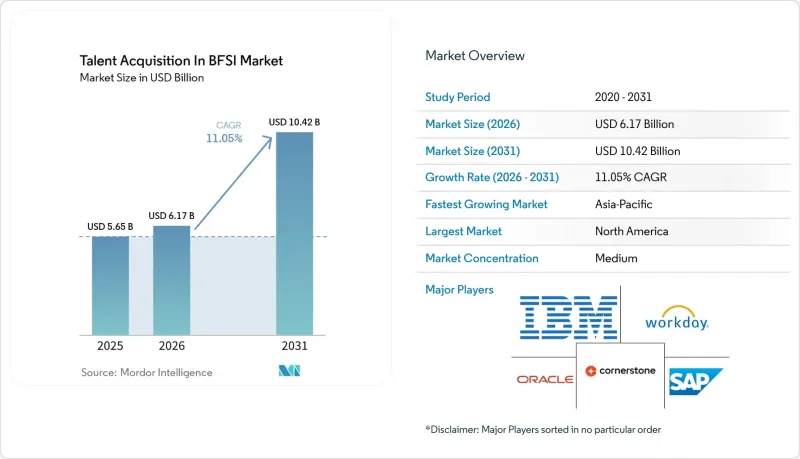
Mordor Intelligence에 의하면, BFSI 분야 인재 채용 시장 규모는 2025년에 57억 달러로 평가되었습니다. 예측 기간(2026-2031년) CAGR 11.05%로 성장해 2026년 62억 달러에서 2031년에는 104억 달러에 이를 것으로 추정되고 있습니다.
본 보고서는 구성 요소(소프트웨어 솔루션(지원자 추적 시스템(ATS), 후보자 관계 관리(CRM), 채용·마케팅 제품군, 면접·평가 도구, 온보딩 솔루션) 및 서비스), 배포 방식(On-Premise 및 클라우드), 조직 규모(대기업 및 중소기업), 지역별로 분류되어 있습니다. 시장 전망은 금액(달러) 기준으로 제시되어 있습니다.
세계의 BFSI 분야 인재 채용 시장 동향 및 인사이트
네오뱅크를 통한 디지털 우선 온보딩 의무화
네오뱅크는 BFSI(은행 및 금융 및 보험) 업계에서 신기술을 가장 적극적으로 도입하고 있는 기업 중 하나입니다. 이는 단순히 채용 속도가 빠르기 때문만이 아니라, 규정 준수를 최우선으로 하는 조직 구조상, 은행 면허가 발효되는 첫날부터 완벽하게 감사 가능하고 디지털로 통합된 온보딩 워크플로가 필요하기 때문입니다. 2024년 중반에 영국 은행 라이선스를 취득한 Revolut은 그 후 2025년에 서유럽에서 400명을 채용하는 캠페인을 시작했습니다. 모집 직종의 대부분은 컴플라이언스, 리스크 관리, 금융 범죄 방지 관련 분야였으며, 이 캠페인은 파리에서의 은행 면허 신청 및 이에 따른 규제상 인력 배치 요건과 명확히 연계된 것이었습니다. 네덜란드의 네오뱅크인 Bunq는 2024년에 전 세계 직원 수를 70% 늘리고, 3개 대륙 9개 도시에 걸쳐 있는 전문 인재를 대상으로 삼았습니다. 이를 위해서는 여러 국가에 걸친 인재 확보 인프라의 구축이 전제조건으로 요구되었습니다. Monzo는 2025년 12월 아일랜드 중앙은행을 통해 EU의 정식 은행 면허를 취득함에 따라, 2027년 중반까지 아일랜드 내 직원 수를 현재의 약 2배인 70명으로 늘리는 것을 목표로 하고 있습니다. 각 네오뱅크의 라이선스 취득 과정에서 디지털 인재 채용 플랫폼은 단순한 생산성 향상 도구가 아닌, 규제상 인프라로서 사실상 필수적인 요소로 간주되고 있습니다. 이러한 추세에 따라 네오뱅크의 채용 프로그램은 광범위한 경제 사이클과는 별개로 구조적인 수요를 견인하는 역할을 하고 있습니다.
니치 분야의 리스크 및 컴플라이언스 인력 부족
틈새 분야의 리스크 및 컴플라이언스 인력 부족은 일시적인 현상이 아니라 구조적인 문제이기 때문에 BFSI 시장에서 인재 확보를 위한 가장 강력한 성장 요인 중 하나로 계속해서 자리 잡고 있습니다. 금융 서비스 업계의 컴플라이언스 담당 임원 중 90% 가까이가 지난 3년 동안 자신의 책임이 커졌습니다고 보고했으며, 절반 이상이 향후 12개월 이내에 전문 분야에서 기술 부족을 겪을 것으로 예상하고 있습니다. 싱가포르에서는 싱가포르 금융관리청(MAS)이 현지 및 전 세계 은행들과 협력하여 자금세탁방지(AML) 기준 개선과 인력 부족 문제 해결에 힘쓰고 있으며, 이는 인력 부족 문제가 내부 인사 문제에서 규제상의 우려로 전환되었음을 보여줍니다. 성숙한 인재 유동화 기능을 갖춘 조직은 중기적인 인재 부족에 대응하는 데 있어 3.7배의 효과를 발휘하는 것으로 밝혀졌으며, 이에 따라 BFSI 기관들은 최신 채용 플랫폼 내에서 내부 역량 매핑 및 후계자 계획을 도입하도록 권장받고 있습니다. 홍콩과 싱가포르에서는 2026년 급여 데이터에 따르면, MAS(싱가포르 금융관리청)의 규제 보고 및 디지털 자산 규정 준수 등 전문직 분야에서 3-6%의 급여 프리미엄이 나타나고 있으며, 이는 사후적인 채용 공고가 아닌, 미래를 내다본 인재 파이프라인 구축이 중요함을 뒷받침하고 있습니다. 그 결과, BFSI 분야 인재 채용는 이용 가능한 후보자와 채용 관련 규제의 복잡성 사이에서 발생하는 미미하지만 뿌리 깊은 불일치에 의해 좌우되고 있습니다.
구식 핵심 뱅킹 시스템이 통합을 저해하고 있습니다.
많은 금융 기관이 국가별로 맞춤화된 구식 아키텍처 위에 구축된 급여 계산, 인사, 규정 준수 시스템을 여전히 운영하고 있기 때문에 레거시 핵심 뱅킹 인프라는 BFSI 시장에서 인재 확보의 걸림돌로 남아 있습니다. 금융 기관은 1990년대 또는 그 이전에 구축된 시스템으로 인해 형성된 파편화된 데이터 환경을 다루는 경우가 많으며, 이로 인해 최신 인재 플랫폼과의 API 기반 통합이 어려워지고 있습니다. Danske Bank가 현재 추진 중인, 북유럽의 4개 급여 계산 업체를 통합한 클라우드 솔루션으로의 전환(핀란드에서는 2026년 말 가동을 예정)은 충분한 자원을 보유한 금융기관조차도 수년에 걸친 현대화 일정에 직면해 있음을 보여줍니다. 중견 은행, 협동조합, 지역 보험사의 경우 이러한 장벽이 더욱 두드러집니다. 왜냐하면 IT 팀에는 핵심 시스템의 현대화와 새로운 채용 도구의 연동을 동시에 진행할 만한 여력이 대개 부족하기 때문입니다. 또한, 인사 부서와 IT 부서 간의 거버넌스 격차 역시 데이터 소유권, 설정 기준, 시스템 우선순위가 불분명한 경우 지연의 원인이 됩니다. 이로 인해 구식이며 고도로 맞춤화된 은행 구조가 여전히 일반적인 지역에서는 BFSI 분야 인재 채용에 진입하기가 더욱 어려워지고 있습니다.
부문별 분석
2025년 BFSI 분야 인재 채용 솔루션 중 소프트웨어 솔루션이 84.2%를 차지했습니다. 이는 금융 기관들이 단일 운영 계층 내에서 소싱, 심사, 평가, 온보딩을 지원하는 사용자 정의 가능한 플랫폼에 크게 의존하고 있음을 반영합니다. 2025년에는 지원자 추적 시스템(ATS)이 전체 시장의 34.5%를 차지했으며, 이는 ATS 플랫폼이 여전히 후보자 관계 관리, 면접 도구, 채용 마케팅, 온보딩 모듈을 구축하기 위한 기반이 되고 있음을 보여주었습니다. BFSI 분야 인재 채용 과정에서 이러한 기반이 중요하게 여겨지는 이유는 금융 기관들이 더 높은 부가가치를 창출하는 인텔리전스 부문으로 확장하기 전에 시스템 제어, 업무 흐름의 일관성, 그리고 감사 대응 체제를 확립하고자 하기 때문입니다. 채용 팀이 사후 대응형 채용 공고에서 규정 준수 및 리스크 관리와 같이 채용이 어려운 직책을 위한 장기적인 인재 파이프라인 구축으로 전환함에 따라, 후보자 관계 관리 플랫폼의 중요성이 커지고 있습니다. 또한, AI를 활용한 구조화된 면접을 통해 규제 대상 고용주에게 보다 견고한 프로세스 문서화와 일관된 의사결정 기록이 제공되므로, 면접 및 평가 도구의 가치도 높아지고 있습니다.
서비스 시장은 2031년까지 연평균 성장률(CAGR) 11.8%를 나타낼 것으로 예측되며, BFSI 분야 인재 채용 구성 요소 중 가장 빠르게 성장하는 분야가 될 전망입니다. 이는 많은 BFSI 인사 팀이 소프트웨어 기능을 실제 프로세스 설계, 채용 담당자의 워크플로우, 거버넌스 관리로 전환하는 데 여전히 지원이 필요하다는 점을 보여주는 명백한 실행상의 격차를 반영하고 있습니다. 2025년 인재 확보 기술에 관한 조사 결과, 조직의 56%가 여전히 AI를 혁신을 촉진하는 요인이라기보다는 주로 생산성 향상 도구로 인식하고 있는 것으로 나타났습니다. 이는 도입과 변혁 지원의 필요성을 뒷받침하는 것입니다. SAP는 2025년 9월 인수를 거쳐, 2026년 3월에 SAP SuccessFactors 내에서 SmartRecruiters와의 통합을 강화했습니다. 이는 플랫폼 공급업체들이 제품 스택 자체에 보다 긴밀한 서비스 및 도입 지원을 통합해 나가고 있음을 보여줍니다. 그 결과, BFSI 분야 인재 채용는 소프트웨어 수요에 의해서만 추진되는 것은 아닙니다. 왜냐하면 도입의 질과 속도 측면에서 서비스 파트너가 점점 더 필수적인 존재가 되고 있기 때문입니다.
지역별 분석
2026년 초, 북미는 BFSI 분야 인재 채용 비중에서 38.6%를 차지했으며, 대형 금융기관의 존재, 성숙한 HR 기술에 대한 투자, 그리고 지속적인 규정 준수 인력 채용 압력 등의 요인이 복합적으로 작용하여 계속해서 1위를 유지하고 있습니다. 미국은 계속해서 강력한 수요 기반을 제공하고 있으며, 2024년부터 2034년까지 매년 3만 3,300명의 규정 준수 담당자가 채용될 것으로 예측됩니다. 이는 은행, 보험사, 투자사 전반에 걸친 플랫폼의 지속적인 업데이트와 확장을 뒷받침하고 있습니다. 또한, 규제 당국의 감독도 공급업체 선정에 영향을 미치고 있으며, 뉴욕시의 지방법 144호에 따라 많은 구매자 평가에서 AI를 활용한 심사 도구에 대한 연례 편향 감사가 사실상 필수 요건이 되고 있습니다. 캐나다에서는 스코샤은행의 인재 육성에 대한 투자와 폭넓은 역량을 중시하는 태도에서 볼 수 있듯이, 대형 은행들이 외부 채용과 사내 전보를 병행하는 경향이 강해지고 있습니다. 멕시코 및 기타 북미 국가들은 여전히 시장 기여도가 낮은 편이지만, 해당 지역의 핀테크 활동이 활발해짐에 따라 디지털 및 규정 준수 인력에 대한 수요가 확대되면서 그중요성이 커지고 있습니다.
아시아태평양은 2031년까지 연평균 성장률(CAGR) 13.8%로 성장할 전망이며, BFSI 분야 인재 채용 측면에서 가장 빠르게 성장하는 지역이 될 것입니다. 디지털 뱅킹, 컴플라이언스 인력의 심각한 부족, 규제 현대화가 싱가포르, 홍콩, 중국, 인도, 일본, 한국, 호주 전역에서 플랫폼에 대한 수요를 견인하고 있습니다. 싱가포르 규제 당국이 지원하는 AML(자금세탁방지) 워킹그룹과 지역 채용 거점의 컴플라이언스 및 디지털 자산 전문가들에 대한 2026년 급여 프리미엄(3-6%)은 인력 부족이 고용주들로 하여금 적극적인 인재 발굴 시스템을 구축하도록 부추기고 있음을 보여줍니다. 헤이안 보험이 2025년 3월에 자체 개발한 AI 채용 시스템을 도입한 것은 지역의 주요 기업들이 벤더의 기술 성숙도를 기다리지 않고 시장 전체의 기술 수준을 적극적으로 끌어올리고 있음을 다시 한번 입증해 줍니다.
2025년, 유럽은 BFSI 분야 인재 채용 측면에서 여전히 중요한 위치를 유지했으며, 영국, 독일, 프랑스가 주요 수요 거점으로 남아 있습니다. 영국에서는 기업들이 ‘소비자 보호 의무(Consumer Duty)’, 운영 탄력성(Operational Resilience), 비재무적 부정 행위, 그리고 새로운 AI 거버넌스 요구 사항에 대응함에 따라, 2026년에는 컴플라이언스 인력 채용이 프로젝트 기반 계약에서 정규직 채용으로 전환되었습니다. 유럽연합(EU)의 ‘기업 지속가능성 보고 지침’에 따라, 기존 도구로는 간과되기 쉬웠던 직원 다양성, 임금 격차, 교육 데이터를 체계적인 형식으로 파악할 수 있는 시스템에 대한 수요가 높아지고 있습니다. 중동에서는 아랍에미리트(UAE) 중앙은행의 보고에 따르면, 2025년 12월 31일 기준으로 은행, 금융, 보험 각 분야에서 2만 3,364명의 UAE 국민이 근무했으며, 이는 31%의 ‘에미라티화’ 비율에 해당합니다. 이에 반해, 은행 부문에서는 2026년 말까지 45%라는 목표가 설정되어 있으며, 라이선스 발급 기관의 규정 준수율은 97%로 성장을 지속하고, 있습니다. 사우디아라비아에서는 2026년 4월 7일부터 69개 직종 범위에 걸쳐 100% 사우디인 고용 의무가 확대됨에 따라, 현지화 현황 추적, 임금 규정 준수, 감사 보고 기능을 갖춘 채용 시스템에 대한 유사한 수요가 발생하고 있습니다. 한편, 아프리카와 남미에서는 해당 지역 최대 규모의 은행 그룹이나 핀테크 기업이 주도하는 아직 초기 단계에 있는 사업 기회가 남아 있습니다.
기타 혜택 :
- 엑셀 형식 시장 예측(ME) 시트
- 3개월간의 애널리스트 지원
자주 묻는 질문
목차
제1장 서론
제2장 조사 방법
제3장 주요 요약
제4장 시장 구도
제5장 시장 규모 및 성장 예측
제6장 경쟁 구도
제7장 시장 기회 및 향후 전망
KTH 26.06.26According to Mordor Intelligence, the talent acquisition in the BFSI market was valued at USD 5.7 billion in 2025 and is estimated to grow from USD 6.2 billion in 2026 to USD 10.4 billion by 2031, at a CAGR of 11.05% during the forecast period (2026-2031).
This report is Segmented by Component (Software Solutions [Applicant Tracking System (ATS), Candidate Relationship Management (CRM), Recruitment Marketing Suite, Interview and Assessment Tools, and Onboarding Solutions], and Services), Deployment Mode (On-Premises, and Cloud), Organization Size (Large Enterprises, and SMEs), and Geography. The Market Forecasts are Provided in Terms of Value (USD).
Global Talent Acquisition In BFSI Market Trends and Insights
Digital-First Onboarding Mandates by Neobanks
Neobanks are among the most prolific buyers of recruitment technology in BFSI, not simply because they hire at velocity, but because their compliance-first organizational structures require onboarding workflows that are fully auditable and digitally integrated from day one of any banking license activation. Revolut, which received its UK banking license in mid-2024, subsequently launched a 400-role Western European recruitment drive in 2025, with compliance, risk management, and financial crime prevention dominating the open positions, a campaign explicitly tied to its Paris banking license application and the regulatory staffing requirements that accompany it. Dutch neobank Bunq expanded its global headcount by 70% in 2024, targeting specialized talent across nine cities and three continents, requiring a multi-jurisdictional talent-acquisition infrastructure as a prerequisite. Monzo is committed to nearly doubling its Irish headcount to 70 employees by mid-2027, driven by its December 2025 acquisition of a full EU banking license through the Central Bank of Ireland. Each neobank licensing event effectively mandates digital talent acquisition platforms as regulatory infrastructure rather than optional productivity tooling, a dynamic that makes neobank hiring programs a structural demand driver independent of broader economic cycles.
Shortage of Niche Risk and Compliance Talent
The shortage of niche risk and compliance talent remains one of the strongest growth drivers for talent acquisition in the BFSI market, as it is structural rather than cyclical. Nearly 90% of financial services compliance executives reported their responsibilities had increased over the prior three years, while more than half expected a skills shortage in specialist areas within the next 12 months. In Singapore, the Monetary Authority of Singapore worked with local and global banks to improve AML standards and address staffing gaps, showing that the talent shortage had moved from an internal HR issue to a regulatory concern. Organizations with mature talent mobility functions were found to be 3.7 times more effective at addressing medium-term shortages, prompting BFSI institutions to adopt internal skills mapping and succession planning within modern hiring platforms. In Hong Kong and Singapore, salary data for 2026 pointed to 3-6% premiums for specialist roles such as MAS regulatory reporting and digital assets compliance, reinforcing the case for proactive pipelining rather than reactive posting. As a result, the talent acquisition in the BFSI market is being shaped by a narrow but persistent mismatch between available candidates and the regulatory complexity of open roles.
Legacy Core Banking Systems Limit Integration
Legacy core banking infrastructure continues to slow the talent acquisition in BFSI market because many institutions still run payroll, HR, and compliance systems built on old architectures with country-level customizations. Financial institutions often work with fragmented data environments shaped by systems built in the 1990s or earlier, which makes API-led integration with modern talent platforms difficult. Danske Bank's ongoing effort to consolidate four Nordic payroll vendors into a unified cloud solution, with Finland planned to go live in late 2026, shows how even well-resourced institutions face multi-year modernization timelines. The barrier is sharper in mid-tier banks, cooperative institutions, and regional insurers because IT teams often do not have the capacity to modernize core systems and connect new recruiting tools at the same time. Governance gaps between HR and IT also add delay when data ownership, configuration standards, and system priorities are unclear. This makes the talent acquisition in BFSI market harder to penetrate in regions where older and highly customized banking structures remain common.
Other drivers and restraints analyzed in the detailed report include:
- AI-Powered Screening Reduces Time-to-Hire
- Rise of Embedded Finance Expanding Hiring Pools
- High Data Security and Privacy Concerns
For complete list of drivers and restraints, kindly check the Table Of Contents.
Segment Analysis
Software solutions accounted for 84.2% of talent acquisition in the BFSI market in 2025, reflecting the heavy reliance of financial institutions on configurable platforms that support sourcing, screening, assessment, and onboarding within a single operating layer. Applicant tracking systems captured 34.5% of the overall market in 2025, confirming that ATS platforms remain the foundation on which candidate relationship management, interview tools, recruitment marketing, and onboarding modules are built. Within the talent acquisition in the BFSI industry, that foundation matters because institutions want system control, workflow consistency, and audit readiness before they expand into higher-value intelligence layers. Candidate relationship management platforms are gaining importance as hiring teams move away from reactive job posting and toward long-cycle talent pipelining for hard-to-fill compliance and risk positions. Interview and assessment tools are also rising in value as AI-enabled structured interviews create stronger process documentation and more consistent decision trails for regulated employers.
Services are projected to grow at a 11.8% CAGR through 2031, making them the fastest-growing component of talent acquisition in the BFSI market. This reflects a clear execution gap, as many BFSI HR teams still need help translating software capabilities into live process design, recruiter workflows, and governance controls. A 2025 review of talent acquisition technology found that 56% of organizations still viewed AI mainly as a productivity tool rather than a transformation enabler, which supports the case for implementation and change support. SAP deepened its SmartRecruiters integration within SAP SuccessFactors in March 2026 after its September 2025 acquisition, demonstrating how platform vendors are integrating closer service and deployment support into the product stack itself. As a result, talent acquisition in the BFSI market is not driven solely by software demand, because service partners are becoming essential to the quality and speed of adoption.
Geography Analysis
North America held 38.6% of the talent acquisition in the BFSI market share at the start of 2026, keeping it in the lead because the region combines large financial institutions, mature HR technology spending, and persistent compliance hiring pressure. The United States continues to provide a strong demand base, with projected annual openings of 33,300 compliance officers from 2024 through 2034, which supports ongoing platform renewal and expansion across banks, insurers, and investment firms. Regulatory scrutiny is also shaping vendor selection, as New York City's Local Law 144 has made annual bias audits a practical requirement for AI-enabled screening tools in many buyer evaluations. In Canada, large banks are increasingly blending external recruitment with internal mobility, as seen in Scotiabank's workforce development spending and broader skills focus. Mexico and the rest of North America remain smaller contributors, but they are gaining relevance as regional fintech activity expands demand for digital and compliance talent.
Asia-Pacific is set to expand at a 13.8% CAGR through 2031, making it the fastest-growing geography in the BFSI talent acquisition market. Digital banking, acute shortages of compliance talent, and regulatory modernization are all driving platform demand across Singapore, Hong Kong, China, India, Japan, South Korea, and Australia. Singapore's regulator-backed AML working group and 2026 salary premiums of 3-6% for compliance and digital assets specialists in regional hiring hubs show how scarcity is pushing employers toward proactive sourcing systems. Ping An Insurance's March 2025 launch of its in-house AI recruitment system further showed that leading regional incumbents are not waiting for vendor maturity and are actively raising the technology baseline across the market.
Europe retained a significant position in the talent acquisition in the BFSI market in 2025, with the United Kingdom, Germany, and France remaining the main demand centers. In the UK, compliance hiring shifted in 2026 from project-based contracting toward permanent hiring as firms responded to Consumer Duty, operational resilience, non-financial misconduct, and emerging AI governance needs. The European Union's Corporate Sustainability Reporting Directive is adding pressure for systems that can capture workforce diversity, pay equity, and training data in a structured form that legacy tools often miss. In the Middle East, the Central Bank of the UAE reported that 23,364 UAE nationals were working across banking, financial, and insurance activities as of December 31, 2025, representing a 31% Emiratisation rate, against a banking-sector target of 45% by the end of 2026 and 97% compliance among licensed institutions. Saudi Arabia's widened 100% Saudization mandate across 69 job categories, effective from April 7, 2026, is creating a similar need for recruitment systems with localization tracking, wage compliance, and audit reporting, while Africa and South America remain earlier-stage opportunities led by the region's largest banking groups and fintech firms.
- Workday Inc.
- SAP SE
- Oracle Corporation
- International Business Machines Corporation
- Cornerstone OnDemand Inc.
- Automatic Data Processing Inc.
- Ceridian HCM Holding Inc.
- iCIMS Inc.
- SmartRecruiters Inc.
- Greenhouse Software Inc.
- Lever Inc.
- Jobvite Inc.
- HireVue Inc.
- Eightfold AI Inc.
- Phenom People Inc.
- ClearCompany LLC
- Avature Ltd.
- Pymetrics Inc.
- SeekOut Inc.
- Beamery Inc.
Additional Benefits:
- The market estimate (ME) sheet in Excel format
- 3 months of analyst support
TABLE OF CONTENTS
1 INTRODUCTION
- 1.1 Study Assumptions and Market Definition
- 1.2 Scope of the Study
2 RESEARCH METHODOLOGY
3 EXECUTIVE SUMMARY
4 MARKET LANDSCAPE
- 4.1 Market Overview
- 4.2 Market Drivers
- 4.2.1 Digital-First Onboarding Mandates by Neobanks
- 4.2.2 Shortage of Niche Risk and Compliance Talent
- 4.2.3 AI-Powered Screening Reduces Time-to-Hire
- 4.2.4 Rise of Embedded Finance Expanding Hiring Pools
- 4.2.5 Regulatory Push for Workforce Localization in GCC
- 4.2.6 ESG Reporting Requirements Elevate HR Transparency
- 4.3 Market Restraints
- 4.3.1 Legacy Core Banking Systems Limit Integration
- 4.3.2 High Data Security and Privacy Concerns
- 4.3.3 Volatile Fintech Funding Cycles
- 4.3.4 Difficulty Quantifying ROI on Recruitment Tech
- 4.4 Industry Value-Chain Analysis
- 4.5 Regulatory Landscape
- 4.6 Technological Outlook
- 4.7 Impact of Macroeconomic Factors on the Market
- 4.8 Porter's Five Forces Analysis
- 4.8.1 Bargaining Power of Buyers
- 4.8.2 Bargaining Power of Suppliers
- 4.8.3 Threat of New Entrants
- 4.8.4 Threat of Substitutes
- 4.8.5 Intensity of Competitive Rivalry
5 MARKET SIZE AND GROWTH FORECASTS (VALUE)
- 5.1 By Component
- 5.1.1 Software Solutions
- 5.1.1.1 Applicant Tracking System (ATS)
- 5.1.1.2 Candidate Relationship Management (CRM)
- 5.1.1.3 Recruitment Marketing Suite
- 5.1.1.4 Interview and Assessment Tools
- 5.1.1.5 Onboarding Solutions
- 5.1.2 Services
- 5.1.1 Software Solutions
- 5.2 By Deployment Mode
- 5.2.1 On-Premises
- 5.2.2 Cloud
- 5.3 By Organization Size
- 5.3.1 Large Enterprises
- 5.3.2 Small and Medium Enterprises
- 5.4 By Geography
- 5.4.1 North America
- 5.4.1.1 United States
- 5.4.1.2 Canada
- 5.4.1.3 Mexico
- 5.4.2 South America
- 5.4.2.1 Brazil
- 5.4.2.2 Argentina
- 5.4.2.3 Rest of South America
- 5.4.3 Europe
- 5.4.3.1 United Kingdom
- 5.4.3.2 Germany
- 5.4.3.3 France
- 5.4.3.4 Italy
- 5.4.3.5 Spain
- 5.4.3.6 Rest of Europe
- 5.4.4 Asia-Pacific
- 5.4.4.1 China
- 5.4.4.2 Japan
- 5.4.4.3 India
- 5.4.4.4 South Korea
- 5.4.4.5 Australia
- 5.4.4.6 Rest of Asia-Pacific
- 5.4.5 Middle East
- 5.4.5.1 United Arab Emirates
- 5.4.5.2 Saudi Arabia
- 5.4.5.3 Turkey
- 5.4.5.4 Rest of Middle East
- 5.4.6 Africa
- 5.4.6.1 South Africa
- 5.4.6.2 Nigeria
- 5.4.6.3 Egypt
- 5.4.6.4 Rest of Africa
- 5.4.1 North America
6 COMPETITIVE LANDSCAPE
- 6.1 Market Concentration
- 6.2 Strategic Moves
- 6.3 Market Share Analysis
- 6.4 Company Profiles (includes Global Level Overview, Market Level Overview, Core Segments, Financials as available, Strategic Information, Market Rank/Share, Products and Services, Recent Developments)
- 6.4.1 Workday Inc.
- 6.4.2 SAP SE
- 6.4.3 Oracle Corporation
- 6.4.4 International Business Machines Corporation
- 6.4.5 Cornerstone OnDemand Inc.
- 6.4.6 Automatic Data Processing Inc.
- 6.4.7 Ceridian HCM Holding Inc.
- 6.4.8 iCIMS Inc.
- 6.4.9 SmartRecruiters Inc.
- 6.4.10 Greenhouse Software Inc.
- 6.4.11 Lever Inc.
- 6.4.12 Jobvite Inc.
- 6.4.13 HireVue Inc.
- 6.4.14 Eightfold AI Inc.
- 6.4.15 Phenom People Inc.
- 6.4.16 ClearCompany LLC
- 6.4.17 Avature Ltd.
- 6.4.18 Pymetrics Inc.
- 6.4.19 SeekOut Inc.
- 6.4.20 Beamery Inc.
7 MARKET OPPORTUNITIES AND FUTURE OUTLOOK
- 7.1 White-Space and Unmet-Need Assessment