|
시장보고서
상품코드
2064000
인도네시아의 펜스 시장 : 시장 점유율 분석, 업계 동향 및 통계, 성장 예측(2026-2031년)Indonesia Fencing - Market Share Analysis, Industry Trends & Statistics, Growth Forecasts (2026 - 2031) |
||||||
 Mordor Intelligence
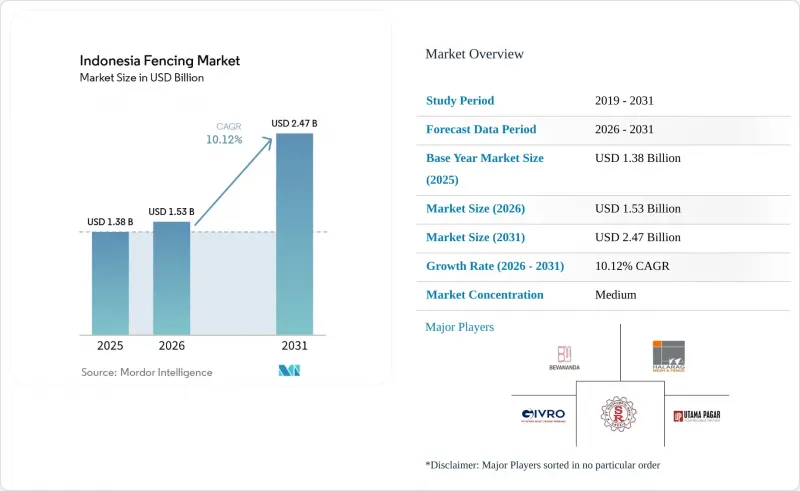
Mordor Intelligence에 의하면, 인도네시아의 펜스 시장 규모는 2025년 13억 8,000만 달러로 평가되었고, 2026년에는 15억 3,000만 달러로 추정되고, 2031년까지 24억 7,000만 달러에 이를 것으로 예상되며, 2026-2031년 CAGR 10.12%로 성장할 전망입니다.
본 보고서는 소재별(금속, 목재, 플라스틱 및 복합재, 콘크리트), 최종 사용자별(주택, 농업 및 농장, 기타), 설치 유형별(고정식 및 영구 울타리, 가설식 및 이동식 울타리), 설치 채널별(전문 업체, 기타-제조업체, DIY 및 모듈형 키트), 지역별(자바, 수마트라, 칼리만탄, 술라웨시, 기타)로 분류되어 있습니다. 시장 전망치는 금액(달러)으로 표시되어 있습니다.
인도네시아의 울타리 시장 동향 및 분석
주택 및 게이트 커뮤니티의 보안 수요
자카르타 대도시권에서 중상위층 및 고급 주택이 확대됨에 따라, 2025년까지 주택용 울타리 수요는 활발한 추세를 보였습니다. 또한 단독주택의 판매율을 살펴보면, 완공된 주택이 방치되지 않고 모두 판매되고 있음을 알 수 있습니다. 이 점은 중요합니다. 왜냐하면 거주자가 있는 커뮤니티에서는 일반적으로 기본적인 경계 공사에서 시작해, 게이트, 출입 통제, 더 높은 품질의 마감 처리가 적용된 첨단 경계 시스템으로의 전환이 더 빠르게 진행되기 때문입니다. 또한, 주택 시장 수요는 자카르타를 넘어 수라바야, 메단, 마카사르와 같은 지역으로 확대되고 있어, 신규 수주에서 단일 도시에 대한 의존도가 낮아지고 있습니다. 개발업체들은 외곽 구역과 내곽 구역에 서로 다른 울타리 사양을 채택하는 경향이 강해지고 있으며, 이로 인해 하나의 계약으로 여러 등급의 제품을 공급할 수 있는 공급업체의 수주 규모가 확대되고 있습니다. 이러한 경향은 조직화된 제조업체에게 유리한 가격 책정을 뒷받침합니다. 왜냐하면 구매자가 인근 지역의 장기적인 보안에 비용을 투자할 경우, 설계의 유연성, 도장 품질, 설치 지원이 더욱 중요하게 여겨지기 때문입니다.
산업단지 및 물류단지의 확대
산업단지는 인도네시아 울타리 시장에서 여전히 가장 유력한 프로젝트 채널 중 하나입니다. 각 사이트에서는 경계 관리, 내부 구역 설정, 검문소 분리, 그리고 운영 기간 중 정기적인 업데이트가 필요하기 때문입니다. 2025년 말 기준으로 인도네시아에는 175개의 가동 중인 산업단지가 있으며, 누적 투자액은 6,744조 6,000억 루피아(419억 달러)에 달했고, 산업단지에 대한 투자는 전년 대비 9.3% 증가했습니다. 또한, 바탄할리에 위치한 KITB 복합 시설도 4,300헥타르 규모의 확장을 위해 22조 루피아(14억 달러)를 투자하고 있으며, 이로 인해 울타리의 적용 범위는 당초 경계 공사 범위를 훨씬 넘어 확장될 것입니다. 또한, Permenperin 제26/2025호는 새로운 요소를 추가하고 있습니다. 더 높은 등급의 산업단지 지정은 인프라의 질에 크게 좌우되기 때문에 개발업자에게는 최저 비용의 대안을 선택하는 대신 울타리 사양을 업그레이드해야 할 직접적인 이유가 됩니다. 또한, 많은 산업단지가 여전히 OVNI 지정 대상에서 제외되어 있기 때문에 경계선 강화 및 보안 시스템 업그레이드는 산업 부문 전반에 걸쳐 여전히 수요가 충족되지 않은 분야로 남아 있습니다.
철강 및 와이어 가격 변동
많은 공급업체들이 여전히 고정 가격 계약으로 사업을 영위하고 있는 반면, 원자재 비용은 지역 및 세계 철강 시세에 좌우되기 때문에 철강 원료 가격의 변동은 인도네시아 울타리 시장에 명백한 걸림돌이 되고 있습니다. 인도네시아 FOB 가격의 선재는 2025년 9월 톤당 480달러에서 2025년 11월에는 462달러로 하락했으나, 이는 표면적으로는 약세를 보인 것처럼 보였을 뿐, 하류 구매자들에게는 근본적인 비용 불확실성을 해소해 주지는 못했습니다. 2025년, 와이어 수입량은 14만 3,662톤에 달했으나, 국내 생산 능력은 21개 생산사의 연간 105만 4,498톤에 그치고 있어, 공급량의 균형과 가격 결정력이 반드시 연동되는 것은 아니라는 점이 드러났습니다. 수출량도 2021년부터 2025년에 걸쳐 급감했는데, 이는 여전히 해외 철강 가격 변동에 민감한 가격 수준에서 더 많은 공급이 국내 시장으로 전환되었음을 시사합니다. 중소 제조업체들은 일반적으로 장기 공급 계약을 체결하지 않아, 입찰 실행 시 발생하는 비용 급등을 흡수할 여지가 적기 때문에 여전히 가장 큰 영향을 받기 쉬운 입장에 있습니다.
부문별 분석
2025년 현재, 금속은 인도네시아 울타리 시장 점유율의 69%를 차지했으며, 주택, 산업, 농업, 공공 인프라 등 각 분야에서 명백히 주력 소재로 자리 잡고 있습니다. 아연 도금 강철 체인 링크, BRC 용접 메쉬, 가시철사는 구매자들에게 친숙하고 널리 구할 수 있으며, 표준 프로젝트 유형에서 사양을 정하기 쉽기 때문에 이 세 가지가 판매량의 주류를 이루고 있습니다. 금속 분야에서 강재가 여전히 판매량의 주요 견인 역할을 하고 있는 반면, 알루미늄은 부식 위험으로 인해 상대적으로 높은 가격을 용인하기 쉬운 연안 지역이나 고습도 환경과 같은 보다 제한적인 용도로 사용되고 있습니다. 목재는 농촌 지역의 경계 공사 분야에서 여전히 중요한 위치를 차지하고 있지만, 유지보수의 필요성과 지속가능성에 대한 압박으로 인해 그 점유율은 제한되고 있습니다. 콘크리트 울타리는 사생활 보호용 벽이나 고속도로 관련 시설 설치에 있어 여전히 중요하지만, 광범위한 범주라기보다는 전문적인 분야로 분류됩니다.
업스트림 부문에 대한 투자가 이 금속 중심의 구조를 지탱하고 있습니다. PT Beka Wire사는 수반에 3,000억 루피아(1,830만 달러)를 투자해 신공장을 가동하며 연간 3만 6,000톤의 생산을 목표로 하고 있는데, 이는 국내 와이어 및 메쉬 수요의 지속성에 대한 자신감을 보여주는 것입니다. 동시에, 재료의 구성도 변화하고 있습니다. 플라스틱 및 복합재료는 경량성, 내염수분무성, 운송의 용이성 등의 특징 덕분에 2031년까지 연평균 성장률(CAGR) 13%로 성장할 것으로 전망됩니다. 이러한 점들은 플랜테이션 지역이나 외딴 섬 프로젝트에 대한 적합성을 높여주고 있습니다. 또한, 구매 가격 자체보다 교체 비용이나 수명이 더 중요하게 여겨지는 용도에서는 자외선 안정화 폴리에틸렌 메쉬가 강재를 대체하기 시작하고 있습니다. 현재의 규격 체계에는 복합재 울타리 제품 전용 규격이 여전히 부재한 상태이며, 이로 인해 단기적으로는 사양상의 모호성이 발생하고 있는 반면, 선점 기업들에게는 향후 보급을 주도할 여지를 제공합니다.
2025년 총 수요에서 주택 사용자가 차지하는 비중은 24%였으며, 인도네시아 울타리 시장의 최대 수요원은 단일 기관 구매자 그룹이 아니라 여전히 일반 주택, 주택 단지, 게이트가 설치된 주거 단지입니다. 이는 교외의 발전과 주요 도시 회랑 전역에 걸쳐 안전하고 둘러싸인 주거 환경을 선호하는 문화적 경향을 반영하고 있습니다. 농업 및 농장 분야 수요도 여전히 중요합니다. 경계 울타리, 부지 관리, 야생동물 대책을 위해 설치됨에 따라 광대한 토지 전체에서 선형 미터 단위로 막대한 수요가 발생하고 있기 때문입니다. 정부 및 공공 인프라 프로젝트는 공식 입찰을 통해 대규모 계약의 투명성을 높이고 있는 반면, 산업 및 물류 시설에서는 운영상의 보안을 확보하기 위해 아연 도금 패널과 전기식 경계 시스템의 도입이 계속해서 요구되고 있습니다. 광업 및 에너지 프로젝트 역시, 자산 보호가 조달상의 최우선 과제가 되는 니켈 가공 및 자원 관련 분야에서 수요를 끌어올리고 있습니다.
군사 및 국경 경비는 가장 빠르게 성장하고 있는 최종 사용자 부문으로, 2031년까지 연평균 성장률(CAGR)이 11.7%를 나타낼 것으로 전망됩니다. 이는 단순한 장벽에서 보안 통합형 경계 시스템으로의 전환을 반영한 것입니다. BNPP의 ‘Smart Border 2026’ 프로그램은 우선순위가 높은 국경 지점에서 물리적 울타리와 감시 시스템을 연계하는 데 있어 핵심적인 역할을 하고 있습니다. 교통 인프라도 안정적인 수요원이 되고 있습니다. 공항이나 철도 시설에서는 네트워크 확장에 따라 정기적인 점검, 보수 및 관리된 경계 공사가 필요하기 때문입니다. 상업 및 공공기관 수요는 시장 점유율 측면에서는 작지만, 2차 회랑 지역의 물류 허브 및 데이터 관련 인프라의 성장에 따라 그 규모는 확대되고 있습니다. 이처럼 최종 사용자의 구성이 다양하기 때문에 시장은 더욱 탄력성을 띠고 있습니다. 특정 구매자 집단 수요가 부진하더라도 총 수요의 성장이 멈출 가능성은 낮기 때문입니다.
기타 혜택 :
- 엑셀 형식 시장 예측(ME) 시트
- 3개월간의 애널리스트 지원
자주 묻는 질문
목차
제1장 서론
제2장 조사 방법
제3장 주요 요약
제4장 시장 구도
제5장 시장 규모 및 성장 예측
제6장 경쟁 구도
제7장 시장 기회 및 향후 전망
AJY 26.06.24According to Mordor Intelligence, the indonesia fencing market size is expected to increase from USD 1.38 billion in 2025 to USD 1.53 billion in 2026 and reach USD 2.47 billion by 2031, growing at a CAGR of 10.12% over 2026-2031.
This report is Segmented by Material (Metal, Wood, Plastic & Composite, Concrete), End-User (Residential, Agriculture & Plantation, and More), Installation Type (Fixed / Permanent Fencing, Temporary / Mobile Fencing), Installation Channel (Professional Contractor, Others - Fabricators, DIY / Modular Kits), and Region (Java, Sumatra, Kalimantan, Sulawesi, and More). Market Forecasts are in Value (USD).
Indonesia Fencing Market Trends and Insights
Residential and Gated-Community Security Demand
Upper-middle and luxury housing expansion in Greater Jakarta kept residential perimeter demand active through 2025, and the landed housing sales rate shows that completed units were being absorbed rather than left idle. That matters because occupied communities usually move faster from basic boundary works to upgraded perimeter systems with gates, access control, and better finishes. The residential side of the market is also broadening beyond Jakarta into Surabaya, Medan, and Makassar corridors, which reduces dependence on one city for new orders. Developers are increasingly using different fencing specifications for outer and inner zones, and that creates larger order baskets for suppliers that can deliver several product grades in one contract. This pattern supports better pricing for organized manufacturers because design flexibility, coating quality, and installation support matter more when buyers are paying for long-term neighborhood security.
Industrial-Estate and Logistics-Park Expansion
Industrial estates remain one of the strongest project channels in the Indonesia fencing market because each site requires perimeter control, internal zoning, checkpoint separation, and recurring replacement over its operating life. Indonesia had 175 operational industrial estates at the end of 2025, with a cumulative investment of IDR 6,744.6 trillion (USD 419 billion), and estate investment growth of 9.3% year on year. The KITB complex in Batanghari is also committing IDR 22 trillion (USD 1.4 billion) toward a 4,300-hectare expansion, which widens the addressable scope for fencing well beyond initial perimeter works. Permenperin No. 26/2025 adds another layer, as higher estate accreditation depends heavily on infrastructure quality, giving developers a direct reason to upgrade fencing specifications rather than choosing the lowest-cost option. A large share of estates also remains outside OVNI designation, so perimeter hardening and security upgrades still represent an underserved pipeline across the industrial segment.
Steel and Wire Price Volatility
Steel input swings are a clear drag on the Indonesia fencing market because many suppliers still operate on fixed-price contracts while their material costs move with regional and global steel conditions. Wire rod FOB Indonesia moved from USD 480 per metric ton in September 2025 to USD 462 in November 2025, which looked softer on paper but did not remove underlying cost uncertainty for downstream buyers. In 2025, wire import volumes reached 143,662 metric tons, while national production capacity stood at 1,054,498 metric tons a year across 21 producers, showing that volume balance and pricing power do not always move together. Export volumes also fell sharply from 2021 to 2025, which suggests more supply was being redirected into the domestic market at prices still exposed to outside steel movements. Smaller manufacturers remain the most exposed because they usually lack long-term supply agreements and have less room to absorb cost spikes during tender execution.
Other drivers and restraints analyzed in the detailed report include:
- Agriculture and Plantation Perimeter Protection
- Border-Post and Critical-Asset Security Upgrades
- Fragmented Local Competition and Price-Led Tendering
For complete list of drivers and restraints, kindly check the Table Of Contents.
Segment Analysis
Metal accounted for 69% of Indonesia fencing market share in 2025, making it the clear anchor material across residential, industrial, agricultural, and public infrastructure uses. Galvanized steel chain-link, BRC welded mesh, and barbed wire together formed the core of this volume because they are familiar to buyers, widely available, and easier to specify across standard project types. Within metal, steel remains the main volume driver, while aluminum serves narrower applications in coastal and high-humidity environments where corrosion risk makes the premium more acceptable. Wood remains present in rural boundary work, but its share is limited by maintenance needs and sustainability pressure. Concrete fencing stays relevant in privacy walls and highway-related installations, though it is a specialist rather than a broad-based category.
Upstream investment supports that metal-led structure. PT Beka Wire commissioned a new IDR 300 billion (USD 18.3 million) facility in Subang, targeting an output of 36,000 metric tons a year, demonstrating confidence in sustained domestic wire and mesh demand. At the same time, the material mix is not standing still. Plastic and composite materials are forecast to grow at a 13% CAGR through 2031 due to their low weight, salt-spray resistance, and ease of transport, which improve their fit for plantation zones and outer-island projects. UV-stabilized polyethylene mesh is starting to replace steel in uses where replacement cost and field life matter more than headline purchase price. The current standards framework still lacks a dedicated composite fencing product standard, and that creates short-term specification ambiguity while giving first movers room to shape future adoption.
Residential users represented 24% of total demand in 2025, so the largest block of the Indonesia fencing market still comes from homes, clusters, and gated communities rather than from a single institutional buyer group. This reflects suburban growth and the cultural preference for secure enclosed living across major urban corridors. Agriculture and plantation demand also remains important because boundary fencing, site control, and wildlife-mitigation installations create large linear-meter requirements across broad land parcels. Government and public infrastructure projects add large contract visibility through formal tenders, while industrial and logistics sites continue to specify galvanized panels and electrified perimeter systems for operational security. Mining and energy projects are also adding demand for nickel processing and resource-linked zones, where asset protection is a procurement priority.
Military and border security is the fastest-growing end-user segment, with a 11.7% CAGR through 2031, reflecting the shift from simple barriers to security-integrated perimeter systems. BNPP's Smart Border 2026 program is a major factor because it links physical fencing to monitoring architecture at priority border locations.Transportation infrastructure provides another recurring stream because airport and rail sites require repeated inspection, repair, and controlled boundary works as networks expand. Commercial and institutional demand is smaller in share, yet it is widening with the growth of logistics hubs and data-related infrastructure in secondary corridors. This broad end-user mix gives the market more resilience because weakness in one buyer group is less likely to stop total demand growth.
List of Companies Covered in this Report:
- PT Bevananda Mustika
- PT Halarag Baja Utama
- PT Sidokumpul Raya
- PT Givro Multi Teknik Perkasa
- PT Utama Pagar Indonesia
- PT Anugerah Wijayatrisna
- PT Fencing Meshindo Raya
- CV BAKTI
- CV Multi Gisma Tehknindo
- PT Karya Utama Steel
- CV Duta Mesh
- PT Baja Prima Lestari
- CV Sukses Dinamika Engineering
- CV Griya Mandiri Konstruksi
- PT Abadi Metal Utama
- PT Pratama Prima Bajatama
- PT Akmal Adi Perkasa
- PT Trinity Global Mandiri
- CV Givro Jaya Mandiri
- CV Bangun Sarana Makmur
Additional Benefits:
- The market estimate (ME) sheet in Excel format
- 3 months of analyst support
TABLE OF CONTENTS
1 Introduction
- 1.1 Study Assumptions & Market Definition
- 1.2 Scope of the Study
2 Research Methodology
3 Executive Summary
4 Market Landscape
- 4.1 Market Overview
- 4.2 Market Drivers
- 4.2.1 Residential and Gated-Community Security Demand
- 4.2.2 Industrial-Estate and Logistics-Park Expansion
- 4.2.3 Agriculture and Plantation Perimeter Protection
- 4.2.4 Border-Post and Critical-Asset Security Upgrades
- 4.2.5 SNI and TKDN Compliance Favoring Organized Suppliers
- 4.2.6 Human-Wildlife Conflict Mitigation Fencing
- 4.3 Market Restraints
- 4.3.1 Steel and Wire Price Volatility
- 4.3.2 Fragmented Local Competition and Price-Led Tendering
- 4.3.3 Archipelagic Freight and Installation-Cost Asymmetry
- 4.3.4 Coastal Permitting and Sensitive-Site Deployment Hurdles
- 4.4 Value / Supply-Chain Analysis
- 4.5 Regulatory Landscape
- 4.6 Technological Outlook
- 4.7 Porter's Five Forces
- 4.7.1 Bargaining Power of Suppliers
- 4.7.2 Bargaining Power of Buyers
- 4.7.3 Threat of New Entrants
- 4.7.4 Threat of Substitutes
- 4.7.5 Intensity of Competitive Rivalry
- 4.8 Pricing Analysis
- 4.9 Sustainability & Low-Maintenance Material Trends
- 4.10 Border Security Framework & Deployment Trends
5 Market Size & Growth Forecasts (Value, USD)
- 5.1 By Material
- 5.1.1 Metal
- 5.1.1.1 Steel
- 5.1.1.2 Aluminum
- 5.1.2 Wood
- 5.1.3 Plastic & Composite
- 5.1.4 Concrete
- 5.1.1 Metal
- 5.2 By End-User
- 5.2.1 Residential
- 5.2.2 Agriculture & Plantation
- 5.2.3 Government & Public Infrastructure
- 5.2.4 Military & Border Security
- 5.2.5 Industrial & Logistics
- 5.2.6 Mining & Energy
- 5.2.7 Transportation Infrastructure
- 5.2.8 Commercial & Institutional
- 5.3 By Installation Type
- 5.3.1 Fixed / Permanent Fencing
- 5.3.2 Temporary / Mobile Fencing
- 5.4 By Installation Channel
- 5.4.1 Professional Contractor
- 5.4.2 Others - Fabricators, DIY / Modular Kits
- 5.5 By Region
- 5.5.1 Java
- 5.5.2 Sumatra
- 5.5.3 Kalimantan
- 5.5.4 Sulawesi
- 5.5.5 Bali & Nusa Tenggara
- 5.5.6 Maluku & Papua
6 Competitive Landscape
- 6.1 Market Concentration
- 6.2 Strategic Moves
- 6.3 Market Share Analysis
- 6.4 Company Profiles {(includes Global level Overview, Market level overview, Core Segments, Financials as available, Strategic Information, Market Rank/Share for key companies, Products & Services, and Recent Developments)}
- 6.4.1 PT Bevananda Mustika
- 6.4.2 PT Halarag Baja Utama
- 6.4.3 PT Sidokumpul Raya
- 6.4.4 PT Givro Multi Teknik Perkasa
- 6.4.5 PT Utama Pagar Indonesia
- 6.4.6 PT Anugerah Wijayatrisna
- 6.4.7 PT Fencing Meshindo Raya
- 6.4.8 CV BAKTI
- 6.4.9 CV Multi Gisma Tehknindo
- 6.4.10 PT Karya Utama Steel
- 6.4.11 CV Duta Mesh
- 6.4.12 PT Baja Prima Lestari
- 6.4.13 CV Sukses Dinamika Engineering
- 6.4.14 CV Griya Mandiri Konstruksi
- 6.4.15 PT Abadi Metal Utama
- 6.4.16 PT Pratama Prima Bajatama
- 6.4.17 PT Akmal Adi Perkasa
- 6.4.18 PT Trinity Global Mandiri
- 6.4.19 CV Givro Jaya Mandiri
- 6.4.20 CV Bangun Sarana Makmur
7 Market Opportunities & Future Outlook
- 7.1 White-space & Unmet-Need Assessment