
|
시장보고서
상품코드
2064349
인도의 고출력 LED 패키지 시장 : 점유율 분석, 업계 동향과 통계, 성장 예측(2026-2031년)India High-Power LED Package - Market Share Analysis, Industry Trends & Statistics, Growth Forecasts (2026 - 2031) |
||||||
 Mordor Intelligence
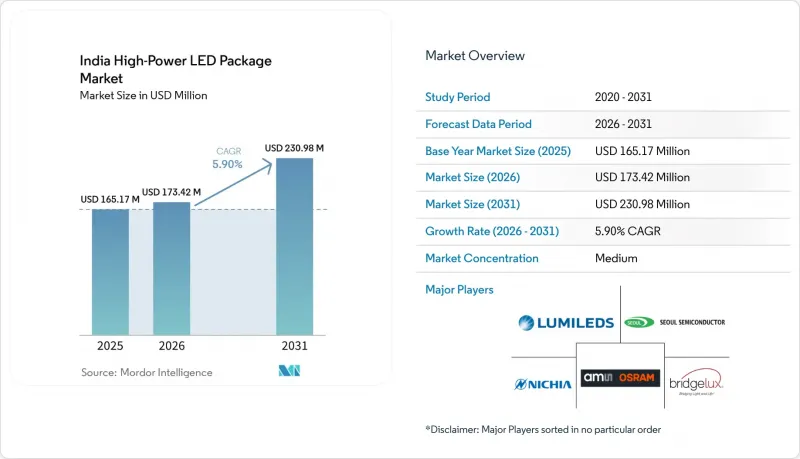
Mordor Intelligence에 의하면, 인도 고출력 LED 패키지 시장 규모는 2025년 1억 6,517만 달러에서 2026년에는 1억 7,342만 달러로 확대되어 2031년까지 2억 3,098만 달러에 이를 것으로 예측되며, 2026년부터 2031년까지 CAGR 5.9%로 성장할 전망입니다.
본 보고서는 출력 범위(1W-3W, 3W-10W, 10W 이상), 아키텍처(싱글 다이 패키지(SMD/디스크리트), 멀티 다이 패키지(SMD), COB(칩 온 보드) 등), 용도(일반 조명, 자동차용 조명, 디스플레이 및 백라이트, 특수/니치 용도)별로 분류되어 있습니다. 시장 전망은 금액(달러) 기준으로 제시되어 있습니다.
인도 고출력 LED 패키지 시장 동향 및 인사이트
UJALA 및 SLNP 프로그램을 통한 정부의 추진
“Unnat Jyoti by Affordable LEDs for All(UJALA)” 및 “Street Lighting National Program(SLNP)”에 따른 일괄 조달을 통해, 전국적으로 3억 6,870만 개의 LED 전구와 1,340만 기의 가로등이 도입되어, 고출력 LED로의 교체 수요라는 예측 가능한 애프터마켓이 형성되었습니다. UJALA가 시작된 후 첫 16개월 동안 단가는 75% 하락했으며, LED가 표준 광원으로 자리 잡음에 따라 국내 조립업체의 잠재 고객 기반이 확대되었습니다. EESL이 새로운 입찰을 스마트하고 조광이 가능한 조명 기구로 전환함에 따라, 패키지 공급업체들은 자격을 유지하기 위해 드라이버와 IoT 제어 기능을 통합해야 합니다. SLNP 조명 기구를 도입한 지자체에서는 7년에서 10년의 교체 주기가 예상되며, 높은 광속 유지율을 갖춘 15W-50W 제품에 대한 안정적인 수요가 확보되고 있습니다. 이러한 추세는 인도 표준국(BIS)의 광도 측정 및 안전 시험 기준을 충족하면서도 정부의 가격 상한선에 맞추어 비용을 조정할 수 있는 수직 통합형 기업에 유리하게 작용합니다.
급속한 도시 인프라 확충과 스마트시티 프로젝트
스마트 시티 미션의 예산 배분을 통해 100개 도시에서 LED로 교체하는 사업에 자금이 지원되고 있습니다. 아메다바드에서는 21만 개의 가로등을 현대화하기 위해 50억 루피(5,670만 달러)를 투자했으며, 코치에서는 4만 개의 네트워크 연결형 조명 기구에 3억 루피(340만 달러)를 지출하고 있습니다. 이러한 대규모 계약에서는 5만 시간 이상의 광속 유지율과 80 이상의 연색 지수가 규정되어 있어, 저가 수입품에 대한 진입 장벽이 높아지고 있습니다. 구와하티의 2025년 프로젝트에서는 에너지 사용량을 60% 절감하는 동시에 유지보수 주기를 5만 시간으로 연장함으로써, 프리미엄 패키지의 총 소유 비용(TCO)의 효과를 입증했습니다. 주별로 분산되어 진행되는 입찰에서는 지역 기후대에 맞추어 열 설계를 맞춤화할 수 있는 지역 유통업체이 우대받습니다. 도시 계약에서 통합형 센서의 도입이 요구됨에 따라, 자체적으로 드라이버 및 RF 기술을 보유한 공급업체들이 경쟁 우위를 점하고 있습니다.
에피택시 및 패키징 장비에 대한 높은 수입 의존도
인도의 제조업체들은 MOCVD 반응기, 리소그래피 라인, 와이어 본더의 대부분을 여전히 Aixtron, Veeco, ASM Pacific 등의 해외 공급업체로부터 조달하고 있어, 업스트림 공정에서의 부가가치 창출이 제한받고 있습니다. 단일 반응기의 가격은 300만-500만 달러이며, 전체 공장 건설비는 1억 달러를 넘기도 해, 이러한 투자는 중견 조명 제조업체에게는 감당하기 어려운 수준입니다. Halonix사는 조립 공정의 현지화를 통해 수입 의존도를 2021년도(FY2021)의 60%에서 2025년도(FY2025)에는 24%까지 낮췄으나, 에피택셜 웨이퍼와 칩은 여전히 대만과 한국에서 조달하고 있습니다. PLI(생산 연계 인센티브) 제도는 2029년까지 국내 부가가치율 75-80%를 목표로 하고 있으나, 이 목표를 달성하기 위해서는 제조 허브의 공유와 공급업체 간의 합작 사업이 필요합니다. 이러한 움직임이 없다면, 환율 변동과 지정학적 리스크가 고출력 패키지의 이익률과 공급 안정성에 계속해서 압박을 가하게 될 것입니다.
부문별 분석
2025년, 인도의 고출력 LED 패키지 시장에서 1W-3W급이 47.84%의 점유율을 차지하며 시장을 독점했습니다. 한편, 10W를 초과하는 부문은 2031년까지 연평균 성장률(CAGR) 6.47%로 성장할 전망입니다. 10W를 초과하는 패키지는 현재 고마스트 가로등, 산업용 조명, 스포츠 시설 등에 공급되고 있으며, 사용자들은 더 우수한 총소유비용(TCO)을 얻기 위해 높은 구매 비용을 감수하고 있습니다. 이 대역의 인도 고출력 LED 패키지 시장은 20-30%의 에너지 절감과 더 좁은 빔 각도를 요구하는 경기장 개보수 공사의 혜택을 받고 있습니다. 50W를 초과하는 패키지는 일반적으로 세라믹 기판과 정밀 광학 시스템을 채택하고 있으며, 이는 다이오드 제조업체와 조명 기구 제조업체 간의 협력을 촉진하고 있습니다. 설치 업체 입장에서는 타워 상단에서의 유지보수가 여전히 비용이 많이 들기 때문에 유지보수 주기를 연장하는 것이 매우 중요합니다. 한편, 과거 UJALA 전구가 주도했던 기존의 1W-3W급 제품은 도시 지역 주택에서 점진적인 교체 단계에 접어들었으며, 그 성장 가능성은 제한적입니다.
현재 시장에 진출한 기업들은 1장의 기판 위에 6-8개의 15W LED 어레이를 그룹화한 모듈식 엔진을 설계하고 있으며, 이를 통해 고마스트 조명 기구의 조립 공정을 줄이고 있습니다. 이러한 시스템 통합 추세에 따라, 단순히 다이오드뿐만 아니라 드라이버, 광학 시스템, 방열 경로를 통합 설계하는 공급업체들이 우위를 점하고 있습니다. 농촌 지역의 전기화 사업에서는 고와트수 태양광 가로등 키트의 경우, 20W-30W 어레이와 리튬 이온 배터리의 조합이 사양으로 채택되기 시작했으며, 10W를 초과하는 패키지가 Off-grid 용도로 더욱 확산되고 있습니다. 그 결과, PLI(생산 연계형 인센티브)를 통해 생산 능력을 확대하고 있는 수탁 제조업체들은 최대 200W 모듈을 처리할 수 있는 자동 조립 라인에 대한 설비 투자에 주력하고 있습니다.
기타 혜택:
- 엑셀 형식 시장 예측(ME) 시트
- 3개월간의 애널리스트 지원
자주 묻는 질문
목차
제1장 서론
제2장 조사 방법
제3장 주요 요약
제4장 시장 구도
제5장 시장 규모와 성장 예측
제6장 경쟁 구도
제7장 시장 기회와 향후 전망
JHS 26.06.23According to Mordor Intelligence, the india high-Power lED package market size is expected to increase from USD 165.17 million in 2025 to USD 173.42 million in 2026 and reach USD 230.98 million by 2031, growing at a CAGR of 5.9% over 2026-2031.
This report is Segmented by Power Range (1W-3W, 3W-10W, Above 10W), Architecture (Single-Die Packages (SMD / Discrete), Multi-Die Packages (SMD), COB (Chip-On-Board), and More), Application (General Lighting, Automotive Lighting, Display and Backlighting, Specialty/Niche). The Market Forecasts are Provided in Terms of Value (USD).
India High-Power LED Package Market Trends and Insights
Government Push Through UJALA and SLNP Programs
Bulk procurement under the Unnat Jyoti by Affordable LEDs for All and Street Lighting National Program has seeded a nationwide installed base of 36.87 crore LED bulbs and 1.34 crore streetlights, creating a predictable aftermarket for high-power replacements. Unit prices fell by 75% within the first 16 months of UJALA, normalizing LEDs as the default light source and widening the addressable base for domestic assemblers. As EESL pivots new tenders toward smart, dimmable luminaires, package suppliers must now integrate drivers and IoT controls to stay qualified. Municipalities that adopted SLNP fixtures face seven-to-ten-year replacement cycles, ensuring steady demand for 15 W-50 W packages with higher lumen maintenance. This dynamic favors vertically integrated firms that can meet Bureau of Indian Standards photometric and safety tests while keeping costs aligned with government price ceilings.
Rapid Urban Infrastructure Expansion and Smart City Projects
Smart Cities Mission allocations have financed LED retrofits across 100 cities, with Ahmedabad investing INR 5 billion (USD 56.7 million) to upgrade 210 000 poles and Kochi spending INR 300 million (USD 3.4 million) on 40 000 networked luminaires. These large contracts specify lumen maintenance above 50 000 hours and a color rendering index above 80, raising entry barriers for low-cost imports. Guwahati's 2025 project cut energy use by 60% while stretching maintenance intervals to 50 000 hours, validating the total-cost-of-ownership case for premium packages. Decentralized tendering across states rewards regional distributors that can customize thermal designs for local climate zones. As city contracts increasingly require integrated sensors, suppliers with in-house driver and RF capabilities gain a competitive edge.
High Import Dependence for Epitaxy and Packaging Equipment
Indian manufacturers still source most MOCVD reactors, lithography lines, and wire-bonders from overseas suppliers such as Aixtron, Veeco, and ASM Pacific, constraining upstream value addition. A single reactor costs USD 3-5 million, while a full fab can exceed USD 100 million, placing such investments beyond the reach of mid-sized lighting firms. Halonix reduced reliance on imports from 60% in FY2021 to 24% in FY2025 by localizing assembly, yet epitaxial wafers and chips still arrive from Taiwan and South Korea. The PLI scheme targets 75-80% domestic value addition by 2029, but achieving this goal will require shared fabrication hubs or joint ventures between equipment vendors. Without such moves, currency volatility and geopolitical risks will continue to pressure margins and supply assurance for high-power packages.
Other drivers and restraints analyzed in the detailed report include:
- Declining Cost-Per-Lumen of High-Power LED Packages
- Automotive Industry Shift to LED Headlamps
- Thermal Management Challenges in Tropical Climate
For complete list of drivers and restraints, kindly check the Table Of Contents.
Segment Analysis
In 2025, the 1 W-3 W class dominated the India High-Power LED package market, capturing 47.84% share. Meanwhile, the Above 10 W segment is set to grow at a 6.47% CAGR, continuing through 2031. Above 10 W packages now supply high-mast streetlights, industrial bays, and sports venues, where users accept higher purchase costs in exchange for better total cost of ownership. The India High-Power LED package market in this band is benefiting from stadium retrofits that demand 20-30% energy savings and tighter beam angles. Packages exceeding 50 W typically employ ceramic substrates and precision optics, driving collaboration between diode makers and luminaire houses. Installers view longer service intervals as critical because tower-top maintenance remains cost-intensive. Meanwhile, the legacy 1 W-3 W class, once propelled by UJALA bulbs, is entering a slow-replacement phase in urban homes, limiting its growth potential.
Market participants now design modular engines that group six to eight 15 W LED arrays on a single plate, cutting assembly steps for high-mast luminaires. This system-integration trend rewards suppliers that co-design drivers, optics, and thermal paths, not merely diodes. In rural electrification schemes, higher-wattage solar-streetlight kits have begun to specify 20-W to 30-W arrays paired with Li-ion batteries, pushing above 10 W packages further into off-grid applications. Consequently, contract manufacturers expanding PLI-backed capacity are focusing CAPEX on automated assembly lines rated up to 200 W modules.
List of Companies Covered in this Report:
- Nichia Corp.
- Everlight Electronics Co., Ltd.
- Osram Opto Semiconductors GmbH
- Seoul Semiconductor Co., Ltd.
- Lumileds Holding B.V.
- Cree LED (Wolfspeed, Inc.)
- Samsung Electronics Co., Ltd. (LED Business)
- MLS Co., Ltd.
- Bridgelux, Inc.
- Citizen Electronics Co., Ltd.
- Edison Opto Corp.
- Dominant Opto Technologies Sdn. Bhd.
- LG Innotek Co., Ltd.
- Surya Roshni Ltd.
- Havells India Ltd.
- Bajaj Electricals Ltd.
- Wipro Lighting (Wipro Enterprises Pvt. Ltd.)
- Crompton Greaves Consumer Electricals Ltd.
- Halonix Technologies Pvt. Ltd.
- Syska LED Lights Pvt. Ltd.
Additional Benefits:
- The market estimate (ME) sheet in Excel format
- 3 months of analyst support
TABLE OF CONTENTS
1 INTRODUCTION
- 1.1 Study Assumptions and Market Definition
- 1.2 Scope of the Study
2 RESEARCH METHODOLOGY
3 EXECUTIVE SUMMARY
4 MARKET LANDSCAPE
- 4.1 Market Overview
- 4.2 Market Drivers
- 4.2.1 Government Push Through UJALA and SLNP Programs
- 4.2.2 Rapid Urban Infrastructure Expansion and Smart City Projects
- 4.2.3 Declining Cost-per-Lumen of High-Power LED Packages
- 4.2.4 Automotive Industry Shift to LED Headlamps
- 4.2.5 Rise of Horticulture LED Farms in Controlled-Environment Agriculture
- 4.2.6 Surge in High-Mast Sports Lighting Upgrades for Upcoming Events
- 4.3 Market Restraints
- 4.3.1 High Import Dependence for Epitaxy and Packaging Equipment
- 4.3.2 Thermal Management Challenges in Tropical Climate
- 4.3.3 Fragmented Standards for High-Power LED Reliability Testing
- 4.3.4 Supply-Chain Volatility for SiC Substrates
- 4.4 Regulatory Landscape
- 4.5 Technological Outlook
- 4.6 Impact of Macroeconomic Factors
- 4.7 Porter's Five Forces Analysis
- 4.7.1 Bargaining Power of Suppliers
- 4.7.2 Bargaining Power of Buyers
- 4.7.3 Threat of New Entrants
- 4.7.4 Threat of Substitutes
- 4.7.5 Intensity of Competitive Rivalry
5 MARKET SIZE AND GROWTH FORECASTS (VALUE)
- 5.1 By Power Range
- 5.1.1 1W-3W
- 5.1.2 3W-10W
- 5.1.3 Above 10W
- 5.2 By Architecture
- 5.2.1 Single-die Packages (SMD / Discrete)
- 5.2.2 Multi-die Packages (SMD)
- 5.2.3 COB (Chip-on-Board)
- 5.2.4 Other Architectures (CSP, Flip-chip, Hybrid Modules)
- 5.3 By Application
- 5.3.1 General Lighting
- 5.3.2 Automotive Lighting
- 5.3.3 Display and Backlighting
- 5.3.4 Specialty / Niche
6 COMPETITIVE LANDSCAPE
- 6.1 Market Concentration
- 6.2 Strategic Moves
- 6.3 Market Share Analysis
- 6.4 Company Profiles (includes Global Level Overview, Market Level Overview, Core Segments, Financials as available, Strategic Information, Market Rank/Share, Products and Services, Recent Developments)
- 6.4.1 Nichia Corp.
- 6.4.2 Everlight Electronics Co., Ltd.
- 6.4.3 Osram Opto Semiconductors GmbH
- 6.4.4 Seoul Semiconductor Co., Ltd.
- 6.4.5 Lumileds Holding B.V.
- 6.4.6 Cree LED (Wolfspeed, Inc.)
- 6.4.7 Samsung Electronics Co., Ltd. (LED Business)
- 6.4.8 MLS Co., Ltd.
- 6.4.9 Bridgelux, Inc.
- 6.4.10 Citizen Electronics Co., Ltd.
- 6.4.11 Edison Opto Corp.
- 6.4.12 Dominant Opto Technologies Sdn. Bhd.
- 6.4.13 LG Innotek Co., Ltd.
- 6.4.14 Surya Roshni Ltd.
- 6.4.15 Havells India Ltd.
- 6.4.16 Bajaj Electricals Ltd.
- 6.4.17 Wipro Lighting (Wipro Enterprises Pvt. Ltd.)
- 6.4.18 Crompton Greaves Consumer Electricals Ltd.
- 6.4.19 Halonix Technologies Pvt. Ltd.
- 6.4.20 Syska LED Lights Pvt. Ltd.
7 MARKET OPPORTUNITIES AND FUTURE OUTLOOK
- 7.1 White-space And Unmet-Need Assessment