
|
시장보고서
상품코드
2064459
태국의 통합 시설 관리 시장 : 시장 점유율 분석, 업계 동향 및 통계, 성장 예측(2026-2031년)Thailand Integrated Facility Management - Market Share Analysis, Industry Trends & Statistics, Growth Forecasts (2026 - 2031) |
||||||
 Mordor Intelligence
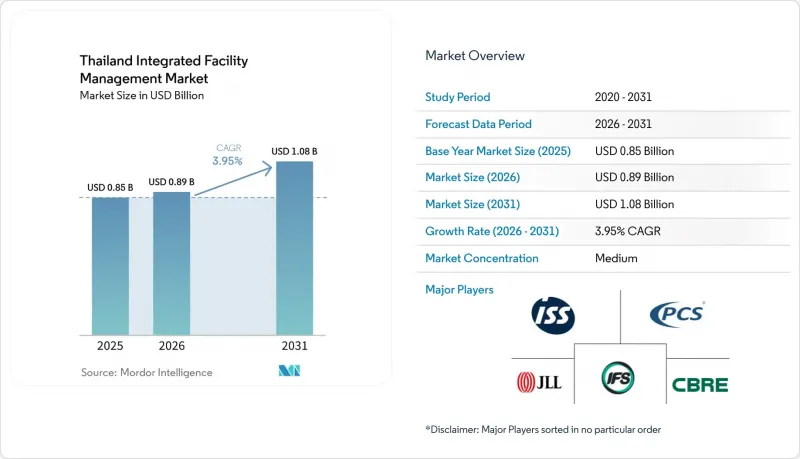
Mordor Intelligence에 의하면, 태국의 통합 시설 관리 시장 규모는 2025년 8억 5,000만 달러로 평가되었고, 2026년 8억 9,000만 달러로 추정되고, 2031년까지 10억 8,000만 달러로 확대될 전망이며, 2026-2031년 CAGR 3.95%를 나타낼 것으로 예측됩니다.
본 보고서는 서비스 유형별(하드 시설 관리(자산 관리, MEP 및 HVAC 서비스 등), 소프트 시설 관리(사무 지원 및 보안, 청소 서비스, 케이터링 서비스 등)), 최종 사용자별(상업, 호텔·관광, 헬스케어, 공공기관 및 공공 인프라, 기타)로 분류되어 있습니다. 시장 전망은 금액(달러) 기준으로 제시되어 있습니다.
태국의 통합 시설 관리 시장 동향 및 인사이트
동부 경제 회랑(EEC) 내 산업단지에 대한 정부 투자가 통합 FM 수요를 견인
EEC(동부 경제 회랑)는 비교적 좁은 운영 구역 내에 대규모 산업단지, 교통망, 새로운 인프라가 집중되어 있어, 태국의 통합 시설 관리 시장에서 여전히 가장 뚜렷한 수요 동력으로 작용하고 있습니다. 2023-2027년 개발 계획에서는 5,000억 바트(145억 달러)의 실질 투자를 목표로 하고 있으며, EEC 내 개발 완료된 산업 용지는 2025년 상반기까지 11만 275라이에 달하고, 2024년 말 대비 7% 증가했습니다. 이러한 규모가 중요한 이유는 멀티테넌트형 산업단지에서는 단일 시설을 개별적으로 관리하는 것이 아니라, 다수의 건물에 걸친 엔지니어링, 보안, 청소, 규정 준수 및 보고 업무를 조정할 수 있는 서비스 제공업체가 필요하기 때문입니다. 우타파오 공항의 ‘이스턴 에비에이션 시티’, 렘차반 항구 3단계, 고속철도 연결 구간은 MEP(기계·전기·배관) 유지관리, 소방 시스템, 빌딩 관리 시스템이 단순한 선택적 부가 서비스가 아닌 핵심 서비스 라인이 되는 영구적인 시설을 조성하고 있습니다. 2025년 5월, 프로스펙트 디벨롭먼트사는 EEC(동부 경제 회랑) 내의 밤파콘 산업단지에 65억 바트(1억 8,840만 달러 상당)를 투자할 것이라고 발표했습니다. 이는 보다 강력한 기술적 운영 지원이 필요한 자동차, 디지털, 식품 가공 분야의 사용자를 대상으로 한 것입니다. 이러한 시설들이 건설 단계에서 안정적인 운영 단계로 전환됨에 따라, 태국의 통합 시설 관리(IFM) 시장에서는 일회성 지원 업무가 아닌, 가동률, 규정 준수, 자산 성과와 연계된 보다 지속 가능한 계약 흐름이 형성되고 있습니다.
상업용 빌딩에 대한 정부의 에너지 절약 규제가 FM 서비스의 범위를 재정의했습니다.
태국의 ‘건축물 에너지 코드’는 2535년(1992년) 에너지 절약법에 근거하여 2563년(2020년)의 장관 규칙으로 공포된 것으로, 2,000제곱미터를 초과하는 신축 또는 대대적인 개축을 하는 건물에 대해 에너지 절약 요건을 적용하고 있으며, 2023년 3월부터 전면적으로 시행되고 있습니다. 이 코드는 건축 외피, 조명, 공조, 온수 공급, 총 에너지 소비량, 재생에너지 등 6가지 시스템을 대상으로 하고 있으며, 이에 따라 소유주가 FM 파트너에게 기대하는 기술적 범위가 확대되었습니다. DEDE의 에너지 효율화 계획은 2037년까지 태국의 에너지 집약도를 30% 감축하는 것을 목표로 하고 있으며, 이 계획에 따라 건축 부문에는 1,574 ktoe의 전력 수요 감축 목표가 부여되었습니다. 이로 인해 태국 IFM 시장의 조달 동향에 변화가 나타나고 있습니다. 특히 대규모 상업용 자산의 경우, 에너지 감사, BMS 최적화, 성과 보고가 계약 설계의 핵심으로 자리 잡게 되었기 때문입니다. 방콕시청은 2025년 12월, ‘방콕 에너지 행동 계획 2024-2030’의 일환으로 74명의 공무원을 대상으로 에너지 절약 연수 프로그램을 실시하여 이러한 방향성을 한층 더 강화했습니다. 이에 따라 수도권 내 모든 공공 건축물에 걸쳐 운영 현황에 대한 면밀한 검토가 확대되고 있습니다. 그 결과, 태국의 통합 시설 관리 시장에서는 일상적인 건물 운영에 있어 측정 가능한 비용 절감, 문서화된 절차, 신뢰할 수 있는 기술적 감독을 입증할 수 있는 운영 사업자에 대한 수요가 높아지고 있습니다.
기술 분야 FM 직종에서 숙련된 인력의 부족이 하드 FM의 확장을 제약하고 있습니다.
태국의 인력 문제는 구조적인 것이며, 단기적인 채용 주기가 시사하는 바 이상으로 태국의 IFM 시장에 심각한 제약 요인으로 작용하고 있습니다. 이 나라의 합계출산율은 2023년에 1.16까지 떨어졌으며, 같은 해 고령화 사회에 진입했고, 2036년까지 초고령화 사회가 될 것으로 예측되고 있습니다. NESDC의 예측에 따르면, 2037년까지 노동 수요는 4,471만 명에 달하는 반면, 노동 가능 인구는 4,070만 명에 그칠 것으로 보이며, 이러한 격차는 기술직 및 중급 숙련직에 가장 심각한 영향을 미칠 가능성이 있습니다. 특히 MEP 엔지니어링, HVAC 유지보수, BMS 운영 분야에서 겪는 압박은 매우 심각합니다. 이러한 기능들은 태국의 통합 시설 관리 시장에서 가장 빠르게 성장하고 있는 부문에 속하며, 일반 근로자로는 쉽게 인력을 충원할 수 없기 때문입니다. JLL은 고소득 국가에서 시설 관리 전문가의 40%가 2026년까지 은퇴할 것으로 예상되며, 56%의 조직이 예측 유지보수 기술 도입을 계획하고 있는 반면, 태국은 여전히 디지털 대응 능력이 낮은 상황이라고 지적하고 있습니다. 구체적으로 말하면, 청년의 74.1%가 기초적인 디지털 역량을 갖추지 못하고 있으며, 2024년 현재 인더스트리 4.0을 도입한 산업은 고작 5%에 불과합니다. 사업자들이 인재 육성과 자동화를 가속화하지 않는 한, 태국의 통합 시설 관리(IFM) 시장에서는 이익률 압박, 서비스 품질의 편차, 기술 관련 계정의 수용 능력 확대 둔화가 지속될 것으로 보입니다.
부문별 분석
소프트 시설 관리(FM)는 2025년에 시장의 54.76%를 차지했으며, 태국의 통합 시설 관리(IFM) 시장에서 가장 큰 비중을 차지하고 있는데, 이는 일상적인 지원이 필요한 상업용 건물, 산업 단지, 소매 센터, 호텔 및 레저 시설 등에 대한 광범위한 도입 실적을 반영한 것입니다. 청소, 경비, 조경 및 기타 지원 서비스는 모든 자산군에서 필요로 하며, 전문적인 엔지니어링 업무보다 지속적인 계약에 포함시키기 쉬우므로 여전히 핵심적인 위치를 차지하고 있습니다. 경비 서비스와 청소·하우스키핑은 소프트 FM의 하위 부문 중 가장 규모가 큰 두 분야로, 이것이 대규모 수주를 확보하는 데 있어 인력 규모와 노선 밀도가 여전히 중요한 이유를 설명해 줍니다. EEC 산업단지에서 95개 이상의 기업 고객에게 서비스를 제공하는 소덱소 아마타 서비스는 멀티테넌트형 단지가 일상적인 서비스 라인을 안정적인 갱신 가능성이 내재된 장기적인 통합 위탁 계약으로 전환하는 구조를 보여주고 있습니다. 또한, 원 방콕에는 108 라이 규모의 개발 구역과 50 라이 규모의 관리 녹지가 포함되어 있으며, 부지 관리 팀, 공용 구역 유지보수, 그리고 보다 광범위한 부지 운영 간의 협력이 확대됨에 따라 프리미엄 프로젝트의 조경 업무도 점차 체계화되고 있습니다.
하드 FM은 태국 IFM 시장에서 가장 빠르게 성장하고 있는 서비스 유형으로, 2031년까지 연평균 성장률(CAGR)이 4.62%를 나타낼 것으로 전망됩니다. 이는 새로운 시설일수록 고도의 엔지니어링 관리와 신속한 대응이 요구되기 때문입니다. 태국의 데이터센터 서비스 매출은 2026년에 142억 바트(4억 1,160만 달러)에 달할 것으로 예상되며, 2025년 대비 9% 증가할 전망입니다. 이는 상시 모니터링과 가동 시간 지원이 필요한 기술 집약형 사이트의 도입 기반이 확대되고 있음을 보여줍니다. 이러한 시설에서는 지속적인 MEP(기계·전기·배관) 감독, 정밀한 냉각 제어, 소방 설비의 규정 준수가 요구되므로, 저숙련 인력 배치 모델로는 대응하기 어렵습니다. 2025년 상반기에 3,891억 4,000만 바트(113억 달러) 규모의 데이터센터 프로젝트 18건이 태국 투자위원회(BOI)의 승인을 받은 것은 태국의 통합 시설 관리 산업이 보다 고도의 기술력을 요하는 계약과 연중무휴 24시간 서비스 제공에 대한 기대가 높아지는 방향으로 계속해서 전환되고 있음을 시사합니다. 이러한 자산들이 본격적으로 가동됨에 따라, 하드 FM은 태국의 통합 시설 관리 시장 전반에 걸쳐 품질 기준과 계약 갱신 판단 기준을 지속적으로 높여갈 것으로 보입니다.
기타 혜택
- 엑셀 형식 시장 예측(ME) 시트
- 3개월간의 애널리스트 지원
자주 묻는 질문
목차
제1장 서론
제2장 조사 방법
제3장 주요 요약
제4장 시장 구도
제5장 시장 규모 및 성장 예측
제6장 경쟁 구도
제7장 시장 기회 및 향후 전망
AJY 26.06.26According to Mordor Intelligence, the thailand integrated facility management market size is projected to expand from USD 0.85 billion in 2025 and USD 0.89 billion in 2026 to USD 1.08 billion by 2031, registering a CAGR of 3.95% between 2026 to 2031.
This report is Segmented by Service Type (Hard Facility Management [Asset Management, MEP and HVAC Service, and More], and Soft Facility Management [Office Support and Security, Cleaning Services, Catering Services, and More]), and End User (Commercial, Hospitality, Healthcare, Institutional and Public Infrastructure, and More). The Market Forecasts are Provided in Terms of Value (USD).
Thailand Integrated Facility Management Market Trends and Insights
Government Investment in Eastern Economic Corridor Industry Parks Drives Integrated FM Demand
The EEC remains the clearest demand engine for the Thailand integrated facility management market because it concentrates large industrial estates, transport links, and new infrastructure within a relatively compact operating corridor. Its 2023-2027 development plan targets THB 500 billion (USD 14.5 billion) in actual investment, while developed industrial land in the EEC reached 110,275 rai by H1 2025, up 7% from the end of 2024. That scale matters because multi-tenant estates need providers that can coordinate engineering, security, cleaning, compliance, and reporting across many buildings instead of serving a single site at a time. U-Tapao Airport's Eastern Aviation City, Laem Chabang Port Phase 3, and the high-speed rail link are creating permanent facilities where MEP upkeep, fire systems, and building management systems become core service lines rather than optional add-ons. In May 2025, Prospect Development announced THB 6.5 billion (USD 188.4 million), equivalent to USD 188.4 million, for the Bangpakong Industrial Estate in the EEC, aimed at automotive, digital, and food processing users that require stronger technical operating support. As those facilities move from construction into steady operations, the Thailand integrated facility management (IFM) market gains a more durable stream of contracts tied to uptime, compliance, and asset performance rather than one-time support work.
Government Mandates on Commercial Buildings for Energy Efficiency Reshape FM Service Scope
Thailand's Building Energy Code, issued under ministerial regulation B.E. 2563 pursuant to the Energy Conservation Act B.E. 2535, applies energy-saving requirements to new or significantly modified buildings above 2,000 sq m and has been fully enforced since March 2023. The code covers six systems, including building envelope, lighting, air-conditioning, hot water, overall energy consumption, and renewable energy, which has widened the technical scope that owners now expect from FM partners. DEDE's Energy Efficiency Plan targets a 30% reduction in Thailand's energy intensity by 2037, and the building sector carries a 1,574-ktoe electricity demand reduction target within that plan. This changes procurement in the Thailand IFM market because energy auditing, BMS optimization, and performance reporting now sit closer to the center of contract design, especially for larger commercial assets. Bangkok Metropolitan Administration reinforced that direction in December 2025 through an energy conservation training program for 74 government officials under the Bangkok Energy Action Plan 2024-2030, extending operating scrutiny across public buildings in the capital. As a result, the Thailand integrated facility management market is seeing stronger demand for operators that can demonstrate measurable savings, documented procedures, and credible technical supervision in day-to-day building operations.
Skilled Labor Shortage in Technical FM Roles Constrains Hard FM Expansion
Thailand's labour challenge is structural, making it a deeper restraint on the Thailand IFM market than a short-term hiring cycle would suggest. The country's total fertility rate fell to 1.16 in 2023, it entered ageing-society status in the same year, and it is projected to become a super-ageing society by 2036. NESDC projects labour demand of 44.71 million by 2037 against a working-age population of 40.7 million, creating a gap likely to affect technical and mid-skilled roles most severely. The pressure is especially acute in MEP engineering, HVAC servicing, and BMS operations because these functions sit inside the fastest-growing parts of the Thailand integrated facility management market and cannot easily be filled with general labour. JLL noted that 40% of FM professionals in high-income countries are expected to retire by 2026 and that 56% of organizations plan to use predictive maintenance technologies, yet Thailand still faces weak digital readiness, with 74.1% of youth lacking foundational digital skills and only 5% of industries having adopted Industry 4.0 by 2024. Unless operators accelerate training and automation, the Thailand integrated facility management (IFM) market will continue to experience margin pressure, uneven service quality, and slower capacity build-out in technical accounts.
Other drivers and restraints analyzed in the detailed report include:
- Expansion Of Special Economic Zones Broadens Market Reach Beyond Core Cities
- Mandatory ISO 41001 Adoption Elevates Contract Standards and Favors Certified Operators
- Fragmented Regulatory Oversight Creates Compliance Friction Across Portfolios
For complete list of drivers and restraints, kindly check the Table Of Contents.
Segment Analysis
Soft facility management (FM) held 54.76% of the market in 2025, giving it the largest role in the Thailand integrated facility management (IFM) market and reflecting the broad installed base of commercial buildings, industrial estates, retail centers, and hospitality assets that need daily support. Cleaning, security, landscaping, and other support services remained central because they are required across asset classes and are easier to bundle into recurring contracts than specialized engineering work. Security services and cleaning or housekeeping were the two largest soft FM sub-segments, which explains why labour scale and route density still matter for winning high-volume accounts. Sodexo Amata Services, which serves more than 95 corporate clients in EEC industrial estates, demonstrates how multi-tenant parks convert routine service lines into long-running integrated mandates with steady renewal potential. Landscaping is also becoming more structured in premium projects because One Bangkok includes 108 rai of development area and 50 rai of managed green space, increasing coordination among grounds teams, common-area maintenance, and broader site operations.
Hard FM is the fastest-growing service type in the Thailand IFM market, with a 4.62% CAGR through 2031, as newer facilities require greater engineering oversight and faster response times. Thailand's data center service revenue is projected at THB 14.2 billion (USD 411.6 million), in 2026, up 9% from 2025, signalling a larger installed base of technically intensive sites that need constant monitoring and uptime support. These facilities require continuous MEP supervision, precision cooling control, and fire suppression compliance, making them difficult to serve with a low-skill staffing model. BOI approvals for 18 data center projects worth THB 389.14 billion (USD 11.3 billion), in H1 2025 suggest that the Thailand integrated facility management industry will continue shifting toward contracts with higher technical intensity and stronger 24/7 service expectations. As those assets move into full operation, hard FM will continue raising the quality threshold and renewal logic across the Thailand integrated facility management market.
List of Companies Covered in this Report:
- CBRE Group, Inc.
- Jones Lang LaSalle Incorporated
- Cushman and Wakefield plc
- PCS Security and Facility Services Limited
- ISS A/S
- Sodexo SA
- IFS Facility Services Co., Ltd.
- G4S Limited
- Guardforce Security (Thailand) Co., Ltd.
- Prompt Techno Service Co., Ltd.
- Metthier Co., Ltd.
- Global Facility Management Co., Ltd.
- STG Professional Co., Ltd.
- ASM Management Co., Ltd.
- Seacon Services Co., Ltd.
- THS Development Co., Ltd.
- AND Facility Management Co., Ltd.
- C.P. Property Management Co., Ltd.
- Siam Piwat Facilities Services Co., Ltd.
- GFM Co., Ltd.
Additional Benefits:
- The market estimate (ME) sheet in Excel format
- 3 months of analyst support
TABLE OF CONTENTS
1 INTRODUCTION
- 1.1 Study Assumptions and Market Definition
- 1.2 Scope of the Study
2 RESEARCH METHODOLOGY
3 EXECUTIVE SUMMARY
4 MARKET LANDSCAPE
- 4.1 Market Overview
- 4.2 Market Drivers
- 4.2.1 Government Investment in Eastern Economic Corridor Industry Parks
- 4.2.2 Government Mandates on Commercial Buildings for Energy Efficiency
- 4.2.3 Expansion of Special Economic Zones
- 4.2.4 Mandatory ISO 41001 Adoption in Public Sectors
- 4.2.5 Thailand Industrial Property Clustering and Industry City Development
- 4.2.6 Rising FDI-Driven Corporate Campus and Digital Infrastructure Investments
- 4.3 Market Restraints
- 4.3.1 Skilled Labor Shortage in Technical FM Roles
- 4.3.2 Fragmented Regulatory Oversight Across Multiple Agencies
- 4.3.3 High Competition from Price-Focused Staffing Outlets
- 4.3.4 Consolidation Gaps Between Traditional IFM Contracts and Legacy Facility Structures
- 4.4 Industry Value Chain Analysis
- 4.5 Impact of Macroeconomic Factors on the Market
- 4.6 Technological Outlook
- 4.7 Porter's Five Forces Analysis
- 4.7.1 Bargaining Power of Suppliers
- 4.7.2 Bargaining Power of Buyers
- 4.7.3 Threat of New Entrants
- 4.7.4 Threat of Substitutes
- 4.7.5 Intensity of Competitive Rivalry
5 MARKET SIZE AND GROWTH FORECASTS (VALUE)
- 5.1 By Service Type
- 5.1.1 Hard Facility Management
- 5.1.1.1 Asset Management
- 5.1.1.2 MEP and HVAC Services
- 5.1.1.3 Fire Systems and Safety
- 5.1.1.4 Other Hard Facility Management Services
- 5.1.2 Soft Facility Management
- 5.1.2.1 Office Support and Security
- 5.1.2.2 Cleaning Services
- 5.1.2.3 Catering Services
- 5.1.2.4 Other Soft Facility Management Services
- 5.1.1 Hard Facility Management
- 5.2 By End User Industry
- 5.2.1 Commercial
- 5.2.2 Hospitality
- 5.2.3 Institutional and Public Infrastructure
- 5.2.4 Healthcare
- 5.2.5 Industrial and Process Sector
- 5.2.6 Other End-User Industries
6 COMPETITIVE LANDSCAPE
- 6.1 Market Concentration
- 6.2 Strategic Moves
- 6.3 Market Share Analysis
- 6.4 Company Profiles (includes Global Level Overview, Market Level Overview, Core Segments, Financials as available, Strategic Information, Market Rank/Share, Products and Services, Recent Developments)
- 6.4.1 CBRE Group, Inc.
- 6.4.2 Jones Lang LaSalle Incorporated
- 6.4.3 Cushman and Wakefield plc
- 6.4.4 PCS Security and Facility Services Limited
- 6.4.5 ISS A/S
- 6.4.6 Sodexo SA
- 6.4.7 IFS Facility Services Co., Ltd.
- 6.4.8 G4S Limited
- 6.4.9 Guardforce Security (Thailand) Co., Ltd.
- 6.4.10 Prompt Techno Service Co., Ltd.
- 6.4.11 Metthier Co., Ltd.
- 6.4.12 Global Facility Management Co., Ltd.
- 6.4.13 STG Professional Co., Ltd.
- 6.4.14 ASM Management Co., Ltd.
- 6.4.15 Seacon Services Co., Ltd.
- 6.4.16 THS Development Co., Ltd.
- 6.4.17 AND Facility Management Co., Ltd.
- 6.4.18 C.P. Property Management Co., Ltd.
- 6.4.19 Siam Piwat Facilities Services Co., Ltd.
- 6.4.20 GFM Co., Ltd.
7 MARKET OPPORTUNITIES AND FUTURE OUTLOOK
- 7.1 White-Space and Unmet-Need Assessment