

|
시장보고서
상품코드
2064521
BFSI용 인재 분석 시장 : 시장 점유율 분석, 산업 동향 및 통계 데이터, 성장 예측(2026-2031년)People Analytics In BFSI - Market Share Analysis, Industry Trends & Statistics, Growth Forecasts (2026 - 2031) |
||||||
 Mordor Intelligence
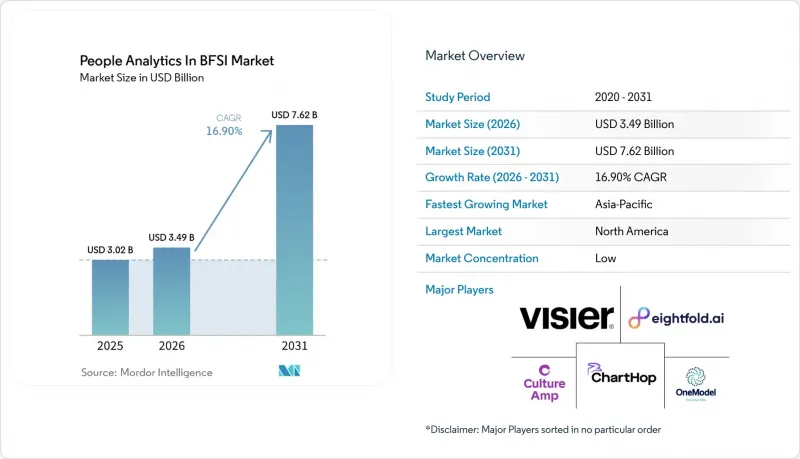
Mordor Intelligence에 의하면, BFSI용 인재 분석 시장 규모는 2025년 30억 2,000만 달러로 평가되었고, 2026년 34억 9,000만 달러로 추정되고, 2031년까지 76억 2,000만 달러로 확대될 전망이며, 2026-2031년 연평균 복합 성장률(CAGR)은 16.90%를 나타낼 것으로 예측됩니다.
본 보고서는 구성 요소별(소프트웨어, 서비스), 도입 형태별(클라우드, 온프레미스, 하이브리드), 기업 규모별(대기업, 중소기업), 용도별(출장 계획, 인재 채용·교육 등), 최종 사용자별(은행, 보험, 금융 서비스 등) 및 지역별로 분류되어 있습니다. 시장 전망은 금액(달러) 기준으로 제시되어 있습니다.
세계의 BFSI용 인재 분석 시장 동향 및 인사이트
AI를 활용한 인재 인텔리전스 및 이직 예측 모델링
BFSI용 인재 분석은 인사 기능 측면에서 사후적인 보고서 작성에서 실시간 의사결정 지원으로의 명확한 전환에 힘입어 주도되고 있습니다. 금융 서비스 업계의 인사팀에서 이 솔루션의 도입률은 여전히 다른 업무 부문에 비해 뒤처져 있으며, 이는 시장이 포화 상태에 이르렀음을 나타내는 것이 아니라, 향후 추가적인 확장을 위한 여지가 여전히 많이 남아 있음을 의미합니다. 실질적인 변화로, AI 모델이 주기의 초기 단계에서 인력 이상 징후나 잠재적인 이직 위험 집단을 감지할 수 있게 되었기 때문에 인사팀은 더 이상 문제가 발생한 후에야 대시보드를 작성할 필요가 없어졌습니다. 대규모 금융기관에서 이는 중요한 의미를 지닙니다. 왜냐하면 내부 생산성 향상과 내부 채용률 증가로 인해, 인재 분석은 업무 효율과 인재 유지 모두와 관련이 있게 되었기 때문입니다. 금융 부문 데이터셋을 활용한 동료 심사 연구에 따르면, GAN-Transformer를 활용한 이직 예측 모델이 92%에서 96.95%의 정확도를 달성한 것으로 나타났으며, BFSI용 인재 분석에서 예측적 재직률 분석이 실험 단계를 벗어나면서, 이에 대한 비즈니스적 근거는 현재 더욱 확고해졌습니다.
노동력 데이터 및 감사 가능성과 관련된 규제의 복잡화
BFSI용 인재 분석은 인력 데이터 거버넌스가 보다 광범위한 운영 탄력성 및 AI 규정 준수 프레임워크에 통합됨에 따라 지지를 넓혀가고 있습니다. DORA(데이터 운영 위험 평가)에 따라 제3자 서비스에 대한 의존 관계를 문서화해야 할 필요성이 커지고 있으며, 이에 따라 HR 워크플로우 전반에 걸쳐 지속적인 로그와 추적 가능한 관리를 유지할 수 있는 플랫폼에 대한 수요가 증가하고 있습니다. EU AI법에서는 직원의 성과 평가, 이직 예측 및 업무 배분 시스템이 고위험 AI 활용으로 간주되고 있으며, 거버넌스 감독과 근로자에 대한 투명성이 공급업체 선정 시 더욱 중요한 요소로 대두되고 있습니다. 2026년 5월 EU 디지털 옴니버스 협정에 따라 고용 분야에서의 AI 규정 준수 완전 이행 기한이 2027년 12월로 연기되었으나, 이 유예 기간은 조기에 규정 준수 대응 운영 모델 구축을 시작한 기관에 유리하게 작용할 것입니다. BFSI용 인재 분석 시장에서 이러한 상황은 기업들이 원활하고 점진적인 도입 경로를 따르기보다는 시행 시기가 다가옴에 따라 단계적인 도입의 물결을 일으킬 가능성이 높다고 볼 수 있습니다.
데이터 개인정보 보호, 데이터 소재지, 그리고 국경을 넘는 직원 데이터와 관련된 마찰
데이터 주권은 BFSI 분야를 대상으로 하는 인력 분석의 가장 뚜렷한 제약 요소 중 하나로 남아 있습니다. 이는 직원 기록에는 국경을 넘어 표준화하기 어려운 현지 노동, 개인정보, 보수에 관한 민감한 정보가 종종 포함되어 있기 때문입니다. 중국과 러시아에서는 직원 데이터를 현지에서 저장해야 할 의무가 있어, 이로 인해 다국적 기업들은 병행된 인사 환경을 구축할 수밖에 없게 되었으며, 고도의 분석에 필요한 통합된 인력 모델이 약화되고 있습니다. 인도에서는 2025년 말, DPDP(데이터 보호 및 개인정보 보호법)와 관련된 국경 간 규정 준수 의무가 추가됨에 따라, 개인정보 관리를 독립적인 과제로 다루기보다는 노동 및 세제 체계와 조화를 이루어야 할 필요성이 커졌습니다. 2026년 5월 보도에 따르면, 일부 기업들은 보상, 후계자 계획, 징계와 관련된 데이터에 대한 직접적인 관리 권한을 유지하기 위해 인적 자본 AI 관련 업무를 온프레미스 또는 엄격하게 관리되는 내부 네트워크로 되돌리고 있다고 합니다. 이러한 경향은 BFSI용 인재 분석 시장의 플랫폼 확장을 지연시키고 있으며, 특히 여러 관할 구역에 걸쳐 현지 사업을 운영하는 데 필요한 기술적 역량이 부족한 소규모 지역 금융 기관에서 두드러지게 나타납니다.
부문별 분석
2025년, BFSI용 인재 분석 시장 점유율 중 소프트웨어가 64.37%를 차지했으며, 이 부문에서 주요 지출 항목은 여전히 서비스가 아닌 플랫폼인 것으로 확인되었습니다. BFSI 기관은 기간이 정해져 있지 않고 서비스 의존도가 높은 계약보다는 예측 가능한 라이선싱 체계와 제품 자체의 기능을 중시하기 때문에 소프트웨어가 가장 큰 시장 점유율을 차지하고 있습니다. 벤더들이 이직 위험 점수 산정, 임금 격차 검증, 역량 추론 및 인재 계획 기능을 맞춤형 프로젝트로 패키지화하는 대신 표준 제품 릴리스에 포함시키기 시작하면서, 이러한 추세는 더욱 강화되고 있습니다. BFSI 분야를 대상으로 하는 인력 분석(People Analytics)에서 이러한 추세는 인사이트를 독립된 보고서 계층으로 취급하기보다는 분석 기능을 관리자나 인사 부서의 워크플로우에 직접 통합할 수 있는 SaaS 네이티브 벤더에게 유리하게 작용하고 있습니다.
서비스 분야는 2031년까지 연평균 성장률(CAGR) 16.93%를 나타낼 것으로 예측되며, 이는 플랫폼이 고도화됨에 따라 도입의 복잡성이 증가하고 있음을 보여줍니다. 인재 데이터는 파편화된 HRIS 환경이나 구식 은행 시스템에 분산되어 있는 경우가 많기 때문에 금융 기관에는 여전히 자문, 통합, 설정 및 관리형 지원이 필요합니다. 2025년 초 시점에서 금융 서비스 기업의 경영진 중 인사 부문에 생성형 AI를 도입한 비율은 고작 18%에 불과했으며, 이는 플랫폼의 잠재력과 기업의 준비 태세 사이에 격차가 있음을 시사합니다. 2026년 HR-AI 예산은 급증하고 있으며, 이것이 서비스 수요가 소프트웨어로 대체되는 것이 아니라 소프트웨어와 병행하여 확대되고 있는 이유 중 하나입니다. 따라서 BFSI 분야를 대상으로 한 피플 애널리틱스에서는 소프트웨어가 주도적인 위치를 유지하고 있는 반면, 실제 운영상의 제약 조건 하에서 플랫폼을 가동하기 위해 필요한 실행 계층으로서 서비스의 비중이 확대되고 있습니다.
2025년 BFSI용 인재 분석 시장 규모 중 클라우드가 69.41%를 차지했습니다. 이는 보다 광범위한 제품군 도입의 일환으로 애널리틱스를 패키지화하게 된 대규모 HCM 생태계의 확고한 입지를 반영하고 있습니다. 이러한 우위는 클라우드 제공을 통한 규모의 경제에 기인하며, 특히 금융 기관이 보다 신속한 업데이트, 인사 및 재무 워크플로우 간의 원활한 통합, 그리고 인프라 오버헤드 감소를 필요로 할 때 두드러집니다. Workday, SAP SuccessFactors 및 Oracle HCM Cloud는 내장형 분석 기능의 보급을 촉진해 왔습니다. 이에 따라 많은 BFSI 업계의 구매자들은 독립형 도구가 아닌, 제품군 중심의 도입 모델로 전환하고 있습니다. 따라서 BFSI 분야를 대상으로 하는 피플 애널리틱스의 경우, 데이터의 기밀성으로 인해 도입과 관련된 논의가 다른 많은 소프트웨어 카테고리보다 복잡함에도 불구하고, 클라우드는 기본 운영 모델로 간주되고 있습니다.
기관들이 기밀성이 높은 직원 기록에 대한 현지 관리 권한을 포기하지 않으면서도 분석의 유연성을 점점 더 추구함에 따라, 하이브리드 도입은 2031년까지 연평균 성장률(CAGR) 17.63%를 나타낼 것으로 예측되며, 이는 모든 도입 모델 중 가장 빠른 성장 속도입니다. 이는 기존의 사고방식으로의 회귀가 아니라, 데이터 저장 위치, 개인정보 보호, 그리고 규제 당국의 감독에 의해 형성된 의도적인 아키텍처 선택입니다. 2026년 5월 보도에 따르면, 일부 기업에서는 필요에 따라 인적 자본 AI의 워크로드를 관리된 네트워크로 되돌리는 움직임이 나타나고 있으며, 이는 해당 부문에서 하이브리드 모델이 부상하는 추세와 일치합니다. 소버린 클라우드에 대한 투자 역시 규정 준수 대응 방안을 확대하고 있으며, AWS와 Google Cloud는 2026년 4월 시행될 현지화 규제에 따라 인도네시아 내 대규모 데이터센터 투자를 약속했습니다. BFSI용 인재 분석 시장에서 하이브리드 방식은 일시적인 대안이 아니라, 규정 준수를 위한 아키텍처로 자리 잡고 있습니다.
지역별 분석
2025년, 북미는 BFSI용 인재 분석 시장의 38.43%를 차지하며 최대 지역 시장이 되었습니다. 이러한 위상은 클라우드 HR의 성숙한 도입 현황, 더 커진 소프트웨어 예산, 그리고 금융 기관에 서비스를 제공하는 전문 벤더의 풍부한 인재 풀을 반영하고 있습니다. SEC의 Regulation S-K에 기반한 인적 자본 공시 프레임워크를 통해 이사회 및 투자자 차원에서 인재 유지, 인재 개발, 보상의 투명성이 높아짐에 따라, 감사 가능한 인력 데이터 시스템에 대한 꾸준한 수요가 뒷받침되고 있습니다. 2026년에 버지니아주와 메인주에서 도입된 주 차원의 임금 투명성 조치와 같은 해 하반기에 코네티컷주에서 도입된 유사한 조치는 지역 은행 및 보험사에 대한 보고 부담을 더욱 가중시켰습니다. 따라서 북미 BFSI 부문의 인력 분석은 성숙한 기술의 도입과, 인력 데이터를 기업의 거버넌스 우선순위와 밀접하게 연계하는 공시 환경이라는 두 가지 요소 모두로부터 혜택을 받고 있습니다.
아시아태평양은 2031년까지 연평균 성장률(CAGR) 17.89%로 성장할 것으로 예상되며, BFSI용 인재 분석 시장에서 가장 빠르게 성장하는 지역이 될 전망입니다. 이 지역이 두드러지는 이유는 인도, 중국, 한국, 호주, 싱가포르에서 BFSI 업계의 방대한 인력이 급속도로 디지털화되고 있기 때문입니다. 인도에서는 2025년 11월 인도준비은행이 발표한 아웃소싱 관련 지침에 따라, 규정 준수 강화와 직원 모니터링에 대한 필요성이 높아지고 있습니다. 이에 따라 주요 직원에 대한 추적, 신원 조사 및 사고 보고 체계에 대한 기대가 높아지고 있습니다. 중국에서 2026년 주요 상장 은행을 분석한 결과, 각 금융기관이 AI에 의한 대체 가능성을 바탕으로 직무를 분류하고 있으며, 이를 통해 재배치 계획 및 사내 인재 세분화를 위한 보다 공식적인 기반이 구축되고 있는 것으로 밝혀졌습니다. 또한 싱가포르에서는 업계 주도의 역량 강화 프로그램을 통해 지역적 모델이 확립되어 있으며, 이는 BFSI 분야 전반의 인력 분석 및 인재 계획 도구의 보급을 뒷받침하고 있습니다.
유럽은 규제 주도형 도입 경로를 따르고 있지만, 남미와 중동 및 아프리카는 BFSI 분야를 대상으로 한 피플 애널리틱스 측면에서 초기 단계이긴 하나, 의미 있는 성장 기회를 내포하고 있습니다. 2026년 6월로 예정된 EU 임금 투명성 지침의 국내법화 시한을 앞두고, 유럽의 여러 국가 은행들은 직무 체계, 임금 등급 및 보상 분석 역량 개선에 힘썼습니다. 특히 프랑스에서는 활발한 움직임이 나타나고 있는데, BPCE가 2025년에 생성형 AI와 관련된 고용 협정에 서명한 데 이어, 프랑스 은행 협회가 9개 은행 직종에 대한 생성형 AI의 영향을 조사했습니다. 남미에서는 디지털 뱅킹의 확대와 인사 부문의 현대화가 클라우드 주도형 도입의 길을 열어주고 있는 반면, 사우디아라비아, 아랍에미리트(UAE), 남아프리카공화국에서는 인재 계획, 현지화 프로그램, 디지털 인재 확보에 대한 수요가 높아지고 있습니다.
기타 혜택 :
- Excel 형식 시장 예측(ME) 시트
- 3개월간의 애널리스트 지원
자주 묻는 질문
목차
제1장 서론
제2장 분석 방법
제3장 주요 요약
제4장 시장 구도
제5장 시장 규모 및 성장률 예측
제6장 경쟁 구도
제7장 시장 기회 및 향후 전망
AJY 26.06.26According to Mordor Intelligence, the people analytics in BFSI market size is projected to expand from USD 3.02 billion in 2025 and USD 3.49 billion in 2026 to USD 7.62 billion by 2031, registering a CAGR of 16.90% between 2026 to 2031.
This report is Segmented by Component (Software, and Services), Deployment Mode (Cloud, On-Premises, and Hybrid), Enterprise Size (Large Enterprises, and Small and Medium Enterprises), Application (Workforce Planning, Talent Acquisition and Onboarding, and More), End-User (Banking, Insurance, Financial Services, and More), and Geography. The Market Forecasts are Provided in Terms of Value (USD).
Global People Analytics In BFSI Market Trends and Insights
AI-Powered Talent Intelligence And Predictive Attrition Modeling
The people analytics in BFSI market is being driven by a clear shift from backward-looking reporting to real-time decision support within talent functions. Adoption in financial services talent teams still trails other business functions, which leaves a meaningful runway for further deployment rather than signaling saturation. The practical change is that HR teams are no longer expected to pull dashboards after a problem appears, because AI models can now flag workforce anomalies and potential flight-risk clusters earlier in the cycle. In large institutions, this matters because internal productivity gains and higher internal fill rates make workforce analytics relevant to both operating efficiency and retention. The commercial case is stronger now because peer-reviewed research on financial-sector datasets showed that GAN-Transformer attrition models achieved 92% to 96.95% accuracy, moving predictive retention analytics out of the experimental stage for people analytics in the BFSI market.
Rising Regulatory Complexity In Workforce Data And Auditability
The people analytics in BFSI market is also gaining support as workforce data governance is folded into broader operational resilience and AI compliance frameworks. DORA has raised the need to document third-party service dependencies, which increases demand for platforms that can maintain durable logs and traceable controls across HR workflows. The EU AI Act has treated employee performance evaluation, attrition prediction, and task allocation systems as high-risk AI uses, making governance oversight and worker transparency more central in vendor selection. A May 2026 EU Digital Omnibus agreement delayed the full employment AI compliance deadline to December 2027, but that extra time favors institutions that start building compliant operating models early. In the people analytics market in the BFSI, this setup is likely to produce stepwise adoption waves as firms move closer to enforcement rather than a smooth, gradual uptake path.
Data Privacy, Data Residency, And Cross-Border Employee Data Friction
Data sovereignty remains one of the clearest constraints on people analytics in the BFSI market because employee records often carry local labor, privacy, and compensation sensitivities that are harder to standardize across borders. China and Russia require local storage of employee data, which pushes multinational firms toward parallel HR environments and weakens the unified workforce models that advanced analytics needs. India added another layer in late 2025 through DPDP-related cross-border compliance obligations, which increased the need to align privacy management with labor and tax structures rather than treating it as a stand-alone exercise. Some firms were reported in May 2026 to be moving human capital AI activity back on-premises or into tightly controlled internal networks to retain direct control over compensation, succession, and disciplinary data. That pattern slows platform rollouts in the people analytics market in BFSI sector, especially for smaller regional institutions that lack the technical capacity to operate local deployments across multiple jurisdictions.
Other drivers and restraints analyzed in the detailed report include:
- Cloud HR Modernization Across Banks And Insurers
- Skills-Based Workforce Planning For Digital And AI Roles
- Algorithmic Bias And Explainability Risk In Employment Decisions
For complete list of drivers and restraints, kindly check the Table Of Contents.
Segment Analysis
Software accounted for 64.37% of the people analytics in BFSI market share in 2025, confirming that platforms, not services, remain the core spending line in this category. The largest share lies with software, as BFSI institutions prefer predictable licensing structures and direct product capabilities over open-ended, services-heavy engagements. That preference has strengthened as vendors embed attrition scoring, pay equity review, skills inference, and workforce planning features into standard product releases rather than packaging them as custom projects. In people analytics in the BFSI industry, this pattern favors SaaS-native vendors that can embed analytics directly into managers' and HR workflows, rather than treating insights as a separate reporting layer.
Services are projected to grow at a 16.93% CAGR through 2031, indicating that implementation complexity is rising as platforms become more sophisticated. Institutions still need advisory, integration, configuration, and managed support because workforce data often sits across fragmented HRIS environments and legacy banking systems. Only 18% of financial services executives were implementing generative AI in their talent functions in early 2025, suggesting a gap between the potential of the platform and enterprise readiness. HR-AI budgets rose sharply for 2026, which helps explain why services demand is growing alongside software rather than being displaced by it. The people analytics in the BFSI market, therefore, keeps software in the lead, while services expand as the execution layer required to make those platforms work under real operating constraints.
Cloud accounted for 69.41% of the people analytics in BFSI market size in 2025, reflecting the strong position of large HCM ecosystems that now package analytics as part of broader suite adoption. This lead is grounded in the scale advantages of cloud delivery, especially where institutions want faster updates, easier integration across HR and finance workflows, and lower infrastructure overhead. Workday, SAP SuccessFactors, and Oracle HCM Cloud have helped normalize embedded analytics, which has pulled many BFSI buyers toward suite-led deployment models rather than stand-alone tools. People analytics in the BFSI market has therefore treated cloud as the default operating model, even though data sensitivity makes the deployment discussion more complex than in many other software categories.
Hybrid deployment is projected to grow at a 17.63% CAGR through 2031, the fastest among deployment models, as institutions increasingly seek analytics flexibility without sacrificing local control over sensitive employee records. This is not a return to legacy thinking, but a deliberate architecture choice shaped by data residency, privacy, and regulated oversight. Some firms were reported in May 2026 to be moving human capital AI workloads back into controlled networks where necessary, which aligns with the rise of hybrid models in the sector. Sovereign cloud investments are also expanding compliant options, with AWS and Google Cloud committing to major in-country data center investments in Indonesia after the April 2026 localization rules. In the people analytics market in the BFSI, hybrid is becoming a compliance architecture rather than a temporary bridge.
Geography Analysis
North America accounted for 38.43% of the people analytics market in the BFSI market in 2025, making it the largest regional market. This position reflects mature cloud HR adoption, larger software budgets, and a deep pool of specialized vendors serving financial institutions. The SEC human capital disclosure framework under Regulation S-K has made retention, talent development, and compensation more visible at the board and investor level, which supports steady demand for auditable workforce data systems. State-level pay transparency measures in Virginia and Maine in 2026, followed by Connecticut later in the year, added another layer of reporting pressure for regional banks and insurers. The people analytics in the BFSI market in North America, therefore, benefits from a mix of mature technology adoption and a disclosure environment that keeps workforce data close to enterprise governance priorities.
Asia-Pacific is projected to grow at a 17.89% CAGR through 2031, making it the fastest-growing region in the people analytics market in BFSI. The region stands out because large BFSI workforces are being digitized quickly across India, China, South Korea, Australia, and Singapore. India is seeing stronger compliance and greater workforce monitoring needs following the Reserve Bank of India's outsourcing directions issued in November 2025, which raised expectations for essential personnel tracking, background verification, and incident reporting discipline. In China, an analysis of major listed banks in 2026 showed that institutions were categorizing roles by AI substitutability, creating a more formal basis for redeployment planning and internal workforce segmentation. Singapore also adds a regional template through industry-led skilling programs, which supports broader adoption of skills analytics and workforce planning tools across the people analytics in BFSI market.
Europe follows a regulatory-first adoption path, while South America, the Middle East, and Africa represent earlier-stage but meaningful expansion opportunities for people analytics in the BFSI market. The June 2026 transposition deadline for the EU Pay Transparency Directive prompted banks in several European countries to improve their job architecture, pay grading, and compensation analytics capabilities. France showed particularly visible activity, with BPCE signing an employment accord around generative AI in 2025 and the French Banking Federation studying the impact of GenAI across nine banking professions. In South America, digital banking expansion and HR modernization are opening the door to cloud-led adoption, while Saudi Arabia, the UAE, and South Africa are driving demand for workforce planning, localization programs, and digital talent retention.
- Visier, Inc.
- Eightfold AI Inc.
- One Model Inc.
- ChartHop, Inc.
- Culture Amp Pty Ltd
- Orgvue Limited
- Panalyt Inc.
- TalentNeuron, LLC
- Syndio Solutions, Inc.
- Praisidio, Inc.
- Worklytics Co.
- Aura Intelligence, Inc.
- Sapience Analytics Corporation
- Prohance Inc.
- Gloat Ltd.
- Perceptyx, Inc.
- Betterworks System Inc.
- Leapsome GmbH
- Hi Bob, Inc.
- Knoetic, Inc.
Additional Benefits:
- The market estimate (ME) sheet in Excel format
- 3 months of analyst support
TABLE OF CONTENTS
1 INTRODUCTION
- 1.1 Study Assumptions and Market Definition
- 1.2 Scope of the Study
2 RESEARCH METHODOLOGY
3 EXECUTIVE SUMMARY
4 MARKET LANDSCAPE
- 4.1 Market Overview
- 4.2 Market Drivers
- 4.2.1 Rising Regulatory Complexity in Workforce Data and Auditability
- 4.2.2 AI-Powered Talent Intelligence and Predictive Attrition Modeling
- 4.2.3 Cloud HR Modernization Across Banks and Insurers
- 4.2.4 Skills-Based Workforce Planning for Digital and AI Roles
- 4.2.5 Behavioral-Risk Monitoring for Front-Line Conduct and Compliance
- 4.2.6 Pay Transparency and Human Capital Disclosure Mandates
- 4.3 Market Restraints
- 4.3.1 Data Privacy, Data Residency, and Cross-Border Employee Data Friction
- 4.3.2 Legacy HR and Core System Integration Complexity
- 4.3.3 Algorithmic Bias and Explainability Risk in Employment Decisions
- 4.3.4 AI Readiness Gaps Across Regulated BFSI Workforces
- 4.4 Impact of Macroeconomic Factors on the Market
- 4.5 Industry Value Chain Analysis
- 4.6 Regulatory Landscape
- 4.7 Technological Outlook
- 4.8 Porter's Five Forces Analysis
- 4.8.1 Threat of New Entrants
- 4.8.2 Bargaining Power of Buyers
- 4.8.3 Bargaining Power of Suppliers
- 4.8.4 Threat of Substitutes
- 4.8.5 Intensity of Competitive Rivalry
5 MARKET SIZE AND GROWTH FORECASTS (VALUE)
- 5.1 By Component
- 5.1.1 Software
- 5.1.2 Services
- 5.2 By Deployment Mode
- 5.2.1 Cloud
- 5.2.2 On-premises
- 5.2.3 Hybrid
- 5.3 Enterprise Size
- 5.3.1 Large Enterprises
- 5.3.2 Small and Medium Enterprises
- 5.4 By Application
- 5.4.1 Workforce Planning
- 5.4.2 Talent Acquisition and Onboarding
- 5.4.3 Employee Engagement and Development
- 5.4.4 Retention and Attrition Analytics
- 5.4.5 Payroll and Compensation Analytics
- 5.4.6 Compliance and Risk Workforce Analytics
- 5.5 By End-user
- 5.5.1 Banking
- 5.5.2 Insurance
- 5.5.3 Financial Services
- 5.5.4 FinTech
- 5.5.5 Capital Markets and Investment Firms
- 5.6 By Geography
- 5.6.1 North America
- 5.6.1.1 United States
- 5.6.1.2 Canada
- 5.6.1.3 Mexico
- 5.6.2 South America
- 5.6.2.1 Brazil
- 5.6.2.2 Argentina
- 5.6.2.3 Rest of South America
- 5.6.3 Europe
- 5.6.3.1 Germany
- 5.6.3.2 United Kingdom
- 5.6.3.3 France
- 5.6.3.4 Italy
- 5.6.3.5 Spain
- 5.6.3.6 Russia
- 5.6.3.7 Netherlands
- 5.6.3.8 Rest of Europe
- 5.6.4 Asia-Pacific
- 5.6.4.1 China
- 5.6.4.2 Japan
- 5.6.4.3 India
- 5.6.4.4 South Korea
- 5.6.4.5 Australia and New Zealand
- 5.6.4.6 Rest of Asia-Pacific
- 5.6.5 Middle East
- 5.6.5.1 Saudi Arabia
- 5.6.5.2 United Arab Emirates
- 5.6.5.3 Rest of Middle East
- 5.6.6 Africa
- 5.6.6.1 South Africa
- 5.6.6.2 Nigeria
- 5.6.6.3 Rest of Africa
- 5.6.1 North America
6 COMPETITIVE LANDSCAPE
- 6.1 Market Concentration
- 6.2 Strategic Moves
- 6.3 Market Share Analysis
- 6.4 Company Profiles (includes Global Level Overview, Market Level Overview, Core Segments, Financials as available, Strategic Information, Market Rank/Share, Products and Services, Recent Developments).
- 6.4.1 Visier, Inc.
- 6.4.2 Eightfold AI Inc.
- 6.4.3 One Model Inc.
- 6.4.4 ChartHop, Inc.
- 6.4.5 Culture Amp Pty Ltd
- 6.4.6 Orgvue Limited
- 6.4.7 Panalyt Inc.
- 6.4.8 TalentNeuron, LLC
- 6.4.9 Syndio Solutions, Inc.
- 6.4.10 Praisidio, Inc.
- 6.4.11 Worklytics Co.
- 6.4.12 Aura Intelligence, Inc.
- 6.4.13 Sapience Analytics Corporation
- 6.4.14 Prohance Inc.
- 6.4.15 Gloat Ltd.
- 6.4.16 Perceptyx, Inc.
- 6.4.17 Betterworks System Inc.
- 6.4.18 Leapsome GmbH
- 6.4.19 Hi Bob, Inc.
- 6.4.20 Knoetic, Inc.
7 MARKET OPPORTUNITIES AND FUTURE OUTLOOK
- 7.1 White-Space and Unmet-Need Assessment


