

|
시장보고서
상품코드
2065502
LED 모듈 시장 : 시장 점유율 분석, 업계 동향 및 통계, 성장 예측(2026-2031년)LED Module - Market Share Analysis, Industry Trends & Statistics, Growth Forecasts (2026 - 2031) |
||||||
 Mordor Intelligence
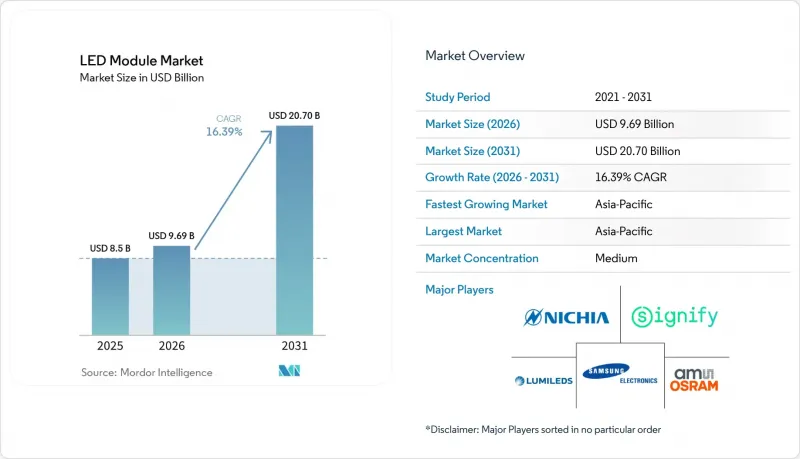
LED 모듈 시장 규모는 2025년에 85억 달러로 평가되었고, 2026년에 96억 9,000만 달러로 추정되고, 2026-2031년 CAGR 16.39%로 성장할 전망이며, 2031년까지 207억 달러에 이를 것으로 예상되고 있습니다.
본 보고서는 모듈 유형별(COB, SMD, 리니어, 백라이트, 고출력, 기타 모듈 유형), 용도별(일반 조명, 자동차, 디스플레이 및 백라이트, 사이니지, 기타 용도), 전력 범위별(저, 중, 고), 폼 팩터별(리지드, 플렉서블), 지역별(북미, 유럽, 기타 지역)로 분류되어 있습니다. 시장 전망은 금액(달러) 기준으로 제시되어 있습니다.
세계의 LED 모듈 시장 동향 및 인사이트
IoT 지원 빌딩 시스템과 스마트 조명의 통합
상업용 건축물에서는 각 LED 모듈을 재실 현황, 자연광, 건강 상태에 대한 원격 측정 데이터를 수집하는 지능형 에지 디바이스로 활용하는 네트워크 기반 조명 시스템이 점점 더 많이 도입되고 있습니다. 2025년에는 북미 및 유럽에서 준공될 신규 연면적의 60%에 대해, 사이트당 55만 달러를 초과하는 무선 게이트웨이, 센서 어레이, 클라우드 구독에 대한 투자가 이루어질 것으로 예측됩니다. 전력 및 유지보수 비용을 30-40% 절감하는 효과가 입증되었으며, 3년 미만의 투자 회수 기간을 실현함으로써 CFO가 허용하는 수익률 기준을 충족하고 있습니다. 새로운 Matter 프로토콜은 Zigbee, Thread 및 독자적인 메시 네트워크를 통합하여 시운전 시간과 지원 문의 건수를 대폭 줄여줍니다. 예측 분석을 통해 고장이 발생하기 전에 교체 일정을 수립함으로써, 입주자의 만족도와 부동산 소유주의 자산 가치 향상을 도모할 수 있습니다.
정부에 의한 비효율적인 광원의 단계적 폐지
3대 대륙의 입법 기관들은 규정 준수 기한을 단축하고 있으며, 과거에는 선택 사항이었던 효율성 향상을 법적 요건으로 전환하고 있습니다. 유럽연합(EU)은 2021년에 대부분의 할로겐 조명 제품의 재고 관리 단위(SKU)를 금지했으며, 2024년에는 세관 단속을 강화하여 항구에서 규정을 준수하지 않는 제품의 수입을 차단하고 있습니다. 캘리포니아주의 2025년판 ‘타이틀 24’ 개정안에 따르면, 신축 상업용 건물에 설치되는 조명 전력 중 90%를 재실 센서 및 자연광 활용 기능을 갖춘 LED 광원으로 충당해야 합니다. 중국의 2024년 로드맵에 따르면, 2026년까지 공공 인프라용 조명 기구의 광속 효율을 1와트당 130루멘 이상으로 높여야 합니다. 이러한 동시에 진행되는 규제 조치로 인해 모듈식 LED 개조 키트와 일체형 천장 패널에 대한 지속적인 수요가 보장됩니다.
고출력 모듈의 열 관리 과제
30와트를 초과하는 고출력 모듈의 경우, 고밀도로 배치된 발광 소자에서 발생하는 열을 방산하기 어려우며, 접합부 온도가 125°C를 초과하면 수천 시간 이내에 광출력이 절반으로 줄어들 가능성이 있습니다. 새로운 IEC 62031:2026의 열저항 보고 규정을 충족하기 위해서는 공급업체가 적외선 이미징이나 유한요소법(FEM)을 이용한 시뮬레이션은 물론, 고가의 금속 코어 및 세라믹 기판에 대한 투자까지 감수해야 합니다. 수동형 방열판은 무게와 부피를 증가시키는 반면, 능동형 팬은 소음 및 신뢰성 문제를 야기합니다. 원예용 및 산업용 조명 기구는 주변 온도가 이미 높은 탓에 그 영향을 가장 먼저 받게 되어, 보증 청구 건수가 증가하고, 구매자의 적극적인 과부하 운용 전략을 저해하는 요인이 되고 있습니다.
부문별 분석
LED 백라이트 모듈 시장은 2026-2031년 연평균 성장률(CAGR) 16.81%로 성장할 전망이며, 미니 LED 기술이 프리미엄 TV 및 모니터에 보급됨에 따라 LED 모듈 시장 전체의 성장률을 크게 상회하고 있습니다. SMD 모듈은 주거용 및 상업용 조명 기기에서 뛰어난 가성비를 바탕으로 2025년 LED 모듈 시장 점유율 33.61%를 유지했습니다. 백라이트 설계에서는 1,000개가 넘는 로컬 디밍 구역을 구현하기 위해 수천 개의 미니 LED가 채택되고 있으며, 얇고 열 효율이 뛰어난 기판에 대한 수요가 증가하고 있습니다. 한편, 칩 온 보드(COB) 아키텍처는 자동차 헤드램프에서 반사기 하우징을 확대하지 않고도 10,000루멘이라는 목표를 달성할 수 있는 컴팩트한 크기로 인해 높이 평가받으며, 채택이 확대되고 있습니다. 리니어 모듈은 배선 공사 없이 형광등을 교체할 수 있고, 까다로운 프로젝트 일정을 준수할 수 있기 때문에 사무실 트로퍼 조명 개조에서 여전히 주류를 이루고 있습니다.
LED 모듈 시장은 새로운 틈새 시장에서도 혜택을 보고 있습니다. 플렉서블 스트립은 곡면 간판을 비추고, UV-C 모듈은 의료 분야로 진출하고 있습니다. COB의 모놀리식 다이는 열 저항을 줄이고 연색성을 90 이상으로 높임으로써 박물관이나 소매점의 요구를 충족시키고 있습니다. Cree LED의 L2 PCBA 플랫폼은 이러한 장점을 통합 드라이버와 결합함으로써 조명 기구의 OEM 설계 주기를 단축합니다. 자동화를 통해 Mini-LED의 비용이 낮아짐에 따라, 고휘도 디스플레이 분야에서 백라이트 모듈이 SMD 시장 점유율을 서서히 잠식하게 되어, 공급업체의 혼합 포트폴리오 전략이 강화될 것입니다.
2025년 LED 모듈 시장 규모에서 일반 조명은 42.59%를 차지했으나, 디스플레이 및 백라이트 분야에 상대적으로 주도권을 내주고 있는 추세이며, 2031년까지 연평균 성장률(CAGR) 16.98%로 확대될 것으로 전망됩니다. 직접 라이트 방식의 TV와 게이밍 모니터의 교체 주기가 교체 수요를 견인하는 한편, HDR 지원 패널이 로컬 디밍 채택 건수를 늘려 화면당 모듈 사용량을 증가시키고 있습니다. 상업용 조명은 사무실, 소매점, 호텔 및 레스토랑 업계의 리모델링 공사를 통해 여전히 가장 큰 모듈 소비량을 차지하고 있지만, 에너지 규제로 인해 스크린 관련 부문에 비해 성장세가 둔화되고 있습니다.
자동차의 외장 조명, 특히 어댑티브 헤드램프는 엄격한 광도 측정이 이루어지기 때문에 고가대로 거래되고 있습니다. 디지털 사이니지 및 옥외 광고 분야에서는 5,000니트 이상의 고휘도와 IP65 규격에 부합하는 보호 기능을 갖춘 모듈이 채택되고 있으며, 스마트 시티 프로젝트에 따른 수요가 지속되고 있습니다. 원예 및 UV-C 살균은 수익성이 높은 분야로, 분광 조정과 살균 파장이 적은 출하량을 상쇄하고 있습니다. 전구 부문이 성숙기에 접어든 가운데, 이러한 각 틈새 시장이 LED 모듈의 잠재적 시장 규모를 확대되고 있습니다.
지역별 분석
아시아태평양은 2025년 LED 모듈 시장 매출의 67.73%를 차지한 것으로 평가되었으며, 2031년까지 연평균 성장률(CAGR) 17.05%를 나타낼 것으로 전망됩니다. 중국은 전 세계 반도체 생산 능력의 70% 이상을 차지하고 있으며, 그 비중을 계속 확대되고 있습니다. BOE Huacan이 장쑤성에 건설 중인 20억 위안(2억 8,000만 달러) 규모의 웨이퍼 공장은월50만 개의 생산 능력을 추가하며, 자동차용 및 Mini-LED 백라이트 시장을 목표로 하고 있습니다(BOE.COM). 인도에서는 공공 부문의 가로등 입찰 규모가 수천만 대 규모로 확대되면서, 제2의 거점으로 부상하고 있습니다. 일본은 UV 및 마이크로 LED라는 특수 분야에서 주도권을 유지하고 있으며, 닛야 화학공업의 형광체 특허를 활용하여 가격 프리미엄을 확보하고 있습니다.
북미는 매출액 기준 2위를 차지했으며, 형광등용 안정기에 대한 규제 따른 사용 금지 및 적응형 LED 헤드라이트 도입 가속화에 힘입고 있습니다. 캐나다에서는 탄소 가격 상승으로 인해 건물 소유주들이 리모델링 예산의 40%를 조명 업그레이드에 할당하게 되었습니다. 한편, 미국 국경과 인접한 멕시코의 각 주에서는 니어쇼어링을 실시하는 OEM 제조업체에 대한 공급에 대응하기 위해 2025년 중 모듈 조립 능력을 25% 확대했습니다.
유럽에서는 엄격한 에코디자인 기준 덕분에 개보수 속도가 안정적으로 유지되고 있으며, 독일과 영국이 사무실 및 공공시설의 개보수를 주도하고 있습니다. 중동 및 아프리카 시장은 아랍에미리트와 사우디아라비아의 고급 스마트시티 지역에 집중되어 있는 반면, 남미 및 아프리카에서는 Off-grid 태양광·LED 프로그램과 관련된 산발적인 수요가 나타나고 있습니다. 모든 지역에서 정책적 압력과 현지 제조 장려책이 맞물리면서, LED 모듈 시장은 높은 성장세를 유지하고 있습니다.
기타 혜택 :
- 엑셀 형식 시장 예측(ME) 시트
- 3개월간의 애널리스트 지원
자주 묻는 질문
목차
제1장 서론
제2장 조사 방법
제3장 주요 요약
제4장 시장 구도
제5장 시장 규모 및 성장 예측
제6장 경쟁 구도
제7장 시장 기회 및 향후 전망
AJY 26.06.26According to Mordor Intelligence, the lED module market size was USD 8.50 billion in 2025 and USD 9.69 billion in 2026, and is expected to reach USD 20.70 billion by 2031, growing at a CAGR of 16.39% over 2026-2031.
This report is Segmented by Module Type (COB, SMD, Linear, Backlight, High-Power, and Other Module Types), Application (General Lighting, Automotive, Display and Backlighting, Signage, and Other Applications), Power Range (Low, Mid, and High), Form Factor (Rigid, and Flexible), and Geography (North America, Europe, and Other Geographies). The Market Forecasts are Provided in Terms of Value (USD).
Global LED Module Market Trends and Insights
Smart-Lighting Integration With IoT-Enabled Building Systems
Commercial construction increasingly embeds networked lighting that treats every LED module as an intelligent edge device collecting occupancy, daylight, and health telemetry. In 2025, sixty percent of new floor space commissioned in North America and Europe funded wireless gateways, sensor arrays, and cloud subscriptions worth more than USD 550 000 per site. Measured savings of 30 to 40 percent on electricity and maintenance deliver sub-three-year paybacks, satisfying CFO hurdle rates. The new Matter protocol unifies Zigbee, Thread, and proprietary meshes, slashing commissioning time and calls. Predictive analytics schedule replacements before outages, lifting tenant satisfaction and landlord valuation premiums.
Government-Mandated Phase-Out of Inefficient Light Sources
Legislators on three continents are compressing compliance timelines, converting what was a voluntary efficiency upgrade into a statutory requirement. The European Union banned most halogen stock-keeping units in 2021 and heightened customs enforcement in 2024, blocking non-compliant imports at ports. California's 2025 Title 24 revision stipulates that 90 percent of installed lighting power in new commercial buildings must originate from LED sources equipped with occupancy sensors and daylight harvesting. China's 2024 roadmap demands public infrastructure luminaires exceeding 130 lumens per watt by 2026. These synchronized decrees guarantee sustained demand for modular LED retrofit kits and integrated ceiling panels.
Thermal Management Challenges in High-Power Modules
High-power modules operating above 30 watts struggle to shed the heat generated by tightly packed emitters, and junction temperatures that drift beyond 125 °C can cut luminous output in half within a few thousand hours. Meeting new IEC 62031:2026 thermal resistance reporting rules forces suppliers to invest in infrared imaging, finite element simulation, and more expensive metal core or ceramic substrates. Passive heat sinks add weight and volume, while active fans raise noise and reliability worries. Horticulture and industrial luminaires feel the impact first because ambient temperatures already sit high, amplifying warranty claims and deterring aggressive overdrive strategies among buyers.
Other drivers and restraints analyzed in the detailed report include:
- Automotive OEM Shift to LED Headlamps and Interior Modules
- Rapid LED Penetration in Residential and Commercial Retrofits
- Price-Erosion and Margin Pressure Owing to Excess Capacity
For complete list of drivers and restraints, kindly check the Table Of Contents.
Segment Analysis
LED backlight modules are advancing at a 16.81% CAGR from 2026-2031, significantly outpacing overall LED module market growth as Mini-LED technology scales into premium televisions and monitors. SMD modules retained 33.61% of the LED module market share in 2025, buoyed by strong cost-performance in residential and commercial luminaires. Backlight designs tap thousands of Mini-LEDs to achieve greater-than 1,000 local-dimming zones, pushing demand for thin, thermally efficient boards. Meanwhile, chip-on-board (COB) architectures win in automotive headlamps where compact footprints meet 10,000-lumen targets without enlarging reflector housings. Linear modules continue to dominate office troffer retrofits because contractors can replace fluorescent lamps without rewiring, preserving tight project timelines.
The LED module market benefits from new specialty niches: flexible strips illuminate curved signage, and UV-C modules expand into healthcare. COB's monolithic die reduces thermal resistance and elevates color rendering above 90, fitting museum and retail needs. Cree LED's L2 PCBA platform packages this benefit with integrated drivers, thereby trimming luminaire OEM design cycles. As automation lowers Mini-LED cost, backlight modules will progressively steal share from SMD in high-brightness displays, reinforcing a mixed portfolio strategy for suppliers.
General lighting represented 42.59% of the LED module market size in 2025, yet is ceding relative momentum to display and backlighting, forecast to climb at a 16.98% CAGR through 2031. Direct-lit TV and gaming-monitor refresh cycles fuel replacement demand, while HDR-ready panels push local-dimming counts upward, inflating module content per screen. Commercial lighting still absorbs the largest module volume via office, retail, and hospitality retrofits, but energy regulations are flattening growth relative to screen-based segments.
Automotive exterior lighting, especially adaptive headlamps, commands premium pricing due to rigorous photometric testing. Signage and outdoor advertising install high-brightness modules rated above 5,000 nits and protected to IP65, sustaining demand from smart-city projects. Horticulture and UV-C disinfection form high-margin verticals where spectral tuning or germicidal wavelengths offset lower shipment volumes. Each niche enlarges the addressable LED module market even as the bulb segment matures.
Geography Analysis
Asia-Pacific accounted for 67.73% of the LED module market revenue in 2025 and is projected to post a 17.05% CAGR through 2031. China controls more than 70% of global chip capacity and continues to expand; BOE Huacan's RMB 2 billion (USD 280 million) wafer plant in Jiangsu will add 500,000 pieces per month, aimed at automotive and Mini-LED backlights BOE.COM. India is emerging as a secondary hub as public-sector street-light tenders scale into the tens of millions of units. Japan retains leadership in UV and micro-LED specialties, leveraging Nichia's phosphor patents to command price premiums.
North America ranks second by revenue, sustained by regulatory bans on fluorescent ballasts and the accelerating adoption of adaptive LED headlamps. Canada's rising carbon price moved building owners to allocate 40% of retrofit budgets to lighting upgrades, while Mexican states near the U.S. border expanded module-assembly capacity by 25% during 2025 to serve nearshoring OEMs.
Europe's strict Ecodesign thresholds guarantee a steady retrofit cadence, with Germany and the United Kingdom spearheading office and municipal conversions. Middle East and Africa markets concentrate on prestige smart-city districts in the United Arab Emirates and Saudi Arabia, whereas South America and Africa see sporadic demand tied to off-grid solar-LED programs. Across all regions, policy pressure and local manufacturing incentives intersect to keep the LED module market on a high-growth trajectory.
- Signify N.V.
- ams-OSRAM AG
- Samsung Electronics Co., Ltd.
- Nichia Corporation
- Lumileds Holding B.V.
- Cree LED, Inc.
- Seoul Semiconductor Co., Ltd.
- LG Innotek Co., Ltd.
- Acuity Brands, Inc.
- Eaton Corporation plc
- General Electric Company
- Toyoda Gosei Co., Ltd.
- Bridgelux, Inc.
- Citizen Electronics Co., Ltd.
- Everlight Electronics Co., Ltd.
- Epistar Corporation
- Opple Lighting Co., Ltd.
- Hubbell Incorporated
- Dialight plc
- Zhejiang Yankon Group Co., Ltd.
- Edison Opto Corporation
Additional Benefits:
- The market estimate (ME) sheet in Excel format
- 3 months of analyst support
TABLE OF CONTENTS
1 INTRODUCTION
- 1.1 Study Assumptions and Market Definition
- 1.2 Scope of the Study
2 RESEARCH METHODOLOGY
3 EXECUTIVE SUMMARY
4 MARKET LANDSCAPE
- 4.1 Market Overview
- 4.2 Market Drivers
- 4.2.1 Rapid LED Penetration in Residential and Commercial Retrofits
- 4.2.2 Smart-Lighting Integration with IoT-Enabled Building Systems
- 4.2.3 Government-Mandated Phase-Out of Inefficient Light Sources
- 4.2.4 Automotive OEM Shift to LED Headlamps and Interior Modules
- 4.2.5 Miniaturised & Flexible Modules Enabling New Form-Factors
- 4.2.6 On-Board Driver IC Adoption Reducing System BOM Cost
- 4.3 Market Restraints
- 4.3.1 Price-Erosion and Margin Pressure Owing to Excess Capacity
- 4.3.2 Thermal Management Challenges in High-Power Modules
- 4.3.3 Semiconductor Supply-Chain Volatility for Key Epitaxy Wafers
- 4.3.4 Absence of Universal Module-Level Safety Standards
- 4.4 Impact of Macroeconomic Factors on the Market
- 4.5 Regulatory Landscape
- 4.6 Technological Outlook
- 4.7 Porter's Five Forces Analysis
- 4.7.1 Threat of New Entrants
- 4.7.2 Bargaining Power of Suppliers
- 4.7.3 Bargaining Power of Buyers
- 4.7.4 Threat of Substitutes
- 4.7.5 Competitive Rivalry
5 MARKET SIZE AND GROWTH FORECASTS (VALUE)
- 5.1 By Module Type
- 5.1.1 COB (Chip-on-Board) LED Modules
- 5.1.2 SMD LED Modules
- 5.1.3 Linear LED Modules
- 5.1.4 LED Backlight Modules
- 5.1.5 High-Power LED Modules
- 5.1.6 Others, Module Type (Flexible, Mini, Custom Assemblies)
- 5.2 By Application
- 5.2.1 General Lighting
- 5.2.2 Residential
- 5.2.3 Commercial
- 5.2.4 Industrial
- 5.2.5 Automotive Lighting
- 5.2.6 Display and Backlighting
- 5.2.7 Signage and Advertising
- 5.2.8 Others, Application (Architectural, Horticulture, UV, Specialty)
- 5.3 By Power Range
- 5.3.1 Low Power (less than or equal to 5 W)
- 5.3.2 Mid Power (greater than 5 W to less than or equal to 30 W)
- 5.3.3 High Power (greater than 30 W)
- 5.4 By Form Factor
- 5.4.1 Rigid LED Modules
- 5.4.2 Flexible LED Modules
- 5.5 By Geography
- 5.5.1 North America
- 5.5.1.1 United States
- 5.5.1.2 Canada
- 5.5.1.3 Mexico
- 5.5.2 Europe
- 5.5.2.1 United Kingdom
- 5.5.2.2 Germany
- 5.5.2.3 France
- 5.5.2.4 Rest of Europe
- 5.5.3 Asia-Pacific
- 5.5.3.1 China
- 5.5.3.2 Japan
- 5.5.3.3 India
- 5.5.3.4 Rest of Asia-Pacific
- 5.5.4 South America
- 5.5.5 Middle East
- 5.5.6 Africa
- 5.5.1 North America
6 COMPETITIVE LANDSCAPE
- 6.1 Market Concentration
- 6.2 Strategic Moves
- 6.3 Market Share Analysis
- 6.4 Company Profiles (includes Global Level Overview, Market Level Overview, Core Segments, Financials as available, Strategic Information, Market Rank/Share, Products and Services, Recent Developments)
- 6.4.1 Signify N.V.
- 6.4.2 ams-OSRAM AG
- 6.4.3 Samsung Electronics Co., Ltd.
- 6.4.4 Nichia Corporation
- 6.4.5 Lumileds Holding B.V.
- 6.4.6 Cree LED, Inc.
- 6.4.7 Seoul Semiconductor Co., Ltd.
- 6.4.8 LG Innotek Co., Ltd.
- 6.4.9 Acuity Brands, Inc.
- 6.4.10 Eaton Corporation plc
- 6.4.11 General Electric Company
- 6.4.12 Toyoda Gosei Co., Ltd.
- 6.4.13 Bridgelux, Inc.
- 6.4.14 Citizen Electronics Co., Ltd.
- 6.4.15 Everlight Electronics Co., Ltd.
- 6.4.16 Epistar Corporation
- 6.4.17 Opple Lighting Co., Ltd.
- 6.4.18 Hubbell Incorporated
- 6.4.19 Dialight plc
- 6.4.20 Zhejiang Yankon Group Co., Ltd.
- 6.4.21 Edison Opto Corporation
7 MARKET OPPORTUNITIES AND FUTURE OUTLOOK
- 7.1 White-Space and Unmet-Need Assessment


