

|
시장보고서
상품코드
2065773
쿠버네티스 시장 : 점유율 분석, 업계 동향과 통계, 성장 예측(2026-2031년)Kubernetes - Market Share Analysis, Industry Trends & Statistics, Growth Forecasts (2026 - 2031) |
||||||
 Mordor Intelligence
Mordor Intelligence에 의하면, 쿠버네티스 시장 규모는 2025년 25억 7,000만 달러에서 2026년에는 31억 3,000만 달러로 확대되어 2026년부터 2031년까지 CAGR 21.85%로 성장을 지속하여, 2031년에는 84억 1,000만 달러에 이를 것으로 예측됩니다.
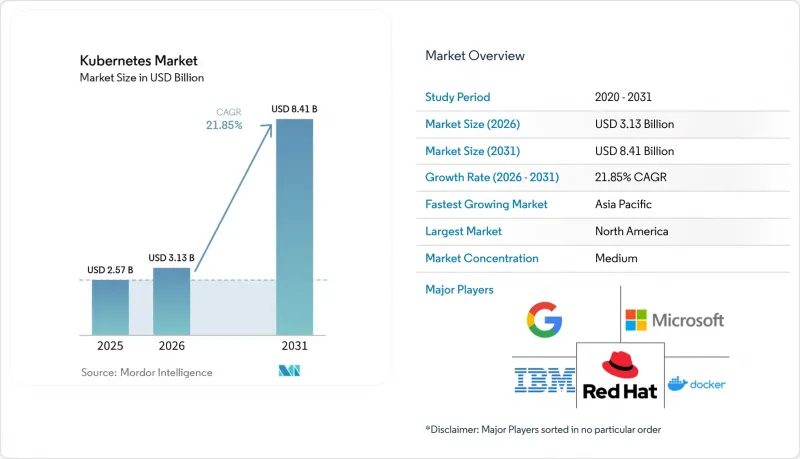
본 보고서는 구성 요소(솔루션 및 서비스), 배포 모델(자체 호스팅형 쿠버네티스 및 관리형 쿠버네티스), 조직 규모(중소기업(SME) 및 대기업), 최종 사용 산업(은행 및 금융 및 보험(BFSI), 의료, 기타) 및 지역별로 분류되어 있습니다. 시장 전망은 금액(달러) 기준으로 제시되어 있습니다.
전 세계 쿠버네티스 시장 동향과 인사이트
마이크로서비스의 부상
기업들은 고도의 오케스트레이션이 필요한, 더 소규모이며 독립적으로 배포 가능한 서비스로 전환하기 위해 모놀리식 시스템을 분해하고 있으며, 쿠버네티스는 그 역할을 탁월하게 수행하고 있습니다. 기업의 80%가 5년 이내에 신규 용도의 대부분을 클라우드 네이티브 스택 기반으로 구축할 계획입니다. 사이드카, 앰배서더, 어댑터와 같은 전용 설계 방식이 주류를 이루며, 모듈성과 유지보수성이 향상되고 있습니다. 이러한 설계 전환이 진행됨에 따라, 쿠버네티스 시장은 릴리스 주기 단축과 비즈니스 민첩성 확보를 위한 전략적 기반이 되어, 업종을 불문하고 플랫폼 엔지니어링의 우선순위를 변화시키고 있습니다.
AI 및 ML 워크로드의 도입 확대
계산 부하가 높은 AI 이니셔티브는 노드 자동 확장, GPU 스케줄링, 서비스 내결함성 등 쿠버네티스의 기능을 통해 이점을 얻고 있습니다. 조사 대상 기업의 절반 이상이 이미 쿠버네티스 클러스터에서 AI/ML 워크로드를 실행하고 있습니다. Kubeflow와 같은 업계 특화 도구가 모델 훈련을 효율화하고 있는 한편, Google, ByteDance, Red Hat의 공동 프로젝트를 통해 대규모 언어 모델 추론 시의 부하 분산과 모델 서버의 성능이 최적화되었습니다. 그 결과, AI 지원 인프라의 적용 범위가 넓어지면서 쿠버네티스 시장도 확대되고 있습니다.
숙련된 인력 부족
IT 리더의 37%가 DevOps 및 DevSecOps 전반에 걸친 기술 격차를 보고하고 있는 것으로 보아, 전문적인 노하우는 여전히 부족한 실정입니다. 학습 곡선이 가파른 탓에 전담 플랫폼 엔지니어링 팀을 구성하는 움직임이 활발해지고 있으며, 자동화에 대한 투자가 촉진되고 있습니다. 또한 기업들은 기존 레거시 가상화 스택에 의존하던 워크로드를 현대화하는 한편, 전문 지식의 격차를 메우기 위해 매니지드 서비스 제공업체에 의존하고 있습니다.
부문별 분석
2025년 쿠버네티스 시장에서 솔루션은 여전히 55.40%를 차지하며 최대 점유율을 유지하고 있습니다. 여기에는 핵심 배포판과 관리용 애드온이 포함됩니다. 한편, 서비스 부문은 기업들이 전환 로드맵, 성능 튜닝, 지속적인 규정 준수 관련 자문을 구함에 따라 연평균 성장률(CAGR) 23.3%로 성장하고 있습니다. 거버넌스 요건이 엄격하고 가동 중단이 허용되지 않는 의료, 금융, 통신과 같은 수직 산업 분야의 이용 사례에 초점을 맞춘 컨설팅 프로젝트가 증가하고 있습니다. 인증 프로그램과 도메인별 프레임워크가 새로운 통합 업체들을 끌어들이면서, 쿠버네티스 서비스 시장은 2031년까지 2배 이상 성장할 것으로 예측됩니다.
이러한 급증은 쿠버네티스의 기능 세트와 운영자의 노하우 사이에서 복잡성이 커지고 있는 점도 반영하고 있습니다. Cloud4C에 따르면, 도입 기업의 59%가 규정 준수를 가장 큰 과제로 인식하고 있으며, 이로 인해 전문적인 감사 및 시정 서비스에 대한 수요가 증가하고 있습니다. 매니지드 쿠버네티스 구독 서비스는 SLA 이행 및 업그레이드 과정을 공급업체에 위임함으로써 활용도를 더욱 높이고 있으며, 이러한 추세는 예측 가능한 비용 범위를 원하는 자원 제약이 있는 팀들로부터 특히 큰 호응을 얻고 있습니다.
관리형 서비스는 각 하이퍼스케일러 기업의 관리형 쿠버네티스 서비스에 힘입어 현재 지출의 62.30%를 차지하며 주류를 이루고 있습니다. 현재 성장은 멀티클라우드 지원 관리형 서비스에 집중되어 있으며, 연평균 성장률(CAGR) 22.4%로 확대될 것으로 전망됩니다. 지연 시간, 주권, 비용 간의 균형을 맞추는 조직은 워크로드를 AWS, Azure, Google Cloud 및 On-Premise 인프라에 분산시키고, 쿠버네티스를 정책 및 배포와 무관한 중립적인 계층으로 활용하고 있습니다. 기업들이 단일 공급업체에 대한 종속성을 피하고 이용률 최적화를 추구함에 따라, 멀티클라우드 배포를 위한 쿠버네티스 시장은 더욱 공고해지고 있습니다.
독자적인 보안 요구 사항이 있거나 메인프레임과의 연동이 필요한 기업들 사이에서는 자체 호스팅형 클러스터의 중요성이 여전히 유지되고 있습니다. 하이브리드 모델은 팀이 중요한 용도를 사내에서 컨테이너화하는 동시에, 피크 시간대의 부하를 퍼블릭 클라우드로 분산시키는 발판 역할을 하고 있습니다. 각 도구 공급업체들은 클라우드 간의 차이를 추상화하는 단일 창 대시보드, GitOps 파이프라인, 정책 엔진을 도입하고 있으며, 이러한 움직임으로 인해 운영상의 오버헤드가 줄어들고 쿠버네티스 시장이 확대되고 있습니다.
지역별 분석
2025년, 북미는 전 세계 매출의 36.40%를 차지했으며, 그 중심에는 전 세계 쿠버네티스 사용자의 절반 이상을 차지하는 미국이 있었습니다. 하이퍼스케일 클라우드의 확산, 조기 도입 기업, 그리고 활발한 개발자 커뮤니티가 이 지역의 리더십을 뒷받침하고 있습니다. 특히 금융 및 소매 업계에서 AI를 활용한 워크로드가 쿠버네티스 도입을 가속화하고 있으며, 업계별 규제(HIPAA, FISMA 등)의 다양성이 보안 자동화 및 정책 게이트웨이에 대한 투자를 촉진하고 있습니다. 이 지역 시장 진출 기업들은 멀티클라우드 청사진을 점점 더 많이 도입하고 있으며, 쿠버네티스는 워크로드의 이식성을 뒷받침하는 보편적인 기반이 되고 있습니다.
아시아태평양은 가장 빠르게 성장하고 있는 지역으로, 2026년부터 2031년까지 연평균 성장률(CAGR) 22.6%를 나타낼 것으로 전망됩니다. 중국, 인도, 일본에서의 디지털화 진전, 5G 인프라 구축, 클라우드 데이터센터의 확장이 수요를 견인하고 있습니다. CAST AI의 인도 진출은 이 지역 내 서비스 제공업체들의 성장세를 상징하는 사례입니다. 알리바바 클라우드 등 국내 주요 기업들은 현지 규정 준수 요건을 충족하는 맞춤형 쿠버네티스 스택을 추진하고 있으며, 이러한 추세를 이어가고 있습니다. 제조업 분야의 활용 사례(스마트 팩토리, 공급망 원격 측정 등) 역시 쿠버네티스 시장의 확대에 더욱 기여하고 있습니다.
유럽은 GDPR(EU 개인정보보호규정)에 중점을 둔 보안 투자와 뿌리 깊은 오픈소스 문화에 힘입어 시장에서 상당한 점유율을 차지하고 있습니다. 독일, 영국, 프랑스의 기업들은 주권과 민첩성 간의 균형을 맞추기 위해 하이브리드 아키텍처를 중시하고 있습니다. 은행 및 통신 부문에서의 쿠버네티스 도입은 핵심 시스템의 현대화를 뒷받침하고 있습니다. Cloud Native Computing Foundation(CNCF)의 미트업 및 코드 이벤트를 포함한 커뮤니티의 협업은 탄탄한 기여자 기반을 조성하고, 기업의 신뢰를 빠르게 높여가고 있습니다. 중동 및 아프리카 및 남미의 신흥 거점에서는 규모는 작지만, 해당 지역에 최적화된 클라우드 가용성 영역이 가동되기 시작함에 따라 꾸준한 확산세가 나타나고 있으며, 이는 전 세계 쿠버네티스 시장의 입지를 더욱 넓혀가고 있습니다.
기타 혜택:
- 엑셀 형식 시장 예측(ME) 시트
- 3개월간의 애널리스트 지원
자주 묻는 질문
목차
제1장 서론
제2장 조사 방법
제3장 주요 요약
제4장 시장 구도
제5장 시장 규모와 성장 예측
제6장 경쟁 구도
제7장 시장 기회와 향후 전망
JHS 26.06.29According to Mordor Intelligence, the kubernetes market size is expected to grow from USD 2.57 billion in 2025 to USD 3.13 billion in 2026 and is forecast to reach USD 8.41 billion by 2031 at 21.85% CAGR over 2026-2031.
This report is Segmented by Component (Solutions and Services), Deployment Model (Self-Hosted Kubernetes and Managed Kubernetes), Organization Size (Small and Medium-Sized Enterprises (SMEs) and Large Enterprises), End User Vertical (Banking, Financial Services, and Insurance (BFSI), Healthcare, and More), and Geography. The Market Forecasts are Provided in Terms of Value (USD).
Global Kubernetes Market Trends and Insights
Advent of Microservices
Organizations are dismantling monoliths in favor of smaller, independently deployable services that demand sophisticated orchestration, and Kubernetes excels at that role. Eighty percent of enterprises plan to build most new applications on cloud-native stacks within five years. Purpose-built design patterns such as sidecar, ambassador, and adapter are mainstream, improving modularity and maintainability. As this design shift continues, the Kubernetes market becomes a strategic backbone for faster release cycles and business agility, transforming platform-engineering priorities across industries.
Increased Adoption of AI and ML Workloads
Compute-intensive AI initiatives benefit from Kubernetes functions such as node autoscaling, GPU scheduling, and service resilience. More than half of surveyed enterprises already run AI/ML workloads in Kubernetes clusters. Sector-specific tools like Kubeflow streamline model training, while a Google, ByteDance, Red Hat collaboration has optimized load balancing and model-server performance for large-language-model inference. The result is a wider addressable base for AI-ready infrastructure and an expanding Kubernetes market.
Lack of Skilled Talent Pool
Specialized know-how remains scarce as 37% of IT leaders report a skills gap across DevOps and DevSecOps. The steep learning curve fuels the rise of dedicated platform-engineering teams and encourages investment in automation. Enterprises also lean on managed service providers to bridge expertise gaps while modernizing workloads previously tied to legacy virtualization stacks.
Other drivers and restraints analyzed in the detailed report include:
- Growing Demand for Managed Kubernetes Services
- Expansion of Hybrid and Multi-Cloud Strategies
- Security and Compliance Complexities
For complete list of drivers and restraints, kindly check the Table Of Contents.
Segment Analysis
Solutions still form the largest slice at 55.40% of the Kubernetes market in 2025, covering core distributions and management add-ons. The Services arm, however, is advancing at a 23.3% CAGR as enterprises seek migration blueprints, performance tuning, and continuous compliance advice. A rising number of consulting engagements focus on vertical use-cases-healthcare, finance, telecommunications - where governance requirements are strict and downtime is intolerable. The Kubernetes market for services is expected to more than double by 2031 as certification programs and domain-specific frameworks attract new integrators.
The surge also reflects widening complexity between Kubernetes feature sets and operator know-how. Cloud4C notes that 59% of adopters deem compliance their chief pain point, creating a pull for specialized audit and remediation services. Managed Kubernetes subscriptions further accelerate consumption by shifting SLA enforcement and upgrade chains to vendors, a pattern especially resonant with resource-constrained teams wanting predictable cost envelopes.
Managed offerings dominate with 62.30% of current spend, underpinned by the hyperscalers' managed Kubernetes services. Growth now clusters around multi-cloud managed variants, projected to climb at 22.4% CAGR. Organizations balancing latency, sovereignty, and spending spread workloads across AWS, Azure, Google Cloud, and on-premises assets, turning Kubernetes into the neutrality layer for policy and placement. Kubernetes market for multi-cloud deployments is reinforced as enterprises insist on avoiding single-provider lock-in and pursue optimized utilization.
Self-hosted clusters retain relevance among firms with bespoke security mandates or mainframe adjacency. Hybrid models serve as stepping-stones, letting teams containerize critical applications internally while bursting peaks to public clouds. Tool vendors are rolling out single-pane dashboards, GitOps pipelines, and policy engines that abstract differences among clouds, a move that compresses operational overhead and widens the Kubernetes market.
Geography Analysis
North America secured 36.40% of global revenue in 2025, anchored by the United States, which accounts for more than half of Kubernetes users worldwide. Hyperscale cloud footprints, early-mover enterprises, and deep developer communities sustain regional leadership. AI-infused workloads, especially in finance and retail, intensify Kubernetes adoption, and a patchwork of sectoral regulations (HIPAA, FISMA) spurs investment in security automation and policy gateways. Market participants here increasingly deploy multi-cloud blueprints, making Kubernetes the universal substrate for workload portability.
Asia-Pacific is the fastest-growing region with a 22.6% CAGR forecast for 2026-2031. Widespread digitization, 5G buildouts, and cloud data-center expansion in China, India, and Japan ignite demand. CAST AI's move into India exemplifies provider momentum in the region. Domestic giants such as Alibaba Cloud promote tailored Kubernetes stacks that satisfy local compliance, sustaining momentum. Manufacturing use-cases-smart factories, supply-chain telemetry-further contribute to the Kubernetes market expansion.
Europe commands a substantial slice, buoyed by GDPR-focused security spending and strong open-source culture. Enterprises in Germany, the United Kingdom, and France emphasize hybrid architectures to balance sovereignty and agility. Kubernetes adoption inside the banking and telco segments supports core system modernization. Community collaboration, including Cloud Native Computing Foundation (CNCF) meetups and code events, nurtures a robust contributor base that accelerates enterprise trust. Emerging hubs in the Middle East and Africa and South America, while smaller, display steady uptake as localized cloud availability zones come online, further widening the global Kubernetes market footprint.
- Google LLC
- Microsoft Corporation
- Amazon Web Services, Inc.
- Red Hat, Inc. (IBM)
- IBM Corporation
- VMware, Inc.
- Oracle Corporation
- SUSE (Rancher Labs)
- Cisco Systems, Inc.
- Alibaba Cloud
- Tencent Cloud
- Huawei Technologies Co., Ltd.
- DigitalOcean, LLC
- Mirantis, Inc.
- Platform9 Systems, Inc.
- Fairwinds
- Nutanix, Inc.
- Docker, Inc.
- Canonical Ltd.
- Ionos SE
- KubeSphere (QingCloud)
- Spectro Cloud
- Weaveworks
- HashiCorp
- Portainer.io
Additional Benefits:
- The market estimate (ME) sheet in Excel format
- 3 months of analyst support
TABLE OF CONTENTS
1 INTRODUCTION
- 1.1 Study Assumptions and Market Definition
- 1.2 Scope of the Study
2 RESEARCH METHODOLOGY
3 EXECUTIVE SUMMARY
4 MARKET LANDSCAPE
- 4.1 Market Overview
- 4.2 Market Drivers
- 4.2.1 Advent of Microservices
- 4.2.2 Increased Adoption of AI and ML Workloads
- 4.2.3 Growing Demand for Managed Kubernetes Services
- 4.2.4 Expansion of Hybrid and Multi-Cloud Strategies
- 4.2.5 Edge-Computing Adoption with Lightweight K8s Distros
- 4.2.6 Kubernetes-native FinOps Automation Reducing TCO
- 4.3 Market Restraints
- 4.3.1 Lack of Skilled Talent Pool
- 4.3.2 Security and Compliance Complexities
- 4.3.3 Control-Plane Cost Escalation under Autoscaling
- 4.3.4 Hyperscaler Dominance Limits OSS Monetisation
- 4.4 Key Regulatory Landscape
- 4.4.1 North America
- 4.4.1.1 HIPAA
- 4.4.1.2 FISMA
- 4.4.1.3 CIS Kubernetes Benchmark
- 4.4.1.4 PIPEDA
- 4.4.2 Europe
- 4.4.2.1 GDPR
- 4.4.3 Asia-Pacific
- 4.4.3.1 China Cybersecurity Law
- 4.4.3.2 India DPDP Act
- 4.4.3.3 CERT-In Guidelines
- 4.4.3.4 IRAP (Australia)
- 4.4.4 South America
- 4.4.4.1 LGPD - Brazil
- 4.4.4.2 Mexico Federal DP Law
- 4.4.5 Middle East and Africa
- 4.4.5.1 UAE DP Law
- 4.4.5.2 Dubai ESC Guidelines
- 4.4.5.3 Saudi CCRF
- 4.4.1 North America
- 4.5 Industry Ecosystem Analysis
- 4.6 Impact of Macro-Economic Factors
- 4.7 Assessment of Key Use Cases
- 4.7.1 Large-Scale Application Deployment
- 4.7.2 High-Performance Computing
- 4.7.3 AI and ML Workloads
- 4.7.4 Hybrid and Multi-Cloud Deployments
- 4.7.5 Other Emerging Use Cases
- 4.8 Market Player Case Studies
- 4.8.1 Huawei - Internal IT Orchestration
- 4.8.2 PayPal - Container Management for Speed
- 4.8.3 Additional Case Studies
- 4.9 Value / Supply-Chain Analysis
- 4.10 Technological Outlook
- 4.11 Porter's Five Forces
- 4.11.1 Threat of New Entrants
- 4.11.2 Bargaining Power of Suppliers
- 4.11.3 Bargaining Power of Buyers
- 4.11.4 Threat of Substitutes
- 4.11.5 Competitive Rivalry
5 MARKET SIZE AND GROWTH FORECASTS (VALUES)
- 5.1 By Component
- 5.1.1 Solutions
- 5.1.2 Services
- 5.1.2.1 Managed Services
- 5.1.2.2 Consulting and Support Services
- 5.2 By Deployment Model
- 5.2.1 Self-Hosted Kubernetes
- 5.2.1.1 On-Premise
- 5.2.1.2 Hybrid
- 5.2.2 Managed Kubernetes
- 5.2.2.1 Cloud-based Managed
- 5.2.2.2 Multi-Cloud Managed
- 5.2.1 Self-Hosted Kubernetes
- 5.3 By Organization Size
- 5.3.1 Small and Medium-Sized Enterprises (SMEs)
- 5.3.2 Large Enterprises
- 5.4 By End-User Vertical
- 5.4.1 Banking, Financial Services, and Insurance (BFSI)
- 5.4.2 Healthcare
- 5.4.3 Media and Entertainment
- 5.4.4 Information Technology (IT) and Telecom
- 5.4.5 Manufacturing
- 5.4.6 Retail
- 5.4.7 Government and Public Sector
- 5.4.8 Other Verticals
- 5.5 By Geography
- 5.5.1 North America
- 5.5.1.1 United States
- 5.5.1.2 Canada
- 5.5.1.3 Mexico
- 5.5.2 Europe
- 5.5.2.1 Germany
- 5.5.2.2 United Kingdom
- 5.5.2.3 France
- 5.5.2.4 Italy
- 5.5.2.5 Spain
- 5.5.2.6 Russia
- 5.5.2.7 Rest of Europe
- 5.5.3 Asia-Pacific
- 5.5.3.1 China
- 5.5.3.2 Japan
- 5.5.3.3 India
- 5.5.3.4 South Korea
- 5.5.3.5 Australia and New Zealand
- 5.5.3.6 Southeast Asia
- 5.5.3.7 Rest of Asia-Pacific
- 5.5.4 South America
- 5.5.4.1 Brazil
- 5.5.4.2 Argentina
- 5.5.4.3 Rest of South America
- 5.5.5 Middle East and Africa
- 5.5.5.1 Middle East
- 5.5.5.1.1 Saudi Arabia
- 5.5.5.1.2 United Arab Emirates
- 5.5.5.1.3 Turkey
- 5.5.5.1.4 Rest of Middle East
- 5.5.5.2 Africa
- 5.5.5.2.1 South Africa
- 5.5.5.2.2 Rest of Africa
- 5.5.5.1 Middle East
- 5.5.1 North America
6 COMPETITIVE LANDSCAPE
- 6.1 Market Concentration
- 6.2 Strategic Moves
- 6.3 Market Share Analysis
- 6.4 Company Profiles (includes Global level Overview, Market level overview, Core Segments, Financials as available, Strategic Information, Market Rank/Share, Products and Services, Recent Developments)
- 6.4.1 Google LLC
- 6.4.2 Microsoft Corporation
- 6.4.3 Amazon Web Services, Inc.
- 6.4.4 Red Hat, Inc. (IBM)
- 6.4.5 IBM Corporation
- 6.4.6 VMware, Inc.
- 6.4.7 Oracle Corporation
- 6.4.8 SUSE (Rancher Labs)
- 6.4.9 Cisco Systems, Inc.
- 6.4.10 Alibaba Cloud
- 6.4.11 Tencent Cloud
- 6.4.12 Huawei Technologies Co., Ltd.
- 6.4.13 DigitalOcean, LLC
- 6.4.14 Mirantis, Inc.
- 6.4.15 Platform9 Systems, Inc.
- 6.4.16 Fairwinds
- 6.4.17 Nutanix, Inc.
- 6.4.18 Docker, Inc.
- 6.4.19 Canonical Ltd.
- 6.4.20 Ionos SE
- 6.4.21 KubeSphere (QingCloud)
- 6.4.22 Spectro Cloud
- 6.4.23 Weaveworks
- 6.4.24 HashiCorp
- 6.4.25 Portainer.io
7 MARKET OPPORTUNITIES AND FUTURE OUTLOOK
- 7.1 White-space and Unmet Need Analysis


