

|
시장보고서
상품코드
2066480
eClinical 솔루션 : 시장 점유율 분석, 업계 동향 및 통계, 성장 예측(2026-2031년)EClinical Solutions - Market Share Analysis, Industry Trends & Statistics, Growth Forecasts (2026 - 2031) |
||||||
 Mordor Intelligence
Mordor Intelligence에 의하면, eClinical 솔루션 시장 규모는 2025년 123억 9,000만 달러로 평가되었습니다. 2026년에는 139억 달러로 확대되어 2026년부터 2031년에 걸쳐 CAGR 12.18%로 성장을 지속하여, 2031년에는 246억 9,000만 달러에 이를 것으로 예측됩니다.
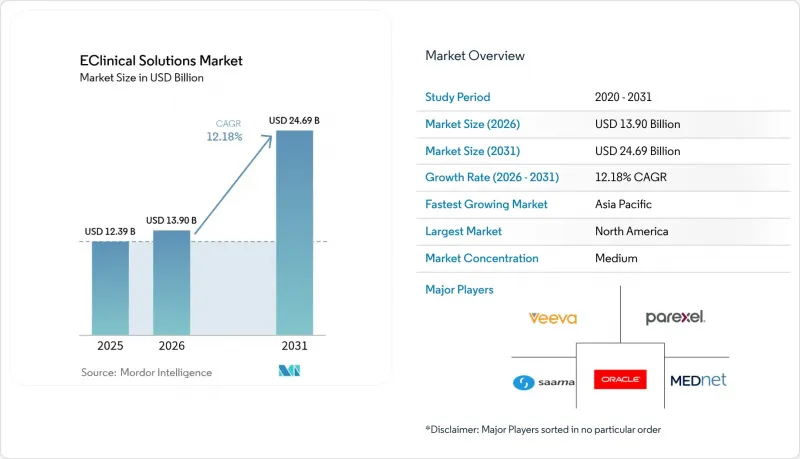
본 보고서에서는 해당 업계를 제품별(전자 임상 결과 평가 등), 제공 형태별(클라우드 기반 등), 임상시험 단계별(1상, 3상 등), 최종 사용자별(제약·바이오기술 기업 등) 및 지역별로 분류하고 있습니다. 시장 규모 및 전망은 금액(달러)으로 표시되어 있습니다.
세계의 eClinical 솔루션 시장 동향 및 인사이트
의료 업계에서 축적되는 방대한 데이터
임상시험 데이터의 양이 급격히 증가하고 있으며, 이에 따라 의뢰사들은 자동화된 품질 검사, 자연어 처리, 예측 분석을 핵심 EDC 플랫폼에 직접 통합하고 있습니다. IQVIA의 보고서에 따르면, 비정형 데이터 소스에 대한 AI 기반 검토를 통해 감사 대응 체제를 유지하면서 데이터 정제 주기를 절반으로 단축할 수 있게 되었습니다. 그 결과, 데이터 사이언스 팀은 단순히 ‘첫 번째 환자 등록(First Patient In)’ 이후뿐만 아니라 프로토콜 수립 단계부터 참여하게 되어, 후속 단계에서의 상호 운용성이 확보되었습니다. 그 결과, 탄력적인 용량이 하드웨어 구매 주기를 초과함에 따라 클라우드 스토리지 예산이 On-Premise 지출을 넘어서는 추세입니다. 암 분야 연구가 그 청사진이 되고 있습니다. 한때는 틈새 시장용이었던 그 분석 프레임워크는 현재 염증성 질환 및 대사성 질환의 파이프라인에도 적용되고 있습니다. 피험자 1인당 데이터 양이 증가함에 따라, eClinical 솔루션 시장은 치료 분야에 관계없이 꾸준한 성장세를 보이고 있습니다.
eClinical 솔루션 도입 확대
스폰서는 시험 1건당 일반적으로 3개 이상의 독립적인 eClinical 용도를 병행하여 운영하고 있지만, 로그인 분산과 데이터 흐름의 비동기화가 명백한 병목 현상으로 대두되고 있습니다. Veeva의 2025년 로드맵은 임상시험 시작, 모니터링, 신청 등 각 워크플로를 통합하는 싱글 사인온 환경에 대한 수요가 증가하고 있음을 보여줍니다. 조기 도입 기업들로부터는 모듈 간 중복 데이터 입력이 사라지고 검증 비용도 절감됨에 따라 프로토콜 확정 주기가 대폭 단축되었다는 보고가 접수되고 있습니다. 통합형 제품군은 현재 베스트 오브 브리드 방식의 구매보다 더 뛰어난 성과를 내고 있으며, 거버넌스 팀은 인력을 수동 조회 업무에서 고급 통계 프로그래밍 업무로 전환할 수 있게 되었습니다. 그 결과, 수년에 걸친 플랫폼 계약이 증가하고 있으며, eClinical 솔루션 시장에서 일회성 라이선스 비용이 예측 가능한 SaaS 수익으로 전환되고 있습니다.
높은 도입 비용
종합적인 플랫폼을 도입하려면 검증, 통합 및 다수의 사용자에 대한 교육을 고려할 때, 종종 7자리 규모의 예산이 필요합니다. Merative의 벤치마크에 따르면, 자금 사정이 어려운 스폰서들은 핵심 시스템인 EDC부터 도입을 시작한 뒤, RTSM 및 eTMF를 추가하는 단계적 도입 방식을 채택하고 있습니다. 이러한 단계적 접근 방식은 초기 비용을 절감해 주지만, 프로젝트 기간을 연장시키고 풀 스위트가 가져다주는 생산성 향상을 지연시킵니다. 따라서 유연한 종량제 가격 정책을 제공하는 공급업체는 그렇지 않았다면 디지털화를 미뤘을지도 모르는 고객들을 확보하고 있습니다. 그렇긴 하지만, 높은 도입 비용은 여전히 소규모 생명공학 기업이나 학술 기관의 후원자들에게 부담이 되고 있으며, 자원이 제한된 환경에서 eClinical 솔루션 시장의 성장을 저해하고 있습니다.
부문별 분석
2025년, 전자 데이터 수집(EDC) 및 임상 데이터 관리(CDM) 시스템은 eClinical 솔루션 시장에서 가장 큰 점유율을 차지했으며, 임상시험 시작 시점에 보편적으로 도입된 것을 배경으로 총 매출의 32.62%를 차지했습니다. 스폰서들은 시스템의 익숙한 사용 편의성과 중간 분석 전에 이상을 감지하는 통합된 위험 기반 모니터링 대시보드를 중요하게 여기고 있기 때문에 라이선스 갱신률은 여전히 높은 수준을 유지하고 있습니다. 현재 시장에서는 기본적인 데이터 입력보다 내장형 예측 쿼리가 더 중요시되고 있으며, 프리미엄 가격 책정이 가능한 AI를 활용한 업그레이드로의 전환이 진행되고 있습니다. EDC를 RTSM(위험 기반 모니터링) 및 안전 모듈과 사전에 통합한 공급업체는 전환 비용을 더욱 높여 주도적인 입지를 공고히 하고 있습니다.
전자 임상 결과 평가 플랫폼은 가장 빠르게 성장하고 있는 하위 부문으로, 환자 중심주의가 단순한 슬로건에서 필수 요건으로 자리 잡아가면서 2031년까지 연평균 성장률(CAGR) 14.79%를 나타낼 것으로 전망됩니다. Medable의 툴 빌더를 사용하면 드래그 앤 드롭 조작만으로 심리 측정 도구 및 QOL(삶의 질) 평가 도구를 생성할 수 있으며, 수동 매핑 과정 없이 EDC 테이블에 직접 가져올 수 있습니다. 각 후원사는 이러한 원활한 인계를 높이 평가했습니다. 이를 통해 대조 주기가 몇 주 단축되고, 대시보드에서 실시간으로 확인할 수 있게 되기 때문입니다. 분산형 임상시험이 보편화됨에 따라, eCOA 기능은 플랫폼 선정의 결정적 요인이 되는 경우가 많으며, 이는 eClinical 솔루션 시장에서 풀 스위트를 제공하는 벤더의 매출 증가를 뒷받침하고 있습니다.
2025년에는 제공 형태별로 볼 때, 클라우드 기반 솔루션이 eClinical 솔루션 시장에서 가장 큰 점유율(48.05%)을 차지했으며, 2031년까지 연평균 성장률(CAGR) 14.21%를 나타낼 것으로 전망됩니다. 멀티테넌트형 SaaS 모델은 즉각적인 확장성, 자동 버전 업그레이드, 그리고 규제 당국이 On-Premise형 관리 체계와 동등하다고 간주하는 경향이 점점 더 강해지고 있는 감사 로그를 제공합니다. 자사 소유 하드웨어에서 전환한 후원 기업들은 유지보수 시간이 두 자릿수만큼 단축되었다고 보고하고 있으며, 이를 통해 IT 팀은 분석 업무에 집중할 수 있게 되었습니다. 진입 비용이 낮다는 점도 중소규모의 생명공학 분야 후원 기업들이 임상시험의 주요 단계에 맞추어 현금 소진을 관리하는 데 도움이 되며, 클라우드의 보급을 촉진하고 있습니다.
웹 호스팅 방식의 단일 테넌트 환경은 30% 중반대의 점유율을 꾸준히 유지하고 있으며, 멀티 테넌트 아키텍처로의 즉각적인 전환을 주저하는 조직에게 과도기적인 선택지가 되고 있습니다. 이러한 환경은 인프라 소유 책임을 외부에 위임하면서도, 위험 회피 성향이 강한 품질 관리 부서가 선호하는 ‘격리성’을 제공합니다. 그러나 테넌트 수준의 암호화 및 전용 키 관리 분야의 최근 발전으로 인해, 웹 호스팅형과 SaaS 간의 보안 격차는 줄어들고 있습니다. 예측 기간 동안 멀티테넌트형 서비스로의 전환이 진행될 가능성이 있지만, 보수적인 후원사들은 eClinical 솔루션 시장에서 웹 호스팅형 벤더를 뒷받침하는 틈새 시장을 계속 유지할 것입니다.
지역별 분석
북미는 2025년에도 eClinical 솔루션 시장에서 최대 규모를 유지했으며, 풍부한 자금력, 디지털 서명에 대한 규제 당국의 조기 승인, 그리고 경험이 풍부한 임상시험 기관이 밀집해 있는 점 덕분에 전 세계 매출의 48.62%를 차지했습니다. 벤더들은 현지 데이터 거버넌스 기준이 신속한 반복 개발을 뒷받침하고 있기 때문에 새로운 AI 모듈을 주로 미국과 캐나다에서 먼저 출시하는 경우가 많습니다. 시장이 성숙기에 접어들었음에도 불구하고, 고객사들이 기존의 On-Premise 방식 도입에서 SaaS로 전환하고, 감사 대응을 신속하게 처리할 수 있는 고도화된 분석을 추구하고 있기 때문에 계약 갱신율은 두 자릿수 성장세를 유지하고 있습니다.
아시아태평양은 가장 빠른 성장세를 보이고 있으며, 전 세계의 후원사들이 대규모 환자 풀과 비용 효율적인 임상시험 시설 네트워크에 대한 접근성을 확보하기 위해 피험자 모집을 동아시아로 전환함에 따라, 2031년까지 연평균 성장률(CAGR) 14.46%를 나타낼 것으로 전망됩니다. 중국, 한국, 인도의 정부는 자국의 바이오의약품 기업을 적극적으로 지원하고 있으며, 도입 장벽을 낮추기 위해 클라우드 인프라에 대한 보조금을 제공합니다. 지역 공급업체들은 인터페이스를 현지 언어 및 개인정보 보호 규정에 맞추어 미세 조정하고 있으며, 이로 인해 서유럽 기존 기업들에 대한 경쟁 압력이 강화되고, eClinical 솔루션 시장공급업체 기반이 다양화되고 있습니다.
유럽은 전 세계 매출의 약 4분의 1을 차지하고 있으며, 다자간 신청을 효율화하는 EU 임상시험 규정에 따른 규제 조화의 혜택을 누리고 있습니다. 이 지역의 엄격한 데이터 개인정보 보호 규정은 향후 전 세계적으로 확대될 보안 기능의 실증 무대로 기능하고 있습니다. 독일, 북유럽 국가들, 네덜란드에서는 전자 환자 일지 및 전자 동의서의 도입이 확대되고 있으며, 이는 환자 대상 기술에 대한 문화적 수용성을 보여주고 있습니다. 규제 당국의 엄격한 감독으로 인해 판매 주기는 길어지지만, 스폰서가 플랫폼 제공 범위에 규정 준수 노력을 반영함에 따라 장기 계약의 가치는 높아집니다.
기타 혜택 :
- 엑셀 형식 시장 예측(ME) 시트
- 3개월간의 애널리스트 지원
자주 묻는 질문
목차
제1장 서론
제2장 조사 방법
제3장 주요 요약
제4장 시장 구도
제5장 시장 규모 및 성장 예측
제6장 경쟁 구도
제7장 시장 기회 및 향후 전망
KTH 26.06.29According to Mordor Intelligence, the eClinical solutions market size is expected to grow from USD 12.39 billion in 2025 to USD 13.9 billion in 2026 and is forecast to reach USD 24.69 billion by 2031 at 12.18% CAGR over 2026-2031.
This report Segments the Industry by Product (Electronic Clinical Outcome Assessment, and More), by Delivery Mode (Cloud-Based, and More), Clinical Trial Phase (Phase I, Phase III, and More), by End User (Pharmaceutical and Biotechnology Companies, and More), and Geography. The Market Sizes and Forecasts are Provided in Terms of Value (USD).
Global EClinical Solutions Market Trends and Insights
Enormous Data Mounting from Healthcare Industry
The volume of trial data has climbed steeply, prompting sponsors to embed automated quality checks, natural-language processing, and predictive analytics directly inside core EDC platforms. IQVIA reports that AI-driven review of unstructured sources halves data-cleaning cycles while preserving audit readiness. In turn, data-science teams are now engaged during protocol build, not merely after first-patient-in, ensuring downstream interoperability. Cloud storage budgets therefore outpace on-premise outlays as elastic capacity overtakes hardware purchase cycles. Oncology studies provide the blueprint: once niche, their analytics frameworks now replicate across inflammatory and metabolic pipelines. As data per subject multiplies, the eClinical solutions market gains a stable tailwind that is independent of therapeutic area focus.
Growing Incorporation of Software Solutions in Clinical Trial
Sponsors routinely juggle three or more discrete eClinical applications per study, yet fragmented log-ins and unsynchronized data flows have become a clear bottleneck. Veeva's 2025 roadmap showcases rising demand for single sign-on environments that merge start-up, monitoring, and submission workflows . Early adopters report materially shorter protocol-finalization cycles because duplicate data entry disappears between modules, reducing validation cost as well. Consolidated suites now outperform best-of-breed purchasing, allowing governance teams to shift head-count from manual queries to advanced statistical programming. The observable outcome is a rise in multiyear platform contracts, which converts sporadic license spend into predictable SaaS revenue inside the eClinical solutions market.
High Implementation Costs
Comprehensive platform roll-outs frequently require budgets well into seven figures once validation, integration, and multi-user training are considered. Merative benchmarks show that sponsors with tight treasury adopt phased deployment, starting with a core EDC and layering RTSM or eTMF later. While the staged path trims initial outlay, it extends project timelines, delaying productivity gains that full suites deliver. Vendors offering flexible, consumption-based pricing therefore capture accounts that might otherwise postpone digitization. Nevertheless, high entry costs still weigh on smaller biotech and academic sponsors, tempering eClinical solutions market growth in resource-constrained settings.
Other drivers and restraints analyzed in the detailed report include:
- Growing Biopharma R&D Investment
- Rapid Shift Toward Patient-Centric and Decentralized Models
- Shortage of Certified Clinical Data Managers in Emerging Markets
- Escalating Cyber-security & Patient-Data Breach Concerns
For complete list of drivers and restraints, kindly check the Table Of Contents.
Segment Analysis
Electronic data capture and clinical data management systems controlled the largest eClinical solutions market size in 2025, contributing 32.62% of total revenue on the strength of universal deployment at study start-up. License renewals remain high because sponsors prize system familiarity and integrated risk-based monitoring dashboards that flag anomalies before interim analysis. The market now values embedded predictive queries more than basic data entry, creating a shift toward AI-infused upgrades that command premium pricing. Vendors that pre-integrate EDC with RTSM and safety modules further raise switching costs, cementing leadership positions.
Electronic clinical outcome assessment platforms represent the fastest expanding subsegment, expected with 14.79% CAGR through 2031 as patient centricity moves from rhetoric to requirement. Medable's instrument builder allows drag-and-drop creation of psychometric and quality-of-life tools that feed directly into EDC tables without manual mapping. Sponsors appreciate the seamless handoff because it cuts reconciliation cycles by weeks and supports real-time dashboard review. As decentralized trials proliferate, eCOA functionality often decides overall platform selection, nudging incremental revenues toward full-suite vendors inside the eClinical solutions market.
Cloud-based deployments captured the largest eClinical solutions market share by delivery mode in 2025 at 48.05% and are projected to post a 14.21% CAGR to 2031. Multi-tenant SaaS models offer immediate scalability, automatic version upgrades, and audit logs that regulators increasingly deem equivalent to on-premise controls. Sponsors migrating from owned hardware document double-digit reductions in maintenance hours, freeing IT teams for analytics work. Lower entry cost also helps smaller biotech sponsors keep cash burn aligned with trial milestones, reinforcing cloud traction.
Web-hosted, single-tenant environments maintain a resilient mid-thirty-percent share, acting as a transitional option for organizations reluctant to jump straight to multi-tenant architecture. These environments still offload infrastructure ownership yet provide perceived isolation that risk-averse quality groups favor. Recent advances in tenant-level encryption and dedicated-key management, however, narrow the security gap between web-hosted and SaaS. Over the forecast horizon, some displacement toward multi-tenant offerings is likely, but conservative sponsors will preserve a viable niche that sustains web-hosted vendors within the eClinical solutions market.
Geography Analysis
North America retained the largest eClinical solutions market size in 2025, contributing 48.62% of global revenue due to deep capital pools, early regulatory acceptance of digital signatures, and dense clusters of experienced investigative sites. Vendors often launch new AI modules first in the United States and Canada because local data-governance norms support rapid iteration. Despite market maturity, double-digit renewal growth persists as sponsors migrate legacy on-premise deployments to SaaS and pursue advanced analytics that speed inspection readiness.
Asia-Pacific represents the fastest growth trajectory, set to register a 14.46% CAGR through 2031 as global sponsors shift recruitment eastward to access large patient pools and cost-efficient site networks. Governments in China, South Korea, and India actively champion domestic biopharma, funding cloud infrastructure grants that reduce implementation hurdles. Regional vendors fine-tune interfaces to local languages and privacy statutes, increasing competitive pressure on Western incumbents and diversifying the supplier base inside the eClinical solutions market.
Europe commands roughly one-quarter of worldwide revenue and benefits from harmonization under the EU Clinical Trials Regulation, which streamlines multi-country submissions. The region's stringent data-privacy rules function as a proving ground for security features that later roll out globally. Germany, the Nordics, and the Netherlands exhibit rising adoption of electronic patient diaries and eConsent, signaling cultural receptivity to patient-facing technology. High regulatory oversight lengthens sales cycles yet boosts long-term contract values because sponsors embed compliance commitments within platform scopes.
- Oracle
- Dassault Systemes (Medidata Solutions)
- Veeva Systems
- Clario (BioClinica)
- IQVIA
- Parexel International
- Covance (Labcorp Drug Development)
- Signant Health
- eClinical Solutions
- Saama Technologies
- Datatrak International
- Medrio
- Castor EDC
- Mednet Solutions
- Aris Global
- Anju Software Inc.
- MasterControl, Inc.
- OpenClinica, LLC
- ClinCapture, Inc.
- Medable
- TransPerfect Life Sciences -
Additional Benefits:
- The market estimate (ME) sheet in Excel format
- 3 months of analyst support
TABLE OF CONTENTS
1 Introduction
- 1.1 Study Assumptions & Market Definition
- 1.2 Scope of the Study
2 Research Methodology
3 Executive Summary
4 Market Landscape
- 4.1 Market Overview
- 4.2 Market Drivers
- 4.2.1 Enormous Data Mounting from Healthcare Industry
- 4.2.2 Surge in Phase II/III Oncology Trials in APAC Requiring Scalable Cloud Platforms
- 4.2.3 Growing Incorporation of Software Solutions in Clinical Trial
- 4.2.4 Growing Biopharma R&D Investment
- 4.2.5 Rapid Shift Towards Patient-Centric and Decentralized Models
- 4.2.6 Expansion of Global Clinical Trial Activities
- 4.3 Market Restraints
- 4.3.1 High Implementation Costs
- 4.3.2 Data Interoperability Gaps Between Legacy & Modern eClinical Modules
- 4.3.3 Shortage of Certified Clinical Data Managers in Emerging Markets
- 4.3.4 Escalating Cyber-security & Patient-Data Breach Concerns
- 4.4 Value-Chain Analysis
- 4.5 Regulatory & Technological Outlook
- 4.6 Porter's Five Forces Analysis
- 4.6.1 Threat of New Entrants
- 4.6.2 Bargaining Power of Buyers/Consumers
- 4.6.3 Bargaining Power of Suppliers
- 4.6.4 Threat of Substitute Products
- 4.6.5 Intensity of Competitive Rivalry
5 Market Size & Growth Forecasts (Value)
- 5.1 By Product
- 5.1.1 Electronic Data Capture (EDC) & Clinical Data Management Systems (CDMS)
- 5.1.2 Clinical Trial Management Systems (CTMS)
- 5.1.3 Randomization & Trial Supply Management (IRT/RTSM)
- 5.1.4 Electronic Clinical Outcome Assessment (eCOA/ePRO)
- 5.1.5 Clinical Analytics & Data-Integration Platforms
- 5.1.6 Safety & Pharmacovigilance Solutions
- 5.1.7 Electronic Trial Master File (eTMF)
- 5.1.8 Other Products
- 5.2 By Delivery Mode
- 5.2.1 Cloud-based (SaaS)
- 5.2.2 Web-hosted (On-Demand)
- 5.2.3 On-premise
- 5.3 By Clinical Trial Phase
- 5.3.1 Phase I
- 5.3.2 Phase II
- 5.3.3 Phase III
- 5.3.4 Phase IV
- 5.4 By End-user
- 5.4.1 Pharmaceutical & Biotechnology Companies
- 5.4.2 Contract Research Organizations (CROs)
- 5.4.3 Medical Device Manufacturers
- 5.4.4 Academic & Research Institutions
- 5.4.5 Other End-users
- 5.5 By Geography
- 5.5.1 North America
- 5.5.1.1 United States
- 5.5.1.2 Canada
- 5.5.1.3 Mexico
- 5.5.2 Europe
- 5.5.2.1 Germany
- 5.5.2.2 United Kingdom
- 5.5.2.3 France
- 5.5.2.4 Italy
- 5.5.2.5 Spain
- 5.5.2.6 Rest of Europe
- 5.5.3 Asia-Pacific
- 5.5.3.1 China
- 5.5.3.2 Japan
- 5.5.3.3 India
- 5.5.3.4 South Korea
- 5.5.3.5 Australia
- 5.5.3.6 Rest of Asia-Pacific
- 5.5.4 Middle East
- 5.5.4.1 GCC
- 5.5.4.2 South Africa
- 5.5.4.3 Rest of Middle East
- 5.5.5 South America
- 5.5.5.1 Brazil
- 5.5.5.2 Argentina
- 5.5.5.3 Rest of South America
- 5.5.1 North America
6 Competitive Landscape
- 6.1 Market Concentration
- 6.2 Market Share Analysis
- 6.3 Company Profiles (includes Global-level Overview, Market-level Overview, Core Segments, Financials as available, Strategic Information, Market Rank/Share, Products & Services, Recent Developments)
- 6.3.1 Oracle Corporation
- 6.3.2 Dassault Systemes (Medidata Solutions)
- 6.3.3 Veeva Systems
- 6.3.4 Clario (BioClinica)
- 6.3.5 IQVIA Holdings Inc.
- 6.3.6 PAREXEL International (Calyx)
- 6.3.7 Covance (Labcorp Drug Development)
- 6.3.8 Signant Health
- 6.3.9 eClinical Solutions LLC
- 6.3.10 Saama Technologies, Inc.
- 6.3.11 Datatrak International Inc.
- 6.3.12 Medrio, Inc.
- 6.3.13 Castor EDC
- 6.3.14 Mednet Solutions
- 6.3.15 ArisGlobal
- 6.3.16 Anju Software Inc.
- 6.3.17 MasterControl, Inc.
- 6.3.18 OpenClinica, LLC
- 6.3.19 ClinCapture, Inc.
- 6.3.20 Medable Inc.
- 6.3.21 TransPerfect Life Sciences -
7 Market Opportunities & Future Outlook
- 7.1 White-space & Unmet-Need Assessment


