

|
시장보고서
상품코드
2116460
이동 진료소 : 시장 점유율 분석, 업계 동향 및 통계, 성장 예측(2026-2031년)Mobile Clinics - Market Share Analysis, Industry Trends & Statistics, Growth Forecasts (2026 - 2031) |
||||||
 Mordor Intelligence
Mordor Intelligence에 의하면, 이동 진료소 시장 규모는 2025년 58억 4,000만 달러로 평가되었습니다. 2026년에는 62억 4,000만 달러로 확대되어 2026년부터 2031년에 걸쳐 CAGR 7.96%로 성장을 지속하여, 2031년까지 91억 5,000만 달러에 이를 것으로 예측됩니다.
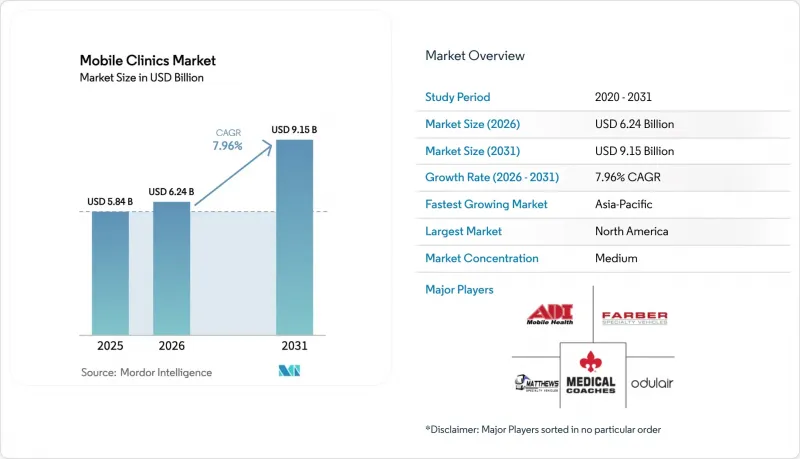
본 보고서는 진료소 유형(응급의료, 산모·신생아 의료, 중환자실·외과, 기타),차량 유형(의료용 밴, 기타), 설계 레이아웃(진료실 1개, 기타), 서비스 모델(1차 진료·예방 의료, 기타), 최종 사용자(병원·의료 시스템, 기타), 기술 통합(기본형, 기타), 지역별로 분류되어 있습니다. 시장 예측은 금액(미 달러) 기준으로 제시되어 있습니다.
세계의 이동 진료소 시장 동향 및 인사이트
만성 질환 및 응급 상황으로 인한 부담 증가
당뇨병, 고혈압, 외상 유병률 증가로 인해 환자와 1차 의료 간의 거리를 좁혀주는 이동 진료 유닛은 극도로 바쁜 상태입니다. 2025년 미국에서 실시된 조사에 따르면, 2024년에는 교통 수단의 제약이 응급실 이용 증가로 이어졌던 것으로 밝혀졌으며, 집 근처에서 건강 검진을 받는 것의 가치가 부각되었습니다. 이동식 플랫폼을 활용하는 지역 응급의료팀은 이미 30일 이내 재방문율을 줄이고 있으며, 이 모델이 가치 기반 계약에서 효과적임을 입증하고 있습니다. 1회 방문(150달러)으로 1,500달러가 드는 응급실 방문을 피할 수 있다는 계산은 보험사에게도 큰 반향을 일으키고 있습니다. 이에 따라 장비 제조업체들은 만성 질환 관리 워크플로우를 좁은 공간에 수용할 수 있도록 투약 관리 스테이션, 네트워크 연결형 진단 키오스크, 재택 모니터링 기기 키트 등을 갖추고 있습니다.
비용 대비 효과가 높은 원격 환자 모니터링 모델
방문 진료 시 배포되는 블루투스 지원 혈압계, 혈당 측정기, 맥박 산소 측정기는 임상의에게 지속적인 데이터 스트림을 제공합니다. 후속 관리를 위해 이동할 필요가 없어짐에 따라, 반복적인 내원 예약에 비해 서비스 제공 비용을 최대 30% 절감할 수 있습니다. 세계보건기구(WHO)가 2024년에 발표한, 자원이 제한된 환경을 위한 AI 기기용 툴킷은 규제상의 우려를 해소하고 기기 도입을 가속화했습니다. 2024년에 감염병 검사 시장 규모만 120억 달러를 돌파함에 따라, 이동 진료 유닛은 선호되는 유통 채널이 되었으며, 첫 방문과 데이터 관리 서비스 모두에서 수익을 창출했습니다.
하루당 진료 가능한 환자 수에 제한이 있습니다.
진료실 한 곳에서는 8시간 근무 교대당 약 32건의 진료를 처리할 수 있습니다. 진료실 수를 늘리지 않고 직원 수만 두 배로 늘려도 수익 증가는 정체될 수밖에 없습니다. 왜냐하면 병목 현상을 일으키는 요인은 인력이 아니라 공간이기 때문입니다. 확장 가능한 포드는 효과적이지만, 설치에 20분이 소요되어 노선당 진료 밀도를 떨어뜨립니다. 일반적으로 손익분기점에 도달하려면 하루 25-30건의 진료가 필요하지만, 극히 외진 지역에서는 이를 확보하기 어렵습니다.
부문별 분석
2025년, 외래 진료 유닛은 경량 장비로 대응 가능한 대량 접종 및 만성 질환 정기 검진을 통해 이동 진료소 시장 점유율의 27.63%를 차지했습니다. 임산부 보건 유닛은 현재 규모가 작지만, 산전 관리에 대한 자금 배분의 우선순위가 높고 건당 진료 보수가 높은 점을 배경으로 2031년까지 연평균 성장률(CAGR) 10.34%를 나타낼 것으로 전망됩니다. 세계보건기구(WHO)는 이동식 산전 검진을 모성 사망률 감소의 핵심 축 중 하나로 꼽고 있습니다. 이 유닛들은 초음파 검사, 채혈, 상담을 결합하여 한 번의 방문만으로 종합적인 진료를 실현하고 있습니다. 특히, 공인 조산사가 부족한 외딴 지역에서는 인력 부족이 여전히 걸림돌로 작용하고 있습니다.
2025년 매출의 49.75%를 밴이 차지했습니다. 이는 저렴한 가격에 도시나 농촌의 좁은 길에도 쉽게 진입할 수 있기 때문입니다. 트레일러는 진료 모듈과 견인차를 분리할 수 있어 섀시를 교체하지 않고도 내부를 업그레이드할 수 있기 때문에 연평균 성장률(CAGR) 11.33%로 시장 점유율을 확대되고 있습니다. Amref의 케냐 내 고처리 능력 차량군은 태양광 발전 시스템을 갖춘 트레일러가 대형 버스 수준의 수용 능력을 더 낮은 비용으로 제공할 수 있음을 보여줍니다. 다만, 설치에 시간이 걸리기 때문에 하루에 여러 방문지를 순회하는 경우에는 그다지 적합하지 않습니다.
지역별 분석
북미는 CMS(의료보험서비스센터)의 연간 100억 달러 규모의 농촌 의료 지출과, 이동 진료에 대해 고정 진료소와 동등한 요금을 지불하는 17개의 ‘패리티 주’를 배경으로 2025년 수익의 35.84%를 차지했습니다. 인력 부족으로 인해 사업자들은 원격 감독 계약을 체결해야 하는 압박을 받고 있지만, 의료 종사자의 면허 제도는 여전히 지역마다 차이가 있습니다.
아시아태평양은 2031년까지 연평균 성장률(CAGR) 9.32%로 가장 빠른 성장세를 보이고 있습니다. 인도의 ‘국가 보건 미션’은 2024-25 회계연도에 3,700억 루피(44억 달러)를 배정하여 원주민 거주 지역에 이동 진료 차량을 파견했습니다. 중국의 ‘건강 중국 2030’ 계획은 농촌 지역의 군(郡)에 있는 노인 돌봄용 밴에 자금을 지원하고 있습니다. 그러나 규제는 국가마다 다르기 때문에 현지 합작 투자가 직접 수입보다 유리한 경우가 많습니다.
유럽, 중동 및 아프리카, 남미는 시장 규모 면에서는 뒤처져 있지만, 틈새 시장의 성장 여지가 있습니다. EU의 더 엄격한 의료기기 규제는 기준을 높여 저품질 수입품을 배제하고 있습니다. 우간다의 500만 달러 규모 태양광 클리닉 프로그램은 전력망이 연결되지 않은 지역에서 재생에너지의 효과를 입증하고 있습니다. 브라질과 아르헨티나는 파벨라나 외딴 팜파 지역에 대한 지역 지원에 투자하고 있지만, 환율 변동이 조달을 복잡하게 만들고 있습니다.
기타 혜택 :
- 엑셀 형식 시장 예측(ME) 시트
- 3개월간의 애널리스트 지원
자주 묻는 질문
목차
제1장 서론
제2장 조사 방법
제3장 주요 요약
제4장 시장 구도
제5장 시장 규모 및 성장 예측
제6장 경쟁 구도
제7장 시장 기회 및 향후 전망
KTH 26.09.04According to Mordor Intelligence, the mobile clinics market size is expected to grow from USD 5.84 billion in 2025 to USD 6.24 billion in 2026 and is forecast to reach USD 9.15 billion by 2031 at 7.96% CAGR over 2026-2031.
This report is Segmented by Clinic Type (Emergency Care, Maternal Health, ICU & Surgery, and More), Vehicle Type (Mobile Medical Vans, and More), Design Layout (Single, and More), Service Model (Primary & Preventive Care, and More), End-User (Hospitals & Health Systems, and More), Technology Integration (Basic, and More), and Geography. The Market Forecasts are Provided in Terms of Value (USD).
Global Mobile Clinics Market Trends and Insights
Rising Burden of Chronic Diseases & Emergencies
Higher rates of diabetes, hypertension, and trauma keep mobile units busy because they shorten the distance between patients and first-line care. A study conducted in the United States in 2025 found that transportation barriers were linked to greater emergency-department use in 2024, highlighting the value of near-home checkups.Community paramedicine teams that ride mobile platforms have already cut 30-day revisit rates, proving the model works for value-based contracts. A single USD 150 mobile visit can avert a USD 1,500 ED episode, an equation that resonates with payers. Unit builders are therefore adding medication reconciliation stations, connected diagnostic kiosks, and home-monitoring device kits so chronic-care workflows fit inside small footprints.
Cost-Effective Remote Patient Monitoring Models
Bluetooth blood-pressure cuffs, glucometers, and pulse oximeters handed out during a mobile visit feed continuous data streams to clinicians. Removing follow-up travel lowers the cost to serve by up to 30% compared with repeat walk-in appointments. The World Health Organization's 2024 toolkit for AI devices in low-resource settings cleared regulatory doubt and accelerated device rollouts. As infectious-disease testing alone passed USD 12 billion in 2024, mobile units became a preferred distribution channel, earning margin on both the initial visit and data-management services.
Limited Daily Patient Throughput
A single exam room supports roughly 32 encounters in an eight-hour shift. Doubling staff without doubling rooms stalls revenue because space, not people, is the pinch point. Expandable pods help, yet setup adds 20 minutes and chips away at route density. Break-even generally needs 25 to 30 encounters per day, which ultra-rural zones struggle to supply.
Other drivers and restraints analyzed in the detailed report include:
- Government Funding for Rural-Health Outreach
- AI-Enabled Portable Diagnostics Integration
- High Capital and Maintenance Costs
For complete list of drivers and restraints, kindly check the Table Of Contents.
Segment Analysis
OPD units captured 27.63% of the mobile clinics market share in 2025, due to high-volume vaccinations and chronic-care checkups that require light gear. Maternal health units, though smaller today, are set for a 10.34% CAGR through 2031, powered by prenatal funding priorities and higher per-encounter payments. The World Health Organization positions mobile prenatal care as a pillar of maternal-mortality reduction. These units bundle ultrasound, lab draws, and counseling, turning a single stop into a full visit. Workforce scarcity remains the brake, especially in remote regions where certified midwives are in short supply.
Vans owned 49.75% of 2025 revenue because they slip into city blocks and rural lanes at a modest price. Trailers are gaining at an 11.33% CAGR since they decouple clinic modules from tow vehicles, letting owners upgrade interiors without replacing the chassis. Amref's high-throughput Kenyan fleet shows solar-backed trailers can deliver big-bus capacity for less money. Setup time, however, makes them less ideal for multi-stop days.
Complete Report Scope:
- By Clinic Type
- Emergency Care
- Maternal Health
- ICU & Surgery
- Infant & Neonatal Health
- Geriatric Care
- Diagnostic / Screening
- Mental Health
- Dental Care
- OPD
- Reproductive & Contraceptive Services
- Others
- By Vehicle Type
- Mobile Medical Vans
- Mobile Medical Buses
- Trailers
- Self-Propelled Trucks
- Others
- By Design Layout
- Single Exam Room
- Double Exam Room
- Triple Exam Room
- Expandable Modular Pods
- By Service Model
- Primary & Preventive Care
- Specialty Care
- Diagnostic Imaging Services
- Screening & Vaccination
- Emergency & Disaster Response
- Telehealth-Enabled Follow-Up
- By End-user
- Hospitals & Health Systems
- Government & Public-Health Agencies
- NGOs & Charities
- Private Healthcare Providers
- Military & Defense
- Corporate / Work-Site Programs
- By Technology Integration
- Basic (Minimal Tech)
- Telehealth-Enabled
- AI-Supported Diagnostics
- Advanced Imaging-Equipped
- Renewable / Zero-Emission Powertrain
- By Geography
- North America
- United States
- Canada
- Mexico
- Europe
- Germany
- France
- United Kingdom
- Italy
- Spain
- Rest of Europe
- Asia-Pacific
- China
- Japan
- India
- South Korea
- Australia
- Rest of Asia-Pacific
- Middle East & Africa
- GCC
- South Africa
- Rest of Middle East & Africa
- South America
- Brazil
- Argentina
- Rest of South America
- North America
Geography Analysis
North America commanded 35.84% of 2025 revenue on the back of USD 10 billion in annual CMS rural-health disbursements and 17 parity states that pay mobile visits at fixed-clinic rates. Workforce gaps push operators to tele-supervision agreements, yet clinician licensing remains a patchwork.
Asia-Pacific posts the fastest expansion at 9.32% CAGR through 2031. India's National Health Mission assigned INR 37,000 crore (USD 4.4 billion) for 2024-25, directing mobile fleets into tribal districts. China's Healthy China 2030 plan funds elder-care vans in rural counties. Regulation, however, varies by country, so local joint ventures often beat direct imports.
Europe, the Middle East and Africa, and South America trail in value but deliver niche upside. The EU's stricter medical-device rule raises the bar and filters out low-grade imports. Uganda's USD 5 million solar-clinic program validates renewables in off-grid zones. Brazil and Argentina invest in community outreach to favelas and remote pampas, though currency swings complicate procurement.
- ADI Mobile Health
- Craftsmen Industries
- CVR Industries USA
- EMS Mobile Systems
- Farber Specialty Vehicles
- GE Healthcare (Mobile Solutions)
- GlobalMed
- Johnson Medical International
- Kentucky Trailer Technologies
- La Boit Specialty Vehicles
- LifeLine Mobile
- Matthews Specialty Vehicles
- Medical Coaches
- MinFound Medical Systems
- Mobile Healthcare Facilities LLC
- Mobile Specialty Vehicles
- Odulair
- Phoenix Modular
- Summit Bodyworks
Additional Benefits:
- The market estimate (ME) sheet in Excel format
- 3 months of analyst support
TABLE OF CONTENTS
1 Introduction
- 1.1 Study Assumptions & Market Definition
- 1.2 Scope of the Study
2 Research Methodology
3 Executive Summary
4 Market Landscape
- 4.1 Market Overview
- 4.2 Market Drivers
- 4.2.1 Rising Burden of Chronic Diseases & Emergency Cases
- 4.2.2 Cost-Effective Remote Patient Monitoring Models
- 4.2.3 Subsequent Rise in Geriatric Population
- 4.2.4 Government Funding for Rural-Health Outreach
- 4.2.5 AI-Enabled Portable Diagnostics Integration
- 4.2.6 Adoption Of Zero-Emission / Solar-Powered Clinic Fleets
- 4.3 Market Restraints
- 4.3.1 Limited Daily Patient Throughput Per Unit
- 4.3.2 High Capital & Lifecycle Maintenance Costs
- 4.3.3 Regulatory Complexity Across Jurisdictions
- 4.3.4 Short-Supply of Dual-Licensed Drivers & Clinicians
- 4.4 Value / Supply-Chain Analysis
- 4.5 Regulatory Landscape
- 4.6 Technological Outlook
- 4.7 Porter's Five Forces Analysis
- 4.7.1 Threat of New Entrants
- 4.7.2 Bargaining Power of Buyers
- 4.7.3 Bargaining Power of Suppliers
- 4.7.4 Threat of Substitute Products
- 4.7.5 Intensity of Competitive Rivalry
5 Market Size & Growth Forecasts (Value in USD)
- 5.1 By Clinic Type
- 5.1.1 Emergency Care
- 5.1.2 Maternal Health
- 5.1.3 ICU & Surgery
- 5.1.4 Infant & Neonatal Health
- 5.1.5 Geriatric Care
- 5.1.6 Diagnostic / Screening
- 5.1.7 Mental Health
- 5.1.8 Dental Care
- 5.1.9 OPD
- 5.1.10 Reproductive & Contraceptive Services
- 5.1.11 Others
- 5.2 By Vehicle Type
- 5.2.1 Mobile Medical Vans
- 5.2.2 Mobile Medical Buses
- 5.2.3 Trailers
- 5.2.4 Self-Propelled Trucks
- 5.2.5 Others
- 5.3 By Design Layout
- 5.3.1 Single Exam Room
- 5.3.2 Double Exam Room
- 5.3.3 Triple Exam Room
- 5.3.4 Expandable Modular Pods
- 5.4 By Service Model
- 5.4.1 Primary & Preventive Care
- 5.4.2 Specialty Care
- 5.4.3 Diagnostic Imaging Services
- 5.4.4 Screening & Vaccination
- 5.4.5 Emergency & Disaster Response
- 5.4.6 Telehealth-Enabled Follow-Up
- 5.5 By End-user
- 5.5.1 Hospitals & Health Systems
- 5.5.2 Government & Public-Health Agencies
- 5.5.3 NGOs & Charities
- 5.5.4 Private Healthcare Providers
- 5.5.5 Military & Defense
- 5.5.6 Corporate / Work-Site Programs
- 5.6 By Technology Integration
- 5.6.1 Basic (Minimal Tech)
- 5.6.2 Telehealth-Enabled
- 5.6.3 AI-Supported Diagnostics
- 5.6.4 Advanced Imaging-Equipped
- 5.6.5 Renewable / Zero-Emission Powertrain
- 5.7 By Geography
- 5.7.1 North America
- 5.7.1.1 United States
- 5.7.1.2 Canada
- 5.7.1.3 Mexico
- 5.7.2 Europe
- 5.7.2.1 Germany
- 5.7.2.2 France
- 5.7.2.3 United Kingdom
- 5.7.2.4 Italy
- 5.7.2.5 Spain
- 5.7.2.6 Rest of Europe
- 5.7.3 Asia-Pacific
- 5.7.3.1 China
- 5.7.3.2 Japan
- 5.7.3.3 India
- 5.7.3.4 South Korea
- 5.7.3.5 Australia
- 5.7.3.6 Rest of Asia-Pacific
- 5.7.4 Middle East & Africa
- 5.7.4.1 GCC
- 5.7.4.2 South Africa
- 5.7.4.3 Rest of Middle East & Africa
- 5.7.5 South America
- 5.7.5.1 Brazil
- 5.7.5.2 Argentina
- 5.7.5.3 Rest of South America
- 5.7.1 North America
6 Competitive Landscape
- 6.1 Market Concentration
- 6.2 Market Share Analysis
- 6.3 Company Profiles (includes Global level Overview, Market level overview, Core Segments, Financials as available, Strategic Information, Market Rank/Share, Products & Services, Recent Developments)
- 6.3.1 ADI Mobile Health
- 6.3.2 Craftsmen Industries
- 6.3.3 CVR Industries USA
- 6.3.4 EMS Mobile Systems
- 6.3.5 Farber Specialty Vehicles
- 6.3.6 GE Healthcare (Mobile Solutions)
- 6.3.7 GlobalMed
- 6.3.8 Johnson Medical International
- 6.3.9 Kentucky Trailer Technologies
- 6.3.10 La Boit Specialty Vehicles
- 6.3.11 LifeLine Mobile
- 6.3.12 Matthews Specialty Vehicles
- 6.3.13 Medical Coaches
- 6.3.14 MinFound Medical Systems
- 6.3.15 Mobile Healthcare Facilities LLC
- 6.3.16 Mobile Specialty Vehicles
- 6.3.17 Odulair
- 6.3.18 Phoenix Modular
- 6.3.19 Summit Bodyworks
7 Market Opportunities & Future Outlook
- 7.1 White-space & Unmet-Need Assessment


