|
시장보고서
상품코드
2066523
자율주행 트랙터 시장 : 점유율 분석, 업계 동향과 통계, 성장 예측(2026-2031년)Autonomous Tractors - Market Share Analysis, Industry Trends & Statistics, Growth Forecasts (2026 - 2031) |
||||||
 Mordor Intelligence
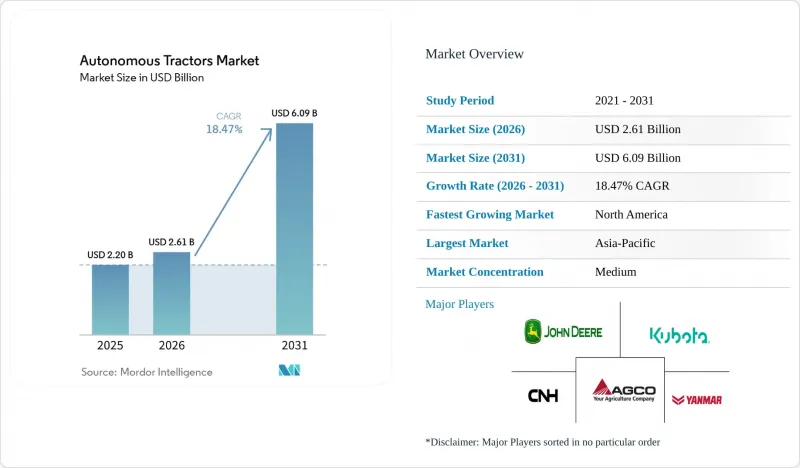
Mordor Intelligence에 의하면, 자율주행 트랙터 시장 규모는 2025년 22억 달러에서 2026년에는 26억 1,000만 달러로 확대되어 2026년부터 2031년까지 CAGR 18.47%로 성장을 지속하여, 2031년에는 60억 9,000만 달러에 이를 것으로 예측됩니다.
본 보고서는 마력(30 HP 이하 및 그 이상), 자동화 수준(완전 자동화 및 반자동화), 구동 방식(디젤 및 기타), 용도(경운 및 기타), 구성 부품(GPS/GNSS 및 기타), 농장 규모(소규모, 중규모, 대규모), 지역(북미, 유럽, 아시아태평양, 남미, 기타)별로 분류되어 있습니다. 시장 전망은 금액(달러) 기준으로 제시되어 있습니다.
세계 자율주행 트랙터 시장 동향과 인사이트
농업 인력 부족과 작업자 부족
농업 인력 부족은 자율주행 트랙터 시장에 있어 여전히 가장 지속적인 수요 동력으로 작용하고 있습니다. 2025 회계연도에 미국 노동부는 1분기부터 3분기까지만 해도 31만 7,000건 이상의 H-2A 임시 농업 근로 비자를 승인했는데, 이는 국내 노동 공급이 여전히 계절적인 농업 수요를 따라가지 못하고 있음을 보여줍니다. 또한, 외국 출신 농업 노동자의 평균 연령이 계속 상승하고 있어 노동력 공급원이 점차 줄어들고 있으며, 장기적인 노동력 확보가 어려워지고 있습니다. 따라서 자율주행 트랙터 시장의 도입은 단순한 효율화라기보다는 작업자 확보가 어려운 상황에서 농작업을 유지하기 위한 수단으로서의 측면이 더욱 강해지고 있습니다. 이러한 상황에서는 이미 안내 기능을 갖춘 트랙터를 운용하고 있는 농장이 유리합니다. 왜냐하면, 감시 하에서 작동하는 기능에서 보다 고도화된 자율 주행 기능으로의 업그레이드는 트랙터 전체를 새로 구입하는 것보다 더 신속하게 수행할 수 있기 때문입니다. 또한, 계절 근로자에 대한 의존이 반복되면서 운영상의 위험 요인이 되고 있는 지역에서도 자율주행 트랙터 시장의 확대를 뒷받침하고 있습니다.
정밀 농업 및 커넥티드 가이던스 스택 도입
정밀 농업은 현재 자율 주행 트랙터 시장이 더 높은 부가가치를 지닌 자동화 시스템을 구축하기 위한 기반이 되고 있습니다. AGCO Corporation은 2025년 8월, 서로 다른 브랜드의 차량군 간에 안내 기능, 농지 데이터, 자율 주행 관리를 연동하는 ‘PTx FarmENGAGE’ 플랫폼을 도입했습니다. 이는 소프트웨어 통합이 트랙터의 하드웨어만큼이나 중요해지고 있음을 보여줍니다. 이미 자동 조향, 디지털 경계 설정, 농지 기록 기능을 활용하고 있는 농장일수록 업무에 미치는 지장을 최소화하면서 자율형 워크플로우를 도입하기 쉬운 상황입니다. 이를 통해 전환 장벽이 낮아지고, 개별 기계보다 연결된 생태계의 가치가 높아집니다. 또한, 이는 자율주행 트랙터 시장이 플랫폼 간 경쟁으로 전환되고 있음을 의미하며, 이 시장에서는 기계적 성능과 마찬가지로 데이터의 연속성과 차량 군 간의 호환성이 중요시됩니다. 그 결과, 다양한 디지털 도구를 보유한 제조업체는 트랙터의 초기 판매량을 훨씬 뛰어넘는 수준의 고객 유지율을 높일 수 있습니다.
소규모 농장의 높은 초기 비용과 불확실한 투자 회수
높은 초기 비용은 특히 상업 규모 미만의 농장에 있어 자율 주행 트랙터 시장에서 여전히 가장 뚜렷한 장벽 중 하나입니다. 완전한 자율 주행 패키지에는 일반적으로 트랙터 본체, 인식용 하드웨어, 소프트웨어 및 지속적인 플랫폼 비용이 포함되어 있어, 이로 인해 투자 회수 기간이 많은 소규모 농장이 감당할 수 있는 범위를 넘어 길어지게 됩니다. 이 때문에 조기 도입은 고정비를 더 넓은 경작 면적이나 기계 가동 시간에 분산할 수 있는 대규모 곡물 농장, 자금력이 있는 전문 농가 등에 집중되고 있습니다. 농산물 가격이 변동하고 현금 흐름 전망이 악화되는 상황에서는 이러한 압박이 더욱 심해집니다. 구독 모델이나 사후 추가 옵션을 통해 도입 장벽은 점차 낮아지고 있지만, 중규모 시장으로의 광범위한 확산을 위해서는 여전히 하드웨어의 가격 인하와 보다 표준화된 자금 조달 수단이 필수적입니다. 그 전까지는 소규모 농가가 주를 이루는 지역에서 비용이 자율주행 트랙터 시장의 확장을 계속해서 저해할 것으로 보입니다.
부문별 분석
2025년 기준으로 31-100 HP 부문은 시장 점유율의 38.9%를 차지하고 있으며, 자율주행 트랙터 시장에서 이 부문이 차지하는 비중은 대규모 밭작물 재배에 이미 널리 사용되고 있는 중급급 줄 재배용 트랙터의 도입 대수가 많다는 점을 반영하고 있습니다. 북미와 유럽의 많은 농장에서는 이미 이 출력 범위의 지침 준수 모델을 운용하고 있기 때문에 차량을 전면적으로 교체하는 것보다 사후 업그레이드가 더 현실적이며, 이 부문은 여전히 최대 규모를 유지하고 있습니다. 이 트랙터들은 파종, 살포, 경운과 같은 일반적인 작업에 적합하며, 이러한 작업은 반복적이며 상업적 조건에서 자동화하기 쉬운 작업입니다. 따라서 고출력 플랫폼이 주목을 받고 있는 상황에서도 수요는 안정적입니다. 자율주행 트랙터 업계는 어시스트 스티어링의 도입과 보다 광범위한 자율주행을 연결하는 가교 역할을 하는 이 출력 대역에 여전히 크게 의존하고 있습니다.
100 HP 이상은 가장 빠르게 성장하고 있는 마력 부문으로, 대규모 농장들이 경운 및 곡물 운반 작업을 무인화 워크플로로 전환함에 따라 2026년부터 2031년까지 연평균 성장률(CAGR) 23.4%로 확대될 것으로 전망됩니다. AGCO 코퍼레이션은 2025년 말에 출고 시 ‘OutRun’ 자율 주행 시스템이 통합된 ‘Fendt 1000 Vario Gen4’ 시리즈를 출시했으며, 2026년에는 400-520마력 모델에 대한 상용 납품을 시작했습니다. Deere and Company 역시 8R, 8RX, 9R, 9RX 트랙터에서 자율 경작의 호환성을 확대하여, 대규모 상업 농장에서의 고출력 밭 작업을 지원하고 있습니다.
2025년에는 반자율 주행 시스템이 시장 점유율의 67.6%를 차지할 것으로 예측됩니다. 자율 주행 트랙터 시장에서 이러한 우위는 대부분의 상업적 도입 사례에서 여전히 운전자가 감독 역할을 맡고 있다는 점에 기인합니다. 이 부문에는 자동 조향, 헬란드 턴, 섹션 컨트롤 등이 포함되며, 딜러는 익숙한 도구와 정립된 인터페이스를 사용하여 이러한 시스템의 설치 및 지원을 수행할 수 있습니다. 또한, 책임이 기계 조작자와 가까운 곳에 있기 때문에 농가들도 이러한 시스템을 위험이 낮은 것으로 인식하고 있습니다. 따라서 이 부문은 현재 자율주행 트랙터 시장에서 가장 큰 상업적 진출 경로가 되고 있습니다. 또한, 대부분의 국가에서 현재 적용되고 있는 보험 및 규제 조건에도 더 잘 부합합니다.
완전 자율 주행 시스템은 가장 빠르게 성장하고 있는 부문으로, 소프트웨어, 인식 기술 및 차량 관리 도구의 발전에 힘입어 2026년부터 2031년까지 연평균 성장률(CAGR) 22.5%로 확대될 것으로 전망됩니다. AGCO 코퍼레이션은 2030년까지 경작부터 파종, 살포, 수확 조정에 이르기까지 자율성을 확대하여, 전체 주기를 아우르는 자율형 작물 생산 시스템을 실현하겠다는 목표를 세웠습니다. 많은 농장에서는 우선 반자율 운전을 통해 밭의 경계를 설정하고, 디지털 기록을 구축하며, 신뢰 관계를 형성하는 것부터 시작하기 때문에 도입 과정은 단계적으로 진행됩니다. 즉, 현재 도입된 감시 시스템의 기반은 향후 무인화로의 업그레이드를 위한 공급원 역할도 하고 있는 것입니다. 자율주행 트랙터 시장에서 이러한 구조적 전환은 현재 시장 점유율과 미래의 성장세를 단순히 비교하는 것보다 더 중요한 의미를 지닙니다.
지역별 분석
2025년, 아시아태평양은 자율주행 트랙터 시장 점유율의 45.8%를 차지하며, 금액 기준으로 가장 큰 시장이 되었습니다. 일본은 첨단 농업용 로봇 개발과 자율형 기계 활용을 향해 꾸준히 발전해 온 정책 환경을 바탕으로 이러한 위상을 유지하고 있습니다. 중국은 광범위한 기계화 추진이라는 우선 과제의 혜택을 누리고 있는 반면, 인도는 소규모 농가가 많고 인프라도 고르지 않아 완전 자율 주행으로의 전환이 더딘 편이지만, 연간 트랙터 판매 대수가 많아 시장 규모가 확대되고 있습니다. 얀마 홀딩스는 인공지능과 엣지 컴퓨팅을 활용한 농업 작업 지원 기술을 지속적으로 개발하고 있으며, 이는 해당 지역이 실용적인 원격·자동 농업 운영을 추진하고 있음을 반영하고 있습니다. 한국과 호주 역시 농업 종사자의 고령화와 광대한 경작 면적이 각기 다른 방식으로 도입을 뒷받침하고 있어, 여전히 중요한 시장으로 남아 있습니다.
북미는 자율주행 트랙터 시장에서 가장 빠르게 성장하고 있는 지역 부문으로, 2026년부터 2031년까지 연평균 성장률(CAGR) 22.6%로 확대될 것으로 전망됩니다. 이 지역은 광활한 농지, 높은 인건비, 그리고 자율적인 경운, 살포, 곡물 운반 작업 흐름을 도입할 타당한 근거가 되는 농업 구조와 같은 장점을 갖추고 있습니다. Deere &Company는 2026년까지 자율 경운 제품공급을 확대하고 있으며, 이를 통해 대규모 농업 분야에서 최초의 실질적인 상용화 기반이 구축될 전망입니다. 캐나다 역시 ‘캐나다 농업·식품 자동화 및 지능화 네트워크(Canadian Agri-Food Automation and Intelligence Network)’에 대한 정부 자금 지원을 통해, 보다 친환경적이고 자동화된 농업 기술을 지원하고 있습니다. 한편, 멕시코에서는 농장 규모가 비교적 작기 때문에 완전한 자율화에 따른 즉각적인 경제적 효과가 제한적이어서, 도입은 여전히 초기 단계에 머물러 있습니다.
유럽은 정밀 농업이 고도로 발달해 있는 반면, 안전 및 규제 측면에서의 감독 요건이 엄격하기 때문에 자율 주행 트랙터 시장에서 여전히 중요한 위치를 차지하고 있습니다. 유럽연합(EU)의 기후·농업기계 정책은 저배출 및 디지털 방식으로 관리되는 농업기계에 대한 투자를 장려하고 있지만, 자율주행의 활용 사례에 대해서는 다른 지역에 비해 여전히 엄격한 규정 준수 요건이 적용되고 있습니다. 지역별 수요를 보면 독일, 프랑스, 영국이 주도적인 역할을 하고 있는 반면, 중동 및 아프리카는 시범 사업이나 상업적인 대규모 농장 경영을 중심으로 한, 아직 초기 단계에 머무르고 있습니다. 남미에서는 브라질과 아르헨티나에 장기적으로 큰 잠재력이 기대되지만, 수입 비용, 통신 환경의 격차, 위치 정보의 신뢰성 문제 등이 여전히 더 빠른 보급을 가로막고 있습니다.
기타 혜택:
- 엑셀 형식 시장 예측(ME) 시트
- 3개월간의 애널리스트 지원
자주 묻는 질문
목차
제1장 서론
제2장 조사 방법
제3장 주요 요약
제4장 시장 구도
제5장 시장 규모와 성장 예측
제6장 경쟁 구도
제7장 시장 기회와 향후 전망
JHS 26.06.29According to Mordor Intelligence, the autonomous tractor market size is projected to grow from USD 2.20 billion in 2025 to USD 2.61 billion in 2026 and is forecast to reach USD 6.09 billion by 2031 at 18.47% CAGR over 2026-2031.
This report is Segmented by Horsepower (Up To 30 HP, and More), by Automation Level (Fully Automated and Semi-Automated), by Drive Type (Diesel, and More), by Application (Tillage, and More), by Component (GPS/GNSS, and More), by Farm Size (Small, Medium, and Large) and by Geography (North America, Europe, Asia-Pacific, South America, and More). The Market Forecasts are Provided in Terms of Value (USD).
Global Autonomous Tractors Market Trends and Insights
Farm labor shortages and operator scarcity
The farm labor deficit remains the most durable demand driver for the autonomous tractor market. In fiscal year 2025, the United States Department of Labor certified more than 317,000 H-2A temporary agricultural positions in the first 3 quarters alone, which showed that the domestic labor supply still fell short of seasonal farm demand. The workforce pipeline is also narrowing as the average age of foreign-born farmworkers has continued to rise, weakening long-term labor availability. That makes adoption in the autonomous tractor market less about optional efficiency and more about maintaining field operations when operators are hard to secure. This setting favors farms that already run guidance-enabled fleets, because upgrades from supervised functions to higher autonomy can happen faster than full fleet replacement. It also supports the autonomous tractor market in regions where seasonal labor dependence has become a recurring operating risk.
Precision agriculture and connected guidance stack adoption
Precision agriculture has become the operating base on which the autonomous tractor market now builds higher-value automation. AGCO Corporation introduced the PTx FarmENGAGE platform in August 2025 to connect guidance, field data, and autonomy management across mixed-brand fleets, which showed that software integration is becoming as important as tractor hardware. Farms that already use automated steering, digital boundaries, and field records are better positioned to adopt autonomous workflows with less disruption. That lowers switching friction and strengthens the value of connected ecosystems over standalone machines. It also means the autonomous tractor market is moving toward platform competition, where data continuity and fleet compatibility matter as much as mechanical performance. As a result, manufacturers with broad digital tools can extend customer retention well beyond the initial tractor sale.
High upfront cost and uncertain return on investment for smaller farms
High initial cost remains one of the clearest limits on the autonomous tractor market, especially for farms below commercial scale. A full autonomous package usually includes the tractor, perception hardware, software, and ongoing platform costs, which stretches payback periods beyond what many smaller operations can accept. This keeps early adoption concentrated among larger grain farms and well-capitalized specialty operators that can spread fixed costs across more acres and more machine hours. The pressure becomes stronger when crop prices are volatile and cash flow visibility weakens. Subscription models and retrofit options are starting to reduce the entry burden, but broad mid-market penetration still depends on cheaper hardware and more standardized financing. Until then, cost will continue to slow the autonomous tractor market in regions dominated by smaller holdings.
Other drivers and restraints analyzed in the detailed report include:
- Government support for smart and low-emission farm equipment
- Productivity gains from 24-hour field operations and multi-machine supervision
- Safety, liability, and regulatory ambiguity for unattended field operations
For complete list of drivers and restraints, kindly check the Table Of Contents.
Segment Analysis
The 31 to 100 HP segment held 38.9% market share in 2025, and its share of the autonomous tractor market reflected the broad installed base of mid-range row-crop tractors already used across large field crops. This band remains the largest because many farms in North America and Europe already operate guidance-ready models in this range, making retrofit upgrades more practical than a complete fleet replacement. These tractors are well-suited for common sowing, spraying, and light tillage tasks that are repetitive and easier to automate under commercial conditions. That keeps demand steady even as higher-power platforms gain attention. The autonomous tractor industry still depends heavily on this range because it forms the bridge between assisted steering adoption and broader autonomy.
Above 100 HP is the fastest-growing horsepower segment and is projected to expand at 23.4% CAGR from 2026 to 2031 as very large farms shift more tillage and grain-cart operations toward driverless workflows. AGCO Corporation launched the Fendt 1000 Vario Gen4 series in late 2025 with factory-integrated OutRun autonomy, and commercial deliveries began in 2026 for models spanning 400 to 520 horsepower. Deere and Company also expanded compatibility for autonomous tillage on 8R, 8RX, 9R, and 9RX tractors, which supports higher-power field work on large commercial farms.
Semi-autonomous systems are projected to account for 67.6% of the market share in 2025. This dominance in the autonomous tractor market is attributed to the continued reliance on operators in supervisory roles for most commercial deployments. This segment includes automated steering, headland turning, and section control that dealers can install and support using familiar tools and established interfaces. Farmers also view these systems as lower-risk because responsibility remains closer to the machine operator. That makes the segment the largest commercial pathway in the autonomous tractor market today. It also fits better with current insurance and regulatory conditions in most countries.
Fully Autonomous systems are the fastest-growing segment and are forecast to rise at 22.5% CAGR from 2026 to 2031 as software, perception, and fleet management tools improve. AGCO Corporation has stated a goal of enabling a full-cycle autonomous crop production system by 2030, extending autonomy beyond tillage into seeding, spraying, and harvest coordination. The adoption path is gradual because many farms first build field boundaries, digital records, and trust through semi-autonomous use. That means the current installed base of supervised systems also serves as the feeder pipeline for later driverless upgrades. In the autonomous tractor market, this structural transition matters more than a simple comparison between current share and future growth.
Geography Analysis
Asia-Pacific held 45.8% of the autonomous tractor market share in 2025, which made it the largest region by value. Japan supports this position through advanced farm robotics development and a policy environment that has steadily moved toward the use of autonomous machinery. China benefits from broad mechanization priorities, while India adds scale through its large annual tractor sales base, even though smallholding patterns and uneven infrastructure slow the pursuit of full autonomy. YANMAR HOLDINGS CO., LTD. has continued to develop agricultural work-support technologies using artificial intelligence and edge computing, reflecting the region's push toward practical remote and autonomous farm operations. South Korea and Australia also remain important because aging farm populations and large operational footprints support adoption in different ways.
North America is the fastest-growing regional segment in the autonomous tractor market, projected to expand at a 22.6% CAGR from 2026 to 2031. The region benefits from large field sizes, high labor costs, and farm structures that can justify autonomous tillage, spraying, and grain-cart workflows. Deere & Company is scaling its autonomous tillage offering through 2026, which will support the first meaningful commercial installed base in large-scale agriculture. Canada is also supporting cleaner and more automated farm technology through public funding for the Canadian Agri-Food Automation and Intelligence Network. Mexico remains earlier in adoption because smaller farm structures reduce the immediate economics of full autonomy.
Europe remains an important part of the autonomous tractor market because it combines strong precision agriculture maturity with strict safety and regulatory oversight expectations. The European Union's climate and machinery policy is supporting investment in low-emission, digitally managed farm equipment, even though unattended use cases still face tighter compliance requirements than in some other regions. Germany, France, and the United Kingdom lead regional demand, while the Middle East and Africa remain earlier-stage markets centered on pilot activity and commercial estate farming. South America has strong long-run potential in Brazil and Argentina, but import costs, connectivity gaps, and correction reliability issues still restrain faster rollout.
- Deere & Company
- AGCO Corporation
- CNH Industrial N.V.
- Kubota Corporation
- Mahindra & Mahindra
- Monarch Tractor
- AutoNext Automation
- YANMAR HOLDINGS CO., LTD.
- CLAAS KGaA mbH
- TYM Corporation
- SDF Group
- ZETOR TRACTORS a.s. (HTC Corporation)
- Sonalika
- Kioti (daedong)
- ISEKI & Co., Ltd
Additional Benefits:
- The market estimate (ME) sheet in Excel format
- 3 months of analyst support
TABLE OF CONTENTS
1 Introduction
- 1.1 Study Assumptions and Market Definition
- 1.2 Scope of the Study
2 Research Methodology
3 Executive Summary
4 Market Landscape
- 4.1 Market Overview
- 4.2 Market Drivers
- 4.2.1 Farm labor shortages and operator scarcity
- 4.2.2 Precision agriculture and connected guidance stack adoption
- 4.2.3 Government support for smart and low-emission farm equipment
- 4.2.4 Productivity gains from 24-hour field operations and multi-machine supervision
- 4.2.5 Retrofit autonomy kits and autonomy-ready tractor platforms
- 4.2.6 Specialty-crop mechanization in orchards and vineyards
- 4.3 Market Restraints
- 4.3.1 High upfront cost and uncertain return on investment for smaller farms
- 4.3.2 Safety, liability, and regulatory ambiguity for unattended field operations
- 4.3.3 GNSS reliability, connectivity gaps, and cyber risk in connected fleets
- 4.3.4 Implement interoperability and dealer-service readiness bottlenecks
- 4.4 Regulatory Landscape
- 4.5 Technological Outlook
- 4.6 Porter's Five Forces Analysis
- 4.6.1 Bargaining Power of Suppliers
- 4.6.2 Bargaining Power of Buyers
- 4.6.3 Threat of New Entrants
- 4.6.4 Threat of Substitutes
- 4.6.5 Intensity of Competitive Rivalry
5 Market Size and Growth Forecasts (Value, USD)
- 5.1 By Horsepower
- 5.1.1 Up to 30 HP
- 5.1.2 31 - 100 HP
- 5.1.3 Above 100 HP
- 5.2 By Automation Level
- 5.2.1 Semi-Autonomous
- 5.2.2 Fully Autonomous
- 5.3 By Drive Type
- 5.3.1 Diesel
- 5.3.2 Hybrid
- 5.3.3 Battery-Electric
- 5.4 By Application
- 5.4.1 Tillage
- 5.4.2 Sowing
- 5.4.3 Harvesting
- 5.4.4 Orchard and Vineyard Operations
- 5.5 By Component
- 5.5.1 GPS/GNSS
- 5.5.2 Sensors and Vision Systems
- 5.5.3 LiDAR and Radar Modules
- 5.5.4 Control and Navigation Software
- 5.6 By Farm Size
- 5.6.1 Small ( Less than 100 ha)
- 5.6.2 Medium (100-500 ha)
- 5.6.3 Large ( More than 500 ha)
- 5.7 By Geography
- 5.7.1 North America
- 5.7.1.1 United States
- 5.7.1.2 Canada
- 5.7.1.3 Mexico
- 5.7.1.4 Rest of North America
- 5.7.2 South America
- 5.7.2.1 Brazil
- 5.7.2.2 Argentina
- 5.7.2.3 Rest of South America
- 5.7.3 Europe
- 5.7.3.1 Germany
- 5.7.3.2 United Kingdom
- 5.7.3.3 France
- 5.7.3.4 Spain
- 5.7.3.5 Russia
- 5.7.3.6 Rest of Europe
- 5.7.4 Asia-Pacific
- 5.7.4.1 China
- 5.7.4.2 India
- 5.7.4.3 Japan
- 5.7.4.4 Australia
- 5.7.4.5 South Korea
- 5.7.4.6 Rest of Asia-Pacific
- 5.7.5 Middle East
- 5.7.5.1 Saudi Arabia
- 5.7.5.2 UAE
- 5.7.5.3 Turkey
- 5.7.5.4 Rest of Middle East
- 5.7.6 Africa
- 5.7.6.1 South Africa
- 5.7.6.2 Rest of Africa
- 5.7.1 North America
6 Competitive Landscape
- 6.1 Market Concentration
- 6.2 Strategic Moves
- 6.3 Market Share Analysis
- 6.4 Company Profiles (Includes Global Level Overview, Market Level Overview, Core Segments, Financials as available, Strategic Information, Market Rank/Share for Key companies, Products and Services, and Recent Developments)
- 6.4.1 Deere & Company
- 6.4.2 AGCO Corporation
- 6.4.3 CNH Industrial N.V.
- 6.4.4 Kubota Corporation
- 6.4.5 Mahindra & Mahindra
- 6.4.6 Monarch Tractor
- 6.4.7 AutoNext Automation
- 6.4.8 YANMAR HOLDINGS CO., LTD.
- 6.4.9 CLAAS KGaA mbH
- 6.4.10 TYM Corporation
- 6.4.11 SDF Group
- 6.4.12 ZETOR TRACTORS a.s. (HTC Corporation)
- 6.4.13 Sonalika
- 6.4.14 Kioti (daedong)
- 6.4.15 ISEKI & Co., Ltd