|
시장보고서
상품코드
2119192
미국의 자율주행 농업용 트랙터 시장 : 시장 점유율 분석, 업계 동향 및 통계, 성장 예측(2026-2031년)United States Autonomous Agricultural Tractors - Market Share Analysis, Industry Trends & Statistics, Growth Forecasts (2026 - 2031) |
||||||
 Mordor Intelligence
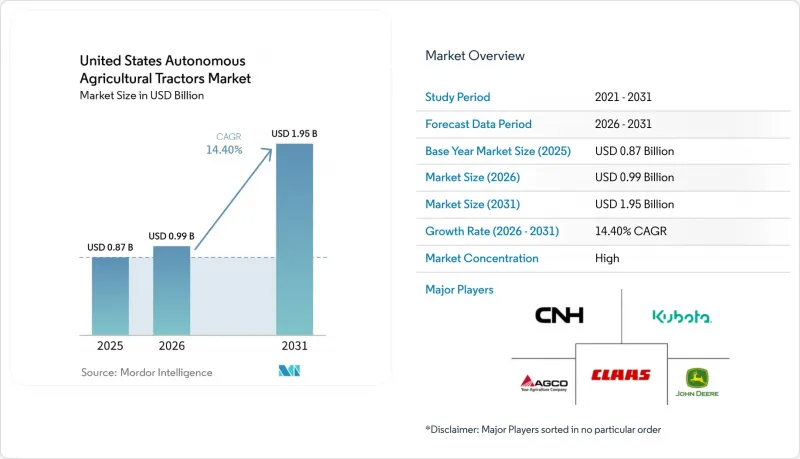
Mordor Intelligence에 의하면, 미국의 자율주행 농업용 트랙터 시장은 2025년에 8억 7,000만 달러 규모로 평가되었고, 2026년 9억 9,000만 달러에서 2031년까지 19억 5,000만 달러로 확대될 전망이며, 예측 기간(2026-2031년) CAGR은 14.4%로 성장이 추정되고 있습니다.
본 보고서는 마력(HP)별(30HP 이하, 31-100HP, 100HP 이상), 자동화 수준별(반자율, 완전 자율), 구동 방식별(디젤, 하이브리드, 기타), 용도별(경운, 파종, 수확, 기타), 구성 요소별(GPS·GNSS, 기타), 그리고 농장 규모별(소규모, 중규모, 대규모)로 분석되었습니다. 시장 예측은 금액(달러) 기준으로 제시되어 있습니다.
미국의 자율주행 농업용 트랙터 시장 동향 및 인사이트
숙련된 농기계 조작자의 만성적인 부족
훈련을 받은 농업 기계 조작원의 부족은 미국 자율주행 농업용 트랙터 시장을 직접적으로 견인하는 요인이 되고 있습니다. 미국 농무부(USDA)에 따르면, H-2A 비자 승인 건수는 2005 회계연도의 4만 8,000건에서 2024 회계연도에는 38만 5,000건으로 증가했습니다. 그러나 승인된 모든 직책이 비자 발급으로 이어진 것은 아니었기 때문에 이러한 확대만으로는 계절적 인력 부족 문제를 해결하지는 못했습니다. 농장에서는 대형 기계를 조작할 수 있고, 정밀 파종, 안내 시스템, 포장 상황을 이해할 수 있는 운전자가 요구되고 있습니다. 이러한 능력은 일반적인 농업 노동보다 전문성이 높기 때문에 농장이 경험 많은 트랙터 운전자를 신속하게 보충하기는 어렵습니다. 자율 시스템을 도입함으로써, 경험이 풍부한 직원은 연속 운전에서 감독 업무나 예외 상황 대응으로 업무를 전환할 수 있게 되어, 운영 측면과 인력 측면의 노동력 부족 문제를 모두 해결할 수 있습니다. 이러한 필요성은 농장이 단기간 내에 여러 포장 작업을 완료해야 하는 경우에 가장 두드러집니다.
제한된 기상 조건 하에서의 자율 작업
옥수수 벨트 지역의 파종 및 경운 적기는 토양 상태가 악화되기 전까지 10일도 채 지속되지 않습니다. 야간에도 작업을 계속할 수 있는 트랙터가 있다면, 농장은 이 제한된 시간을 더 효율적으로 활용할 수 있습니다. 그 이점은 노동 시간 단축뿐만 아니라 적시에 농장 작업을 수행할 수 있다는 점에도 있습니다. John Deere는 CES 2025에서 16대의 카메라로 구성된 인식 시스템을 탑재하고, 1세대 플랫폼에 비해 밭 주행 속도가 40% 향상된 자율 주행 트랙터 ‘9RX’를 발표했습니다. 이 시스템은 장기간에 걸친 작업에서 일관된 조작이 필수적인 밭 작업용으로 설계되었습니다. 자율 주행 농업 기계는 주야를 가리지 않고 동일한 프로그램에 따라 밭 가장자리 선회나 작업 기구의 깊이 조정을 수행할 수 있으므로, 주간과 야간 밭 작업 간의 편차를 줄여줍니다. 파종이나 경작 지연으로 인해 작물 관리의 선택지가 좁아지는 상황에서 미국의 자율 주행 농업용 트랙터 시장은 혜택을 받게 됩니다. 중서부 및 그레이트 플레인스 지역의 평탄하고 광활한 농지는 이러한 이용 사례에 가장 적합한 운영 조건을 제공합니다.
높은 초기 비용과 농장 차원에서의 투자 회수 불확실성
자율 주행 키트에는 초기 투자가 필요하지만, 많은 농장에서는 그 투자를 정당화하기 어렵습니다. 2026년 2월, 퍼듀 대학교 농업 센터는 John Deere의 8R 및 9R 트랙터 개조 비용으로 4만-4만 5,000달러, 그리고 무제한 경작 면적에 대한 연간 구독료로 1만 달러를 제시했습니다. 이 센터의 2026년 분석에서는 중서부 지역의 옥수수와 대두를 50대 50으로 번갈아 재배하는 모델을 시뮬레이션했습니다. 이 조사 결과, 기준 가정을 바탕으로 헥타르당 63달러의 적자가 발생하는 것으로 나타났습니다. 또한, 시간당 임금이 44달러를 초과할 때까지는 자율주행 농기계가 기존 농기계보다 우수한 성능을 발휘하지 않는다는 사실도 밝혀졌습니다. 미국 농무부(USDA) 보고서에 따르면, 2025년 4월 농장 근로자의 평균 시간당 임금은 18.58달러였습니다. 이러한 격차는 인건비 절감만으로는 구매 결정을 뒷받침하기에 불충분함을 의미합니다. 미국의 자율주행 농업용 트랙터 시장은 성수기에 노동력을 확보하지 못하는 농장에서 먼저 확대될 것으로 예측됩니다. 소규모 농장의 경우, 실질적인 도입을 실현하기 위해서는 서비스 기반 요금 체계나 키트 가격 인하가 필요할 수 있습니다.
부문 분석
2025년, 31-100HP 부문은 미국 자율주행 농업용 트랙터 시장 매출의 46%를 차지했습니다. 이 부문은 일반적인 줄 작물 작업에 대응하며, 중서부 지역 농장에서 이미 사용되고 있는 많은 트랙터와 호환됩니다. 또한, 사후 장착 시스템과의 호환성 덕분에 구매자가 기존 장비를 교체하는 대신 업그레이드할 수 있어 수요가 더욱 촉진되고 있습니다. 아울러 이 HP 범위는 정기적인 경작이나 농지 정비 작업에 자율 주행이 필요한 농장에도 적합합니다. 이 부문이 가장 큰 점유율을 차지하고 있다는 사실은 도입 대수가 많다는 점과 이러한 트랙터의 실용적인 유용성을 반영합니다. CES 2025에서 Deere & Company는 16대의 카메라로 구성된 지각 시스템을 탑재한 자율 주행 트랙터 ‘9RX’를 발표하며, 각 제조업체들이 다양한 트랙터 등급으로 자율 주행 기능을 확대하고 있음을 보여주었습니다. 미국의 자율 주행 농업용 트랙터 시장은 작물 유형과 농장 면적에 따라 운영 요건이 다르기 때문에 여러 HP 범위에 걸쳐 있습니다.
100HP 이상의 부문은 2031년까지 연평균 성장률(CAGR) 23.4%를 나타낼 것으로 예측됩니다. 대규모 상업 농장에서는 이러한 기계를 중노동이 필요한 경작이나 광대한 농지 작업에 사용하고 있습니다. 한 명의 운전자가 여러 대의 기계를 동시에 관리할 수 있기 때문에 고마력 장비의 가치는 더욱 높아집니다. 또한, 이러한 기계는 기상 조건이 제한적인 짧은 기간에도 더 넓은 농지를 커버할 수 있으므로, 광대한 농지를 보유한 농장에서는 높은 구매 비용도 비교적 부담하기 쉬워집니다. 30HP 이하 부문은 시장 규모 면에서는 여전히 작지만, 그 컴팩트한 크기가 대형 장비로는 작업하기 어려운 장소에 적합하기 때문에 특산 작물이나 시설 재배에서 중요한 역할을 하고 있습니다. 미국의 자율주행 농업용 트랙터 시장에는 대용량 밭용 플랫폼과 소형 특수 목적 기계가 모두 계속 포함되어 있으며, 고마력(HP) 부문은 특히 대규모 농장 운영과 밀접한 관련이 있습니다.
2025년, 미국 자율주행 농업용 트랙터 시장 매출의 58%를 반자율형 시스템이 차지했습니다. 이러한 시스템에서는 현장 또는 원격지에서 사람의 모니터링이 필요합니다. 이러한 운영 모델은 현재의 안전 대책 및 주 차원의 요건에 부합하며, 생산자는 완전 무인 운전을 도입하지 않고도 자율 주행 기술에 익숙해질 수 있습니다. 이 부문이 과반수의 점유율을 차지하고 있다는 사실은 이용 가능한 기술과 실용적인 농장 리스크 관리 간의 균형을 반영합니다. 반자율형 시스템은 반복 가능한 작업을 처리하는 동시에, 상황이 변화할 경우 인간의 판단을 허용합니다. 이 접근 방식은 경운, 곡물 운반 작업 및 기타 계획적인 밭 작업에 적용됩니다. 현재 모니터링 기능이 탑재된 시스템은 미국 자율 농업용 트랙터 시장에서 주요 상용 도입의 관문이 되고 있습니다.
완전 자율 시스템은 2031년까지 연평균 성장률(CAGR) 22.5%를 나타낼 것으로 예측됩니다. 이러한 성장은 현장에서 축적된 경험, 소프트웨어 개선, 개입 요건의 감소에 달려 있습니다. 상업적 도입이 이루어질 때마다 제조업체는 장애물 감지, 위치 파악, 기계 동작에 관한 추가 데이터를 확보할 수 있으며, 이를 통해 직접적인 감독을 최소화하면서 수행 가능한 작업의 범위를 확대할 수 있습니다. 이 부문은 성수기에 농장이 운영 인력을 확보하기 어려운 경우 특히 중요하며, 반자율형 시스템에 비해 대규모 기계 군에 대해 확장성이 더 뛰어난 노동 모델을 제공합니다. 규제 및 책임 체계는 무인 운전이 얼마나 빠르게 보급될지에 영향을 미칠 전망입니다. 미국의 자율 농업용 트랙터 시장은 당분간 감독형 모델이 주류를 이어갈 전망입니다. 완전 자율 장비는 확장 가능한 기계 군 관리라는 장기적인 수요에 부응하기 위해 더 높은 성장률을 보이고 있습니다.
기타 혜택
- 엑셀 형식 시장 예측(ME) 시트
- 3개월간 애널리스트 지원
자주 묻는 질문
목차
제1장 서론
제2장 조사 방법
제3장 주요 요약
제4장 시장 구도
제5장 시장 규모 및 성장 예측
제6장 경쟁 구도
제7장 시장 기회 및 향후 전망
AJY 26.09.03According to Mordor Intelligence, the United States autonomous agricultural tractors market was valued at USD 0.87 billion in 2025 and is estimated to grow from USD 0.99 billion in 2026 to USD 1.95 billion by 2031, at a CAGR of 14.4% during the forecast period (2026-2031).
This report is Segmented by Horsepower (Up To 30 HP, 31 To 100 HP, and Above 100 HP), by Automation Level (Fully Automated and Semi-Automated), by Drive Type (Diesel, Hybrid, and More), by Application (Tillage, Sowing, Harvesting, and More), by Component (GPSand GNSS, and More), and by Farm Size (Small, Medium, and Large). The Market Forecasts are Provided in Terms of Value (USD).
United States Autonomous Agricultural Tractors Market Trends and Insights
Persistent Shortage of Skilled Farm Equipment Operators
The shortage of trained equipment operators is a direct driver for the United States autonomous agricultural tractors market. According to the United States Department of Agriculture (USDA), H-2A certifications rose from 48,000 in fiscal year 2005 to 385,000 in fiscal year 2024. This expansion did not eliminate seasonal coverage gaps, as not every certified position resulted in a visa issuance. Farms require operators who can handle large equipment and understand precision planting, guidance systems, and field conditions. These capabilities are more specialized than general farm labor, making it difficult for farms to quickly replace experienced tractor operators. Autonomous systems enable experienced employees to shift from continuous driving to supervision and exception handling, addressing both operational and numerical workforce gaps. This need is most pronounced when farms must complete multiple field tasks within a short period.
Autonomous Work during Narrow Weather Windows
Planting and tillage windows in the Corn Belt can last fewer than 10 days before soil conditions become unsuitable. A tractor that can continue working through the night allows farms to make better use of this limited time. The benefit comes from timely fieldwork, not only from reduced labor hours. John Deere presented its autonomous 9RX at CES 2025, featuring a 16-camera perception system and a 40% increase in field speed compared with the first-generation platform[. The system was designed for field tasks where consistent operation is critical over long work periods. Autonomous equipment can perform headland turns and adjust implement depth using the same programmed approach during both day and night operations, reducing variability between daytime and overnight field passes. The United States autonomous agricultural tractor market benefits when delayed planting or tillage would otherwise reduce crop management options. Flat, large fields in the Midwest and Great Plains offer the most suitable operating conditions for this use case.
High Upfront Cost and Uncertain Farm-Level Payback
Autonomy kits require an upfront investment that many farms find difficult to justify. In February 2026, Purdue University's center for agriculture cited retrofit costs of USD 40,000 to USD 45,000 for John Deere 8R and 9R tractors, plus annual subscription fees of USD 10,000 for unlimited-acre tillage. Its 2026 analysis modeled a 50/50 corn-soybean rotation in the Midwest. The study found a USD 63 per-hectare deficit under baseline assumptions. It also found that autonomous equipment did not outperform conventional equipment until wages exceeded USD 44 per hour. The USDA reported an average field worker wage of USD 18.58 per hour in April 2025 . This gap means that labor savings alone are not enough to support the purchase decision. The United States autonomous agricultural tractors market to expand first among farms that cannot obtain labor at critical times. Smaller farms may need a service-based payment model or lower kit prices before adoption becomes practical.
Other drivers and restraints analyzed in the detailed report include:
- Precision Placement and Input-Use Optimization
- Retrofit Autonomy for Existing Tractors
- State-Level Operator-Presence and Liability Uncertainty
For complete list of drivers and restraints, kindly check the Table Of Contents.
Segment Analysis
The 31 to 100 HP segment accounted for 46% of the United States autonomous agricultural tractors market revenue in 2025. This segment supports common row-crop tasks and is compatible with many tractors already in use on Midwestern farms. Demand is further supported by compatibility with retrofit systems, which allows buyers to upgrade existing equipment rather than replace it. The horsepower range also suits farms requiring autonomy for recurring tillage and field-preparation work. The segment's leading share reflects the size of the installed base and the practical utility of these tractors. At CES 2025, Deere & Company introduced the autonomous 9RX tractor, featuring a 16-camera perception system, demonstrating that manufacturers are extending autonomous capabilities across different tractor classes. The United States autonomous agricultural tractors market spans multiple horsepower ranges, as operating requirements vary by crop type and farm acreage.
The above 100 HP segment is forecast to grow at a 23.4% CAGR through 2031. Large commercial farms use these machines for heavy tillage and broad-acre fieldwork. Multi-machine supervision improves the value of high-horsepower equipment, as a single operator can oversee several units simultaneously. These machines can also cover more acreage during narrow weather windows, making their higher purchase cost more manageable on farms with substantial acreage. The less than 30 HP segment remains smaller in value but plays a role in specialty crops and controlled environments, as their compact dimensions suit areas where larger equipment cannot operate easily. The United States autonomous agricultural tractors market continues to include both high-capacity field platforms and smaller specialty machines, with the high-horsepower segment more closely tied to fleet-scale operations.
Semi-autonomous systems accounted for 58% of the United States autonomous agricultural tractors market revenue in 2025. These systems require human supervision, either on-site or remotely. This operating model aligns with current safety practices and state-level requirements, and allows growers to become familiar with autonomous technology without committing to fully unattended operation. The segment's majority share reflects the balance between available technology and practical farm risk management. Semi-autonomous systems can handle repeatable tasks while allowing human judgment when conditions change. This approach applies to tillage, grain cart work, and other planned field operations. Supervised systems currently serve as the primary commercial entry point in the United States autonomous agricultural tractors market.
Fully autonomous systems are forecast to grow at a 22.5% CAGR through 2031. Their growth depends on accumulated field experience, software improvements, and reduced intervention requirements. Each commercial deployment provides manufacturers with additional data on obstacle detection, positioning, and machine behavior, which helps expand the range of tasks that can be performed with less direct oversight. This segment is particularly relevant where farms cannot reliably hire operators during critical periods, and it offers a more scalable labor model for large fleets compared to semi-autonomous setups. Regulations and liability frameworks will influence how quickly unattended operation becomes common. The United States autonomous agricultural tractors market will remain weighted toward supervised models in the near term. Fully autonomous equipment carries a higher growth rate because it addresses the longer-term need for scalable fleet management.
Complete Report Scope:
- By Horsepower
- Up to 30 HP
- 31 to 100 HP
- Above 100 HP
- By Automation Level
- Semi-Autonomous
- Fully Autonomous
- By Drive Type
- Diesel
- Hybrid
- Battery-Electric
- By Application
- Tillage
- Sowing
- Harvesting
- Orchard and Vineyard Operations
- By Component
- GPS and GNSS
- Sensors and Vision Systems
- LiDAR and Radar Modules
- Control and Navigation Software
- By Farm Size
- Small (Less than 100 ha)
- Medium (100 to 500 ha)
- Large (More than 500 ha)
List of Companies Covered in this Report:
- Deere & Company
- CNH Industrial N.V.
- AGCO Corporation
- Kubota Corporation
- Monarch Tractor
- YANMAR HOLDINGS CO., LTD.
- CLAAS KGaA mbH
- Mahindra & Mahindra Ltd.
- SDF S.p.A.
- TYM Corporation
- ISEKI & CO., LTD.
- Ztractor Inc.
- Sabanto
- Kinze Manufacturing
- TYM Corporation
Additional Benefits:
- The market estimate (ME) sheet in Excel format
- 3 months of analyst support
TABLE OF CONTENTS
1 Introduction
- 1.1 Study Assumptions and Market Definition
- 1.2 Scope of the Study
2 Research Methodology
3 Executive Summary
4 Market Landscape
- 4.1 Market Overview
- 4.2 Market Drivers
- 4.2.1 Persistent shortage of skilled farm equipment operators
- 4.2.2 Autonomous operation across narrow weather windows
- 4.2.3 Precision placement and input-use optimization
- 4.2.4 Retrofit autonomy extending existing tractor life
- 4.2.5 Multi-machine supervision in large-scale row-crop farms
- 4.2.6 Specialty-crop safety and labor economics
- 4.3 Market Restraints
- 4.3.1 High upfront cost and uncertain farm-level payback
- 4.3.2 State-level operator-presence and liability uncertainty
- 4.3.3 Intervention burden in real-world field conditions
- 4.3.4 Limited interoperability across implements and farm software
- 4.4 Regulatory Landscape
- 4.5 Technological Outlook
- 4.6 Porter's Five Forces Analysis
- 4.6.1 Bargaining Power of Suppliers
- 4.6.2 Bargaining Power of Buyers
- 4.6.3 Threat of New Entrants
- 4.6.4 Threat of Substitutes
- 4.6.5 Intensity of Competitive Rivalry
5 Market Size And Growth Forecasts (Value)
- 5.1 By Horsepower
- 5.1.1 Up to 30 HP
- 5.1.2 31 to 100 HP
- 5.1.3 Above 100 HP
- 5.2 By Automation Level
- 5.2.1 Semi-Autonomous
- 5.2.2 Fully Autonomous
- 5.3 By Drive Type
- 5.3.1 Diesel
- 5.3.2 Hybrid
- 5.3.3 Battery-Electric
- 5.4 By Application
- 5.4.1 Tillage
- 5.4.2 Sowing
- 5.4.3 Harvesting
- 5.4.4 Orchard and Vineyard Operations
- 5.5 By Component
- 5.5.1 GPS and GNSS
- 5.5.2 Sensors and Vision Systems
- 5.5.3 LiDAR and Radar Modules
- 5.5.4 Control and Navigation Software
- 5.6 By Farm Size
- 5.6.1 Small (Less than 100 ha)
- 5.6.2 Medium (100 to 500 ha)
- 5.6.3 Large (More than 500 ha)
6 Competitive Landscape
- 6.1 Market Concentration
- 6.2 Strategic Moves
- 6.3 Market Share Analysis
- 6.4 Company Profiles (includes Global Level Overview, Market Level Overview, Core Segments, Financials as available, Strategic Information, Market Rank/Share, Products and Services, and Recent Developments)
- 6.4.1 Deere & Company
- 6.4.2 CNH Industrial N.V.
- 6.4.3 AGCO Corporation
- 6.4.4 Kubota Corporation
- 6.4.5 Monarch Tractor
- 6.4.6 YANMAR HOLDINGS CO., LTD.
- 6.4.7 CLAAS KGaA mbH
- 6.4.8 Mahindra & Mahindra Ltd.
- 6.4.9 SDF S.p.A.
- 6.4.10 TYM Corporation
- 6.4.11 ISEKI & CO., LTD.
- 6.4.12 Ztractor Inc.
- 6.4.13 Sabanto
- 6.4.14 Kinze Manufacturing
- 6.4.15 TYM Corporation