|
시장보고서
상품코드
2119163
영국의 자율주행 농업용 트랙터 시장 : 시장 점유율 분석, 업계 동향 및 통계, 성장 예측(2026-2031년)United Kingdom Autonomous Agricultural Tractors - Market Share Analysis, Industry Trends & Statistics, Growth Forecasts (2026 - 2031) |
||||||
 Mordor Intelligence
Mordor Intelligence에 의하면, 영국의 자율주행 농업용 트랙터 시장 규모는 2025년에 3,800만 달러로 평가되었고, 2026년 4,800만 달러에서 2031년까지 7,730만 달러에 이를 것으로 예측되며, 예측 기간(2026-2031년) CAGR은 12.5%를 나타낼 전망입니다.
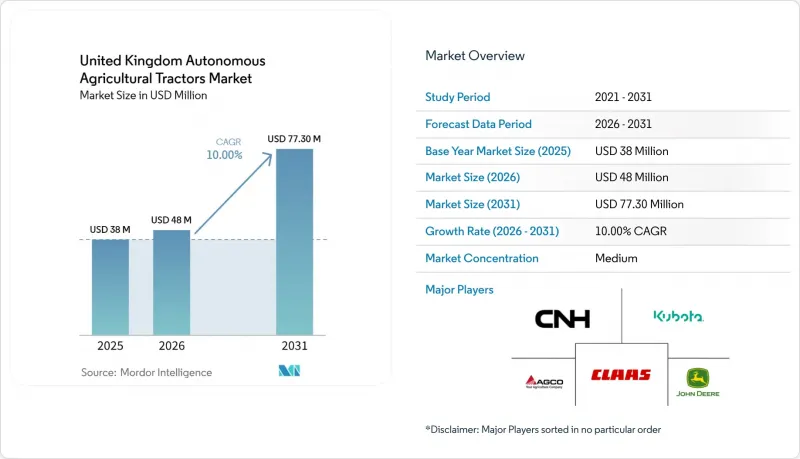
본 보고서는 마력(HP)별(30HP 이하, 31-100HP, 100HP 초과), 자동화 수준별(완전 자율, 반자율), 구동 방식별(디젤, 하이브리드, 기타), 용도별(경운, 파종, 수확, 기타), 구성 요소별(GPS·GNSS, 기타), 그리고 농장 규모별(소규모, 중규모, 대규모)로 분석되었습니다. 시장 예측은 금액(달러) 기준으로 제시되어 있습니다.
영국의 자율주행 농업용 트랙터 시장 동향 및 인사이트
농업 인력 부족과 숙련된 운전자의 부족
영국의 자율주행 농업용 트랙터 시장은 일시적인 것이 아닌 구조적인 노동력 변화의 혜택을 받고 있습니다. 브렉시트 이후 이민 정책의 변경으로 인해, 2024년에는 2020년 이전 수준과 비교하여 유럽연합(EU)에서 영국으로 유입되는 계절 근로자의 연간 수가 약 4만 명에서 7만 명 감소한 것으로 추정됩니다. 이러한 차이로 인해 원예 및 밭작물 농업 분야의 농장 작업 경제성이 변화하고 있습니다. 이러한 압박은 일반적인 농장 노동에 그치지 않고, 숙련된 트랙터 운전사나 감독자의 경우에도 고령 노동자들이 노동 시장에서 은퇴함에 따라 후임자를 찾는 것이 점점 더 어려워지고 있습니다. 이는 중요한 점입니다. 왜냐하면 초기 단계의 자율형 농업 기계는 경작이나 파종과 같은 반복적인 작업에서 가장 높은 성능을 발휘하기 때문입니다. 지금까지는 농장이 장시간에 걸쳐 정밀도를 유지하기 위해 숙련된 운전자에게 의존해 왔습니다. 이러한 인력 풀이 축소됨에 따라, 작업의 질을 유지하면서도 부족한 운전자에 대한 의존도를 낮추려는 농장들에게 영국의 자율주행 농업용 트랙터 시장은 점점 더 매력적인 선택지가 되고 있습니다. 이것이 광활한 경작 지역에서 중출력 및 고출력급 트랙터가 계속해서 상업적 관심의 대부분을 차지하는 이유 중 하나입니다.
정밀 농업 및 커넥티드 가이던스 스택의 도입
영국 자율 주행 농업용 트랙터 시장의 성장은 주요 경작지에서 정밀 농업의 도입 확대에 힘입고 있습니다. 농업·원예 개발 위원회(AHDB)에 따르면, 2025년 기준으로 국내 대규모 경작 농장의 65% 이상이 공장 출고 시 또는 사후 장착을 통해 RTK-GNSS 조향 시스템을 탑재한 트랙터를 이미 사용하고 있습니다. 이는 기존 트랙터 군의 상당 부분이 더 높은 수준의 자율 주행에 필요한 핵심 위치 파악 인프라를 이미 갖추고 있음을 의미합니다. 이러한 기존 기반을 통해 모든 경우에 기계를 완전히 교체하는 대신 소프트웨어, 센서, 제어 시스템의 업그레이드를 통해 자율 주행을 도입할 수 있으므로 도입 장벽이 낮아집니다. 존 디어는 기존의 정밀 농업 워크플로우에 기반한 경로 계획과 밭에서의 작업 실행을 지원하는 ‘커넥티드 머신 및 운영 생태계’를 통해 이러한 단계적 접근 방식을 추진해 왔습니다. 가이드 기능 지원 트랙터가 차량 군에 추가됨에 따라 자율 주행으로의 업그레이드 대상이 되는 기반이 확대되며, 현재의 정밀 농업 투자가 향후 몇 년에 걸쳐 영국의 자율주행 농업용 트랙터 시장 성장에 직접 기여하게 될 것입니다.
대기업 이외의 기업으로의 확산을 제한하는 높은 도입 비용
높은 초기 비용은 영국 자율주행 농업용 트랙터 시장에서 여전히 가장 뚜렷한 장벽 중 하나입니다. 고마력 대역의 완전 자율형 패키지에 수반되는 높은 가격은 연간 기계 사용량이 제한적이고, 투자 회수 기간이 일반적인 교체 주기를 초과하는 경우 소규모 농장에서는 비용 정당화를 어렵게 만듭니다. 2024년 환경·식량·농촌지역부(DEFRA)의 데이터에 따르면, 100헥타르 미만의 농장이 총 농지 면적의 대부분을 차지하고 있으며, 이는 대다수의 농장이 고가 자동화 기술의 초기 단계에서 경제성에 자연스럽게 부합하지 않음을 의미합니다. 사후 장착 옵션을 통해 도입 장벽은 낮아지지만, 사업 타당성은 여전히 가동률, 농지 배치, 숙련된 지원 서비스 이용 가능 여부에 좌우됩니다. 그 결과, 도입이 가장 활발한 곳은 광대한 농지와 가동 시간을 활용하여 기술을 더 넓은 면적에 적용할 수 있는 대규모 농장이나 계약업체입니다. 리스, 도급, 농장 간 공유와 같은 소유 모델이 더 보편화되기 전까지는 비용이 계속해서 영국 자율 주행 농업용 트랙터 시장의 도입을 저해하는 요인이 될 것으로 보입니다.
부문 분석
2025년, 31-100HP 부문은 영국 자율 농업용 트랙터 시장에서 38.9%의 점유율을 차지했으며, 매출 기준 최대의 HP 대역이 되었습니다. 이러한 위상은 잉글랜드 저지대 농업 전역에서 경운, 파종, 살포를 위해 다목적으로 활용 가능한 중출력 트랙터에 의존하는 밭작물과 수확기 대응 작물을 병행하는 농장의 보급을 반영하고 있습니다. 또한, 이 부문은 장비 비용, 농지에서의 범용성, 가이드 방식 또는 반자율 주행에 대한 적합성 사이에서 실용적인 균형을 이루고 있다는 점도 장점입니다. 영국 자율주행 농업용 트랙터 시장의 대부분에서 이 HP 대역은 즉시 최고급 기계로 전환하지 않고 자동화를 목표로 하는 농장에게 여전히 가장 현실적인 진입 지점으로 남아 있습니다.
100HP를 초과하는 부문은 2031년까지 연평균 성장률(CAGR) 11.5%를 나타낼 것으로 예측되며, 더욱 강력한 성장이 기대되는 부문임을 보여줍니다. 이러한 성장은 대규모 곡물 및 뿌리채소 재배 사업과 밀접한 관련이 있으며, 높은 견인력이 필요한 작업, 장거리 농지 주행, 야간 작업 등이 자동화에 대한 투자 대비 효과를 높이고 있습니다. AGCO 코퍼레이션은 ‘Fendt 1000 Vario Gen4’ 시리즈 출시를 통해 이러한 방향성을 한층 더 강화했습니다. 이 시리즈에는 경운 및 곡물 운반 작업을 위한 공장 출고 시 기본 장착된 자율 주행 옵션이 포함되어 있으며, 2026년부터 납품이 시작됩니다. 한편, 마력이 가장 낮은 부문은 여전히 제한적인 특수 용도에 그치고 있으며, 영국의 자율 주행 농업용 트랙터 시장에서 주류를 이루는 농지용 장비 부문에 비해 크게 뒤처져 있습니다. 상업적 도입이 확대됨에 따라, 대형 기계가 더 광활한 농지에서 더 오랜 시간 가동될 수 있는 부문에서 HP의 성장세가 가장 두드러질 것으로 추정됩니다.
2025년 시점에서 반자율형 시스템은 영국 자율주행 농업용 트랙터 시장 점유율의 67.6%를 차지했으며, 주요 자동화 수준이 되었습니다. 이러한 위상은 작업자(운영자)를 작업 루프 내 또는 그 근처에 머물게 하는 시스템을 선호하는 현재의 보험, 안전, 규제 상황을 반영한 것입니다. 반자율형 기계는 인정된 운영 관행의 범위 내에서 경로 실행, 밭 가장자리 관리, 작업 기구와의 연동을 통해 가치를 제공합니다. 그 결과, 2025년과 2026년 영국의 자율주행 농업용 트랙터 시장에서 감독형 자율 주행이 가장 상업적으로 실현 가능한 범주로 자리매김하고 있습니다.
완전 자율 시스템은 현재 생산 대수가 적지만, 2031년까지 연평균 성장률(CAGR) 13.0%를 나타낼 것으로 예측됩니다. 이러한 성장 전망은 존 디어(John Deere)와 쿠보타(Kubota)를 비롯한 주요 제조업체들의 제품 출시로 뒷받침되고 있습니다. 이들 기업은 이미 밭작물 및 특수 작물용 자율성이 높은 플랫폼을 상용화하고 있습니다. 이는 규제가 미비한 상황에서도 제품 준비가 진행되고 있음을 보여줍니다. 안전성 검증이 진행되고 법적 명확성이 높아짐에 따라, 영국의 자율주행 농업용 트랙터 시장에서 감독 하의 운행에서 무인 농장 작업으로 전환되는 비율이 확대될 것으로 추정됩니다. 이러한 전환은 지오펜스가 설정된 농장 환경에서의 반복적인 작업에서 시작되어, 이후 더욱 다양한 용도로 확대될 것으로 전망됩니다.
기타 혜택
- 엑셀 형식 시장 예측(ME) 시트
- 3개월간의 애널리스트 지원
자주 묻는 질문
목차
제1장 서론
제2장 조사 방법
제3장 주요 요약
제4장 시장 구도
제5장 시장 규모 및 성장 예측
제6장 경쟁 구도
제7장 시장 기회 및 향후 전망
AJY 26.09.03According to Mordor Intelligence, the United Kingdom autonomous agricultural tractors market size was valued at USD 38 million in 2025 and estimated to grow from USD 48 million in 2026 to reach USD 77.3 million by 2031, at a CAGR of 12.5% during the forecast period (2026-2031).
This report is Segmented by Horsepower (Up To 30 HP, 31 To 100 HP, and Above 100 HP), by Automation Level (Fully Automated and Semi-Automated), by Drive Type (Diesel, Hybrid, and More), by Application (Tillage, Sowing, Harvesting, and More), by Component (GPS and GNSS, and More), and by Farm Size (Small, Medium, and Large). The Market Forecasts are Provided in Terms of Value (USD).
United Kingdom Autonomous Agricultural Tractors Market Trends and Insights
Farm Labor Shortages and Skilled Operator Scarcity
The United Kingdom autonomous agricultural tractors market is benefiting from a labor shift that has become structural rather than temporary. Post-Brexit migration changes reduced the annual inflow of seasonal European Union farm workers into the United Kingdom by an estimated 40,000 to 70,000 in 2024 compared with pre-2020 levels, and that gap has altered the economics of field operations across horticulture and arable farming. The pressure is not limited to general field labor, as experienced tractor operators and supervisors are also becoming harder to replace as older workers leave the workforce. This is relevant because early autonomy performs best in repetitive activities such as tillage and drilling, where farms previously relied on skilled operators to maintain accuracy over long hours. As that labor pool shrinks, the United Kingdom autonomous agricultural tractors market becomes more attractive to farms seeking to reduce dependence on scarce operators while maintaining work quality. This is one reason the mid-range and high-horsepower classes continue to draw most of the commercial attention in large arable regions.
Precision Agriculture and Connected Guidance Stack Adoption
Growth in the United Kingdom autonomous agricultural tractors market is supported by the increasing adoption of precision agriculture across major arable holdings. According to Agriculture and Horticulture Development Board (AHDB), more than 65% of large arable farms in the country in 2025 already use tractors equipped with factory-fitted or retrofit RTK-GNSS steering systems. This means a significant share of the existing fleet already has the core positioning infrastructure required for higher levels of autonomy. This installed base reduces adoption barriers, as autonomy can be introduced through software, sensor, and control upgrades rather than full machine replacement in every case. John Deere has pursued this staged approach through its connected machine and operations ecosystem, which supports path planning and field execution based on existing precision workflows. As more guidance-ready tractors enter the fleet, they expand the addressable base for autonomous upgrades, making current precision agriculture investments a direct contributor to growth in the United Kingdom autonomous agricultural tractors market over the next several years.
High Acquisition Cost Limits Reach Beyond Large Enterprises
High upfront cost remains one of the clearest barriers to the United Kingdom autonomous agricultural tractors market. The premium attached to fully autonomous packages in the higher horsepower range is difficult for smaller farms to justify when annual machine use is limited and payback periods extend beyond normal replacement cycles. In 2024, Department for Environment, Food and Rural Affairs (DEFRA) data show that farms below 100 ha account for a large share of total holdings, which means much of the farm base does not naturally fit the early economics of premium automation. Although retrofit options reduce the entry point, the business case still depends on utilization, field layout, and access to skilled support. As a result, adoption remains strongest among large farms and contractors, which can spread the technology across more acres and operating hours. Until ownership models such as leasing, contracting, and cross-farm sharing become more common, cost will continue to slow adoption in the United Kingdom autonomous agricultural tractors market.
Other drivers and restraints analyzed in the detailed report include:
- Government Funding Accelerates Autonomous Tractor Adoption
- Productivity Gains from 24-Hour Field Operations and Multi-Machine Supervision
- Regulatory Ambiguity Delays Fully Unattended Deployment
For complete list of drivers and restraints, kindly check the Table Of Contents.
Segment Analysis
The 31-to-100 HP segment held 38.9% of the United Kingdom autonomous agricultural tractors market in 2025, making it the largest horsepower band by revenue. This position reflects the prevalence of mixed arable and combinable-crop farms that rely on versatile mid-range tractors for cultivation, sowing, and spraying throughout English lowland agriculture. The segment also benefits from a practical balance between equipment cost, field versatility, and suitability for guided or semi-autonomous operation. Across much of the United Kingdom's autonomous agricultural tractor market, this range remains the most realistic entry point for farms seeking automation without immediately transitioning to the largest machines.
The above-100 HP segment is forecast to grow at a 11.5% CAGR through 2031, indicating where stronger expansion is anticipated. This growth is tied to large cereal and root crop operations, where high-draft work, long field runs, and overnight operations generate a stronger return on investment in autonomy. AGCO Corporation reinforced this direction with the launch of the Fendt 1000 Vario Gen4 series, which includes factory-integrated autonomy options for tillage and grain cart operations, with deliveries beginning in 2026. The smallest horsepower tier remains limited to narrower specialty uses, keeping it well behind the mainstream field equipment classes in the United Kingdom autonomous agricultural tractors market. As commercial adoption broadens, horsepower growth is estimated to remain strongest where large machines can operate for longer hours across more acres.
Semi-autonomous systems held 67.6% of the United Kingdom autonomous agricultural tractors market share in 2025, making them the dominant automation level. This position reflects current insurance, safety, and regulatory conditions, which favor systems that keep an operator in or near the working loop. Semi-autonomous machines deliver value through path execution, headland management, and implement coordination while remaining within accepted operating practices. As a result, supervised autonomy has become the most commercially viable category in the United Kingdom autonomous agricultural tractors market for 2025 and 2026.
Fully autonomous systems are projected to grow at a 13.0% CAGR through 2031, despite currently lower volumes. This growth outlook is supported by product launches from large manufacturers, including John Deere and Kubota Corporation, that are already commercializing higher-autonomy platforms for field and specialty-crop use. This indicates that product readiness is advancing even as regulation remains incomplete. As safety validation improves and legal clarity increases, a larger share of the United Kingdom autonomous agricultural tractors market is estimated to shift from supervised execution to unattended field operation. This transition will likely begin with repetitive tasks in geofenced field conditions before extending to more variable applications.
Complete Report Scope:
- By Horsepower
- Up to 30 HP
- 31 to 100 HP
- Above 100 HP
- By Automation Level
- Semi-Autonomous
- Fully Autonomous
- By Drive Type
- Diesel
- Hybrid
- Battery-Electric
- By Application
- Tillage
- Sowing
- Harvesting
- Orchard and Vineyard Operations
- By Component
- GPS and GNSS
- Sensors and Vision Systems
- LiDAR and Radar Modules
- Control and Navigation Software
- By Farm Size
- Small (Less than 100 ha)
- Medium (100 to 500 ha)
- Large (More than 500 ha)
List of Companies Covered in this Report:
- Deere and Company
- CNH Industrial N.V.
- AGCO Corporation
- Kubota Corporation
- CLAAS KGaA mbH
- YANMAR HOLDINGS CO., LTD.
- Monarch Tractor
- Mahindra and Mahindra
- TYM Corporation
- SDF Group
- ZETOR TRACTORS a.s. (HTC Corporation)
- Sonalika
- Kioti (Daedong)
- New Holland Agriculture
- JCB
Additional Benefits:
- The market estimate (ME) sheet in Excel format
- 3 months of analyst support
TABLE OF CONTENTS
1 Introduction
- 1.1 Study Assumptions and Market Definition
- 1.2 Scope of the Study
2 Research Methodology
3 Executive Summary
4 Market Landscape
- 4.1 Market Overview
- 4.2 Market Drivers
- 4.2.1 Farm labor shortages and skilled operator scarcity
- 4.2.2 Precision agriculture and connected guidance stack adoption
- 4.2.3 Government funding accelerates autonomous tractor adoption
- 4.2.4 Productivity gains from 24-hour field operations and multi-machine supervision
- 4.2.5 Retrofit autonomy kits and autonomy-ready tractor platforms
- 4.2.6 Specialty-crop mechanization in orchards and vineyards
- 4.3 Market Restraints
- 4.3.1 High acquisition cost limits reach beyond large enterprises
- 4.3.2 Regulatory ambiguity delays fully unattended deployment
- 4.3.3 Connectivity and positioning weaknesses reduce operating confidence
- 4.3.4 Mixed-fleet compatibility and service readiness still need work
- 4.4 Regulatory Landscape
- 4.5 Technological Outlook
- 4.6 Porter's Five Forces Analysis
- 4.6.1 Bargaining Power of Suppliers
- 4.6.2 Bargaining Power of Buyers
- 4.6.3 Threat of New Entrants
- 4.6.4 Threat of Substitutes
- 4.6.5 Intensity of Competitive Rivalry
5 Market Size and Growth Forecasts (Value)
- 5.1 By Horsepower
- 5.1.1 Up to 30 HP
- 5.1.2 31 to 100 HP
- 5.1.3 Above 100 HP
- 5.2 By Automation Level
- 5.2.1 Semi-Autonomous
- 5.2.2 Fully Autonomous
- 5.3 By Drive Type
- 5.3.1 Diesel
- 5.3.2 Hybrid
- 5.3.3 Battery-Electric
- 5.4 By Application
- 5.4.1 Tillage
- 5.4.2 Sowing
- 5.4.3 Harvesting
- 5.4.4 Orchard and Vineyard Operations
- 5.5 By Component
- 5.5.1 GPS and GNSS
- 5.5.2 Sensors and Vision Systems
- 5.5.3 LiDAR and Radar Modules
- 5.5.4 Control and Navigation Software
- 5.6 By Farm Size
- 5.6.1 Small (Less than 100 ha)
- 5.6.2 Medium (100 to 500 ha)
- 5.6.3 Large (More than 500 ha)
6 Competitive Landscape
- 6.1 Market Concentration
- 6.2 Strategic Moves
- 6.3 Market Share Analysis
- 6.4 Company Profiles (Includes Global Level Overview, Market Level Overview, Core Segments, Financials as Available, Strategic Information, Market Rank/Share, Products and Services, Recent Developments)
- 6.4.1 Deere and Company
- 6.4.2 CNH Industrial N.V.
- 6.4.3 AGCO Corporation
- 6.4.4 Kubota Corporation
- 6.4.5 CLAAS KGaA mbH
- 6.4.6 YANMAR HOLDINGS CO., LTD.
- 6.4.7 Monarch Tractor
- 6.4.8 Mahindra and Mahindra
- 6.4.9 TYM Corporation
- 6.4.10 SDF Group
- 6.4.11 ZETOR TRACTORS a.s. (HTC Corporation)
- 6.4.12 Sonalika
- 6.4.13 Kioti (Daedong)
- 6.4.14 New Holland Agriculture
- 6.4.15 JCB