|
시장보고서
상품코드
2066581
유리 기판 : 시장 점유율 분석, 업계 동향 및 통계, 성장 예측(2026-2031년)Glass Substrate - Market Share Analysis, Industry Trends & Statistics, Growth Forecasts (2026 - 2031) |
||||||
 Mordor Intelligence
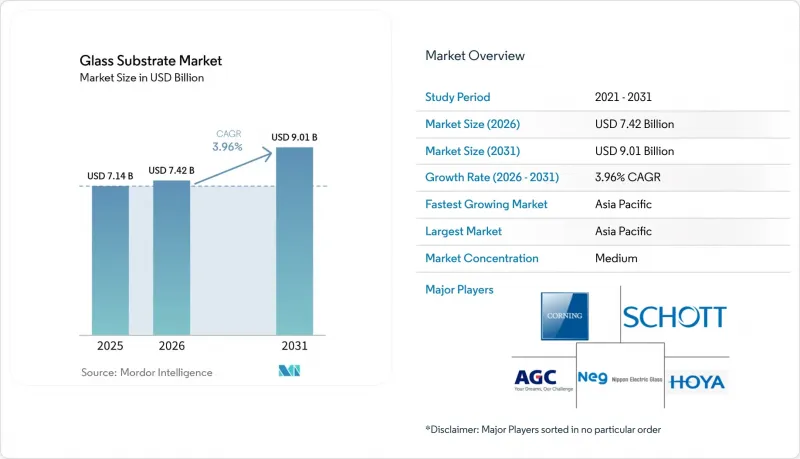
Mordor Intelligence에 의하면, 유리 기판 시장 규모는 2025년에 71억 4,000만 달러로 평가되었습니다. 2026년 74억 2,000만 달러에서 2031년까지 90억 1,000만 달러에 이를 것으로 예상되며, 예측 기간(2026-2031년) CAGR은 3.96%를 나타낼 전망입니다.
본 보고서는 소재 유형(붕규산 유리, 실리콘, 기타), 용도(디스플레이 패널, 반도체 등), 최종 사용자 산업(전자, 자동차, 항공우주 및 방위, 의료 등) 및 지역(아시아태평양, 북미, 유럽, 남미, 중동 및 아프리카)별로 분류되어 있습니다. 시장 전망은 금액(달러) 기준으로 제시되어 있습니다.
세계의 유리 기판 시장 동향 및 분석
소비자용 전자기기에서의 LCD 활용 확대
중급형 스마트폰, 태블릿, 모니터용 LCD 출하량이 견조한 추세를 보이고 있어, 유리 기판 시장은 아시아태평양의 제조 거점에 확고히 자리 잡고 있습니다. 대형 게이밍 모니터나 전문가용 모니터의 경우, 베젤리스 디자인을 구현하기 위해 더 얇고 가벼운 기판이 채택되고 있으며, 이를 통해 운송 중량을 줄이고 패널 파손을 방지하는 데 기여하고 있습니다. 고부가가치 LCD 패널로 제품 구성이 전환됨에 따라, 범용 규모의 생산 능력은 물론 정밀한 두께 감소 가공 및 표면 처리가 가능한 공급업체에게 유리한 상황이 되고 있습니다. 이러한 이중 역량은 여러 용도에 걸쳐 연구개발비를 상각할 수 있는 수직 통합형 제조업체의 기존 입지를 강화하고 있습니다. 또한, 디스플레이 OEM 제조업체의 로드맵을 통해 자동차용 인포테인먼트 시스템의 사후 장착 시장에서 유리 수요가 점차 증가할 것으로 예상되며, 기존 LCD 공장에서는 곡면 콕핏 클러스터용으로 생산 능력을 재분배하고 있습니다.
반도체 생산 라인 확장
인텔, 삼성, TSMC가 2030년까지 발표했던 총 1,500억 달러 규모의 신규 팹 건설 열풍이 유리 기판 시장을 재편하고 있습니다. 수요는 EUV 패터닝용 석영 포토마스크 블랭크, 2.5D 및 3D 패키징용 유리 코어 기판, 그리고 극한의 클린룸 환경에서 사용되는 화학적 비활성 검사용 윈도우라는 세 가지 분야에서 확대되고 있습니다. 라피다스사가 600mm×600mm 크기의 유리 패널을 실증함에 따라, 실리콘 인터포저에 비해 칩 수율이 10배 향상될 것으로 기대되며, 이는 원형 웨이퍼에 비해 직사각형 유리 패널이 면적 효율 측면에서 우월함을 여실히 보여주고 있습니다. 이 생태계에서 초기 설계 채택은 공급업체를 장기적인 인증 주기에 묶어두게 되며, 파운드리 생산량에 맞추어 생산 능력을 확대하는 기업에 이점을 가져다줍니다.
높은 제조 비용과 설비 투자
새로운 플로트법 또는 퓨전 드로 방식 생산 라인의 건설 비용은 2억-5억 달러이며, 그중 용해로 비용이 초기 투자의 최대 40%를 차지합니다. SCHOTT사가 마인츠에서 진행한 4,000만 유로 규모의 전기용해 설비 개조는 탈탄소화에 따른 설비 투자 비용을 여실히 보여주고 있지만, 통합형 기업들은 에너지 가격 변동 위험을 헤지하기 위해 이를 필수적인 조치로 간주하고 있습니다. 초박형 유리나 석영 블랭크와 같은 특수 제품 분야에서는 화학적 강화, 연마, 클래스 1 클린룸에 대한 추가 투자가 필요하며, 프로젝트의 총 비용은 3억 달러를 초과합니다. 이러한 장벽으로 인해, 폭넓은 제품 포트폴리오를 활용하여 회수 기간이 긴 투자를 다른 분야에서 상쇄할 수 있는 기존 기업들을 중심으로 유리 기판 시장이 통합되고 있습니다.
부문별 분석
붕규산 유리는 2025년 유리 기판 시장 규모의 45.76%를 차지했으며, 열적 안정성과 비용 면에서의 우위 덕분에 TFT-LCD 생산의 기반으로서 계속해서 자리매김하고 있습니다. 기존의 LCD 생산 능력이 자동차용 및 산업용 디스플레이로 전환됨에 따라 시장 점유율 증가세는 둔화되고 있지만, 8.5세대 및 10.5세대 생산 시설의 막대한 처리 능력 덕분에 붕규산 유리 생산량은 여전히 높은 수준을 유지하고 있습니다. 각 공급업체들은 특히 곡면형 인포테인먼트 디스플레이나 대형 게이밍 모니터를 대상으로, 더 높은 이익률을 확보하기 위해 정밀 박형화 및 표면 처리 라인 확충을 추진하고 있습니다. 한편, 석영 기판은 EUV 리소그래피를 통한 3nm 이하의 지속적인 미세화를 배경으로, 2031년까지 연평균 성장률(CAGR) 4.41%를 나타낼 것으로 전망됩니다. 열팽창 계수(CTE)가 거의 0에 가깝고, 금속 불순물이 ppb 미만일 정도로 순도가 높기 때문에 석영의 단가는 붕규산 유리보다 몇 배나 높아, 상품 가격 변동으로부터 이익률을 보호하고 있습니다.
석영 수요 증가는 공급망을 변화시키고 있습니다. HOYA와 신에츠 화학공업으로 대표되는 합성 석영 분야의 두 독점 기업은 현재 CVD 반응기 증설에 투자하고 있는 반면, 반도체 OEM 업체들은 EUV 블랭크 부족을 해소하기 위해 생산 능력 확충에 공동 투자하고 있습니다. 따라서 유리 기판 시장은 비용 효율성을 추구하는 대량 생산형 붕규산 유리 공장과, 결함 없는 품질을 중시하는 소량 생산형 석영 공장으로 양극화가 진행되고 있습니다. 두 소재 모두 필수적이지만, 수익의 원천은 석영과 유연성 및 내스크래치성을 겸비한 접이식 기기용 새로운 유리-세라믹 하이브리드 소재로 이동하고 있습니다.
지역별 분석
아시아태평양은 2025년에 48.82%의 점유율로 유리 기판 시장을 독점했으며, 2031년까지 연평균 성장률(CAGR) 4.19%로 가장 높은 성장세를 보일 것으로 전망됩니다. 중국의 BOE, CSOT, HKC는 전 세계 TFT-LCD 생산 능력의 대부분을 차지하고 있으며, 이로 인해 붕규산 유리에 대한 막대한 수요가 발생하고 있습니다. 일본은 EUV 마스크 블랭크용 합성 석영공급을 계속해서 장악하고 있는 반면, 한국은 초박형 유리 및 접이식 OLED 분야의 혁신을 주도하고 있습니다. 대만의 파운드리 클러스터에서는 석영 블랭크와 유리 캐리어가 소비되고 있으며, TSMC의 애리조나주 및 구마모토현 내 확장으로 인해 해당 지역 외부에 2차 거점이 형성되고 있습니다. 인도의 Vedanta-AvanStrate가 진행한 투자는 현지 스마트폰 및 TV 조립을 목적으로 하는 신생 국내 기판 생산 거점의 형성을 시사하고 있습니다.
북미 시장의 성장은 범용 LCD 생산보다는 반도체 패키징 및 자동차용 디스플레이 프로젝트에 의해 뒷받침되고 있습니다. 인텔의 오하이오주 및 애리조나주 팹에서는 패널 크기의 유리 코어 기판에 대한 검증이 진행될 예정이며, 앱솔릭스(Absolix)사의 ‘CHIPS법’ 지원을 받은 이 공장은 이 분야에서 미국 최초의 제조 거점이 될 것입니다. 코닝사의 뉴욕 및 노스캐롤라이나 주 사업장은 해당 지역의 전자기기 및 자동차 OEM 제조업체에 고릴라 글라스, UTG, 정밀 광학 소자를 공급하고 있습니다. 미국, 캐나다, 멕시코의 자동차 제조업체들은 2026년부터 2027년형 모델에 전면 유리 전체를 덮는 HUD(헤드업 디스플레이)를 탑재하고 있어, 곡면 유리 미러와 홀로그래픽 라미네이트에 대한 수요가 증가하고 있습니다.
유럽의 유리 기판 수요는 독일, 프랑스, 영국에서의 상당한 소비에 힘입어 증가하고 있습니다. 샷(Shot)사의 전기 용융로 개조는 유럽의 탈탄소화 노력을 상징하는 것이며, 2024년에 석영 유리 전문 기업인 QSIL을 인수함으로써 EUV 리소그래피 분야로의 전략적 진출이 강화되었습니다. BMW와 메르세데스-벤츠 등 자동차 OEM 각사는 고투명도 유리에 적층된 ZEISS 및 파나소닉의 광학 소자를 채택한 AR 전면 유리를 도입하고 있습니다. 에너지 비용의 급등과 배출 규제의 강화로 인해 범용 붕규산 유리의 이익률이 압박을 받고 있으며, 유럽의 제조업체들은 고수익을 올릴 수 있는 특수 분야나 에너지 효율이 높은 용융 기술로 전환하고 있습니다.
남미 및 중동 및 아프리카에서는 유리 기판, 특히 건설용 및 자동차용 플로트 유리에 대한 수요가 증가하고 있지만, 반도체 및 첨단 디스플레이 시장에서의 비중은 제한적입니다.
기타 혜택 :
- 엑셀 형식 시장 예측(ME) 시트
- 3개월간의 애널리스트 지원
자주 묻는 질문
목차
제1장 서론
제2장 조사 방법
제3장 주요 요약
제4장 시장 구도
제5장 시장 규모 및 성장 예측
제6장 경쟁 구도
제7장 시장 기회 및 향후 전망
KTH 26.06.29According to Mordor Intelligence, the glass substrate market size was valued at USD 7.14 billion in 2025 and is estimated to grow from USD 7.42 billion in 2026 to reach USD 9.01 billion by 2031, at a CAGR of 3.96% during the forecast period (2026-2031).
This report is Segmented by Material Type (Borosilicate, Silicon, and Other Types), Application (Display Panels, Semiconductors, and More), End-User Industry (Electronics, Automotive, Aerospace and Defense, Medical, and More), and Geography (Asia-Pacific, North America, Europe, South America, and Middle-East and Africa). The Market Forecasts are Provided in Terms of Value (USD).
Global Glass Substrate Market Trends and Insights
Growing Usage of LCDs in Consumer Electronics
Persistent LCD volumes in mid-range smartphones, tablets, and monitors keep the glass substrates market firmly anchored in Asia-Pacific manufacturing hubs. Large-format gaming and professional monitors are now adopting thinner, lighter substrates to enable borderless designs that cut shipping weight and curb panel breakage. The mix shift toward higher value LCD panels favors suppliers capable of precision thinning and surface treatments alongside commodity-scale output. These dual capabilities strengthen incumbent positions for vertically integrated producers that can amortize R&D across multiple applications. Display OEM roadmaps also signal incremental glass demand from automotive infotainment retrofits, where existing LCD fabs redeploy capacity toward curved cockpit clusters.
Expansion of Semiconductor Fabrication Lines
The USD 150 billion wave of new fabs announced by Intel, Samsung, and TSMC through 2030 is reshaping the glass substrates market. Demand is ramping across three vectors: quartz photomask blanks for EUV patterning, glass-core substrates for 2.5D and 3D packages, and chemically inert inspection windows used in extreme-clean-room environments. Rapidus's demonstration of a 600 mm X 600 mm glass panel promises 10-fold chip yield relative to silicon interposers, highlighting the area-economy edge of rectangular glass panels over round wafers. Early design wins in this ecosystem lock suppliers into long qualification cycles, rewarding those who scale capacity in tandem with foundry outputs.
High Manufacturing and Capital Costs
Greenfield float or fusion-draw lines cost USD 200 million-USD 500 million, with melting furnaces consuming up to 40% of initial outlays. SCHOTT's EUR 40 million electric-melting retrofit at Mainz highlights the capex premium of decarbonization, yet integrated players deem it essential to hedge energy volatility. Specialty paths-ultra-thin glass, quartz blanks-stack extra investments in chemical strengthening, polishing, and Class 1 clean rooms, pushing fully loaded project costs above USD 300 million. This barrier consolidates the glass substrates market around incumbents capable of cross-subsidizing long paybacks with broad product portfolios.
Other drivers and restraints analyzed in the detailed report include:
- Rising Demand for Automotive and AR/VR Displays
- Emergence of Glass Core Substrates in Advanced Packaging
- Persistent Supply-Chain Volatility and Energy Price Spikes
For complete list of drivers and restraints, kindly check the Table Of Contents.
Segment Analysis
Borosilicate glass accounted for 45.76% of the glass substrates market size in 2025 and continues to underpin TFT-LCD production due to its thermal stability and cost advantage. Its share growth is slowing as legacy LCD capacity pivots toward automotive and industrial displays, yet the sheer throughput of Gen 8.5 and Gen 10.5 fabs keeps borosilicate volumes high. Suppliers are adding precision thinning and surface-treatment lines to command better margins, particularly for curved infotainment and larger gaming monitors. Meanwhile, quartz substrates are projected to post a 4.41% CAGR through 2031 on the back of EUV lithography's relentless scaling below 3 nm. Near-zero CTE and sub-ppb metallic purity push quartz unit pricing multiples higher than borosilicate, insulating margins from commodity swings.
Quartz's rising demand transforms supply chains: HOYA and Shin-Etsu's synthetic-quartz duopoly now invests in additional CVD reactors, while semiconductor OEMs co-fund capacity to avoid EUV blank shortages. The glass substrates market, therefore, bifurcates into high-volume borosilicate workshops chasing cost efficiencies and low-volume quartz operations emphasizing defect-free quality. Both materials remain indispensable, but profit pools skew toward quartz and emerging glass-ceramic hybrids for foldables that blend flexibility with scratch resistance.
Geography Analysis
Asia-Pacific dominated the glass substrates market with a 48.82% share in 2025 and is projected to post the highest 4.19% CAGR through 2031. China's BOE, CSOT, and HKC run the bulk of global TFT-LCD capacity, generating massive demand for borosilicate glass. Japan maintains control of the synthetic-quartz supply for EUV mask blanks, while South Korea spearheads ultra-thin glass and foldable OLED innovations. Taiwan's foundry cluster consumes quartz blanks and glass carriers, with TSMC's expansion in Arizona and Kumamoto creating secondary hubs outside the region. India's Vedanta-AvanStrate investment signals an emerging domestic substrate base aimed at local smartphone and TV assembly.
North America market growth is buoyed by semiconductor packaging and automotive display projects rather than commodity LCD output. Intel's Ohio and Arizona fabs will validate panel-scale glass-core substrates, and Absolics' CHIPS Act-supported plant anchors the first U.S. manufacturing footprint in this field. Corning's New York and North Carolina sites supply Gorilla Glass, UTG, and precision optics to regional electronics and vehicle OEMs. Automotive makers in the United States, Canada, and Mexico are integrating windshield-wide HUDs into 2026-2027 models, intensifying demand for curved glass mirrors and holographic laminates.
The European glass substrates demand is anchored by significant consumption in Germany, France, and the United Kingdom. SCHOTT's electric-melting retrofit showcases Europe's decarbonization push, while its 2024 acquisition of quartz-glass specialist QSIL strengthens strategic exposure to EUV lithography. Automotive OEMs such as BMW and Mercedes-Benz deploy AR windshields that rely on ZEISS and Panasonic optics laminated in high-clarity glass. Elevated energy costs and tighter emission norms pressure commodity borosilicate margins, driving European producers toward high-margin specialty segments and energy-efficient melting technologies.
South America and the Middle East & Africa are witnessing a rising demand for glass substrates, mostly float-glass for construction and autoglass, with limited exposure to semiconductor or advanced display markets.
- AGC Inc.
- AvanStrate Inc.
- Corning Incorporated
- HOYA Corporation
- Irico Group New Energy Company Limited
- Kyocera Corporation
- Nippon Electric Glass Co., Ltd.
- Nitto Boseki Co., Ltd.
- Ohara Inc.
- Planoptik AG
- Saint-Gobain
- Samtec
- SCHOTT AG
- SHENZHEN LAIBAO HI-TECH CO., LTD
- TOPPAN Holdings Inc.
Additional Benefits:
- The market estimate (ME) sheet in Excel format
- 3 months of analyst support
TABLE OF CONTENTS
1 Introduction
- 1.1 Study Assumptions and Market Definition
- 1.2 Scope of the Study
2 Research Methodology
3 Executive Summary
4 Market Landscape
- 4.1 Market Overview
- 4.2 Market Drivers
- 4.2.1 Growing usage of LCDs in consumer electronics
- 4.2.2 Expansion of semiconductor fabrication lines
- 4.2.3 Rising demand for automotive and AR/VR displays
- 4.2.4 Growth of high-efficiency photovoltaic cells
- 4.2.5 Emergence of glass core substrates in advanced packaging
- 4.3 Market Restraints
- 4.3.1 High manufacturing and capital costs
- 4.3.2 Persistent supply-chain volatility and energy price spikes
- 4.3.3 Stringent environmental regulations on boron emissions
- 4.4 Value Chain Analysis
- 4.5 Porter's Five Forces
- 4.5.1 Threat of New Entrants
- 4.5.2 Bargaining Power of Buyers
- 4.5.3 Bargaining Power of Suppliers
- 4.5.4 Threat of Substitute Products
- 4.5.5 Degree of Competition
- 4.6 Technological Snapshot
5 Market Size and Growth Forecasts (Value)
- 5.1 By Material Type
- 5.1.1 Borosilicate
- 5.1.2 Silicon
- 5.1.3 Ceramic
- 5.1.4 Quartz
- 5.1.5 Other Types (Sapphire, Aluminosilicate, etc.)
- 5.2 By Application
- 5.2.1 Display Panels
- 5.2.2 Semiconductors
- 5.2.3 Solar Cells
- 5.2.4 Other Applications
- 5.3 By End-user Industry
- 5.3.1 Electronics
- 5.3.2 Automotive
- 5.3.3 Aerospace and Defense
- 5.3.4 Medical
- 5.3.5 Solar Power
- 5.3.6 Other End-user Industries (Equipment Manufacturing, Telecommunication, etc.)
- 5.4 By Geography
- 5.4.1 Asia-Pacific
- 5.4.1.1 China
- 5.4.1.2 Japan
- 5.4.1.3 South Korea
- 5.4.1.4 India
- 5.4.1.5 ASEAN Countries
- 5.4.1.6 Rest of Asia-Pacific
- 5.4.2 North America
- 5.4.2.1 United States
- 5.4.2.2 Canada
- 5.4.2.3 Mexico
- 5.4.3 Europe
- 5.4.3.1 Germany
- 5.4.3.2 United Kingdom
- 5.4.3.3 France
- 5.4.3.4 Italy
- 5.4.3.5 Spain
- 5.4.3.6 NORDIC Countries
- 5.4.3.7 Rest of Europe
- 5.4.4 South America
- 5.4.4.1 Brazil
- 5.4.4.2 Argentina
- 5.4.4.3 Rest of South America
- 5.4.5 Middle East and Africa
- 5.4.5.1 Saudi Arabia
- 5.4.5.2 United Arab Emirates
- 5.4.5.3 Qatar
- 5.4.5.4 South Africa
- 5.4.5.5 Nigeria
- 5.4.5.6 Egypt
- 5.4.5.7 Rest of Middle-East and Africa
- 5.4.1 Asia-Pacific
6 Competitive Landscape
- 6.1 Market Concentration
- 6.2 Strategic Moves
- 6.3 Market Share(%)/Ranking Analysis
- 6.4 Company Profiles (includes Global level Overview, Market level overview, Core Segments, Financials as available, Strategic Information, Market Rank/Share for key companies, Products and Services, and Recent Developments)
- 6.4.1 AGC Inc.
- 6.4.2 AvanStrate Inc.
- 6.4.3 Corning Incorporated
- 6.4.4 HOYA Corporation
- 6.4.5 Irico Group New Energy Company Limited
- 6.4.6 Kyocera Corporation
- 6.4.7 Nippon Electric Glass Co., Ltd.
- 6.4.8 Nitto Boseki Co., Ltd.
- 6.4.9 Ohara Inc.
- 6.4.10 Planoptik AG
- 6.4.11 Saint-Gobain
- 6.4.12 Samtec
- 6.4.13 SCHOTT AG
- 6.4.14 SHENZHEN LAIBAO HI-TECH CO., LTD
- 6.4.15 TOPPAN Holdings Inc.
7 Market Opportunities and Future Outlook
- 7.1 White-space and Unmet-need Assessment