

|
시장보고서
상품코드
2072744
피부과 분야 AI 시장 : 시장 점유율 분석, 업계 동향 및 통계, 성장 예측(2026-2031년)AI In Dermatology - Market Share Analysis, Industry Trends & Statistics, Growth Forecasts (2026 - 2031) |
||||||
 Mordor Intelligence
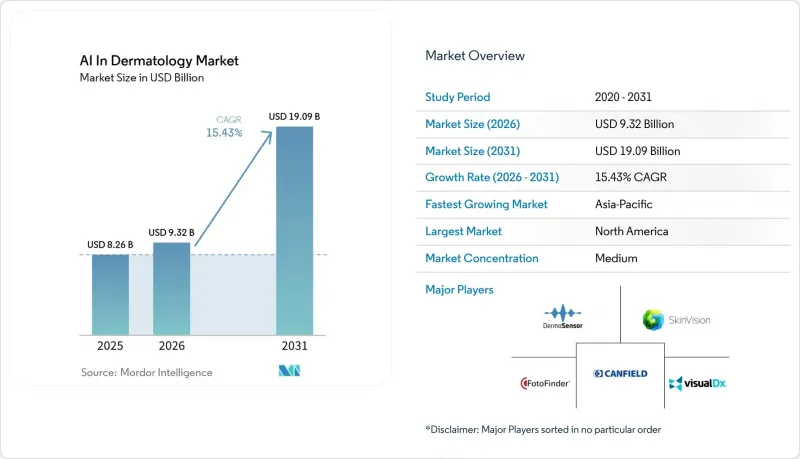
Mordor Intelligence에 의하면, 피부과 분야 AI 시장은 2025년 82억 6,000만 달러로 평가되었고, 2026년에는 93억 2,000만 달러로 추정되고, 2031년까지 190억 9,000만 달러에 이를 것으로 예측되며, 2026-2031년 CAGR 15.43%로 성장할 전망입니다.
본 보고서는 제품 유형별(AI 진단 소프트웨어, 기타), 도입 형태별(클라우드 기반, 온프레미스형, 엣지 및 디바이스형), 질환별(피부암, 기타), 최종 사용자별(병원, 피부과 클리닉, 학술 기관, 기타), 지역별(북미, 유럽, 아시아태평양, 중동 및 아프리카, 남미)로 분류되어 있습니다. 시장 전망은 금액(달러) 기준으로 제시되어 있습니다.
세계의 피부과 분야 AI 시장 동향 및 인사이트
딥러닝을 활용한 피부 병변 분류기의 정확도 향상
피부과 분야 AI 시장은 실제 임상 현장에서 분류기의 성능이 전문의 수준의 결과에 근접함에 따라 성장세를 보이고 있습니다. 독일의 8개 대학병원을 대상으로 한 전향적 다기관 공동 연구에 따르면, ADAE 앙상블 모델의 정확도는 0.798(피부과 전문의의 0.781에 비해)로 비슷한 수준을 보였으며, 민감도는 0.922(피부과 전문의의 0.734에 비해)를 기록했습니다. 특히 악성 주근깨 및 표재성 확산형 흑색종에서 매우 뛰어난 성능이 확인되었습니다. 이러한 개선은 소프트웨어 도입에 관한 논의를 '소프트웨어가 작동하는지'라는 단계에서 '실무에서 어떻게 조정해야 할까'라는 단계로 전환시킨다는 점에서 중요합니다. 그 대가로, 민감도가 높아지면 특이도가 낮아질 가능성이 있습니다. 즉, 해당 지역의 환자 특성에 맞추어 기준치를 조정하지 않는 한, 과도한 의뢰의 위험이 높아진다는 것입니다. 영국에서 원격 피부과 진료 도입 사례에서는 Skin Analytics사의 'DERM'은 표준 치료와 비교했을 때, 환자 1,000명당 156,063.79파운드의 비용과 259시간의 전문의 진료 시간을 절감할 수 있는 것으로 추정됩니다. 이로써 교정이 신중하게 이루어진다면, 피부과 분야 AI 시장에 대해 보다 명확한 경제적 근거가 제시될 것입니다.
병원과 AI 업체 간의 피부과 영상 데이터베이스 제휴 가속화
피부과 AI 시장은 모델의 품질을 강화하고, 시스템 도입 후 교체를 어렵게 만드는 병원과의 데이터 제휴를 통해서도 형성되고 있습니다. PathAI는 2025년 6월, 노스웨스턴 메디슨과의 전략적 제휴를 발표하며, AISight 디지털 병리 플랫폼 도입과 새로운 AI 진단 도구의 공동 개발을 통해 영상 관리 및 워크플로우 통합을 임상 업무에 직접 연계할 것이라고 밝혔습니다. 일본에서는 일본피부과학회가 주도하는 '전국 피부질환 데이터베이스'가 국내 모델 개발을 지원하여 피부 종양의 검출 정확도를 90% 이상으로 높였습니다. 이를 통해 외부 업체가 단기간 내에 재현하기 어려운 전국 규모의 교육 자원이 구축되었습니다. 이러한 제휴가 중요하게 여겨지는 이유는 초기 검증 작업에서 나타난 의료기관별 성능 편차를 줄일 수 있기 때문입니다. 그 결과, 피부과 분야 AI 시장에서는 용도의 기능이 더욱 표준화되기 전에, 데이터 접근, 워크플로우 통합 및 전환 비용을 통해 진입 장벽이 형성되고 있습니다.
데이터셋의 편향이 피부색이 어두운 사람들의 경우 정확도 저하를 초래하고 있습니다.
피부과 분야 AI 시장은 훈련 데이터에서 피부색이 어두운 사람들의 데이터가 여전히 과소평가되어 있어, 이것이 공정성과 상업적 도달 범위 모두에 영향을 미치고 있다는 점에서 큰 제약에 직면해 있습니다. ICCS 2025의 조사에 따르면, 주요 피부과 훈련 데이터셋 전체를 통틀어 피츠패트릭 피부 유형 V의 이미지는 단 10장, 유형 VI의 이미지는 단 1장밖에 포함되어 있지 않으며, 이는 전 세계 인구 구성의 현실과는 동떨어져 있습니다. 2025년 『npj Digital Medicine』지에 게재된 연구에서는 대규모 데이터셋 내에서 피부 색조 라벨이 누락된 것이 성능 격차의 직접적인 원인임이 다시 한번 밝혀졌으며, 중요도가 높은 진단에서는 합성을 통한 데이터 확장이 실제 이미지의 다양성을 대체할 수 없습니다는 사실이 확인되었습니다. 이는 상업적으로도 중요한 문제입니다. 왜냐하면, 성능상의 우려로 인해 승인 범위나 적응증이 축소될 경우, 피부과 분야 AI 시장은 남아시아, 사하라 이남 아프리카, 라틴아메리카, 그리고 북미와 유럽의 다양한 인구층에서 균등하게 확대될 수 없게 되기 때문입니다. 따라서 피부과 분야 AI 시장이 확대됨에 따라, 초기 단계에서 보다 광범위한 커뮤니티 기반 데이터 세트를 구축하는 업체는 규제 측면과 상업적 측면 모두에서 우위를 점할 가능성이 높을 것입니다.
부문별 분석
2025년, AI 진단 소프트웨어는 피부과 AI 시장 점유율의 44.36%를 차지했으며, 매출 기준 최대 제품 카테고리가 되었습니다. 이 리드는 소프트웨어 전용 SaMD(소프트웨어 의료기기) 제품의 비용 구조와, 하드웨어 조달 없이도 기존 임상 시스템에 통합할 수 있는 능력을 반영하고 있습니다. 피부과 분야 AI 시장에서는 도입이 설비 투자 주기가 아닌 IT 및 업무 흐름 예산 범위 내에서 이루어지기 때문에 여전히 소프트웨어가 운영 면에서 우위를 점하고 있습니다. 또한, 많은 도입 환경에서 하드웨어에 내장된 대체 제품에 비해 규제 승인 절차가 신속하다는 점도 이러한 우위를 뒷받침하고 있습니다.
AI 통합형 영상 진단 장치는 2031년까지 연평균 성장률(CAGR) 17.43%를 기록하며 성장할 것으로 예상되며, 피부과 분야 AI 시장에서 가장 빠르게 성장하는 제품 부문이 될 전망입니다. DermaSensor사는 22개 1차 진료 기관에서 1,005명의 환자를 대상으로 실시한 검증 연구에서 악성 흑색종, 기저세포암, 편평상피암에 대해 96%의 민감도를 보고했으며, 해당 회사에 따르면 이 기기를 통해 의사의 피부암 의뢰 누락이 50% 감소했다고 합니다. 이러한 휴대용 기기의 성능은 진료 현장에서 1차 진료와 전문의의 진찰 사이의 격차를 줄이는 데 있어 중요합니다. 따라서 피부과 분야 AI 업계에서는 소프트웨어가 여전히 수익의 핵심을 차지하는 한편, 즉각적인 영상 피드백, 환자 분류, 그리고 전문의가 아닌 사용자에 의한 활용 가치가 높아짐에 따라 기기 시장의 성장이 더욱 가속화되고 있습니다.
2025년 피부과 AI 시장 규모 중 클라우드 기반 도입이 51.73%를 차지하며, 계속해서 주요 도입 아키텍처로서의 입지를 유지하고 있습니다. 대규모 병원 네트워크에서는 통합된 모델 관리, 소프트웨어 업데이트의 용이성, 그리고 확장 가능한 컴퓨팅이 기업의 조달 패턴에 부합하기 때문에 이러한 접근 방식이 선호되고 있습니다. 피부과 분야 AI 시장은 데이터 거버넌스가 허용하는 한 여전히 클라우드 시스템 쪽으로 기울어져 있으며, 특히 여러 시설에 걸쳐 단일 관리 환경을 필요로 하는 조직에서 이러한 경향이 두드러집니다. 이러한 경향은 증거, 알고리즘 및 규정 준수 요건의 발전에 따라 클라우드 도구가 업데이트하기 더 쉽다는 사실로 인해 더욱 강화되고 있습니다.
엣지 또는 디바이스 기반 도입은 2031년까지 연평균 성장률(CAGR) 17.63%를 나타낼 것으로 예측되며, 이는 피부과 분야 AI 시장 세분화 중 가장 빠른 성장률입니다. 이러한 성장은 지연이 임상적 문제가 되는 이용 사례나, 데이터 주권 관련 규제로 인해 클라우드로의 완전한 전송이 현실적으로 어려운 이용 사례와 관련이 있습니다. 또한, 오프라인 지원 도구는 안정적인 대역폭이 없어도 계속 작동할 수 있기 때문에 피부과 분야 AI 시장은 지방이나 외딴 지역, 자원이 제한된 환경에서도 점차 확대되고 있습니다. 성능과 개인정보 보호라는 두 가지 요구 사항을 모두 충족하는 구조이기 때문에 클라우드 상에서의 집중적인 훈련과 진료 현장에서의 로컬 추론을 결합한 하이브리드 모델이 향후 유력한 방향으로 꼽히고 있습니다.
지역별 분석
2025년, 북미는 피부과 분야 AI 시장 점유율 49.81%를 차지했으며, 지역별로는 가장 큰 기여를 한 지역이 되었습니다. 이 지역의 피부과 분야 AI 시장은 성숙한 보험 급여 환경, 명확한 임상 도입 절차, 그리고 병원 네트워크 전반에 걸친 적극적인 조기 도입의 혜택을 누리고 있습니다. 미국은 여전히 핵심적인 위치를 차지하고 있습니다. 이는 규제상의 선례, 전문의들 수요, 그리고 민간 부문의 구매력이 모두 신속한 상용화를 뒷받침하고 있기 때문입니다. 2025년 1월, DermaSensor사가 1차 진료 분야에서 흑색종, 기저세포암 및 편평상피암에 대한 객관적인 위험도 평가에 대해 FDA 승인을 획득한 것은 미국 피부과 AI 시장에서 전문의가 아닌 의료진이 AI를 활용하는 데 있어 실질적인 근거를 더욱 공고히 했습니다.
유럽에서는 피부과 분야 AI 시장에서 두 가지 방향으로 진전이 나타나고 있습니다. 북유럽 및 서유럽에서는 공적 의료 제도, 디지털 의뢰 모델, 임상 근거 프로그램이 체계적인 도입을 뒷받침하고 있어, 더 빠른 속도로 발전하고 있습니다. NICE는 Skin Analytics사의 'DERM'에 대해, NHS의 '피부암이 의심되는 응급 사례'의 진료 과정에서 자율적인 사용을 조건부로 권장했습니다. 이를 통해 잉글랜드 피부과 분야 AI 시장에서 다른 공급업체들에게 명확한 기준이 제시되었습니다. 독일에서는 DKFZ가 2024년에 예측과 시각적·문자 기반 피부경검사의 근거를 결합한 '설명 가능한 AI'가 피부과 의사의 진단 정확도를 높이고 인지적 피로를 줄였습니다고 보고했습니다. 이것은 '설명 가능성을 최우선으로'라는 포지셔닝에 대해, 보다 증거에 기반한 근거를 뒷받침하는 것입니다. 또한, 유럽 피부과 분야 AI 시장은 EU AI법과 MDR 또는 IVDR을 함께 준수해야 하기 때문에 규정 준수 부담이 더욱 가중되고 있으며, 이로 인해 대형 벤더에 비해 중소 벤더의 사업 전개가 둔화될 가능성이 있습니다.
아시아태평양은 2031년까지 연평균 성장률(CAGR) 18.43%를 기록하며 성장할 것으로 예상되며, 피부과 AI 시장에서 가장 두드러진 성장을 보일 지역 부문이 될 전망입니다. 그 주된 이유는 구조적인 수요에 있으며, 피부과 전문의 부족과 광범위한 디지털 헬스 프로그램으로 인해 대규모 AI 분류 시스템 도입에 대한 유인이 커지고 있기 때문입니다. 일본에서는 피부과 분야 AI 시장에서 가장 명확한 제도적 사례 중 하나를 찾아볼 수 있습니다. '전국 피부질환 데이터베이스'를 활용함으로써, 국내 연구진은 피부 종양의 감지 정확도가 90% 이상의 모델을 구축하는 데 성공했습니다. 중국, 인도, 한국의 피부과 분야 AI 시장 역시 정부 주도의 디지털 헬스 정책에 힘입어, 이를 통해 대규모 인구를 대상으로 한 원격 분류가 더욱 실용화되고 있습니다. 중동 및 아프리카 및 남미는 여전히 초기 단계에 있는 지역으로, 병원 차원의 도입에 앞서 스마트폰용 앱이나 원격 피부과 플랫폼이 점차 보급되고 있지만, 근거 기반과 보험 환급 제도가 성숙해짐에 따라 이러한 지역에서도 피부과 분야 AI 시장은 장기적으로 볼 때 큰 성장 여지가 남아 있습니다.
기타 혜택 :
- 엑셀 형식 시장 예측(ME) 시트
- 3개월간의 애널리스트 지원
자주 묻는 질문
목차
제1장 서론
제2장 조사 방법
제3장 주요 요약
제4장 시장 구도
제5장 시장 규모 및 성장 예측
제6장 경쟁 구도
제7장 시장 기회 및 향후 전망
AJY 26.07.07According to Mordor Intelligence, the AI in dermatology market is expected to increase from USD 8.26 billion in 2025 to USD 9.32 billion in 2026 and is forecasted to reach USD 19.09 billion by 2031, advancing at a CAGR of 15.43% over 2026-2031.
This report is Segmented by Product Type (AI Diagnostic Software, and Others), Deployment Mode (Cloud-Based, On-Premise, and Edge/Device-Based), Condition (Skin Cancer, and Others), End-User (Hospitals, Dermatology Clinics, Academic Institutes, Others), and Geography (North America, Europe, Asia-Pacific, Middle East and Africa, South America). The Market Forecasts are Provided in Terms of Value (USD)
Global AI In Dermatology Market Trends and Insights
Increasing Accuracy of Deep-Learning Skin-Lesion Classifiers
The AI in dermatology market is gaining momentum because classifier performance has moved close to specialist-level results in real clinical settings. A prospective multicenter study across 8 German university hospitals found that the ADAE ensemble reached balanced accuracy of 0.798 versus 0.781 for dermatologists, while sensitivity reached 0.922 versus 0.734, with especially strong performance in lentigo maligna and superficial spreading melanoma. That improvement matters because it changes procurement discussions from whether the software works to how it should be calibrated in practice. The tradeoff is that higher sensitivity can reduce specificity, which means over-referral risk increases unless thresholds are adjusted for local patient profiles. In UK teledermatology deployment, Skin Analytics' DERM was estimated to save GBP 156,063.79 and 259 specialist hours per 1,000 patients versus standard care, which gives the AI in dermatology market a clearer economic argument when calibration is managed carefully.
Accelerating Dermatology Image-Database Partnerships Between Hospitals And AI Vendors
The AI in dermatology market is also being shaped by hospital data partnerships that strengthen model quality and make replacement more difficult once systems are embedded. PathAI announced a strategic collaboration with Northwestern Medicine in June 2025 to deploy the AISight digital pathology platform and co-develop new AI diagnostics, tying image management and workflow integration directly to clinical operations. In Japan, the National Skin Disease Database led under the Japanese Dermatological Association supported domestic model development and enabled skin tumor detection accuracy above 90%, creating a national training asset that is difficult for outside vendors to replicate quickly. These partnerships matter because they reduce institution-specific performance swings that appeared in earlier validation work. As a result, the AI in dermatology market is building entry barriers through data access, workflow integration, and switching costs before application features become more standardized.
Dataset Bias Causing Reduced Accuracy on Darker Skin Tones
The AI in dermatology market faces a major limit because training data still underrepresent darker skin tones in a way that affects both equity and commercial reach. ICCS 2025 research found only 10 images of Fitzpatrick skin type V and 1 image of type VI across major dermatological training datasets, which is far from global demographic reality. A 2025 study in npj Digital Medicine further showed that missing skin-tone labels inside large datasets is a direct cause of performance gaps, and it found that synthetic augmentation cannot replace authentic image diversity in high-stakes diagnosis. This matters commercially because the AI in dermatology market cannot scale evenly across South Asia, sub-Saharan Africa, Latin America, and diverse populations in North America and Europe if approvals or labels are narrowed by performance concerns. Vendors that build broader community-based datasets early are therefore likely to hold both a regulatory and a commercial advantage as the AI in dermatology market expands.
Other drivers and restraints analyzed in the detailed report include:
- Payers Piloting AI-Triage Reimbursement Codes in the United States and Europe
- Rise of Multimodal Models Integrating Dermoscopy, Genomics, and EHR Data
- Fragmented Global Regulatory Guidance for Adaptive Algorithms
For complete list of drivers and restraints, kindly check the Table Of Contents.
Segment Analysis
AI diagnostic software held 44.36% of AI in dermatology market share in 2025, which made it the largest product category by revenue. That lead reflects the cost profile of software-only SaMD offerings and their ability to fit into existing clinical systems without hardware procurement. The AI in dermatology market still gives software an operational advantage because implementation can move through IT and workflow budgets instead of capital equipment cycles. This position also benefits from faster regulatory pathways relative to hardware-embedded alternatives in many deployment settings.
AI-integrated imaging devices are projected to grow at a 17.43% CAGR through 2031, making them the fastest-rising product segment in the AI in dermatology market. DermaSensor reported 96% sensitivity for melanoma, basal cell carcinoma, and squamous cell carcinoma in a validation study of 1,005 patients across 22 primary care sites, and the company said the device cut physicians' missed skin cancer referrals by 50%. That kind of handheld performance matters because it narrows the gap between primary care and specialist review at the point of care. The AI in dermatology industry is therefore seeing software remain the revenue core while device growth rises faster where immediate imaging feedback, triage, and non-specialist use are becoming more valuable.
Cloud-based deployment accounted for 51.73% of the AI in dermatology market size in 2025, which keeps it as the leading deployment architecture. Large hospital networks favor this approach because centralized model management, easier software updates, and scalable computing fit enterprise procurement patterns. The AI in dermatology market still leans toward cloud systems where data governance permits it, especially in organizations that want one managed environment across many facilities. That position is strengthened by the fact that cloud tools are easier to update as evidence, algorithms, and compliance needs evolve.
Edge or device-based deployment is expected to grow at a 17.63% CAGR through 2031, the fastest rate in this segmentation of the AI in dermatology market. This growth is tied to use cases where latency is a clinical issue or where data sovereignty rules make full cloud transfer less practical. The AI in dermatology market is also opening up in rural, remote, and resource-limited settings because offline-capable tools can keep working without stable bandwidth. The likely direction is a hybrid model, with centralized cloud training and local inference at the point of care, because that structure fits both performance and privacy needs.
Complete Report Scope:
- By Product Type
- AI Diagnostic Software
- AI-Integrated Imaging Devices
- Clinical Decision-Support Platforms
- Virtual Care and Tele-Dermatology Platforms
- By Deployment Mode
- Cloud-Based
- On-Premise
- Edge / Device-Based
- By Dermatology Condition
- Skin Cancer
- Psoriasis
- Acne
- Atopic Dermatitis
- Other Conditions
- By End-User
- Hospitals
- Dermatology Clinics
- Academic and Research Institutes
- Other End-Users
- By Geography
- North America
- United States
- Canada
- Mexico
- Europe
- Germany
- United Kingdom
- France
- Italy
- Spain
- Rest of Europe
- Asia-Pacific
- China
- Japan
- India
- Australia
- South Korea
- Rest of Asia-Pacific
- Middle East and Africa
- GCC
- South Africa
- Rest of Middle East and Africa
- South America
- Brazil
- Argentina
- Rest of South America
- North America
Geography Analysis
North America held 49.81% of AI in dermatology market share in 2025, which made it the largest regional contributor. The AI in dermatology market in this region benefits from a mature reimbursement environment, clearer clinical procurement pathways, and stronger early adoption across hospital networks. The United States remains the anchor because regulatory precedent, specialist demand, and private-sector buying capacity all support faster commercialization. DermaSensor's January 2025 FDA authorization for objective melanoma, basal cell carcinoma, and squamous cell carcinoma risk assessment in primary care strengthened the practical case for non-specialist use of the AI in dermatology market in the United States.
Europe is moving forward on two tracks inside the AI in dermatology market. Northern and Western Europe are advancing faster because public health systems, digital referral models, and clinical evidence programs support structured deployment. NICE conditionally recommended Skin Analytics' DERM for autonomous use in the NHS urgent suspected skin cancer pathway, which gives the AI in dermatology market in England a visible benchmark for other vendor. In Germany, DKFZ reported in 2024 that explainable AI combining predictions with visual and textual dermoscopic justification improved dermatologist accuracy and reduced cognitive fatigue, supporting a more evidence-based case for explainability-first positioning. The AI in dermatology market in Europe also faces heavier compliance work because the EU AI Act and MDR or IVDR must be managed together, which can slow smaller vendors more than larger ones.
Asia-Pacific is projected to grow at an 18.43% CAGR through 2031, making it the fastest-growing regional segment in the AI in dermatology market. The main reason is structural demand, since dermatologist shortages and broader digital health programs create stronger incentives for scaled AI triage. Japan provides one of the clearest institutional examples in the AI in dermatology market, with the National Skin Disease Database helping domestic researchers build models that exceeded 90% accuracy in skin tumor detection. The AI in dermatology market in China, India, and South Korea is also supported by government-backed digital health mandates that make remote triage more practical at large population scale. The Middle East and Africa and South America remain earlier-stage regions, where smartphone-enabled apps and teledermatology platforms are moving ahead of hospital-grade deployments, but the AI in dermatology market still has meaningful longer-term room to expand in those settings as evidence and reimbursement mature.
- AIBerry Derm
- Canfield Scientific
- DeepSkin
- DermaSensor
- DermTech
- Diagnoskin
- FotoFinder Systems
- Heidelberg Engineering
- IBM
- Legit.Health
- Lunit
- MedX Health
- MetaOptima (MoleScope)
- PROscia
- Quantificare
- Skin Analytics
- SkinIO
- SkinVision
- VisualDx
- VUNO
Additional Benefits:
- The market estimate (ME) sheet in Excel format
- 3 months of analyst support
TABLE OF CONTENTS
1 Introduction
- 1.1 Study Assumptions and Market Definition
- 1.2 Scope of the Study
2 Research Methodology
3 Executive Summary
4 Market Landscape
- 4.1 Market Overview
- 4.2 Market Drivers
- 4.2.1 Increasing Accuracy of Deep-Learning Skin-Lesion Classifiers
- 4.2.2 Accelerating Dermatology Image-Database Partnerships Between Hospitals and AI Vendors
- 4.2.3 Smartphone Penetration Enabling Direct-to-Consumer Skin-Health Apps
- 4.2.4 Payers Piloting AI-Triage Reimbursement Codes in the United States and Europe
- 4.2.5 FDA Fast-Track Pathways for Software-as-a-Medical-Device (SAMD)
- 4.2.6 Rise of Multimodal Models Integrating Dermoscopy, Genomics, and EHR Data
- 4.3 Market Restraints
- 4.3.1 Dataset Bias Causing Reduced Accuracy on Darker Skin Tones
- 4.3.2 Fragmented Global Regulatory Guidance for Adaptive Algorithms
- 4.3.3 Limited Clinician Trust in AI Black-Box Decisions
- 4.3.4 High Liability Risk for Misdiagnosis in Direct-to-Consumer Apps
- 4.4 Value Chain Analysis
- 4.5 Regulatory Landscape
- 4.6 Technological Outlook
- 4.7 Porter's Five Forces Analysis
- 4.7.1 Threat of New Entrants
- 4.7.2 Bargaining Power of Suppliers
- 4.7.3 Bargaining Power of Buyers
- 4.7.4 Threat of Substitutes
- 4.7.5 Competitive Rivalry
5 Market Size & Growth Forecasts (Value, USD)
- 5.1 By Product Type
- 5.1.1 AI Diagnostic Software
- 5.1.2 AI-Integrated Imaging Devices
- 5.1.3 Clinical Decision-Support Platforms
- 5.1.4 Virtual Care and Tele-Dermatology Platforms
- 5.2 By Deployment Mode
- 5.2.1 Cloud-Based
- 5.2.2 On-Premise
- 5.2.3 Edge / Device-Based
- 5.3 By Dermatology Condition
- 5.3.1 Skin Cancer
- 5.3.2 Psoriasis
- 5.3.3 Acne
- 5.3.4 Atopic Dermatitis
- 5.3.5 Other Conditions
- 5.4 By End-User
- 5.4.1 Hospitals
- 5.4.2 Dermatology Clinics
- 5.4.3 Academic and Research Institutes
- 5.4.4 Other End-Users
- 5.5 By Geography
- 5.5.1 North America
- 5.5.1.1 United States
- 5.5.1.2 Canada
- 5.5.1.3 Mexico
- 5.5.2 Europe
- 5.5.2.1 Germany
- 5.5.2.2 United Kingdom
- 5.5.2.3 France
- 5.5.2.4 Italy
- 5.5.2.5 Spain
- 5.5.2.6 Rest of Europe
- 5.5.3 Asia-Pacific
- 5.5.3.1 China
- 5.5.3.2 Japan
- 5.5.3.3 India
- 5.5.3.4 Australia
- 5.5.3.5 South Korea
- 5.5.3.6 Rest of Asia-Pacific
- 5.5.4 Middle East and Africa
- 5.5.4.1 GCC
- 5.5.4.2 South Africa
- 5.5.4.3 Rest of Middle East and Africa
- 5.5.5 South America
- 5.5.5.1 Brazil
- 5.5.5.2 Argentina
- 5.5.5.3 Rest of South America
- 5.5.1 North America
6 Competitive Landscape
- 6.1 Market Concentration
- 6.2 Market Share Analysis
- 6.3 Company Profiles (includes Global level Overview, Market level overview, Core Segments, Financials as available, Strategic Information, Market Rank/Share for key companies, Products & Services, Recent Developments)
- 6.3.1 AIBerry Derm
- 6.3.2 Canfield Scientific
- 6.3.3 DeepSkin
- 6.3.4 DermaSensor
- 6.3.5 DermTech
- 6.3.6 Diagnoskin
- 6.3.7 FotoFinder Systems
- 6.3.8 Heidelberg Engineering
- 6.3.9 IBM
- 6.3.10 Legit.Health
- 6.3.11 Lunit
- 6.3.12 MedX Health
- 6.3.13 MetaOptima (MoleScope)
- 6.3.14 PROscia
- 6.3.15 Quantificare
- 6.3.16 Skin Analytics
- 6.3.17 SkinIO
- 6.3.18 SkinVision
- 6.3.19 VisualDx
- 6.3.20 VUNO
7 Market Opportunities & Future Outlook
- 7.1 White-space & Unmet-need Assessment


