

|
시장보고서
상품코드
2122721
피부과용 의료기기 시장 : 시장 점유율 분석, 업계 동향 및 통계, 성장 예측(2026-2031년)Dermatology Devices - Market Share Analysis, Industry Trends & Statistics, Growth Forecasts (2026 - 2031) |
||||||
 Mordor Intelligence
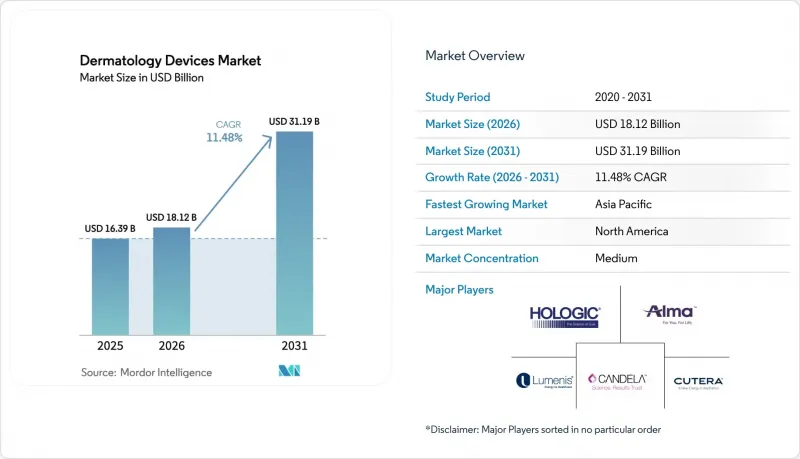
Mordor Intelligence에 의하면, 피부과용 의료기기 시장 규모는 2025년 163억 9,000만 달러로 평가되었고, 2026년에는 181억 2,000만 달러로 추정되고, 2026-2031년 CAGR 11.48%로 성장을 지속할 전망이며, 2031년에는 311억 9,000만 달러에 이를 것으로 예측됩니다.
본 보고서는 제품 유형별(진단 기기, 치료 기기), 기술별(레이저, 광 기반/IPL, 고주파, 초음파/HIFU, 기타), 기기 휴대성별(고정형/콘솔형, 기타), 용도별(피부암 진단, 기타), 최종 사용자별(병원, 기타), 지역별(북미, 기타)로 분류되어 있습니다. 시장 예측은 금액(달러) 기준으로 제시되어 있습니다.
세계의 피부과용 의료기기 시장 동향 및 인사이트
피부 질환 및 피부암 유병률 증가
2026년에는 미국 내 악성 흑색종 신규 발병 건수가 11만 2,000건에 달할 것으로 예측되며, 비악성 흑색종 피부암으로 인한 지불자의 연간 부담액은 89억 달러에 이를 것으로 보입니다. 이러한 임상적 부담으로 인해 생검 없이 악성 종양을 검출하는 ‘DermaSensor’(2024년 FDA 승인 획득)와 같은 AI 기반 진단 도구의 보급이 가속화되고 있습니다. 건선과 여드름은 전 세계적으로 합계 1억 5,000만 명 이상에게 영향을 미치고 있으며, 피지선에 초점을 맞춘 엑시머 레이저 및 1,726 nm 레이저에 대한 수요를 뒷받침하고 있습니다. 보험사는 현재 조기 발견에 대한 비용을 보상하고 있으며, 이것이 진단용 영상 진단 기기의 판매 대수가 치료용 콘솔을 웃도는 이유입니다. 북미와 유럽의 고령화에 따라 선별 검사 건수가 증가함에 따라, 이러한 추세는 앞으로도 지속될 것으로 예측됩니다.
저침습 미용 시술 수요 증가
미국 성형외과학회(ASPS)의 기록에 따르면, 2025년에는 2,820만 건의 저침습 치료가 시행되었으며, 그 중심은 신경 조절제와 레이저 리서페이싱이었습니다. 프랙셔널 레이저와 하이브리드 레이저는 회복 기간을 단축하면서도 여러 적응증에 대응할 수 있어 신규 도입 대수를 주도하고 있습니다. ASDS의 소비자 조사에 따르면, 응답자의 70%가 2025년에 미용 시술을 고려하고 있다고 답했습니다. 아시아태평양의 가처분 소득 증가가 시술 건수를 비약적으로 끌어올리고 있으며, 특히 2024년 중국의 1780억 위안 규모의 미용 시장에서 이러한 경향이 두드러집니다. 2024년에는 지방 제거에 대한 수요가 급격히 축소됨에 따라, 자본은 지방 세포가 아닌 콜라겐 리모델링을 목표로 하는 에너지 기반 플랫폼으로 이동했습니다. 그 결과, 클리닉에서는 시술 시간 활용을 극대화하기 위해 용도 간 전환이 신속하게 이루어지는 콘솔을 선호하는 경향이 있습니다.
첨단 장비의 높은 도입 및 유지 비용
다중 모드 레이저 콘솔의 가격은 10만 달러에서 50만 달러에 달하며, 연간 서비스 계약에는 구매 가격의 10-15%가 추가됩니다. 냉각 카트리지나 램프 교체와 같은 소모품도 이익률을 더욱 압박하고 있습니다. 인도나 브라질의 소규모 클리닉은 자금 조달이 어려워, 이용 요금이 내려가거나 리스 이용이 가능해질 때까지 장비 업그레이드를 미루는 경우가 많습니다. 구독 모델은 진입 장벽을 완화하는 한편, 잔존 가치에 대한 위험을 제조업체 측으로 전가합니다. 그 결과, 수요는 더 많은 환자 수를 처리함으로써 비용을 상각할 수 있는 대규모 미용 클리닉이나 대학 병원으로 쏠리고 있습니다.
부문 분석
2025년에는 클리닉들이 레이저, IPL, RF 콘솔에 대한 투자를 지속한 결과, 치료용 기기가 피부과용 의료기기 시장 매출의 61.53%를 차지했습니다. 반면, 진단용 영상 장비는 흑색종 조기 발견에 대한 보험사 측의 인센티브를 반영하여 연평균 성장률(CAGR) 13.75%로 확대될 것으로 예측됩니다. 이러한 변화는 사진 기록 및 AI를 활용한 평가가 진단 과정을 단축시켜, 기존에는 미용 치료가 주류를 이루던 환경에서도 도입을 촉진하고 있음을 보여줍니다.
피부과용 의료기기 시장의 진단 분야 규모는 2026년 추정치인 60억 달러에서 2031년까지 110억 달러 가까이 확대될 전망입니다. DermaSensor사의 2024년 FDA 승인 및 FotoFinder사의 AI를 활용한 전신 매핑은 비침습적 병변 분석에 중점을 둔 제품 개발의 흐름을 보여주고 있습니다. 치료 플랫폼은 여전히 수익의 핵심이지만, 자본 예산 측면에서는 높은 이익률을 보이는 소모품으로 인한 수익과 환자 유치율을 높이는 영상 진단 기술에 대한 전략적 투자 간의 균형을 점점 더 중시하는 추세입니다.
2025년 시점에서 레이저 시스템은 피부과용 의료기기 시장 점유율의 41.77%를 차지했으나, 레이저, RF, 초음파 에너지를 융합한 하이브리드 콘솔은 14.54%라는 가장 높은 연평균 성장률(CAGR)을 보일 것으로 전망됩니다. 임상의들은 치료실이나 전원을 전환할 필요 없이 여드름, 혈관성 병변, 광노화를 치료할 수 있으며 설치 공간을 최소화한 솔루션을 높이 평가했습니다.
하이브리드 시스템의 성장에 따라, 멀티모달리티 콘솔과 관련된 피부과용 의료기기 시장 규모는 확대되는 반면, 단일 적응증 기기의 도입 대수는 감소하고 있습니다. 루메니스(Lumenis)사의 ‘스텔라 M22’ IPL 플랫폼과 ‘아큐어’ 1,726 nm 레이저는 새로운 파장과 에너지의 조합이 임상 치료 메뉴를 얼마나 넓힐 수 있는지를 보여주고 있습니다. 그 결과, 각 벤더들은 단독 하드웨어의 개선보다는 소프트웨어 업데이트와 어플리케이터의 혁신에 연구 개발 자금을 집중하고 있습니다.
지역별 분석
북미는 2025년에 36.14%의 점유율을 유지했습니다. 이는 11만 2,000건으로 예측되는 악성 흑색종 사례 수, 신속한 의료기기 승인 절차, 그리고 휴대용 진단 기기 사용을 촉진하는 원격의료에 대한 보험 환급이 원동력이 되고 있습니다. 이 지역은 희토류 공급 차단의 영향을 받기 쉬운 상황이 지속되고 있지만, 견고한 서비스 네트워크와 높은 가처분 소득의 혜택을 누리고 있습니다.
아시아태평양은 13.43%라는 가장 높은 연평균 성장률(CAGR)을 기록하고 있습니다. 이는 중국의 미용 의료 시장이 2024년에 1,780억 위안 이상으로, 연간 15-20%의 속도로 성장하고 있기 때문입니다. 인도의 의료기기 시장은 의료비 지출 확대를 목표로 하는 정책에 힘입어 2030년까지 500억 달러 규모로 성장할 전망입니다. 한국은 의료 관광을 활용하고 있는 반면, 일본에서는 고령화가 진행되는 인구 구조로 인해 광노화 치료 및 암 치료에 대한 수요가 유지되고 있습니다. 중국과 한국에 현지 생산 거점을 두고 있어, 이익률이 낮은 클리닉에서도 만족할 수 있도록 가격 면에서 최적화된 콘솔을 제공할 수 있게 되었습니다.
유럽에서는 MDR 인증 지연으로 인해 상용화 주기가 3년에 달하기 때문에 시장 침투 속도는 둔화되고 있습니다. 그럼에도 불구하고 독일, 프랑스, 영국은 AI를 활용한 진단 및 에너지 효율이 뛰어난 하이브리드 플랫폼에 대한 투자를 계속하고 있습니다. 중동에서는 사우디아라비아와 UAE를 필두로 ‘비전 2030’에 따라 의료기기 수입이 가속화되고 있으며, 라틴아메리카의 브라질은 통화 악재에도 불구하고 여전히 세계 2위의 수술 시장을 유지하고 있습니다.
기타 혜택 :
- 엑셀 형식 시장 예측(ME) 시트
- 3개월간의 애널리스트 지원
자주 묻는 질문
목차
제1장 서론
제2장 조사 방법
제3장 주요 요약
제4장 시장 구도
제5장 시장 규모 및 성장 예측
제6장 경쟁 구도
제7장 시장 기회 및 향후 전망
AJY 26.09.07According to Mordor Intelligence, the dermatology devices market size is expected to grow from USD 16.39 billion in 2025 to USD 18.12 billion in 2026 and is forecast to reach USD 31.19 billion by 2031 at 11.48% CAGR over 2026-2031.
This report is Segmented by Product Type (Diagnostic Devices, Treatment Devices), Technology (Laser, Light-based/IPL, Radiofrequency, Ultrasound/HIFU, and More), Device Portability (Fixed/Console-Based, and More), Application (Skin Cancer Diagnosis, and More), End User (Hospitals, and More), and Geography (North America, and More). The Market Forecasts are Provided in Terms of Value (USD).
Global Dermatology Devices Market Trends and Insights
Rising Prevalence of Skin Disorders and Skin Cancer
Melanoma incidence is forecast to hit 112,000 new U.S. cases in 2026, and non-melanoma skin cancers cost payers USD 8.9 billion annually. This clinical burden accelerates uptake of AI-enabled diagnostic tools such as DermaSensor, cleared by FDA in 2024 for malignancy detection without biopsy. Psoriasis and acne collectively affect more than 150 million individuals worldwide, underpinning demand for excimer and 1,726 nm lasers that focus on sebaceous glands. Insurers now reimburse earlier detection, explaining why diagnostic imaging devices outpace treatment consoles. The trend is expected to persist as aging populations in North America and Europe move screening volumes higher.
Growing Demand for Minimally Invasive Aesthetic Procedures
The American Society of Plastic Surgeons logged 28.2 million minimally invasive treatments in 2025, led by neuromodulators and laser resurfacing. Fractional and hybrid lasers dominate new installations because they shorten recovery times yet cover multiple indications. An ASDS consumer survey showed 70% of respondents are considering a cosmetic procedure in 2025. Asia-Pacific's rising disposable incomes turbocharge procedure counts, particularly within China's CNY 178 billion aesthetic market in 2024. Fat-reduction demand contracted sharply in 2024, redirecting capital toward energy platforms that target collagen remodeling rather than adipocytes. Clinics therefore prefer consoles that allow quick pivoting among applications to maximize chair-time utilization.
High Capital and Maintenance Costs of Advanced Devices
Multi-modality laser consoles range from USD 100,000 to USD 500,000, with annual service contracts adding 10-15% of purchase price. Consumables such as cooling cartridges and lamp replacements further erode margins. Small clinics in India and Brazil struggle to secure financing, often delaying upgrades until usage fees fall or leasing becomes available. Subscription models soften barriers yet transfer residual-value risk to manufacturers. Demand therefore skews to large aesthetic centers and academic hospitals that can amortize costs across higher patient throughput.
Other drivers and restraints analyzed in the detailed report include:
- Advances in Laser and Imaging Technologies
- Increasing Disposable Income and Healthcare Spending in Emerging Markets
- Stringent and Heterogeneous Regulatory Approvals
For complete list of drivers and restraints, kindly check the Table Of Contents.
Segment Analysis
Treatment devices generated 61.53% of Dermatology devices market revenue in 2025 as clinics continued to invest in lasers, IPL, and RF consoles. Diagnostic imaging units, however, are forecast to advance at a 13.75% CAGR, reflecting payer incentives for early melanoma detection. The shift underscores how photo-documentation and AI-assisted assessment shorten diagnostic pathways, boosting adoption even in settings traditionally dominated by aesthetic treatments.
The Dermatology devices market size for diagnostics is on track to expand from an estimated USD 6.0 billion in 2026 to nearly USD 11 billion by 2031. DermaSensor's 2024 FDA clearance and FotoFinder's AI-based total-body mapping illustrate a pipeline tilted toward non-invasive lesion analysis. Treatment platforms remain essential for revenue, yet capital budgets increasingly balance high-margin consumable streams against strategic investments in imaging that lifts patient capture rates.
Laser systems held 41.77% Dermatology devices market share in 2025, but hybrid consoles that blend laser, RF, and ultrasound energies will post the strongest 14.54% CAGR. Clinicians value single-footprint solutions able to treat acne, vascular lesions, and photodamage without swapping rooms or power supplies.
Hybrid system growth elevates the Dermatology devices market size attached to multi-modality consoles while trimming the installed base of single-indication equipment. Lumenis's Stellar M22 IPL platform and the Accure 1,726 nm laser highlight how new wavelengths and energy combinations widen clinical menus. Vendors consequently devote R&D funds to software updates and applicator refreshes rather than standalone hardware iterations.
Complete Report Scope:
- By Product Type
- Diagnostic Devices
- Treatment Devices
- By Technology
- Laser
- Light-based / IPL
- Radiofrequency (Mono-, Bi-, Multipolar)
- Ultrasound / HIFU
- Hybrid & Other Energy-Based Systems
- By Device Portability
- Fixed / Console-Based Systems
- Portable / Handheld Professional Devices
- Consumer-Grade Home-Use Devices
- By Application
- Skin Cancer Diagnosis
- Psoriasis
- Acne & Acne Scar
- Hair Removal
- Skin Rejuvenation & Resurfacing
- Tattoo Removal
- Vascular & Pigmented Lesion Removal
- Body Contouring / Fat Reduction
- By End User
- Hospitals
- Dermatology Clinics
- Aesthetic / Cosmetic Centers & Spas
- Homecare Settings
- By Geography
- North America
- United States
- Canada
- Mexico
- Europe
- Germany
- France
- United Kingdom
- Italy
- Spain
- Rest of Europe
- Asia-Pacific
- China
- Japan
- India
- South Korea
- Australia
- Rest of Asia-Pacific
- Middle East & Africa
- GCC
- South Africa
- Rest of Middle East & Africa
- South America
- Brazil
- Argentina
- Rest of South America
- North America
Geography Analysis
North America maintained 36.14% share in 2025, driven by 112,000 projected melanoma cases, rapid device clearance pathways, and telehealth reimbursement that encourages portable diagnostics. The region remains vulnerable to rare-earth supply disruptions but benefits from robust service networks and high discretionary income.
Asia-Pacific posts the fastest 13.43% CAGR as China's aesthetic segment exceeded CNY 178 billion in 2024 and grows 15-20% annually. India's device market moves toward USD 50 billion by 2030, aided by policy goals to expand healthcare spending. South Korea leverages medical tourism, while Japan's aging demographics sustain demand for photoaging and oncologic care. Local manufacturing bases in China and South Korea allow price-optimized consoles that satisfy clinics operating on thinner margins.
Europe faces slower uptake because MDR certification delays stretch commercialization cycles to three years. Nonetheless, Germany, France, and the United Kingdom continue to invest in AI-assisted diagnostics and energy-efficient hybrid platforms. The Middle East, led by Saudi Arabia and UAE, accelerates equipment imports under Vision 2030, and Latin America's Brazil remains the second-largest procedural market despite currency headwinds.
- Aerolase Corp.
- Alma Lasers
- Bausch Health
- BTL
- Candela Medical
- Canfield Scientific Inc.
- Carl Zeiss
- Cutera
- DermLite LLC
- FotoFinder Systems
- Fotona d.o.o.
- HEINE Optotechnik
- Hologic
- Lumenis
- Michelson Diagnostics Ltd.
- Sciton
- SkinVision
- Strata Skin Sciences
- Candela Medical
- Venus Concept
Additional Benefits:
- The market estimate (ME) sheet in Excel format
- 3 months of analyst support
TABLE OF CONTENTS
1 Introduction
- 1.1 Study Assumptions & Market Definition
- 1.2 Scope of the Study
2 Research Methodology
3 Executive Summary
4 Market Landscape
- 4.1 Market Overview
- 4.2 Market Drivers
- 4.2.1 Rising Prevalence of Skin Disorders & Skin Cancer
- 4.2.2 Growing Demand for Minimally Invasive Aesthetic Procedures
- 4.2.3 Advances In Laser & Imaging Technologies
- 4.2.4 Increasing Disposable Income & Healthcare Spending in Emerging Markets
- 4.2.5 Tele-Dermatology Uptake Spurring Portable Diagnostics
- 4.2.6 Subscription-Based Device Financing Models
- 4.3 Market Restraints
- 4.3.1 High Capital & Maintenance Costs of Advanced Devices
- 4.3.2 Stringent & Heterogeneous Regulatory Approvals
- 4.3.3 Energy-Efficiency & Sustainability Scrutiny in Procurement
- 4.3.4 Supply-Chain Risk for Rare-Earth Laser Components
- 4.4 Value / Supply-Chain Analysis
- 4.5 Regulatory Landscape
- 4.6 Technological Outlook
- 4.7 Porter's Five Forces Analysis
- 4.7.1 Threat of New Entrants
- 4.7.2 Bargaining Power of Suppliers
- 4.7.3 Bargaining Power of Buyers
- 4.7.4 Threat of Substitutes
- 4.7.5 Intensity of Competitive Rivalry
5 Market Size & Growth Forecasts (Value in USD)
- 5.1 By Product Type
- 5.1.1 Diagnostic Devices
- 5.1.2 Treatment Devices
- 5.2 By Technology
- 5.2.1 Laser
- 5.2.2 Light-based / IPL
- 5.2.3 Radiofrequency (Mono-, Bi-, Multipolar)
- 5.2.4 Ultrasound / HIFU
- 5.2.5 Hybrid & Other Energy-Based Systems
- 5.3 By Device Portability
- 5.3.1 Fixed / Console-Based Systems
- 5.3.2 Portable / Handheld Professional Devices
- 5.3.3 Consumer-Grade Home-Use Devices
- 5.4 By Application
- 5.4.1 Skin Cancer Diagnosis
- 5.4.2 Psoriasis
- 5.4.3 Acne & Acne Scar
- 5.4.4 Hair Removal
- 5.4.5 Skin Rejuvenation & Resurfacing
- 5.4.6 Tattoo Removal
- 5.4.7 Vascular & Pigmented Lesion Removal
- 5.4.8 Body Contouring / Fat Reduction
- 5.5 By End User
- 5.5.1 Hospitals
- 5.5.2 Dermatology Clinics
- 5.5.3 Aesthetic / Cosmetic Centers & Spas
- 5.5.4 Homecare Settings
- 5.6 By Geography
- 5.6.1 North America
- 5.6.1.1 United States
- 5.6.1.2 Canada
- 5.6.1.3 Mexico
- 5.6.2 Europe
- 5.6.2.1 Germany
- 5.6.2.2 France
- 5.6.2.3 United Kingdom
- 5.6.2.4 Italy
- 5.6.2.5 Spain
- 5.6.2.6 Rest of Europe
- 5.6.3 Asia-Pacific
- 5.6.3.1 China
- 5.6.3.2 Japan
- 5.6.3.3 India
- 5.6.3.4 South Korea
- 5.6.3.5 Australia
- 5.6.3.6 Rest of Asia-Pacific
- 5.6.4 Middle East & Africa
- 5.6.4.1 GCC
- 5.6.4.2 South Africa
- 5.6.4.3 Rest of Middle East & Africa
- 5.6.5 South America
- 5.6.5.1 Brazil
- 5.6.5.2 Argentina
- 5.6.5.3 Rest of South America
- 5.6.1 North America
6 Competitive Landscape
- 6.1 Market Concentration
- 6.2 Market Share Analysis
- 6.3 Company Profiles (includes Global level Overview, Market level overview, Core Segments, Financials as available, Strategic Information, Market Rank/Share for key companies, Products and Services, and Recent Developments)
- 6.3.1 Aerolase Corp.
- 6.3.2 Alma Lasers
- 6.3.3 Bausch Health
- 6.3.4 BTL Industries
- 6.3.5 Candela Corporation
- 6.3.6 Canfield Scientific Inc.
- 6.3.7 Carl Zeiss Meditec AG
- 6.3.8 Cutera Inc.
- 6.3.9 DermLite LLC
- 6.3.10 FotoFinder Systems GmbH
- 6.3.11 Fotona d.o.o.
- 6.3.12 Heine Optotechnik GmbH & Co. KG
- 6.3.13 Hologic Inc
- 6.3.14 Lumenis Ltd.
- 6.3.15 Michelson Diagnostics Ltd.
- 6.3.16 Sciton Inc.
- 6.3.17 SkinVision
- 6.3.18 Strata Skin Sciences
- 6.3.19 Syneron Medical Ltd.
- 6.3.20 Venus Concept Ltd.
7 Market Opportunities & Future Outlook
- 7.1 White-space & Unmet-Need Assessment


